
Amazon Lex pricing starts at $0.00075 per text request and $0.004 per speech request, with streaming voice billed at $0.0065 per 15 seconds. Those rates are rarely the whole bill once Connect, Lambda, and Bedrock charge beside them. Here's what each billing path costs and which fits your traffic.
TL;DR: Amazon Lex Pricing
- Request-and-response mode bills $0.00075 per typed input and $0.004 per spoken input, so a spoken turn costs 5.3x a typed one.
- Streaming voice bills $0.0065 for every 15 seconds a session listens, silence included, and it only beats per-request billing when callers speak about every 9 seconds or faster.
- Free tier terms depend on account age. Older accounts keep 10,000 text and 5,000 speech requests a month for 12 months after they start using Lex, and newer ones get up to $200 in credits.
- Inside Amazon Connect Customer, Lex requests that start in your instance are included in the $0.038 per-minute voice rate.
Amazon Lex Pricing Plans: At a Glance
Lex has no subscription tiers. You pay per input, per streaming interval, or per training minute, and the interaction model you build decides which meter runs.
| Plan | Price | Best For |
|---|---|---|
| Text requests | $0.00075 per request | Web, app, and SMS chat bots |
| Speech requests | $0.004 per request | Voice bots with short, spaced-out turns |
| Streaming conversations | $0.0065 per 15-second speech interval | Fast, back-and-forth phone calls |
| Automated Chatbot Designer | $0.50 per training minute | Turning contact center transcripts into intents |
| Lex inside Connect Customer | Included in $0.038 per voice minute | New Amazon Connect contact centers |
| Free tier | Up to $200 in credits for new accounts | Proofs of concept and pilots |
Pricing verified against the Lex pricing page and the Connect pricing appendix on 17 September 2026. Verify with the vendor before you commit.
AWS lists these Lex V2 rates in USD. The standard rates are the same across the 12 Regions in AWS's published rate data. Confirm your total in the AWS Pricing Calculator before you set a budget.
Amazon Lex Pricing Plans Explained
Text Requests: $0.00075 Per Request
What's included: Every typed input to a Lex V2 bot counts as a request, so a user who sends five messages bills five requests. Each one costs $0.00075, and that price covers intent recognition and slot filling on the text.
Lambda, Bedrock, and logging bill on their own meters, even when they run on the same turn.
Best for: Web chat, in-app assistants, and messaging channels where users type short, structured answers.
Pros:
✅ One million text requests cost $750, which keeps typed self-service cheap at contact center volume.
✅ Spend follows input count, so conversation length alone gives you a usable forecast.
Cons:
❌ Every reprompt is a new request. A bot that asks "Which date?" three times bills four inputs for one answer.
❌ The published rate card has no volume tiers. Anything below list price goes through AWS pricing sales.
Speech Requests: $0.004 Per Request
What's included: Each spoken input bills as a speech request at $0.004.
Request-and-response mode accepts up to 15 seconds of speech per RecognizeUtterance call by default, and your client sends each utterance as its own API call.
AWS prices a sample month of 8,000 speech requests and 2,000 text requests at $33.50 in total. Speech accounts for $32.00 of it.
Best for: Voice assistants and push-to-talk apps where the user speaks, waits for the answer, and speaks again.
Pros:
✅ Nothing bills between inputs. Pauses, reading time, and think time cost zero in this mode.
✅ Typed and spoken inputs keep their own rates, so a mixed bot pays voice prices only on voice turns.
Cons:
❌ A spoken turn costs 5.3x a typed one. Voice menus that could be a button or a typed reply carry that premium on every turn.
❌ The user has to start every turn. Proactive prompts and interruption handling belong to streaming, where the bot listens continuously.
Streaming Conversations: $0.0065 Per 15-Second Speech Interval
What's included: Streaming holds one API session open for the whole conversation. Lex keeps listening and can send prompts on its own, such as a "Take your time" nudge while a caller finds a card number.
Streaming speech bills $0.0065 per 15-second interval. The window counts silence along with speech, so a quiet caller still moves the meter.
Any input rounds up to the next 15-second interval, so a 52-second input bills as four intervals. AWS prices a sample month of 8,000 streaming intervals and 2,000 text requests at $56.00.
Streaming text still bills per request, at $0.002 per text or keypad input, which is 2.7x the request-and-response text rate. Speech is where streaming switches to time-based billing, and it carries the bigger multiplier.
One interval costs as much as 1.625 speech requests. Streaming wins only when callers take a turn faster than once every 9.2 seconds.
Illustrative example: A 3-minute call bills 12 intervals, or $0.078, in streaming mode. The same call with 8 caller turns costs $0.032 in request-and-response mode, and streaming only comes out ahead once the call passes 19 turns.
Best for: Phone agents that need barge-in, proactive prompts, or rapid short answers like digits and confirmations.
Pros:
✅ Callers can interrupt the bot, and the bot can re-engage a quiet caller without waiting for input.
✅ Rapid exchanges share one interval, which pays off on confirmation loops and number capture.
Cons:
❌ Silence is billable. A caller hunting for an account number burns intervals while saying nothing.
❌ An open session keeps metering until your code or contact flow closes it.
Automated Chatbot Designer: $0.50 Per Training Minute
What's included: The designer reads conversation transcripts and proposes intents, sample phrases, and slots. You pay for analysis time at $0.50 per training minute.
Transcripts need a standardized JSON format, and Contact Lens transcripts work in their original format.
AWS's credit union scenario analyzes 180,000 transcript lines in 300 minutes for $150. Its insurance scenario states 1,080 billed minutes and $540 in the text, then 1,000 minutes and $500 in the table. Budget on the higher figure.
Best for: Contact centers with months of agent transcripts that want a first intent map without hand-labeling.
Pros:
✅ Training time is the only meter, with no per-line or per-file charge.
✅ You keep control of the output. You review the proposed design and add only the intents and slot types that fit.
Cons:
❌ Language coverage stops at English. AWS's FAQ lists five English locales, but its developer guide accepts transcripts in English (US) only, so plan on US English.
❌ Cost is hard to forecast up front. The meter follows analysis time, and transcript size only hints at it.
Amazon Lex Inside Amazon Connect: Included in Connect Customer Pricing
What's included: On Connect Customer, Lex requests are included when they originate from your Connect instance. Voice bills $0.038 per minute, and that rate covers end-customer self-service, conversational analytics, and post-contact summaries.
Chat on Connect Customer bills $0.010 per message, email $0.080 per email, and SMS $0.014 per message.
Customer Basic, the older plan some customers are still on, prices features one by one. Voice costs $0.018 per minute, self-service adds $0.008 per minute, and Lex bills on top at its standard rates.
Best for: Contact centers already on Amazon Connect, or moving their phone self-service onto it.
Pros:
✅ The Lex line drops to zero for bot traffic that starts in your Connect Customer instance.
✅ One per-minute rate covers the AI layer, including Polly generative text-to-speech and Amazon Nova Sonic.
Cons:
❌ Every voice minute costs $0.038, including minutes a caller spends with a human agent, where Basic charges $0.018.
❌ The bundle stops at the Connect boundary. A Lex bot called directly from your own app or telephony stack bills at standard Lex rates.
Amazon Lex Free Tier: Up to $200 in Credits for New Accounts
What's included: Your terms depend on when the AWS account was opened.
- Accounts created before July 15, 2025 keep the legacy Free Tier, which for Lex covers 10,000 text and 5,000 speech monthly requests for 12 months from the date you start using Lex. At list rates, that allowance is worth $27.50 a month.
- Accounts created on or after July 15, 2025 get $100 at sign-up plus up to $100 more for completing activities. The credits apply to Lex and other eligible services.
New accounts pick a free plan or a paid plan at sign-up. The free plan lasts six months or until the credits run out, and all credits expire 12 months after the account opens.
Best for: Proofs of concept and pilot bots with low, bounded traffic.
Pros:
✅ No card charges on the free plan until you choose to upgrade to paid.
✅ Leftover credits carry over to your bills automatically when you upgrade.
Cons:
❌ An expired free plan closes the account. AWS holds your data for 90 days, and you lose access to your resources until you upgrade.
❌ Regulated setups end the free plan early. Designating the account as HIPAA upgrades it to paid, and joining an AWS Organization voids the credits immediately.
AWS Charges Outside the Lex Rate
What this covers: Four AWS services commonly run beside a Lex bot, and each bills on its own meter.
AWS Lambda code hooks. When you enable the dialog code hook, Lex calls your Lambda function after every user input, so Lambda invocations track your request count.
Lambda charges $0.20 per million requests plus $0.0000166667 per GB-second. The monthly free tier covers 1 million requests and 400,000 GB-seconds.
Amazon Bedrock. QnAIntent uses a Bedrock model to answer from a Bedrock knowledge base, an OpenSearch domain, or a Kendra index. BedrockAgentIntent relays requests to a Bedrock agent until that agent marks the conversation finished.
Assisted slot resolution calls Bedrock only after Lex misses an utterance, so its spend rises as recognition accuracy drops, and all three features bill at Bedrock model rates.
Amazon Polly. Voices you call bill per character directly, from $4 per million characters for standard voices to $16 for neural, $30 for generative, and $100 for long-form.
On Connect Customer Basic, Polly generative text-to-speech bills separately, while Connect Customer folds it into the voice rate.
CloudWatch Logs and S3. Conversation logs write text to CloudWatch Logs and audio to S3, and each service bills at its own rates. Also, selective capture lets you log chosen intents and slots and skip the rest.
Best for: Any production bot, since Lex almost never runs alone.
Pros:
✅ Lambda's free tier absorbs small bots. At 512 MB and 200 ms, 300,000 hook calls a month use 30,000 of the 400,000 free GB-seconds and 300,000 of the 1 million free requests.
✅ Each service has its own dial. Memory size, model choice, voice type, and log scope all move independently.
Cons:
❌ Four meters mean four places to investigate when the invoice jumps.
❌ Bedrock features tie cost to accuracy, so a weak intent model raises two separate bills at once.
Which Amazon Lex Plan Should You Choose?
Choose request-and-response if you:
- Run web, app, or SMS chat
- Expect callers to pause, think, or read between spoken turns
- Want spend to follow input count, with nothing billed between turns
Choose streaming if you:
- Need callers to interrupt the bot mid-prompt
- Handle rapid exchanges like digits, dates, and confirmations
- Average more than one caller turn every 9 seconds
Choose Lex inside Connect Customer if you:
- Are opening a new Amazon Connect contact center
- Want Lex, analytics, and summaries under one per-minute rate
- Route most calls to self-service and keep human handle time short
Choose the Automated Chatbot Designer if you:
- Already store agent transcripts in JSON or Contact Lens format
- Want a first intent map before writing sample utterances by hand
Is Amazon Lex Worth the Cost?
Lex's share of the bill depends on where it runs. On Connect Customer Basic, it can be the largest line per call, and on a standalone chatbot it can be close to the only one.
Monthly Cost for 20,000 Connect Calls
Illustrative example: 20,000 self-service calls a month, 3 minutes each, on one US phone number, priced with the per-minute rates in AWS's Connect examples.
| Cost Line | Customer Basic | Connect Customer |
|---|---|---|
| Voice service (60,000 minutes) | $1,080.00 | $2,280.00 |
| Self-service AI agent | $480.00 | Included |
| Lex streaming (12 intervals per call) | $1,560.00 | Included |
| Inbound telephony ($0.0022 per minute) | $132.00 | $132.00 |
| Phone number (30 days) | $0.90 | $0.90 |
| Monthly total | $3,252.90 | $2,412.90 |
Lex is 48% of the Basic bill in this scenario, since streaming bills 12 intervals on every 3-minute call, and the line disappears on Connect Customer. If you move the mix toward human-handled minutes, Basic's $0.018 voice rate starts to win.
Reselling the agent? Our voice agent pricing guide maps component costs like these to a client-facing price.
Monthly Cost for a Standalone Chatbot
Illustrative example: A web chatbot handles 50,000 conversations a month at 6 user turns each. That's 300,000 text requests, or $225 in Lex charges.
The validation hook adds 300,000 Lambda invocations. At 512 MB and 200 ms each, that's 30,000 GB-seconds, which fits inside Lambda's monthly free tier. Add QnAIntent for FAQ answers, and Bedrock becomes the line to watch.
Amazon Lex is worth it if you:
- Already run Amazon Connect and can use the Connect Customer bundle
- Build bots around defined intents like bookings, payments, and order status
- Need KMS-encrypted conversation logs stored in the bot's own Region
Skip Amazon Lex if you:
- Want open-ended LLM conversation, where Bedrock charges will outweigh the Lex line
- Run your stack outside AWS and would take on IAM, Lambda, and logging setup for one service
- Want one vendor to price speech, reasoning, and telephony together per minute
Hidden Amazon Lex Charges and How to Cut Them
Unexpected Amazon Lex Charges
Streaming sessions left open. AWS bills a stream for as long as the connection stays open and Lex is ready to receive input.
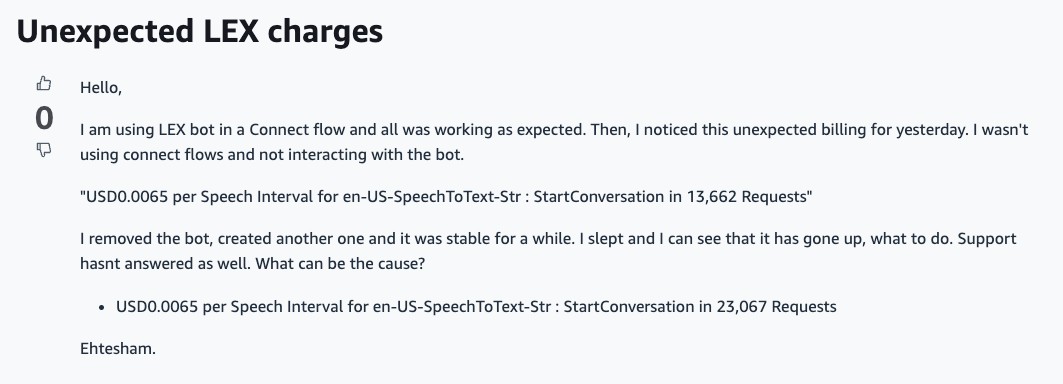
One Amazon Connect user on AWS re:Post saw 13,662 streaming speech intervals billed on a day they believed the bot was idle, then 23,067 after rebuilding the bot, all under the usage type en-US-SpeechToText-Str on StartConversation.
Their own follow-up traced the traffic to failed outbound call attempts. At $0.0065 per interval, that second day cost about $150.
Waits inside a stream. A contact flow that holds callers in an open session during a slow backend lookup pays for that wait in 15-second blocks.
Test runs on production APIs. Test Workbench executions call RecognizeText, RecognizeUtterance, or StartConversation, the same runtime APIs your users hit.
A nightly suite of 2,000 spoken inputs adds $8 a night, or about $240 a month (illustrative). Test traffic from any harness, Cekura included, reaches the same meters when it calls your bot, so size suites against your chatbot testing plan.
Reprompt and fallback loops. Each retry is another billable input. That means a slot that takes three reprompts costs four requests, and a FallbackIntent that repeats the same question multiplies that across every confused caller.
Amazon Lex Cost Optimization Practices
- Match the mode to turn cadence: Pull average turns per minute from conversation logs. Below about 6.5 caller turns a minute, request-and-response is cheaper for speech.
- Close streams on every exit path: Hang-up, transfer, and error branches should all end the session, since an open stream keeps metering.
- Move typed journeys to text: Order lookups and account questions cost 5.3x less per turn over chat than over voice.
- Fix intent accuracy before enabling assisted slot resolution: Every utterance Lex resolves on its own is a Bedrock call you skip.
- Log selectively: Selective capture keeps logging to the intents and slots you debug.
- Set a usage budget on Lex usage types: AWS Budgets can track specific usage types and alert by email or SNS. Budget alerts don't stop traffic on their own, so pair each alert with a runbook that disables the offending flow.
- Give test traffic its own account: Running regression suites from a separate AWS account keeps their Lex spend visible as a separate line.
Amazon Lex Alternatives & Pricing Comparison
Lex, Dialogflow CX, and Retell bill on three different units, so compare them on cost per completed conversation at your own turn count.
Here’s how the main Amazon Lex alternatives compare:
| Tool | Starting Price | Best For |
|---|---|---|
| Cekura | $0.25 per voice testing minute, 300 free credits | Testing and monitoring Lex bots and the platforms you compare them with |
| Amazon Lex V2 | $0.00075 per text request, $0.004 per speech request | Intent-and-slot bots on AWS and Amazon Connect |
| Google Dialogflow CX (Flows) | $0.007 per chat request, $0.001 per voice second | Deterministic flow agents on Google Cloud |
| Retell AI | $0.07 to $0.31 per voice minute | LLM phone agents priced per minute |
Pricing verified against vendor pages on 17 September 2026. Verify with the vendor before you commit.
Dialogflow CX meters voice by the second. Flows bill $0.001 per second of listening and spoken output, barge-in listening included. The full response audio bills even when a caller interrupts it.
Playbooks, the generative edition, cost $0.012 per chat request and $0.002 per voice second. New users get a $600 credit for Flows and $1,000 for Playbooks, valid for 12 months.
Retell prices the whole phone agent per minute. Voice infrastructure, text-to-speech, the LLM, and telephony combine into a $0.07 to $0.31 range, billed to the nearest second.
Retell also bills silence and hold time, and new accounts start with $10 in credits and 20 concurrent calls.
All three platforms bill for dead air in some form, so turn design moves cost on every one of them. The conversational AI platforms comparison covers how the builder platforms differ on setup and monitoring.
Open-source frameworks like Rasa and Botpress trade the managed-service model for full control, which could be worth a look if your team has the infra bandwidth.
Cekura vs Amazon Lex: Which Should You Choose?
Lex runs the bot, and Cekura tests whether it holds up on a real call, so the two belong at different layers of the same stack.
Amazon Lex is better for: Recognizing intents, filling slots, and routing callers inside Amazon Connect, with AWS handling speech recognition and scale.
Cekura is better for: Independent QA on the finished agent. It runs simulated conversations before launch, scores live calls after, and uses one harness across platforms.
Use both if: Your Lex bot answers a phone number. Neither Lex nor Amazon Connect has a native Cekura integration, so tests reach the bot the way callers do, by dialing the Connect number, and production transcripts reach Cekura through the custom integration.
Pre-production:
- Text-based simulations: Chat testing runs scenarios as text, which suits Lex bots whose flows you can exercise without audio.
- Keypad paths: DTMF testing simulates button presses, so the IVR menu in front of your Lex bot gets tested in the same run.
Infrastructure:
- Latency and stability checks: The infrastructure suite ships pre-built latency and stability scenarios, and load testing checks behavior at high call volume.
Observability:
- Production scoring from your backend: The custom integration accepts call transcripts by webhook, so transcripts you export from Connect can feed Cekura's metrics.
- Controlled evaluation spend: Metric sampling scores a set percentage of production calls to cut evaluation costs on high-volume lines.
Native integrations cover Retell, Vapi, ElevenLabs, LiveKit, Pipecat, Bland, and more, so a Lex bake-off against any of those platforms runs through the same scenarios.
Independent research points the same way. In the tau-Voice benchmark from Princeton and Sierra, audio-native agents kept only 30 to 45% of their text task completion on grounded customer-service tasks.
Repeatability is the number to watch in a bake-off. Cekura Bench ran 82 scenarios three times each across eight voice stack configurations, or 246 calls per configuration.
Retell completed 93.88% of tasks and passed all three runs on 75.61% of scenarios. Vapi's gap ran wider, with 97.56% task completion on 205 of 246 calls that connected, against 59.76% of scenarios passing all three runs.
Mean response time ran from 1.27 seconds on ElevenLabs to 3.08 seconds on Vapi. Lex sits outside the benchmark cohort, so run the same scenarios through your Connect number and compare it on repeatability and response time.
Cekura supports SOC 2, HIPAA, and GDPR compliance, covering transcript redaction, role-based access, and audit logs on the Enterprise plan.
Pay-as-you-go pricing starts with 300 free credits, roughly 60 minutes of voice testing. Chat simulations cost $0.025 per reply against $0.25 per voice minute, and the Startup plan runs $500 a month with a signed BAA. Every plan includes one seat, and each additional seat costs $30 a month.
My Bottom Line on Amazon Lex Pricing
Amazon Lex pricing rewards bots with tight, well-defined intents. Text costs a fraction of a cent, speech costs under half a cent, and a Connect Customer instance folds both into its voice rate.
My call by traffic type:
- Chat bots: request-and-response, with Lambda sized to stay near its free tier
- Voice bots with slow turns: request-and-response speech
- Fast phone flows: streaming, with every exit path closing the session
- New contact centers: Connect Customer, where Lex rides inside the voice rate
Model turns per conversation and seconds of silence per call first, because those two numbers move a Lex bill more than any line on the rate card.
Book a demo and run your Lex bot's hardest call flows through simulated callers before your next deploy.
Frequently Asked Questions
How Much Does Amazon Lex Cost Per Request?
Amazon Lex costs $0.00075 per text request and $0.004 per speech request in request-and-response mode. Streaming voice bills by time, at $0.0065 per 15-second interval.
Is Amazon Lex Free?
No, Amazon Lex isn't permanently free, but new AWS accounts get up to $200 in Free Tier credits that apply to Lex. Accounts created before July 15, 2025 keep 10,000 text and 5,000 speech requests a month for 12 months after they start using Lex.
What Is the Difference Between Amazon Lex Request-and-Response and Streaming Pricing?
The main difference between Amazon Lex request-and-response and streaming pricing is the billing unit. Request-and-response charges per user input, while streaming charges $0.0065 for every 15 seconds a speech session stays open, silence included.
Does Amazon Lex Charge for Generative AI Features?
Yes, Amazon Lex generative AI features bill through Amazon Bedrock. QnAIntent, BedrockAgentIntent, and assisted slot resolution use Bedrock models, and those calls bill at Bedrock rates on top of Lex request charges.
Does Amazon Lex V1 Pricing Still Apply?
No, Amazon Lex V1 pricing no longer applies, because AWS ended V1 support on September 15, 2025. The V1 console and V1 resources are no longer accessible, so current rates cover Lex V2.