
If you're wondering how to price AI voice agents, know that most providers bury the real number across four or five separate line items. There are six models, and each fits a different deployment type.
Why Pricing AI Voice Agents Is Harder Than It Looks
Most AI voice agent pricing guides focus on the per-minute rate, but that number doesn't tell you what a completed call costs. For example, an agent at $0.08/min that fails 30% of conversations is more expensive per successful interaction than one at $0.20/min that finishes 95% of flows.
What makes that hard to model is that voice agents draw from five independent charge layers: telephony, LLM inference, speech synthesis, transcription, and orchestration. Each one's priced differently and moves with usage.
6 Ways to Price AI Voice Agents
No single pricing model works for every deployment. The right structure depends on your client's call volume, how forecastable their usage is, and whether you can tie the agent to a measurable outcome.
| Method | What It Is | How It Works |
|---|---|---|
| Usage-Based (Per-Minute or Per-Call) | Clients pay only for what they consume | Bill per minute or per completed call. Your margin is the spread between the platform cost and your charge rate |
| Tiered Subscription | Fixed monthly plans with bundled usage and feature access | Layer tiers above platform costs. Feature gating (integrations, compliance, SLAs) gives clients reasons to upgrade. |
| Hybrid (Platform Fee and Usage) | Recurring base fee plus metered usage on top | Base covers fixed costs like QA and maintenance. Usage layer adjusts with volume without penalizing light months. |
| Value-Based | Pricing anchored to business outcomes, not usage | Establish the client's baseline cost or revenue per outcome, then price as a fraction of the value delivered |
| Per-Agent/Per-Bot | Flat monthly fee per agent deployed, regardless of call volume | Revenue decouples from usage. Price per agent reflects scope and complexity rather than minutes consumed. |
| Custom Enterprise | Fully negotiated pricing for large or complex deployments | Build quotes around volume commitments, SLAs, compliance, and integrations. Pull large deals off the pricing page entirely. |
Method 1: Usage-Based (Per-Minute or Per-Call)
What it is: Clients pay only for what they consume, billed per minute of active conversation or per completed call.
How it works: Your floor depends directly on your platform. Bland AI publishes a flat rate of $0.11-$0.14/min. But the real driver of your bill is usage.
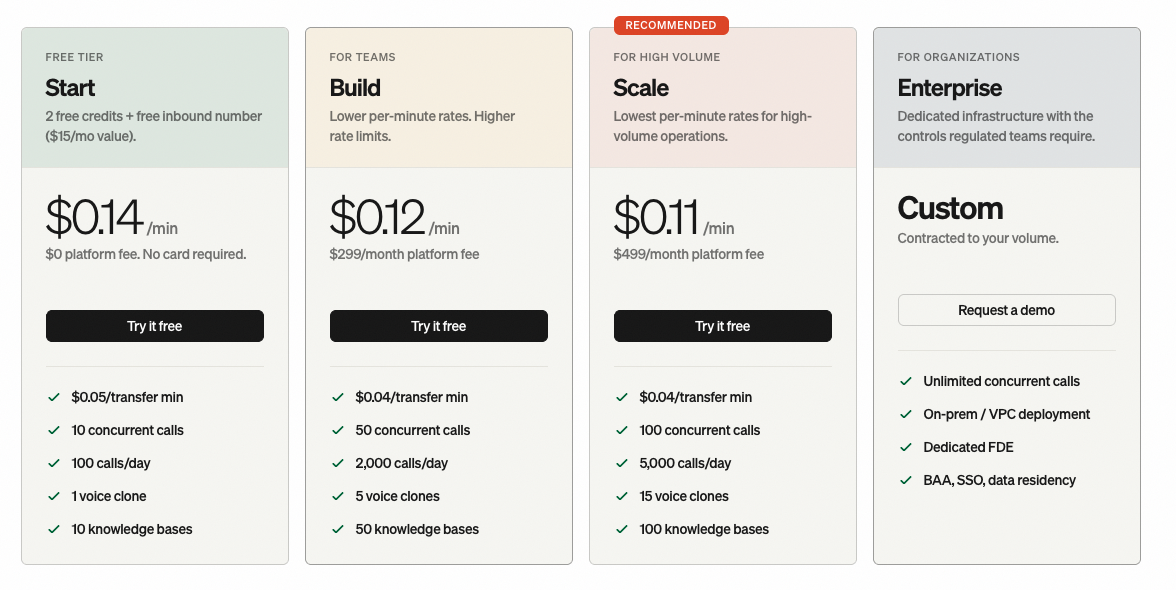
Vapi works differently, charging $0.05/min for hosting and invoicing model provider fees on top, so your loaded rate moves with every model choice and compounds at volume.
If your calls are short and scoped to a single task, per-call billing is worth considering. You bill a flat fee per finished interaction regardless of duration, which is easier for clients to budget and keeps your margin consistent when the average call length is stable.
Real example: Running on Bland AI's Start plan at $0.14/min all-in, LLM, STT, TTS, and telephony bundled, no platform fee, no stacking. Charge your client $0.40/min, and you're at ~65% gross margin before overhead ($0.14 / $0.40 = 35% cost).
Method 2: Tiered Subscription (Monthly Packages)
What it is: Fixed monthly plans with bundled usage allowances, tiered feature access, and escalating support levels.
How it works: Each tier combines a platform fee with a reduced per-minute rate. Your margin comes from the spread between your platform cost and what you charge, plus the services you layer on top.
Feature gating widens that spread over time.
Here's how that works:
- A base tier covers core calling and basic reporting
- Mid-tier adds CRM integrations or multilingual support
- Enterprise adds compliance coverage and custom SLAs
Each gate gives clients a concrete reason to move up, and each upgrade increases your revenue per account without touching your infrastructure cost.
Real example: Dialora runs the Starter plan at $49/month with 200 minutes included, Pro at $97/month with 400 minutes, Business at $149/month, and Agency at $297/month with white-label and multi-tenant management.
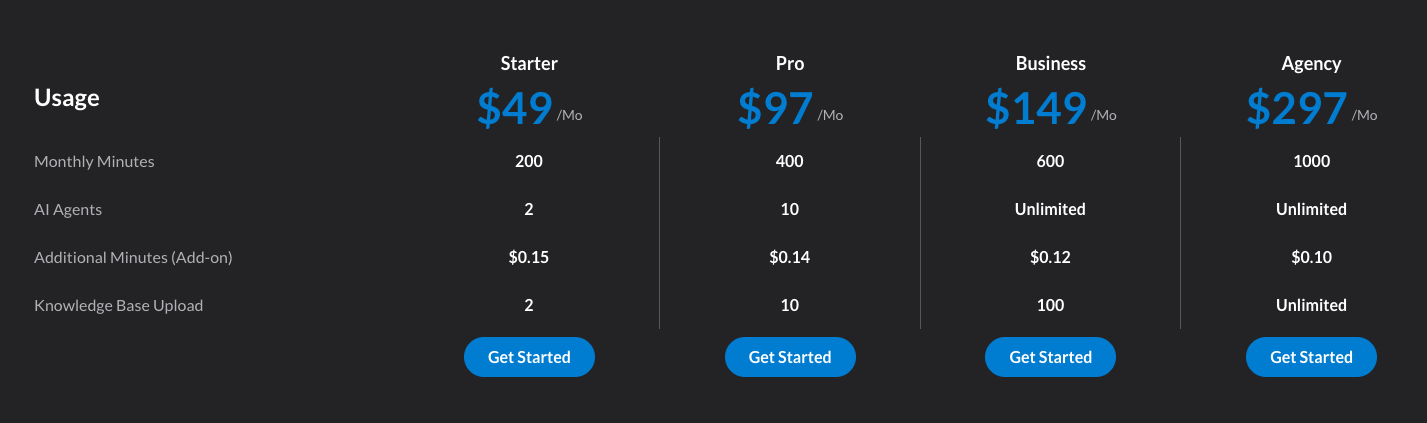
As an agency building on top, your tiers sit above those costs, and the difference is your margin.
Method 3: Hybrid (Platform Fee + Usage)
What it is: A recurring base fee covers platform access and account management, while a metered layer tracks actual usage on top.
How it works: The base fee covers QA infrastructure and prompt maintenance. The floating piece adjusts with real usage without punishing light months or undercharging heavy ones.
The usage metric doesn't have to be minutes. Some platforms bill by the number of unique customers served per month, which ties pricing more closely to business value than raw call duration.
Real example: Goodcall charges $79/month per agent on the Starter plan, which covers 100 unique customers monthly, with overages at $0.50 per additional customer. There are no per-minute fees or token charges.
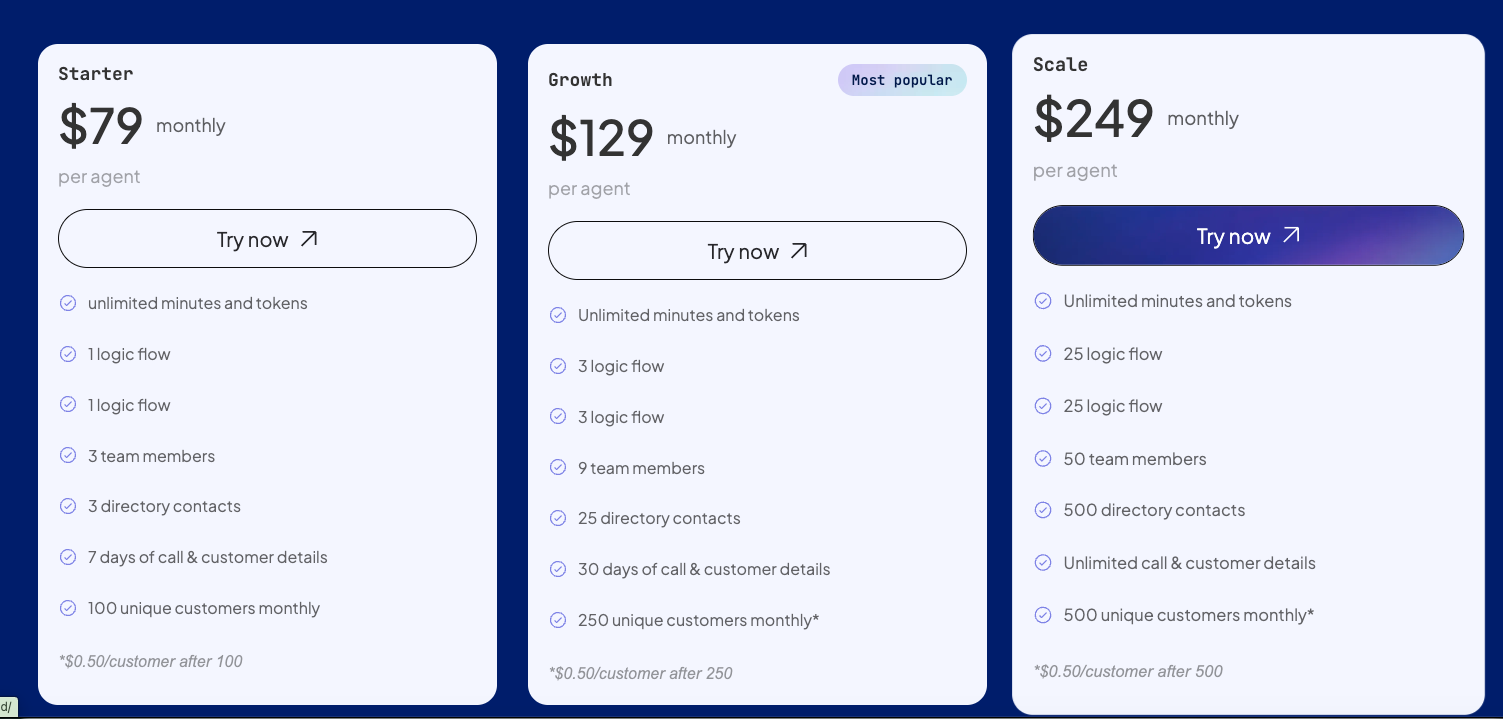
At 150 unique customers, the invoice is $79 + $25 = $104. The base is stable, and the overage is proportional to the value delivered. As an agency, you replicate this logic.
Your platform fee covers your fixed stack and QA layer, and your overage rate reflects the real incremental cost when clients scale past their tier.
Method 4: Value-Based Pricing
What it is: Pricing anchored to the business outcome the agent delivers rather than usage metrics.
How it works: You start with the client's baseline. What does one human agent cost per month? What's a booked appointment worth?
Once you have those numbers, you price as a fraction of the value delivered. The model only holds up if you have pre-deployment baselines and post-deployment tracking to back the claim.
Real example: Retell AI's published cost model shows that on a standard configuration with a modern LLM and platform voices, the all-in rate runs around $0.11 per minute.
A million minutes of AI-handled calls costs roughly $110,000 compared to a human-equivalent cost of $540,000-$1,120,000 for the same volume.
That's a 5-10x cost advantage before factoring in availability or scale. Anchor your value-based price above the AI cost, and the client still saves substantially. The price justifies itself.
Method 5: Per-Agent/Per-Bot Pricing
What it is: Clients pay a flat monthly fee per AI agent deployed, regardless of how many calls or minutes that agent handles.
How it works: Each voice agent live in production carries a fixed monthly fee, whether it processes 500 calls or 5,000. That decouples your revenue entirely from usage volume.
A client running 10,000 calls through a single agent pays the same as when they ran 1,000. You capture the efficiency gains rather than watching your margin erode as they grow.
Feature differentiation still applies. A single-workflow agent with no integrations commands less than one with CRM sync, multilingual support, and custom escalation logic. Price per agent reflects scope and complexity rather than call volume.
Real example: LiveKit structures pricing around agent deployments. The Ship plan costs $50/month and covers 2 deployments with 5,000 agent minutes, and the Scale plan is $500/month and covers 4 deployments with 50,000 minutes.
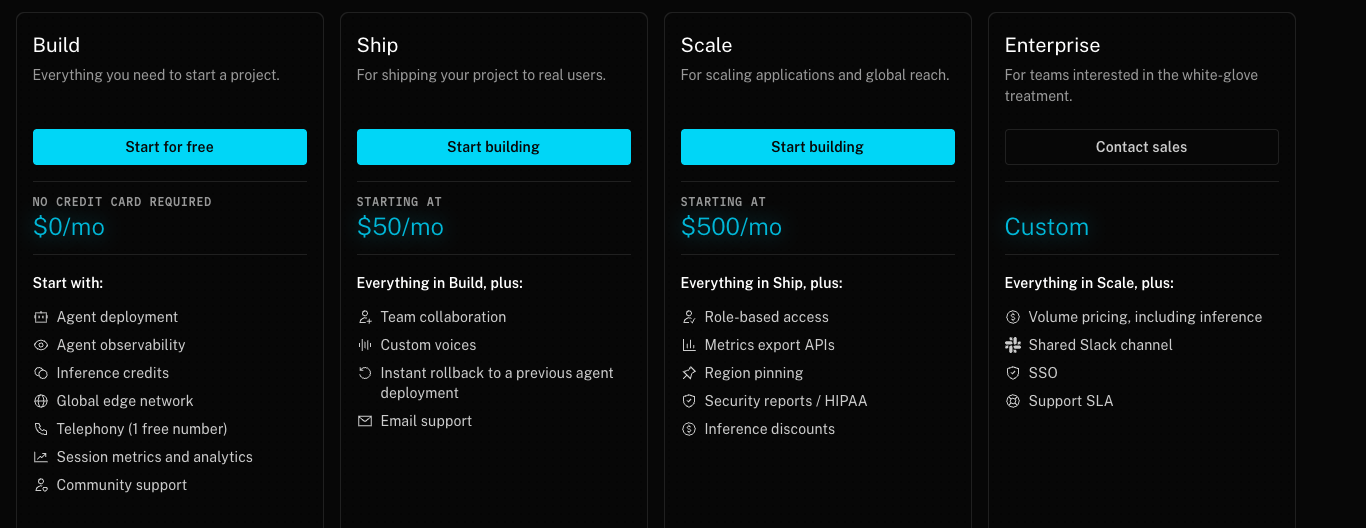
As an agency, you mirror that logic per client. A business running 3 specialized agents gets invoiced per deployment.
Method 6: Custom Enterprise Pricing
What it is: Fully negotiated pricing built around volume commitments, SLAs, compliance scope, and dedicated infrastructure. There are no published rates and no pricing page.
How it works: For deals over $5K-$10K/month, a public pricing page is a ceiling on your deal size. You build a custom quote around projected call volume, required integrations, uptime SLAs, and white-label needs.
In most deals, including a one-time implementation fee as a separate line item is worth it.
The negotiation itself is part of the value signal. When a vendor says "contact us for pricing," they're telling you the solution is scoped to specific needs. That perception matters in buying cycles that involve both procurement and legal.
Real example: Regal.ai doesn't publish pricing online. Every plan involves contacting sales, with quotes built around cumulative contacts and usage tiers. As a rough proxy, they estimate to work with companies handling at least 75 agents or 150,000 calls/month.
As an agency, apply the same logic. Once a client's scope involves compliance requirements or multi-department deployments, pull the conversation off the pricing page and into a scoping call.
Which Pricing Model Should You Choose?
The right model depends on where your client is in their deployment, how predictable their usage is, and how clearly you can connect the agent to a business outcome.
Choose Usage-Based if:
- Volume is unpredictable or still being established
- You're running a pilot before committing to a structure
- Monthly retainers feel premature before the client sees results
- Getting started matters more than optimizing margin right now
Choose Tiered Subscription if:
- Usage is consistent enough to forecast month over month
- Prompt maintenance, QA, and monitoring are part of what you deliver
- Recurring revenue that doesn't swing with usage suits your business model
- Managing multiple accounts means you need a cash flow that holds
Choose Hybrid if:
- Some months run light, others run heavy, and the model needs to handle both
- A base fee keeps your economics stable regardless of usage swings
- QA and monitoring are bundled in
- Clients want a steady floor with flexibility above it
Choose Value-Based if:
- There's a direct line between the agent and a revenue outcome or cost reduction
- Clients are mature enough to share baselines and track results over time
- Appointment setting, lead qualification, or outbound sales is the use case
- ROI drives the sales process, not per-minute rates
Choose Per-Agent if:
- Multiple specialized agents are going live across departments
- Per-minute billing gets politically uncomfortable at high volumes in procurement
- Each agent has a bounded scope, one function, and one workflow
- Invoicing tied to live deployments, rather than call volume, fits the relationship better
Choose Custom Enterprise if:
- Procurement, legal, or compliance is part of the buying process
- Regulated industries like healthcare or financial services are involved
- Dedicated infrastructure, custom SLAs, or white-label setup are on the table
- Deal size exceeds $5K-$10K/month, and a pricing page would cap the discussion
Best Practices for Pricing AI Voice Agents
Choosing the right model matters, but execution is where most agencies lose margin. Most teams are still stuck on how to price AI voice agents. These four things are what the ones winning on margin have already figured out.
Map Your Full Cost Stack Before Setting a Rate
The floor isn't what the platform charges. It's the sum of every layer running simultaneously. Setup fees, integration work, and ongoing support all compound, so don't quote anything until every line item is accounted for.
Include an Implementation Fee on Every Project
A one-time setup fee covers discovery, configuration, and initial testing. It also filters out clients who aren't serious. High setup fees can lead to losing deals to agencies that offer low-friction monthly retainers, so calibrate to your client's risk tolerance.
Don't Price Below Your Loaded Cost
Once you factor in overhead, support, and change requests, the margin erodes faster than the rate suggests. Regulated industries like healthcare or financial services warrant an additional multiplier, given the compliance layer involved.
Revisit Your Cost Stack When Platforms Update Their Pricing
Platform rates change more often than most agencies track. Bland and Retell have both updated their pricing structures in the last 12 months. If you're not checking when vendors announce changes, you're either leaving margin behind or pricing below cost without knowing it.
Your Pricing Model Still Needs a QA Layer
Choosing how to price AI voice agents solves the commercial question, but it doesn't address reliability by itself. Prompt changes, model swaps, noisy calls, failed tool calls, and unexpected user behavior can still break production workflows after you've locked in a rate.
That's where Cekura fits in.
You can add Cekura on top of whichever platform you're using for workflow testing and production monitoring.
It helps conversational AI teams run structured simulations, test infrastructure conditions like interruptions and background noise, review production calls, and catch regressions before and after launch.
When something breaks in production, conversation replay lets you show the client exactly what happened and confirm the fix worked. That's what turns a churn conversation into a trust conversation.
Every time you swap a model or update a prompt to adjust your cost floor, CI/CD integration runs your full test suite automatically before anything goes live.
Native integrations work out of the box for Retell, VAPI, ElevenLabs, LiveKit, Pipecat, Bland, and more. You don't rebuild anything. You add a testing and monitoring layer on top of what you already have.
Plus, it's SOC 2-, HIPAA-, and GDPR-compliant for transcript redaction, role-based access, and audit trails.
Book a demo to see how Cekura tests voice and chat AI agents before they reach your customers.
Frequently Asked Questions
How Much Does an AI Voice Agent Cost?
AI voice agent costs vary widely depending on the platform and model. Per-minute rates run $0.07-$0.31/min on pay-as-you-go plans. Tiered subscriptions start around $49-$299/month. Enterprise deployments with compliance requirements are priced on custom contracts.
How to Price AI Voice Agents and Choose the Right Model?
Pricing your AI voice agents depends on your deployment stage and client type. Usage-based pricing works for early-stage or unpredictable volumes. Tiered subscriptions suit managed services with consistent usage.
Value-based pricing works when the agent is directly tied to a measurable revenue outcome, like appointments booked or leads qualified.
What Hidden Costs Should I Watch for With AI Voice Agents?
You should watch for hidden fees, like LLM inference fees, TTS and STT charges, and per-minute telephony costs, which are often billed separately from the platform rate. Setup and integration work can also add $500 to $5,000 before a single call is made.
How Do I Calculate ROI for an AI Voice Agent?
To calculate ROI for an AI voice agent, compare your client's current cost per handled call to the AI agent's loaded cost per completed interaction. If the agent resolves the same volume at a lower total cost, the difference is your ROI baseline.
Can AI Voice Agents Replace Human Agents?
No. AI voice agents can handle a significant portion of routine inbound and outbound interactions, but they work best alongside human agents rather than as a full replacement.
Most production deployments use AI to handle high-volume, repetitive calls and route complex or sensitive conversations to humans.