
For Vapi vs Bland, I'd pick Vapi if your engineers want to choose and tune every layer of the voice stack, and Bland if you run outbound or contact-center volume and want it assembled for you.
In short, it's a build-or-buy decision. That split shapes the rest of any Bland vs. Vapi comparison, from the bill at 10,000 minutes to how fast you can sign a BAA.
I checked both vendors' pricing pages, docs, trust centers, and changelogs on November 19, 2026, modeled the monthly bill at 3 volumes, and pulled Vapi's results from Cekura's own benchmark.
Vapi vs Bland: What's the Difference?
Both platforms run AI phone and web agents, and the difference is who picks and pays for the models. Vapi lets you choose the speech and language providers and passes their cost through, while Bland runs its own models and charges one per-minute rate.
Vapi is orchestration middleware: you bring (or pick) the speech and language models, and Vapi runs the call loop, telephony, and tools on top.
Bland is a full in-house stack: one company runs the models, voices, and telephony, priced per minute.
Choose Vapi if: you have engineers who want to swap models and tune turn-taking, and you're fine paying model providers at cost on top of Vapi's hosting fee.
Choose Bland if: you run high-volume outbound or contact-center calls and would rather have one vendor and a single per-minute price for the AI stack, plus documented CRM and CCaaS integrations.
Vapi's Key Features
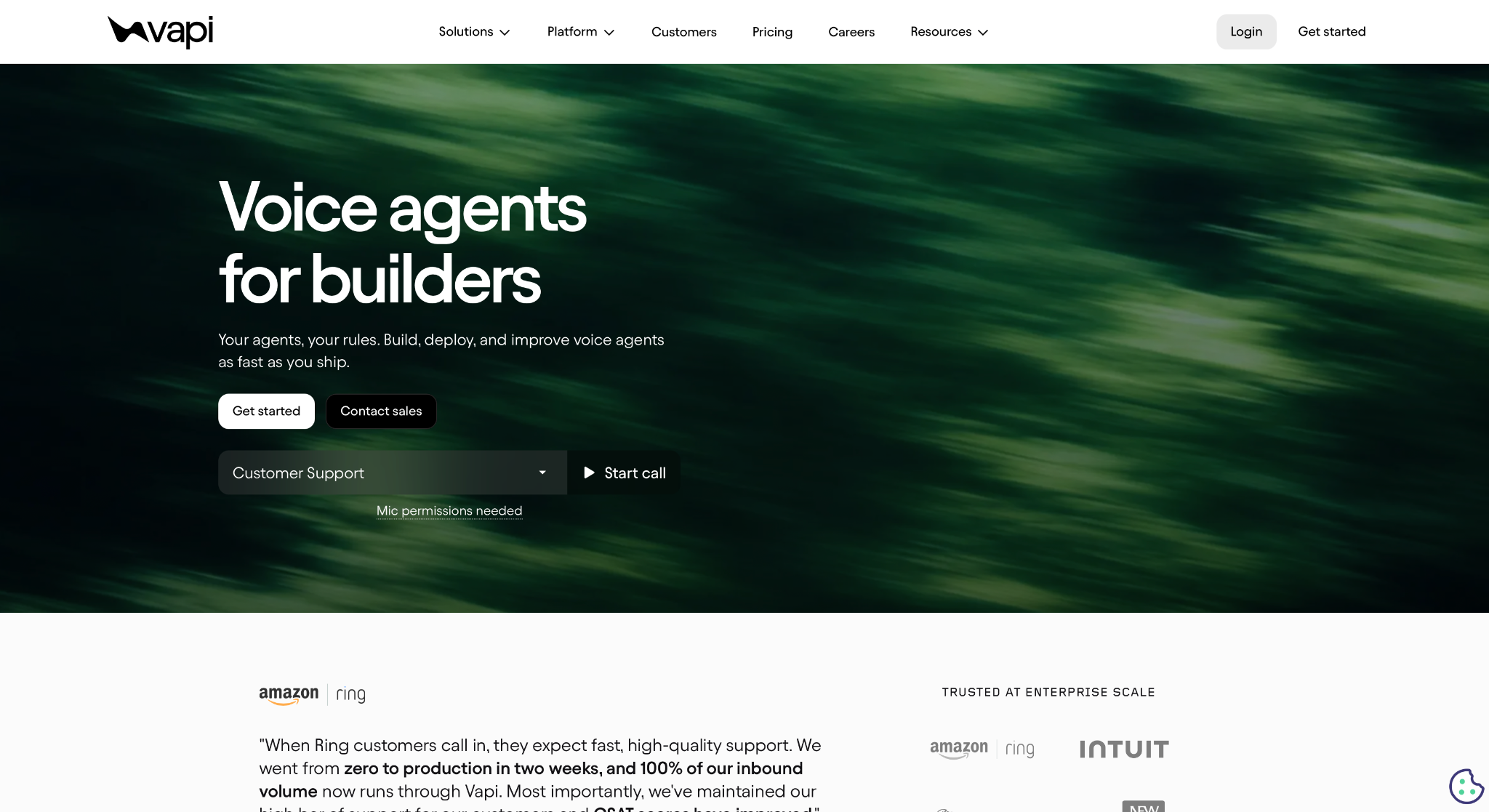
Vapi is a developer platform for building voice agents on the phone or the web. Its FAQ says you can "bring your own custom models for any part of the pipeline," so the same assistant can run Deepgram, GPT-4.1, and ElevenLabs today and other providers next week.
Multi-step flows run as Squads, groups of specialized assistants that hand the caller off mid-call. Vapi's older Workflows builder was retired in August 2026, so Squads now handles that job.
Vapi also ships function tools, warm and blind transfers, voicemail detection, and native Evals and Simulations. The kit pays off for teams with engineers who'll wire it together. Our full Vapi review covers setup in more depth.
Vapi's FAQ states it "does not support on-premise deployments," so teams that must self-host can rule it out.
Bland's Key Features
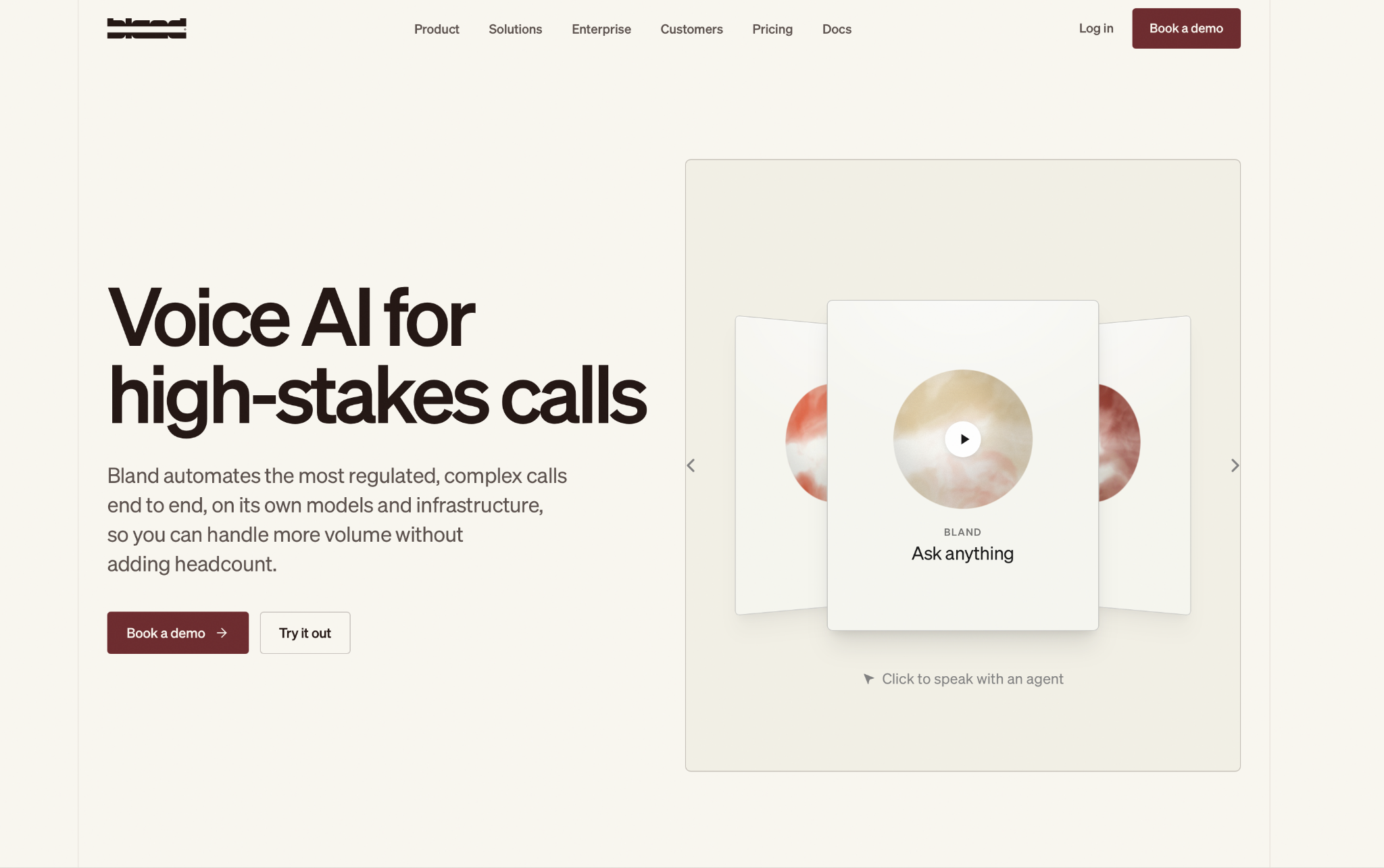
Bland sells the stack as one product. Its product page says "Bland owns every layer of the call," from telephony and speech-to-text through the language model and voice, and it "self-hosts its models and uses no third-party model providers."
Its homepage says 230+ regulated companies run on Bland, which fits the compliance list covered below.
You make agents in Bland's agent builder, which covers "prompts, variables, pathways, tools, knowledge, settings, and publishing." Standalone pathways and personas had until November 15, 2026, to move into agents, per Bland's migration guide.
Batch calls take a CSV with a phone_number column, and three environments (development, staging, and production) keep a pinned, tested version from changing under live traffic.
Bland's Send Call API exposes temperature and interruptibility, but its docs offer only Bland's own base and turbo models, with no way to choose a third-party LLM or bring your own, so model choice stays with Bland.
For a call operation that would rather manage one stack, giving that up is a fair trade.
Vapi vs Bland at a Glance
The table condenses the sections that follow, so you can check the headline differences before reading the details.
| Category | Vapi | Bland |
|---|---|---|
| Best for | Engineering teams that want to choose and tune each layer | High-volume outbound and contact-center teams that want one vendor for the AI stack |
| Pricing | $0.05/min hosting, pre-paid, plus model providers billed at cost | $0.14/min (Start) or $0.12/min plus $299/month (Build), telephony extra |
| Key strength | Swap STT, LLM, and TTS providers per assistant | LLM, STT, and TTS included in one rate |
| Main weakness | Bill and latency move with every provider you add | No third-party or BYO LLM option |
| Ideal team size | Self-serve dev teams, plus enterprises on Premier | Mid-market and enterprise call operations |
| Latency (vendor-stated) | Vendor says "around 800 milliseconds" end to end | Vendor says "about 200 milliseconds" per reply |
| Telephony/SIP | 1 to 10 Vapi numbers included by plan, free Vapi SIP; Twilio, Telnyx, or BYO SIP at carrier rates | Own SIP over TLS; BYO carrier or Bland's at pass-through cost |
| CRM and tools | Function tools, GoHighLevel, Google Calendar, Slack, MCP; Make and n8n via API request | Salesforce, HubSpot, Cal.com, Calendly, Zapier, Make |
| Compliance | SOC 2 Type II, SOC 3, HIPAA ($2,000/month add-on), PCI DSS, GDPR | SOC 2 Type II, HIPAA (BAA on Enterprise), GDPR, FedRAMP 20x Class C, PCI self-attested |
| Included concurrency | 4 (No Success Package), 10 (Core), 30 (Pro) | 10 (Start), 50 (Build) |
Vapi vs Bland, Feature by Feature
Each round below compares one part of the stack and ends with a winner, so you can jump to the parts your team cares about.
Architecture and Model Control
Vapi treats each model in the call as a slot you fill per assistant, and you can plug in your own keys so Vapi stops billing that provider. So an A/B test between models is a config change.
You also take on the upkeep. Having three vendors in the call path means three status pages to watch, three bills to reconcile, and three places a slow response can come from.
Bland makes those choices for you, so there's one vendor to call when the AI side breaks and no token bill. Enterprise customers get isolated infrastructure run by Bland, per its pricing page, and Bland's docs say self-hosted and on-premises deployments are available for regulated industries.
If you need a specific frontier model for reasoning-heavy calls, you can't select it through Bland's public API.
Winner: Vapi, for teams that choose and benchmark their own models.
Pricing at 1K, 10K, and 50K Minutes
Vapi vs Bland pricing follows two different logics. Vapi charges for orchestration and passes the rest through at cost, while Bland bundles the models into its per-minute price.
Vapi pricing
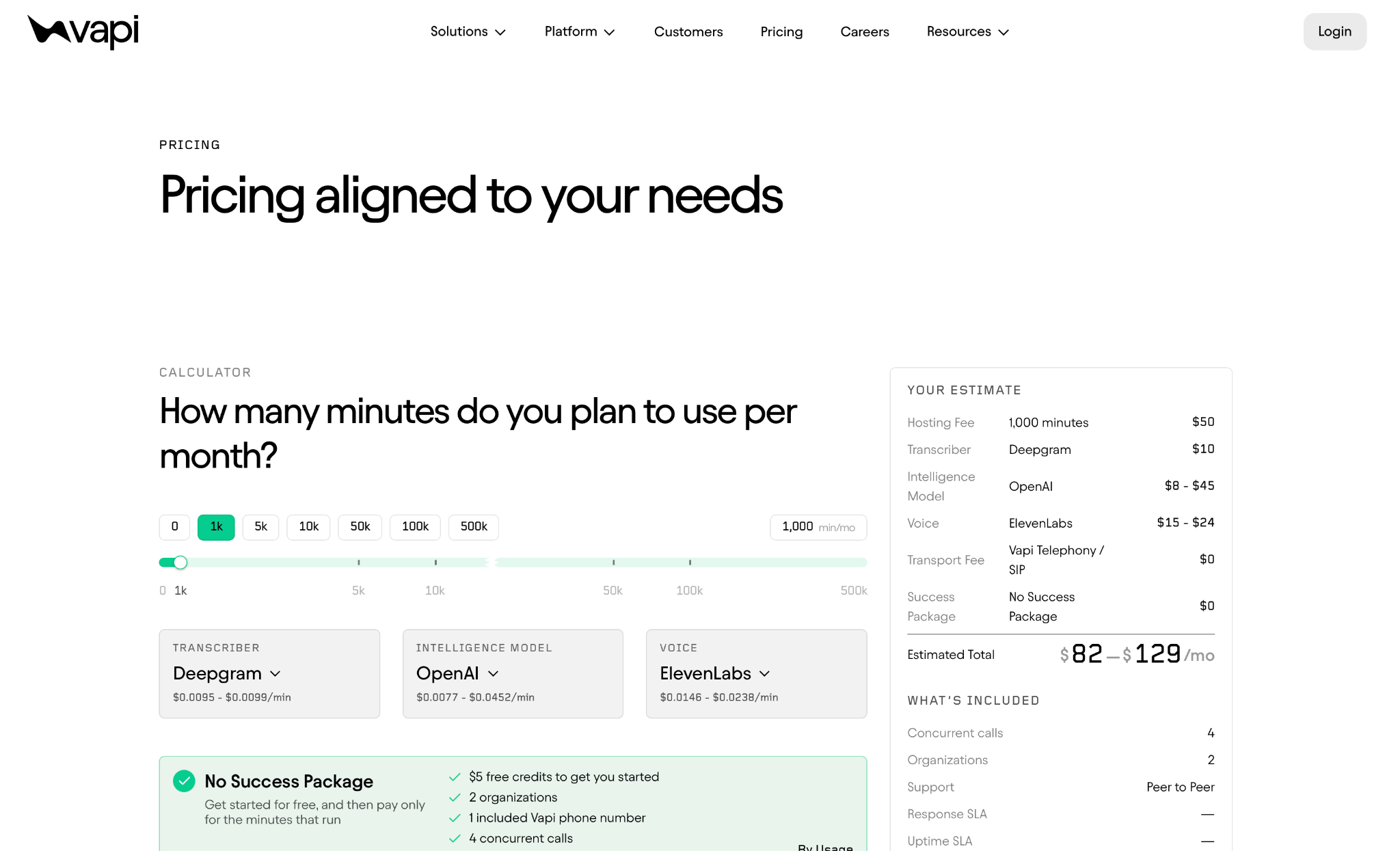
Vapi bills its hosting per minute, and the paid plans add a monthly fee or minimum on top.
Four plans, from pay-as-you-go to custom:
-
No Success Package: $0.05/min Vapi hosting, pre-paid, with models billed at provider cost, $5 in starter credits, 1 included Vapi number, and 4 concurrent calls.
-
Core: $29 per month, pre-paid with auto-renew, with 5 Vapi numbers, 10 concurrent calls, and Zero Data Retention included.
-
Pro: 10% of the Vapi hosting fee with a $999 monthly minimum, 10 Vapi numbers, 30 concurrent calls, and a 99% uptime SLA.
-
Premier: custom pricing, sold directly, with a 99.9% uptime SLA.
Add-ons cost $2,000 per month for HIPAA and $10 per line per month for extra concurrency. Vapi SIP, WebSockets, and WebRTC carry no transport fee, while Twilio runs $0.008/min inbound and $0.014/min outbound.
Vapi's own calculator puts Deepgram, OpenAI, and ElevenLabs at $82 to $129 for 1,000 minutes, hosting included, or about $0.082 to $0.129 per minute. Our Vapi AI pricing breakdown goes plan by plan.
Bland pricing
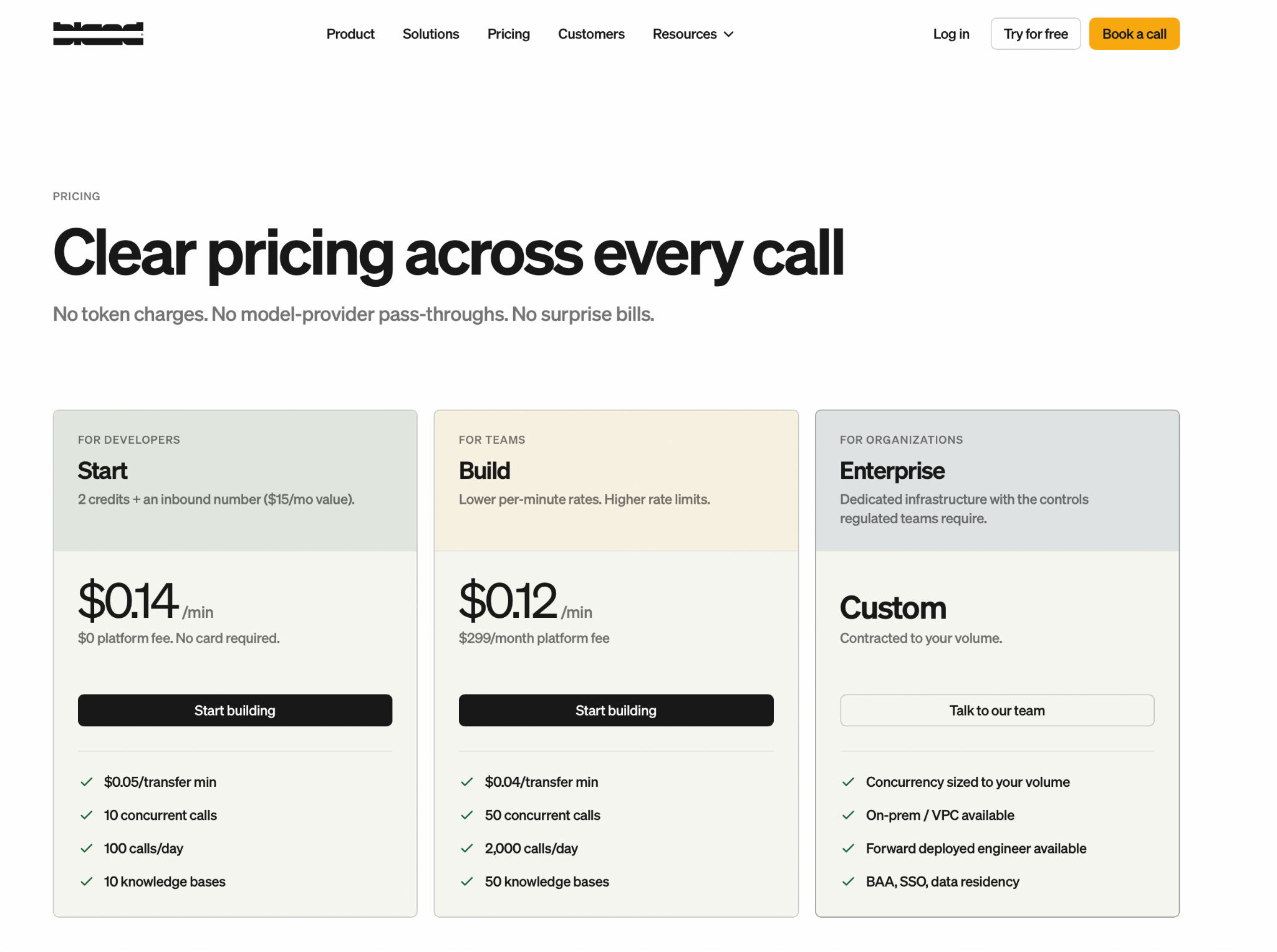
Bland's per-minute rate already covers the models, so the plan you pick mainly changes your rate and how many calls you can run.
Three tiers on the pricing page, all billed per minute of talk time (Bland's billing docs also list a Scale plan at $499 a month plus $0.11/min):
-
Start: $0.14/min talk time with a $0 platform fee, $0.05/min for transfers, 10 concurrent calls, and a cap of 100 calls a day.
-
Build: $0.12/min plus a $299/month platform fee, $0.04/min for transfers, 50 concurrent calls, and 2,000 calls a day.
-
Enterprise: custom, contracted to your volume, with BAA, SSO, and data residency.
Every Bland plan carries a 99.9% uptime SLA. Telephony is billed separately, on your own carrier or Bland's at pass-through cost.
Total monthly cost at 1K, 10K, and 50K minutes (by my math, before telephony):
| Minutes/month | Vapi (No Success Package) | Bland Start | Bland Build |
|---|---|---|---|
| 1,000 | $82-$129 | $140 | $419 |
| 10,000 | $818-$1,289 | $1,400 | $1,499 |
| 50,000 | $4,090-$6,445 | Not practical† | $6,299 |
†Start's 100-calls-a-day cap works out to roughly 3,000 calls a month, so reaching 50,000 minutes ($7,000 at list price) would need 17-minute average calls.
The Vapi range uses that one calculator mix, so your number moves with the providers you pick. It starts below Bland at all 3 volumes. At 50K, though, its high end ($6,445) runs slightly above Bland Build ($6,299), so premium models erase Vapi's price advantage.
When it comes to HIPAA, Vapi adds $2,000 a month, and Bland only signs a BAA on a custom Enterprise contract.
Pricing was checked against vendor pages on November 19, 2026. Confirm with each vendor before you commit.
Winner: Vapi, at 1K and 10K minutes on this model mix. At 50K, it depends on which models you run.
Latency and Barge-In
Latency is the hardest part of Vapi vs Bland to judge. Both vendors publish their own numbers, and Cekura's voice quality benchmark is the one independent test that put both on the same call setup.
Vapi rates its own latency, in its FAQ, at "typically around 800 milliseconds for end-to-end voice processing."
Barge-in is tunable in the speech configuration: the agent waits 0.4 seconds by default before speaking, stops after 0.2 seconds of caller voice, and backs off for 1 second, then resumes.
In Cekura's voice agent benchmark (we ran it, and each provider chose its own models and settings), Vapi on GPT-4.1 averaged 3.08 seconds per response and scored 4.73 out of 5 on interruption handling. That ranked Vapi 9th of 10 platforms on interruption handling.
Bland says its agent "replies in about 200 milliseconds," while its developer docs summary cites "sub-400ms response latency." Barge-in is set with an interruptibility level from 0 (block) to 4 (always interrupt), with 2 as the default.
Bland also documents a resumption mode that matches each caller's pace, though its docs say it "may not yet be active in your environment."
Bland isn't in Cekura's voice agent workflow benchmark, so there's no workflow number for it on that test setup. Both vendors do appear on Cekura's separate voice quality benchmark, which called each platform's live production line on the same 15 scenarios.
There, Bland ranked 6th of 16 (quality 91.4) with a 2.28-second mean response time, and Vapi 10th (quality 89.5) at 3.57 seconds.
Winner: Tie. The vendor figures measure different intervals. On Cekura's voice quality benchmark, where both were tested the same way, Bland's mean response time (2.28s) came in ahead of Vapi's (3.57s).
If you plan to tune turn-taking yourself, Vapi gives you separate start- and stop-speaking timing settings against Bland's single 0-to-4 interruptibility level.
Telephony and SIP
Vapi includes its own phone numbers on every plan (1 on No Success Package, 5 on Core, 10 on Pro) and free Vapi SIP. It also imports Twilio and Telnyx numbers, plus DIDWW through a BYO SIP trunk.
Its SIP trunk docs list US signaling at sip.vapi.ai, and EU SIP (sip.eu.vapi.ai) is "available only with the Premier Success Package." For a deeper look at the carrier layer, see Twilio vs Vapi.
Bland has its own SIP stack. SIP runs only over TLS on port 5061 with SRTP media, and since March 23, 2026, SIP trunks are open to every organization. Its integration hub lists Genesys, Five9, NICE CXone, Amazon Connect, Talkdesk, RingCentral, and Microsoft Teams.
If your agent has to live inside an existing contact center, Bland has a published setup path (its forward-deployed team scopes each integration with you).
Winner: Bland, for agents that have to live inside Genesys, Five9, NICE CXone, or another existing contact center. If you only need phone numbers, Vapi includes them on every plan, plus free Vapi SIP.
CRM, Tools, and Integrations
Both platforms can call your own APIs mid-call. Vapi's ready-made integrations lean toward automation tools, and Bland's toward CRMs and contact centers.
Vapi sends a tool-calls request to your server and expects HTTP 200 back with a flat-string result (or error) for each toolCallId, even when the tool fails.
Its integrations page covers GoHighLevel, Google Calendar, Google Sheets, and Slack, while Make connects through an API Request, MCP, or Function tool, and n8n through an API Request tool and a published webhook.
MCP servers plug in as tools too. Salesforce isn't on the integrations page, so you'd connect it through your own tool.
Bland's integrations hub lists 29 connections, including Salesforce, HubSpot, Cal.com, Calendly, Zapier, Make, and Pipedream. Tools are set up once and attached to an agent, so a booking step can call Calendly mid-call.
Since July 2026, Bland syncs contact memory to HubSpot and Salesforce through one OAuth connection, which saves a sales team on either CRM some glue code.
Winner: Bland, for sales teams on Salesforce or HubSpot. Vapi's integrations lean toward GoHighLevel, Slack, n8n, and MCP servers.
Compliance and Data Residency
Vapi's Trust Center lists SOC 2, SOC 3, HIPAA, PCI DSS v4.0.1, GDPR, and CCPA, and states it completed SOC 2 Type II and SOC 3 examinations covering July 1, 2025, to July 31, 2026.
HIPAA is a dashboard add-on at $2,000 a month that applies to every assistant in the org. Once it's on, you can only pick HIPAA-compliant providers, and it can't run alongside Zero Data Retention.
Bland's trust page lists SOC 2 Type II, HIPAA with a signed BAA, GDPR with a DPA, self-attested PCI DSS, and FedRAMP 20x Class C (Moderate), granted November 17, 2026. (Bland reached Class A on August 25, 2026.)
Bland's pricing page notes "Compliance documentation is available under NDA on Enterprise," and the BAA, SSO, and data residency only come with that plan.
A healthcare startup on a self-serve budget can turn on HIPAA in Vapi's billing dashboard and get the BAA by email, with no Enterprise contract. A bank that needs on-prem deployment should look at Bland, since Vapi's FAQ says it doesn't support on-premise deployments.
Winner: Tie. Vapi takes self-serve HIPAA, and Bland takes deployment options and FedRAMP.
What Users Say in Reviews
Quotes below come from G2, Trustpilot, and Product Hunt as of November 19, 2026. Both review footprints are small. Vapi shows 3.6 out of 5 from less than 10 reviews on G2, 2.5 from 10+ on Trustpilot, and 4.9 from 20+ on Product Hunt. Bland has 5.0 from 10+ reviews on G2 and only a handful of reviews on Trustpilot, with a poor average score.
Vapi
Vapi's reviews split between developers who like the setup and builders frustrated by latency swings and support waits.
Pros
The praise centers on how fast setup goes and what the platform costs.
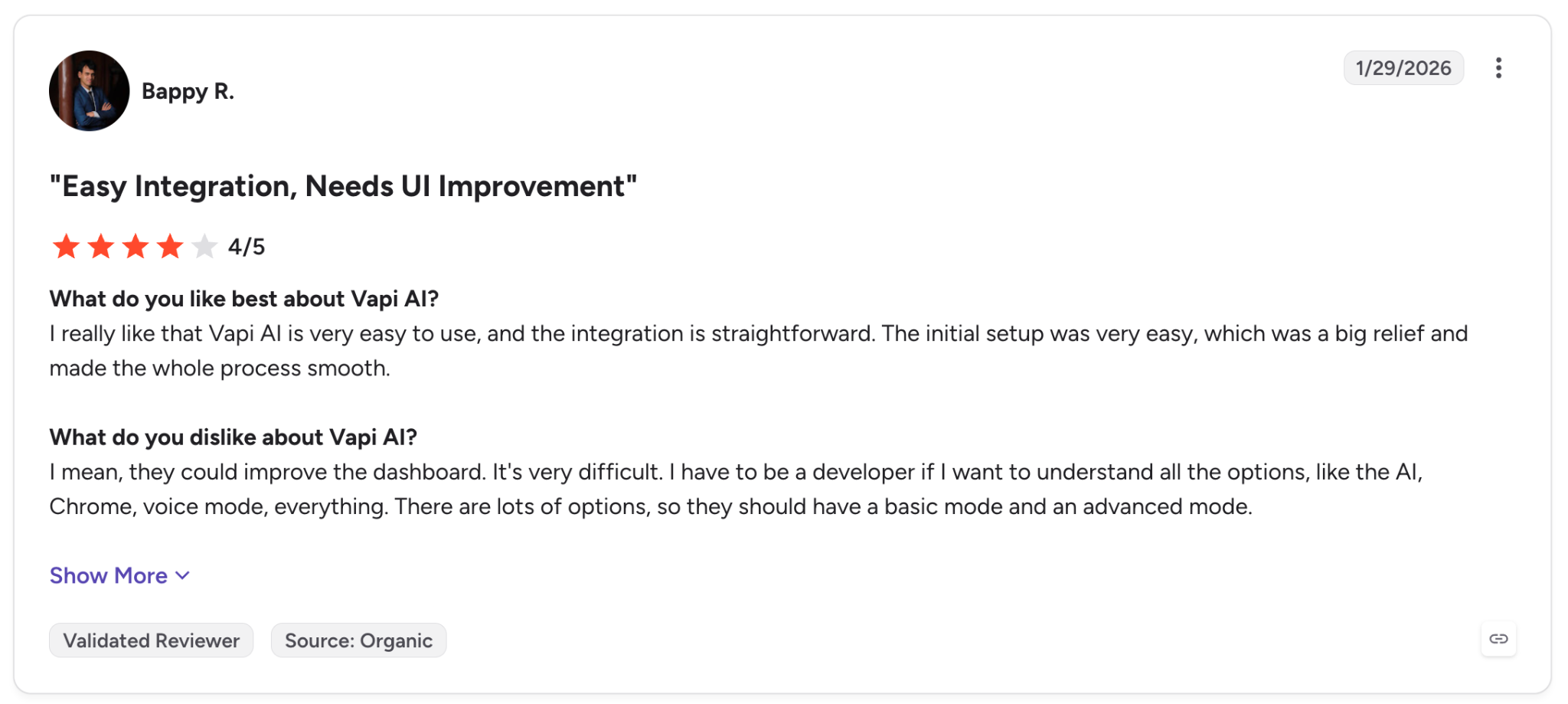
"The initial setup was very easy, which was a big relief and made the whole process smooth." Bappy R., G2
"The developer experience is excellent, integrations are straightforward…" Prashant Patil, Product Hunt
"Costwise - it's one of the cheapest platform out there to make a voice AI bot." Lalit A., Internshala Student Partner, G2 (incentivized review)
Cons
The complaints point at unstable latency, limited debugging tools, and slow support.
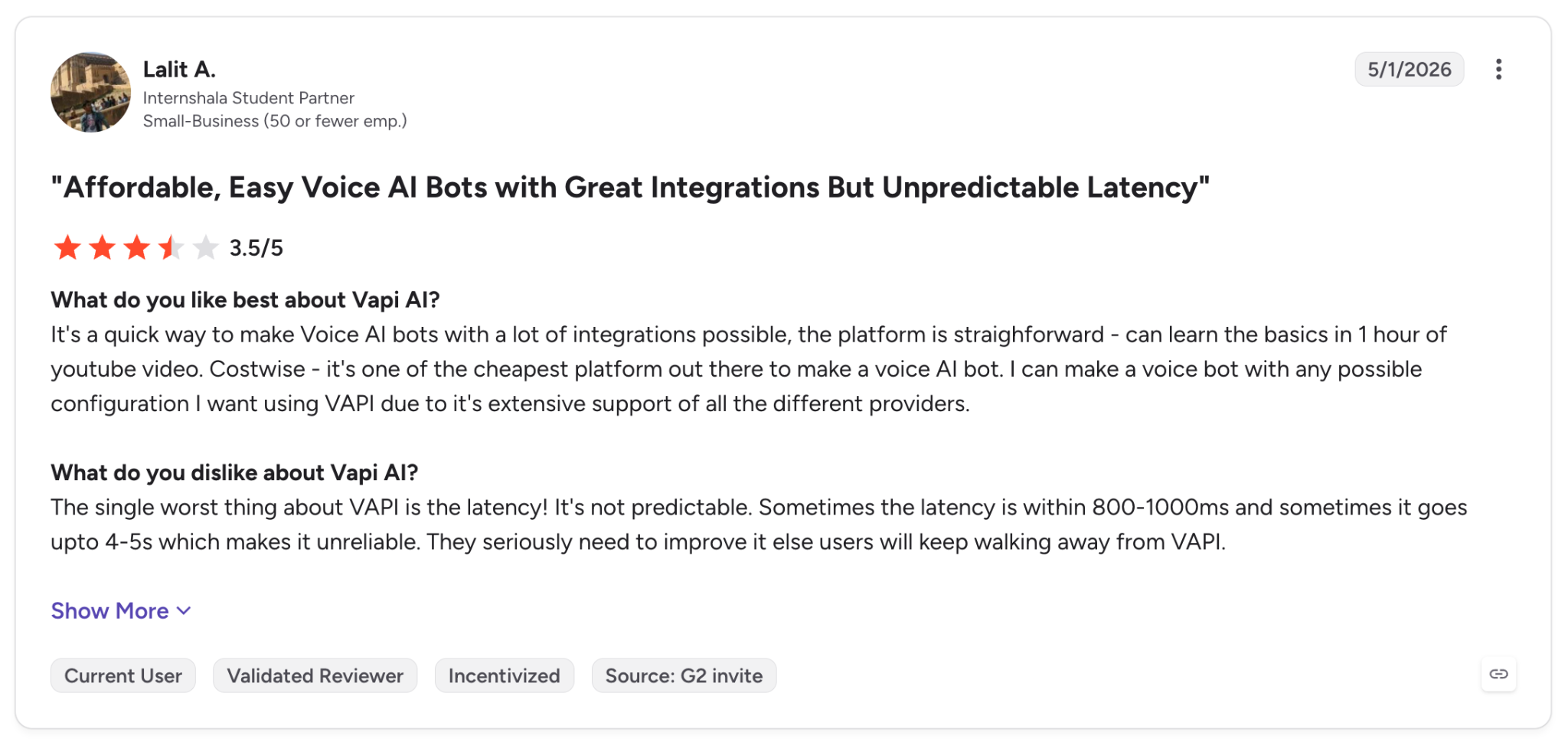
"Sometimes the latency is within 800-1000ms and sometimes it goes upto 4-5s which makes it unreliable." Lalit A., Internshala Student Partner, G2 (incentivized review)
"I'd like better debugging tools around failed calls, latency breakdowns, provider fallback, transcript quality, and assistant decision traces." Abhishek Patel, Product Hunt
"expect to be waiting a week for anything to even be looked at properly." James, Trustpilot
Bland
Bland's reviews come mostly from G2, where reviewers range from a small-business CEO to a mid-market support team.
Pros
Reviewers credit Bland with fast builds, natural-sounding calls, and training help for new teams.
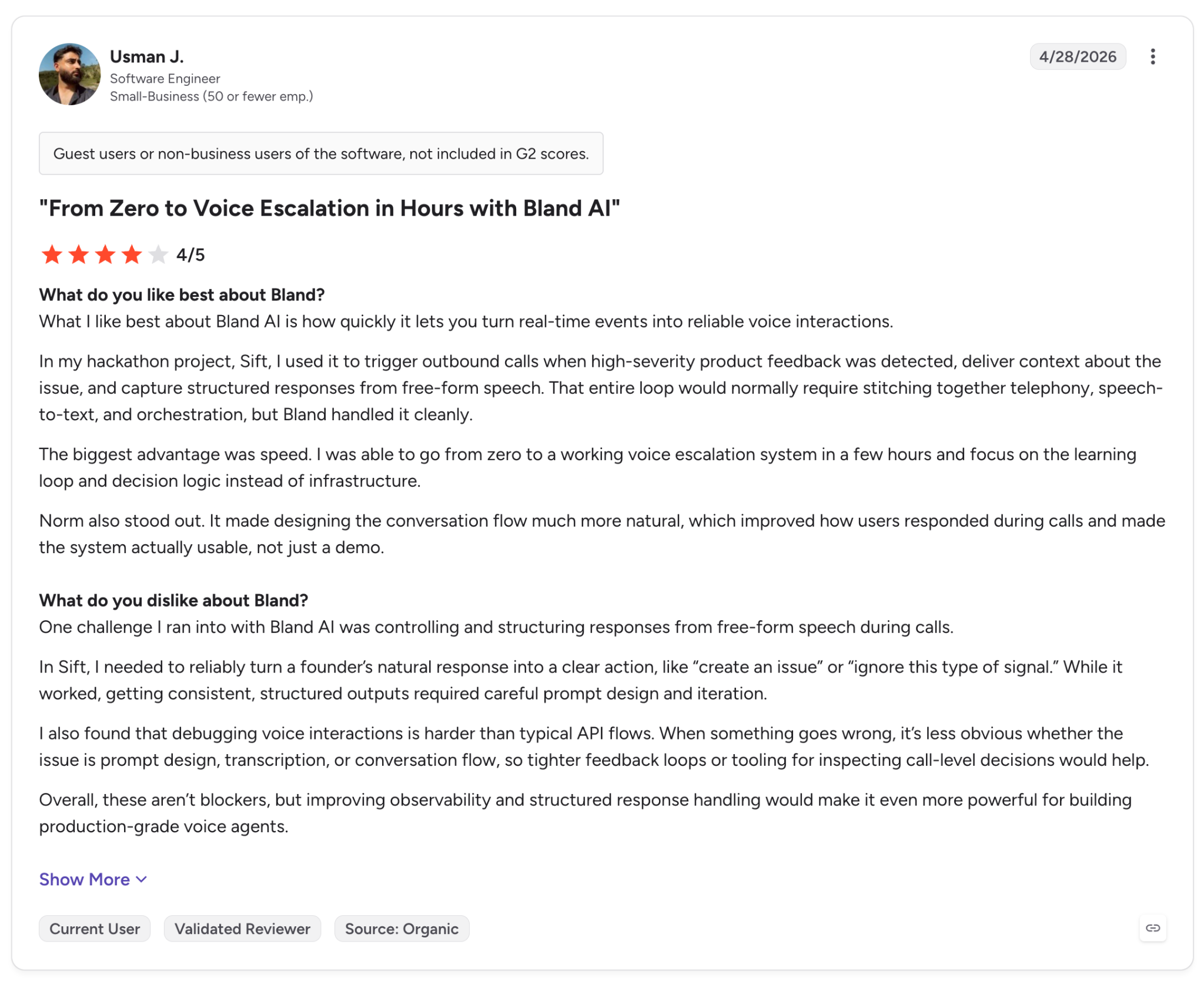
"I was able to go from zero to a working voice escalation system in a few hours…" Usman J., Software Engineer, G2 (not counted in G2's score)
"I love that Bland AI is extremely conversational…" Ben S., mid-market company, G2
"…amazing resources to help train our internal team…" Ben S., mid-market company, G2
Cons
The critiques are mild, and the sharpest one is about tracing what went wrong on a failed call.
"Pretty solid. Always areas that can be better." Joshua C., CEO at a small business, G2
"When something goes wrong, it's less obvious whether the issue is prompt design, transcription, or conversation flow." Usman J., Software Engineer, G2 (not counted in G2's score)
Reviewers on both sides say similar things. They like how fast setup goes, and they struggle when a call fails, and they have to find out why.
How to Make Your Choice
The Vapi vs Bland choice depends on who's building. Engineering-led teams get more out of Vapi, and Bland makes more sense when you're running high-volume outbound calls or connecting to a contact center.
Vapi Is Better For
These cases lean on Vapi's model choice and its self-serve plans.
Where Vapi pulls ahead:
-
Developers who want to A/B test STT, LLM, and TTS providers inside one platform.
-
Healthcare and other regulated teams that need a BAA on a self-serve plan.
-
Products around 10,000 minutes a month or less, where provider-cost billing keeps the bill low.
-
Web and in-app voice agents running over WebRTC or WebSockets.
Bland Is Better For
These cases rest on Bland's contact-center integrations and its Enterprise deployment options.
Bland's strongest cases:
-
Outbound campaigns that load contacts by CSV and run up to 2,000 calls a day on Build (more on Enterprise).
-
Contact centers on Genesys, Five9, NICE CXone, or Amazon Connect.
-
Sales teams that need contact data synced to Salesforce or HubSpot with less glue code.
-
On-prem, isolated infrastructure, data residency, or FedRAMP requirements.
If neither matches your stack, our roundup of Vapi alternatives and our Retell vs Vapi comparison cover the wider field.
My Verdict
In a Vapi vs Bland decision, I'd start with Vapi. Model choice and a lower bill at 1K and 10K minutes on the mix I priced make it the stronger default for a technical team shipping its first production agent.
I'd switch to Bland as soon as the project calls for "outbound at scale inside our contact center." Documented CCaaS and CRM integrations plus one rate for the whole AI stack remove work that Vapi leaves to your engineers.
Test Either Platform Before Launch
Vapi and Bland both ship native testing, and each one checks only its own agents. Vapi has Evals and Simulations. Bland has Testbed for re-running a single turn from an earlier call, Agent Testing for full simulated calls, and Evals that run LLM judges on test cases and past calls.
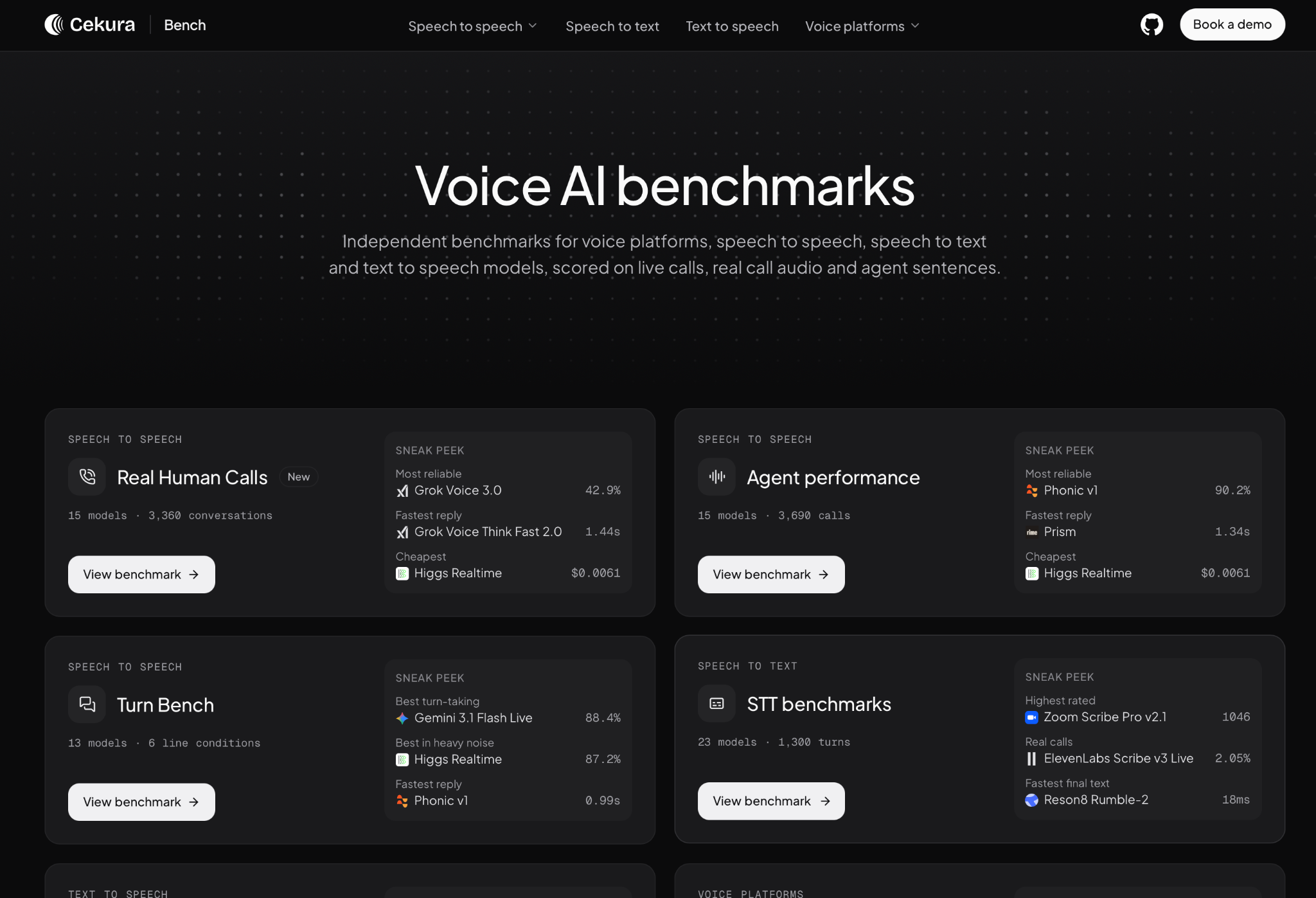
Before you settle Vapi vs Bland, run the same test calls on both. In Cekura's benchmark, one agent spec ran across 10 platforms, 82 caller scenarios, 3 times each (2,460 calls).
Vapi completed 97.6% of tasks but passed only 59.8% of scenarios on all 3 runs, against 90.2% for Retell, the top platform on that metric. Results are relative to one fixed test setup and to each provider's own model picks, so treat them as a shortlist and validate on your own traffic.
Cekura tests your own agent the same way, on either platform. Native integrations cover Retell, Vapi, ElevenLabs, LiveKit, Pipecat, and Bland, which connects with a Bland Agent ID and API key.
With Cekura, teams can:
-
Simulate thousands of calls with personas, accents, background noise, and interruptions before go-live.
-
Test barge-in and latency across turn-taking and poor audio.
-
Turn production transcripts into simulations to confirm a prompt or model fix.
-
Gate CI/CD by running the full suite on every prompt or model change.
-
Monitor production calls for drift and failed metrics.
-
Red-team the agent with jailbreak and prompt-injection attempts.
It's SOC 2-, HIPAA-, and GDPR-compliant for transcript redaction, role-based access, and audit trails.
Book a demo to run the same test suite on your Vapi or Bland agent before your customers do.
Frequently Asked Questions
Why is Vapi used?
Vapi is used to build and run voice agents with the STT, LLM, and TTS providers you choose. Developers pick it for model flexibility and provider-cost billing with a $0.05/min hosting fee.
How good is Bland AI?
Bland works best for high-volume outbound and contact-center calls. It runs its own models, holds 5.0 out of 5 from 11 G2 reviews, and has documented integrations for Salesforce, HubSpot, Genesys, and Five9. Reviewers mention that debugging a failed call takes work.
Why is Vapi so expensive?
Vapi gets expensive when you add premium providers and compliance. On top of the $0.05/min hosting fee, top-range OpenAI and ElevenLabs models push the total near $0.13/min, and HIPAA adds $2,000 a month.
How much does Vapi cost per month?
Vapi costs about $82 to $129 a month at 1,000 minutes on usage-only billing, based on its own calculator's default model mix. Core adds $29 a month, Pro carries a $999 monthly minimum, and Twilio telephony is extra.
Is Bland cheaper than Vapi?
No, Bland is usually not cheaper than Vapi at 1,000 or 10,000 minutes a month, before telephony. At 10,000 minutes, Bland Start costs $1,400 against Vapi's $818 to $1,289. At 50,000 minutes, Bland Build ($6,299) can undercut Vapi with premium models ($6,445).
What are some alternatives to Bland AI?
Common alternatives to Bland AI include Vapi, Retell, ElevenLabs, and Synthflow. Each takes a different line on model choice and pricing.