
I ran Retell vs. Vapi through outbound lead qualification and inbound appointment workflows to see where each one holds up. Retell gets you live fast, with no heavy configuration. Vapi hands developers full control over every layer of the call stack, but you pay for that in setup time.
Here's everything I learned about what actually works and what doesn't.
Retell vs. Vapi: What's the Difference?
Retell AI is a performance-driven voice AI platform built for businesses that need production-ready phone agents. Fast deployment, transparent pricing, and enterprise compliance included from day one.
Vapi is a developer-first platform that gives engineering teams full API control to build highly customized voice agents, with complete freedom to choose every component of the stack.
Choose Retell if: Your team doesn't write code, you need agents live within days, and you're handling inbound reception, after-hours calls, or outbound qualification at volume.
Choose Vapi if: You have engineers who want to own every layer of the stack, pick their own STT, LLM, and TTS providers, and ship a voice product built around specific technical requirements.
| Feature | Retell AI | Vapi |
|---|---|---|
| 🎯 Best For | Ops and sales teams | Engineering teams |
| 💰 Pricing | $0.07-$0.31/min all-in (infra + LLM + TTS + telephony) | $0.05/min hosting + LLM + STT + TTS at provider cost |
| 💪 Key Strength | ~600ms latency, preset functions, no-code workflows | Sub-500ms latency (optimized config), full API control, 100+ languages |
| ⚠️ Main Weakness | Limited stack customization | High setup time, no out-of-the-box workflows |
| 👥 Ideal Team Size | SMBs to Enterprise | Startups to mid-size dev teams |
| 🔒 Compliance | HIPAA, SOC2 Type 1 & 2, GDPR included | HIPAA, SOC2 available (some at extra cost) |
| 🖥️ No-Code Option | Yes | Limited (dashboard + Composer alpha) |
Meet Retell AI: Features & Highlights
Retell AI targets business teams that need phone agents to live fast, without writing a single line of code. A proprietary voice orchestration engine, a visual agent builder, and enterprise compliance ship together on a single platform.
What it brings to the table:
- ~600ms latency: Confirmed by independent benchmarks. Conversations stay fluid and natural.
- Visual agent builder: Design call flows without writing code using a drag-and-drop interface with built-in guardrails. This is the fastest path to deployment for non-technical teams.
- Preset function calling: Agents book appointments, update CRM records, process payments, and transfer calls mid-conversation.
- Auto-sync knowledge base: Pulls directly from your website content so agents always answer with current information.
- Batch calling: Run outbound campaigns at scale with full conversion tracking.
- Branded and verified call IDs: Outbound calls display your brand name, verified to avoid spam labels.
- Native SIP trunking: Connect any existing telephony or VoIP provider without touching your infrastructure.
- Compliance included: HIPAA, SOC 2 Type II, GDPR, PII redaction, RBAC, and SSO, all at no extra cost.
- Omni-channel: Voice, Chat, SMS, and API in one platform.
- Integrations: HubSpot, Salesforce, Twilio, GoHighLevel, Zapier, Make, Cal.com, and more.
The numbers back it up.
Medical Data Systems now handles 100% of inbound calls with its AI, resolving 70% of conversations end-to-end and transferring only 30% to live agents, while collecting ~$280,000/month.
SWTCH Energy cut support costs by over 50% after deploying Retell.
Meet Vapi: Features & Highlights
Vapi is a developer-first API platform for engineering teams that need total control over every layer of their voice stack. Thousands of configuration points, bring-your-own models, and deep API access make it the go-to choice for teams shipping a custom voice product from zero.
Here is what stands out:
- Full API access: Every feature is available via API with deep configuration options across the entire stack.
- Bring your own models (BYOM): Plug in your own API keys for STT, LLM, and TTS, or connect self-hosted models.
- 100+ languages: English, Spanish, Mandarin, and many more.
- 1,000+ templates: Start from a ready-made agent or build from scratch.
- A/B testing: Test different prompts, voices, and call flows to sharpen performance over time.
- Simulated test suites: Run agent tests to catch hallucination risks before going live.
- Tool and API calling: Connect your own APIs as tools to fetch data and take actions server-side in real time.
- Conversation guardrails: Built-in controls to limit model drift and protect data integrity.
- Enterprise reliability: Custom real-time audio infrastructure with HIPAA and financial services compliance.
- Dedicated deployment engineer: Forward-deployed engineer support to get you live within a week.
Vapi claims to serve teams from trail-blazing startups to Fortune 500 companies, and its Discord developer community has grown to 13,000+.
Retell vs. Vapi: Feature-by-Feature Comparison
Both platforms cover the core ground. Where they differ is in how much control you want and how much setup you can stomach.
Ease of Use & Setup
The no-code path is straightforward on Retell. Pre-built templates, a drag-and-drop builder, and simulation testing are ready from signup. You don't need to write a line of code.
Vapi is built code-first. Every feature runs through the API, so even basic configurations need developer familiarity with STT, LLM, and TTS pipeline assembly.
Retell: Visual workflow builder with preset functions (book appointments, transfer calls, update CRMs) that non-technical teams configure and deploy on day one.
Vapi: A Workflows visual editor covers simpler flows, but advanced setups like custom LLMs, squad orchestration (coordinating multiple agents across a single call), and tool calling still require code and direct API work.
Winner: Retell for teams without dedicated dev resources. Vapi wins if that's what you're after.
Latency & Voice Quality
A 1.5-second silence kills call completion rates. Retell delivers a confirmed ~600ms average end-to-end latency without configuration, managed through its own voice orchestration engine.
Vapi targets sub-500ms with the right model stack, but production results vary depending on which STT, LLM, and TTS combination you configure.
Retell: Consistent low latency with no tuning required, because the platform manages the full pipeline internally.
Vapi: Highly configurable latency. Optimized setups hit sub-500ms; heavier LLM choices push response times to 1.5-2s.
Winner: Retell for consistent production latency. Vapi can match it, but it won't happen automatically.
Pricing & Cost Transparency
You need to know what you're spending before you commit. Retell publishes every component publicly with a documented rate card. Vapi's total cost depends on which providers you bring in, so real cost forecasting only happens after you've built.
Retell: Voice Infra at $0.055/min, TTS at $0.015/min, LLM (GPT 4.1) at $0.045/min, telephony at $0.015/min. No platform fees, no feature gating, $10 free credits to start. The first 20 concurrent calls and the first 10 knowledge bases are free.
Vapi: $0.05/min for hosting, then each component billed separately at provider cost. STT, LLM, and TTS rates shift depending on which providers you configure.
Winner: Retell for predictability. Vapi's component model gives flexibility but complicates cost planning.
Integrations & Telephony
Native SIP trunking ships at no extra charge on Retell, plus pre-built connectors for major CRMs, automation tools, and telephony providers like HubSpot, Salesforce, Twilio, and GoHighLevel.
On Vapi, virtually any external system is reachable through API and tool calling, but most connections require custom development.
Retell: Native connectors for the tools most teams already use, with SIP trunking included at no extra charge.
Vapi: Maximum depth for custom pipelines, but every connection requires developer work.
Winner: Call it a tie. Retell wins on out-of-the-box connectivity. Vapi wins on depth for dev teams that need full custom control.
Compliance & Security
Retell includes HIPAA, SOC2 Type I & II, GDPR, PII auto-redaction, RBAC (role-based access control), and SSO across all plans at no extra cost. Vapi offers HIPAA and SOC2 compliance, but enterprise-grade features like custom DPA and BAA are gated behind direct enterprise agreements.
Retell: PII redaction covers names, addresses, dates of birth, passwords, and PINs. Opt-out recording and custom data retention are available from the start.
Vapi: HIPAA and SOC2 are covered, but custom DPA and BAA terms require a direct enterprise agreement.
Winner: Retell for regulated industries where you can't wait on a contract to be compliant.
Scalability & Concurrency
Starting at 20 free concurrent calls, scaling on demand at $8/concurrency/month, and running at 99.99% uptime. Enterprise plans remove the concurrency cap entirely and move to a dedicated stable server.
The other platform supports high-volume scaling with no stated rate limit and a custom real-time audio infrastructure. Its recorded uptime also sits at 99.99%.
Retell: Pay-as-you-go runs on shared infrastructure with a built-in fallback system. Enterprise moves to a dedicated stable server with no concurrency cap.
Vapi: Supports squad orchestration for multi-agent call flows and custom real-time audio infrastructure for teams that need to own every layer.
Winner: Tie. Both platforms hit 99.99% uptime. Retell has the edge on pricing transparency, where every concurrency cost is documented upfront.
What Real Users Are Saying
Specs and pricing only tell part of the story. I went through real deployment experiences shared by developers and ops teams who've run both platforms in production, and the feedback is consistent enough to be useful.
Retell AI
Pro:
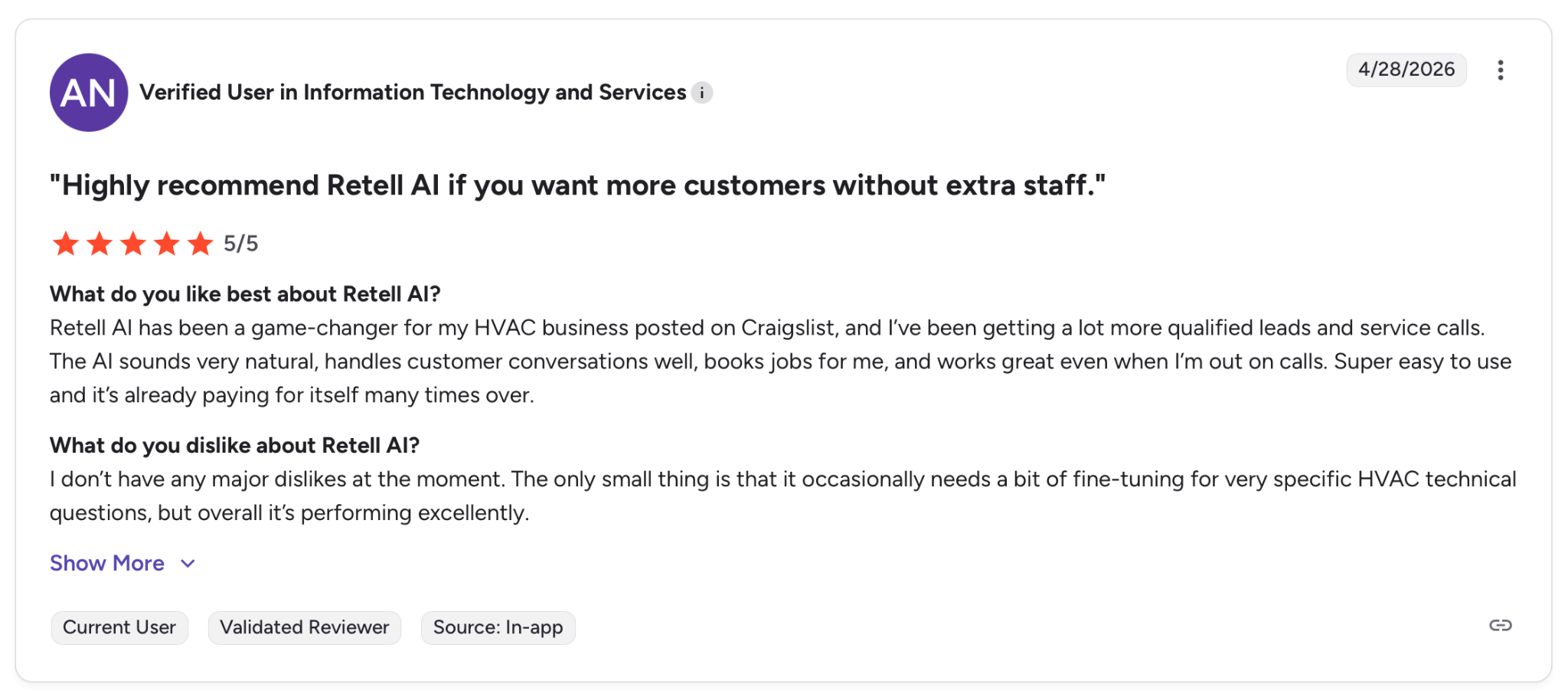
✅ "Retell AI has been a game-changer for my HVAC business. Posted on Craigslist, and I've been getting a lot more qualified leads and service calls." — Verified User, G2
Con:
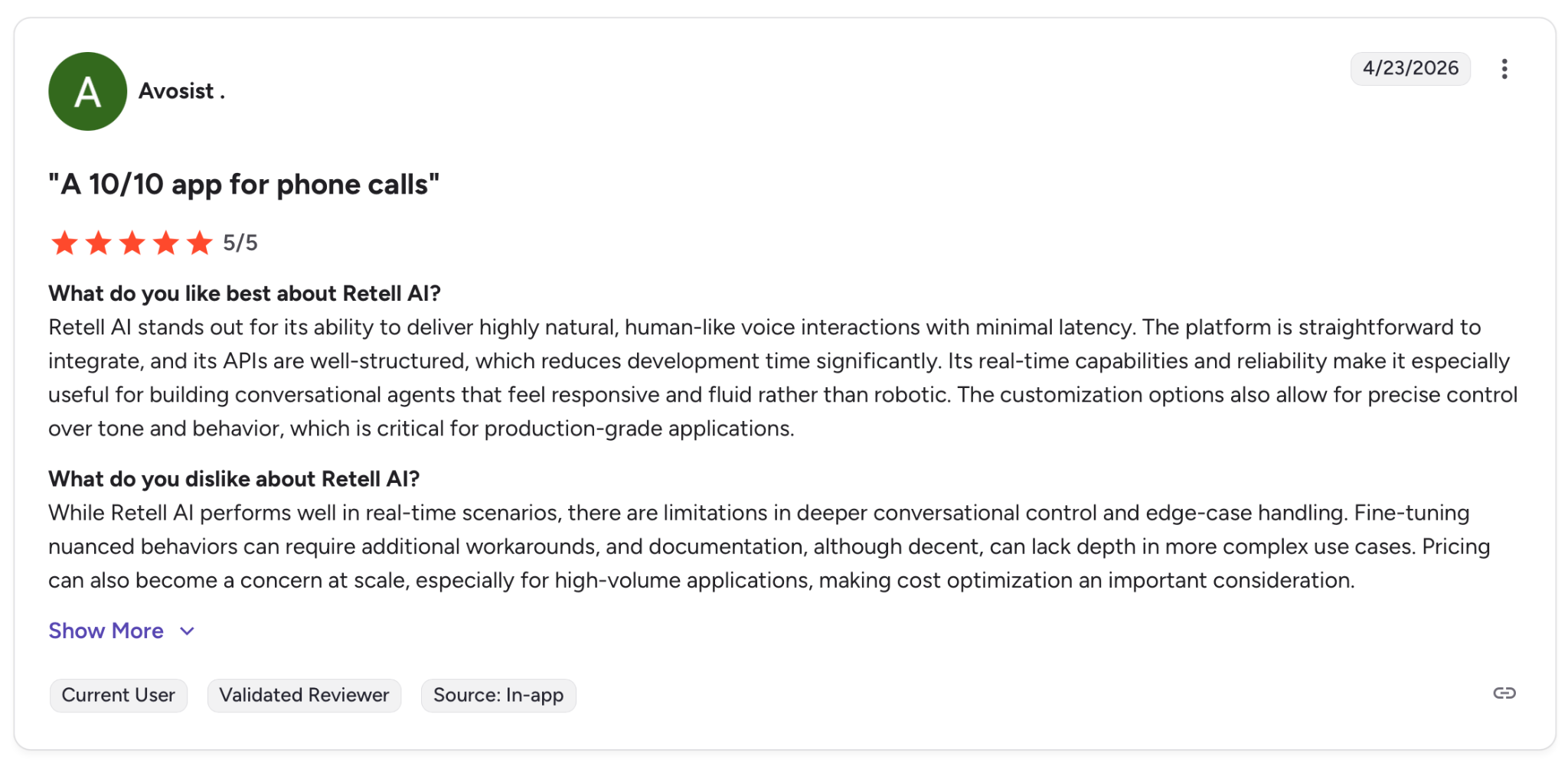
❌ "While Retell AI performs well in real-time scenarios, there are limitations in deeper conversational control and edge-case handling." — Avosist, G2
Vapi
Pro:
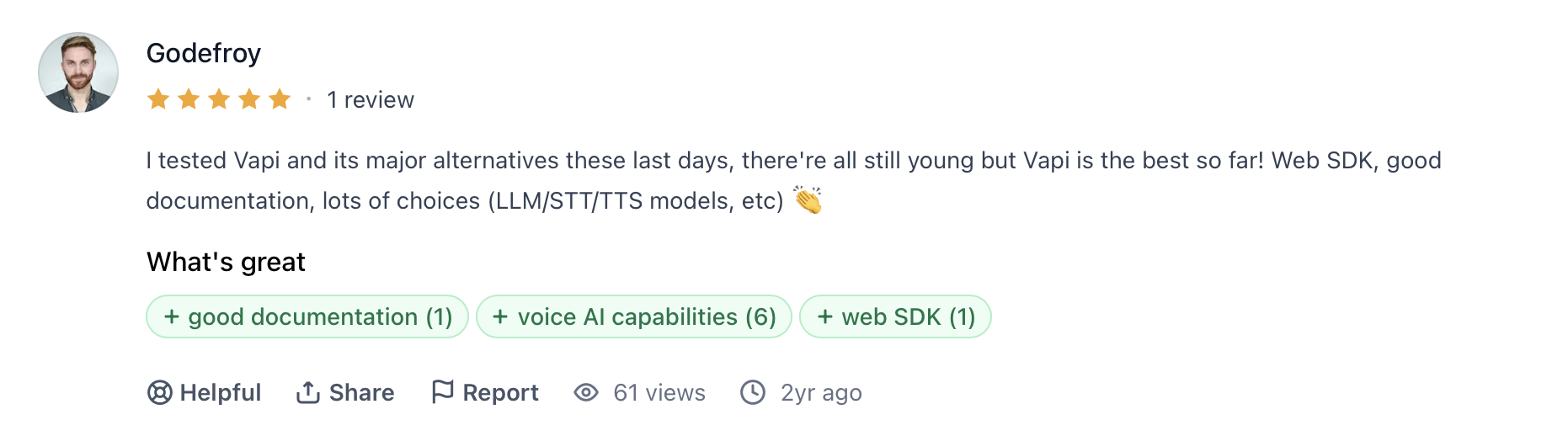
✅ "I tested Vapi and its major alternatives these last days, they're all still young, but Vapi is the best so far! Web SDK, good documentation, lots of choices (LLM/STT/TTS models, etc)." — Godefroy, Product Hunt
Con:
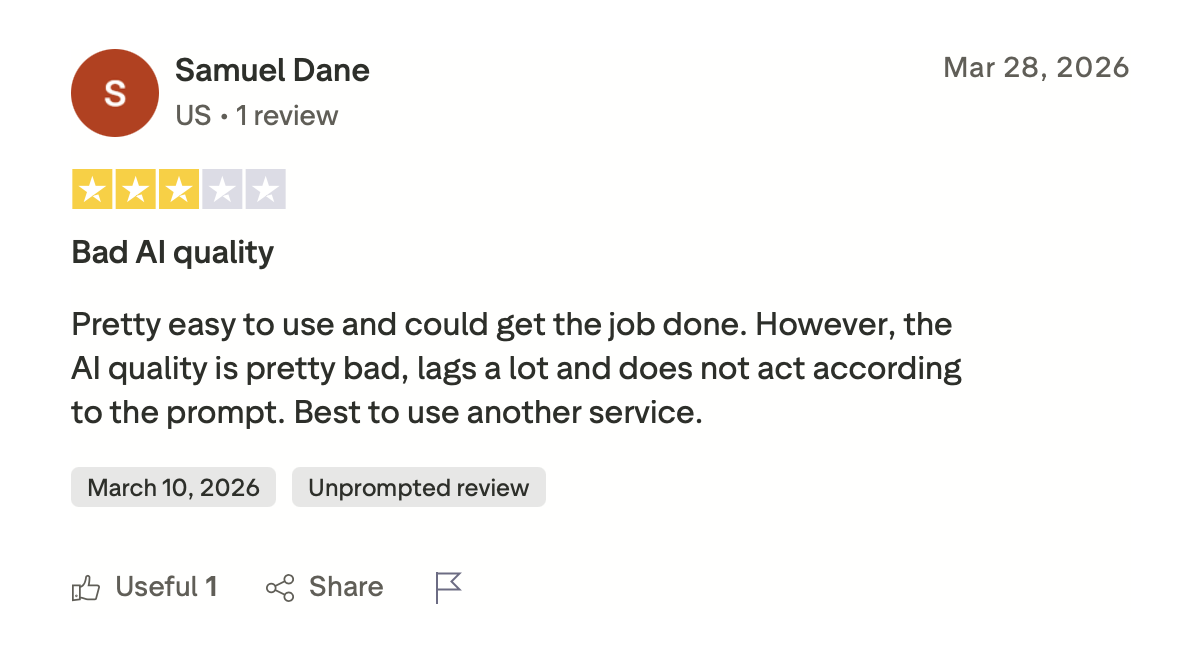
❌ "The AI quality is pretty bad, lags a lot, and does not act according to the prompt." — Samuel Dane, Trustpilot
How to Make Your Choice
After testing both platforms across inbound reception, outbound lead qualification, and appointment-setting workflows, the decision comes down to whether your team writes code or needs to ship fast without it.
Retell is the stronger production platform for most business teams. It's reliable, compliant, and ready without configuration. Vapi is the right call when your team has developer bandwidth and needs full control over every layer of the voice stack.
One gap both share: Neither includes a native testing or monitoring layer. Teams shipping to production add Cekura on top of whichever platform they choose to run pre-launch call simulation and catch issues before real callers do.
Retell AI Is Better For:
- Non-technical or mixed teams: Need to deploy AI phone agents without writing custom code
- Regulated industries: Healthcare, insurance, finance, where HIPAA, PII redaction, and SOC2 compliance need to be in place from day one
- High-volume outbound campaigns: Batch calling, verified caller IDs, and branded call display included at no extra cost
- Businesses that need CRM-native workflows: GoHighLevel, HubSpot, Salesforce, and Cal.com connect without custom development
- Teams prioritizing consistent latency: ~600ms average end-to-end with no configuration needed
- Lead gen and appointment-setting agencies running inbound and outbound workflows at scale
Vapi Is Better For:
- Developer-led teams building fully custom voice products where every pipeline component needs independent control
- Startups shipping voice AI as a product: Not just using it internally, but delivering it to end customers
- Multilingual deployments where 100+ language coverage and voice model variety are non-negotiable
- Teams that need A/B testing and simulated test suites before going live
- Custom LLM integrations: Bring your own fine-tuned model, self-hosted inference, or any third-party provider
- Highly specific voice personas requiring granular control over tone, accent, and model selection across diverse markets
My Verdict
For many teams, Retell is the stronger call. It ships fast, stays compliant, and handles production workloads without asking your engineers to babysit it.
If you're building a custom voice product from scratch and have the dev bandwidth, Vapi delivers.
Both are solid options, but they're solving different problems.
How to Know Your Voice Agent Works Once It Goes Live
Picking between Retell and Vapi is only part of the equation. Neither platform tells you whether your agent holds up once a real caller is on the line. Most teams find out something is wrong after the fact, when a caller drops, or a transcript comes back wrong.
Teams shipping to production add Cekura on top of whichever platform they choose to run pre-launch call simulation and catch issues before real callers do.
This isn't hypothetical. Cekura already runs both Retell and Vapi through one identical agent brief in its public voice agent benchmark, scoring all seven platforms across 82 caller scenarios and three repeats each. Retell tops repeatable reliability at 75.61% (62 of 82 scenarios passing all three runs), while Vapi posts the cohort's highest task-completion rate at 97.56%, and every run report is open to audit.
Cekura runs on top of whichever platform you choose and adds native testing and monitoring. Here's how:
- Testing at scale: Thousands of simulated calls run before go-live, catching the edge cases that only surface when real callers push your agent off-script.
- Interruption detection: When the agent talks over a caller or cuts off mid-sentence, Cekura catches those timing patterns before they become a habit.
- Latency tracking: Measures where slowdowns originate in the pipeline so you know exactly what to fix after each update.
- CI/CD integration: Every time you update a prompt, swap a model, or change a configuration, Cekura runs your full test suite before anything goes live.
- Conversation replay: When something breaks in production, replay that exact exchange against your updated configuration to confirm the fix held.
- A/B testing: Compare multiple versions of your agent against the same call scenarios and review results in one place.
- Custom evaluation: Score every call on accuracy, missed intents, and incorrect responses using your own criteria.
- SOC 2-, HIPAA-, and GDPR-compliant: Transcript redaction, role-based access, and audit trails included.
Native integrations work out of the box for Retell, VAPI, ElevenLabs, LiveKit, Pipecat, Bland, and more. You don't rebuild anything. Cekura adds a testing and monitoring layer on top of what you already have.
Running Retell or Vapi in production and want to know if your agent holds up under real calls? Schedule a demo to see how Cekura integrates with your current setup.
Frequently Asked Questions
Retell vs. Vapi: What's the Difference?
The main difference between Retell AI vs. Vapi is who they're built for.
Retell targets business teams that need phone agents to live fast, with compliance and integrations included. Vapi hands engineering teams full control over every component of the voice stack, but the setup requires a lot of upfront work.
Is Retell AI Better Than Vapi?
Whether Retell AI is better than Vapi depends on your needs.
Retell AI produces better results for teams that measure success by call outcomes, not by stack flexibility. SWTCH Energy cut support costs by over 50% after deploying Retell. Vapi suits teams whose primary goal is to build a custom voice product, not to run one.
How Much Does Retell AI Cost Compared to Vapi?
Retell AI charges $0.07-$0.31/min all-in, with every component documented publicly and no platform fees. Vapi charges $0.05/min for hosting, then bills STT, LLM, and TTS separately at provider cost, making total spend harder to predict before you build.
Can Non-Technical Teams Use Vapi?
Yes, non-technical teams can use Vapi for basic flows through its dashboard and Workflows editor, but many advanced setups still require writing code. Retell is the better fit for non-technical teams to get up and running in minutes without touching the API.
Does Retell AI Support HIPAA Compliance?
Yes, Retell AI covers HIPAA across all plans at no extra cost, along with SOC2 Type I & II, GDPR, PII auto-redaction, and role-based access control. Vapi meets the same standard, but custom BAA terms sit behind a direct enterprise agreement.
Which Platform Has Lower Latency, Retell or Vapi?
Retell has lower latency in its default configurations, at ~600ms average end-to-end latency with no tuning required. Vapi can reach sub-500ms, but only with an optimized model stack. Default setups on Vapi often run slower.