
Typical Twilio vs Vapi comparisons for building AI voice agents stop at infrastructure and orchestration. They skip the part that tells you whether the agent works once it ships. Cekura addresses that blind spot, and after testing all three, I can say the answer depends on which part of the stack you're solving for.
Twilio vs Vapi vs Cekura at a Glance
Three tools that sit on three different layers of the voice AI stack.
| 💻 Tool | 🎯 Best For | ⚡ Key Strength | 💰 Starting Price (model varies) |
|---|---|---|---|
| Twilio | Enterprise teams adding voice AI to existing telephony infrastructure | Carrier-grade telephony with BYO-LLM flexibility and a drag-and-drop Studio widget | $0.07/min (Conversation Relay, voice minutes billed separately) |
| Vapi | Developers building fully custom voice agent pipelines with swappable providers | Model-agnostic orchestration across dozens of STT, LLM, and TTS providers | $0.05/min platform fee (STT, LLM, TTS costs passed through separately) |
| Cekura | Engineering teams testing and monitoring voice and chat AI agents before and after production | Conversation simulation with CI/CD quality gates and production call monitoring | $30/month Developer plan (750 credits, 7-day free trial) |
Choose Twilio if: You already run Twilio for telephony and want to add voice AI without swapping out your call infrastructure.
Choose Vapi if: Your engineering team wants granular control over every component in the voice pipeline and can manage layered provider billing.
Choose Cekura if: You ship voice or chat agents on any platform and need automated testing, regression coverage, and production call monitoring in one place.
TL;DR: Twilio vs Vapi vs Cekura
- Twilio: Best for enterprise teams adding voice AI to existing telephony infrastructure. Carrier-grade telephony via Conversation Relay, BYO-LLM flexibility, PCI/HIPAA-eligible natively. $0.07/min (voice minutes billed separately).
- Vapi: Best for developers who want full orchestration control with swappable providers. Model-agnostic across STT/LLM/TTS, Squads for multi-assistant handoffs, native Evals/Simulations/Monitoring (Vapi-deployed agents only). $0.05/min platform fee (provider costs pass through separately).
- Cekura: Best for testing and monitoring voice/chat agents on any platform, before and after launch. Simulation across 50+ personas, CI/CD regression gates, live call scoring, and failed calls convert directly into test cases. $30/month Developer plan (750 credits, 7-day trial).
Before You Meet the Contenders
Twilio and Vapi tackle the same core problem from different angles. Both get a voice AI agent onto live phone calls with low latency. Twilio supplies the telephony backbone, and Vapi handles the agent orchestration above it.
Cekura belongs to a different category. It tests voice agents before they go live and monitors them after launch, which means it works alongside either of the other two rather than competing with them.
Twilio for Enterprise Voice AI Infrastructure
Twilio's been powering communications APIs for over a decade. Its voice AI product, Conversation Relay, launched to GA in 2025 and handles STT, TTS, and WebSocket orchestration so your application can focus on LLM logic.
What stands out:
- BYO-LLM architecture means you pick your own language model and connect it through a WebSocket interface, keeping control over conversation logic and cost
- Conversation Relay Studio widget adds drag-and-drop voice AI flow building without writing pure code for every deployment
- Conversational Intelligence integration passes transcripts directly to Twilio's analytics layer for task completion tracking, hallucination detection, and sentiment analysis
- PCI-compliant workflows and HIPAA-eligible architectures ship natively, so regulated workloads don't require a separate enterprise contract to get started
- Global telephony reach with PSTN, SIP, and WebRTC from the same platform
What it's good for: Teams already running Twilio for telephony who want voice AI layered in without changing their model vendor, since the BYO-LLM design means you pick whichever LLM fits your use case. Compliance certifications also reduce friction if you're deploying in healthcare or financial services.
Where it runs into limits: Twilio doesn't provide the agent orchestration layer that platforms like Vapi handle. You bring your own LLM, build your own conversation logic, manage your own prompt engineering. That's a lot of ownership. If you don't have backend engineering capacity, you'll hit a wall fast.
Vapi, the Developer-First Voice Agent Orchestrator
Vapi orchestrates the full voice agent pipeline, with STT, LLM, and TTS running in a low-latency loop. After closing a $50M Series B led by Peak XV with backing from YC and Kleiner Perkins among others, the company has been investing in observability and enterprise features alongside the core orchestration product.
What stands out:
- Model-agnostic design lets you swap STT providers (Deepgram, AssemblyAI), LLMs (OpenAI, Anthropic, Google), and TTS engines (ElevenLabs, Cartesia, PlayHT) without rebuilding the agent
- Squads orchestrate multiple assistants with context-preserving transfers across a single call, covering multi-department workflows where each step needs separate prompts and tools
- Composer is an AI assistant inside the dashboard that builds voice agents from a natural language description, generating the full agent configuration on the spot
- Observability features include Evals, Simulations, and Monitoring, all shipped between late 2025 and early 2026
- 99.9% reliability with SOC 2, HIPAA, and PCI compliance on the Scale plan
What it's good for: Teams that care more about component-level control than setup speed, especially if you need to benchmark providers against each other or test different model configurations per use case.
Where it runs into limits: The $0.05/min platform fee is the headline number. Transcription, inference, speech synthesis, and your phone line are all billed separately by whichever provider you pick, so the total per-minute cost will vary. HIPAA compliance is an additional $2,000/month.
Cekura for QA and Observability on Voice and Chat AI Agents
Cekura is an automated QA and observability platform for conversational AI agents. Backed by Y Combinator with a $2.4M seed round, it simulates conversations before deployment and watches live calls once they're in the wild. It plugs into existing orchestration tools and frameworks rather than replacing them.
What stands out:
- Automated scenario generation across 50+ predefined user personas, including interrupters, non-native accents, and adversarial users, testing the kind of conversations that break agents in production
- Live call observability captures latency, sentiment, instruction-following, tool-call accuracy, and hallucinations across conversations with automated alerts
- CI/CD integration with GitHub Actions, GitLab, Jenkins, and Azure DevOps, with pass/fail gates that block bad prompt changes from shipping
- Replay recorded production calls against updated agent versions to verify fixes before they reach users
- SOC 2-, HIPAA-, and GDPR-compliant with transcript redaction, role-based access, and audit trails
What it's good for: Teams shipping voice or chat agents on any platform who need to catch failures before users find them. The CI/CD integration stood out when I tested it. Every prompt change, model swap, or provider update triggers a regression suite on its own.
Where it runs into limits: Cekura doesn't deploy voice agents. Teams that need an orchestration platform or telephony infrastructure will still need Twilio, Vapi, or something similar alongside it.
Twilio vs Vapi vs Cekura Feature Breakdown
This is where the three tools stop overlapping. Each one handles a different part of the voice AI lifecycle, and a comparison table alone won't tell you which combination you need.
Voice AI Agent Building and Deployment
Twilio: Supplies the telephony layer and STT/TTS orchestration through Conversation Relay. You build the conversation logic on your side using a WebSocket connection to your LLM. The Studio widget adds visual flow building for teams that want to skip code-first setup.
Vapi: Handles the full orchestration loop from STT through LLM to TTS. You configure an assistant with a system prompt, pick your providers, and Vapi manages the low-latency pipeline. Composer generates complete agent configurations from a natural language description.
Cekura: Covers testing and observability only. It connects to Retell, VAPI, ElevenLabs, LiveKit, Pipecat, and others through native integrations to run simulated calls and measure live call quality.
Winner: Vapi for full-stack orchestration with maximum provider flexibility. Twilio when your team needs carrier-grade telephony and already runs Twilio infrastructure.
Pre-Production Testing and Quality Assurance
Twilio: Doesn't have a native pre-production simulation engine, so testing requires manual calls or custom test harnesses.
Vapi: Shipped Evals, Simulations, and Monitoring between late 2025 and early 2026. Evals let you define JSON-based tests with three judge types, and Simulations layer AI-caller-driven scenarios with configurable personas on top of that. Strong tooling overall, but scoped to Vapi-deployed agents only.
Cekura: Executes thousands of automated simulations across diverse user personas before an agent goes to production. Tests cover workflow completion, interruption handling, background noise tolerance, adversarial inputs, and jailbreak attempts. Recorded production conversations can also be imported and turned into reusable regression test cases.
Cekura publishes this kind of cross-platform testing openly. Our Voice Agent Benchmark ran one identical agent brief across seven voice platforms, 82 caller scenarios, and three repeats each, ranking on pass³, the share of scenarios that pass on all three runs.
No configuration cleared 76%, which is the gap between a demo that works once and an agent that holds up on every call. Vapi is one of the seven platforms tested.
Winner: Cekura. Vapi's native testing works for Vapi-deployed agents. Cekura tests agents regardless of where they run and covers infrastructure-level scenarios that platform-native tools typically miss.
Production Monitoring and Observability
Twilio: Conversational Intelligence analyzes transcripts from Conversation Relay sessions. It tracks task completion, hallucinations, and sentiment, and supports custom Language Operators. Those operators come at an additional $0.005/min.
Vapi: Monitoring spans effectiveness, compliance, technical, and infrastructure metrics, though Effectiveness and Compliance are gated behind the Enterprise-only Scale plan. Custom dashboards (Boards) track conversion rates, ROI, and performance data.
Cekura: Watches live conversations as they happen. Scores latency, interruptions, tool-call accuracy, sentiment, instruction-following, and hallucinations at the turn level. Alerts fire on failures and anomalies within seconds, and a failing call can be converted directly into a regression test with one action.
Winner: Cekura for voice and chat AI observability, since it covers more metric categories than either Twilio or Vapi and lets you turn a failed call into a test case. Twilio for teams that want native analytics and don't want to add another vendor. Vapi for teams already on the platform who need dashboard-level visibility.
Pricing Breakdown
Twilio: Conversation Relay costs $0.07/min. Voice minutes are billed separately at $0.0085/min inbound, $0.014/min outbound in the US, and phone numbers start at $1.15/month. LLM costs are yours since you bring your model. Conversational Intelligence is $0.005 per 1,000 characters extra for Language Operators.
Vapi: Platform fee is $0.05/min. STT, LLM, and TTS provider costs pass through separately at cost, or zero if you bring your own API keys. Telephony is billed by the transport provider. HIPAA is an extra $2,000/month. Zero Data Retention is $1,000/month.
Cekura: Developer plan is $30/month with 750 credits included, 10 concurrent calls, unlimited agents, and a 7-day free trial with 300 credits. Enterprise pricing is custom and covers compliance certifications, dedicated support, custom integrations, and self-hosting options.
Winner: Cekura on cost predictability for QA workloads. Twilio on clear component-level billing for telephony. Vapi on low platform fees, though the all-in cost requires careful modeling across providers.
What Users Say
Across all three tools, one theme kept coming up. Twilio and Vapi get praise for what they build, and complaints for what happens after launch. Cekura picks up from there.
Twilio
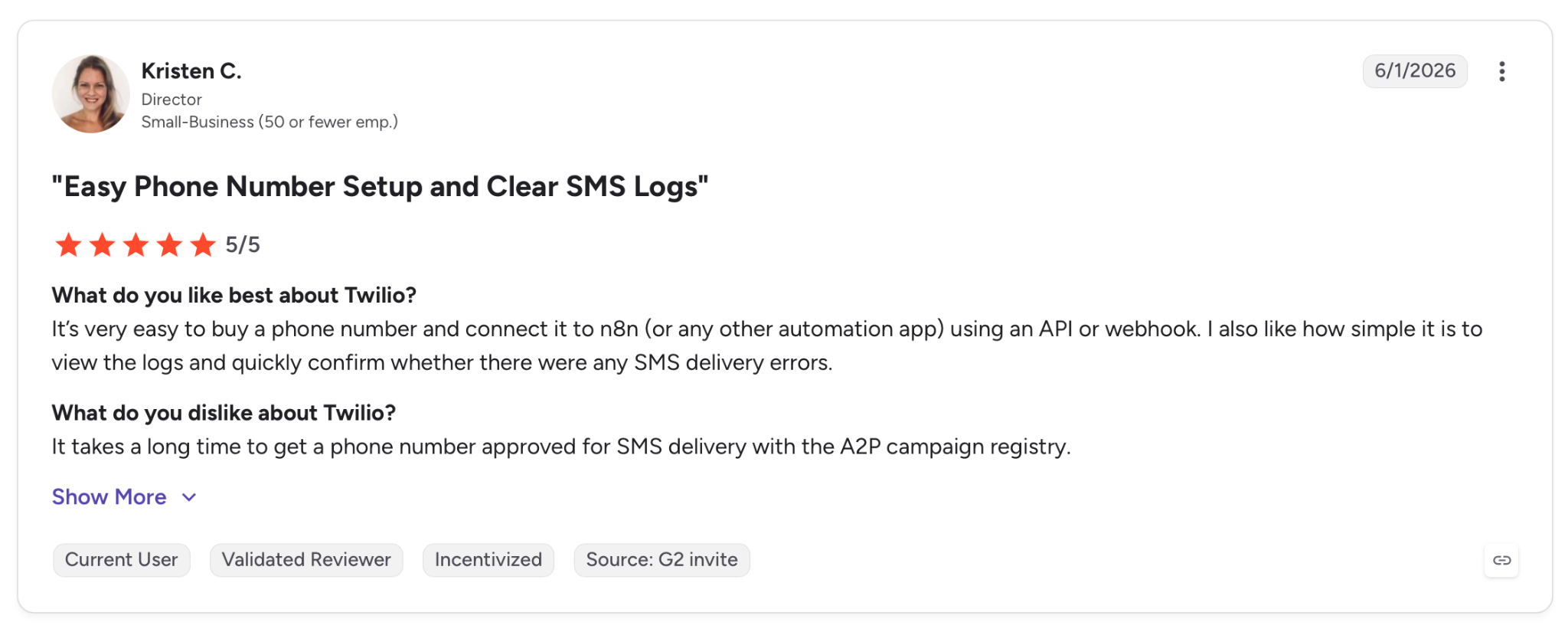
✅ Pro: "It's very easy to buy a phone number and connect it to n8n (or any other automation app) using an API or webhook." (Kristen C., G2)
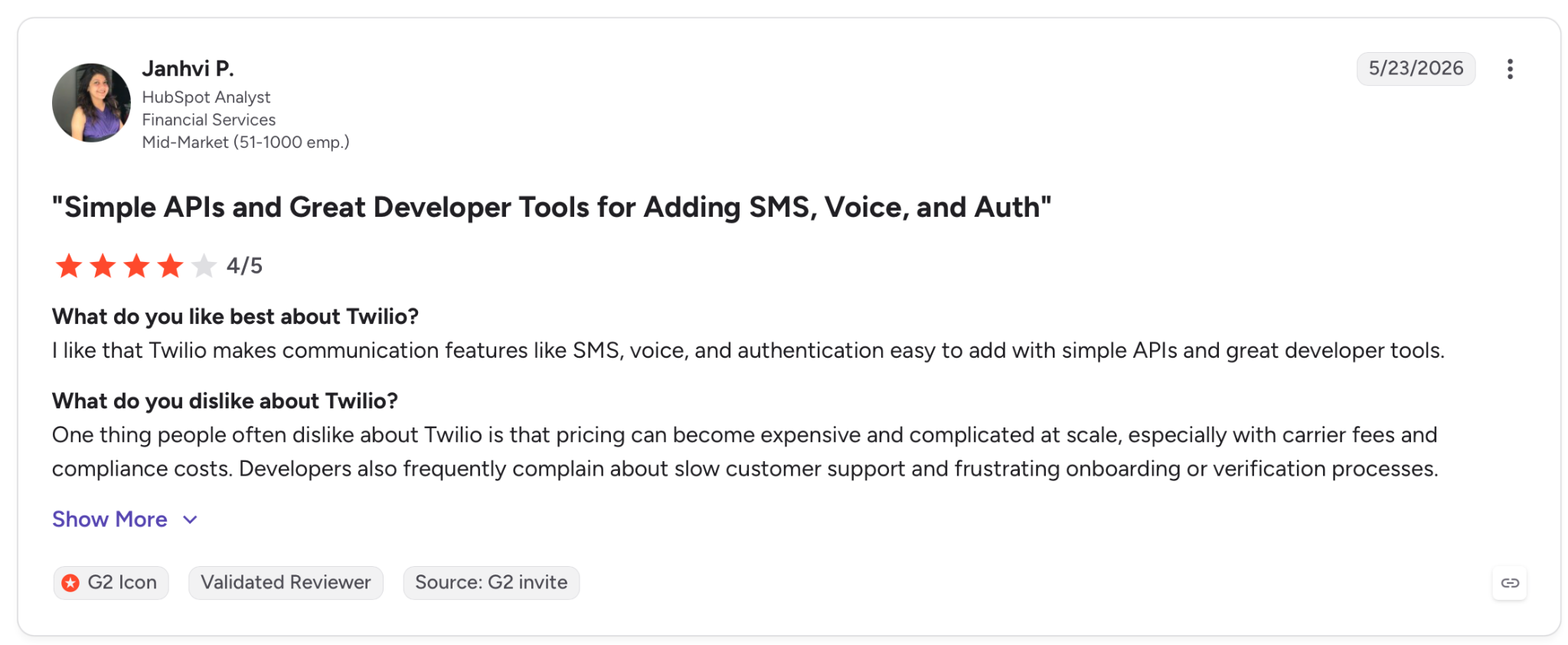
❌ Con: "One thing people often dislike about Twilio is that pricing can become expensive and complicated at scale." (Janhvi P., G2)
Vapi
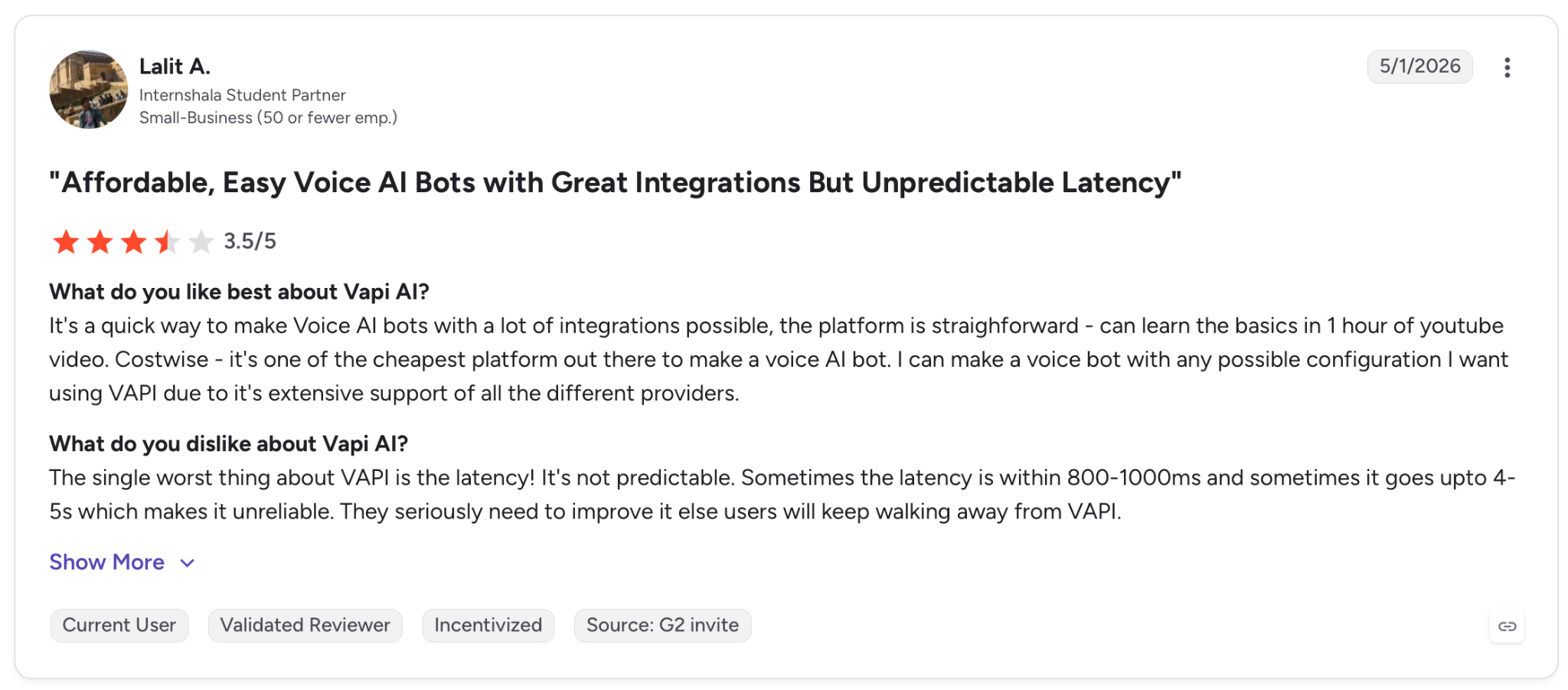
✅ Pro: "It's a quick way to make Voice AI bots with a lot of integrations possible, the platform is straighforward." (Lalit A., G2)
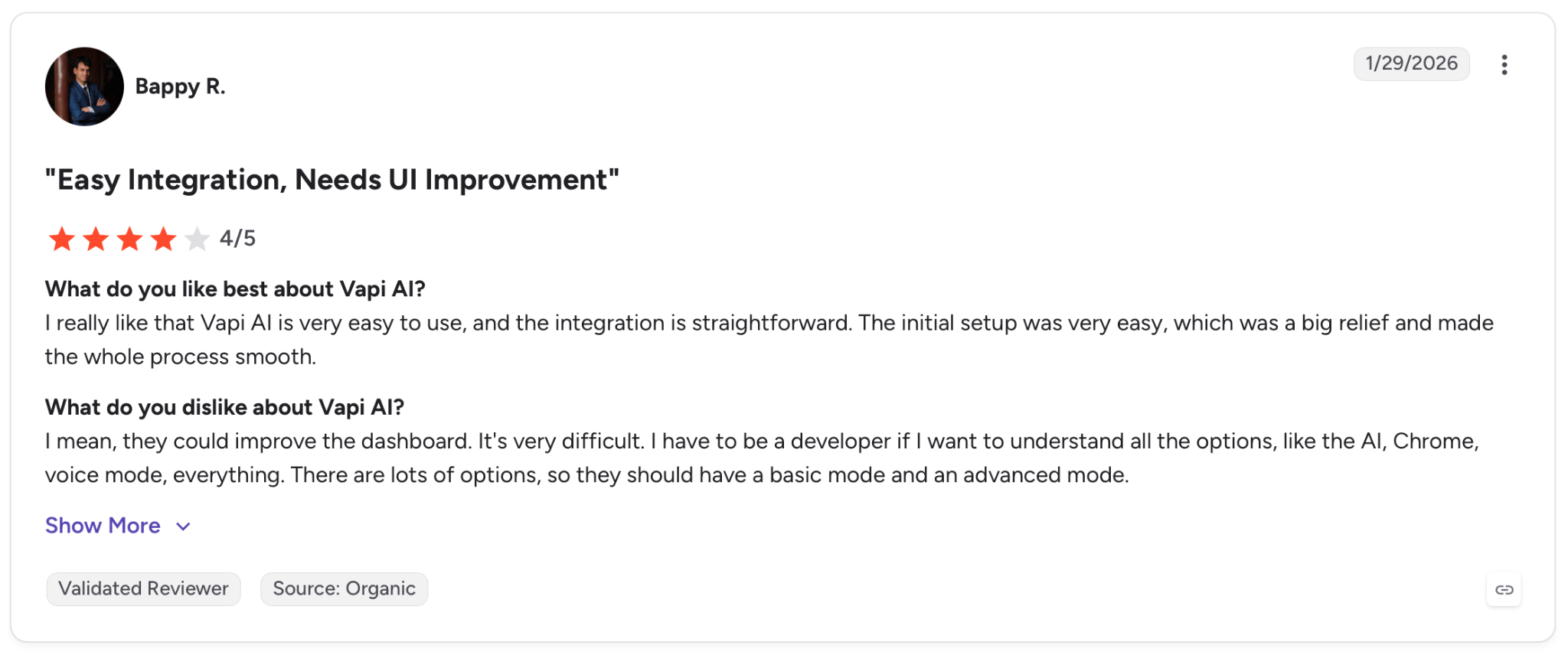
❌ Con: "I mean, they could improve the dashboard. It's very difficult. I have to be a developer if I want to understand all the options, like the AI, Chrome, voice mode, everything." (Bappy R., G2)
Cekura
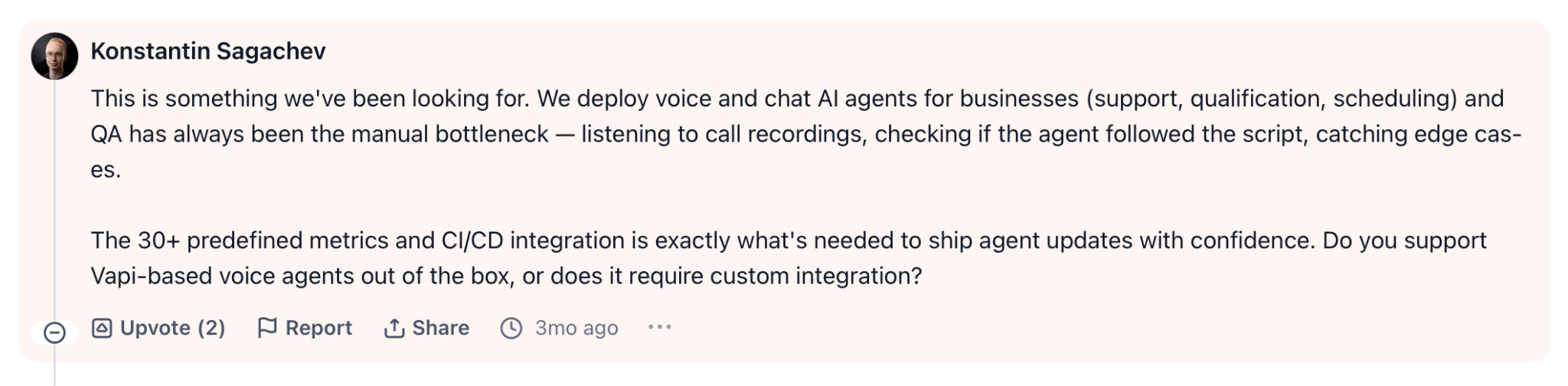
✅ Pro: "The 30+ predefined metrics and CI/CD integration is exactly what's needed to ship agent updates with confidence." (Konstantin Sagachev, Product Hunt)

❌ Con: "Credits are consumed across multiple features; testing, monitoring, evaluations, reports. Hard to know upfront how many actual test runs you get." (Verified User, Reddit)
Which Tool Should You Choose?
Twilio and Vapi both solve the deployment question, just from different positions. Cekura picks up where they leave off and answers whether the thing you deployed is working.
Choose Twilio if you:
- Already run Twilio for voice, SMS, or contact center infrastructure and want to add AI without switching platforms
- Need carrier-grade telephony with PCI and HIPAA compliance included in the voice layer
- Have backend engineers who can build and maintain conversation logic against a WebSocket interface
Choose Vapi if you:
- Want granular control over which STT, LLM, and TTS providers power each agent
- Need multi-assistant orchestration with context-preserving handoffs across departments
- Have an engineering team comfortable managing billing relationships with multiple providers
Choose Cekura if you:
- Deploy voice or chat AI agents on any platform and need automated simulation testing before launch
- Want CI/CD quality gates that block regressions from reaching production
- Work in a regulated industry where documented test coverage and compliance audit trails are requirements
- Need production monitoring that converts live call failures into reusable regression tests
My Final Verdict
I've seen the same pattern play out across voice AI deployments. The team spends weeks picking an orchestration platform, ships without structured testing, and the agent breaks on edge cases that manual QA won't catch, from interruptions and off-script callers to latency spikes under load.
That's why the platform choice and the QA choice are two separate decisions. Twilio fits if you already live in the Twilio ecosystem, while Vapi gives you more control over the stack if your engineers can manage the layered billing that comes with it. Whatever you deploy on, the testing and monitoring layer is what keeps a demo-quality agent from going live. I'd recommend giving Cekura a look regardless of which platform runs underneath.
Ready to Try Cekura?
If your team ships voice or chat AI agents, start a free trial with Cekura and see how automated simulation testing fits into your deployment workflow.
Frequently Asked Questions
What's the Main Difference Between Twilio, Vapi, and Cekura?
Twilio handles telephony infrastructure and voice AI orchestration through Conversation Relay. Vapi orchestrates the full voice agent pipeline and lets you swap providers at every layer. Cekura tests and monitors voice and chat agents before and after production, plugging into platforms like Twilio and Vapi.
Can I Use Cekura With Twilio or Vapi?
Yes. Cekura has native integrations with Vapi, Twilio, Retell, ElevenLabs, LiveKit, Pipecat, Bland, and others. It plugs into your existing voice AI stack as a testing and observability layer.
How Much Does a Twilio vs Vapi Voice Agent Cost per Minute?
Twilio's Conversation Relay costs $0.07/min plus separate voice minute charges and your LLM costs. Vapi charges $0.05/min as a platform fee, with every other provider billed separately. Total all-in costs depend on your provider choices and call volume.
Does Vapi Include Native Testing Tools?
Vapi shipped Evals, Simulations, and Monitoring between late 2025 and early 2026. These work for agents deployed on Vapi. For platform-agnostic testing across multiple voice AI providers, Cekura covers a broader scope.
Which Platform Works Best for Healthcare Voice AI?
All three support compliance requirements. Twilio offers PCI-compliant workflows and HIPAA-eligible architectures natively. Vapi provides HIPAA at $2,000/month on the Scale plan. Cekura supports SOC 2, HIPAA, and GDPR compliance with transcript redaction and audit trails on Enterprise.
Do I Need All Three Tools?
Twilio and Vapi serve the same layer, so you'd typically choose one or the other for agent deployment. Cekura complements whichever platform you pick by adding automated testing and production monitoring that neither Twilio nor Vapi fully covers on its own.