
On the Speechify API, Simba 3.2 lists at $10 per million characters, the lowest price on Cekura's text-to-speech benchmark, shared with Simba 3.0 and Murf Falcon 2.1. Given a whole sentence, it makes its first sound in a median 70 ms, second of the 33 models tested. No other model is both as cheap and as fast.
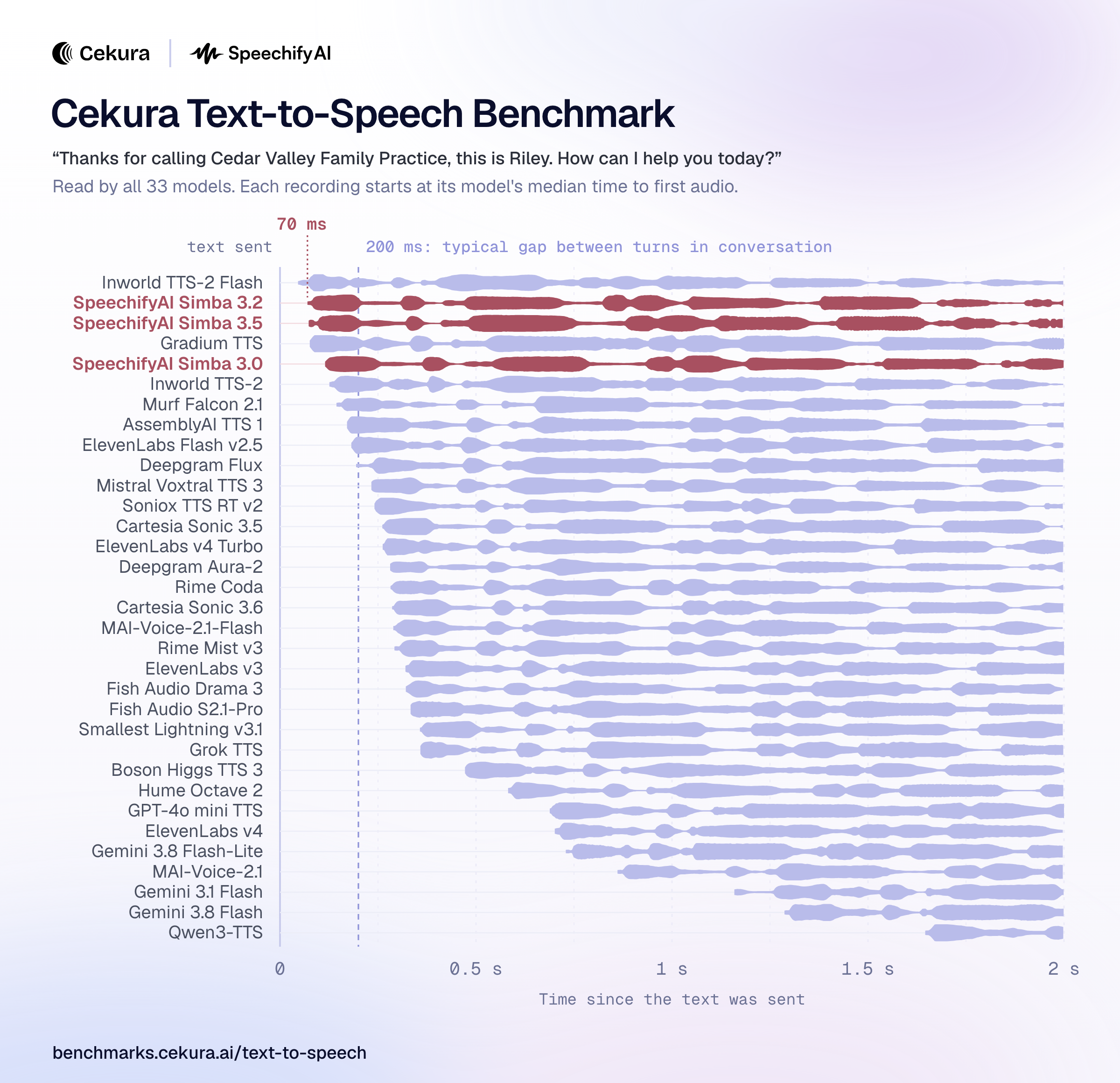
Listen: Simba 3.2 reading the same greeting.
SpeechifyAI is Speechify's developer API, billed separately from the Speechify Reader app. It serves three text-to-speech models: Simba 3.5 in 48 languages, Simba 3.2 in English and Simba 3.0 in six languages. Cekura's text-to-speech benchmark tests all three beside 30 other models. It sends every model the same 104 sentences a phone agent says, times every reply, checks how each model reads text that needs interpreting, such as times, codes and drug names, and records each model's list price. All times in this post are medians unless stated otherwise.
How the Speechify API compares on price and speed
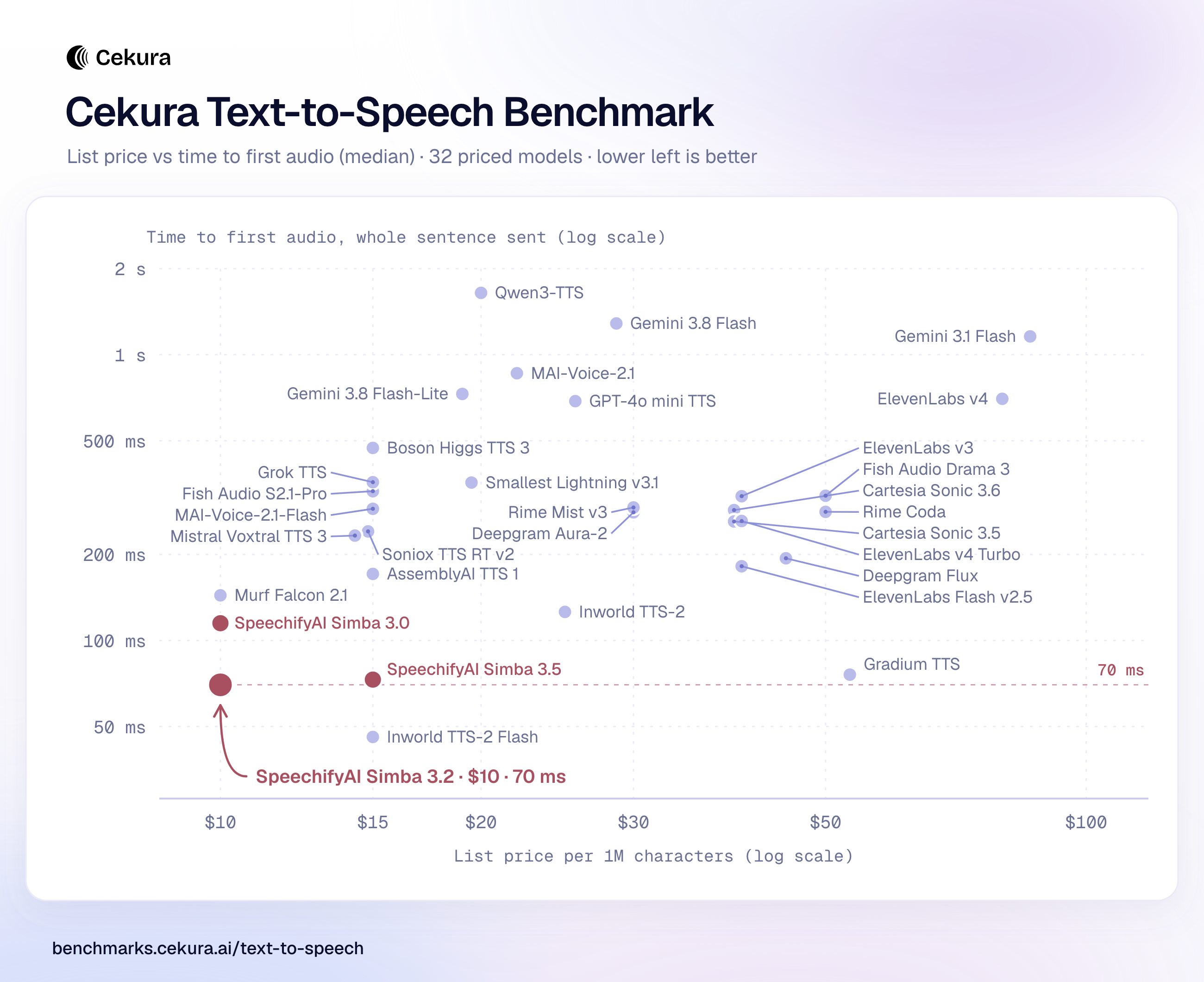
On this board, paying more than $15 does not buy a faster start. None of the 20 models listed above $15 starts as fast as Simba 3.2. The fastest of them, Gradium TTS at $53.33, takes 76 ms.
Only two models are on the price and speed frontier, where no other model is at least as cheap and at least as fast while beating them on one of the two: Simba 3.2 at $10 and 70 ms, and Inworld TTS-2 Flash at $15 and 46 ms. Every model off the frontier costs at least as much as Simba 3.2 and starts later.
Murf Falcon 2.1 matches Simba 3.2's $10 but takes 144 ms, about twice as long. The median list price is $23.50, more than twice Simba 3.2's. The board records SpeechifyAI's Starter plan rate and Inworld's pay-as-you-go rate, and both vendors charge less on larger plans.
A price per million characters is hard to picture, so convert it to talk time. At the board's median pace of 78.6 ms of audio per character, a million characters is about 22 hours of speech. Divide a price per million characters by 22 for the price of an hour of agent speech: about 45 cents for Simba 3.2, under a cent a minute, against $1.07 at the median list price.
What time to first audio means on a call
People leave gaps of about 200 ms between turns in conversation, though planning even a single word takes 600 ms or more. The gap is that short because listeners appear to plan their reply while the other person is still talking (Levinson and Torreira, 2015).
A voice agent has to fit its whole speech pipeline into that pause. It notices that the caller has stopped, transcribes the last words, gets a language model to start its answer, and turns the first words of that answer into sound. Every stage adds to the silence the caller hears, and text-to-speech is the last one. The median model on this board takes 286 ms to make its first sound, more than the whole gap a person leaves. Simba 3.2 takes 70.
Simba 3.2's second place holds up against every other vendor. The 95% confidence interval on Simba 3.2's median, 68.5 to 71.7 ms, overlaps only that of its sibling, Simba 3.5, and both sit clear of every model behind them. At the slow end, nine requests in ten start within 92 ms, again second of 33. That figure is the 90th percentile, or p90, which shows the slower replies a median hides.
Many agents stream the language model's words to the voice as they are generated. The leaderboard's streaming latency covers that case: text arrives at 30 words a second, and the clock runs from the last word to the first sound. Simba 3.2 takes 50 ms, third of the 24 models that accept streamed text, and all three Simba models are in the top six.
First audio chunk versus first sound
Most latency figures stop the clock at the first byte of audio. This benchmark stops it at the first audible sound, because a first chunk can arrive early and still open with silence, and the caller hears that silence as waiting.
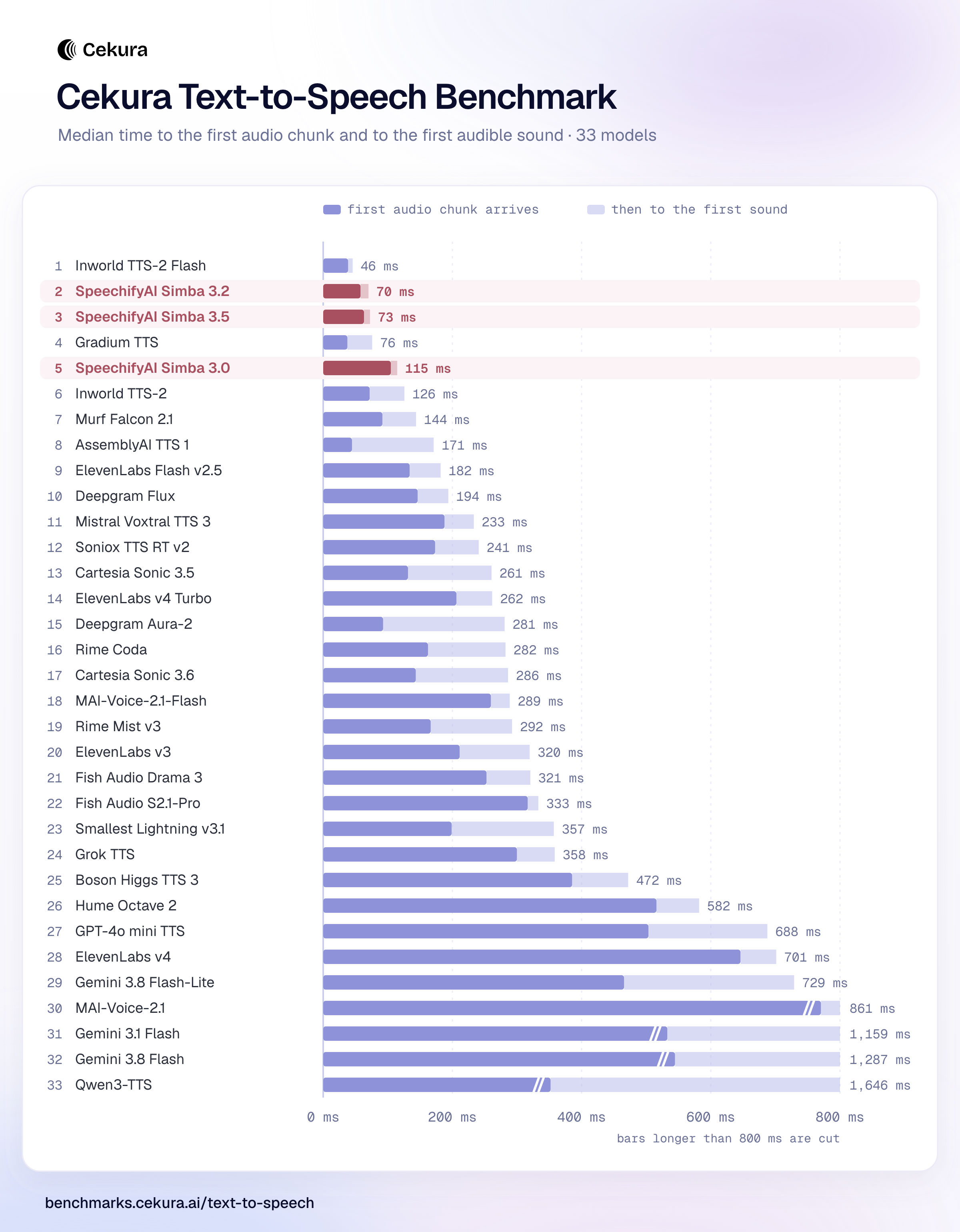
The median model opens with about 55 ms of silence, and the longest opening runs to 427 ms. The three SpeechifyAI models open with 9 to 12 ms, all among the five shortest.
That changes the order. Ranked by when the first audio chunk arrives, Simba 3.2 would be fourth. Two of the three models ahead of it open with 38 ms and 126 ms of silence. Counted to the first sound, Simba 3.2 is second.
SpeechifyAI publishes its own figure for Simba 3.2: a 56 ms median time to the first audio byte on its US East production path (speechify.ai). Cekura's clock, running from its own client in US East, puts the first audio chunk at a median 58 ms, close to that figure, and the first sound at 70 ms. When you time your own stack, stop the clock at the first audible sample, not the first byte.
Choosing a Simba model on the Speechify API
SpeechifyAI has three models on the board. All three are among the five fastest to make a first sound, and they differ in price and in how well they read.
The benchmark's hard parts are the bits of text a voice has to interpret before it can say them, such as "7 a.m.", "36°F", "SAVE20", "help@north-clinic.org", "St. Mary's on Main St." and "levothyroxine". The leaderboard groups them as numbers and shorthand, codes and addresses, words read from context, and medical terms.
| Model | Languages | Price per 1M characters | First sound (median) | 9 in 10 start within | Hard parts read right |
|---|---|---|---|---|---|
| Simba 3.2 | English | $10 | 70 ms | 92 ms | 79.5% |
| Simba 3.5 | 48 | $15 | 73 ms | 145 ms | 92.5% |
| Simba 3.0 | 6 | $10 | 115 ms | 170 ms | 81.5% |
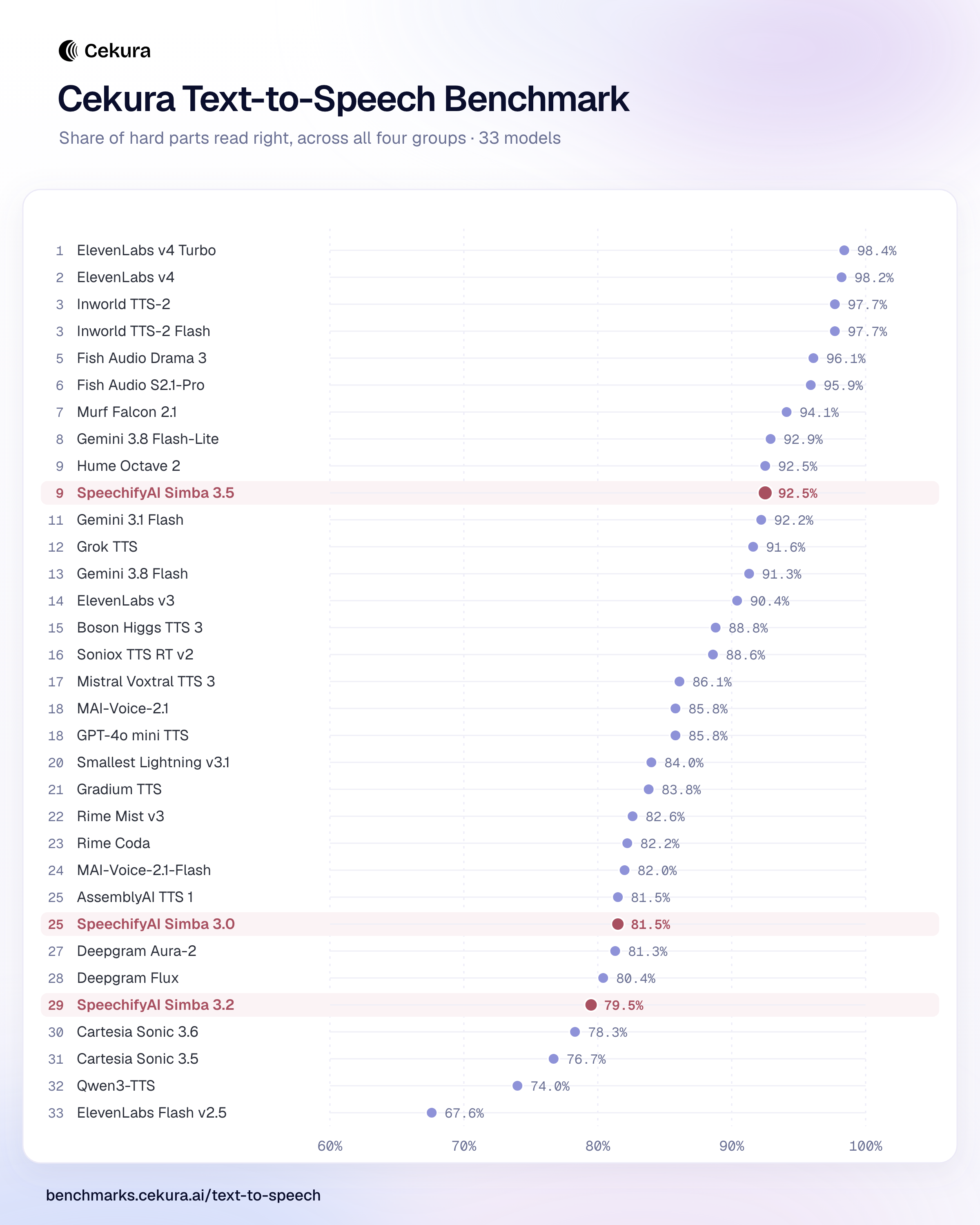
Simba 3.5 against Simba 3.2
Simba 3.5, which SpeechifyAI calls its flagship, costs $5 more per million characters, about 23 cents more per hour of speech at the board's median pace. It starts about 3 ms later at the median and has a longer slow tail, with nine requests in ten starting within 145 ms against 92 ms. In return it reads 92.5% of the hard parts right against 79.5%, joint 9th of 33 against 29th.
Most of that gain comes from two groups. On numbers and shorthand, Simba 3.5 reads 95% right, up from 79%. On words read from context, such as "St." as Saint or Street, it gets every one right, up from 75%, one of nine models with a perfect score there.
Listen: Simba 3.2 and Simba 3.5 reading "Store the vaccine between 36°F and 46°F, never below -4°F." In these recordings, Simba 3.2 reads the last temperature as "4 degrees F", without the minus. Simba 3.5 says "minus 4 degrees Fahrenheit".
Simba 3.2 is ahead in one group: it reads every item in the medical-terms group right, where Simba 3.5 gets 96%. Agents that read out numbers, shorthand and words that depend on context are where Simba 3.5's extra accuracy pays off. Where cost and the fastest start matter most, Simba 3.2 gives both at two-thirds of the price.
Whichever you pick, name it in the request. SpeechifyAI's docs recommend Simba 3.5 for new integrations, and a request that leaves out the model gets Simba 3.0, the slowest of the three at a median 115 ms.
How the benchmark works
Every model read the same 104 sentences a phone agent says, from a greeting to a 500-character reply, three times each: 312 timed requests for each SpeechifyAI model. Every model was called from one US East cloud region, so the network round trip is inside every measurement. SpeechifyAI ran with its Harper voice.
Time to first audio, shown on the leaderboard as non-streaming latency, runs from sending the whole sentence to the first audible sound, the first 10 ms of audio louder than 1% of full scale. Connection setup is left out, and silence at the start is counted. Streaming latency feeds the text in at 30 words a second and runs from the last word to the first sound.
Reading accuracy comes from two speech-to-text models, Deepgram Nova-3 and OpenAI Whisper. Both transcribe every recording, a hard part passes when a transcript holds an accepted reading of it, and the two verdicts are pooled. No person listens, so the score is an estimate.
Prices are each vendor's published or quoted rate on the date shown on the site, converted to characters where a vendor charges another way. Hume Octave 2, now discontinued, has no current price, so price comparisons cover 32 models. The benchmark harness is open source in cekura-bench on GitHub.
Speechify API FAQ
Does Speechify have an API?
Yes. SpeechifyAI is Speechify's developer API for text to speech and voice cloning, billed separately from the Speechify Reader app. It serves Simba 3.5 in 48 languages, Simba 3.2 in English and Simba 3.0 in six languages. The free plan needs no credit card and includes 500,000 characters a month of Simba 3.2 or Simba 3.0, or 333,000 of Simba 3.5, then pauses until the next month.
How much does the Speechify API cost?
The paid plans are Starter at $10 a month, Pro at $99 and Scale at $499. Each returns its fee as a usage balance, doubled on Starter and topped up by 10% on Pro and 20% on Scale, drawn down at the plan's per-character rate. Simba 3.2 and Simba 3.0 cost $10, $8 and $6 per million characters on those plans, and Simba 3.5 costs $15, $12 and $10 (SpeechifyAI pricing). Cekura's benchmark records the Starter rates.
How fast is the Speechify API?
Simba 3.2 made its first sound a median 70 ms after receiving a whole sentence, second of 33 models on Cekura's benchmark, and nine requests in ten started within 92 ms. With text streamed in at 30 words a second, it took 50 ms from the last word, third of 24. Cekura called every model from one US East cloud region and left out connection setup.
Which Simba model should I use?
Use Simba 3.5 when your agent reads numbers, shorthand or words that depend on context, or speaks a language other than English. It read 92.5% of the benchmark's hard parts right, against 79.5% for Simba 3.2, and covers 48 languages. Use Simba 3.2 for English agents where price and the fastest start matter most: it costs two-thirds as much and started about 3 ms sooner at the median. Either way, set the model in each request, because the API falls back to Simba 3.0.
Does the Speechify API support streaming, voice cloning and SSML?
Yes. Every plan, the free one included, streams audio and accepts SSML, and the paid plans add voice cloning. In Cekura's streamed-text test, where text arrives at 30 words a second, all three Simba models were among the six fastest of 24 models from the last word to the first sound.
How do I get a Speechify API key?
Create one at platform.speechify.ai/api-keys and set it as SPEECHIFY_API_KEY, which both SDKs read automatically. Install pip install speechify-api for Python or npm install @speechify/api for TypeScript, and send the key as a bearer token. The SpeechifyAI quickstart walks through a first request.
From SpeechifyAI
SpeechifyAI is the developer platform from the team behind the Speechify reading app. We train our own speech models, the Simba family, for apps and voice agents that need to talk in real time.
Simba 3.5 is our flagship and the model we recommend for new integrations. It is streaming-native and speaks 48 languages under one model id, with every catalog voice in each. Choose it when your agent reads out numbers, codes, addresses or anything that depends on context. Simba 3.2 speaks English and costs a third less, for English agents where price leads. Simba 3.0 is our older six-language model. It is still the default when a request names no model, so set model on every call.
Pricing is per character. Simba 3.2 and 3.0 cost $10, $8 and $6 per million characters on Starter, Pro and Scale, and Simba 3.5 costs $15, $12 and $10. Every paid plan returns its monthly fee as usage and adds instant voice cloning from 10 to 30 seconds of audio.
To start, create a key at platform.speechify.ai/api-keys, install the Python or TypeScript SDK, and send your first request. The free plan needs no card.
Full results
Every measurement in this post comes from the public leaderboard at benchmarks.cekura.ai/text-to-speech and its data file, where you can also hear all 33 models read the same lines. Each SpeechifyAI model has its own page: Simba 3.2, Simba 3.5 and Simba 3.0.
For how the main text-to-speech APIs compare on features and pricing as well as speed, see 12 text-to-speech APIs compared with benchmarks.
Cekura (YC F24) tests, monitors and improves voice and chat AI agents. Its other public benchmarks cover speech-to-text and speech-to-speech models and voice agent platforms, all at benchmarks.cekura.ai. To run the same kind of tests on your own voice agent, book a demo with Cekura.