
Many open-source TTS models can't go into a paid product because the weights carry a research or non-commercial license, even when the code is MIT or Apache 2.0.
I read the license file and model card for 16 open-weight speech models, and these 10 are worth your time (Kokoro-82M, Chatterbox, and Qwen3-TTS are the 3 I'd build a commercial agent on).
10 Best Open Source TTS Models in 2026: TL;DR
-
Choose Kokoro-82M if you want a small, Apache-licensed English voice that's ready to ship.
-
Choose Chatterbox if you need MIT-licensed voice cloning in 23 languages.
-
Choose Qwen3-TTS if you want streaming speech and 3-second cloning under Apache 2.0.
-
Choose CosyVoice 3 if you serve Chinese dialects or need cross-lingual cloning with bi-streaming.
-
Choose Orpheus TTS if you want expressive English speech on an LLM backbone.
-
Choose Pocket TTS if you're running on a CPU with no GPU in the box.
-
Choose Dia2 if you need 2-speaker English dialogue.
-
Choose Fish Audio S2-Pro if you're doing research or prototypes that need 80+ languages.
-
Choose VibeVoice Realtime if you're experimenting with streaming text input.
-
Choose XTTS-v2 if you run non-commercial projects that already depend on Coqui.
How I Researched and Ranked These Open Source TTS Models
I didn't run these models on my own hardware, so you won't find "I measured" anywhere below. Every figure comes from the project's own pages or from Cekura's published benchmark, and each one says which.
For each model, I read the repo, the model card, and the license file. Then I checked it against Cekura's TTS benchmark of 29 models to see which ones have measured numbers.
Only 2 do, and the tables mark the rest as untested.
Latency numbers from maintainers are vendor-measured, and Fish Audio is the only one that names the GPU (an H200). Treat them as a ceiling for what's possible, and expect your own stack to land somewhere slower.
I ranked on 5 things:
-
License: The code license and the weights license, read separately, plus any "research only" wording on the card.
-
Live-call readiness: Whether the model streams, and what time to first audio the maintainers report.
-
Size and hardware: Parameter count, and whether the repo states a VRAM or CPU requirement at all.
-
Languages and cloning: How many languages ship in the released weights, and how much reference audio cloning needs.
-
Project health: Whether the repo is active or archived, and whether pieces are missing.
License comes first in the order, so a model with clean terms and thin docs (Kokoro) ranks above faster models with license caveats.
Cekura's benchmark reads the same 104 agent sentences 3 times per model from one US East region, with one stock voice each (last updated November 13, 2026). It covers 29 models, and 8 of the 10 picks below aren't among them.
Where it has data on one of these picks, I quote it. Where it doesn't, the table says untested.
6 models I left off, and why:
-
Piper: Already covered in depth in our Piper TTS guide. The active engine is GPL-3.0-or-later now, and Piper grants no license of its own over the voices, so each one's terms come from its training data.
-
Higgs TTS 3 (Boson AI): The weights use Boson's research and non-commercial license, and embedding it in a product needs a separate commercial license. Cekura's benchmark scores it on hard-to-read text (numbers 89%, codes 75%, context 100%, medical terms 97%) and lists no streaming latency figure.
-
Voxtral TTS: CC BY-NC 4.0. Its model card says it runs on a single GPU with 16 GB of memory or more.
-
Sesame CSM: The README says it "likely won't do well" outside English, and that the model hasn't been fine-tuned on any specific voice.
-
NeuTTS Air: Apache 2.0 and designed for phones, but streaming works on GGUF builds only, and the repo gives no time-to-first-audio figure.
-
IndexTTS-2.5: Released under the Bilibili Model Use License Agreement, which allows royalty-free use but requires a separate license above 100 million monthly users or RMB 1 billion in annual revenue and bars using it to improve other commercial AI models.
Commercial APIs like ElevenLabs and Cartesia aren't here either. You can find those in our roundups of TTS APIs and the best TTS for AI voice agents.
10 Open Source TTS Models Compared at a Glance
| Model | License (code/weights) | Size | Commercial Use | Streaming (maintainer figure) | Cekura Benchmark |
|---|---|---|---|---|---|
| Kokoro-82M | Apache 2.0/Apache 2.0 | 82M | ✅ Yes | Not stated | Untested |
| Chatterbox | MIT/MIT | 110M to 500M | ✅ Yes (watermarked) | Not stated | Untested |
| Qwen3-TTS | Apache 2.0/Apache 2.0 | 0.6B, 1.7B | ✅ Yes | As low as 97 ms | Accuracy and non-streaming latency only |
| CosyVoice 3 | Apache 2.0/Apache 2.0 | 0.5B | ⚠️ Card has an academic-use disclaimer | As low as 150 ms | Untested |
| Orpheus TTS | Apache 2.0/Apache 2.0 | 3B | ✅ Yes | About 200 ms | Untested |
| Pocket TTS | MIT/CC BY 4.0 | 100M | ⚠️ Depends on the voice | About 200 ms on CPU | Untested |
| Dia2 | Apache 2.0/Apache 2.0 | 1B, 2B | ⚠️ Card says research and educational use | Streams, no figure | Untested |
| Fish Audio S2-Pro | Fish Audio Community/Fish Audio Research | 4B | ❌ Needs a paid license | About 100 ms on an H200 | Hosted S2.1-Pro only |
| VibeVoice Realtime | MIT/MIT | 0.5B | ❌ Cards say research only; README advises against commercial use | About 300 ms | Untested |
| XTTS-v2 | MPL-2.0/CPML 1.0.0 | Not stated | ❌ Non-commercial | Under 200 ms | Untested |
License and size details verified against each project's repo and model card on November 11, 2026. Check with the project before you commit.
1. Kokoro-82M: Best for a Small, Apache-Licensed English Voice
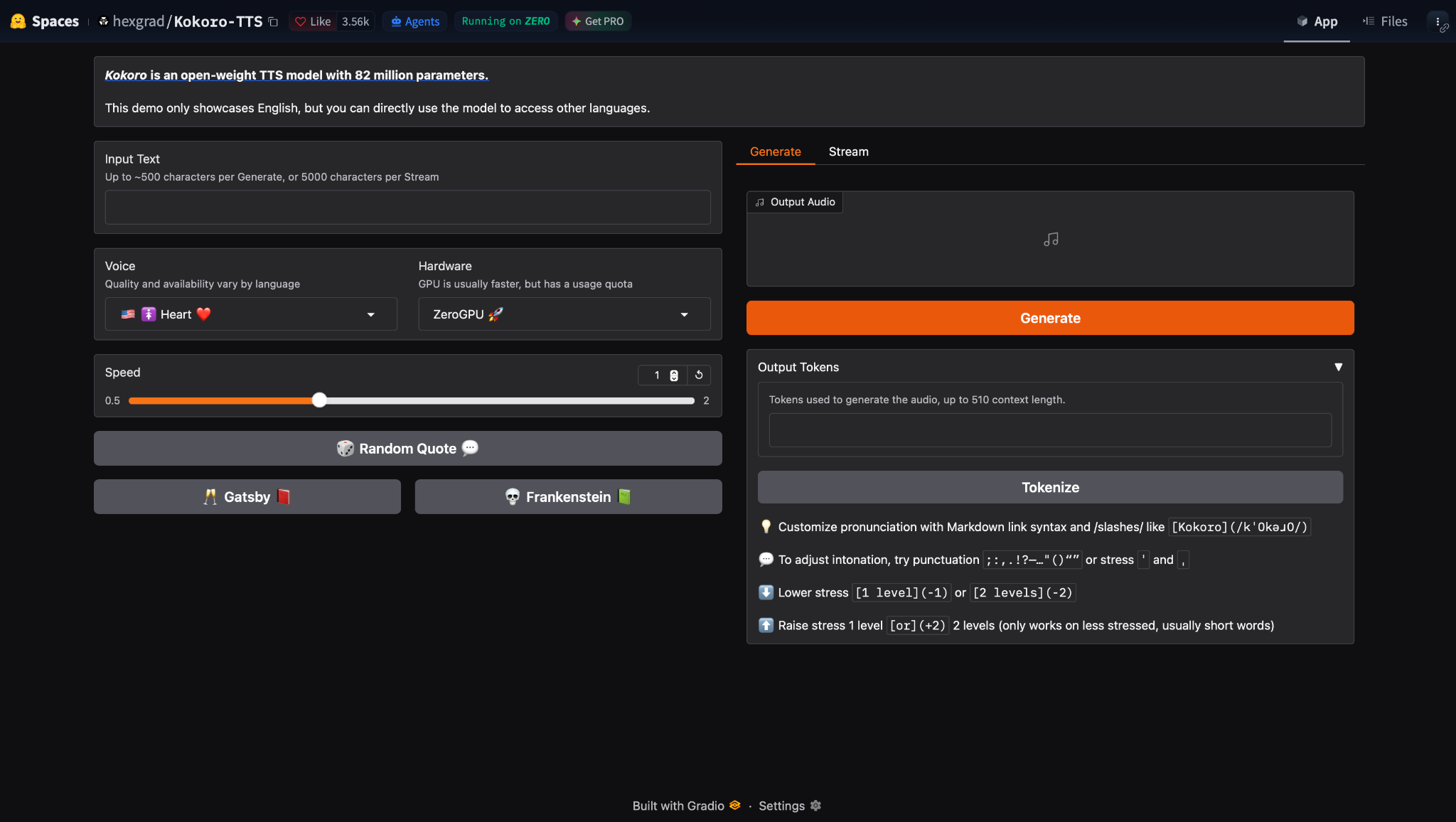
What it does: Kokoro is an 82-million-parameter text-to-speech model with preset voices, released by hexgrad with Apache-licensed weights and code.
Best for: Teams that want a fixed set of voices in a commercial product and don't need cloning.
Kokoro has one of the simplest license stories on this list. Both the weights and the inference library are Apache 2.0.
The model card says it "has been deployed in numerous projects and commercial APIs," and at 82M parameters it's the smallest full-size model here.
Version 1.0 (January 27, 2025) ships 54 voices across 8 languages: American and British English, Spanish, French, Hindi, Italian, Japanese, Brazilian Portuguese, and Mandarin. (Japanese and Mandarin need an extra install.)
Kokoro's documentation is thin. Neither the card nor the repo states a latency, an RTF (how fast it generates compared with playback), or a hardware requirement, and the word "streaming" never appears.
The library yields audio one text chunk at a time, so first-audio time is a number you'll have to collect.
Key Features
-
Preset voice library: 54 voices you pick by name, so output stays the same from one call to the next.
-
Per-language pipelines: A one-letter language code selects the right text front end, with espeak-ng as the English fallback and the front end for some other languages.
-
Apple Silicon support: The README documents an environment variable that turns on the GPU of M-series Macs.
Pros and Cons
Pros:
✅ Apache 2.0 on both code and weights, with no "research only" wording anywhere on the card.
✅ 82M parameters, small enough to sit next to your STT and LLM on 1 machine.
✅ 8 languages in a single release.
Cons:
❌ Neither the card nor the README documents voice cloning. You pick from the preset voices.
❌ No published latency, RTF, or VRAM figure from the maintainer.
What Users Say

"I use Kokoro TTS to turn text (articles, HN threads) to MP3s to listen to while doing chores, it's been great." (littlexsparkee, Hacker News)

"As others have mentioned short utterances are problematic, but solvable." (Judson, Hacker News, in a thread about running Kokoro on CPU)
Pricing and License
Free, Apache 2.0 for code and weights. Your only cost is the compute you run it on.
Bottom Line
Start here if you need English (or one of 7 other languages) in a product you charge for and a stock voice is fine. If your agent has to sound like a specific person, go to Chatterbox or Qwen3-TTS.
2. Chatterbox: Best for MIT-Licensed Voice Cloning in 23 Languages
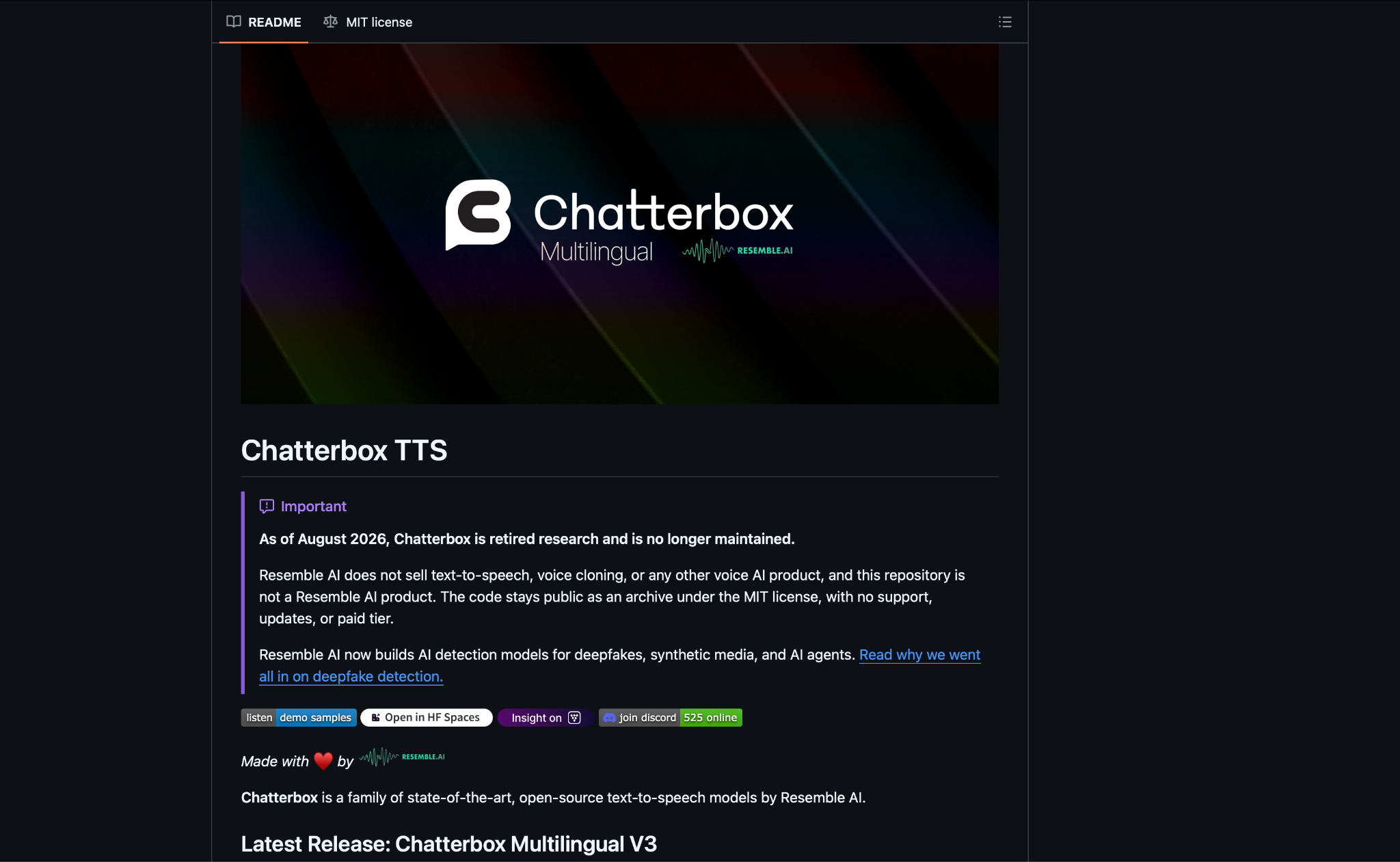
What it does: Chatterbox is Resemble AI's family of open TTS models with zero-shot voice cloning: Turbo (350M), Nano (110M), and Multilingual V3 (500M).
Best for: Builders who need a cloned voice in a commercial product and want a license with no asterisks.
Chatterbox ships 3 main models in one repo, and choosing between them is the bulk of the work. Multilingual V3 covers 23 languages on a 0.5B backbone.
Turbo and Nano are English-only per the GitHub README, with Nano aimed at CPUs. Resemble says Nano runs 3x faster than playback on 8 CPU cores.
The code is MIT, and so is the license tag on the Hugging Face card. We ranked the multilingual model in our multilingual TTS roundup, where it was the only open-weight entry.
The README's "sub 200ms" figure describes Resemble's paid hosted service, and the open models come with no time-to-first-audio number of their own.
Every file they generate also carries Resemble's Perth watermark, which you should know about before a customer's audio team finds it.
Key Features
-
Zero-shot cloning: Turbo takes a reference clip and speaks in that voice with no fine-tuning step.
-
Cross-language cloning: Resemble pitches Multilingual V3 as "one voice cloning model that works across many languages."
-
Built-in watermarking: Every output is tagged with Perth, Resemble's watermark.
Pros and Cons
Pros:
✅ MIT on code and model card, so commercial use is clear.
✅ A CPU-sized model (Nano) in the same family as the GPU ones.
✅ Turbo supports inline tags such as [laugh] and [chuckle].
Cons:
❌ The latency number on the README belongs to the paid service.
❌ The watermark is always on in the released models.
❌ Turbo and Nano are English-only.
What Users Say

"I was able to clone my voice easily and had fun uploading and playing with others." (Llynara, Hugging Face)

"However, it doesn't seem to support the RTX 50-series Blackwell architecture." (fa4amir, Hugging Face)
Pricing and License
Free. MIT. Resemble retired Chatterbox in August 2026 and no longer sells a hosted version, so there’s no paid tier or support behind it.
Bottom Line
Go with Chatterbox when cloning is a requirement and legal wants a one-word answer on licensing. Budget a day for latency testing, because Resemble hasn't published a figure for the open models.
The code still runs under MIT, but nobody is fixing bugs anymore, so pin a version and plan to own it.
3. Qwen3-TTS: Best for Streaming Speech With 3-Second Cloning
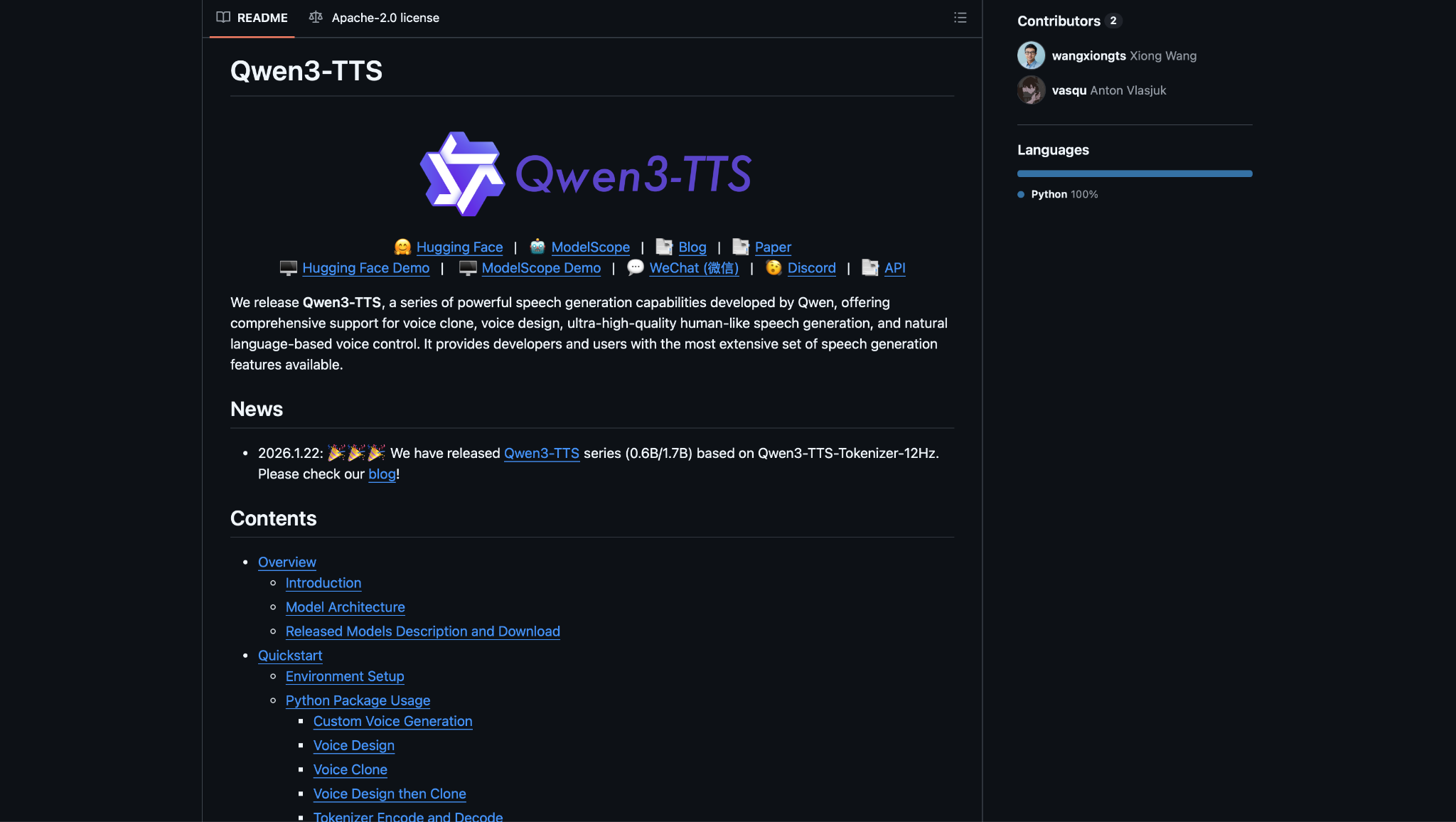
What it does: Qwen3-TTS is Alibaba's open TTS series in 0.6B and 1.7B sizes, with streaming generation and voice design, plus cloning from a 3-second sample.
Best for: Teams that want a recent, Apache-licensed model with a published streaming figure.
Released January 22, 2026, Qwen3-TTS is the newest clean-licensed model in the ranking, with Apache 2.0 on both code and weights.
It speaks 10 languages (Chinese, English, Japanese, Korean, German, French, Russian, Portuguese, Spanish, and Italian), and the README reports "end-to-end synthesis latency as low as 97ms."
It's also the only Apache-licensed pick that appears in Cekura's benchmark, and the result is mixed. On hard-to-read text, it scored 100% on medical terms and 75% on reading from context.
Then it dropped to 69% on numbers and shorthand and 49% on codes and addresses in Cekura's benchmark, last of 29.
For a voice agent that reads back order numbers, street addresses, or confirmation codes, 49% is a serious problem.
The benchmark doesn’t list streaming latency for Qwen3-TTS, so the 97 ms claim is still Alibaba's own. Cekura tested Qwen3-TTS through DeepInfra's hosted endpoint, so a self-hosted deployment on your own GPU can land faster or slower.
Key Features
-
3-second cloning: The Base models copy a voice from a short reference clip.
-
Streaming output: Per the README, the first audio packet can go out after a single input character.
-
2 sizes: 0.6B for tighter memory budgets and 1.7B for quality.
Pros and Cons
Pros:
✅ The newest Apache-licensed release here, from January 2026.
✅ A maintainer-published streaming latency, which Kokoro and Chatterbox don't have.
✅ Independent accuracy data exists, so you know its weak spot before you build.
✅ Voice design from a text description, in the VoiceDesign model.
Cons:
❌ 49% on codes and addresses in Cekura's benchmark, last of 29.
❌ The repo and the card give no VRAM figure.
❌ No independent streaming latency figure.
What Users Say
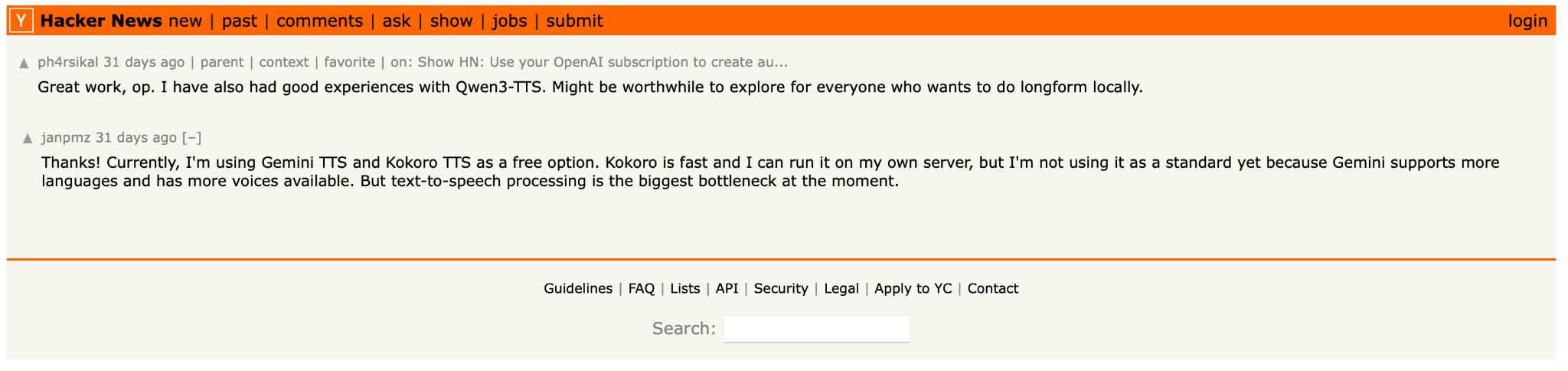
"I have also had good experiences with Qwen3-TTS." (ph4rsikal, Hacker News)

"If I break a longer paragraph into sentences, all outputs are significantly different from each other." (anujchopra, Hugging Face)
Pricing and License
Free. Apache 2.0 for code and weights.
Bottom Line
Qwen3-TTS has the best mix of license, age, and features of anything here. Put a text normalization step in front of it (spell out digits and codes before they hit the model), or it'll misread the exact strings your callers care about.
4. CosyVoice 3: Best for Chinese Dialects and Cross-Lingual Cloning
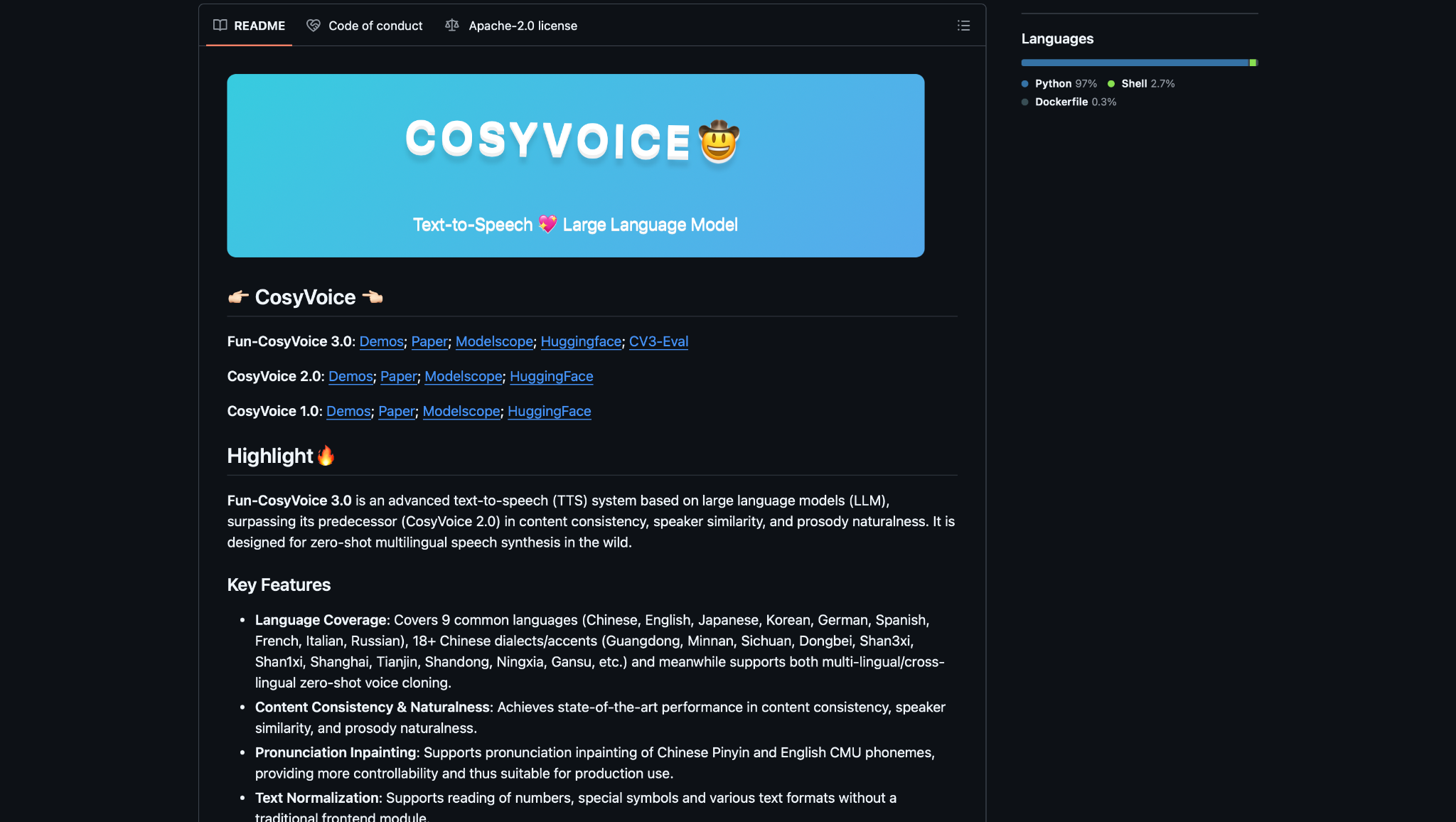
What it does: CosyVoice 3 (released as Fun-CosyVoice3-0.5B-2512) is a 0.5B multilingual TTS model with zero-shot cloning and bi-directional streaming.
Best for: Products serving Chinese-speaking users across dialects, or agents that keep one cloned voice across several languages.
The December 2025 release covers 9 languages plus more than 18 Chinese dialects and accents, a dialect range no other model on this list matches.
Streaming works in both directions (text in, audio out), and the maintainers put latency at "as low as 150ms."
The GitHub repo now shows up as QwenAudio/CosyVoice, so check any pinned URLs in your build scripts.
The repo is Apache 2.0, and the Hugging Face tag says apache-2.0, yet the card's disclaimer reads, "The content provided above is for academic purposes only and is intended to demonstrate technical capabilities."
I read it as covering the demo examples, and I'd still run it past your legal team before shipping.
Key Features
-
Bi-streaming: Accepts text as it arrives from the LLM and returns audio as it's generated.
-
Cross-lingual cloning: A voice cloned in 1 language can speak the others.
-
Training scripts included: The December 2025 release shipped base and RL models with training and inference scripts.
Pros and Cons
Pros:
✅ The widest dialect coverage of any open model I checked.
✅ A published 150 ms streaming figure on a 0.5B model.
✅ Apache 2.0 on the repo and on the model card tag.
Cons:
❌ The academic-purposes disclaimer on the card sits awkwardly next to the Apache tag.
❌ You'll size the GPU by trial, since no VRAM figure is published.
What Users Say
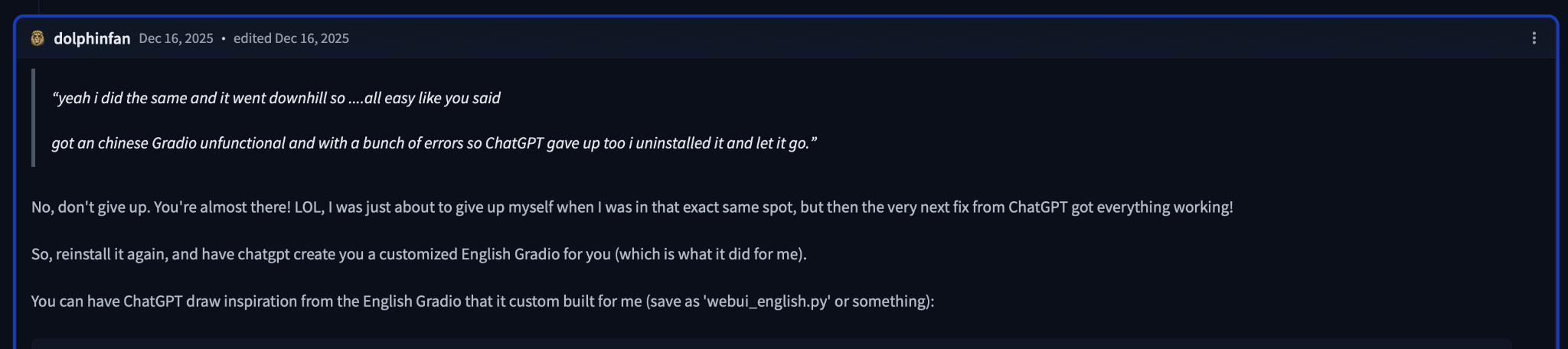
"That's how I got mine to work flawlessly." (dolphinfan, Hugging Face, on a Windows install)

"I spent a full day trying to get this model to work (the onnx export)." (cmoney1133, Hugging Face)
Pricing and License
Free. Apache 2.0 on the repo and the model card tag, with the disclaimer noted above.
Bottom Line
For Mandarin and Chinese regional accents, this is the model to evaluate first. If your market is English-only, the dialect support adds nothing for you, and Kokoro or Chatterbox is simpler.
5. Orpheus TTS: Best for Expressive English Speech
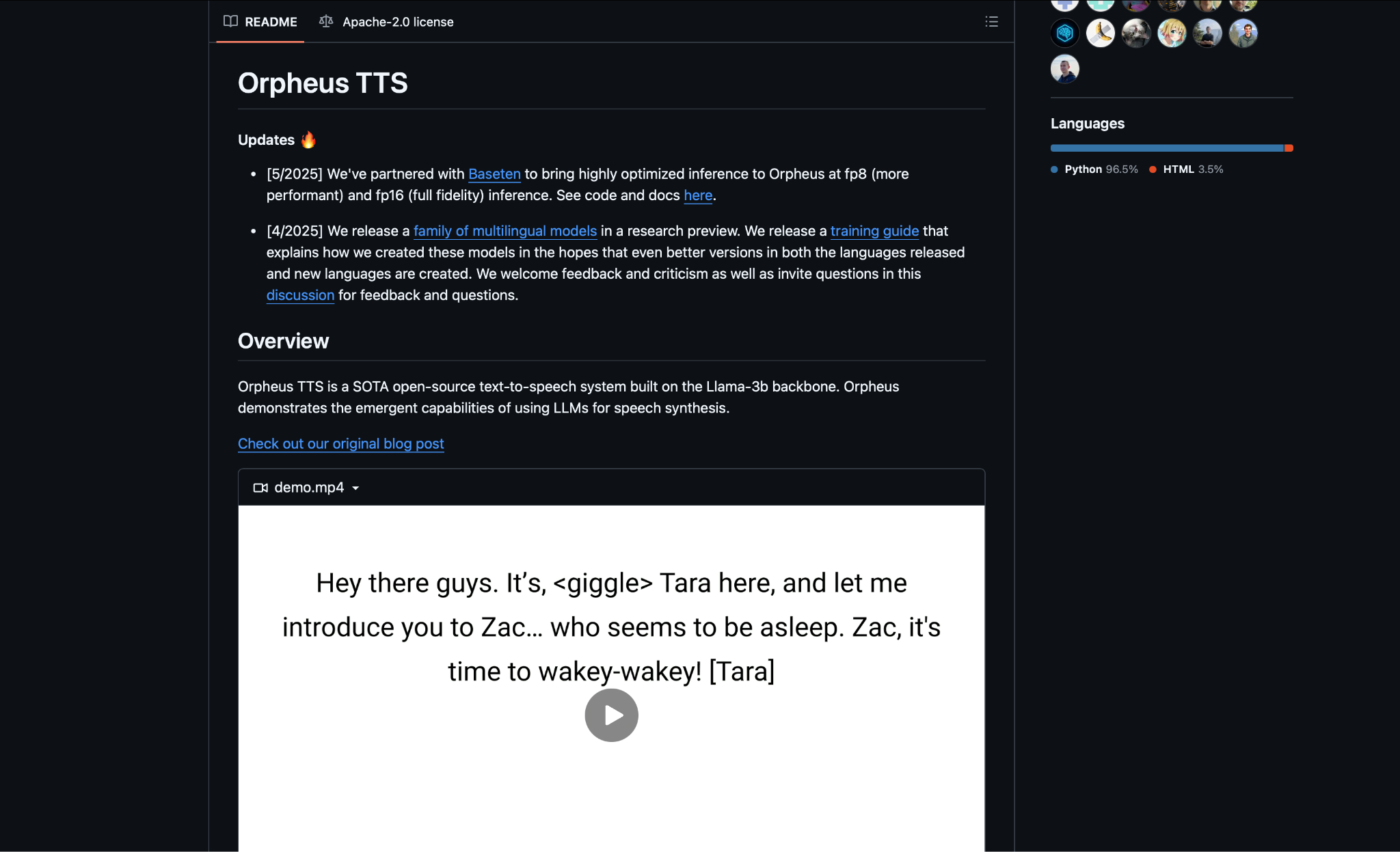
What it does: Orpheus is Canopy Labs' speech model based on a Llama 3B backbone, with emotion tags and streaming output, plus a set of fine-tuned English voices.
Best for: English voice agents where tone and emotion carry the conversation, and you have GPU budget for a 3B model.
Orpheus treats speech as a language-model problem, and that's why it runs on vLLM. The released models are tagged Apache 2.0, though the cards list Llama-3.2-3B-Instruct as the base model, so have legal look at the Llama terms too.
Canopy reports about 200 ms of streaming latency, which drops to about 100 ms if you stream text into it.
A 3B model costs more to serve. The roadmap checklist marks the 3B models as released, while the 1B, 400M, and 150M versions are still unchecked boxes, and the README's last dated update is from May 2025.
There's no VRAM figure either, just a llama.cpp option for running with no GPU. Hugging Face's metadata lists the model at 4B (rounded up), though it's named and documented as 3B.
Canopy's own docs add a caveat on cloning, saying the pretrained model "hasn't been explicitly trained on the zero-shot voice cloning objective."
Key Features
-
LLM-style serving: Runs on vLLM, so it batches and streams like the text models you already host.
-
Emotion tags: Inline tags steer delivery within a sentence.
-
Multilingual research family: 7 pairs of pretrained and finetuned models released as a research preview.
Pros and Cons
Pros:
✅ About 200 ms of published streaming latency, and about 100 ms with streamed text input.
✅ 8 fine-tuned English voices ship with the release (Tara, Leah, Jess, Leo, Dan, Mia, Zac, and Zoe).
Cons:
❌ The 1B, 400M, and 150M sizes are still unreleased, and the README's last dated update is from May 2025.
❌ The model is gated on Hugging Face, so you need to share account details to download it.
❌ The base model wasn't trained for zero-shot cloning.
What Users Say

"This model is extremely good for it’s size [sic] and has way better support than Sesame's CSM!" (shadowlilac, Hugging Face)
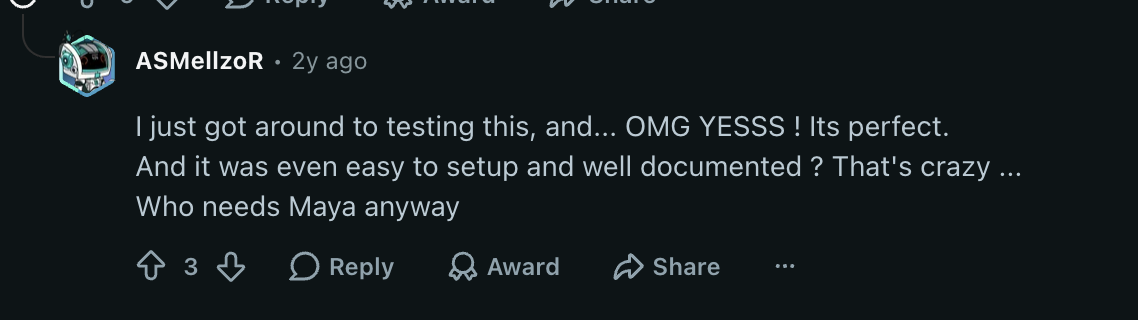
"I just got around to testing this, and... OMG YESSS ! Its perfect." (ASMellzoR, Reddit)
Pricing and License
Free under Apache 2.0.
Bottom Line
Pick Orpheus when expressiveness is the product, and you're already running vLLM. On a tight GPU budget, the smaller models ranked above it will cost you less to serve.
6. Pocket TTS: Best for Running on a CPU
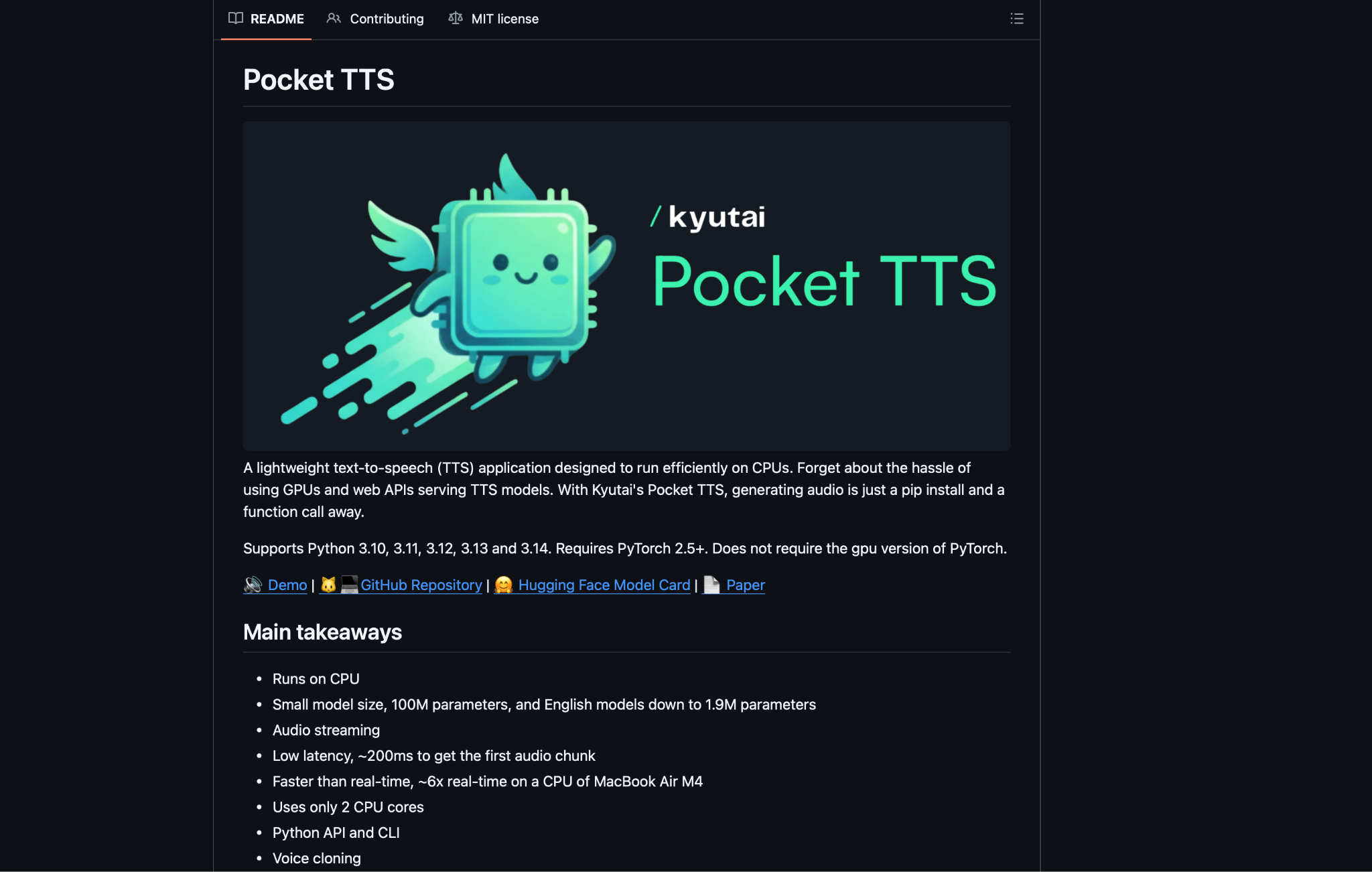
What it does: Pocket TTS is Kyutai's 100M-parameter model that runs on a CPU, streams audio, and clones a voice from a WAV file.
Best for: On-device and edge deployments, or any stack where a GPU for TTS isn't in the budget.
The headline numbers in Kyutai’s README are all CPU numbers. It reports about 200 ms to the first audio chunk and roughly 6x faster than playback on a MacBook Air M4.
The README also says the model "uses only 2 CPU cores," and GPU use is "not officially supported," which tells you who Kyutai designed it for.
It's among the busiest repos on this list. Training code went public in August 2026, and an October 2026 note adds smaller English models (down to 1.9M parameters) that run up to 25x faster than playback on 1 CPU thread.
The repo lists 7 languages: English, French, German, Portuguese, Italian, Spanish, and Dutch.
Licensing has 3 layers. Code is MIT, weights are CC BY 4.0, and the bundled voices each carry their own terms. Several voice folders (Expresso and EARS among them) are marked non-commercial only.
Key Features
-
CPU streaming: About 200 ms to first audio, using only 2 CPU cores, per the README.
-
WAV-file cloning: Point the voice argument at a WAV file to clone it.
-
Tiny English variants: 18.2M, 6.9M, and 1.9M models for very constrained devices.
Pros and Cons
Pros:
✅ No GPU needed, which for many teams is the biggest line item in self-hosting.
✅ Active development through October 2026.
✅ 7 languages on the GitHub README (the model card lists 6), in 100M parameters.
Cons:
❌ Some bundled voices are non-commercial, so you have to check each one you ship.
❌ CC BY 4.0 weights mean an attribution requirement.
What Users Say

"It is also very easy to make new voices from small sample files with pocket-tts." (psanford, Hacker News)

"Pocket-TTS does cloning on CPU, but for me randomly outputs something pretty weird sounding mixed in with like 90% good outputs." (ilaksh, Hacker News)
Pricing and License
Free. MIT for code, CC BY 4.0 for weights, per-voice licenses for the voice library.
Bottom Line
If the constraint is "no GPU," Pocket TTS covers it, with Chatterbox Nano as the English-only alternative. Use a CC0 or CC BY voice (or clone one you have rights to) and keep a record of which.
7. Dia2: Best for Two-Speaker English Dialogue
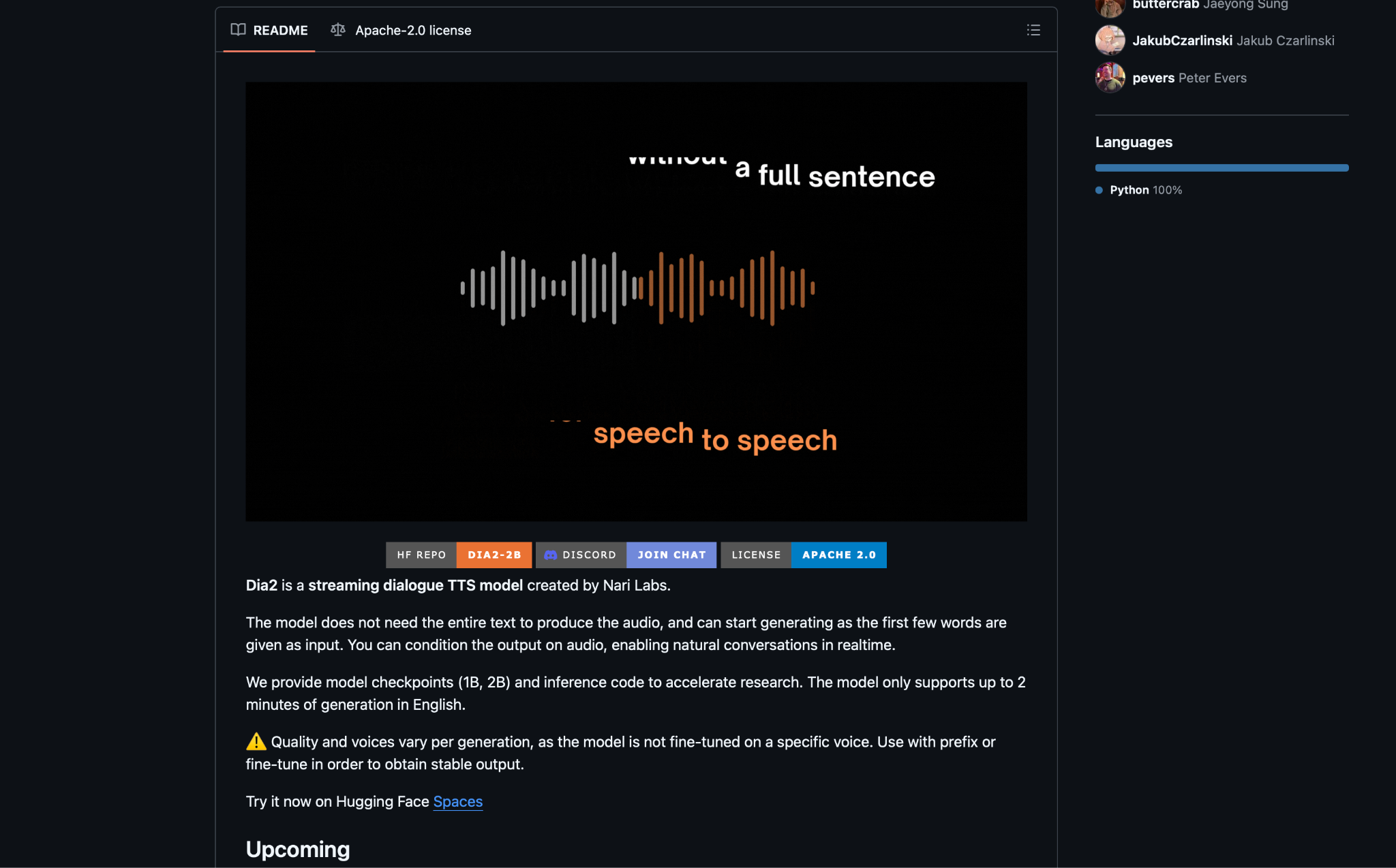
What it does: Dia2 is Nari Labs' streaming dialogue model in 1B and 2B sizes that generates multi-speaker English conversation from a tagged script.
Best for: Podcast-style audio, demos, and training data where 2 voices talk to each other.
Dia2 takes a script with speaker tags and produces the whole exchange in one call, and it can start generating before the full text has arrived. Code and the Dia2-2B weights are both Apache 2.0.
The model card states 2 limits. It "only supports up to 2 minutes of generation in English," and the TTS server with full streaming support is listed under Upcoming. You also need CUDA 12.8 or newer drivers.
For hardware planning, the only hard numbers come from its predecessor. Dia 1.6B needs about 4.4 GB of VRAM in bf16 and 7.9 GB in fp32 on an RTX 4090, and Dia2 has no published figure yet.
Key Features
-
Dialogue generation: One script with speaker tags produces a full two-voice exchange.
-
Audio prefix conditioning: Feed a short clip per speaker to set each voice.
-
Incremental generation: Starts producing audio before the script is complete.
Pros and Cons
Pros:
✅ 2 sizes, so you can trade quality for memory.
✅ Its predecessor (Dia 1.6B) has published VRAM figures, a rough floor for planning.
Cons:
❌ English only, capped at 2 minutes per generation, and the streaming server isn't released.
❌ The model card says it's intended for research and educational use.
❌ No latency or VRAM figure for Dia2 itself.
What Users Say
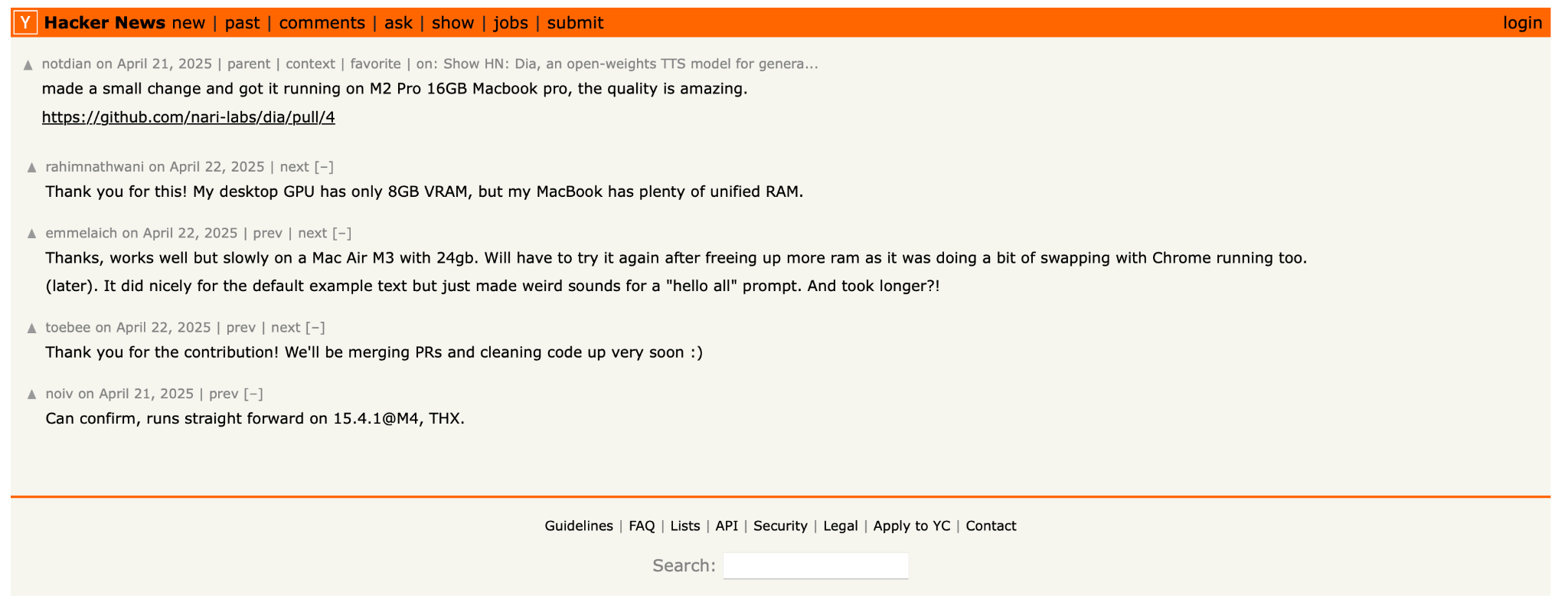
"made a small change and got it running on M2 Pro 16GB MacBook pro, the quality is amazing." (notdian, Hacker News, about the earlier Dia 1.6B)
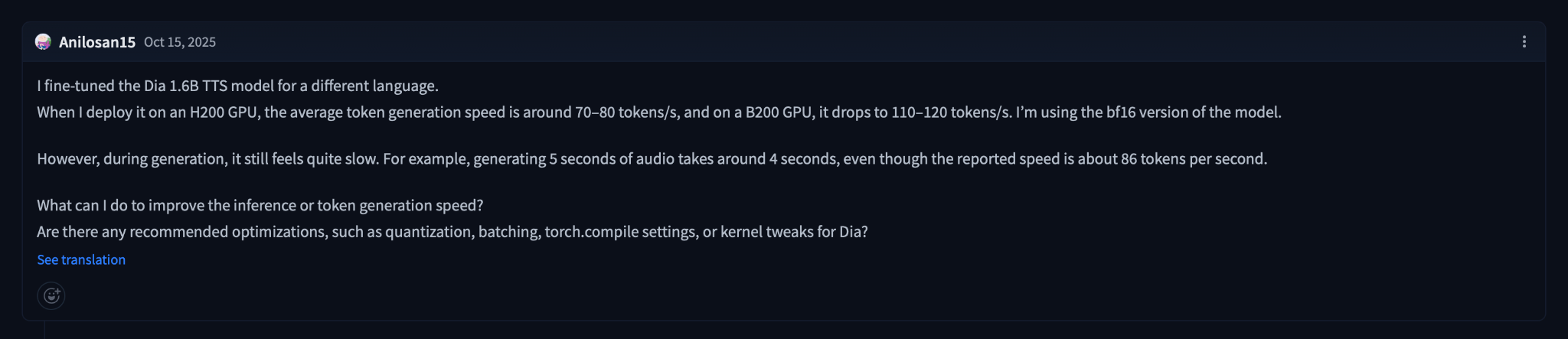
"However, during generation, it still feels quite slow." (Anilosan15, Hugging Face, about the earlier Dia 1.6B)
Pricing and License
Free. Apache 2.0. The card adds that the model is "intended for research and educational use" and lists forbidden uses, including producing audio that resembles an identifiable person without permission.
Bottom Line
Dia2 suits scripted 2-voice audio, demos, and training data. Wait for the streaming server before you put it on a live call.
8. Fish Audio S2-Pro: Best for Research That Needs 80+ Languages
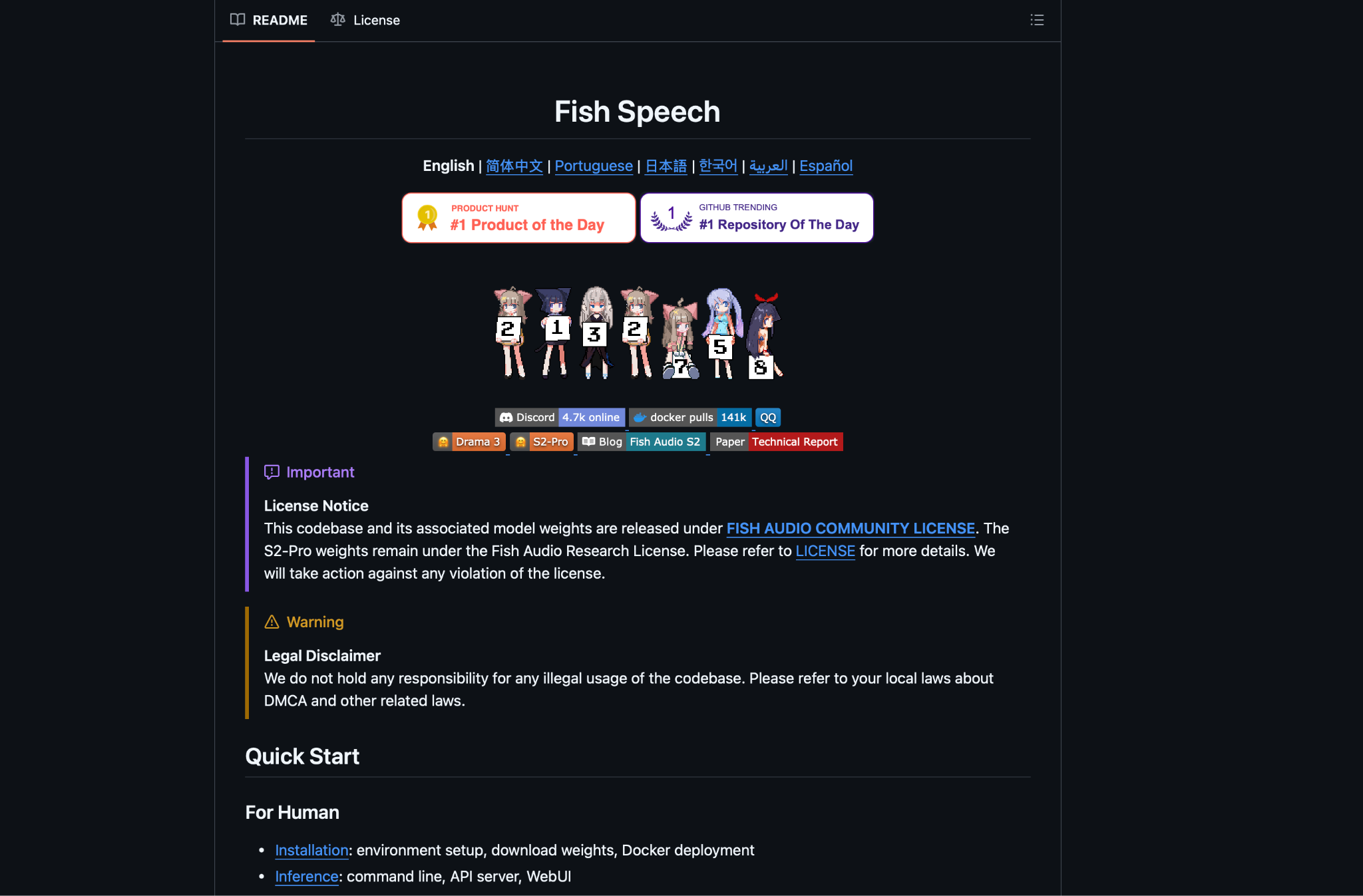
What it does: S2-Pro is Fish Audio's 4B open-weight model with cloning from 10 to 30 seconds of audio and support for more than 80 languages per its model card.
Best for: Research, internal prototypes, and teams willing to buy a commercial license.
On paper, S2-Pro is among the fastest models in this article. Fish Audio reports about 100 ms to first audio and an RTF of 0.195, measured on a single H200.
Its install docs ask for at least 24 GB of VRAM and also list a CPU option. Fish Audio's README now labels S2-Pro "previous-generation" behind Drama 3, which the install docs say needs at least 48 GB.
It’s also the only pick with independent streaming latency data. Cekura's benchmark tested the hosted S2.1-Pro API (Fish Audio’s hosted version of the S2 model): 321 ms streaming latency, 92.0% hard-parts accuracy, and $15.00 per 1M UTF-8 bytes.
S2.1-Pro's accuracy is within 2 points of the top of the table.
Cekura's board also lists Fish Audio's newer Drama 3 (preview) at 312 ms streaming latency and 91.3% accuracy, with the board's top naturalness score (4.54, an automated UTMOS estimate). It has no list price there yet.
Since October 13, 2026, the fish-speech code and the newer Drama 3 weights use the Fish Audio Community License, which allows commercial use while your annual revenue stays under $500K and never covers running a hosted TTS service.
The S2-Pro weights stay on the Fish Audio Research License, and the model card says commercial use "requires a separate license from Fish Audio."
Key Features
-
Short-sample cloning: 10 to 30 seconds of reference audio reproduces a voice.
-
Language breadth: 80+ languages in one set of weights.
-
Fast first audio: About 100 ms on an H200, per Fish Audio.
Pros and Cons
Pros:
✅ The hosted version has measured latency and accuracy in a third-party benchmark.
✅ The install docs list a CPU option next to the GPU path.
✅ Maintainer-published speed figures with the hardware named.
Cons:
❌ Commercial use needs a paid license.
❌ The GPU path needs at least 24 GB of VRAM, more than many consumer cards have.
❌ The repo says 4B parameters, while the Hugging Face metadata says 5B (the card's architecture section lists 4B plus a 400M module).
What Users Say
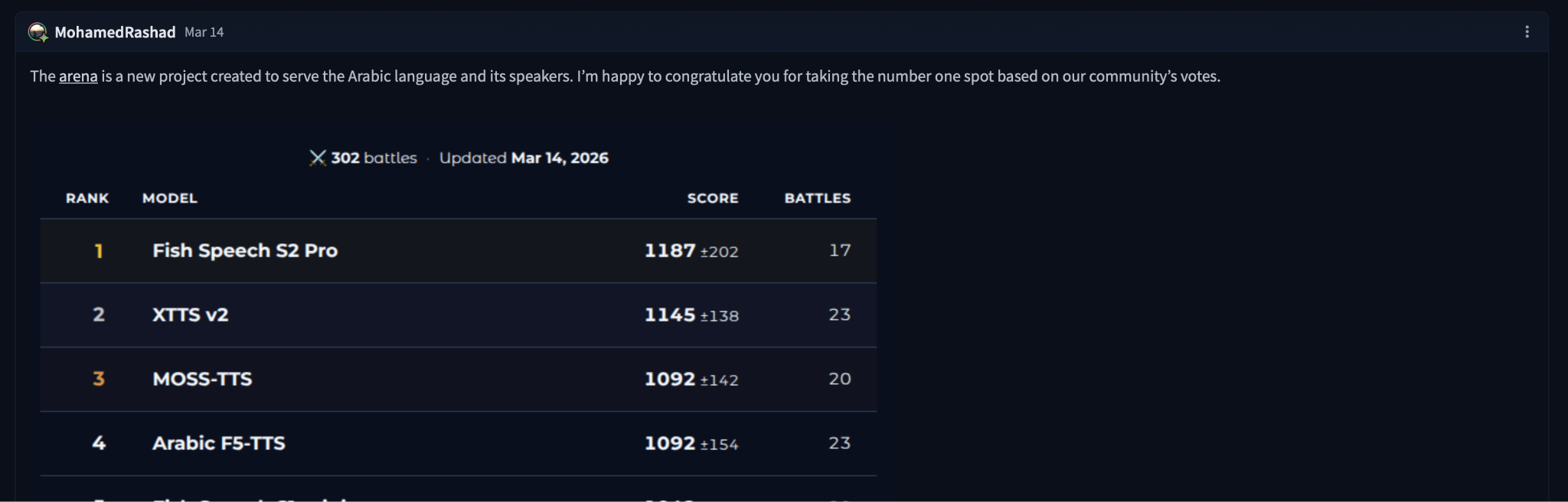
"I'm happy to congratulate you for taking the number one spot based on our community's votes." (MohamedRashad, Hugging Face, on the Arabic TTS Arena)
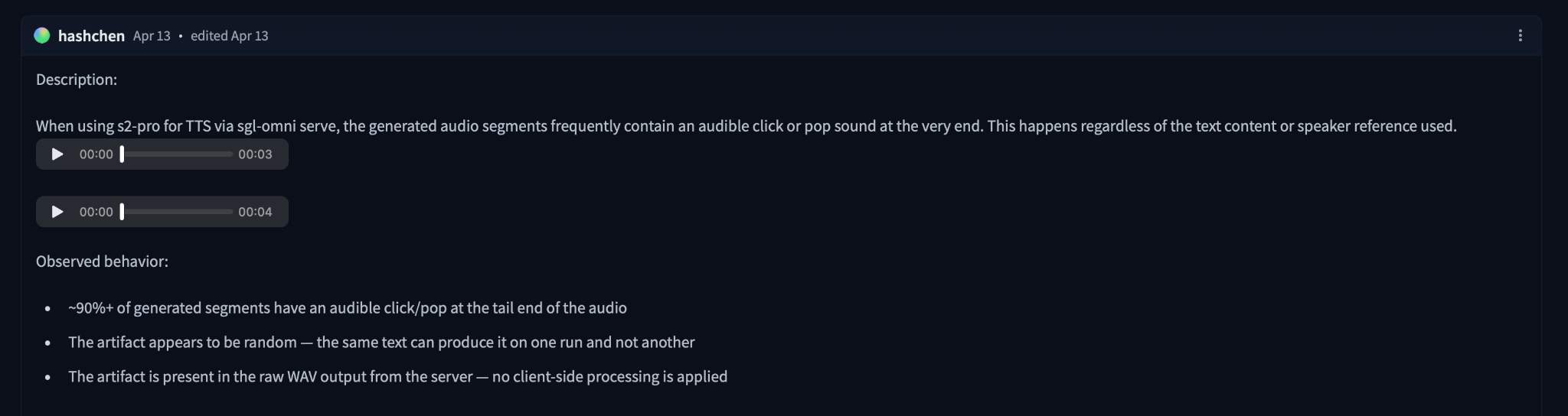
"The artifact appears to be random…" (hashchen, Hugging Face)
Pricing and License
Free for research and non-commercial use. Commercial self-hosting needs a paid license from Fish Audio, which its developers page lists from $10k/month. The hosted S2.1-Pro API is $15 per 1M UTF-8 bytes on Fish Audio’s pricing page.
Bottom Line
S2-Pro is a strong model under a license that makes it a paid product. Evaluate it if you'd consider Fish Audio as a vendor anyway, and skip it if "open source" has to mean free to ship.
9. VibeVoice Realtime: Best for Experimenting With Streaming Text Input
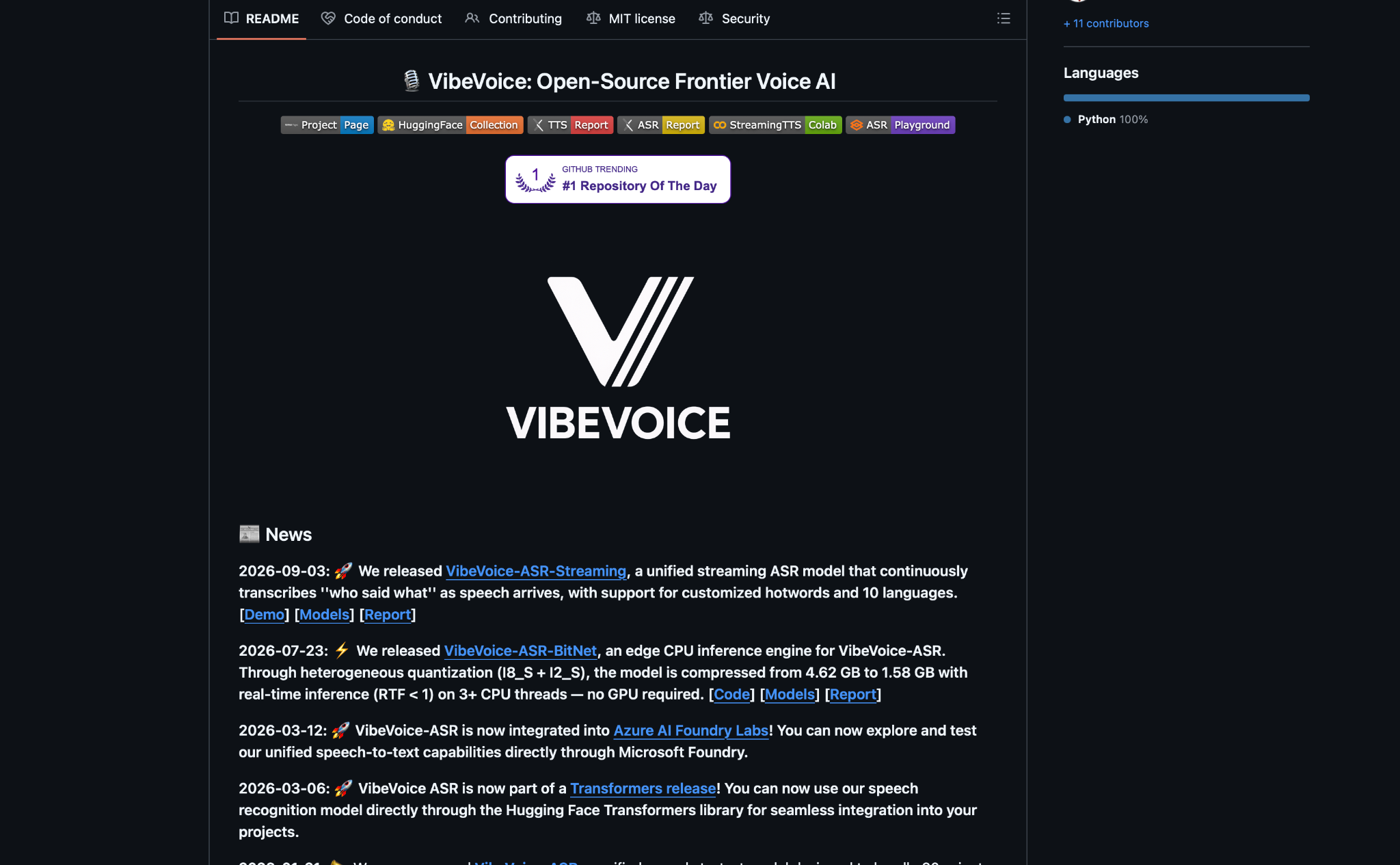
What it does: VibeVoice Realtime is Microsoft's 0.5B streaming TTS model that accepts text as it's generated and produces up to about 10 minutes of speech.
Best for: Research teams studying streaming TTS design. I wouldn't put it in production.
The streaming model came out December 3, 2025, with "~300 milliseconds first audible latency" and streaming text input, which is exactly the shape a voice agent wants. It's primarily English, with experimental voices in 9 languages.
Microsoft removed the original VibeVoice-TTS code from the repo on September 5, 2025, and the 1.5B model's demo is listed as "Disabled," though its weights are still on Hugging Face.
The license tag is MIT, yet both model cards say the release is "intended for research and development purposes only," and the README advises against commercial use "without further testing and development."
Even the size is unsettled, with 0.5B on GitHub and the model card, and about 1B in the Hugging Face file metadata.
Key Features
-
Streaming text input: Starts speaking before the LLM has finished the sentence.
-
Long-form output: Holds together for about 10 minutes of continuous speech.
-
Experimental voices: 11 English-style voices plus multilingual voices in 9 languages.
Pros and Cons
Pros:
✅ A streaming-first design at 0.5B parameters.
✅ MIT-tagged, so reading and modifying the code is unrestricted.
✅ A stated first-audio latency.
Cons:
❌ Microsoft's own cards limit it to research and development.
❌ The main TTS code was pulled from the repo in 2025.
❌ Hardware planning is guesswork, with no VRAM figure on any of its 3 pages.
What Users Say

"I have ported the model inference code to Swift and tested the stream input." (mzbac, Hugging Face)

"I tried, got an audio with disgusting noise, why does it have 2k likes?" (qpqpqpqpqpqp, Hugging Face, about the 1.5B model)
Pricing and License
Free. MIT tag on code and weights, with research-only guidance on the cards.
Bottom Line
Give it an afternoon if you're studying how streaming text input changes turn latency. For anything a customer will hear, the maintainer's own guidance rules it out.
10. XTTS-v2: Best for Non-Commercial Projects Already on Coqui
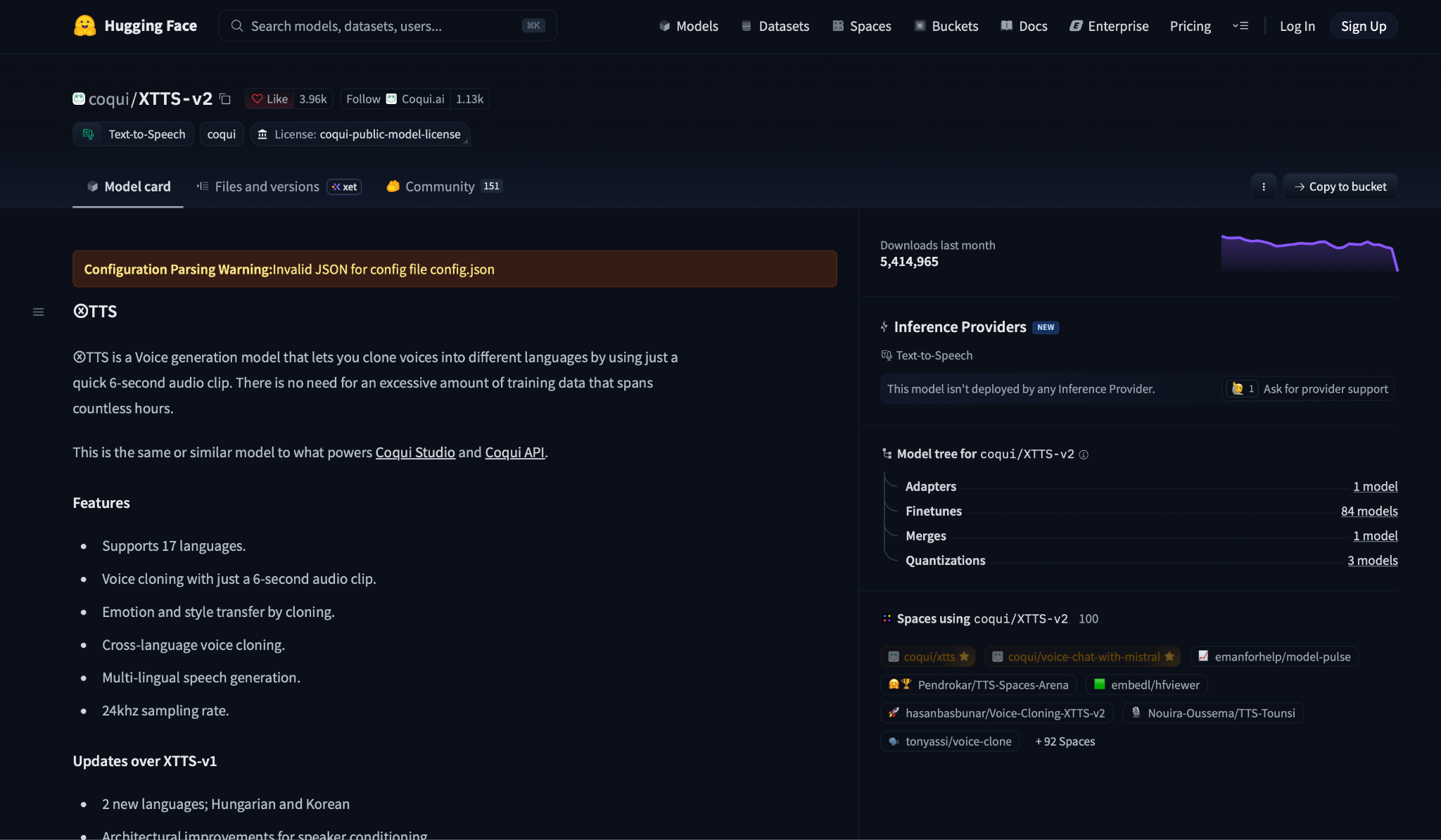
What it does: XTTS-v2 is Coqui's multilingual model that clones a voice from a 6-second clip across 17 languages.
Best for: Hobby projects, academic work, and existing codebases that already call the Coqui library.
XTTS-v2 is the model older tutorials usually point to, and it still does a lot: 17 languages, 6-second cloning, and streaming "with <200ms latency" according to the library’s README.
The weights ship under the Coqui Public Model License 1.0.0, which opens with "This license allows only non-commercial use of a machine learning model and its outputs."
The license text has no commercial option in it.
The idiap fork on GitHub describes the original coqui-ai/TTS repo as unmaintained, and the fork itself is on version 0.28.
Key Features
-
6-second cloning: A short clip is enough to copy a voice.
-
17 languages: Including Arabic, Hindi, Japanese, Korean, and Turkish.
-
Streaming inference: Under 200 ms per the library's notes.
Pros and Cons
Pros:
✅ Years of tutorials, forks, and community fixes to draw on.
✅ An active fork that still ships releases.
✅ The fork caches cloned voices, so you pass the reference audio once.
Cons:
❌ Non-commercial license, with no commercial option in the license text.
❌ The model card skips both parameter count and hardware needs.
❌ Fixes land only in the idiap fork.
What Users Say
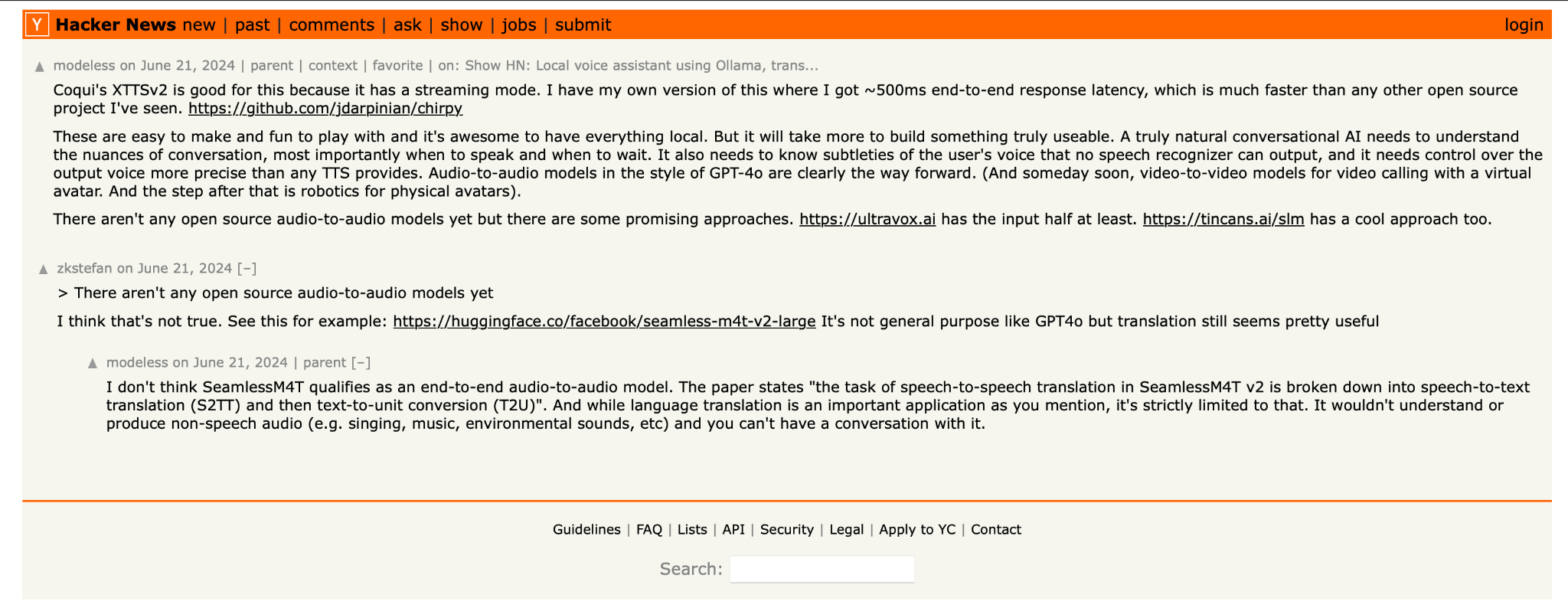
"Coqui's XTTSv2 is good for this because it has a streaming mode." (modeless, Hacker News)
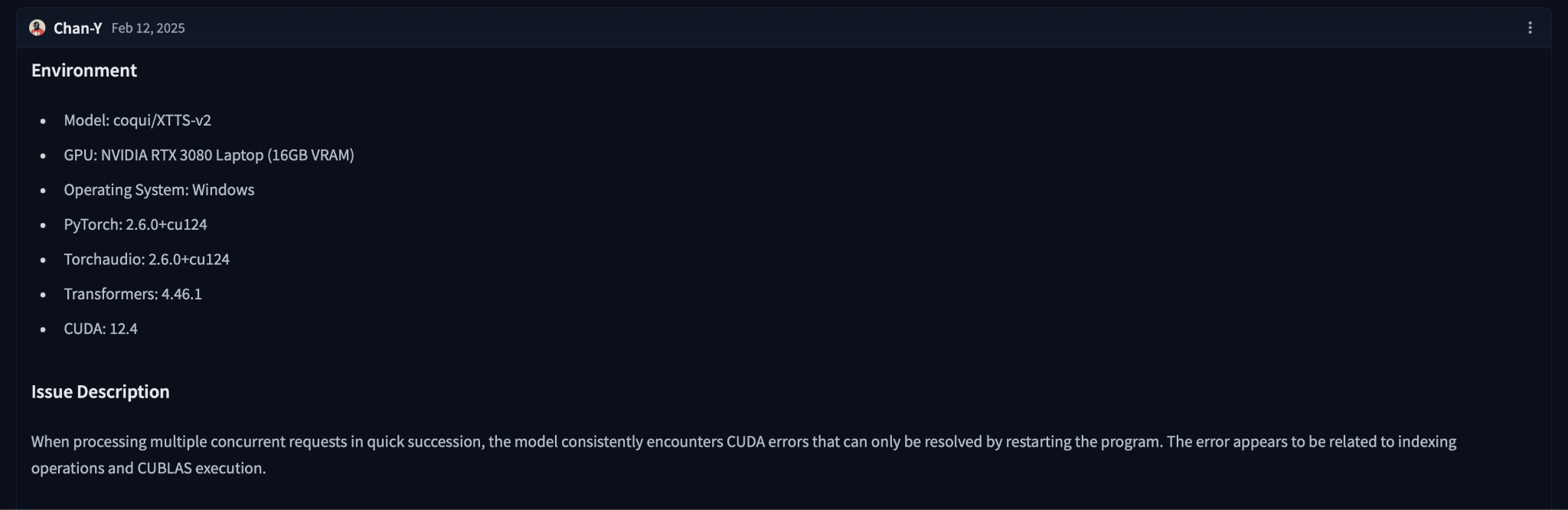
"The error appears to be related to indexing operations and CUBLAS execution." (Chan-Y, Hugging Face, on concurrent requests)
Pricing and License
Free for non-commercial use only. MPL-2.0 for the library, CPML 1.0.0 for the weights.
Bottom Line
Keep using it if you're already on it and the output stays non-commercial. For a new commercial build, Qwen3-TTS covers cloning under Apache 2.0, and Chatterbox does too under MIT if you’re fine running an unmaintained project.
Self-Host vs Managed API: Which One Suits Your Voice Agent?
Self-hosting an open-source text-to-speech model means no per-character bill and audio that never leaves your network, and the voice is fully yours.
The cost is a GPU (or CPU capacity) plus an engineer to keep it serving, and you'll redo the latency tuning that API vendors have already done.
Here's what the managed side looks like in Cekura's benchmark. Across the models it measured, streaming latency ran from 45 ms (Inworld TTS-2 Flash) to 584 ms (ElevenLabs v4), and one model (Gradium TTS) started speaking 64 ms before the last word arrived.
List prices ran from $12.56 (Murf Falcon 2.1) to $100.00 (Hume Octave 2) per 1M characters. Those are figures under one fixed test setup, so use them to shortlist, then confirm with live calls.
Self-host when:
-
Call audio can't leave your infrastructure (common in healthcare and financial services).
-
Your volume is high and flat enough that a reserved GPU beats per-character pricing.
-
You need a cloned or custom voice and want to own the weights.
Use a managed API when:
-
You're pre-launch or low-volume, and a GPU would sit idle for much of the day.
-
You need measured, published latency today.
-
Your team doesn't want to be on call for a speech server.
Hardware Guide: CPU vs GPU, VRAM, and Streaming
Only 4 of these 10 projects publish a hardware requirement, so the table below shows what each maintainer states, blanks included.
| Model | Runs On | Maintainer-Stated Requirement | Streams? |
|---|---|---|---|
| Kokoro-82M | Not stated (82M parameters) | Not stated | Chunked output, no streaming claim |
| Chatterbox | CPU (Nano), GPU recommended (Turbo, V3) | Nano: 3x faster than playback on 8 CPU cores | Not stated |
| Qwen3-TTS | GPU | Not stated | ✅ Yes |
| CosyVoice 3 | Not stated | Not stated | ✅ Yes, bi-directional |
| Orpheus TTS | GPU (llama.cpp option for CPU) | Not stated | ✅ Yes |
| Pocket TTS | CPU | 2 CPU cores | ✅ Yes |
| Dia2 | GPU (CUDA 12.8+), CPU fallback | Not stated (Dia 1.6B: 4.4 to 7.9 GB VRAM) | ✅ Yes, server pending |
| Fish Audio S2-Pro | GPU (CPU listed as an option) | At least 24 GB VRAM | ✅ Yes |
| VibeVoice Realtime | Not stated | Not stated | ✅ Yes |
| XTTS-v2 | Not stated | Not stated | ✅ Yes |
3 rules of thumb from that table:
-
No GPU: Pocket TTS or Chatterbox Nano. Kokoro is small enough to try on a CPU too, though its maintainer gives no figure.
-
One GPU shared with other models: Going by parameter count, Kokoro, Chatterbox Turbo and Qwen3-TTS 0.6B are the lightest GPU options among the commercially usable picks, with CosyVoice 3 close behind once legal clears its disclaimer.
-
A dedicated large card: Fish S2-Pro (at least 24 GB, per its docs) and Orpheus 3B (no figure published, but the largest Apache-licensed model here).
Whatever you choose, measure time to first audio on your own hardware with your own sentences. A maintainer's 97 ms, measured on hardware they don't name, won't be your number.
Which Open Source TTS Model Should You Choose?
Start with the license, then the language, then the hardware. Your shortlist will usually be down to 3 or 4 models after the first question.
Kokoro-82M makes sense if you:
-
Need a commercial-safe model with preset voices.
-
Want the smallest footprint next to the rest of your voice stack.
Go with Chatterbox if you:
-
Need voice cloning under MIT.
-
Serve more than one language and can accept a watermark.
Reach for Qwen3-TTS if you:
-
Want streaming and cloning under Apache 2.0.
-
Can normalize numbers and codes before they reach the model.
Pick CosyVoice 3 if you:
-
Serve Chinese dialects or need one voice across languages.
-
Want bi-directional streaming on a 0.5B model.
Try Pocket TTS if you:
-
Have no GPU, or you're shipping to a device.
-
Can check each bundled voice's license before you ship.
Orpheus is the better bet if you:
-
Care above all about expressive English.
-
Already run vLLM.
Dia2 belongs on the list if you:
-
Need scripted 2-voice audio.
-
Can wait for the streaming server before going live.
Skip open source TTS entirely if:
-
You need a vendor SLA and published latency this quarter. A hosted API will get you there faster.
-
Your agent reads account numbers, addresses, and codes all day and you can't add a normalization layer.
Final Verdict
For a commercial voice agent, the open-source TTS shortlist is shorter than 10.
Kokoro-82M, Chatterbox (now unmaintained), and Qwen3-TTS are the 3 I'd build on first, with clean licenses on code and weights and a size that shares a GPU with the rest of your stack. Orpheus clears the license bar too, at 3B parameters.
Kokoro is the safest starting point, Chatterbox wins when you need cloning, and Qwen3-TTS has the widest feature set if you can work around its trouble with code. Pocket TTS covers CPU-only setups, as long as you check the voice license.
Fish Audio S2-Pro and XTTS-v2 are worth knowing about and hard to ship, and so is VibeVoice. Their licenses or their maintainers say so directly.
Test Your Open Source TTS Choice on Live Calls Before It Ships
A voice that sounds fine in a demo clip can still talk over an interruption or add latency to every turn once it's wired into an agent. Picking the model gets you to the first test call.
This is the part Cekura handles. It runs simulated calls against your voice agent and scores latency and interruption handling on each one, so swapping Kokoro for Qwen3-TTS becomes a test run you can compare.
Native integrations cover Retell, Vapi, ElevenLabs, LiveKit, Pipecat, Bland, and more, and Cekura supports SOC 2, HIPAA, and GDPR compliance, covering transcript redaction, role-based access, and audit trails.
If you're moving a self-hosted TTS model into production, book a demo and run it through your own call scenarios first.
Frequently Asked Questions
What is the best open source TTS model?
The best open source TTS model for a typical commercial project is Kokoro-82M, because its code and weights are both Apache 2.0 and it's only 82M parameters. Chatterbox is the better choice if you need voice cloning, and Qwen3-TTS if you need streaming with a published latency figure.
Can I use open source TTS models commercially?
Yes, but only some open-source TTS models allow commercial use. Kokoro-82M, Chatterbox, Qwen3-TTS, and Orpheus have permissive licenses on both code and weights.
Dia2 is Apache 2.0 too, though its card says it's intended for research and educational use. XTTS-v2 doesn’t allow commercial use at all, Fish Audio S2-Pro needs a separate paid license, and Microsoft advises against commercial use of VibeVoice.
Which open source TTS models run on a CPU?
Pocket TTS and Chatterbox Nano run on a CPU by design. Kyutai reports about 200 ms to first audio for Pocket TTS, which uses only 2 CPU cores, and Resemble AI reports Chatterbox Nano at 3x faster than playback on 8 cores.
Which open source TTS model has the lowest latency?
Qwen3-TTS reports the lowest latency figure, at as low as 97 ms end-to-end. Fish Audio puts S2-Pro at about 100 ms to first audio on an H200 GPU, and Canopy Labs puts Orpheus at about 100 ms with streamed text input.
All 3 numbers are vendor-measured, so test on your own hardware before you rely on them.
Is Coqui TTS still maintained?
No, the original Coqui TTS repo isn't maintained anymore. The idiap organization on GitHub keeps an active fork of the library, currently on version 0.28. The XTTS-v2 weights are still limited to non-commercial use under the Coqui Public Model License.
Do open source TTS models support voice cloning?
Yes, most of the models on this list support some form of voice cloning. Kokoro-82M and VibeVoice Realtime are the clear exceptions, with preset voices only, and Orpheus’s maintainers say its base model wasn’t trained for zero-shot cloning.