
The top multilingual TTS voice AI platforms in 2026 separate on locales voiced and tested, as opposed to on language codes accepted.
A pricing page counting 200 codes may ship pronunciation control in a dozen of them. This ranking scores seven platforms on locale coverage, per-locale pronunciation fixes, and mid-call language switching.
By the end of this ranking, you'll know which platform covers your locales, which one lets you correct it when it mispronounces, and which marketing claims to discount.
Top 7 Multilingual TTS Voice AI Platforms: TL;DR
- Inworld Realtime TTS-2: Best for agents that need one voice across dozens of languages, with mid-utterance switching.
- ElevenLabs Eleven v3: Best for the widest single-model language list, 74 languages on one model ID.
- Microsoft Azure AI Speech: Best for regional dialects, with locale variants no other vendor documents.
- Google Cloud Text-to-Speech: Best for developers who want per-locale feature availability in writing.
- Cartesia Sonic 3.6: Best for low-latency multilingual calls.
- MiniMax Speech 2.6: Best for Asian-language deployments and reading numbers, dates, and URLs aloud correctly.
- Chatterbox Multilingual V3: Best for self-hosted stacks that need 23 languages under an MIT license.
How I Researched and Tested These Multilingual TTS Platforms
I read the primary language-support documentation for each platform, counted locales and per-locale features from the published tables rather than trusting headline numbers, and pulled pricing from each vendor's official pricing page.
Where a vendor's marketing page and developer docs disagreed, I went with the docs, and I say so in the relevant section.
I also used Cekura's own voice agent benchmark, which scores voice quality inside live agent calls rather than in isolated listening tests. Per Cekura's benchmarks, a frozen study of 7 configurations across 82 scenarios scored ElevenLabs highest on Voice Tone and Clarity at 4.47/5, with Retell and LiveKit at 4.36/5.
Here's what I scored each platform on:
- Language codes accepted vs. locales voiced and tested: A model that accepts 200 codes and tests 15 is a 15-language platform with an asterisk.
- Pronunciation control in the locale you need: Whether phoneme overrides, custom lexicons, or IPA input exist for that specific locale, since a wrong drug name costs trust on the first call.
- Voice identity across a language switch: Whether the same voice keeps its timbre when the language changes, or a Spanish reply arrives in a different-sounding speaker.
- Text normalization per locale: How the platform speaks numbers, dates, currency, and phone digits in each language, the single most common defect in production voice agents.
- Streaming behavior: Voice agents stream audio, and some control features silently stop working on streaming endpoints.
Four well-known providers missed the cut on the multilingual axis specifically.
Deepgram Aura-2 supports 7 languages, Speechmatics limits TTS output to English while its recognition side covers 55+, OpenAI TTS accepts 57 input languages through a voice catalog built around English, and Hume's Octave covers 16+ languages for cloning.
All four are strong tools, and several rank highly in our TTS API roundup for voice agents, where language coverage carries less weight. None of them wins a multilingual ranking.
The Speech Arena that everyone cites for quality is English-only under the hood. It generates 8 voices per model: 2 US male, 2 US female, 2 UK male, 2 UK female, so the leaderboard tells you nothing about how a model sounds in Marathi.
This locale-by-locale counting surfaced gaps that never appear in a headline number, and those gaps decided the ranking below.
Top Multilingual TTS Voice AI Platforms: Quick Comparison
The table below compares all seven platforms across the axes that decide a deployment, including locales voiced, per-locale pronunciation control, mid-call switching, and each platform's main limitation.
| 🌍 Platform | 🗣️ Locales voiced | 🔧 Pronunciation control | 🔀 Mid-call switching | ⚠️ Limitation | 💰 Starting price |
|---|---|---|---|---|---|
| Inworld Realtime TTS-2 | 15 GA + 79 experimental | IPA custom pronunciation | ✅ Mid-utterance | Normalization in 12 of 94 languages | Free, $25/month |
| ElevenLabs Eleven v3 | 74 (v3), 32 (Flash v2.5) | Phoneme + pronunciation dictionaries | ✅ Auto-detected | Coverage drops per model tier | Free, $6/month |
| Azure AI Speech | 150+ languages and locales | SSML phoneme + custom lexicon | ✅ Multilingual voices | Pricing tiers hard to predict | Pay-as-you-go |
| Google Cloud TTS | 53 locales (Chirp 3 HD) | IPA/X-SAMPA in 26 of 53 locales | ⚠️ Per-request language | No SSML on streaming | Pay-as-you-go, $30/1M chars |
| Cartesia Sonic 3.6 | 42 languages | Custom IPA pronunciations | ✅ In-transcript | Variants for En, Es, Pt only | Free, $5/month |
| MiniMax Speech 2.6 | 40 languages | Pause markers, normalization toggle | ✅ Inline switching | Thin English documentation | Pay-as-you-go |
| Chatterbox Multilingual V3 | 23 languages | Reference-clip conditioning | ⚠️ Per-generation language tag | You run the infrastructure | Free (MIT) |
Switching voices after launch calls for a platform to run regression tests, which we show on Retell agents by replaying a fixed scenario set.
The Top Multilingual TTS Voice AI Platforms, Ranked
Here are the 7 tools, broken down and compared on use cases, features, and pros and cons.
1. Inworld Realtime TTS-2: Best for Genuinely Global Agents
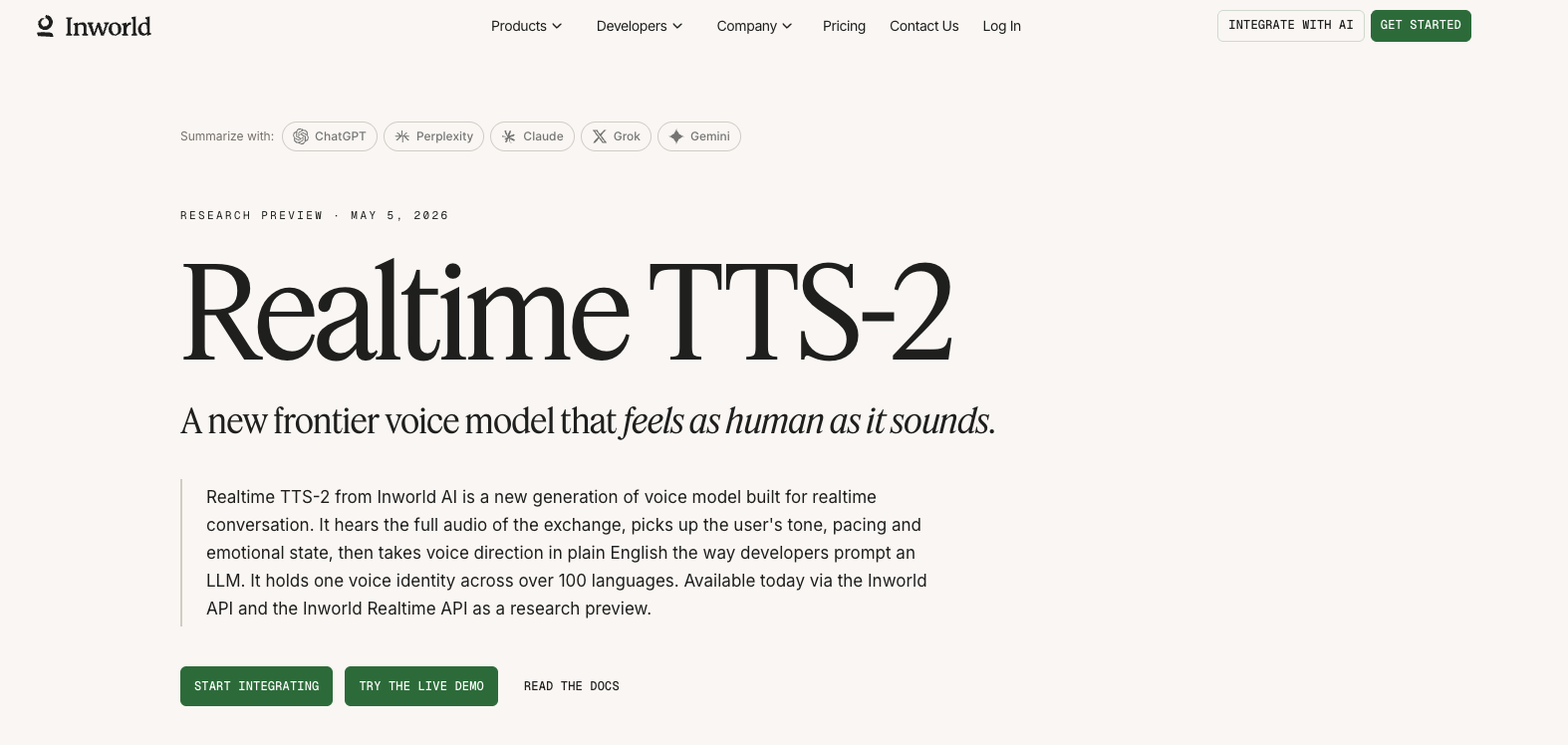
What it does: Inworld Realtime TTS-2 synthesizes streaming speech across more languages than any other production TTS, with one cloned voice holding its identity from English to Hindi to Arabic.
Best for: Engineering groups shipping one agent into many markets at once, and products where a single brand voice has to speak every customer's language natively.
Reading the language documentation is what put Inworld at #1, because it's the only vendor that publishes the honest version of its own coverage.
The model accepts 200+ BCP-47 codes, and the docs then split that into 15 generally available languages and 79 experimental ones, feature by feature. Every other vendor makes you find that split yourself.
The catch sits in the same tables. Text normalization, the machinery that turns "$49.99" into spoken words, works in 12 of the 94 listed languages. An agent quoting prices in Danish or Thai speaks the digits however the model guesses.
Key Features
- 200+ language and locale codes: From broad tags like es down to regional ones like es-MX, so you can steer toward Mexican rather than European Spanish per request.
- Cross-lingual synthesis by default: Realtime TTS-2 speaks the target language natively instead of carrying the source accent, the exact opposite of TTS-1.5, which keeps the accent of the cloning clip.
- Voice localization: Adapt an English-cloned voice into a native-sounding speaker of another language from the portal, with the same voice ID.
- Mid-utterance language switching: One generation can move between languages inside a single sentence, which matters for code-switching callers.
- Benchmark position: Inworld's Realtime TTS 1.5 Max sits at #10 on the Artificial Analysis Speech Arena as of August 2026, down from #1 earlier in the year, and the board reshuffles weekly, so check current standings before you commit.
Pros and Cons
Pros:
✅ The widest honest coverage in the ranking, with the GA/experimental split published rather than buried
✅ One voice identity survives language switches, so a brand voice stays recognizable in every market
✅ Rates drop to $12.50 per 1M characters on the Growth tier, low for a top-ranked model
Cons:
❌ Normalization in 12 of 94 languages means numbers and currency need your own preprocessing almost everywhere
❌ Voice localization currently only accepts English source audio
❌ Timestamps cover 27 of the 79 experimental languages, so caption alignment is a lottery outside the GA list
What Users Say
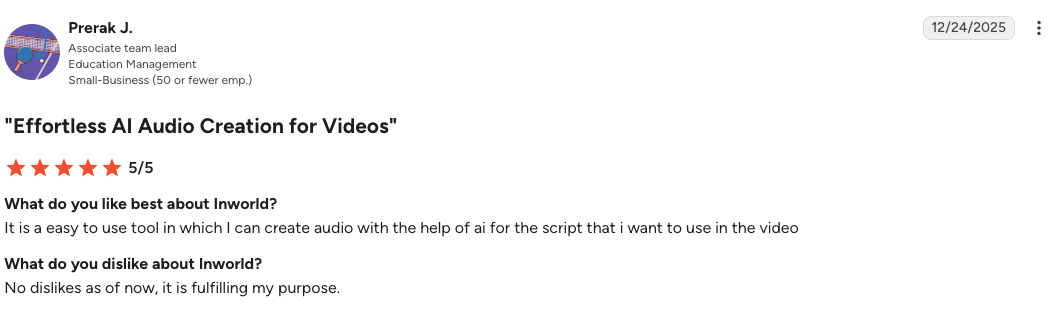
“It is a easy to use tool in which I can create audio with the help of ai” (Prerak J., G2)

“Inworld AI is happy to take your money, but if their system breaks, their support team will stall you” (G A., Trustpilot)
Pricing
Inworld offers a free On-Demand tier, then paid plans from $25/month (Creator) to $1,500/month (Growth). Enterprise pricing goes as low as $5 per 1M characters.
Bottom Line
Take Inworld when the agent has to sound like one speaker across a genuinely global footprint, and budget engineering time for number formatting in the 82 languages without normalization.
Anyone whose deployment lives inside the 15 GA languages gets the least-compromised multilingual TTS on the market.
2. ElevenLabs Eleven v3: Best for the Widest Coverage on One Model
What it does: ElevenLabs generates expressive speech in 74 languages on its Eleven v3 model, with the largest voice library and cloning ecosystem in the industry.
Best for: Content-heavy products, dubbing pipelines, and agents where expressive quality in the top 30 languages matters more than raw response speed.
The number everyone quotes is real, and it belongs to one model. Working through the model documentation, the coverage story splits four ways.
Flash v2.5, the low-latency model a phone agent actually runs on, speaks 32. Multilingual v2 speaks 29, and Flash v2 speaks English, full stop. Pick your model by latency and the language list changes under you.
Within its languages, though, the polish is hard to argue with. On the Artificial Analysis Speech Arena, read 25 August 2026, ElevenLabs v3 Conversational ranks #5 and Eleven v3 ranks #14.
Key Features
- 74 languages on Eleven v3: The longest single-model list of any commercial TTS, spanning Sindhi, Chichewa, and Luxembourgish alongside the majors.
- Automatic in-text language switching: v3 reads mixed-language input and changes language mid-generation without tags.
- Voice cloning across the catalog: Instant clones from short samples, professional clones on Creator plans and above, usable across supported languages.
- Pronunciation dictionaries: Phoneme-level overrides for names and jargon, applied per project.
- ElevenAgents language support: Agent deployments inherit the language lists of v3 Conversational, Flash v2.5, and Turbo v2.5.
Pros and Cons
Pros:
✅ 74 languages under one model ID, with no per-language voice hunting
✅ Strongest expressive quality in the top tier, confirmed by blind listening rather than vendor demos
✅ The $6/month entry plan is the cheapest path to a 30+ language production voice
Cons:
❌ The latency-appropriate models cover far fewer languages than the headline, 32 on Flash v2.5
❌ Default and generated voices carry English phonetics into other languages, so accents drift without native clones
❌ Credit-based billing punishes downgrades, a recurring theme in user complaints
What Users Say
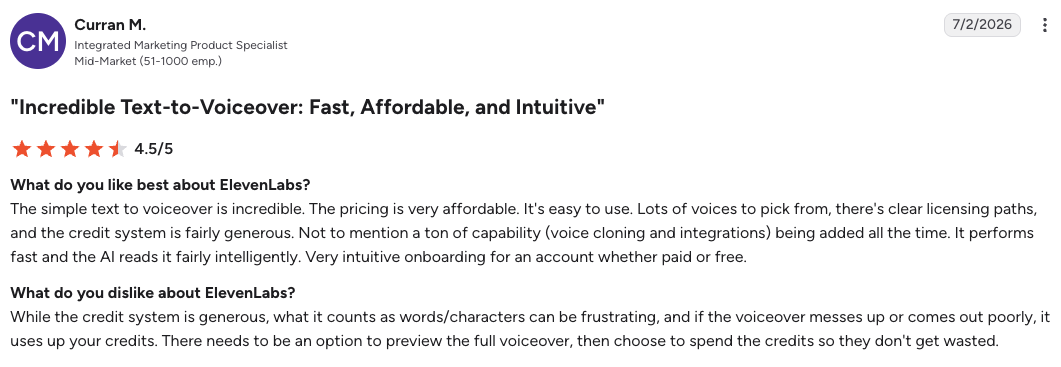
“The simple text to voiceover is incredible. The pricing is very affordable. It's easy to use.” (Curran M., G2)
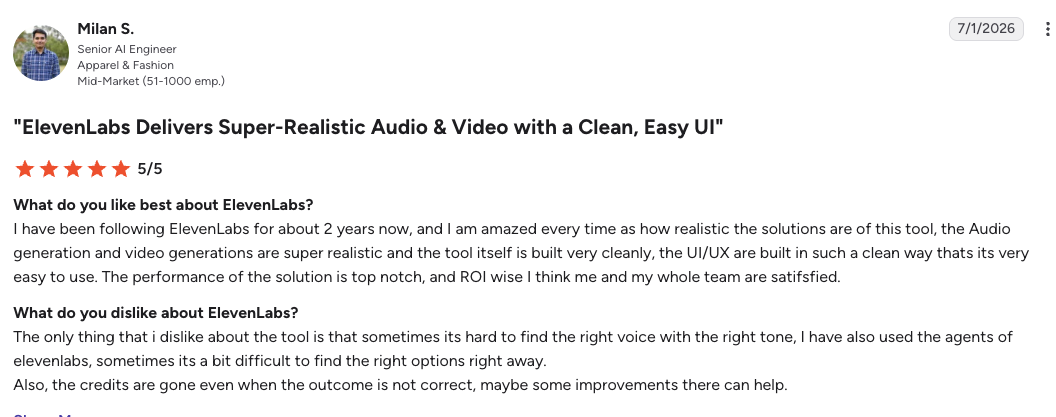
“Sometimes it's hard to find the right voice with the right tone” (Milan S., G2)
Pricing
ElevenLabs runs a free tier, then paid plans from $6/month (Starter) through Creator at $22, Pro at $99, Scale at $299, and Business at $990, with Enterprise by contact.
Bottom Line
ElevenLabs earns the #2 slot for reach and quality, with one instruction attached. Match the language list of the model your latency budget forces you onto, and clone native speakers for any market you care about instead of shipping the default voices.
3. Microsoft Azure AI Speech: Best for Regional Dialects and Locale Variants
What it does: Azure AI Speech provides 600+ neural voices across 150+ languages and locales, the largest documented locale matrix of any TTS vendor.
Best for: Enterprises serving markets where the dialect matters as much as the language, and regulated deployments that need on-premises containers.
Azure's coverage goes a level deeper than a language list. One voice, zh-cn-XiaoxiaoDialects, carries 13 secondary locales on its own, including Sichuan, Henan, and Cantonese variants of Mandarin.
Across the seven platforms in this ranking, no other vendor documents dialect coverage at that grain. The March 2026 price cut on Neural HD voices, from $30 to $22 per 1M characters, also made the premium tier cheaper than Google's equivalent.
The tradeoff is the platform itself. Between Neural, Neural HD, HD Flash, multilingual, and turbo voice classes, each with its own locale list and price, estimating a bill takes a spreadsheet.
Key Features
- 150+ languages and locales: With multiple voices per locale and bilingual variants for markets like en-US/zh-CN.
- DragonHD voices with contextual delivery: LLM-based HD voices detect emotional cues in the input and adjust tone in real time.
- Full SSML with phoneme control: Custom lexicons and IPA input for pronunciation fixes, the most mature markup implementation in the ranking.
- Custom Neural Voice: Train a branded voice from your own recordings, deployable across locales.
- On-premises containers: Run synthesis inside your own network for data-residency requirements.
Pros and Cons
Pros:
✅ Dialect-level locale documentation that no competitor in this ranking matches
✅ Neural HD dropped to $22 per 1M characters in March 2026, undercutting Google's Chirp 3 HD on the premium tier
✅ SSML, lexicons, and viseme support give the finest pronunciation control of any platform here
Cons:
❌ Voice classes, regions, and price tiers interact in ways that make cost forecasting genuinely hard
❌ Some voices and features are region-locked, so your locale list depends on your Azure region
❌ Setup assumes Azure fluency, and the learning curve is steep for anyone outside that ecosystem
What Users Say
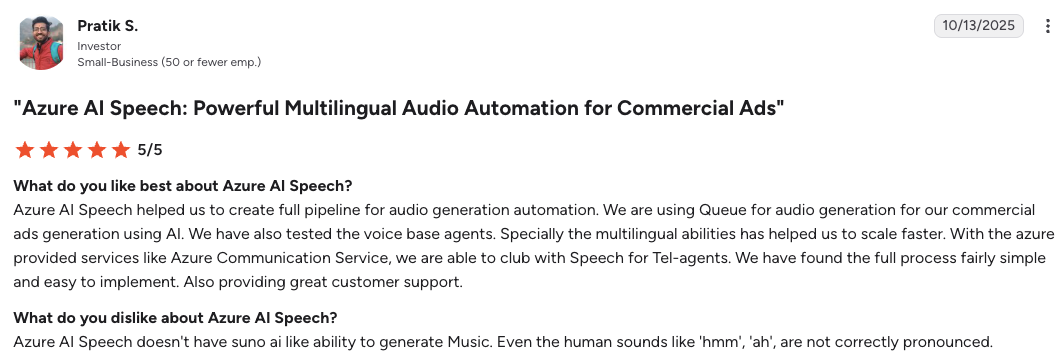
“Azure AI Speech helped us to create full pipeline for audio generation automation” (Pratik S., G2)
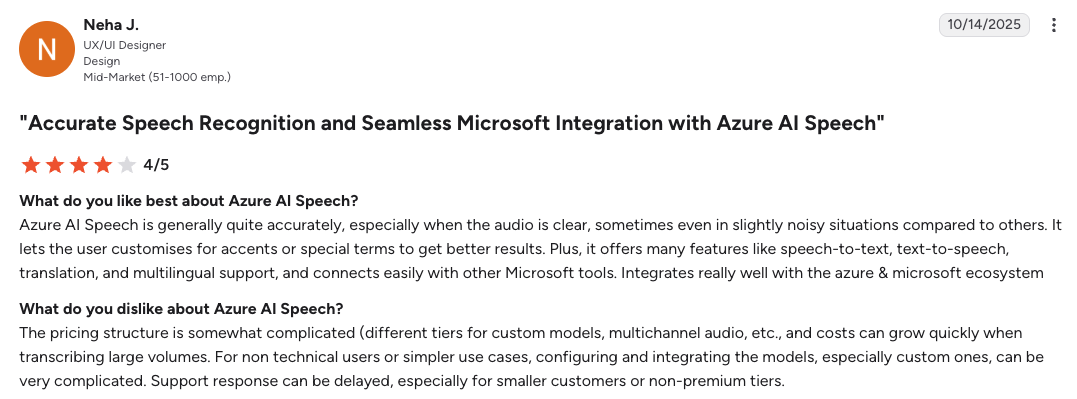
“The pricing structure is somewhat complicated” (Neha J., G2)
Pricing
Azure Speech is pay-as-you-go, with standard neural voices billed per character, Neural HD at $22 per 1M characters as of March 2026, and free monthly grants on the standard tier.
Bottom Line
Azure is the pick when your customers speak a dialect rather than a textbook language, and when procurement already lives in Microsoft's cloud. Buyers without Azure experience should price in the ramp-up time, because the locale matrix rewards people who read documentation.
4. Google Cloud Text-to-Speech: Best for Documented Locale Coverage
What it does: Google Cloud Text-to-Speech runs Chirp 3 HD voices in 53 locales across 47 base languages, with Gemini-TTS adding prompt-steerable delivery in 75+ locales.
Best for: Developers who want to check, in writing and per locale, exactly which control features will work before committing an agent to a market.
Counting through the Chirp 3 HD documentation produced the most useful single table in this entire research pass. All 30 named voices exist in all 53 locales. Pause control works in 38 of those locales.
Custom pronunciation, the IPA and X-SAMPA overrides that fix a mangled medication name, works in 26. That means half the advertised locales ship without a pronunciation fix path, and Google is the only vendor that tells you which half.
The same document settles a second question. SSML works on synchronous requests only, and streaming requests ignore it. Voice agents stream. Plan on markup-free input for live calls.
Key Features
- 53 Chirp 3 HD locales, 30 voices each: Every voice name works in every locale via the <locale>-Chirp3-HD-<voice> pattern, so voice selection decouples from language.
- Per-locale feature tables: Pause control and custom pronunciation availability listed locale by locale, exclusions and all.
- Pace control everywhere: Speaking rate from 0.25x to 2x across all locales, including streaming.
- Gemini-TTS prompt steering: Style, accent, pace, and emotion directed through natural-language prompts in 75+ locales.
- Markup pause tags: [pause], [pause short], and [pause long] inline in text, no SSML required.
Pros and Cons
Pros:
✅ The most transparent per-locale feature documentation of any vendor in this ranking
✅ Voice-locale decoupling means one voice persona scales to 53 markets without recasting
✅ Swahili, Urdu, and five Indian languages sit in the GA list, rare among Western vendors
Cons:
❌ Custom pronunciation is missing in 27 of 53 locales, including Thai, Vietnamese, and Ukrainian
❌ Streaming drops SSML entirely, which removes phoneme fixes from live agents
❌ GCP setup overhead, since billing, service accounts, and API enablement come before the first request
What Users Say
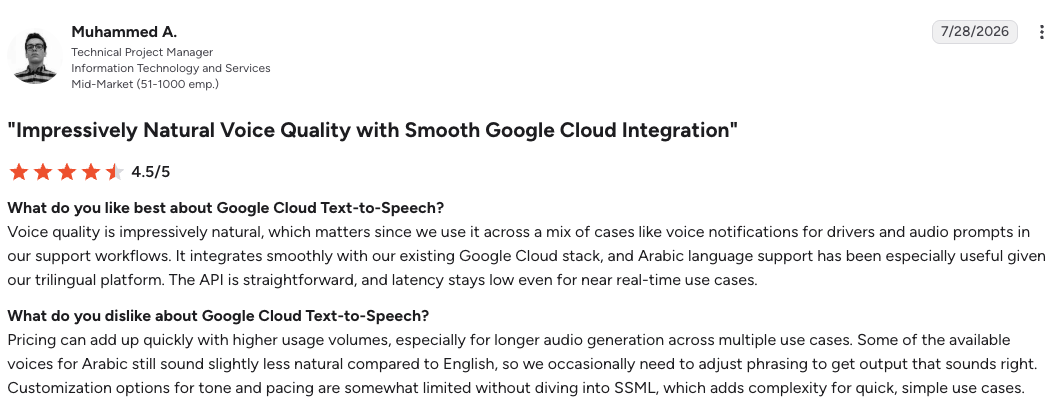
“It integrates smoothly with our existing Google Cloud stack, and Arabic language support” (Muhammed A., G2)
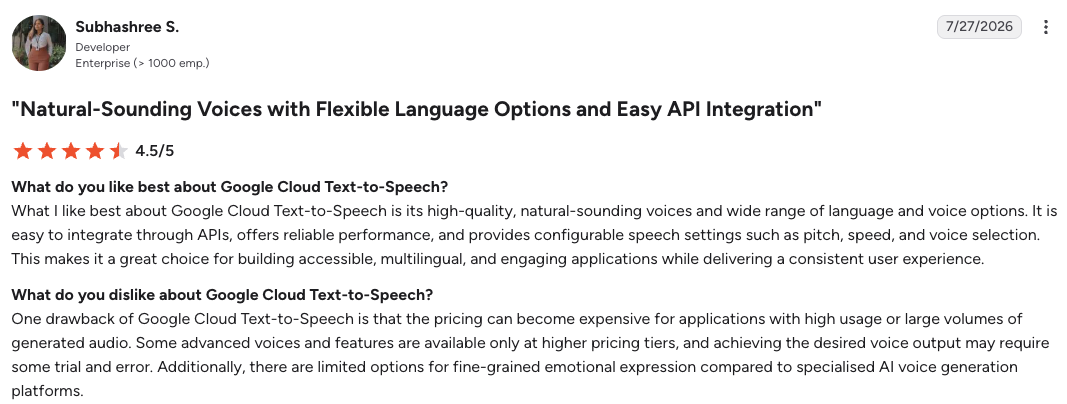
“Pricing can become expensive for applications with high usage or large volumes of generated audio” (Subhashree S., G2)
Pricing
Google Cloud TTS is pay-as-you-go, with Chirp 3 HD at $30 per 1M characters after a 1M-character monthly free allowance, Neural2 at $16, and Gemini-TTS billed on tokens rather than characters.
Bottom Line
Google wins for anyone who treats locale support as an engineering requirement, since the docs let you verify before you build. Skip it if your agent needs phoneme-level fixes in a locale from the excluded list, because no workaround exists on streaming.
5. Cartesia Sonic 3.6: Best for Low-Latency Multilingual Calls
What it does: Cartesia Sonic-3 streams speech in 40+ languages at sub-90ms time to first audio (model latency; real-world time to first audio runs closer to 130ms with network included), built on state space models rather than transformers.
Best for: Phone-facing agents in major commercial languages, where a caller notices a half-second delay before they notice an accent.
The language page lists 47 locale entries, and counting the distinct languages underneath gives 42. Regional variants exist for exactly three of them, English, Spanish, and Portuguese, so a French-Canadian or Gulf-Arabic deployment gets the generic variant.
Nine Indian languages made the list, which is more than most Western vendors manage.
The January 2026 changelog told me more than the marketing page did.
A multilingual quality pass improved most languages while explicitly excluding Hindi, the other Indic languages, Arabic, Hebrew, Chinese, and a few more, with those "targeted for future updates."
That's the level of honesty I want from a vendor. It also tells you which languages to test hardest before launch.
Key Features
- Sub-90ms time to first audio: Cartesia states sub-90ms for Sonic 3.5, among the fastest in this ranking, though that is a model-latency figure and real-world time to first audio runs closer to 130ms with network included.
- Benchmark position: Cartesia Sonic 3.6 ranks #1 on the Artificial Analysis Speech Arena as of 25 August 2026, the highest-scoring model on the board, so the latency pick is currently also the quality pick.
- 42 languages with a growing voice library: A single January drop added 94 voices across 17 locales, including Telugu, Thai, and Hebrew.
- Custom IPA pronunciations: Pronunciation overrides with strengthened adherence per the 2026 changelog.
- In-transcript expressiveness: Laughter and non-verbal cues inserted directly in the text, with emotion inferred from context.
- Model versioning: Dated snapshots like sonic-3-2026-01-12 pin production behavior against silent model updates.
Pros and Cons
Pros:
✅ The best latency-to-language-count ratio in the ranking, 42 languages under 90ms (model latency; real-world time to first audio runs closer to 130ms with network included)
✅ Public changelogs name which languages each quality pass did and did not improve
✅ The $5/month Pro plan is the lowest paid entry among the commercial platforms here
Cons:
❌ Regional variants for three languages only, so most locales get one generic accent
❌ Hindi, Arabic, Hebrew, and Chinese sat outside the most recent quality improvements
❌ Voice cloning localizes into 42 languages, but pro cloning requires a paid tier and a dated model ID
What Users Say

“Cartesia is amazing! They have enabled us to reduce system latency by hundreds of milliseconds” (Julia Szatar, Product Hunt)

“Only caveat is voice agents are super pipeline-dependent, so test it in YOUR stack with real agent-style outputs” (Reviewer, Reddit)
Pricing
Cartesia runs a free plan and paid plans from $5/month for Pro, with Startup at $49/month, Scale at $299/month, and Enterprise by contact.
Bottom Line
For a voice agent living or dying on response time across the major commercial languages, Cartesia is the strongest package here. Deployments centered on Hindi, Arabic, or Chinese should run their own listening tests first, since Cartesia's own changelog flags those as work in progress.
6. MiniMax Speech 2.6: Best for Asian Languages and Spoken Formatting
What it does: MiniMax Speech 2.6 converts text to speech in 40 languages with end-to-end latency under 250ms and 300+ system voices.
Best for: Deployments anchored in Chinese, Japanese, Korean, or Southeast Asian markets, and any agent that reads structured data aloud all day.
The feature that earned MiniMax its slot has nothing to do with voice quality. Speech 2.6 directly converts URLs, email addresses, phone numbers, dates, and monetary amounts into spoken form across its languages.
That's the normalization work Inworld covers in 12 languages, handled natively, and it's precisely what a booking or billing agent says on every single call.
Cloning follows the same multilingual logic. A 10-second sample produces a voice that speaks all 40 languages, and the 2.6 release added one-click fluency for cloned voices across the full list.
The weak side is everything around the model, since English documentation trails the Chinese original and Western integration examples stay thin.
Key Features
- 40 languages with dialect support: Documented across both the HD and Turbo variants, with particular strength in Mandarin and Cantonese.
- Sub-250ms end-to-end latency: A rebuilt generation pipeline puts total latency under 250ms, fast enough that TTS stops being the bottleneck.
- Native spoken formatting: URLs, emails, phone numbers, dates, and currency read correctly without preprocessing.
- 10-second voice cloning: One clip yields a voice usable across every supported language with native pronunciation.
- Long-text mode: Asynchronous synthesis handles up to 1 million characters per request for narration workloads.
Pros and Cons
Pros:
✅ The strongest Chinese and broader Asian-language coverage among the seven
✅ Spoken formatting of structured data solves the defect that plagues booking and payment agents
✅ Long-text mode synthesizes up to 1 million characters per request for audiobook and narration workloads
Cons:
❌ English-language documentation lags the Chinese version, which slows debugging
❌ Smaller Western community, so fewer integration examples for common agent stacks
❌ Model IDs churn quickly across 02, 2.5, 2.6, and 2.8 generations, and pricing pages mix them
What Users Say

"Its cloning technology delivers remarkably accurate voice replication" (Reviewer, Product Hunt)

"My main issue with them is that their file size seems to be smaller" (Reviewer, Reddit)
Pricing
MiniMax bills pay-as-you-go, with speech-2.6-turbo at $60 per 1M characters and speech-2.6-hd at $100 per 1M characters.
Bottom Line
MiniMax belongs on the shortlist of anyone whose call volume leans Asian-Pacific, and its structured-data handling alone justifies a trial for billing-heavy agents anywhere. Buyers who need deep English-language support channels will spend more time in translation than they'd like.
7. Chatterbox Multilingual V3: Best for Self-Hosted Deployments
What it does: Chatterbox Multilingual V3 is Resemble AI's open-source TTS, a 0.5B-parameter model covering 23+ languages with zero-shot voice cloning under an MIT license.
Best for: Privacy-bound deployments that can't send audio to a third-party API, and engineering groups that want to own their multilingual voice stack end to end.
The 23-language list runs from Arabic and Hindi through Swahili, Hebrew, and Chinese, and V3 specifically improved speaker similarity across language switches while cutting hallucinated continuations.
Resemble also ships dedicated single-language finetunes for Chinese, Hindi, and four Spanish and Portuguese variants where tighter quality control matters. The community reception was strong, and Chatterbox routinely pulls over 2 million Hugging Face downloads a month
The model card warns that a reference clip in the wrong language makes cross-language output inherit that clip's accent, so a French agent cloned from English audio speaks French with an English accent unless you zero the CFG weight.
Key Features
- 23 languages, MIT licensed: Commercial use with no per-character fees and no vendor dependency.
- Zero-shot multilingual cloning: A 10-second reference clip transfers a speaker across every supported language.
- Single Language Pack finetunes: Dedicated models for six priority languages where the general model needed sharper control.
- PerTh watermarking: Every generation carries an imperceptible watermark that survives re-encoding, useful for provenance and audit.
- Chatterbox Turbo for latency: A 350M-parameter English variant with a one-step decoder for low-latency agent turns.
Pros and Cons
Pros:
✅ Zero marginal cost per character, which changes the economics of high-volume multilingual synthesis
✅ Benchmarked competitively against closed models in blind evaluations, unusual for a 0.5B model
✅ The default watermarking gives compliance and provenance for free
Cons:
❌ You own inference, scaling, and latency engineering, and self-hosted numbers depend entirely on your hardware
❌ The low-latency Turbo variant covers English only, so multilingual agents run the slower general model
❌ Accent transfer from mismatched reference clips demands per-language cloning discipline
What Users Say
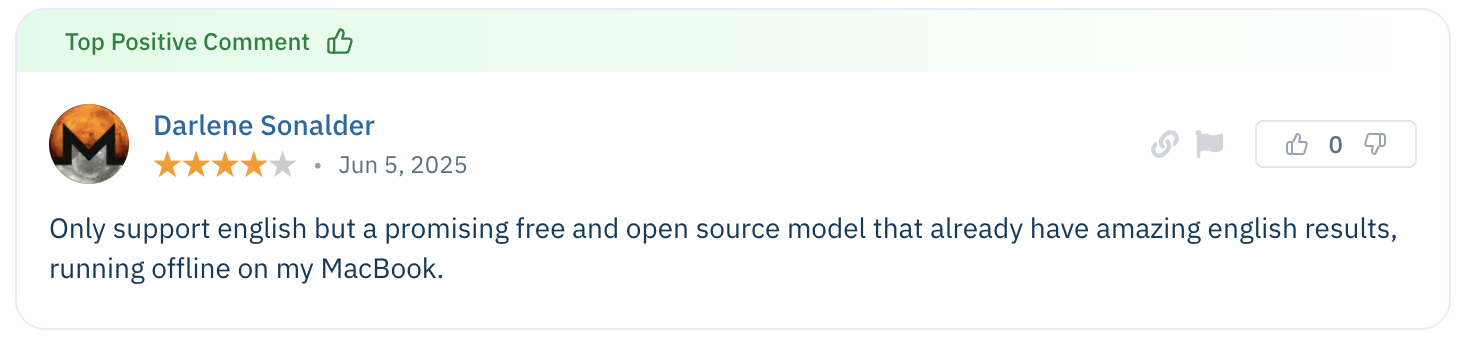
"…a promising free and open source model that already have amazing english results, running offline on my MacBook." (Darlene Sonalder, AlternativeTo)
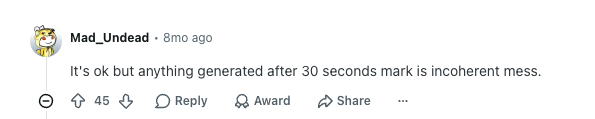
“It's ok but anything generated after 30 seconds mark is incoherent mess.” (Reviewer, Reddit)
Pricing
Chatterbox is free under MIT for commercial and personal use. Your costs are GPU inference and the engineering time to run it, and Resemble sells a hosted version for anyone who'd rather not.
Bottom Line
For a self-hosted stack, nothing else combines this language list, this license, and this cloning quality. Anyone without infrastructure appetite should buy one of the six platforms above instead, because the per-character savings evaporate into DevOps time fast.
Code-Switching Inside a Single Call
Every roundup compares language lists. Almost none of them ask what happens when a caller changes language mid-sentence, which is exactly what 125+ million English speakers in India and millions of Spanglish speakers in the US do on real calls.
The platforms handle it in three distinct ways. Inworld switches inside a single generation, holding one voice identity through the transition. ElevenLabs' Eleven v3 auto-detects language changes from the text itself.
Rime and Amazon Polly sit outside the ranking because neither clears 25 documented locales, but both solve the code-switching half of the problem better than most platforms that do.
Rime built its Arcana models so that every voice speaks every supported language, letting an agent shift mid-conversation without sounding like a new speaker, and its earlier work made English-Spanish-Spanglish switching a first-class feature rather than an accident.
Amazon Polly attacks the identity half of the problem. Its polyglot capability gives six generative voices the same vocal identity as the US English voice Matthew across French, German, and three Spanish variants, so a brand voice survives a language change.
The constraint is scope, since the generative engine that supports this covered 31 voices across 20 locales as of November 2025, with 10 more voices added in March 2026, a fraction of Polly's 40+ nominal language variants.
Test this scenario explicitly before launch. A TTS that renders both languages beautifully in isolation can still butcher the sentence that contains both.
Cekura drives a single test call through a mid-sentence language change, so the code-switch is a scored scenario before launch instead of a discovery in production.
Numbers, Dates, and Currency in Non-English Locales
The most expensive TTS defect in production voice agents is also the least glamorous, and it's how the model speaks "$49.99," "03/04/2026," or a 10-digit confirmation number in the caller's language.
Text normalization at Inworld is language-specific rather than locale-specific, so English normalizes identically whether you target en-US or en-GB, even though the two disagree on date order and currency phrasing.
A UK caller hearing an American date reading is a bug the language list will never warn you about. The same docs note that language auto-detection struggles on short inputs made of digits, and short digit strings are most of what a confirmation flow says.
The spread across vendors is wide. MiniMax converts URLs, phone numbers, dates, and money natively across its languages.
Google exposes normalization through locale-specific voices but strips SSML from streaming requests. Inworld covers 12 of 94 languages. If your agent quotes prices, run a currency script through every target locale before you sign anything.
Cekura turns that script into scored scenarios. Prices, dates, and confirmation numbers run in each target locale, so a locale that mangles currency is caught before a caller hears it.
Which Multilingual TTS Platform Should You Choose?
No platform wins all five scoring criteria, so the honest answer depends on your locale list and your latency budget.
Choose Inworld if you:
- Need one brand voice speaking dozens of languages with mid-utterance switching
- Can preprocess numbers and currency yourself outside its 12 normalized languages
Choose ElevenLabs if you:
- Want maximum language reach with the strongest expressive quality per language
- Can live with a smaller list on the low-latency models real agents use
Choose Azure if you:
- Serve dialect-sensitive markets where province-level variants matter
- Already run infrastructure and procurement through Microsoft
Choose Google Cloud TTS if you:
- Want per-locale feature availability documented before you build
- Can design agents around markup-free streaming input
Choose Cartesia if you:
- Are building phone agents where sub-90ms response time is the product
- Deploy mostly in major commercial languages rather than Indic or Middle Eastern ones
Choose MiniMax if you:
- Anchor in Chinese, Japanese, Korean, or Southeast Asian markets
- Read structured data like prices and confirmation numbers aloud constantly
Choose Chatterbox if you:
- Can't send audio to a third-party API for privacy or residency reasons
- Have the engineering capacity to own inference and scaling
Skip this category entirely if:
- Your agent serves one language in a low-stakes flow, where any basic cloud TTS already covers you
- You need a no-code agent builder, since these are synthesis engines rather than full agent platforms
Final Verdict
Among the top multilingual TTS voice AI platforms in 2026, Inworld Realtime TTS-2 takes the overall win for publishing honest coverage and holding one voice across the most languages, with ElevenLabs the pick when expressive quality in the top 30 languages outranks everything else.
Azure wins dialects, Google wins documentation, Cartesia wins latency, MiniMax wins Asia and spoken formatting, and Chatterbox wins the self-hosted case outright.
Treat all of it as a shortlist. These rankings score each engine on vendor documentation and vendor audio. Cekura scores your build on your locales, inside live agent calls, against the flows you ship.
How to Validate a Multilingual Voice Agent Before Launch
Picking the TTS is the start of the multilingual problem rather than the end of it, because the recognition side degrades faster than the synthesis side.
A study of five commercial speech systems in PNAS measured an average word error rate of 0.35 for Black speakers against 0.19 for white speakers, and later work on a World Englishes evaluation set reported 3 to 5 times higher error rates for Asian and non-Iberian Romance accents relative to inner-circle English.
Your beautifully synthesized Spanish reply means little if the agent misheard the Spanish question.
Four practices catch multilingual defects before callers do:
- Test the accent alongside the language. A Chennai English speaker and a London English speaker stress the same agent differently, so run both against every flow that touches money or identity.
- Script the structured data. Prices, dates, phone numbers, and confirmation codes in every target locale, spoken and recognized, before any launch sign-off.
- Force the code-switch. Insert mid-sentence language changes into test conversations, since this is where single-language test suites go blind.
- Re-run everything on every change. A prompt tweak or TTS model swap that improves English can regress Tamil, and only a regression suite notices.
Cekura tests this layer before production traffic arrives.
Where it fits across the lifecycle:
- Pre-production: Language-and-accent personality matrices generate hundreds of test conversations per flow, and scenario suites replay them against every prompt or model change.
- Pre-production: Evaluators run in-language, including Tagalog and code-switched Tagalog-English, so scoring keeps up with what callers actually say.
- Infrastructure: A triple speech-to-text pipeline routes each language to the engine that transcribes it best, keeping accent and code-switching defects visible instead of averaged away.
- Infrastructure: Interruption, background noise, and latency conditions layer onto any language, since a Hindi caller on a noisy line is the real test.
- Observability: Production calls get transcription accuracy scoring with per-utterance WER, so a locale that degrades after a vendor update surfaces in a dashboard rather than a complaint.
Cekura connects natively to Retell, VAPI, ElevenLabs, LiveKit, Pipecat, Bland, and more, so whichever TTS you picked above slots straight into an existing test harness.
It's SOC 2, HIPAA, and GDPR compliant for transcript redaction, role-based access, and audit trails.
Shipping a voice agent into more than one language? Book a demo and run your hardest locale against it first.
Frequently Asked Questions
What is the top multilingual TTS voice AI platform in 2026?
Inworld Realtime TTS-2 is the top multilingual TTS voice AI platform in 2026 because it holds one voice identity across the largest tested language set and switches languages mid-utterance.
ElevenLabs Eleven v3 is the stronger pick when expressive quality within its 74 languages matters more than cross-lingual voice consistency.
Which TTS platform supports the most languages?
Microsoft Azure AI Speech supports the most languages and locales, with 600+ neural voices across 150+ languages and locales. Inworld accepts more raw language codes at 200+, but its actively tested list is 15 generally available languages plus 79 experimental ones.
Can a TTS voice switch languages in the middle of a call?
Yes, several platforms handle a language switch mid-call.
Inworld Realtime TTS-2 switches inside a single generated utterance, ElevenLabs Eleven v3 auto-detects language changes in the input text, and Rime's Arcana voices each speak every supported language so the speaker stays consistent through the switch.
Is an open-source multilingual TTS good enough for production?
Yes, an open-source multilingual TTS can run in production if you own the infrastructure.
Chatterbox Multilingual V3 covers 23 languages under an MIT license and benchmarks competitively against closed models, but you take on inference hosting, latency engineering, and per-language cloning discipline that a managed API would handle for you.
How do I test a multilingual voice agent before launch?
Test a multilingual voice agent by running simulated calls across every target language, accent, and code-switching pattern before real traffic arrives.
Automated platforms like Cekura generate these conversations at scale and score transcription accuracy per locale, which catches the recognition-side errors that a World Englishes evaluation set found run 3 to 5 times higher for Asian and non-Iberian Romance accents than for inner-circle English.