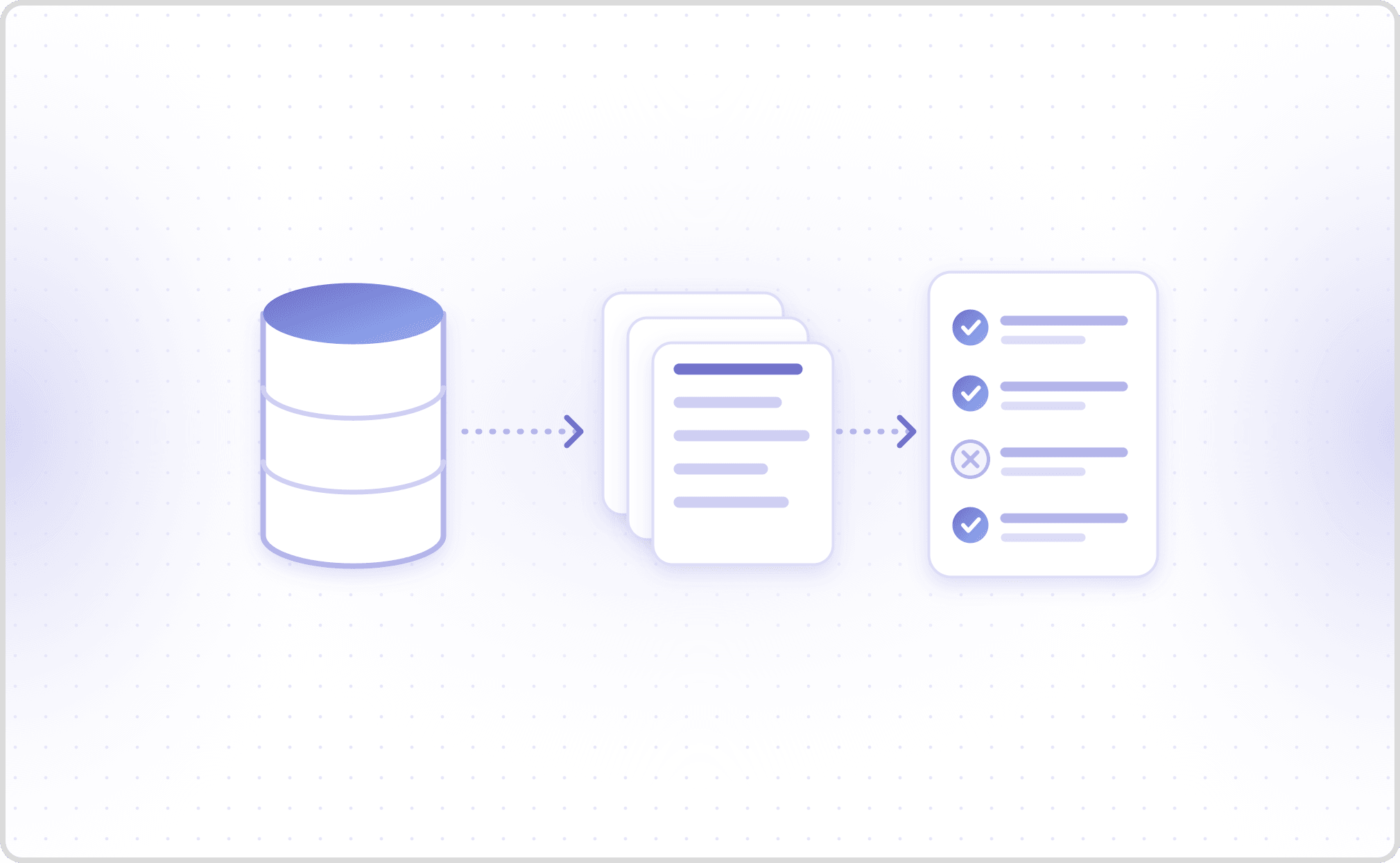
An LLM eval framework is the system you use to grade a model's outputs against a benchmark, rubric, or reference answer, then track whether scores hold steady or slip across model versions. It combines a dataset, a grading method, and a way to compare runs over time.
What Is an LLM Eval Framework?
This guide covers one specific layer of LLM evaluation: grading what a model outputs for a single prompt or a single turn, the kind of scoring behind a benchmark leaderboard or an LLM-as-judge pipeline. If you need the basic definition of an eval first, including how a dataset, task, grader, and threshold fit together, the evals glossary covers that ground.
An LLM eval framework narrows that general idea to model output specifically. You feed it prompts, capture what the model returns, and score each response against a rubric or a reference answer. That is different from evaluating a multi-step agent that calls tools, holds a conversation across turns, and completes a task end to end. Agent-level evaluation checks whether the whole trajectory succeeded. An LLM eval framework checks whether one output, on its own, was correct, safe, or useful.
Most teams need both, but they solve different problems. Get the output-level grading wrong and every downstream agent behavior inherits the error. Get it right and you have a stable base to build more complex evaluation on top of.
Benchmark Suites vs. Custom Eval Harnesses
You have two starting points, and most serious eval setups end up using both.
A benchmark suite is a pre-built, scored dataset that tests general capability. You run the model against it and get a score you can compare against other models and other labs' published results. OpenAI Evals, an open-source framework and benchmark registry, is a working example: it ships existing benchmarks you can run without writing evaluation code, using a YAML template and a JSON dataset.
A custom eval harness is a dataset and grading rubric you build around your own product. It tests the prompts, edge cases, and failure modes that actually show up in your application, which a general benchmark was never designed to catch.
| Approach | What it tests | Setup cost | Best for |
|---|---|---|---|
| Standard benchmark suite | General capability across many tasks | Low, run an existing scored dataset | Comparing base models before you commit to one |
| Custom eval harness | Behavior specific to your product's prompts | High, you write the dataset and rubric | Catching regressions in your actual use case |
Benchmark suites tell you whether a model is broadly capable. A custom harness tells you whether it is capable at your task. Skipping the second one is how a model that tops an LLM benchmark leaderboard still fails in production on your specific prompts.
What Standard Benchmark Leaderboards Actually Measure
"State of the art" gets repeated a lot in model announcements, and it means something specific and narrow every time: a score on one benchmark, under one set of conditions, on one date. Here is what a handful of the most-cited LLM benchmarks actually test.
| Benchmark | What it tests | Format |
|---|---|---|
| MMLU | 57 subjects spanning academic and professional knowledge, from elementary math to law | Multiple-choice accuracy |
| GPQA Diamond | 198 graduate-level science questions in biology, physics, and chemistry, the subset where experts answer correctly and most skilled non-experts with unrestricted web access do not | Multiple-choice accuracy |
| HumanEval | 164 hand-written programming problems, each checked against unit tests | pass@k |
| GSM8K | Roughly 8,500 grade-school math word problems needing multi-step reasoning | Exact-match accuracy |
| TruthfulQA | 817 questions across 38 categories, built to trigger common misconceptions | Truthful-answer rate |
The original MMLU paper is worth reading directly rather than trusting a summary of it: it introduced the 57-subject test specifically because prior benchmarks let models look competent without demonstrating broad knowledge, and it found that even the best models of that era needed real improvement before reaching expert-level accuracy on every one of the 57 tasks (Hendrycks et al., "Measuring Massive Multitask Language Understanding," arXiv). pass@k, the metric behind HumanEval, measures the probability that at least one of k generated code samples passes the held-out unit tests. It rewards a model for getting a working answer within a few tries, not on the first attempt every time, which matches how developers actually use code generation.
Reading Model Benchmark Claims Correctly: A Qwen Example
Model cards and leaderboard posts rarely tell you the full story behind a number. Alibaba's Qwen LLM family is a useful case study because its own technical report shows how much a single benchmark score depends on details that are easy to skip past.
Qwen3-235B-A22B, the flagship model in the Qwen3 release, activates 22 billion of its 235 billion total parameters per token, a mixture-of-experts design that keeps inference cheaper than a dense model of the same total size. Run in "thinking" mode, meaning it generates extended reasoning before answering, it scores 92.7 on MMLU-Redux and 71.1 on GPQA-Diamond. Run in standard non-thinking mode, the same model scores 89.2 on MMLU-Redux and 62.9 on GPQA-Diamond, a meaningful drop from turning off extended reasoning alone. The report also states that Qwen3-235B-A22B in thinking mode outperforms DeepSeek-R1 on 17 of the 23 benchmarks tested, despite activating roughly 60% as many parameters per token (Qwen Team, "Qwen3 Technical Report," arXiv).
Two things follow from that. First, "Qwen beats DeepSeek-R1" is true on most of one specific benchmark set, not a blanket claim, and it is not true on all 23 benchmarks in that same report. Second, thinking mode and non-thinking mode are not the same model for scoring purposes, and a benchmark comparison that does not say which mode it used is not a comparison you can trust. An eval framework worth using forces you to record that kind of detail, because it is exactly the detail marketing copy tends to drop.
Automated Evaluation: How LLM-as-a-Judge Works
LLM-as-a-judge uses a second model to score a first model's output against criteria you define, instead of a human doing that scoring by hand. It is the most flexible way to grade thousands of open-ended responses without a human evaluator reading every one. Reference-based metrics like BLEU and ROUGE also scale, but they need a gold answer to compare against and correlate poorly with human judgment on open-ended tasks.
G-Eval, introduced by Liu et al. in 2023, prompts a judge model with chain-of-thought instructions to generate evaluation steps before scoring, then weights the final score by the judge's token probabilities rather than taking its raw answer at face value, which is the step that separates it from simply asking a model for a score out of five.
LLM judges are not neutral graders, and the research on this is specific rather than vague. A widely cited study introducing the MT-Bench and Chatbot Arena benchmarks found that on MT-Bench, strong LLM judges like GPT-4 agree with human preference judgments 85% of the time once tied votes are excluded, similar to the 81% agreement rate among human judges under the same non-tie setup. Counting tied and split votes, agreement drops to 70% for GPT-4 and 63% between human judges. The same paper examines where judges go wrong: position bias (favoring whichever answer appears first in a side-by-side comparison), verbosity bias (favoring longer answers regardless of quality), and limited reasoning ability on tasks that need real math or logic rather than surface-level fluency; it measures position and verbosity bias directly, and reports that its data could not determine whether a self-enhancement bias, a model judge scoring outputs from its own model family more favorably, is present (Zheng et al., "Judging LLM-as-a-Judge with MT-Bench and Chatbot Arena," NeurIPS 2023). A full comparison of LLM-as-a-judge against other grading methods, including where it breaks down completely, is covered in this guide to LLM-as-a-judge.
None of that makes LLM-as-a-judge unusable. It makes it a tool with known failure modes you should test for, the same way you would document any measurement instrument's error bars before trusting its readings.
Human Evaluation and When You Still Need It
Automated LLM evaluation is fast and cheap per response. It is not a full replacement for a person reading the output, and no eval framework worth using treats it that way.
| Method | Speed | Cost per response | Best for |
|---|---|---|---|
| LLM-as-a-judge | Fast, thousands per hour | Low, one API call | High-volume screening, regression checks between model versions |
| Human evaluation | Slow, dozens per hour per rater | High, requires trained reviewers | Subjective quality, tone, safety edge cases, judge calibration |
Human evaluation is how you catch what a judge model was never trained to notice, and it is also how you check whether the judge model itself is any good. The same MT-Bench study puts human-to-human agreement at 81% under its non-tie setup, close to the 85% it measures for GPT-4 as a judge on the same basis, though both figures drop once tied votes are counted (70% for GPT-4, 63% for humans), which is worth remembering before you treat one reviewer's score as ground truth. A judge that matches your raters is not necessarily right; it is as consistent as your raters are. The practical pattern most teams land on: human review to build and calibrate the rubric, then LLM-as-a-judge to apply it at scale, with a smaller human sample re-checked on a schedule to catch drift.
How Your Framework Choice Affects CI/CD
An eval framework that only runs manually, once a quarter, catches regressions long after they ship. One wired into your pipeline catches them before a merge does.
The pattern that works looks like unit testing, applied to model outputs instead of code paths:
-
Define a scored eval set that represents your real traffic, not just easy cases.
-
Run it automatically on every pull request that touches a prompt, a model version, or a retrieval step.
-
Set a pass-rate threshold below which the build fails, the same way a broken unit test would block a merge.
-
Run a smaller, faster subset on every commit, and the full suite on a schedule, since LLM-as-a-judge calls cost real money and add real latency per run.
Eval gates catch regressions before a merge. They do not tell you what a model is doing once it is live, which is a separate discipline; LLM observability covers the production-monitoring side that picks up after the gate passes.
Frameworks differ in how well they support this. Some, like DeepEval, are built around a pytest-style interface specifically so evals can sit inside existing CI tooling rather than requiring a separate pipeline. Others, like the academic benchmark suites, were built for one-time model comparison and need real engineering work bolted on before they fit a CI gate. That difference matters more than almost anything else if your team ships prompt or model changes weekly rather than quarterly.
Comparing Popular LLM Eval Frameworks
| Framework | Type | Benchmark registry | Custom evals | CI/CD fit |
|---|---|---|---|---|
| OpenAI Evals | Open-source, template-based | Yes, existing registry | Yes, via YAML/JSON, no code required for template-based evals | Moderate, needs custom wiring |
| DeepEval | Open-source, pytest-style | Yes, 16 standard benchmarks | Yes, extensive custom metric support | Strong, built for unit-test-style CI runs |
| HELM (Stanford CRFM) | Open-source, research-oriented | Yes, 16 core scenarios across 7 metrics | Limited, designed for standardized comparison | Weak, built for public leaderboard research, not CI gating |
None of these is a universal right answer. A team validating a base model before committing to it wants HELM's standardized, multi-metric comparison. A team shipping prompt changes weekly wants something closer to DeepEval's CI-first design. A team that just needs to run existing benchmarks without writing scoring code has a reasonable starting point in OpenAI Evals.
Where LLM Eval Fits Into a Voice or Chat Agent Pipeline
Benchmark scores, judge models, and human review all grade a model's output in isolation. In production, that output rarely stands alone. It gets passed to a text-to-speech engine, wrapped in a voice pipeline, or chained into a multi-turn conversation, and the eval framework you build for grading raw model outputs becomes the layer other testing sits on top of.
Cekura's own benchmark data shows why that layer matters. Across seven production configurations tested on the same 82 caller scenarios, single-run task completion ranged from 87.8% to 97.6%, while pass-cubed reliability on those same configurations, where a scenario only counts as a pass if it succeeds on all three retained runs, ranged from 30.5% to 75.6%, with calls that failed to connect or returned no transcript left in the denominator (per Cekura's benchmarks, read 2026-08-26). Providers chose their own models and speech components for six of the seven; Cekura tested the OpenAI configuration directly. That gap between a one-shot success rate and a repeatable one is close to the whole argument for treating LLM output evaluation as a discipline rather than a single number: four of those seven pipelines run on GPT-4.1, and the reasoning quality of that model is one layer beneath the end-to-end number a buyer actually sees.
Cekura tests, monitors, and self-improves voice and chat agents built on top of these models, and the eval framework concepts in this guide, benchmark suites, LLM-as-judge scoring, human calibration, are the same building blocks that layer depends on. If you are building or buying an eval framework for raw model outputs, it is worth asking the same repeatability question Cekura asks of full agents: does this pass once, or does it pass reliably across repeated runs. If you are extending that discipline past a single model output into a full voice or chat agent, talk to the Cekura team about running it against your own agent.
Choosing the Right LLM Eval Framework for Your Team
There is no single best framework, only a best fit for what you are testing and how often you ship changes. A few questions narrow it down fast:
-
Are you comparing base models, or testing your own product? Comparing models favors a standard benchmark suite. Testing your own product favors a custom harness built on your real prompts.
-
How often do you ship prompt or model changes? Weekly or faster favors a framework with a test-runner interface that drops into existing CI. Quarterly model evaluations can tolerate a heavier, research-style tool like HELM.
-
What is your budget for judge-model API calls? LLM-as-a-judge scales further than human review, but it is not free, and a large eval set run on every commit adds up fast.
-
Do you need output-level grading, or full agent evaluation? This guide covers grading a model's own output. If your system calls tools, holds multi-turn conversations, or completes multi-step tasks, you need an evaluation approach built for trajectories, not single responses, which is a different and broader problem. Cekura evaluates at that broader layer, scoring full voice and chat agent runs rather than single model outputs, which is the natural next step once your output-level eval framework is in place.
Most teams that get this right do not pick one framework and stop. They start with a benchmark suite to screen candidate models, add a custom harness for their specific use case, and layer in LLM-as-a-judge once the eval set is too large for a human to grade by hand.
Frequently Asked Questions
What's the difference between an LLM eval framework and a single benchmark?
A benchmark is one scored dataset, like MMLU or GSM8K. An LLM eval framework is the broader system around it: the dataset, the grading method, the pass/fail threshold, and the process for running it repeatedly as models or prompts change. You can use a benchmark without a framework, but you cannot track regressions over time without one.
Is LLM-as-a-judge reliable enough to replace human evaluation?
For high-volume screening and regression checks, yes, with known limits. On the MT-Bench setup, GPT-4 as a judge agreed with human preferences 85% of the time when tied votes are excluded, similar to the 81% rate at which human judges agreed with each other on the same basis; counting ties, agreement drops to about 70% for GPT-4 and 63% for humans. Judges also show measurable position and verbosity bias. Most teams use LLM-as-a-judge at scale and keep a human sample to calibrate and catch drift.
How often should you re-run your LLM eval suite?
Run a fast subset on every change that touches a prompt, model version, or retrieval step, and the full suite on a schedule, such as nightly or before a release. Waiting until a quarterly review catches regressions long after they have shipped to users.
What is pass@k, and how is it different from accuracy?
Accuracy checks whether a single output is correct. pass@k checks whether at least one of k generated attempts is correct, which better reflects how developers actually use a model that can retry. HumanEval is the benchmark that made pass@k standard for code generation.
Do I need a different eval framework for open-source vs. proprietary models?
Not structurally. The same benchmark suites, custom harnesses, and judge-based scoring apply to both. What changes is what you can verify: an open-source model's weights and training details are usually inspectable, while a proprietary model's benchmark claims often depend on details, like thinking mode versus standard mode, that only show up if the vendor's technical report states them explicitly.
Does a strong benchmark score mean a model will perform well in production?
Not on its own. A benchmark score tells you about general capability under controlled conditions on a fixed dataset. It does not test your specific prompts, your edge cases, or how the model behaves once it is wired into a larger pipeline. That gap is exactly what a custom eval harness is built to close.
Building an LLM eval framework is less about picking one tool and more about matching the grading method to what you are actually trying to catch. Start with a benchmark suite to screen models, add a custom harness for your real use case, and treat any single benchmark score, including ones cited in this guide, as a snapshot rather than a verdict.