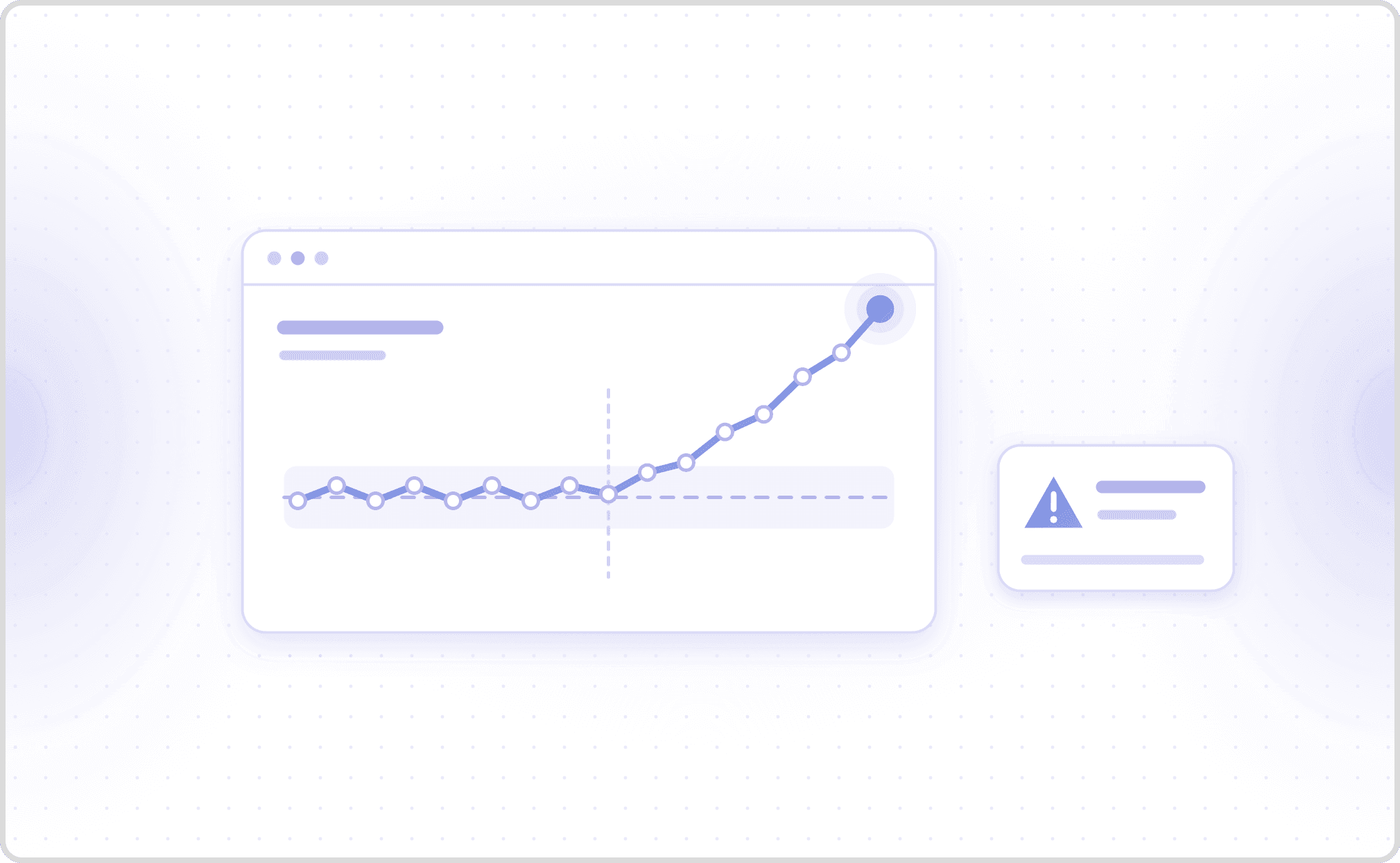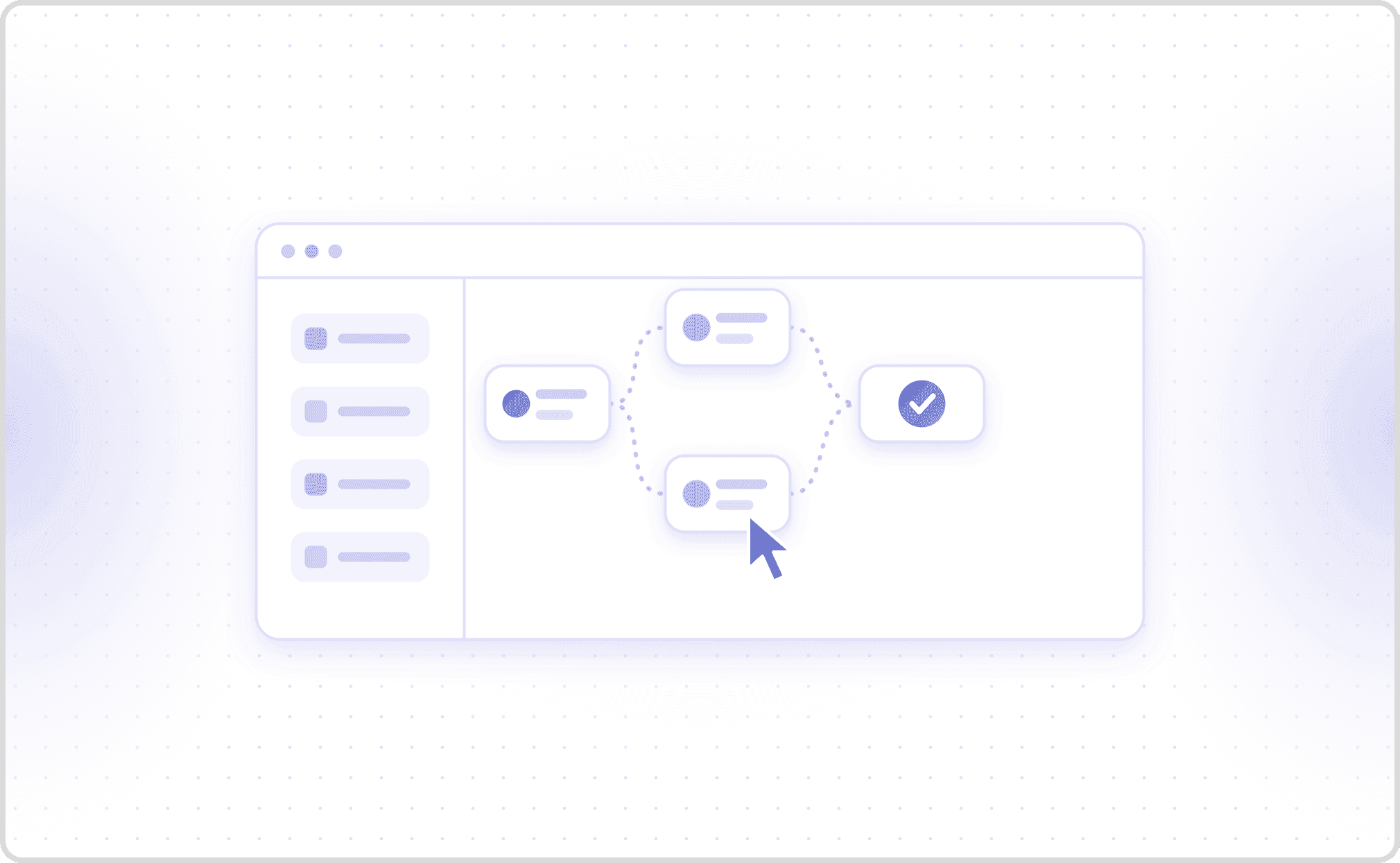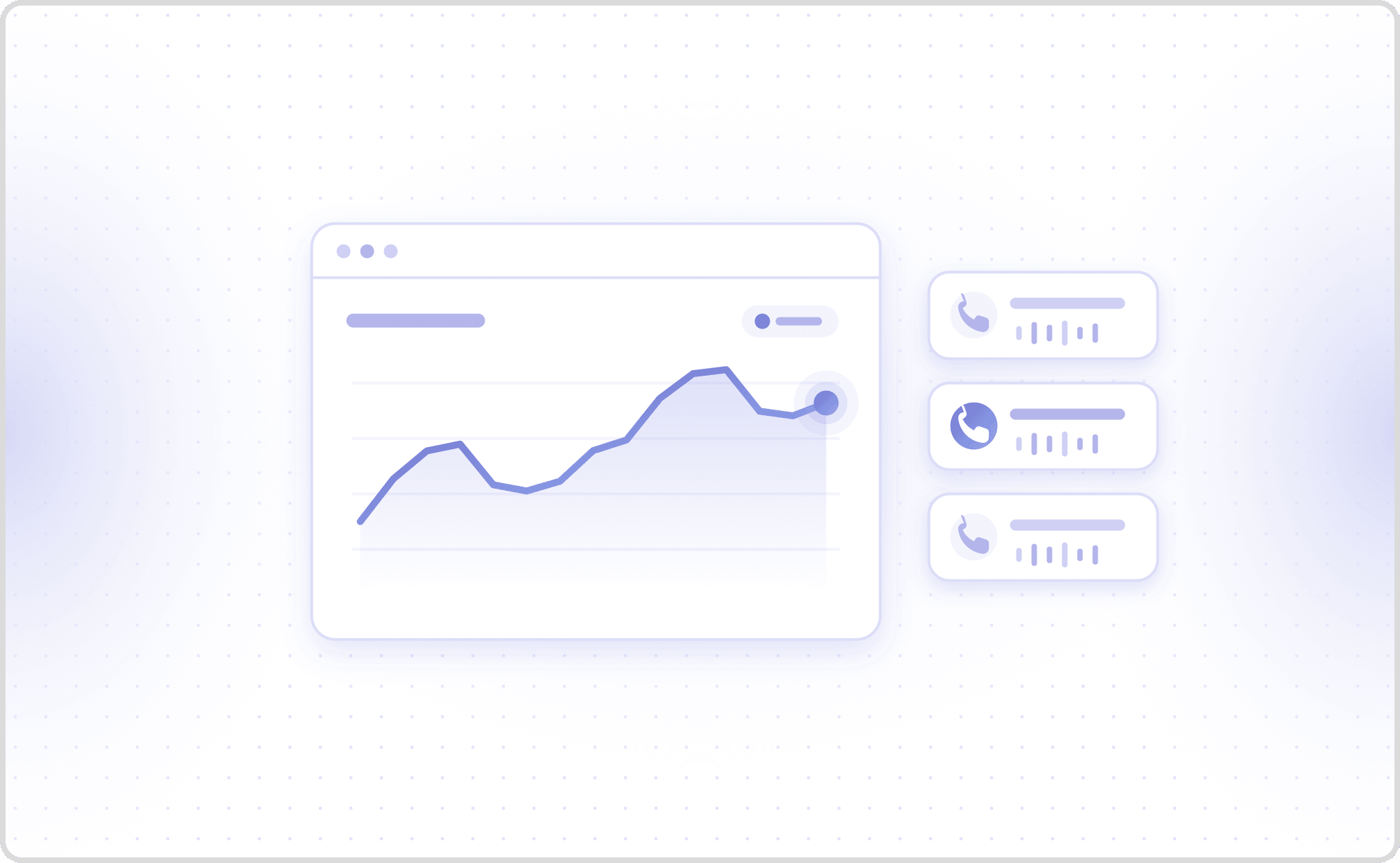

Customer experience monitoring is the practice of measuring live customer interactions as they happen, rather than waiting for survey scores to arrive weeks later. It watches the systems delivering the experience, the quality of each conversation, and whether the customer's goal was actually met, so failures surface before customers report them.
Most guides on this topic stop at defining NPS, CSAT and CES. Those are lagging indicators. They tell you that something went wrong last month, from the small fraction of customers who bothered to answer a survey. This guide covers the other half: the telemetry, thresholds and checks that tell you something is going wrong right now, on the call that is happening at this moment.
What is customer experience monitoring?
Customer experience monitoring is the continuous measurement of the systems and conversations that deliver service to customers, combining technical telemetry with conversation-level quality scoring.
It differs from customer experience management, which is the broader discipline of designing journeys and acting on feedback. Monitoring is the instrumentation layer underneath it. Where management asks "is our strategy working", monitoring asks "is the IVR answering, is the agent understanding, did this customer get what they called for".
Three things separate monitoring from surveying:
- Coverage. Surveys sample the customers who respond. Monitoring covers every interaction.
- Latency of signal. Survey results arrive after the customer has already had the bad experience. Telemetry arrives during it.
- Attribution. A survey tells you a customer was unhappy. Monitoring tells you the transcription failed on the account number, which is why they were unhappy.
The scope has widened considerably. When a human agent handled every call, this work meant call recording plus quality assurance sampling. Now that AI agents handle a growing share of first-contact volume across voice, chat and messaging, the thing being watched is a software system that can fail in ways a human never would, and can fail silently.
Why do survey scores miss most CX failures?
A survey captures a customer's recollection of an interaction, filtered through their willingness to fill in a form. Response rates for post-call surveys are low enough that the sample skews toward the strongly satisfied and the strongly angry, leaving the broad middle unmeasured.
Research on contact centre audio supports measuring the interaction itself rather than only the aftermath. In an Interspeech 2017 study of real call-centre interactions at a large corporation, Luque and colleagues trained models to predict self-reported customer satisfaction from the call itself. They report that "linguistic features can predict self-reported satisfaction more accurately than those based on prosodic and conversational descriptors", and that fusing linguistic and prosodic features gave the best performance of the configurations they tested. The signal for whether a customer was satisfied is present in what was said and how it was said, which means it can be measured on every call rather than on the few that generate a survey response.
That study also found that turn-level conversational features generally outperformed frame-level signal descriptors. The unit of analysis that matters is the conversational turn, not the audio frame. This has a direct consequence for how you instrument: a setup that reports one aggregate score per call will average away the specific turn where the interaction broke.
There is a second, harder problem. Some failures produce no unhappy customer at all, because the customer never learns anything went wrong. An agent that confidently confirms an order it did not actually place generates a clean transcript, a satisfied-sounding caller, and a defect that surfaces days later as a fulfilment complaint. Nothing in a survey-based program catches that.
What are the four layers of customer experience monitoring?
A complete setup instruments four distinct layers. Most programs cover one or two and assume the others are fine.
Layer 1: Channel delivery
This is whether the pipe works. Can customers reach you, does the call connect, does the audio arrive intact, does the chat widget load.
Telephony and CPaaS providers expose per-call quality telemetry for exactly this purpose, gathered directly from carrier and SDK-level sensors, which is the raw material for delivery-layer measurement on the voice channel.
The threshold that matters most here is one-way delay. ITU-T Recommendation G.114, the standard on one-way transmission time, gives three ranges: 0 to 150 ms is acceptable for general network planning, 150 to 400 ms is acceptable provided users are aware of the transmission delay and its characteristics, and anything above 400 ms is unacceptable for general network planning purposes. That 400 ms ceiling is the closest thing to a hard number in this field, and it predates AI agents entirely. It applies to the transport layer only. Any processing your agent does sits on top of it.
Layer 2: Conversation quality
This is whether the interaction was any good. Did the system understand the customer, did it stay on instruction, did it say anything false, did it talk over them.
The measurable components include transcription accuracy on the words that matter, instruction adherence, hallucination, interruption handling and speaking pace. A working set of six such measures for production conversations is set out in this guide to AI conversation monitoring metrics.
Layer 3: Outcome
This is whether the customer got what they came for. It is the layer most commonly skipped, because it requires knowing what the customer wanted, which is harder than reading a latency graph.
Outcome measurement means defining, per conversation type, what success looks like: the appointment was booked, the balance was given, the dispute was logged, the transfer landed with a human who could help. A conversation can score well on every technical metric and still fail this test.
Layer 4: Compliance
This is whether the interaction stayed inside the rules, and whether you can prove it later. For outbound and telemarketing calls in the United States, the Telemarketing Sales Rule sets explicit recordkeeping duties. Under 16 CFR 310.5, sellers and telemarketers must keep specified records "for a period of 5 years from the date the record is produced unless specified otherwise", including a record of each telemarketing call covering the calling and called number, date, time and duration, the script or prerecorded message used, and the disposition of the call.
That is a monitoring requirement disguised as a paperwork requirement. If your system cannot reconstruct what was said on a call from five years ago, you do not have a compliance program, you have an intention.
What does automated CX monitoring miss?
Automated scoring is now standard practice, usually with a language model grading transcripts against a rubric. It is a large improvement over sampling two percent of calls for manual review. It is also, on the published evidence, considerably less complete than teams assume.
A June 2026 study of a deployed multi-turn ordering agent, Catching One in Five, compared what the system's built-in language-model judge flagged against exhaustive human review of the same transcripts. In one batch the judge caught 2 of 9 patterns, or 22%. In another, its operational gate flagged zero of 100 rounds in a batch where human reviewers confirmed 23 distinct defects and 7 new cross-cutting patterns.
The authors attribute the gap to rubric design rather than model capability. Their judge scored on three coarse axes covering intent, brand voice and personalization, and the defects clustered in behavioural dimensions the rubric had no category for: cross-turn state problems such as cart hallucination and confirm-gate lockout. The monitor could not report a failure it had no field for.
This is the single most useful finding for anyone building this capability, and it generalizes past that one deployment. Your rubric is your coverage. Failures that fall outside the categories you defined are not scored as failures, they are scored as passes, and the dashboard turns green. The practical countermeasures are to review a rolling sample of transcripts by hand against no rubric at all, to add a category every time a human finds something the rubric missed, and to treat cross-turn state as a first-class scoring axis rather than an emergent property of per-turn scores.
Cekura scores conversations per state rather than as call-level averages, so a regression on one node does not get averaged away by passes on other nodes. Cekura also lets teams define custom KPIs as Boolean, rating or enum checks scoped to specific conversation nodes, which is how a rubric gains a category for a failure mode that generic metrics do not name.
What thresholds should customer experience monitoring enforce?
Thresholds are where most programs go vague. Here are the ones with defensible numbers behind them.
| Signal | Threshold |
|---|---|
| One-way transport delay | Under 400 ms, with under 150 ms preferred |
| Speaking pace | Around 200 words per minute is typical for production voice agents |
| Talk ratio | Above 0.80 the agent starts to feel domineering |
| Recovery after interruption | Agent resumes within roughly two seconds |
| Repeatable task success | Measured across three identical runs, not one |
The transport figure is from ITU-T Recommendation G.114 on one-way transmission time. The pace, talk ratio and interruption figures come from Cekura's voice AI evaluation metrics reference. The last row deserves explanation, because it is the threshold most programs do not have at all.
Cekura's benchmarks ran 82 scenarios against seven voice agent configurations, three times each, retaining 246 calls per configuration. The headline metric is Pass³, the share of scenarios that passed all three retained runs. Across those seven configurations, Pass³ ranged from 30.49% to 75.61%, while task completion measured on single calls with outcome evidence ranged from 87.80% to 97.56%. Two caveats travel with those figures: providers chose their own configurations for that benchmark, submitting the models and speech components they preferred, so the numbers compare provider-selected setups rather than a controlled sweep of one variable, and they are a snapshot of that single dated run rather than a live tracker.
Read those two ranges together. A configuration can complete better than nine calls in ten and still pass all three runs of a scenario only three-quarters of the time. The gap between them is variance, and variance is invisible to any setup that measures each conversation once. Per Cekura's benchmarks of provider-selected configurations in that dated run, the same configuration handling the same scenario does not reliably produce the same outcome, which means a single passing observation is weak evidence that the experience is working.
How to set up customer experience monitoring
- Inventory the journeys, not the channels. List the things customers actually try to do. Channels are how they arrive; journeys are what you are measuring.
- Define success per journey. Write the outcome condition in plain language before choosing any metric. If you cannot state what a successful booking looks like, you cannot measure it.
- Instrument the delivery layer first. Connectivity, delay and completion rates come from your telephony or messaging provider and need no modelling. Set the G.114 ceiling as an alert.
- Add conversation scoring. Score instruction adherence, hallucination, transcription accuracy on critical entities, interruption handling and pace. Score at the turn or node level, not once per conversation.
- Add the outcome check. This is usually a custom evaluator per journey, and it is the one that maps to revenue.
- Run scenarios repeatedly, not once. Repeated runs of one scenario do not reliably produce the same outcome, so treat a single pass as provisional. Cekura runs each scenario multiple times and reports the share that pass every run, which is the number that predicts production behaviour.
- Close the loop. Route findings back into fixes and re-test. Cekura tests, monitors and self-improves voice and chat agents, so a failure caught in production becomes a regression test rather than a ticket.
A companion guide to monitoring AI chat and voice agents in production covers the alerting side of this in more detail, including routing to Slack, email, webhooks and incident tooling.
How does customer experience testing differ from monitoring?
Monitoring tells you what your live customers are experiencing. Customer experience testing tells you what they would experience, before they do. The two are the same measurement applied at different times, and a program with only one of them is incomplete.
CX testing means running scripted and generated scenarios against the system in a pre-production environment, scoring them with the same evaluators you use against live traffic. The benefit of sharing evaluators is that a regression caught in testing and an incident caught in production speak the same language, with the same thresholds and the same failure categories. Cekura runs one evaluator set across both, which is what makes the two directly comparable.
The practical sequence is to build the evaluator set once, run it as cx testing in CI on every change to prompts, models or tools, and run the identical set continuously against production traffic.
Where teams get this wrong is treating customer experience testing as a launch gate and then never running it again. Model versions change underneath you. A prompt edit made to fix one journey regresses another. The tests earn their value on the hundredth run, not the first.
Frequently asked questions
What is the difference between customer experience monitoring and customer experience management?
Monitoring is the measurement layer: continuous instrumentation of live interactions and the systems delivering them. Management is the broader practice of designing journeys, setting strategy and acting on what measurement and feedback reveal. Monitoring produces the evidence; management decides what to do about it.
What metrics should customer experience monitoring track?
Track four layers: channel delivery such as connection success and one-way delay, conversation quality such as instruction adherence and hallucination, outcome such as whether the customer's goal was met, and compliance such as recordkeeping and disclosure. Survey metrics like NPS and CSAT sit alongside these as lagging confirmation, not as the primary signal.
Is NPS enough to monitor customer experience?
No. NPS samples the customers who respond, arrives after the experience, and does not attribute a score to a cause. It is useful as a trend check across quarters. It cannot tell you that transcription is failing on account numbers, which is the kind of finding that lets you fix something.
How often should customer experience monitoring run?
Continuously for live interactions, and on every change for cx testing. Because repeated runs of the same scenario do not reliably produce the same result, evaluate on multiple runs rather than one. Cekura's benchmark measures this as Pass³, the share of scenarios passing all three retained runs, using provider-selected configurations in a single dated run.
Can automated scoring replace human review of customer conversations?
Not entirely. In the deployed system studied in Catching One in Five, the automated judge caught 22% of confirmed problem patterns in one batch and none in another, because its rubric had no category for the cross-turn state failures where defects clustered. Keep a rolling human sample reviewed without a rubric, and add a category whenever it finds something the automated scoring missed.
What are the compliance requirements for monitoring customer calls?
For telemarketing calls covered by the Telemarketing Sales Rule, 16 CFR 310.5 requires sellers and telemarketers to retain specified records for 5 years from the date the record is produced, including per-call details such as numbers, date, time, duration, the script used and the call disposition. Requirements differ by jurisdiction and call type, so confirm what applies to your operation.