
Vapi vs ElevenLabs reads like a head-to-head between two rivals. Look closer, and you find three tools doing three different jobs in one stack. Vapi orchestrates your voice pipeline, ElevenLabs generates the voice and runs agents, and Cekura tests whether either one holds up with real callers.
After thousands of simulated calls across both stacks, here is where they differ in 2026 and where each one fits.
Vapi vs ElevenLabs vs Cekura: At a Glance
Here is the short version before the details.
| 🛠 Tool | 🎯 Best For | 💰 Starting Price | ⚡ Key Strength |
|---|---|---|---|
| Cekura | Testing and monitoring the agent you built | $30/month | Catches failures before and after launch |
| Vapi | Bring-your-own-stack orchestration | $0.05/min platform fee | Model-agnostic control over every layer |
| ElevenLabs | Voice-first agents with top-tier speech | Free, then $6+/month (Agents) | ~75ms Flash voice across 32 languages |
Choose Vapi if you want control over your speech-to-text, LLM, and voice providers.
Choose ElevenLabs if you want the fastest path to a voice-first agent with the best-sounding voice.
Add Cekura if you are shipping either one to production and need proof it works.
TL;DR: Vapi vs ElevenLabs vs Cekura
- Vapi: Best for bring-your-own-stack orchestration. Model-agnostic across STT, LLM, and TTS providers; full control over every layer; HIPAA available without an enterprise contract. $0.05/min platform fee (real cost typically $0.15–$0.40/min once providers stack).
- ElevenLabs: Best for the fastest voice-first agent with top-tier speech. ~75ms Flash v2.5 latency across 32 languages, live in 15–30 minutes, but less flexibility to swap the voice engine. Free tier, then $6+/month (Agents).
- Cekura: Best for testing and monitoring whichever agent you build. Auto-generates scenarios, simulates callers with accents and edge cases, red-teams for jailbreaks, and monitors live calls with CI/CD regression gates. $30/month Developer plan (7-day free trial).
Meet the Contenders
These three tools take care of three layers of the same voice stack. Here is what each one actually does.
Cekura: The Testing and Observability Layer
Cekura is an automated QA and observability platform for voice and chat AI agents, backed by Y Combinator. It connects to the agent you already built, runs thousands of simulated calls before launch, and watches live traffic after.
You keep your orchestration and voice provider. You add a testing layer on top. Cekura serves 70+ customers and evaluates 60K+ voice AI calls daily.
Vapi: The Orchestration Layer
Vapi is a voice AI orchestration platform. It ties the four pieces of a voice agent into one call flow. Speech-to-text, an LLM, text-to-speech, and telephony all run through a single API, and you choose each provider yourself.
Developers pick Vapi when voice sits at the core of their product, and they want control over every layer.
ElevenLabs: The Voice-Model and Agent Layer
ElevenLabs started as a text-to-speech tool. It now covers voice cloning, dubbing, and conversational AI agents under one platform.
Its ElevenAgents product builds a voice agent fast, and its Flash v2.5 model generates speech in about 75ms across 32 languages. Teams pick ElevenLabs when voice quality is the priority and a quick build matters.
Vapi vs ElevenLabs vs Cekura: Feature Breakdown
Six categories decide this build. Each one gets real numbers and an honest winner.
Setup and Time to Live
Cekura: Setup runs in minutes on top of either platform. For Vapi, drop in your API keys. For ElevenLabs, add one webhook.
Vapi: You wire up your own speech-to-text, LLM, voice, and telephony providers. That flexibility costs time, often a day or more before a production-ready agent runs.
ElevenLabs: A working prototype takes 15 to 30 minutes. You point the agent at a knowledge base, pick a voice, and test in the dashboard.
Winner: ElevenLabs. It offers the fastest path from signup to a live agent.
Voice Quality and Latency
Cekura: Measures voice clarity and latency across every test run. It flags TTS failures, interruptions, and slow turns for whatever voice you use.
ElevenLabs: The strongest voice here. Flash v2.5 ships first audio in about 75ms, which sits inside the roughly 500ms budget a natural conversation allows. Its v3 model sounds even richer, though ElevenLabs recommends Flash for live agents.
Vapi: Voice quality equals whatever text-to-speech you plug in. Pair Vapi with ElevenLabs, and you get ElevenLabs quality. Latency stacks across every provider hop, so your slowest layer sets the pace.
Winner: ElevenLabs. It owns the voice layer that other tools plug into.
Real Cost Once the Stack Is Assembled
Cekura: The Developer plan is $30 per month, with a 7-day free trial and no credit card required.
Vapi: The platform fee is $0.05 per minute. Add speech-to-text, an LLM, voice, and telephony, and real cost lands between $0.15 and $0.40 per minute. HIPAA runs $2,000 per month, and Zero Data Retention adds another $1,000. You can see the full figures in our Vapi pricing breakdown.
ElevenLabs: Agents plans bundle call minutes, from 15 minutes free up to 1,238 on Pro. Overage runs $0.08 per minute and $0.16 during a concurrency spike. Your LLM and telephony bill separately. Our ElevenLabs pricing guide breaks down every tier.
Winner: ElevenLabs for predictable bundles, Vapi for pay-as-you-go control.
Flexibility and Control
Cekura: Model-agnostic by design. It benchmarks GPT-4o against Gemini against Claude on the same scenarios, so you can compare before you switch.
Vapi: Swap any provider at any layer. Run GPT-4o today, Gemini tomorrow, and a cheaper voice next week. This suits teams that tune cost and quality per component.
ElevenLabs: Voice-first and more opinionated. You get a fast, polished agent with less freedom to swap the underlying voice engine.
Winner: Vapi. It gives you the most control over every layer of the stack.
Compliance and Support
Cekura: SOC 2, HIPAA, and GDPR compliance, covering transcript redaction, role-based access, and audit trails. Support runs 24/7 across the US and India. See our voice bot testing guide for regulated teams for how compliance checks run in practice.
Vapi: HIPAA is a paid add-on at $2,000 per month, plus $1,000 for Zero Data Retention. Support runs through email and a Discord community on lower tiers.
ElevenLabs: SOC 2 Type 2 and HIPAA attested, though a signed BAA sits on the Enterprise plan. Healthcare teams on lower tiers reach that wall fast.
Winner: Vapi. HIPAA is available without an enterprise contract.
Testing and Monitoring
Cekura: Purpose-built for this layer. It generates hundreds of scenarios from your agent description, simulates callers with varied accents and edge cases, runs red teaming across jailbreaks and data leakage, and monitors every live call.
Our guide to voice AI evaluation metrics covers what to score.
Vapi: Ships Voice Test Suites for scripted scenarios. Good for initial validation. Coverage stops short of large-scale simulation, red teaming, and production monitoring.
ElevenLabs: Offers a testing button and an Agents Testing feature for basic simulations. Coverage stays thin once real callers go off-script.
Cekura publishes this cross-platform testing openly. Its Voice Agent Benchmark ran one identical agent brief across seven voice platforms, 82 caller scenarios, and three repeats each, ranking on pass³, the share of scenarios that pass on all three runs.
Both Vapi and ElevenLabs are in the cohort, and no configuration cleared 76%, which is the gap between a demo that works once and an agent that holds up on every call.
Winner: Cekura. Testing and observability are the job it exists to do.
What Real Users Say
The quotes below come from verified G2 reviews and Product Hunt. Each one links to its source, so you can read the full review.
Vapi
Vapi holds a strong score on G2 across a small review base. Users praise the low cost and flexibility. Latency draws the loudest complaints, with one reviewer clocking calls from 800ms to 4 or 5 seconds.
Pro:
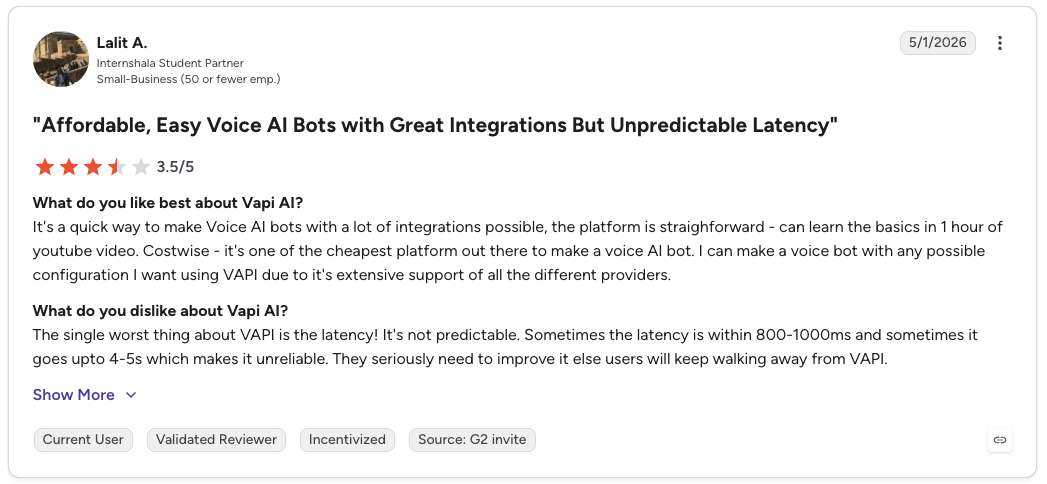
"One of the cheapest platforms out there to make a voice AI bot." (Lalit A., G2)
Con:
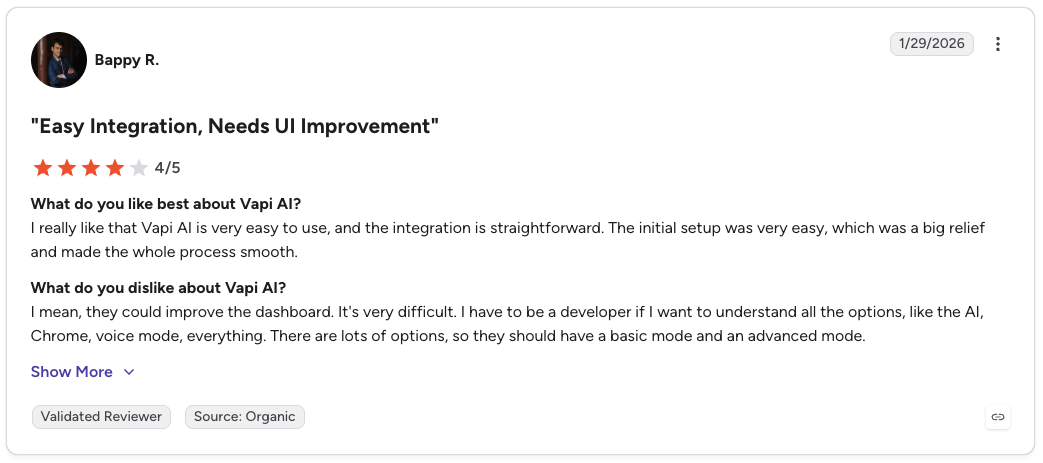
"They could improve the dashboard. It's very difficult." (Bappy R., G2)
ElevenLabs
ElevenLabs rates 4.5 out of 5 across more than 1,100 G2 reviews. Voice quality earns the most praise. The credit-based pricing draws the most criticism.
Pro:
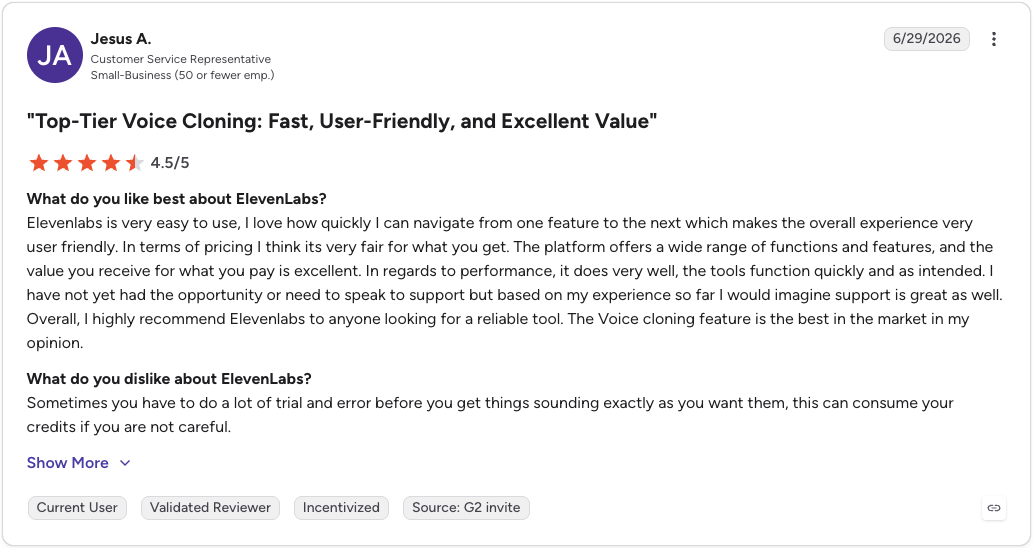
"Elevenlabs is very easy to use, I love how quickly I can navigate from one feature to the next which makes the overall experience very user friendly." (Jesus A., G2)
Con:
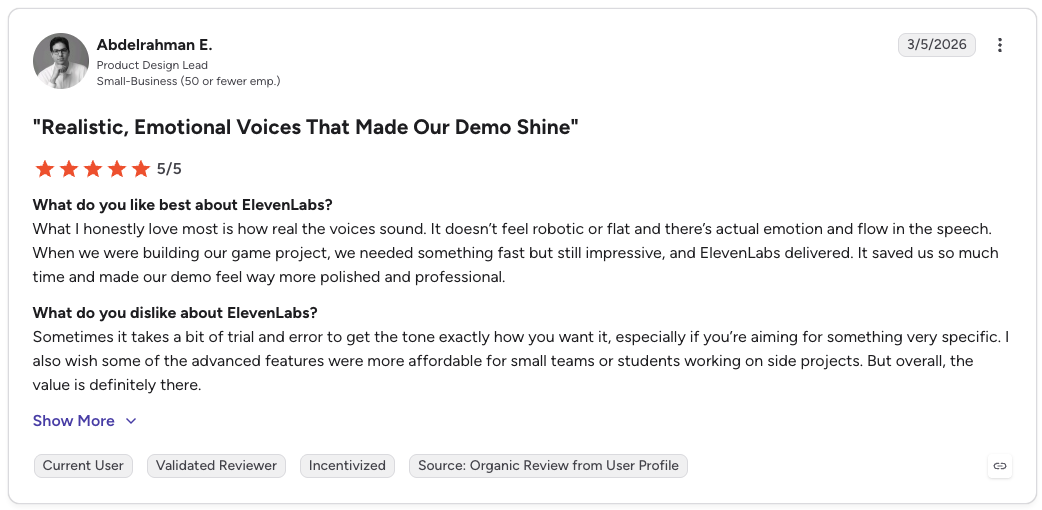
"Sometimes it takes a bit of trial and error to get the tone exactly how you want it, especially if you're aiming for something very specific." (Abdelrahman E., G2)
Cekura
Cekura has a thinner public review footprint, but its published customer results carry more weight. Kastle processes over $100M in transactions on Cekura at 90% CSAT, and Twin Health gates every deploy on the full simulation suite.
Pro:
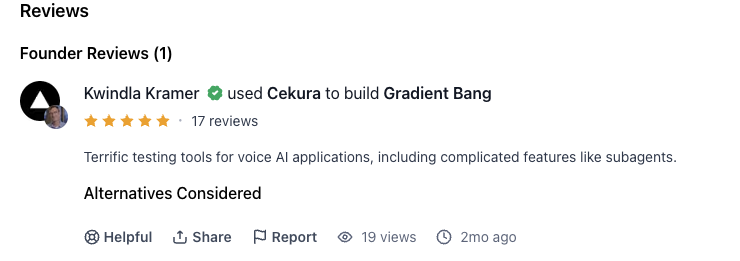
"Terrific testing tools for voice AI applications, including complicated features like subagents." (Kwindla Kramer, Product Hunt)
Con:
Cekura tests agents, so you still run Vapi or ElevenLabs underneath to build them. See the Cekura case studies for verified outcomes.
Which Tool Should You Choose?
The right pick depends on the job in front of you, since these tools own different layers.
Choose Vapi if you:
- Have developers and want control over every provider.
- Plan to tune cost and quality per component.
Choose ElevenLabs if you:
- Want the fastest voice-first agent with top voice quality.
- Value a quick build over deep stack control.
Add Cekura if you:
- Ship a voice agent to production on any stack.
- Need to catch regressions before customers do.
My Final Verdict
There is no single winner here because Vapi, ElevenLabs, and Cekura solve three different problems. The Vapi vs ElevenLabs choice comes down to control versus speed. Pick Vapi for control over your stack, or ElevenLabs for the fastest build and the best voice.
Then add Cekura on top, so you find failures before your callers do. The tools that build your agent and the tool that proves it works belong in the same stack.
Ready to Test What You Built?
Both Vapi and ElevenLabs ship agents. Neither one shows you how those agents behave with thousands of real callers. Cekura does, across three areas.
Pre-production testing: Auto-generate scenarios from your agent description, simulate callers with varied accents and edge cases, and run red teaming across jailbreaks and data leakage before launch.
Infrastructure testing: Measure latency, interruptions, background-noise handling, and turn-taking timing, so audio problems surface before customers hear them.
Production observability: Monitor every live call, flag drop-offs and instruction failures, and send Slack alerts on latency spikes.
Cekura wires into your stack with no glue code. For Vapi, drop in your API keys and tests run over WebRTC against your assistant. For ElevenLabs, add one webhook and Cekura pulls the audio and transcript from each call.
Native integrations work out of the box for Retell, VAPI, ElevenLabs, LiveKit, Pipecat, Bland, and more. You don't rebuild anything. You add a testing and monitoring layer on top of what you already have.
Cekura supports SOC 2, HIPAA, and GDPR compliance, covering transcript redaction, role-based access, and audit trails.
Book a demo to watch it run against your Vapi or ElevenLabs agent before your next deploy.
Frequently Asked Questions
What's the main difference between Vapi and ElevenLabs?
The main difference between Vapi and ElevenLabs is the layer each one owns. Vapi orchestrates your full voice stack and stays model-agnostic. ElevenLabs generates the voice and runs a voice-first agent platform with its own low-latency models.
Is ElevenLabs cheaper than Vapi?
ElevenLabs is often cheaper to start, since its Agents plans bundle call minutes from a free tier up to Pro. Vapi charges $0.05 per minute plus separate speech-to-text, LLM, voice, and telephony costs, which push the real cost to $0.15 to $0.40 per minute.
Can Vapi use ElevenLabs voices?
Yes, Vapi can use ElevenLabs voices. Vapi is model-agnostic and supports ElevenLabs as a text-to-speech provider, so you pay ElevenLabs at-cost rates on top of Vapi's platform fee.
Does Vapi or ElevenLabs test voice agents?
Both offer light testing. Vapi ships Voice Test Suites for scripted checks, and ElevenLabs has a testing button for basic simulations. Full simulation, red teaming, and production monitoring need a dedicated layer like Cekura.
Is Cekura a Vapi or ElevenLabs alternative?
No, Cekura is a testing and observability layer that runs on top of Vapi or ElevenLabs. You build the agent on either platform, then use Cekura to simulate callers before launch and monitor live calls after.