
The best alternative to Vapi for voice AI APIs depends on why you are leaving. Retell wins for compliance without setup work, Bland for high-volume outbound on your own infrastructure, and Telnyx for teams that want to own the phone line.
I spent two weeks with each. I read the live pricing pages, priced a full production stack, and checked latency and compliance against our voice orchestration benchmarks and each vendor's docs. Prices are current as of July 2026. Verify before you commit.
Best Vapi alternatives: TL;DR
- Retell AI: Best for teams that want a managed voice API with compliance included and no stack assembly.
- Bland: Best for high-volume outbound and regulated teams that need one proprietary stack and on-premise control.
- Telnyx: Best for teams that want to own the telephony layer and get one predictable invoice.
- LiveKit: Best for engineers who want to self-host the real-time media layer under an open-source license.
- Pipecat: Best for Python teams that want frame-level pipeline control without a platform margin.
- Synthflow: Best for operations teams shipping voice agents without writing code.
- ElevenLabs Conversational AI: Best for teams where voice quality is the deciding factor.
Why look for a Vapi alternative?
Vapi is a strong developer platform. You can swap the language model, speech-to-text, and voice providers whenever you want. If you bring your own provider accounts, Vapi adds no markup, and each provider bills you directly.
The platform has handled more than 1 billion calls and raised a $50M Series B in May 2026. For an engineering team that wants to control every part of the voice stack, it works well.
That control has a cost, and it surfaces once your agent is live. Here are the four reasons teams start looking for an alternative.
Billing stacks across four or five line items. The $0.05 per minute you see is the Vapi hosting fee for calls. On top of that sit your language model, speech-to-text, text-to-speech, and telephony.
Real deployments land closer to $0.20 to $0.33 per minute once every layer is counted. Our full breakdown of Vapi pricing walks through the math.
Compliance is a paid floor. HIPAA runs $2,000 per month as an add-on, and Zero Data Retention adds $1,000 per month. Those charges apply every month regardless of your call volume, per Vapi's own pricing page.
Concurrency and retention have hard limits. Every account starts with 10 concurrent call lines. Each line past that costs $10 per month. Call history sticks around for 14 days on the Build plan, so longer retention pushes you into a custom contract.
Latency stacks across every hop. Audio travels from the caller through speech-to-text, a language model, and text-to-speech, then back. Each hop adds delay. Humans expect a reply gap of about 200 milliseconds in natural conversation, a figure that holds across ten languages in a landmark study.
Vapi targets sub-500ms, though our orchestration benchmarks show per-turn latency swings widely with the provider config you pick. If you are weighing a realtime model instead, compare speech-to-speech models against a cascaded pipeline on response time.
Which Vapi alternative should you choose?
Choose Retell if you want production speed and HIPAA coverage without wiring the stack yourself. Component costs still stack, so model your full per-minute rate first.
Choose Bland if you run high-volume outbound or need on-premise data control. Latency tends to sit higher, and you need developers to run it.
Choose Telnyx if you want to own the phone line and get verified caller ID. The utility-style billing is powerful and harder to forecast.
Choose LiveKit or Pipecat if you want open-source control and can run your own infrastructure. You take on the DevOps that a managed platform would handle.
Choose Synthflow if a non-technical team needs to ship an agent without code. You pay more per minute, and HIPAA lives on the Enterprise plan.
Choose ElevenLabs if voice quality is the single most important factor. HIPAA and concurrency caps will shape your plan choice.
Stick with Vapi if you want maximum provider modularity, bring-your-own-key economics, and you have the engineers to run the stack. That combination is where it still leads.
Best Vapi alternatives at a glance
| Platform | Best for | Model | HIPAA | Starting price |
|---|---|---|---|---|
| Retell AI | Compliance plus speed | Managed API + no-code | Self-serve BAA, no fee | $0.07/min voice engine |
| Bland | Outbound scale, data control | Proprietary, on-premise option | Included with BAA | ~$0.09/min all-in |
| Telnyx | Owned telephony | Carrier-owned network | HIPAA-eligible BAA | ~$0.05/min bundled |
| LiveKit | Self-hosted media layer | Open source (Apache 2.0) | Scale tier ($500/mo) | Free self-host |
| Pipecat | Python pipeline control | Open source (BSD-2) | Pipecat Cloud | Free self-host |
| Synthflow | No-code operations teams | No-code builder | Enterprise only | ~$0.08/min |
| ElevenLabs | Voice quality | Managed API | Enterprise only | Bundled minutes + $0.08/min |
Pricing correct as of July 2026. Verify with each vendor.
The 7 best Vapi alternatives for voice AI APIs
A rundown of seven Vapi alternatives in 2026 across managed platforms, owned-telephony carriers, and open-source frameworks, with the pricing model, compliance posture, and control tradeoff that decides which one fits your stack.
1. Retell AI
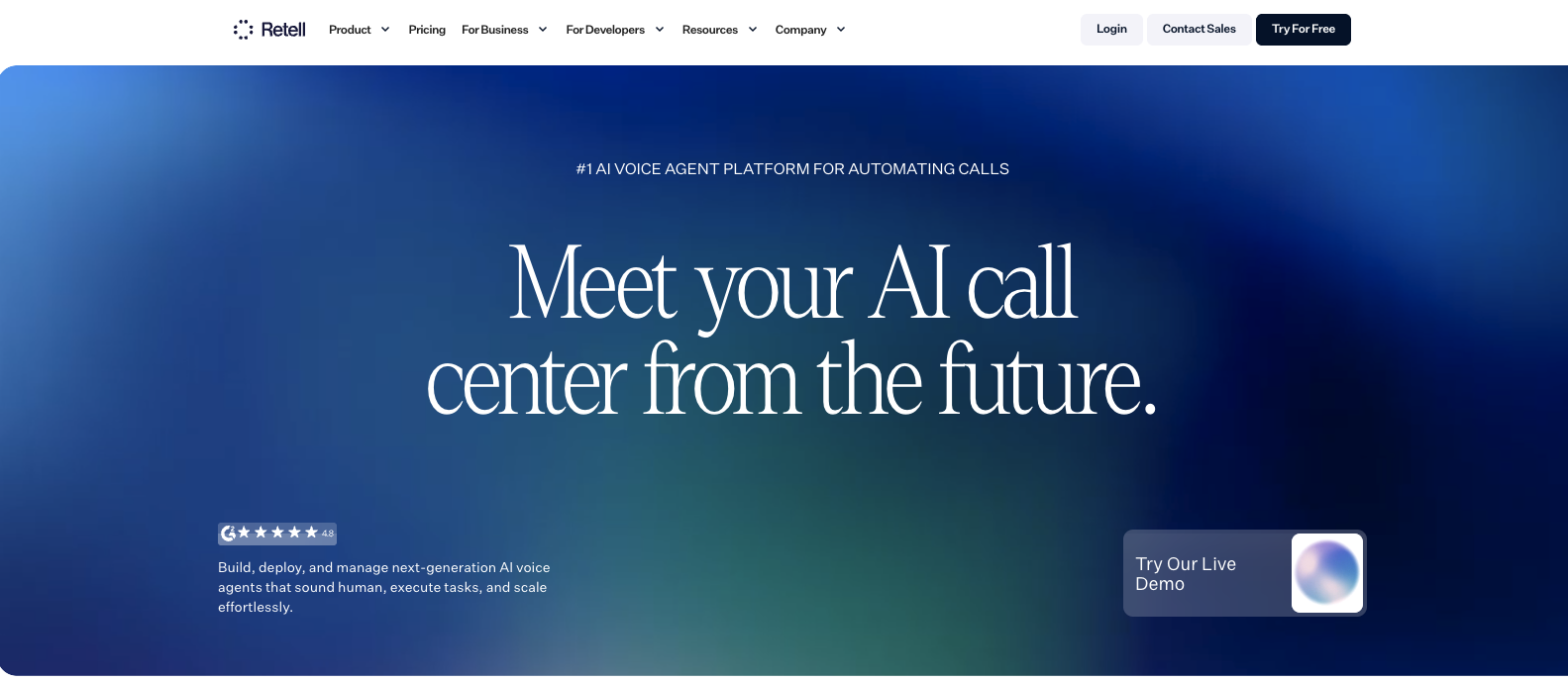
Retell AI is the closest managed alternative to Vapi that ships compliance without an enterprise gate. It runs a voice streaming API that connects real-time agents to phone or web over WebSocket audio. You bring your own language model and telephony, and Retell handles the orchestration.
Compliance is where it separates from Vapi. Retell is SOC 2 Type II certified and offers a HIPAA Business Associate Agreement you can self-sign from the dashboard, at no extra fee, on the pay-as-you-go plan. Healthcare teams skip the $2,000 monthly line item that Vapi charges.
Retell reports around 600ms latency and powers more than 30 million calls a month across 3,000-plus businesses. For a deeper head-to-head, see our Retell vs. Vapi comparison.
Key features
- No-code builder and full API: Design flows with nodes and transitions, or drop to the API for custom logic.
- Self-serve HIPAA: Sign a BAA from the dashboard and enable PII redaction for about a penny a minute.
- Bring your own carrier: Connect Twilio, Telnyx, Vonage, or any SIP provider with no surcharge.
- Configurable retention: Set per-agent retention from 1 day up to 2 years.
Pros
✅ SOC 2, HIPAA, and GDPR coverage on the standard plan, with no enterprise contract required.
✅ Fast path to production with pre-built templates and simulation testing.
✅ Serves both no-code operators and engineers from one platform.
Cons
❌ Pay-as-you-go caps concurrency at 20 calls (but more can be purchased)
❌ Component costs stack, so real all-in pricing runs $0.13 to $0.31 per minute.
Best for
- Healthcare and finance teams that need a signed BAA without an enterprise commitment.
- Product teams that want a voice SDK plus a visual builder in one place.
- Startups with variable call volumes that want to pay only for usage.
Pricing
Voice engine starts at $0.07 per minute with no platform fee and $10 in free credits. Enterprise pricing is custom and typically opens up above $350 per month in usage. See the Retell pricing page for the calculator.
2. Bland
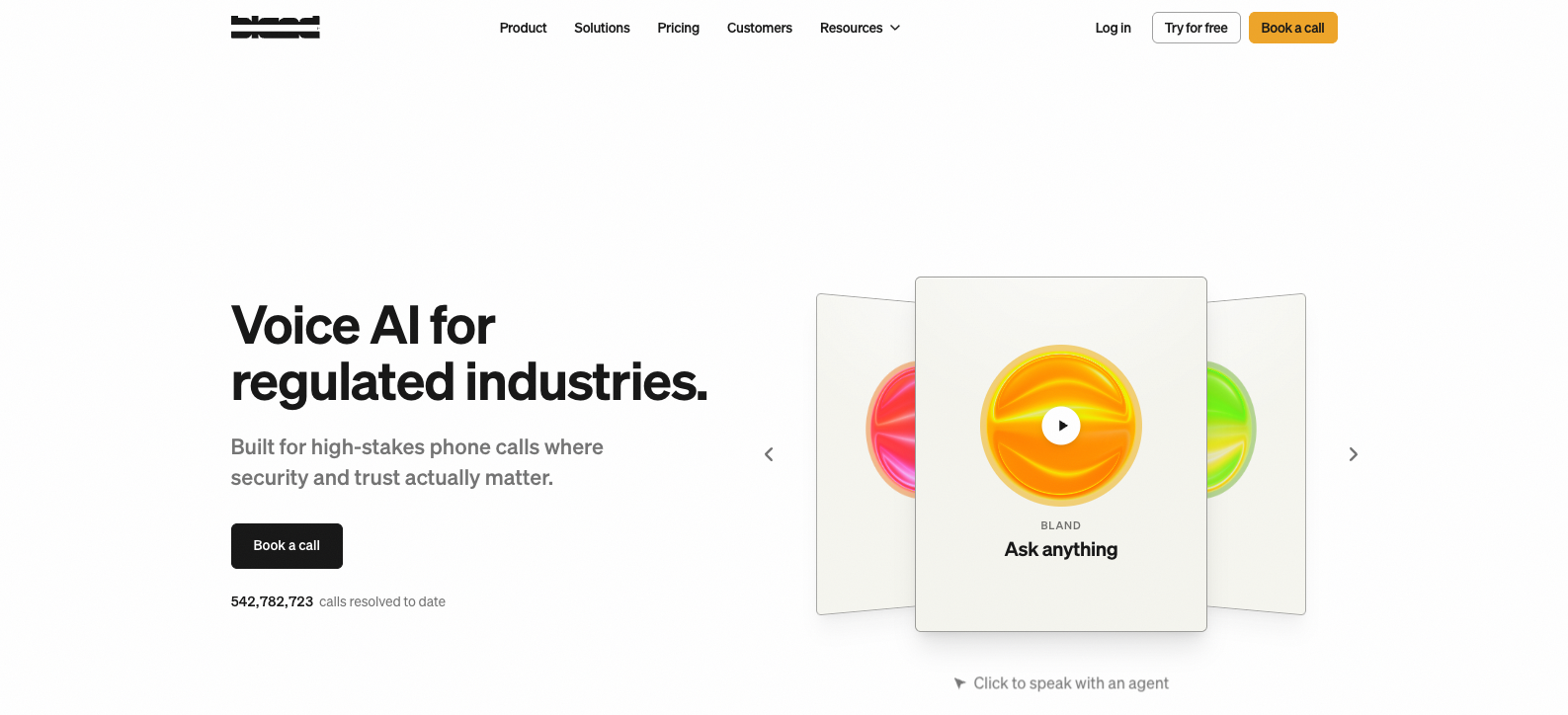
Bland folds the whole stack into one per-minute rate and runs on dedicated infrastructure you can host yourself.
One rate covers the language model, speech-to-text, text-to-speech, and telephony. There are no per-token charges and no separate vendor invoices, which removes the layered billing that pushes teams off Vapi.
The other draw is data control. Bland positions itself as self-hosted and enterprise-controlled, with dedicated servers and on-premises deployment for sensitive workloads. If you can’t send audio to shared infrastructure, that’s a big pain point.
Bland is built for scale. It handles up to 20,000 calls per hour and leans into outbound campaigns with real-time scripting and webhooks. A forward-deployed engineering team builds your first agent end-to-end.
Key features
- Single all-in rate: One per-minute charge spans model, speech, and telephony.
- On-premise deployment: Dedicated servers and self-hosted models for regulated data.
- Pathways flow control: Design call logic with guardrails, loops, and decision trees.
- Voice cloning: Clone a voice from a single short audio clip.
Pros
✅ One invoice instead of four, which makes budgeting predictable.
✅ On-premise and self-hosted options fit strict data-sovereignty rules.
✅ High outbound capacity for campaigns at real production volume.
Cons
❌ Latency commonly lands in the 800ms range, which callers notice as dead air.
❌ Developer-only. There is no true no-code builder, so a non-technical team cannot use it.
Best for
- High-volume outbound sales, reminders, and operational calls.
- Regulated teams that need SOC 2, HIPAA, PCI, and on-premise control.
- Engineering teams that want granular flow control through Pathways.
Pricing
Bland's connected-minute rate is plan-based. Start is free at $0.14 per minute, Build runs $299 a month at $0.12 per minute, and Scale runs $499 a month at $0.11 per minute. Higher tiers lower your per-minute rate and raise your daily, hourly, and concurrency caps.
Transfers to a human bill separately, from $0.05 down to $0.03 per minute by plan, and drop to $0 if you bring your own Twilio number. Outbound attempts and failed calls carry a $0.015 minimum charge on Bland's telephony.
3. Telnyx
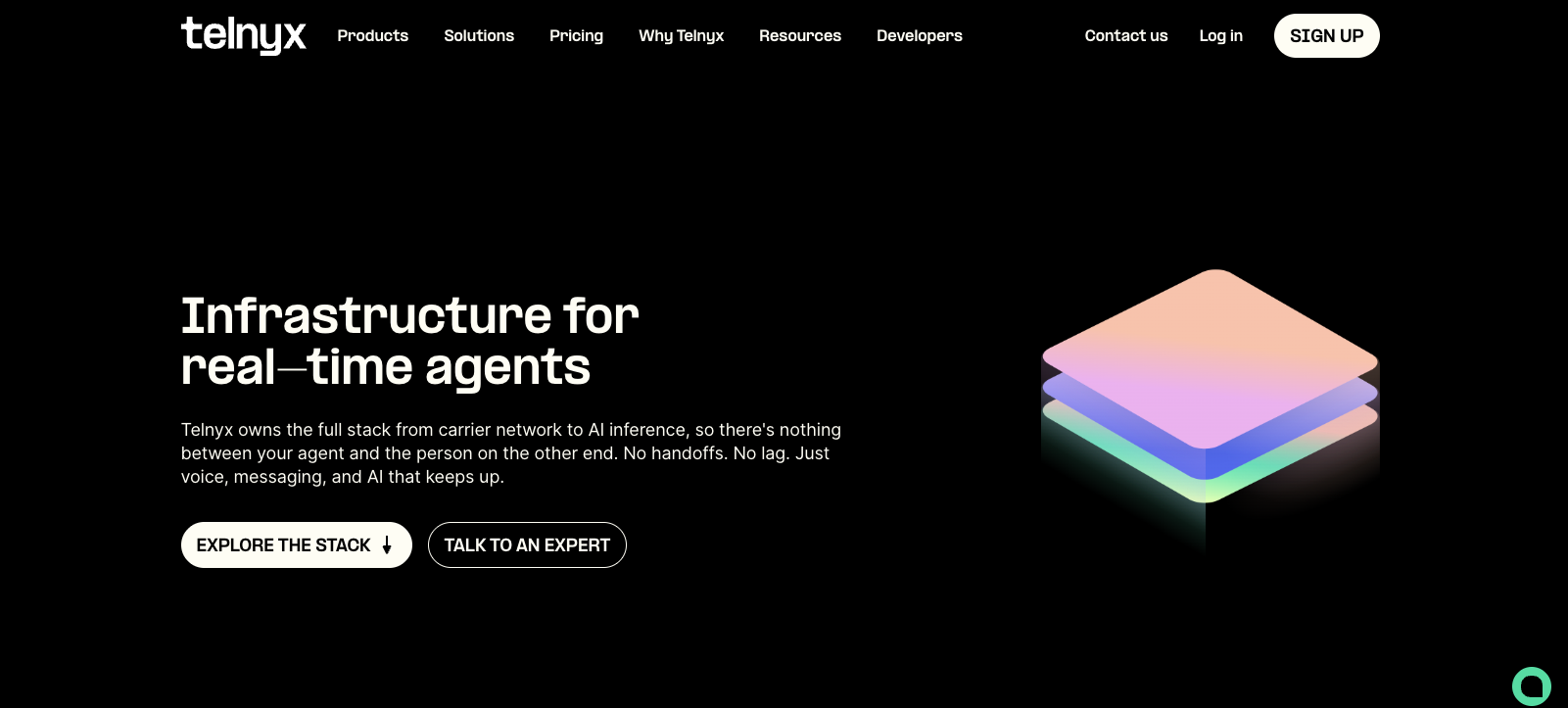
Telnyx is the alternative for teams that want to own the phone line instead of renting it. It is a licensed carrier, so speech-to-text, text-to-speech, orchestration, and telephony all run on infrastructure Telnyx owns. That ownership is why it can bundle the stack into one rate and sign calls itself.
Caller identity is where Telnyx stands out. Telnyx signs eligible outbound traffic at A-level STIR/SHAKEN attestation as the originating carrier. A-attestation lifts pickup rates, since a spam-flagged call is a wasted call. For outbound teams, verified caller ID is a real revenue lever.
Telnyx reports sub-200ms round-trip on the carrier leg through its private backbone and co-located GPUs. The tradeoff is billing, since Telnyx meters each service separately like a utility bill, which is cheap per unit and harder to forecast.
Key features
- Carrier-owned network: Every layer of the stack runs on Telnyx infrastructure.
- STIR/SHAKEN A-attestation: Native call signing that improves pickup rates.
- Bundled voice AI rate: Speech-to-text, text-to-speech, and orchestration in one base rate.
- Owned GPU inference: Open-source language models run on Telnyx GPUs, billed per token.
Pros
✅ Owning every layer gives Telnyx tight control over price and latency.
✅ A-attestation on eligible traffic raises answer rates for outbound.
✅ One vendor is accountable when something goes wrong on a recorded call.
Cons
❌ Usage-metered billing across services is hard to forecast before you run traffic.
❌ Self-service onboarding favors developers, and support reviews are mixed.
Best for
- Outbound teams that depend on verified caller ID and answer rates.
- Regulated workflows that need SOC 2, HIPAA, PCI, ISO 27001, and GDPR under one contract.
- Teams already running LiveKit or another framework that want a cheaper telephony layer.
Pricing
Voice AI agents start around $0.05 to $0.06 per minute, bundling speech-to-text, text-to-speech, and orchestration. Language model tokens are billed separately. Pricing is usage-based with no fixed plans.
4. LiveKit
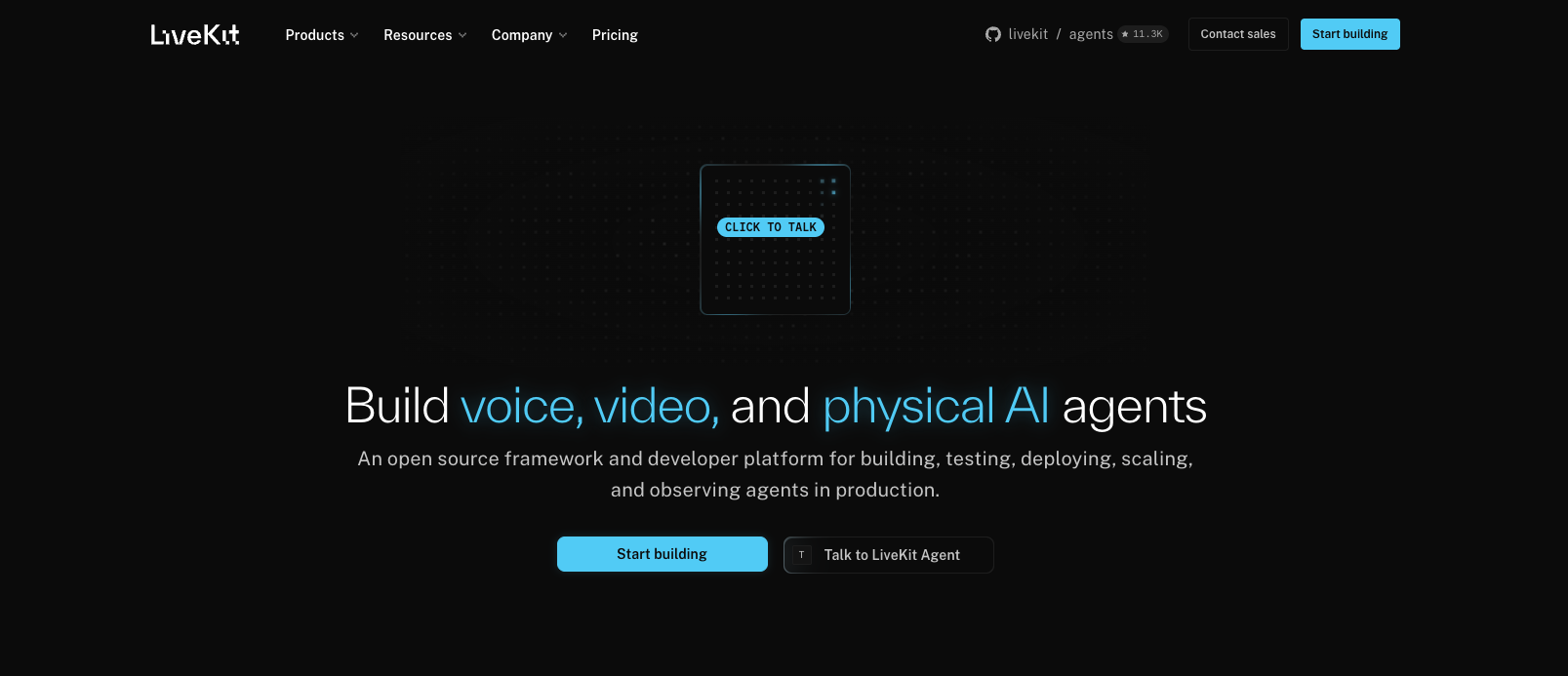
LiveKit is the alternative for engineers who want to own the real-time media layer under an open-source license.
The Agents framework and media server are both open source under Apache 2.0, so you can self-host on your own infrastructure with no per-minute fees. LiveKit Cloud is the managed path when you would rather not run it yourself.
LiveKit provides the real-time transport behind OpenAI's ChatGPT voice mode, and it handles roughly a quarter of US 911 emergency calls. The company raised a $100M Series C at a $1 billion valuation in January 2026.
Self-hosting trades money for ownership. You avoid usage charges and vendor lock-in, and you take on deployment, scaling, and monitoring yourself. For a framework-level view, read our Pipecat vs. LiveKit breakdown.
Key features
- Open-source media server: Self-host the WebRTC stack under Apache 2.0.
- Agents 1.0 and SIP 1.0: Production telephony plus semantic turn detection and noise cancellation.
- Model flexibility: Point an agent at gpt-realtime, Gemini Live, or a classic speech pipeline with one config change.
- Consolidated Cloud billing: Deployment, inference, telephony, and transport land on one invoice.
Pros
✅ Self-hosting eliminates per-minute fees. You pay only for your own infrastructure.
✅ No lock-in. The open-source stack runs the same code in your own cloud.
✅ Proven at massive concurrency across OpenAI, xAI, and emergency services.
Cons
❌ Self-hosting means you own DevOps, scaling, and monitoring.
❌ HIPAA, RBAC, and data residency are gated to the Scale tier at $500 per month.
Best for
- Engineering teams that need control over their media stack and want to self-host.
- Products where the agent lives inside a broader real-time system.
- Teams with in-house Python, WebRTC, and DevOps experience.
Pricing
Self-hosting is free under Apache 2.0. LiveKit Cloud offers Build (free, 1,000 agent session minutes), Ship ($50/mo), Scale ($500/mo), and Enterprise (custom). Agent session minutes run $0.01 per minute above the plan allotment. See the LiveKit pricing page.
5. Pipecat
Pipecat gives Python teams frame-level control over the voice pipeline without paying a platform margin. It is an open-source Python framework licensed under BSD-2, built and maintained by Daily.
Pipelines compose FrameProcessor nodes that pass audio, video, and text between transports, speech services, language models, and custom processors.
The design is based on vendor neutrality. You swap any provider, and the pipeline structure holds. All the foundation AI labs use it, along with NVIDIA and AWS. The framework carries more than 13,000 GitHub stars.
The tradeoff is ownership. Migrating off a closed platform like Vapi means rebuilding the orchestration layer, since that code is not yours. Migrating between open frameworks is a refactor. Pipecat Cloud, the managed runtime, went generally available in January 2026 after a beta with more than 1,000 teams.
Key features
- Composable pipeline: Assemble your own speech, model, and voice stack, and own every frame.
- Vendor-neutral by design: Swap any provider without rewriting the pipeline.
- Developer tooling: Whisker for real-time debugging and Tail for live monitoring.
- Managed runtime option: Pipecat Cloud handles scaling, telephony, and compliance.
Pros
✅ Deepest pipeline control for tuning latency and quality frame by frame.
✅ No lock-in. The code runs anywhere under BSD-2.
✅ Backed by Daily's decade of real-time infrastructure experience.
Cons
❌ Python-only on the server side, so a JavaScript-first team faces a learning curve.
❌ Telephony, provisioning, and analytics are integrations you wire yourself at the framework layer.
Best for
- Python teams that want full control over every pipeline component.
- Multimodal agents that combine voice, video, and text in one pipeline.
- Regulated teams that need HIPAA on a self-serve Pipecat Cloud plan.
Pricing
The framework is free and open source. Pipecat Cloud charges $0.01 per minute per active agent session and $0.018 per minute for PSTN telephony. Self-hosting is free at the framework level, and the infrastructure cost is yours. See the Pipecat project for docs.
6. Synthflow
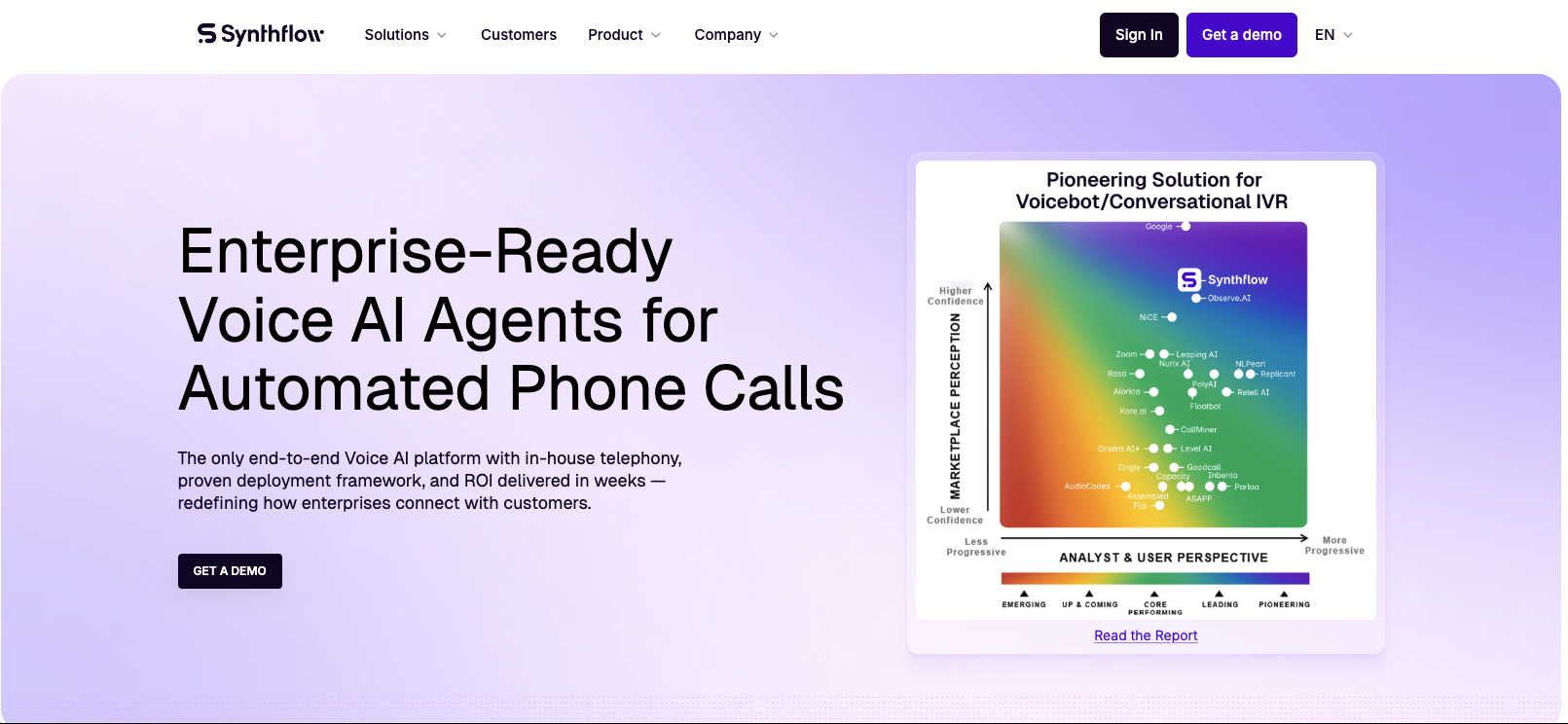
Synthflow is the no-code alternative for operations teams that need to ship an agent without writing code. The visual Flow Designer lets a non-technical operator build call logic with a drag-and-drop interface. It supports inbound and outbound calls, appointment booking, voicemail detection, and AI call routing.
Integrations are the moat. Synthflow ships more than 50 native connections across CRMs and 20 telephony providers, with bring-your-own-carrier at no markup. It defaults to ElevenLabs voices, which clear the naturalness bar most synthetic speech misses. White-label and reseller tooling make it a favorite for agencies.
The catches are cost and compliance. Synthflow sits at the higher end per minute, and HIPAA lives on the Enterprise plan with a $30,000 annual minimum. Latency tends to run 500 to 800 milliseconds, since the pipeline chains several external providers.
Key features
- No-code Flow Designer: Build multi-branch call flows without code.
- 50-plus native integrations: Connect GoHighLevel, ServiceTitan, HubSpot, and Salesforce directly.
- In-house telephony option: Native telephony on Enterprise, or bring your own Twilio at $0 markup.
- White-label toolkit: Custom branding, sub-accounts, and Stripe rebilling for agencies.
Pros
✅ Fastest no-code launch for a non-technical operator.
✅ Deepest native integration list in the no-code category.
✅ White-label features built for agency resellers.
Cons
❌ HIPAA is Enterprise-only, which starts around $30,000 per year.
❌ Bring-your-own-key means separate ElevenLabs, model, and speech bills on top.
Best for
- Agencies reselling voice agents under their own brand.
- Operations teams on supported CRMs that want to skip engineering.
- Small and mid-market teams launching a first agent quickly.
Pricing
Synthflow runs two tiers. Pay-as-you-go starts around $0.08 per minute. Enterprise contracts start at $30,000 a year, scoped around call volume, concurrency, telephony, integrations, and security.
7. ElevenLabs Conversational AI
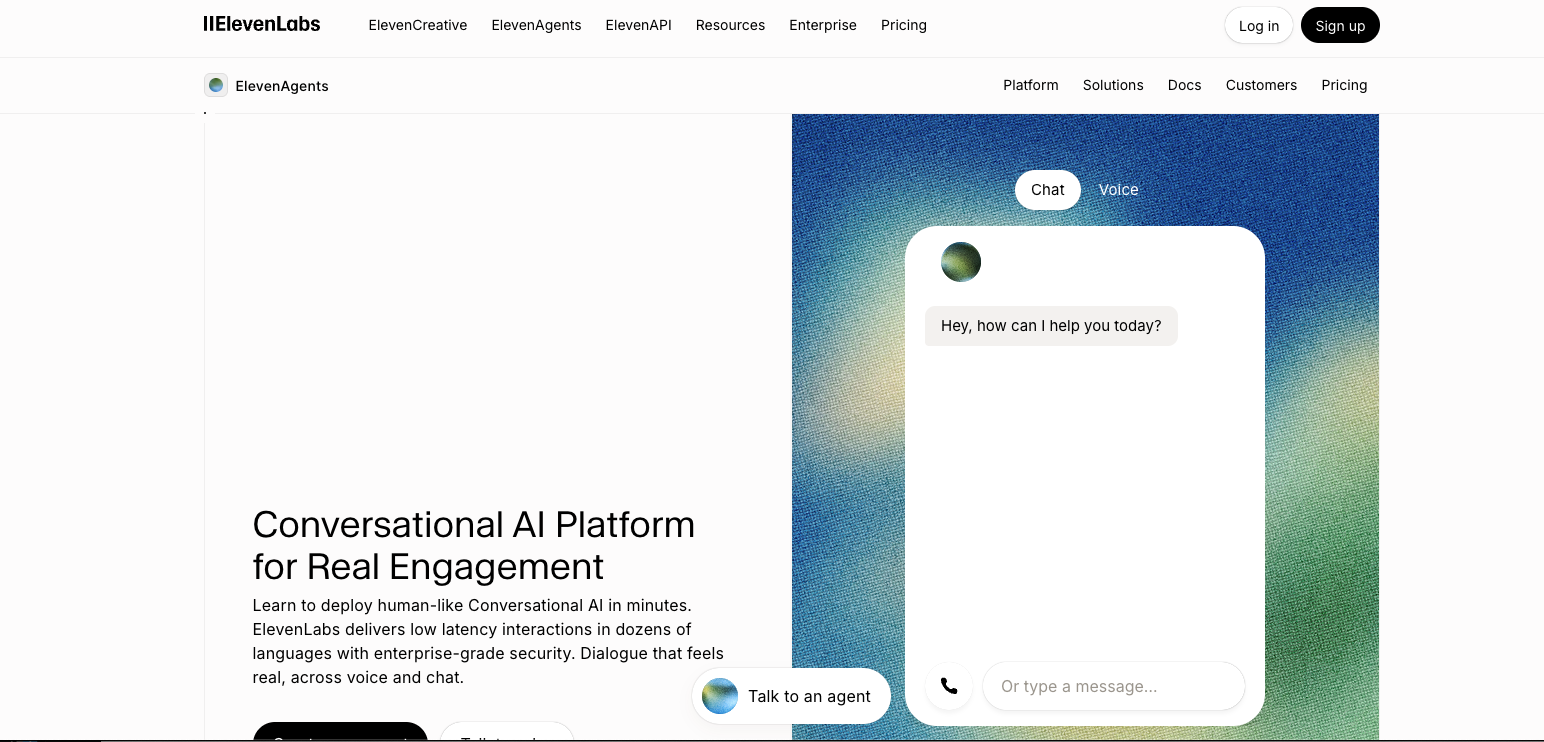
ElevenLabs Conversational AI is the alternative for teams where voice quality decides the deal. ElevenAgents deploys expressive voice agents across phone, WhatsApp, and embedded web chat.
The v3 voice model covers 70-plus languages and a library of more than 10,000 voices, and the Flash model keeps latency in the sub-second range.
The turn-taking model is a real upgrade. Conversational AI 2.0 detects cues like "um," pauses, and breath sounds, so the agent knows when to listen. Retrieval-augmented generation is baked in, so agents pull from your knowledge base without extra infrastructure.
Voice naturalness is where ElevenLabs wins side-by-side comparisons. The limits are compliance and concurrency. HIPAA lives on the Enterprise tier, and concurrent-call caps scale by plan. In our own voice orchestration benchmarks, ElevenLabs posted the fastest median per-turn latency yet carried a long tail on slower calls.
Key features
- v3 voice model: 70-plus languages and 5,000-plus community voices.
- Turn-taking detection: Reads conversational cues to time responses naturally.
- Built-in RAG: Agents answer from your knowledge base without bolted-on infrastructure.
- Multichannel deployment: Phone, WhatsApp, and web chat from one platform.
Pros
✅ Best-in-class voice naturalness on functional and expressive speech.
✅ Turn-taking model reduces awkward talk-over moments.
✅ Bundled call minutes on every paid plan, tracked separately from text credits.
Cons
❌ HIPAA and a signed BAA require the Enterprise tier.
❌ Concurrency caps by plan can force multiple accounts to scale.
Best for
- Customer-facing agents where voice realism drives satisfaction.
- Multilingual deployments across many languages.
- Teams that want voice, WhatsApp, and web chat from a single vendor.
Pricing
Each paid plan bundles call minutes, from 75 on Starter to 12,375 on Business. Additional minutes run $0.08 per minute, with burst pricing at $0.16 per minute when you exceed your concurrency limit.
Language model and telephony bill separately. See the ElevenLabs Agents pricing page.
How to evaluate a Vapi alternative
Five questions separate a platform that demos well from one that survives production.
Who owns the telephony? Rented telephony adds a hop and a vendor, owned networks like Telnyx control latency and caller ID, and bring-your-own-carrier keeps your existing contracts. Pick based on where your calls originate.
Is the pricing bundled or stacked? A single all-in rate is easy to forecast, while a stacked model across four providers is cheaper to optimize and harder to predict. Model your full per-minute cost before you compare headline numbers.
Where does compliance live? Ask whether HIPAA is included, an add-on, or an enterprise gate. For a healthcare team, a self-serve BAA changes the budget. Confirm the BAA, PII redaction, and retention controls before you deploy.
What is the deployment model? Managed platforms ship fast, open-source frameworks give control and self-hosting, and on-premise fits strict data rules. It’s important to match the model to your team's DevOps capacity.
Can you test before and after you ship? Most failures surface only when real callers push an agent off-script. You need to know that the new stack holds up under load.
Test any voice AI platform before real callers reach it
The big challenge here is confirming the new stack works when a caller interrupts, the line is noisy, or a prompt change shifts behavior on a path you never tested. Every platform on this list sounds great in a demo, but production is a different test.
The stakes are rising. Gartner projects that agentic AI will resolve 80% of common customer service issues by 2029, yet its follow-up warns that more than 40% of agentic AI projects will be canceled by 2027 over unclear value and weak controls. The projects that survive are the ones that test.
Cekura sits alongside whichever platform you pick. Your agents stay exactly where they are, and Cekura wraps testing and monitoring around them. Coverage maps to three stages of an agent's life:
- Pre-production simulations: Run thousands of simulated calls across personas, accents, and edge cases before go-live, including red-teaming for jailbreaks and data leakage.
- Infrastructure testing: Stress interruptions, background noise, latency, and voice activity detection.
- Production observability: Score live calls for instruction-following, CSAT, and drop-off, and convert failed calls into new test cases.
Cekura ships native integrations for Retell, VAPI, ElevenLabs, LiveKit, Pipecat, Bland, and more. It’s SOC 2-, HIPAA-, and GDPR-compliant for transcript redaction, role-based access, and audit trails
The team has stress-tested more than 5 million voice agent minutes and serves 100-plus customers from Sunnyvale. Cekura is backed by Y Combinator.
Book a demo to see how Cekura catches failures in a simulation instead of a live call.
Frequently Asked Questions
What is the best alternative to Vapi for voice AI APIs?
The best alternative to Vapi depends on your priority. Retell wins for teams that want compliance and fast deployment without assembling the stack.
Bland fits high-volume outbound and on-premise data control. Telnyx suits teams that want to own the telephony layer with verified caller ID.
Is there a cheaper alternative to Vapi?
Telnyx and Retell start at competitive base rates, around $0.05 and $0.07 per minute. Cheaper is relative, since every managed platform stacks language model, speech, and telephony costs on top. Model your full per-minute rate before you compare headline prices.
What is the main difference between Vapi and Retell?
The main difference between Vapi and Retell is how much of the stack you assemble and how compliance is priced. Vapi hands engineers full control over every provider and charges $2,000 per month for HIPAA. Retell ships a managed path with a self-serve HIPAA BAA at no extra fee.
Can I get HIPAA-compliant voice AI without Vapi's $2,000 monthly add-on?
Yes, several Vapi alternatives include HIPAA without a separate monthly fee. Retell offers a self-serve BAA on its pay-as-you-go plan. Bland includes HIPAA with a signed BAA on its infrastructure. Make sure of the BAA and PII controls with each vendor before handling protected health information.
Do I still need to test my voice agent after switching from Vapi?
Yes, a platform switch raises the need to test. A new stack changes latency, turn-taking, and failure modes that only surface under real call conditions. Run pre-production simulations and monitor live calls so a migration does not introduce regressions your callers discover first.