
The right Synthflow alternative depends on who will own the agent after launch. Pick Retell AI or Vapi if your engineers do, Goodcall or Smith.ai if your reception staff does, and PolyAI if you run an enterprise contact center that counts calls resolved without a human.
Price is what changed this year. Synthflow now sells only annual enterprise agreements, with no free plan or trial and no per-minute rate.
Older roundups, including some written before this change, still quote a $29 starter plan or a per-minute Voice Engine rate, so check the date on any Synthflow price you find.
I read the pricing pages and docs for all 10 platforms on October 29, 2026, then compared each one with the public call benchmarks where it was tested.
For each platform, I note which team it suits and where that team will run into a plan limit.
10 best Synthflow alternatives: TL;DR
-
Retell AI: Developer API with a no-code flow builder, best for engineering teams that want telephony and call QA on one per-minute bill.
-
Vapi: Developer API, best for engineers who pick their own transcriber, model, and voice.
-
Bland AI: Developer API with enterprise controls, best for regulated programs that need FedRAMP or self-hosted models.
-
ElevenLabs Agents: Developer API plus visual Workflows, best for multilingual agents where voice quality and reply speed come first.
-
Voiceflow: No-code builder, best for CX teams running voice and chat agents from one workspace.
-
Goodcall: No-code receptionist, best for local businesses paying a monthly price set by callers served.
-
Smith.ai: Receptionist with live-agent backup, best for law firms and service businesses that need a person available when the AI can't finish.
-
PolyAI: Enterprise and regulated, best for high-volume inbound lines judged on resolution.
-
Replicant: Enterprise and regulated, best for contact centers handing tier-1 calls to AI on their current phone system.
-
Fin Voice: Enterprise and regulated, best for support teams already on Fin that need phone coverage from that agent.
How I compared these Synthflow alternatives
Every price comes from the vendor's own pages, read on October 29, 2026, and each entry names the page when it isn't the pricing page. Where a vendor publishes no rate, the entry says so.
That rule has one exception. Synthflow is the one platform quoted from a third party, because its only public dollar figure comes from Retell's comparison page.
For compliance, I read each vendor's trust or security page. If a certification shows up only as a badge with no trust page behind it, the entry says that too.
The performance figures come from two Cekura studies. The workflow benchmark runs 82 caller scenarios three times each on ten platforms, and a scenario passes only if all three runs pass (pass^3).
The voice quality benchmark scored 1,395 live calls to 31 phone lines across 16 platforms in November 2026.
Each provider chose its models and settings, which makes those numbers a shortlisting tool. Cekura publishes the benchmarks and this article. Our wider AI voice agent platform roundup ranks nine voice agent platforms tested on real calls.
I didn't place test calls through all 10 platforms, so capability claims rest on vendor docs, and I name the vendor page behind each marketing figure.
Why look for Synthflow alternatives?
Synthflow pitches itself to operations and engineering teams. The Flow Designer lets a non-engineer lay out a call on a canvas, and where the contract includes launch support, its Forward-Deployed Engineers take agents live within weeks, per the homepage.
The homepage claims 1M+ calls a day and 200+ integrations, and its telephony docs target a round-trip time under 100 ms for traffic that stays in one region. Its security section lists SOC 2 Type II, ISO 27001, PCI DSS v4.0.1, GDPR, a signed HIPAA BAA, and hosting in the US or EU.
What changed in 2026 is how you buy it, starting with the pricing page.
Self-serve pricing is gone
Synthflow’s pricing page says it has “no free plan or trial and no rate by the minute.” It's "sold as an annual enterprise agreement, scoped to your call volume, phone system, integrations, security needs and launch support," and the page publishes no price.
The only dollar figure I found appears on Retell's comparison page, dated October 2026, which says Synthflow's annual contracts start at $30,000.
If that minimum is accurate, it equals $2,500 a month, which buys roughly 22,700 minutes at Retell's default $0.11 rate (my math, and Synthflow’s contract can also cover onboarding and launch support).
Concurrency moved into the contract
The Enterprise plan lists "custom concurrency planning," with no number attached. Retell includes 20 concurrent calls before you pay for more, Vapi's Core plan includes 10, and ElevenLabs Business includes 40, all listed on their pricing pages.
If you're planning for a peak in inbound volume or a 5,000-number outbound campaign, Synthflow's concurrency limit comes from a sales call. Waiting on that number delays the load test you'd run before launch to see how the agent behaves at peak volume.
Phone numbers and HIPAA depend on the contract
In May 2026, Cekura's Retell AI competitors roundup found that Synthflow's native phone numbers covered only the US, Canada, and Australia, so European teams brought their own Twilio account.
The same roundup found HIPAA coverage and guaranteed SLA uptime gated behind Enterprise. Now that Enterprise is the only plan, ask Synthflow which of those terms your contract includes in writing.
Integration reliability is the other question to raise. One Trustpilot reviewer reported "frequent failures with basic integrations like SMS triggers and webhooks…" (Small Business Owner, Trustpilot, May 2026).
Since this is one reviewer's account, ask Synthflow for webhook failure rates during your evaluation.
Synthflow's call quality has no outside baseline
In Cekura’s November 2026 voice quality benchmark, Synthflow placed 15th of 16 at 82.9, with the lowest turn-taking score in the field (70.6). It took 4.34 seconds to stop speaking after a caller cut in, against 1.13 seconds for Retell and 0.92 for PolyAI.
That score rests on a single phone line, and Synthflow isn’t in the workflow benchmark, so there’s no pass^3 figure to compare.
The same May roundup found that testing inside Synthflow used paid credit minutes. Its newer Test Center measures simulations separately, and they may be billable depending on your contract. Export them before your renewal date.
Which Synthflow alternative should you choose?
Choose Retell AI if your engineers want a per-minute rate they can forecast, plus simulation and live-call QA in one product.
Choose Vapi if you want to swap the transcriber, model, or voice without rebuilding the agent.
Choose Bland AI if you're in a regulated industry and need FedRAMP or on-premises hosting from a vendor with its own models.
Choose ElevenLabs Agents if voice quality and response speed decide the deal and you'd rather start on a plan with a listed monthly price.
Choose Voiceflow if a CX team will own voice and chat agents together. Prices show up in the app after you sign up, or through a sales demo.
Choose Goodcall if you operate a local business on a US number and want a monthly price set by how many people call.
Choose Smith.ai if you need trained live agents, staffed by the vendor, to take the calls the AI can't finish.
Choose PolyAI if you manage an inbound contact center and resolution rate is the metric your team reports on.
Choose Replicant if your contact center wants AI to answer its tier-1 calls and prefers the vendor's team to do the build.
Choose Fin Voice if Fin already answers your chat and email, and you want phone support from the same agent.
Stick with Synthflow if you already hold an annual contract and an operations team edits flows on the canvas every week. Forward-Deployed Engineers, if your contract includes launch support, are another reason to stay.
Its EU hosting option and signed BAA also make it worth evaluating for a European healthcare line with the budget, as long as the contract confirms where your data sits and includes a BAA.
10 best Synthflow alternatives: at a glance
The table below compares the ten by build style, compliance, and entry price.
| Tool | Best for | Build style | Compliance | Starting price |
|---|---|---|---|---|
| Retell AI | Managed voice stack with QA | Developer API plus no-code flows | SOC 2 Type II, HIPAA with BAA, GDPR, ISO 27001 | $0 to start, $0.07 to $0.31/min |
| Vapi | Custom provider stacks | Developer API | SOC 2 Type II, PCI DSS, GDPR, HIPAA add-on | $29/month Core plus $0.05/min hosting |
| Bland AI | Regulated, high-volume calling | Developer API plus Agents dashboard | SOC 2 Type II, ISO 27001, FedRAMP 20x Class A, HIPAA (BAA on Enterprise) | $0 platform fee, $0.14/min |
| ElevenLabs Agents | Multilingual, fast-reply agents | Developer API plus visual Workflows | SOC 2 Type II, ISO 27001, PCI DSS Level 1, HIPAA (BAA on Enterprise) | $0 for 15 min, $6/month Starter (billed monthly) after a $1 first month |
| Voiceflow | CX teams on voice and chat | No-code | SOC 2 Type II, ISO 27001, GDPR, HIPAA deployments | Contact sales |
| Goodcall | Small-business receptionist | No-code | SOC 2 Type II, ISO 27001, PCI DSS, HIPAA (BAA on Scale) | $79/month per agent |
| Smith.ai | Intake with human backup | Managed receptionist | None published | $0 for 25 calls, $150/month Pro |
| PolyAI | Enterprise inbound resolution | Enterprise, no-code to API | SOC 2 Type II, ISO 27001, PCI DSS, GDPR, HIPAA | Contact sales |
| Replicant | Tier-1 contact center calls | Enterprise, vendor-led build | SOC 2 Type II, PCI DSS, HIPAA, GDPR | Contact sales |
| Fin Voice | Support teams already on Fin | Enterprise, configured in Fin | SOC 2 Type II, ISO 27001, ISO 42001, HIPAA, GDPR | Contact sales |
Pricing verified against each vendor's site on October 29, 2026. Prices shown are billed monthly where a monthly option exists. Verify with the vendor before you commit.
How to evaluate Synthflow alternatives
Bring these five questions to each vendor call. The first four map to a line on a pricing page or in a contract, and the fifth needs your own call recordings.
Ask what a minute costs all-in: Vapi's $0.05 covers hosting only, and ElevenLabs bills the LLM on top of its plan. Bland bills telephony separately. Get one all-in number for your average call length and compare vendors on that.
Ask which tier holds the BAA and SSO: Retell includes a BAA on pay-as-you-go, Goodcall puts its BAA on the $299 Scale plan and Enterprise, and Vapi sells HIPAA as a $2,000 monthly add-on per organization. Bland and ElevenLabs keep the BAA on Enterprise.
If your security review also needs SSO, check that it is on the same tier as the BAA.
Ask who edits the agent in month three: A canvas suits an operations team, and code review suits engineers. Vapi retired its visual builder in August 2026, so ask each vendor which editing tools it plans to keep during your contract term.
Ask how the shortlist handles your worst Synthflow calls: Pull the transcripts that went wrong (a caller who interrupted twice, a transfer that dropped) and turn them into scenarios. Run the same set against your current agent and your final two.
Cekura handles that step by dialing agents by phone number or over SIP, so one scenario set can test both a Synthflow agent and its replacement. Our AI voice agent testing tools comparison explains how that testing layer works with each vendor.
The 10 best Synthflow alternatives
1. Retell AI
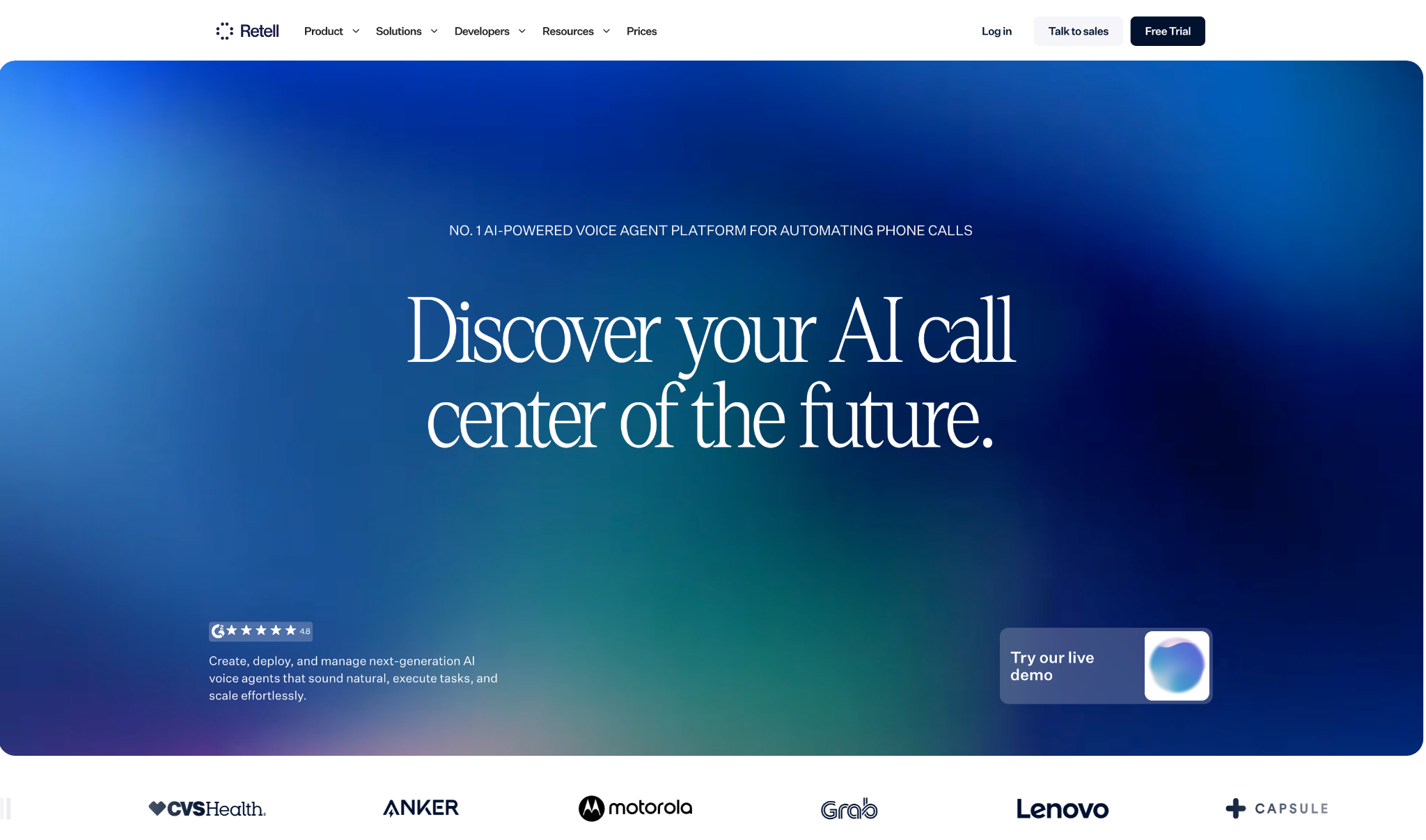
Caption: Retell AI builds phone agents from a single prompt or a node-based Conversation Flow.
Retell AI puts telephony and call QA on one per-minute bill. You build from a Single Prompt agent or a node-based Conversation Flow in the dashboard, or through the Python and Node.js SDKs, which lets an ops lead and an engineer edit the same agent.
In Cekura’s workflow benchmark, Retell (Tell-1) scored 90.2% pass^3, first of ten, with the fastest mean response (0.95 seconds). The November voice quality benchmark placed it third of 16, at a 93.3 composite.
Pricing starts at $0.07 a minute and rises once you pick an LLM and a voice. Even so, if I were moving an engineering team off Synthflow this quarter, I'd price Retell first.
Key features
-
Conversation Flow builder: Nodes on a canvas handle calls that must follow a fixed order, while single-prompt agents cover the less structured ones.
-
Conductor: An AI copilot that builds agents and runs simulated calls without dialing a live phone number.
-
AI quality assurance: Scores up to 100% of production calls, with the first 100 minutes free and $0.10 a minute after that.
-
Batch calling and warm transfer: Outbound campaigns cost $0.005 per dial, branded caller ID adds $0.10 per outbound call, and warm transfer hands the call to a person.
-
Bring your own telephony: SIP trunks and custom telephony carry no Retell charge.
Pros
✅ No platform fee, the first 20 concurrent calls are free, and billing is per second with no charge for failed calls.
✅ The pricing page itemizes LLM, voice infrastructure, TTS, and telephony, and each line shows how a choice changes the total.
✅ Outbound agents can get through another company's keypad menus on their own with IVR navigation.
Cons
❌ Billing continues during silence and hold, and PII removal adds $0.01 a minute on top of the rate.
❌ SSO, role-based access, and any custom BAA or DPA terms require an Enterprise contract.
❌ Retell's Synthflow comparison page (October 2026) states that "Retell does not currently run services inside the EU," which is a problem for anyone who chose Synthflow for EU hosting.
What users say
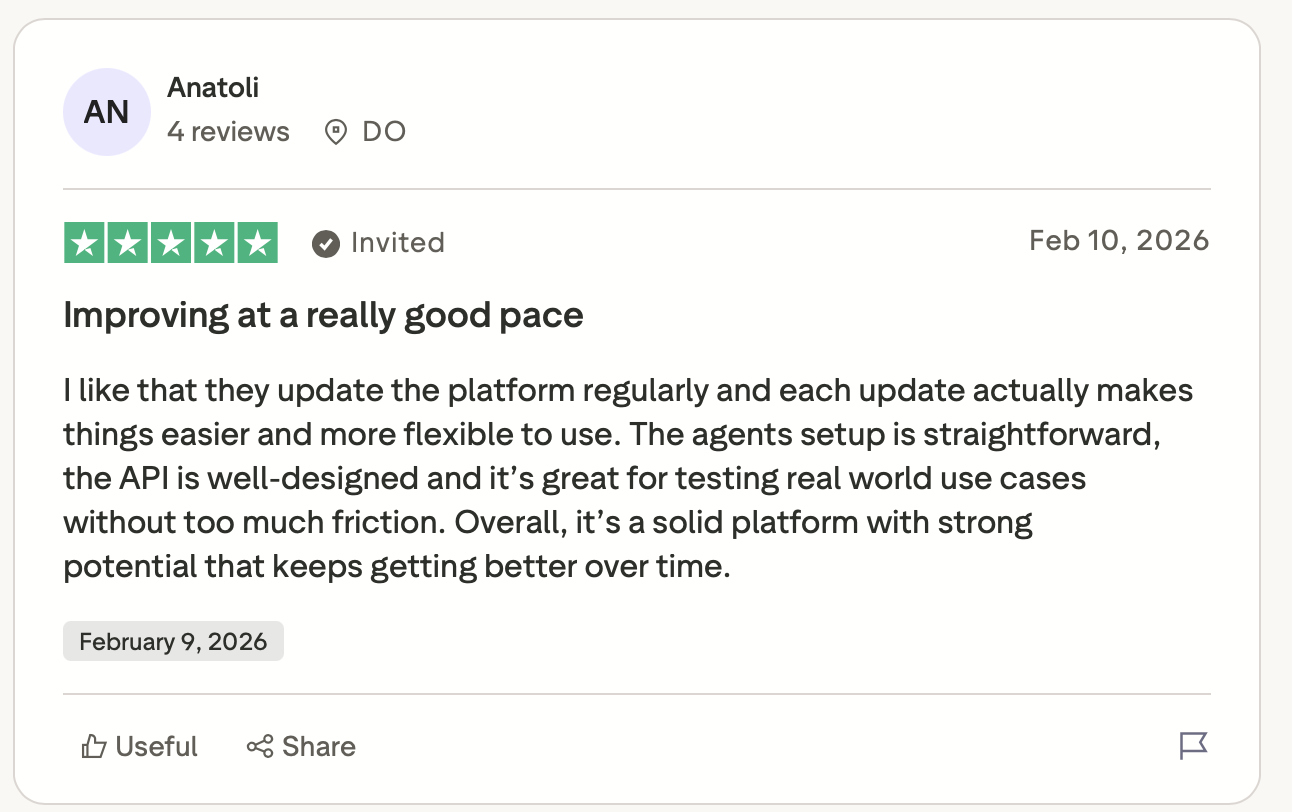
"The agents setup is straightforward, the API is well-designed…" (Anatoli, Trustpilot, February 2026)
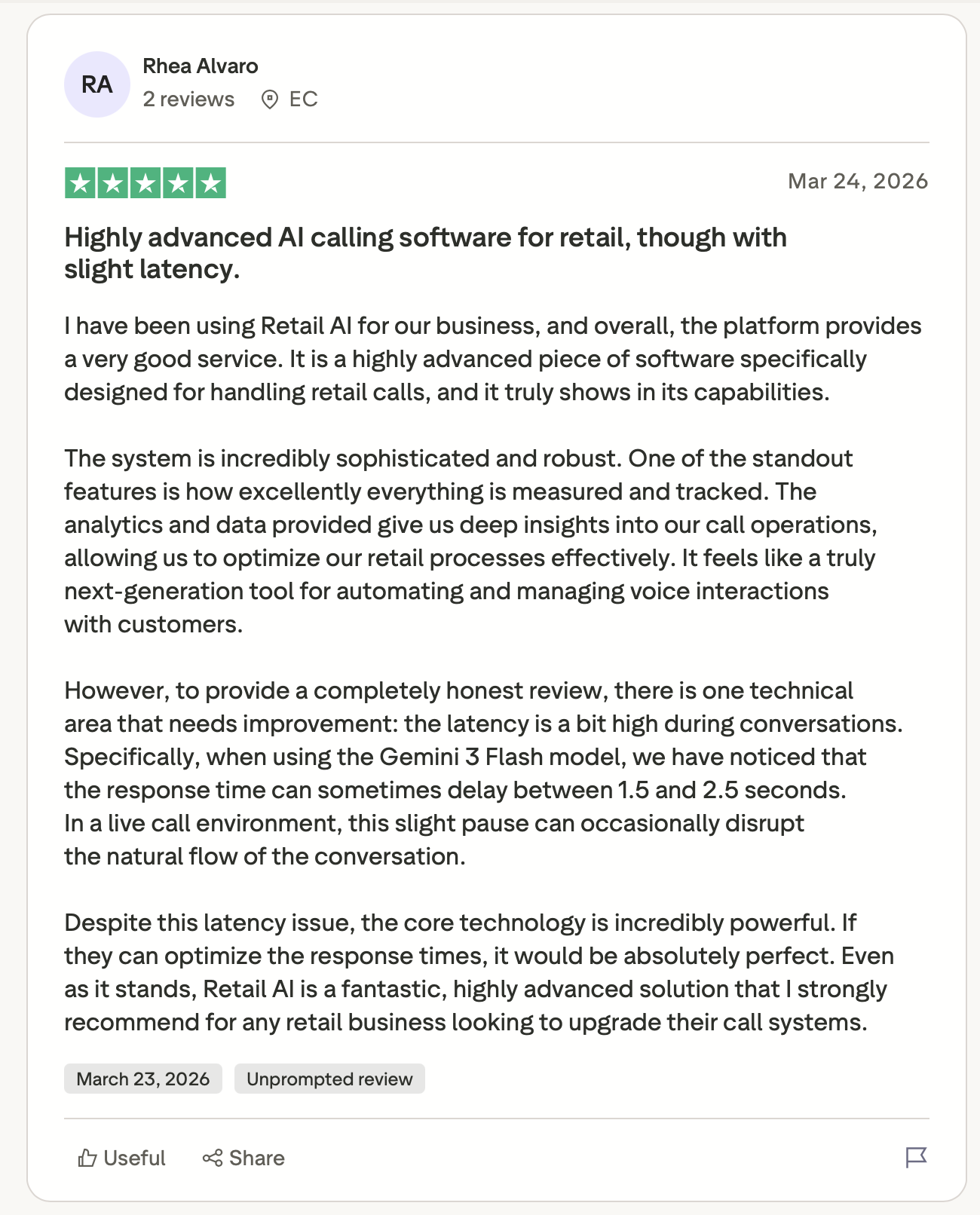
"Specifically, when using the Gemini 3 Flash model, we have noticed that the response time can sometimes delay between 1.5 and 2.5 seconds." (Rhea Alvaro, Trustpilot, March 2026)
Best for
-
Buyers who want to estimate cost per call from an itemized rate card.
-
Outbound programs that need batch dialing and branded caller ID.
-
Voice programs adding simulation and live-call QA without a second vendor at launch.
Pricing
Pay-as-you-go starts at $0 with $10 in free credit, and calls cost $0.07 to $0.31 a minute depending on your LLM and voice choices. The calculator's default example works out to $0.11 a minute.
Extra concurrency costs $8 per slot a month and phone numbers $2 a month. Enterprise is custom.
2. Vapi
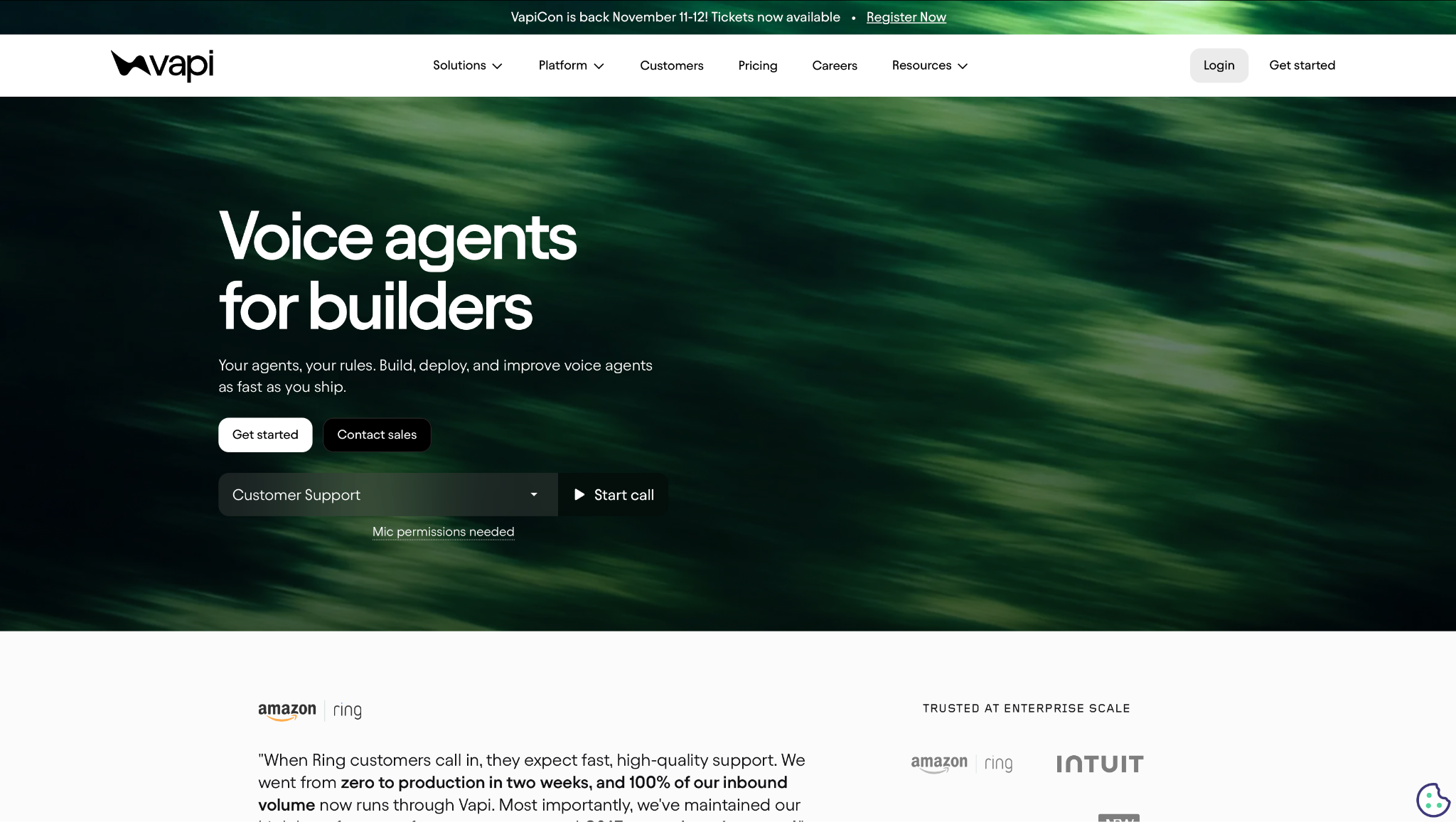
Caption: Vapi lets engineers pick the transcriber, model, and voice behind each assistant.
Vapi lets engineers choose each layer of the voice stack and charges $0.05 a minute to host it. You pick the speech and language providers, such as OpenAI, Anthropic, Deepgram, and ElevenLabs.
Each agent is an Assistant, and Squads hand a caller from one assistant to the next with context intact. In Cekura's workflow benchmark, Vapi completed 97.6% of tasks, but its pass^3 landed at 59.8%.
Vapi retired its visual Workflows builder on August 18, 2026, and existing workflows stopped running the next day. Assistants are now set up in the dashboard or in code.
That makes Vapi an engineering purchase. I'd only shortlist it if someone on your team already owns the provider choices.
Key features
-
Provider choice across the stack: Replace a transcriber or voice without touching the rest of the agent.
-
Squads: Multiple assistants pass a caller between them, such as an intake assistant handing off to a booking assistant.
-
Simulations and Evals: Simulations, launched in August 2026, send AI tester callers to your agent before customers call.
-
Campaigns: CSV contact lists, scheduling, and voicemail detection, rebuilt on August 31, 2026, with a separate guide for warming new numbers.
-
Traffic splitting: Send a share of live calls to a new version and compare results, added in October 2026.
Pros
✅ Vapi SIP and WebRTC transport carry no telephony charge, so calls over them cost only the hosting fee and provider rates.
✅ Config as code puts agent changes through pull-request review like the rest of your product.
✅ Provider costs pass through without markup, so a cheaper transcriber or model lowers the bill by the full difference.
Cons
❌ HIPAA is a $2,000-a-month add-on per organization on any plan, which covers the BAA and DPA.
❌ Only 82.9% of Vapi's calls came through infrastructure-clean in Cekura's workflow benchmark, against 100% for ElevenLabs Agents.
❌ Non-engineers have no visual canvas since Workflows retired, and Composer, the conversational builder, is still in alpha.
What users say
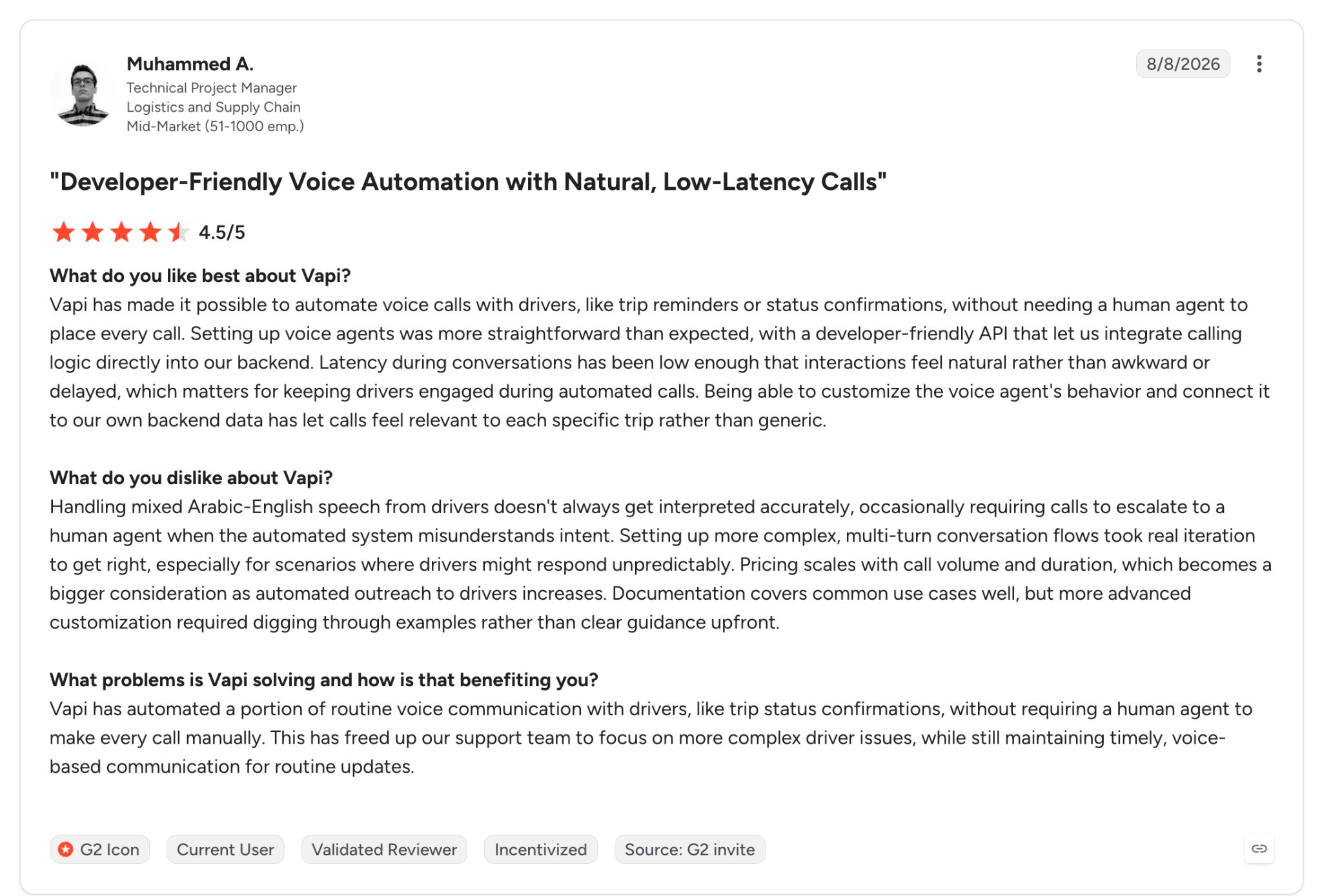
"Latency during conversations has been low enough that interactions feel natural…" (Muhammed A., Technical Project Manager, G2, August 2026)
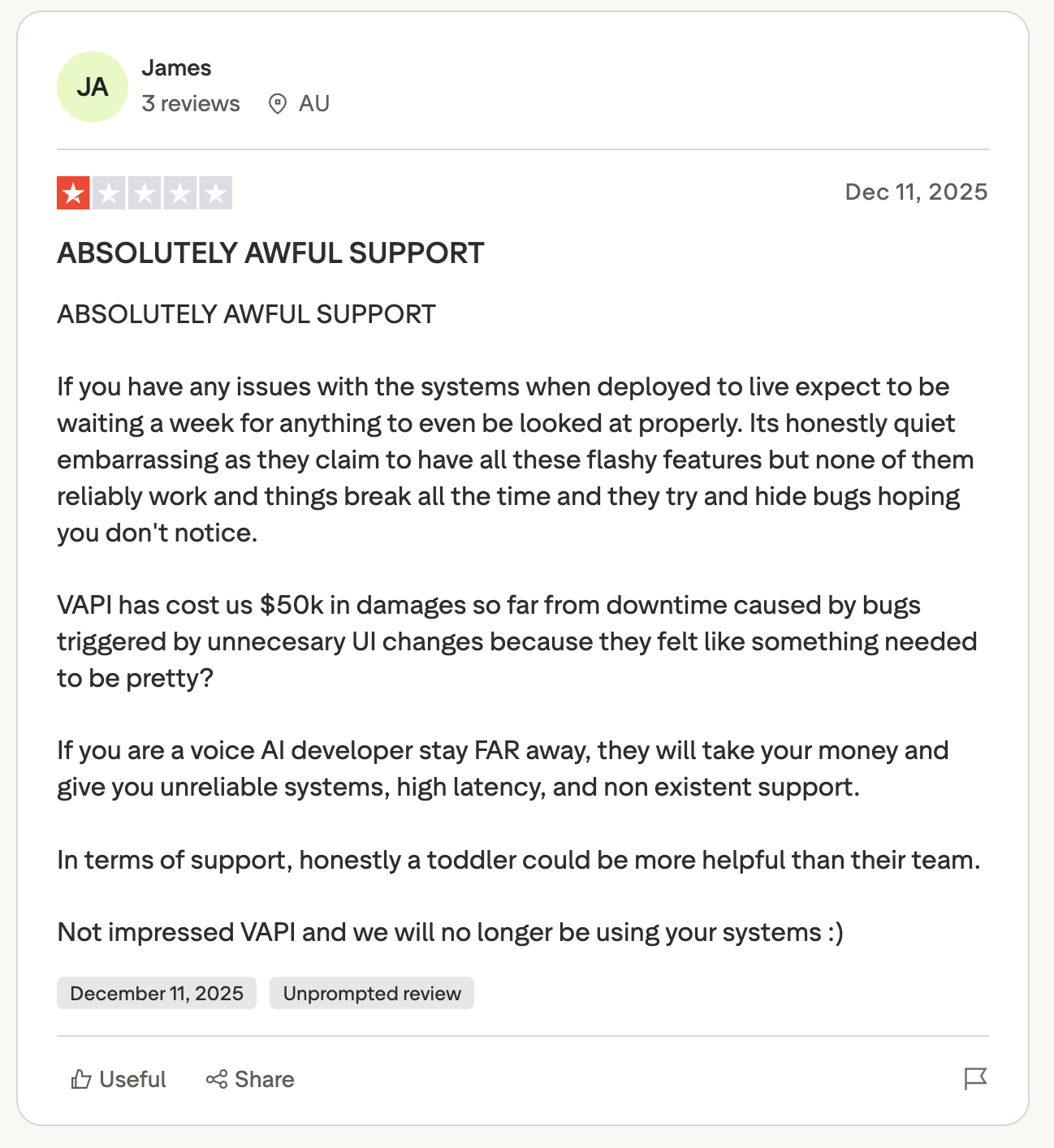
"If you have any issues with the systems when deployed to live expect to be waiting a week for anything to even be looked at properly." (James, Trustpilot, December 2025)
Best for
-
Engineers with a transcriber and model already chosen.
-
Products that embed voice and need agent config under version control.
-
Self-hosted or fine-tuned LLM setups that need a telephony layer on top.
Pricing
Core costs $29 a month with 10 concurrent calls and 5 phone numbers, on top of $0.05 a minute for hosting plus provider costs. Pro bills 10% of the hosting fee with a $999 monthly minimum and 30 concurrent calls, and Premier is custom.
The free tier gives you $5 in credit and 4 concurrent calls. Vapi's calculator puts 1,000 minutes at $82 to $129 a month, and each extra concurrent call costs $10 a month.
3. Bland AI
Caption: Bland AI runs its own speech and language models for enterprise phone agents.
Bland's speech and language models are its own, so that processing stays with one vendor. For regulated buyers, Bland's trust page lists SOC 2 Type II, ISO 27001, self-attested PCI DSS, and FedRAMP 20x Class A (achieved August 25, 2026).
On top of those certifications, the Enterprise plan adds on-premises or VPC hosting.
In Cekura’s November 2026 voice quality benchmark, Bland placed sixth of 16 at 91.4. It stopped speaking 1.06 seconds after a caller cut in.
Key features
-
Agents architecture: The node-based Pathways builder now sits inside each agent, and accounts created after September 18, 2026 start on Agents only.
-
Norm: An AI assistant that drafts agents from a description, billed by tokens.
-
Agent-to-Agent Testing and Evals: One agent calls another to test it, and LLM judges score the results, both launched in spring 2026.
-
CRM sync: HubSpot and Salesforce contact sync, plus GitHub sync for pathways.
Pros
✅ The per-minute rate includes Bland's speech and language models, so calls carry no token charges (only the Norm builder bills by tokens).
✅ Live translation covers 23 of its 40+ languages, so one agent can serve callers who speak a different language from your team.
✅ The Start plan needs no card and comes with an inbound number.
Cons
❌ A BAA and SSO require Enterprise, as do data residency and guardrails (Protected Calls).
❌ Per-minute rates rose on December 5, 2025, from a flat $0.09, and every production agent must move to the new Agents architecture by November 15, 2026.
❌ Self-serve plans cap daily volume at 100 calls on Start and 2,000 on Build.
What users say
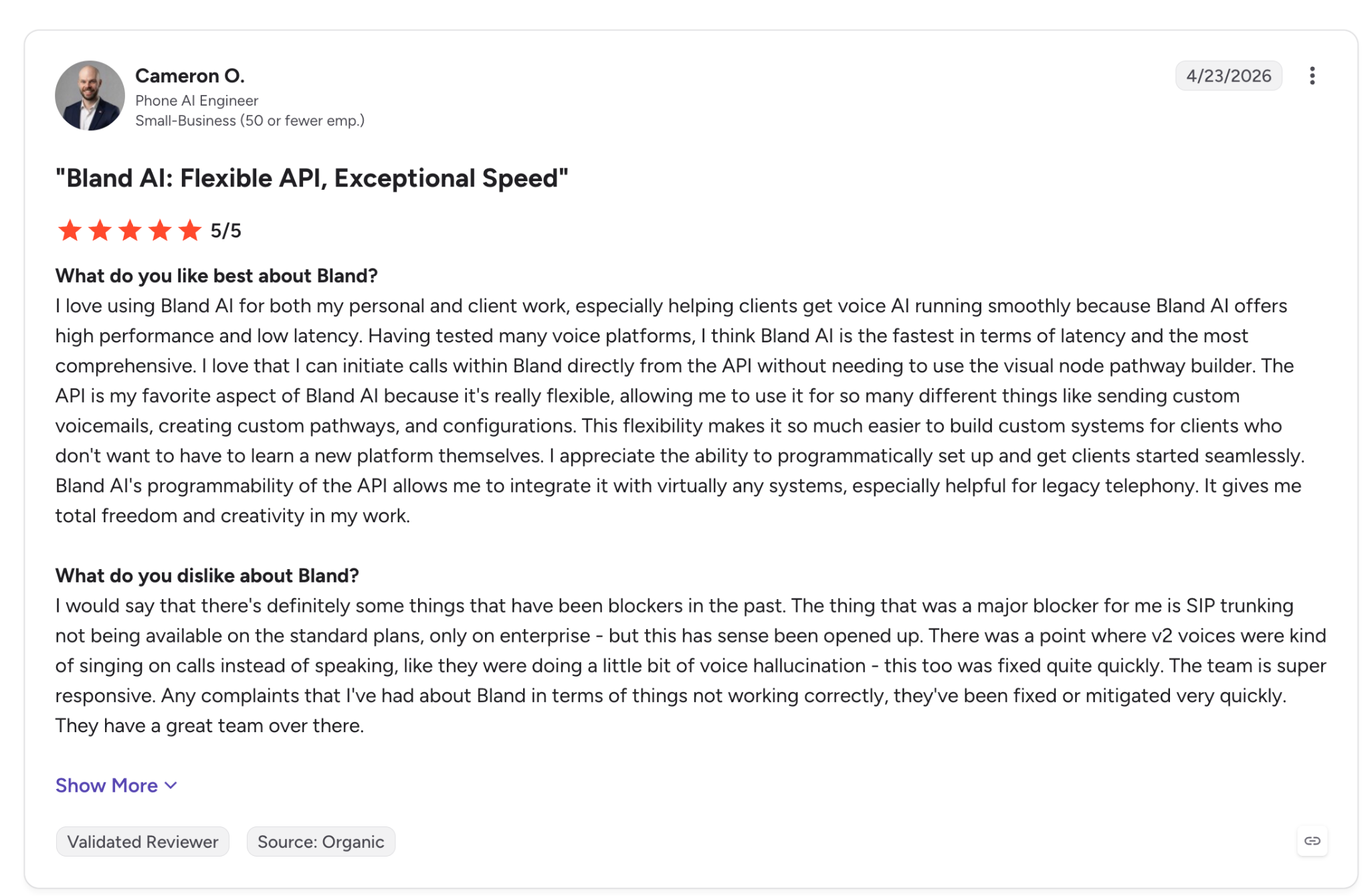
"Having tested many voice platforms, I think Bland AI is the fastest in terms of latency…" (Cameron O., Phone AI Engineer, G2, April 2026)
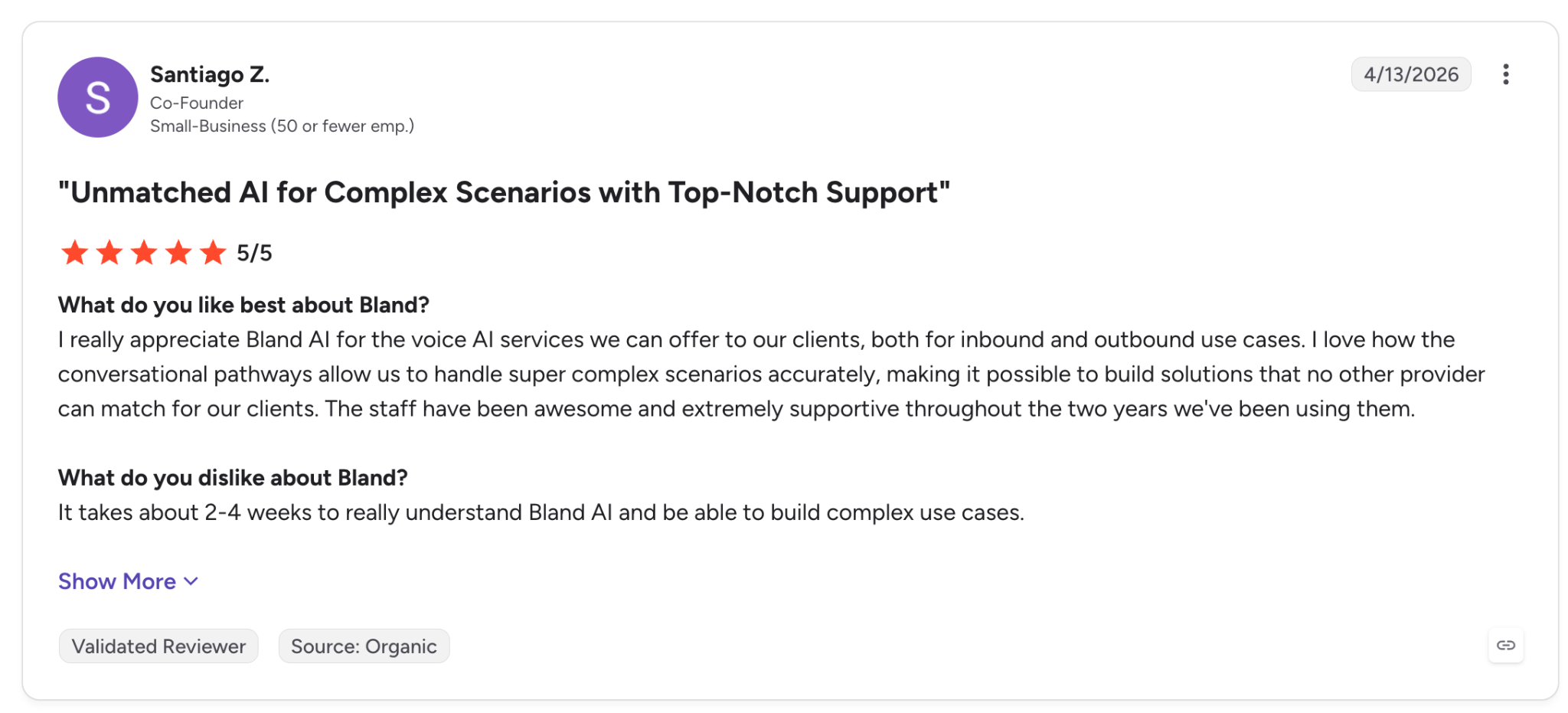
"It takes about 2-4 weeks to really understand Bland AI…" (Santiago Z., Co-Founder, G2, April 2026)
Best for
-
Regulated buyers who need FedRAMP or on-premises hosting.
-
Programs that want speech recognition and the language model from one vendor, with no token charges per call.
Pricing
Start has no platform fee and bills $0.14 a minute with 10 concurrent calls. Build costs $299 a month plus $0.12 a minute with 50 concurrent calls, and transfers bill $0.05 and $0.04 a minute respectively.
Bland's billing docs also list a Scale plan at $499 a month and $0.11 a minute that the pricing page doesn't show. Enterprise is custom.
4. ElevenLabs Agents
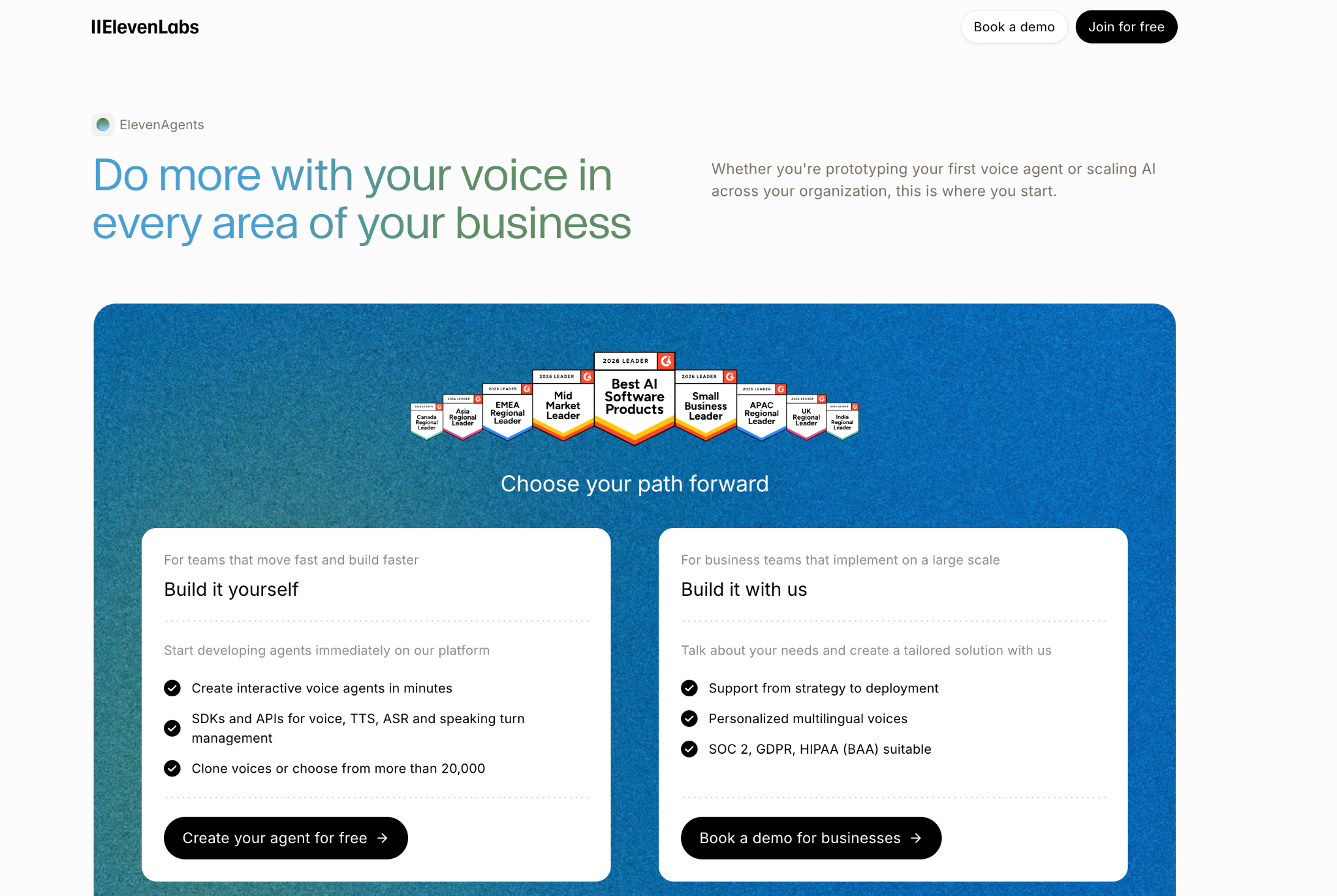
Caption: ElevenLabs Agents lets you build with SDKs, the dashboard, or a visual Workflows builder.
ElevenLabs Agents wraps the company's voice models in an agent builder with its own testing and telephony tools, and monthly plans start at $0. You can build with SDKs for React, Swift, Kotlin, and Unity or in the visual Workflows builder, and transfer callers between agents.
Its 81.7% pass^3 placed it third of ten in Cekura’s workflow benchmark, with 100% infrastructure-clean calls.
The plan price covers only part of the bill. Each plan includes a block of call minutes.
Key features
-
Workflows: A visual builder for branching calls, alongside agent-to-agent transfer.
-
Agent Testing and Experiments: Simulated conversations before launch, and A/B tests on production traffic after it.
-
Telephony providers: Twilio, Telnyx, Vonage, Plivo, Bandwidth, Sinch, Exotel, and SIP trunking, with no ElevenLabs telephony fee.
-
Enterprise connectors: Salesforce, HubSpot, Zendesk, ServiceNow, Genesys, Amazon Connect, Cal.com, and Calendly.
-
Data controls: Regional residency in the US, EU, and India, plus Zero Retention Mode.
Pros
✅ Second-fastest mean response (1.11 seconds, behind Retell’s 0.95) and the top naturalness score (4.40 out of 5) of the ten platforms in Cekura’s workflow benchmark.
✅ The same agent works over voice and text channels, WhatsApp and SMS included.
✅ Enterprise customers can deploy on their own infrastructure.
Cons
❌ LLM usage bills separately and raises the invoice above the plan price whenever calls use the model.
❌ A HIPAA BAA and custom SSO require an Enterprise contract.
❌ Minutes above your concurrency limit bill at the $0.16 burst rate, double the $0.08 overage.
What users say
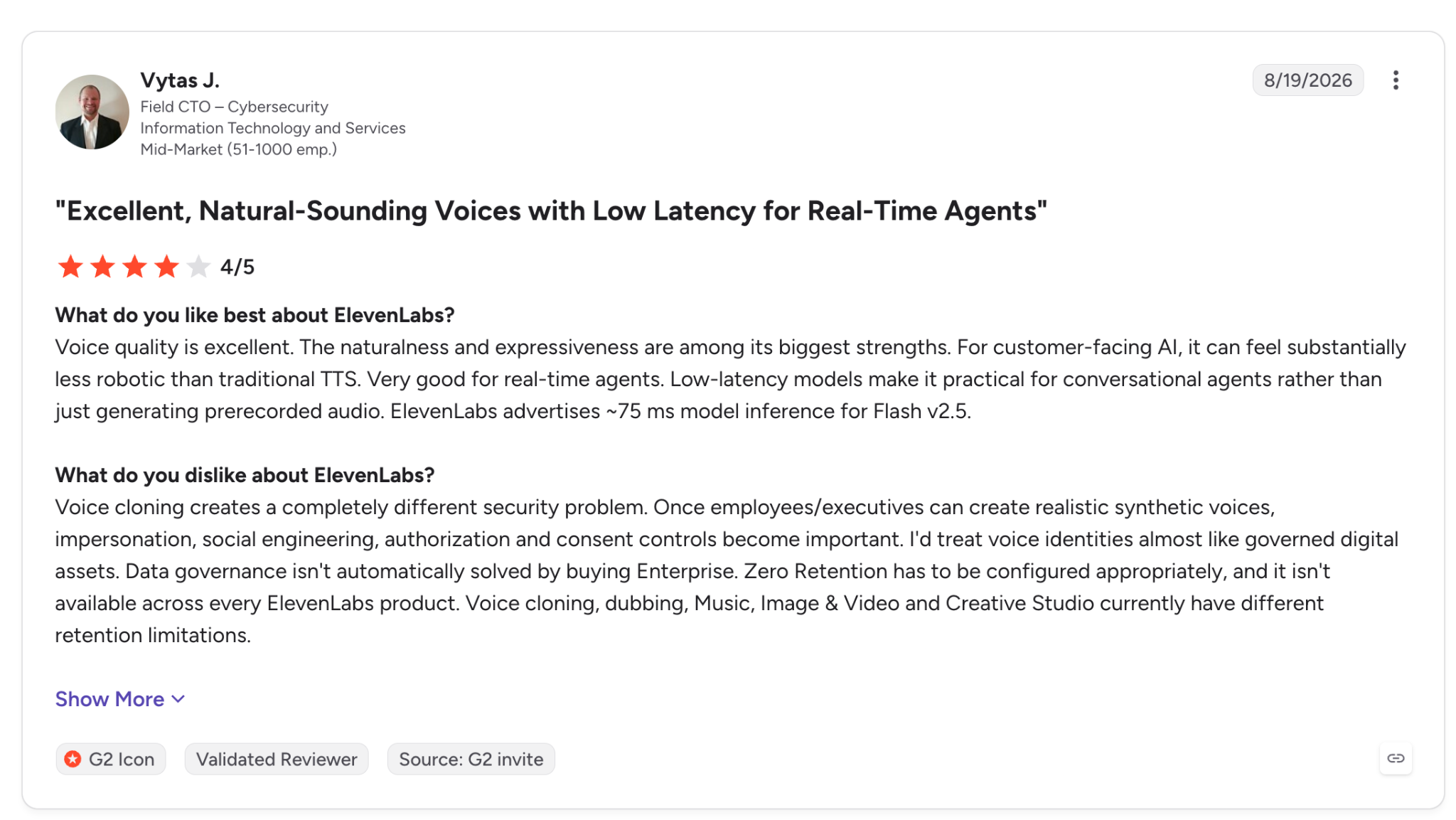
"Low-latency models make it practical for conversational agents…" (Vytas J., Field CTO, G2, August 2026)
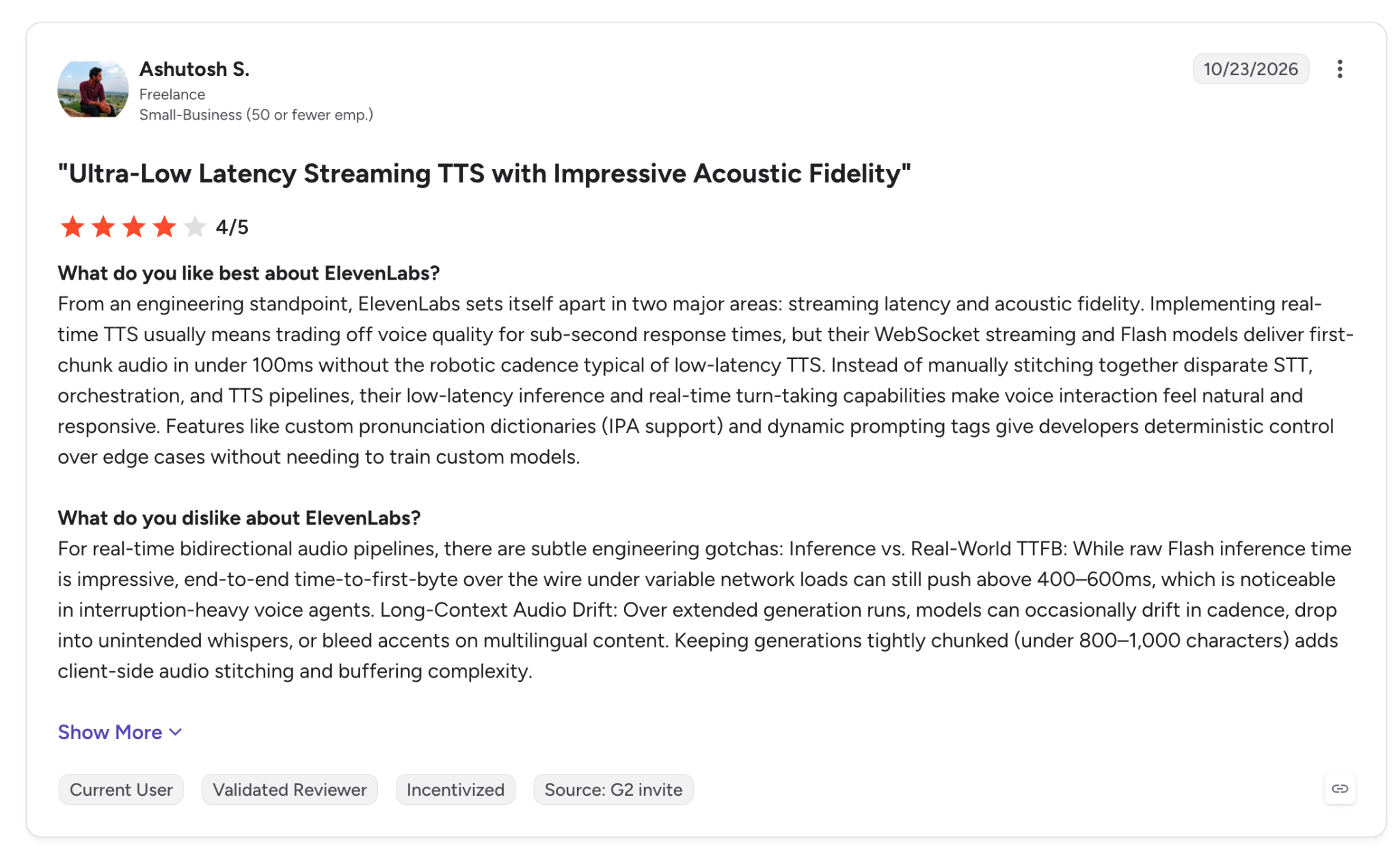
"…end-to-end time-to-first-byte over the wire under variable network loads can still push above 400-600ms, which is noticeable in interruption-heavy voice agents." (Ashutosh S., Freelance, G2, October 2026)
Best for
-
Multilingual support lines where voice quality decides the deal.
-
Products that start on the $6 or $22 tier and expect to move up as call volume grows.
-
Enterprise deployments that need EU or India data residency.
Pricing
Billed monthly, Starter costs $6 for 75 minutes ($1 for the first month), Creator $22 for 275 minutes ($11 for the first month). Scale runs $299 for 3,738 minutes and Business $990 for 12,375 minutes with 40 concurrent calls, and a Free plan covers 15 minutes to try it.
Extra minutes cost $0.08. A yearly toggle appears on the page, and Enterprise is custom.
5. Voiceflow
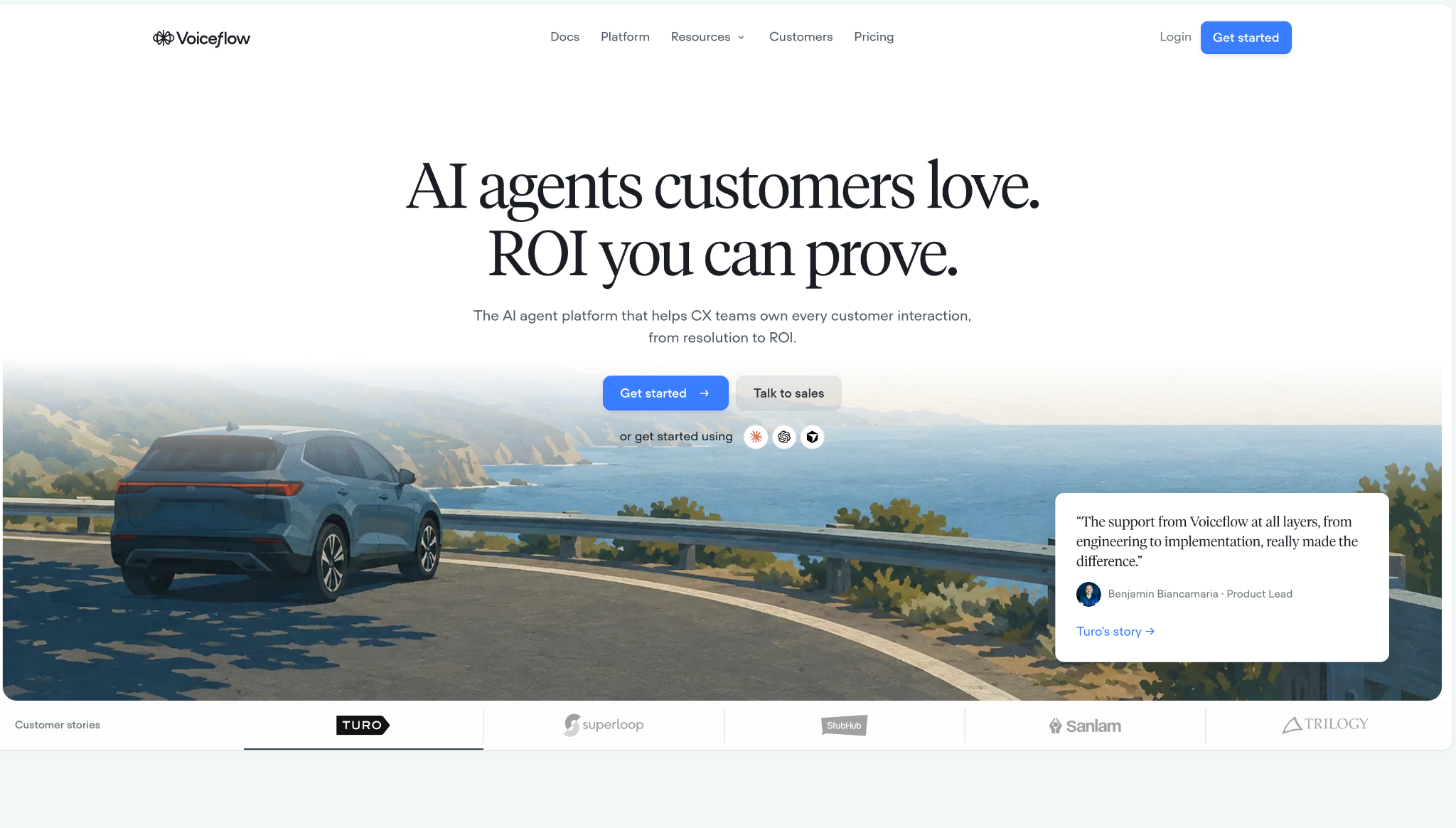
Caption: Voiceflow pairs fixed Workflows with goal-driven Playbooks on one canvas.
Voiceflow, like Synthflow, builds agents on a visual canvas, and it targets CX teams. Workflows handle processes that must happen in a fixed order, and Playbooks are goal-driven sub-agents written as instructions.
One workspace serves web chat, phone, and SMS, and other channels such as WhatsApp connect through the API. Voiceflow recommends Deepgram Flux for speech-to-text.
Voiceflow doesn’t publish list prices, so you see them in the app after signup or get a quote from a demo.
Key features
-
Workflows and Playbooks: Fixed steps for flows like authentication, and instruction-driven sub-agents for the parts where callers go off-topic.
-
Tests and personas: Scripted and AI-simulated conversations with checks on responses, routing, and tool calls, plus personas that preset customer details.
-
Live-agent handoff: Pass the conversation to Zendesk, Genesys, UJET, Kustomer, or Dixa.
-
Environments: Separate development and production versions of an agent, with environment protection added in July 2026.
Pros
✅ CX and ops staff can edit flows without filing an engineering ticket.
✅ Voiceflow states that customer data isn't used to train AI models and that model providers operate under zero data retention.
✅ Agencies get a free trial with no credit card.
Cons
❌ Credit-based billing makes it hard to compare against per-minute platforms before you sign up.
❌ Native phone numbers cover only the US and Canada. Elsewhere you connect your own Twilio, Vonage, or Telnyx account.
❌ SSO and private cloud hosting are limited to the Enterprise plan.
What users say
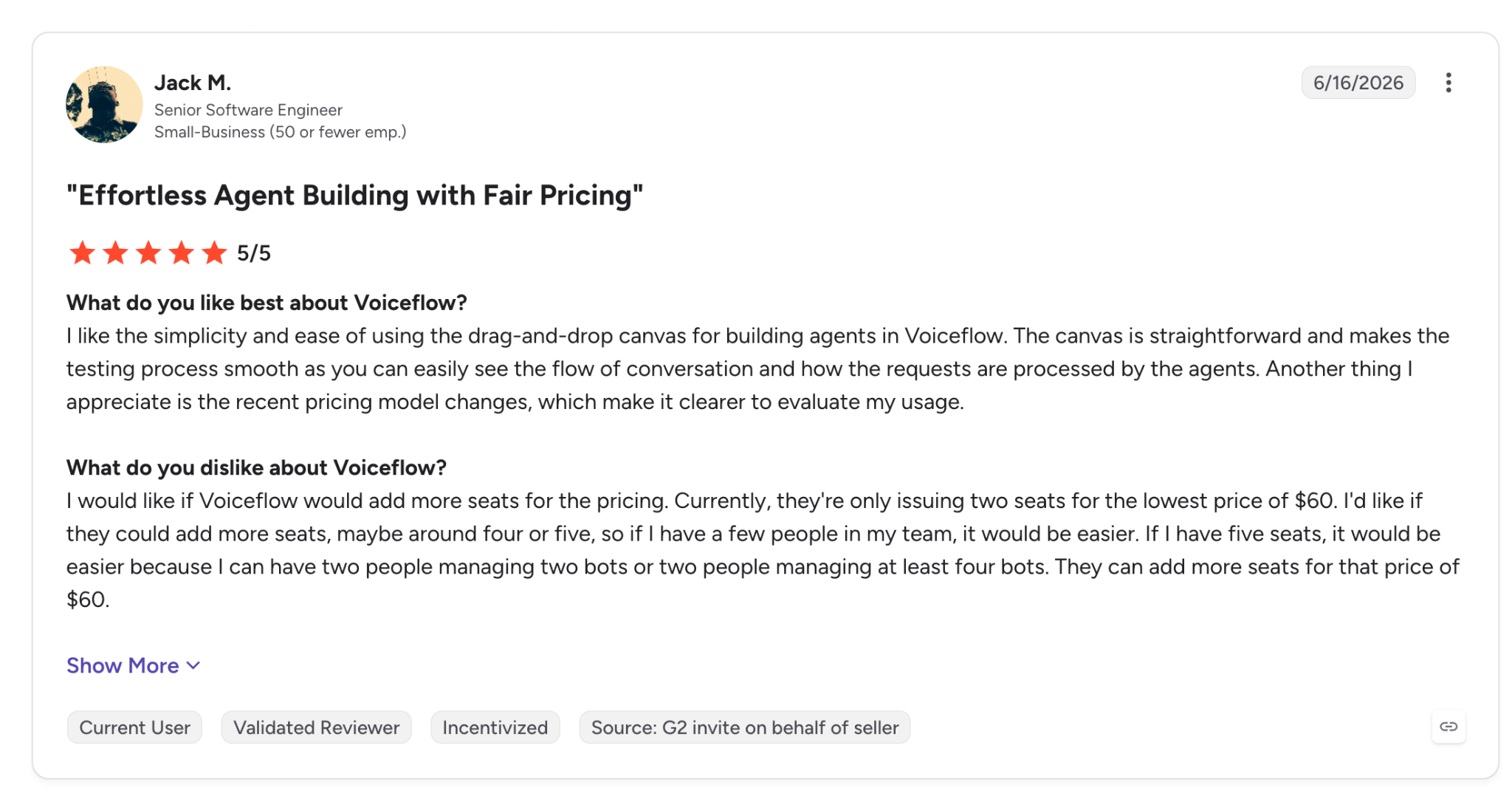
"The canvas is straightforward and makes the testing process smooth as you can easily see the flow of conversation and how the requests are processed by the agents." (Jack M., Senior Software Engineer, G2, June 2026)
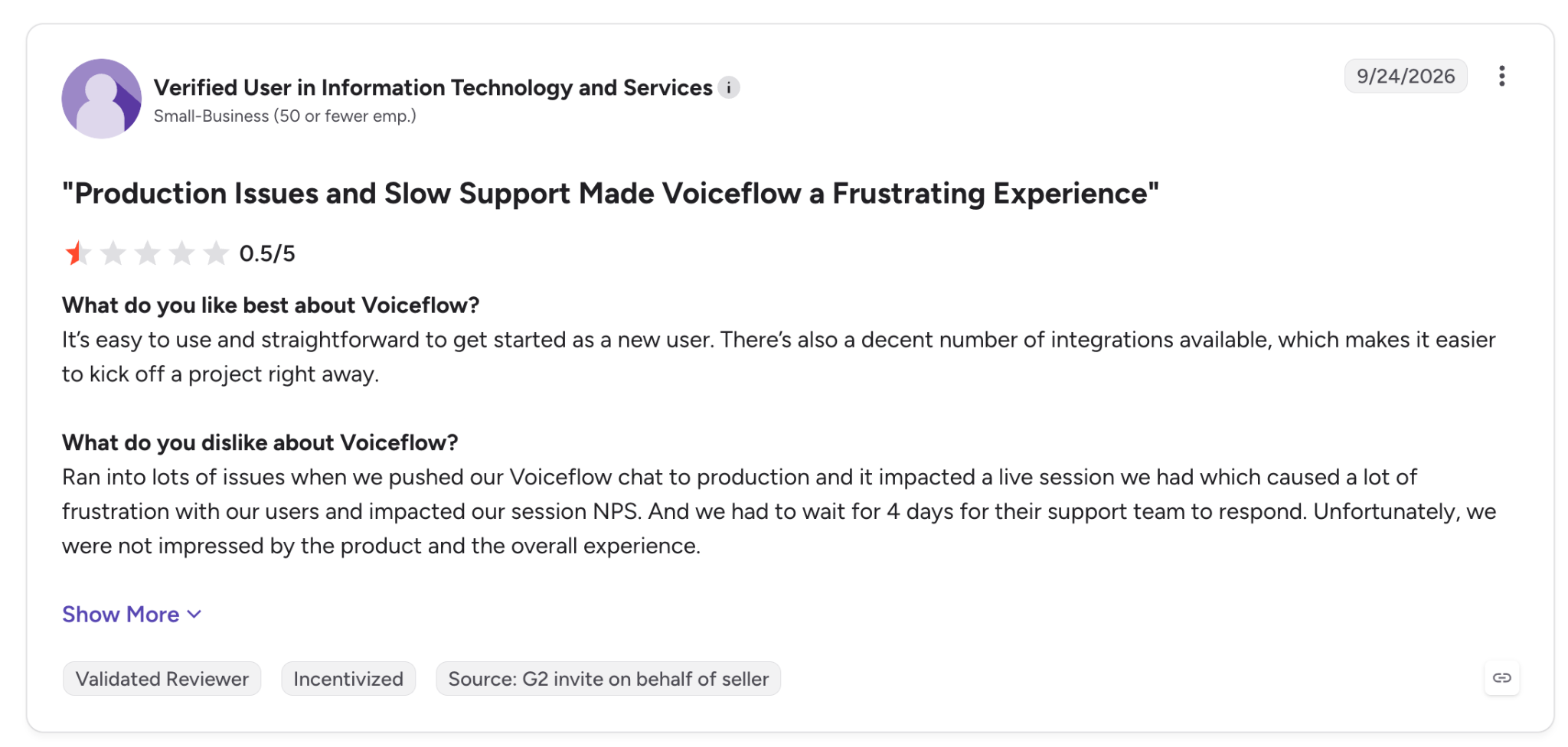
"And we had to wait for 4 days for their support team to respond." (Verified User in Information Technology and Services, G2, September 2026)
That complaint came from a Voiceflow chat deployment and is about support response times.
Best for
-
CX departments running chat and phone agents together.
-
Companies already on Zendesk or Genesys that need conversations passed to a human agent inside their helpdesk.
-
Operations leads who liked Synthflow's canvas and want to keep editing visually.
Pricing
Voiceflow's AI info page names four plans (Pro, Business, Enterprise, and Free) and bills a plan fee plus credit-based usage, with no list prices. You’ll need to request pricing through a demo.
6. Goodcall
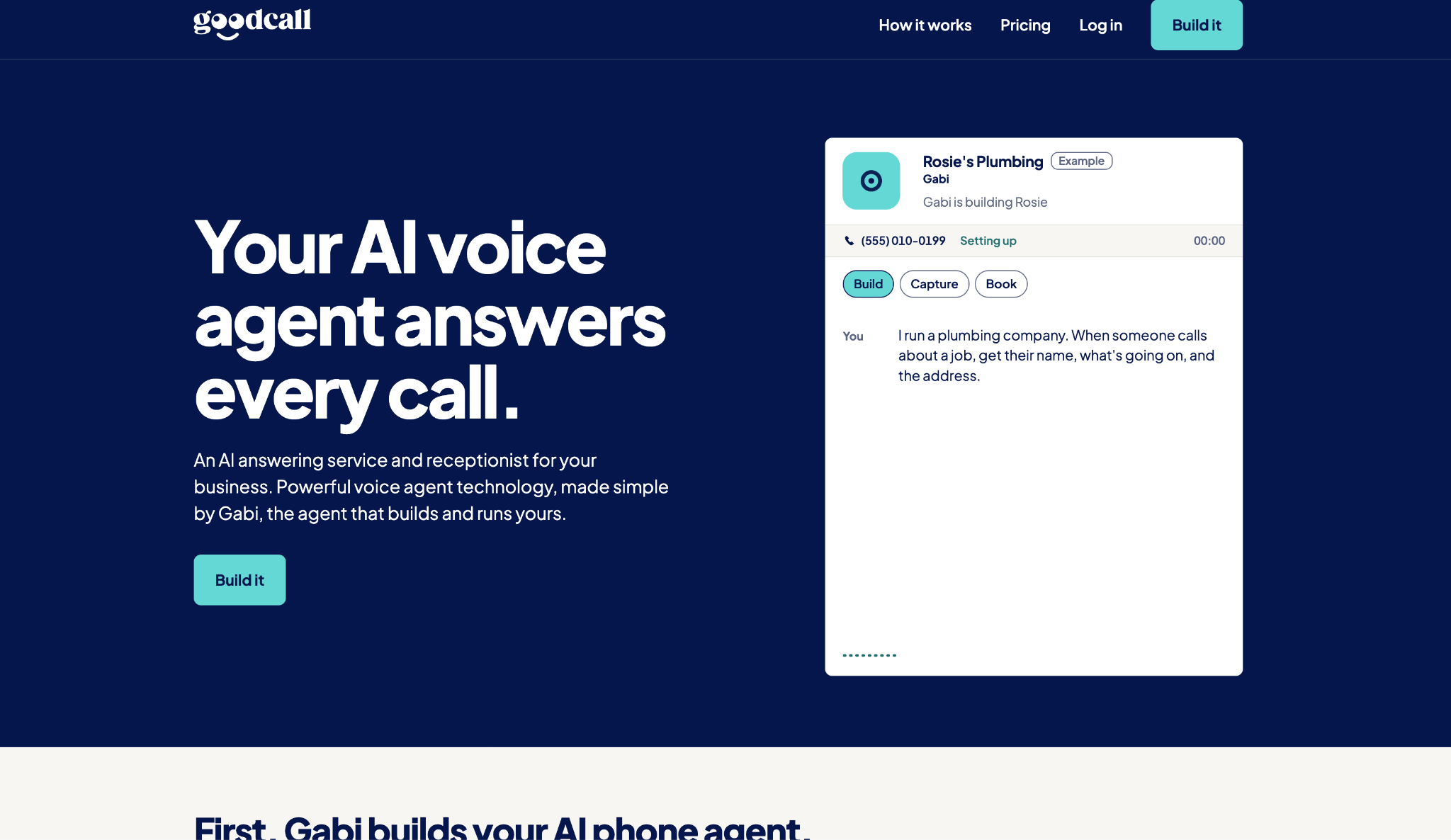
Caption: Goodcall's assistant Gabi builds the receptionist agent from a conversation.
Callers served each month set Goodcall's price, and its pricing page says it never meters minutes. A unique customer is one phone number, once a month. Because the bill follows callers, a long booking call costs the same as a short one.
You build by talking to Gabi, Goodcall's assistant, which learns from your website or a PDF of your services and prices. Gabi then runs practice calls before you approve the agent.
Key features
-
Gabi builder: Describe your business in plain language, and Gabi builds and tests the agent.
-
Transfers down a list: If the first contact doesn't answer, the agent tries the next one, up to three.
-
Lead capture mid-call: Goodcall texts or emails lead details while the caller is still on the line.
-
Connected tools: Google Calendar, Google Sheets, and HighLevel connect natively, and custom systems connect through an API tool or MCP server.
Pros
✅ Unlimited agent edits come on every plan, and a new greeting or question costs nothing.
✅ Spam and wrong numbers don't count toward your customer total.
✅ A BAA is available from the $299 Scale plan, without an Enterprise contract.
Cons
❌ Numbers are local US numbers only, with no toll-free, Canadian, or international options yet.
❌ Connected tools and call history are capped by tier, at 1, 5, or 15 tools and 30 days, 90 days, or unlimited history.
❌ Number porting isn’t self-serve yet, so you go live by forwarding your existing line, and SMS follow-ups can’t take replies.
What users say
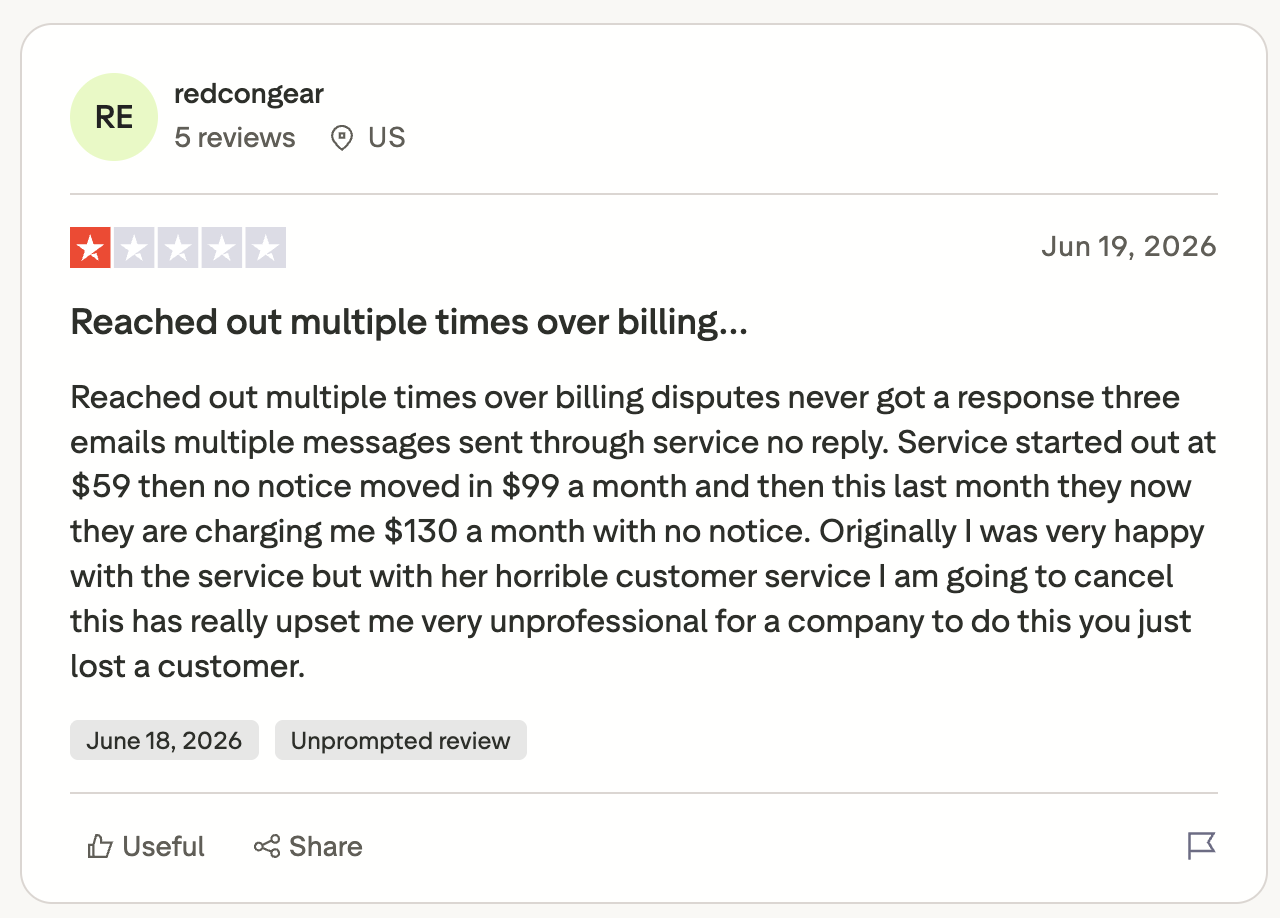
"Service started out at $59 then no notice moved in $99 a month and then this last month they now they are charging me $130 a month with no notice." (redcongear, Trustpilot, June 2026)
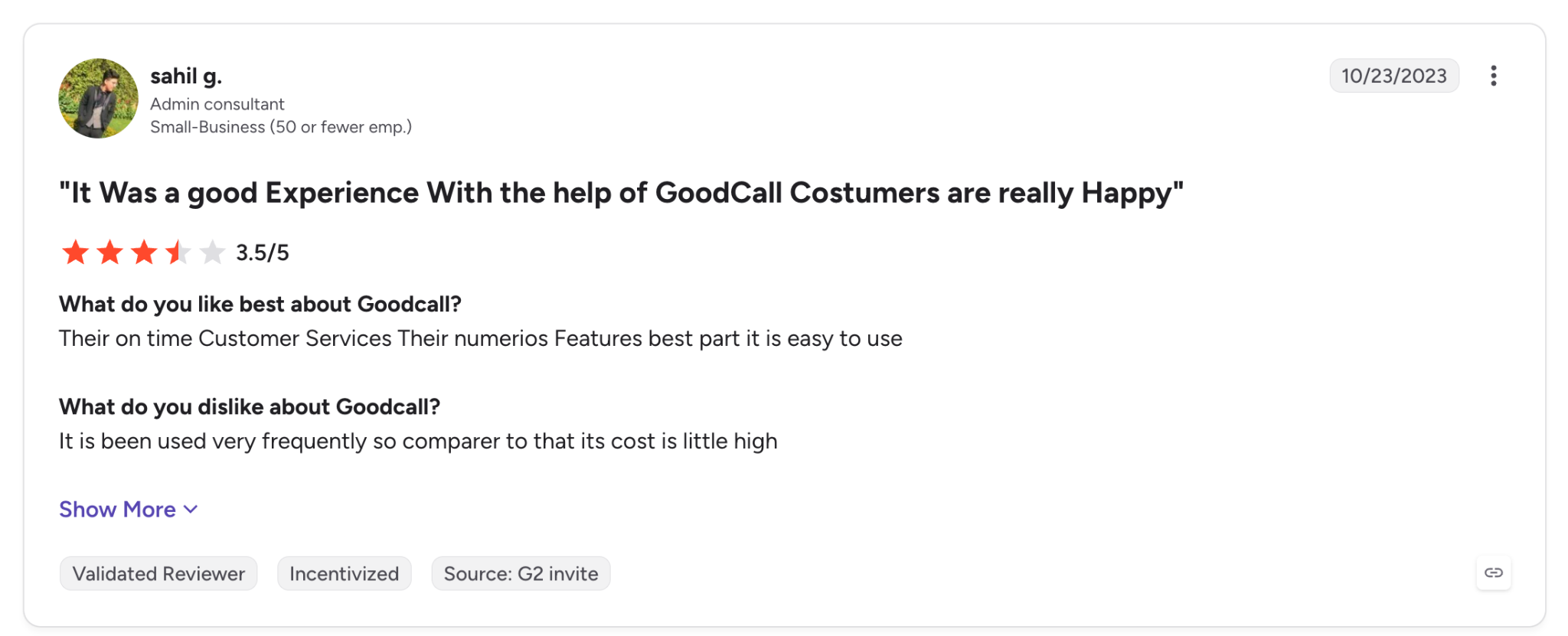
"Their on time customer services their numerous features best part it is easy to use." (sahil g., G2, October 2023)
Best for
-
Local service businesses that miss calls during busy hours.
-
Owners building and testing a receptionist by talking to Gabi, without a developer.
Pricing
Billed monthly per agent, Starter costs $79 for 100 unique customers (about 150 calls), then 79¢ per extra customer. Growth costs $129 for 500 customers at 26¢ each after, and Scale $299 for 2,000 at 15¢.
Enterprise is custom, with volume pricing and an SLA. You can build a free demo agent and hear it answer before adding a number, which is Goodcall's version of a trial.
7. Smith.ai
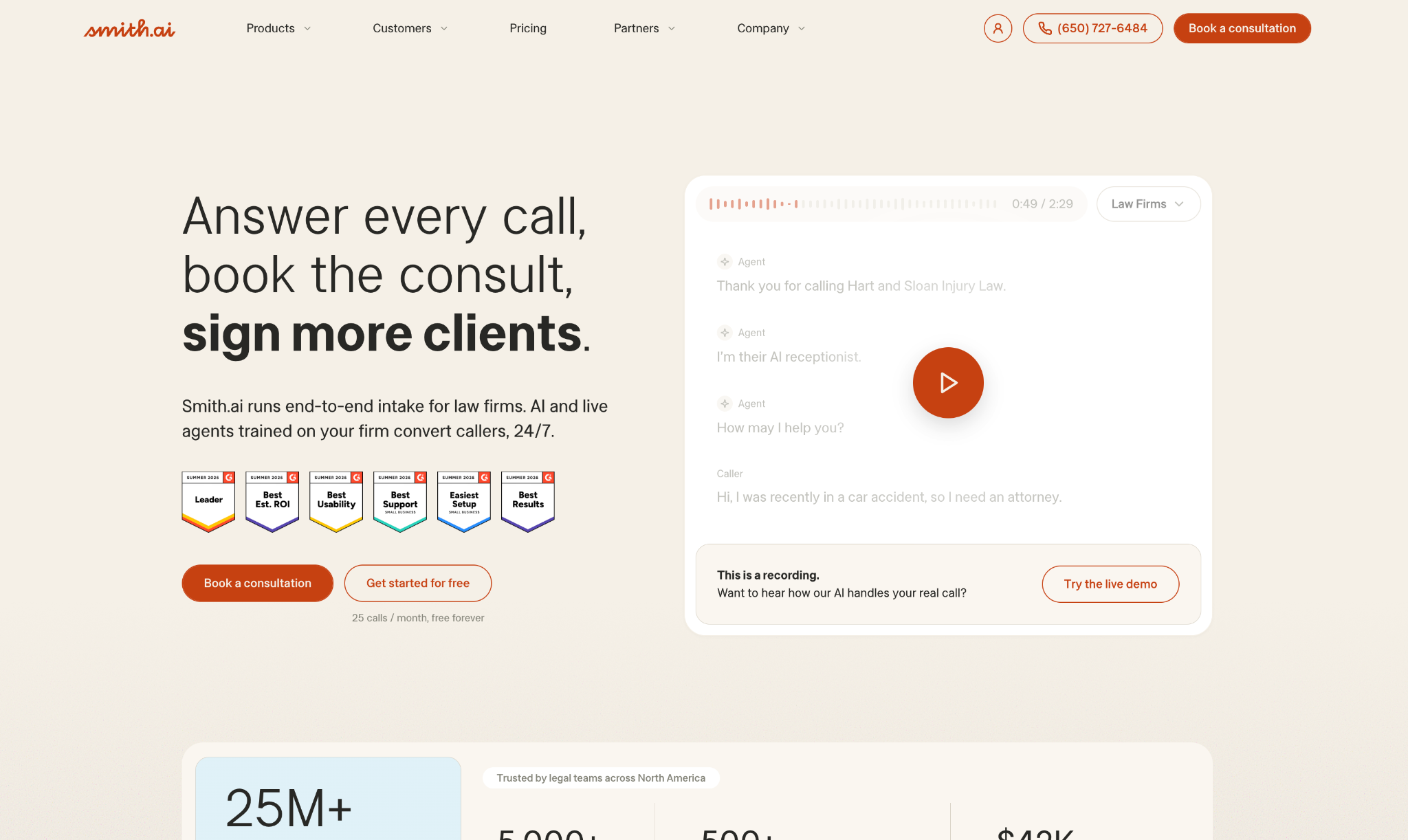
Caption: Smith.ai combines an AI receptionist with live agents for intake calls.
Smith.ai pairs an AI receptionist with 500+ North American live agents who take over the calls the AI hands off. Its homepage leads with law-firm intake, from the first answer to the signed client, and Smith.ai says it has handled 25M+ calls across its services.
AI Receptionist plans handle inbound calls in English and Spanish.
For a law firm, I'd weigh the live-agent backup above the per-call math, because a missed consult costs more than an escalation.
Key features
-
Human escalation: Live agents take over calls the AI can’t finish, and warm transfers pass callers to your own team with context.
-
Legal and CRM integrations: Clio Grow and Manage, Filevine, Lawmatics, MyCase, Salesforce, HubSpot, Calendly, Acuity, and Zapier.
-
Quality Studio: Simulated test calls before launch.
-
Self-healing FAQs: Knowledge gaps found on calls are surfaced for you to fill.
-
Caller Type Identification: Sorts callers into 10 types.
Pros
✅ Escalations the AI starts are free, so a call it can't finish reaches a live agent at no extra cost.
✅ The Free plan includes 25 calls a month, with overages off by default (a card is required to sign up).
✅ Plans are month-to-month with 30 days' notice, and up to 10% of monthly calls can be removed from the bill as spam.
Cons
❌ The pages I read don't state SOC 2, HIPAA, or GDPR status, and the "Security" link leads to a responsible-disclosure page.
❌ Caller-requested handoffs and live-agent help with verification or scheduling cost $3 per call.
❌ AI Receptionist plans take inbound calls only, so returning calls means paying for a Virtual Receptionist or Hybrid plan.
What users say
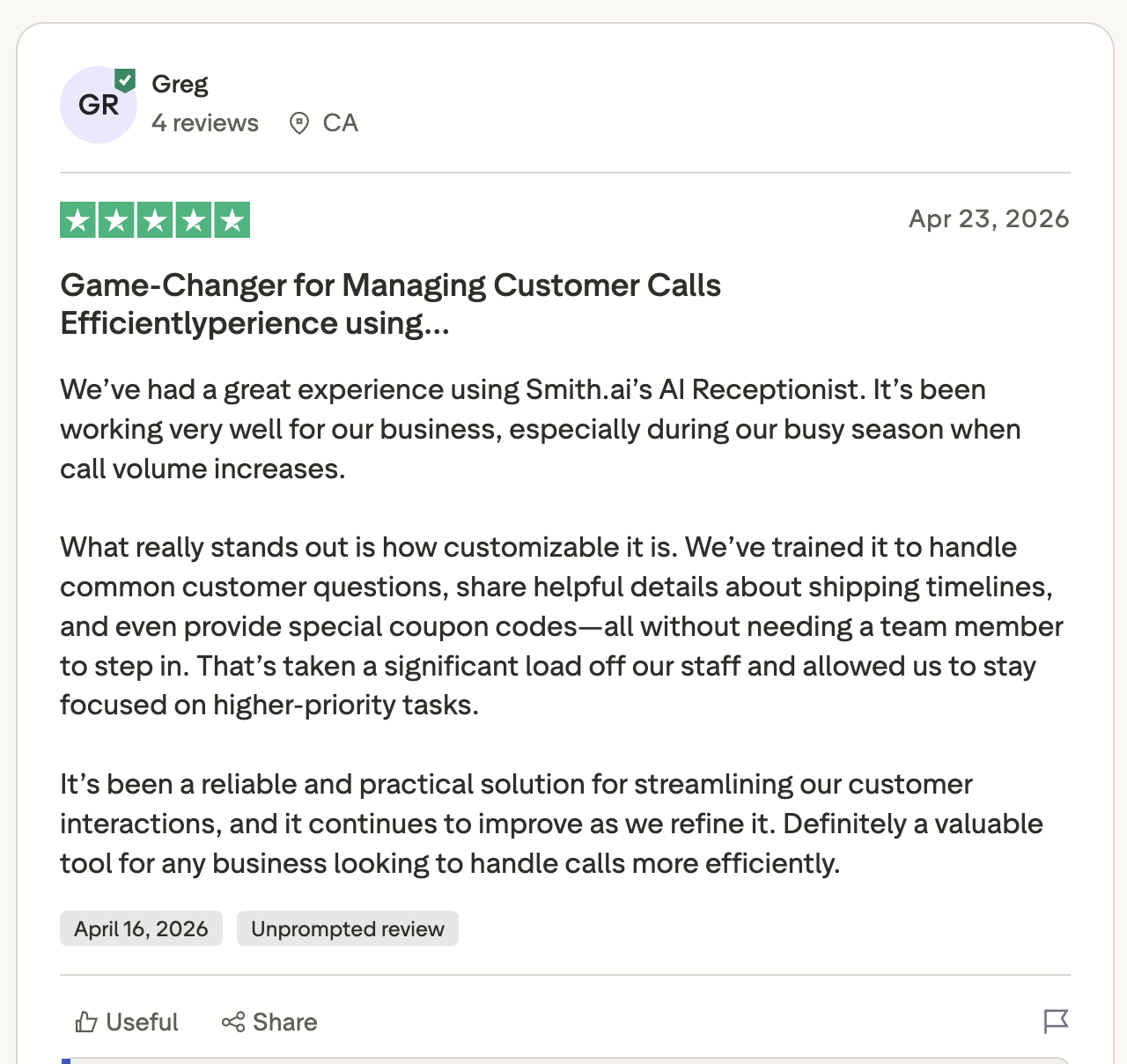
"We’ve trained it to handle common customer questions, share helpful details about shipping timelines, and even provide special coupon codes…" (Greg, Trustpilot, April 2026)
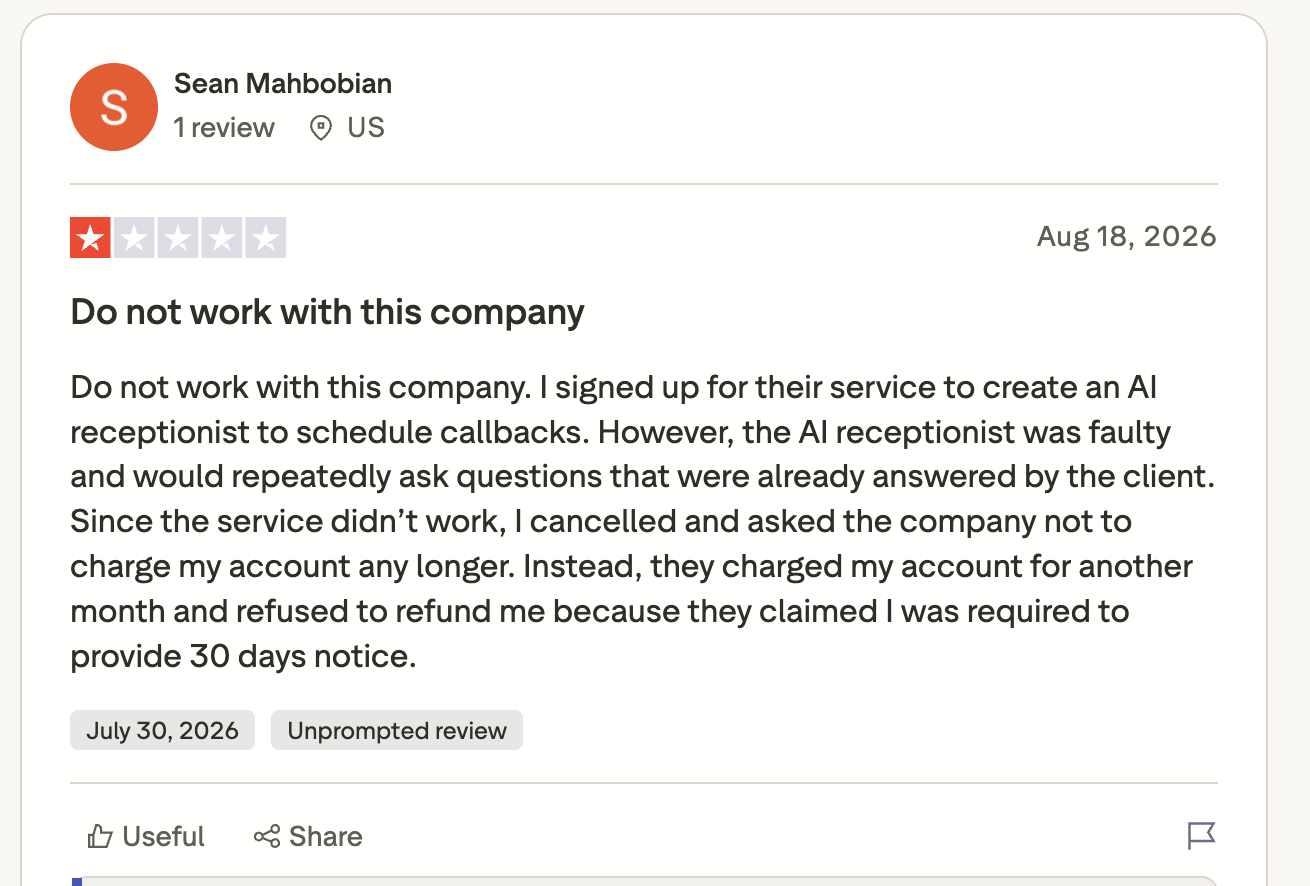
"However, the AI receptionist was faulty and would repeatedly ask questions that were already answered by the client." (Sean Mahbobian, Trustpilot, August 2026)
Best for
-
Law firms that want intake and booking handled in one call.
-
Service businesses that want 24/7 live-agent backup for calls the AI can't finish.
-
Practices that budget by call count, since AI Receptionist plans bill per call.
Pricing
Billed monthly, AI Receptionist Pro costs $150 for 75 calls ($2.00 each), with overage at $2.50. Larger Pro bundles go to 150 or 300 calls, and Enterprise starts at $500 for 300 calls.
Hybrid AI-and-human plans start around $2.50 a call. The human Virtual Receptionist plans start at $300 a month for 30 calls, with 10% off for a 12-month subscription.
8. PolyAI
Caption: PolyAI Dialog Studio builds enterprise voice agents with no-code and low-code tools.
Calls resolved without escalation are the number PolyAI designs its enterprise voice agents around.
The homepage claims hundreds of millions of calls a year, and lists results like 35,000 labor hours saved at PG&E (customer-reported). PolyAI raised an $86M Series D in December 2025.
Cekura’s November 2026 voice quality benchmark placed it fifth of 16, at 92.7.
Key features
-
Dialog Studio (formerly Agent Studio): No-code and low-code configuration in the browser, opened to every builder in May 2026.
-
Agent Development Kit: A command-line tool and Python package for agents managed in code, with a Git-style pull, edit, and push workflow.
-
Wren: An agent that reviews every conversation and tests each improvement it recommends, launched September 2026.
-
Contact center telephony: Amazon Connect, Dialpad, Five9, Genesys, NICE CXone, Zendesk Talk, Zoom, Twilio, and SIP trunks.
-
Regional data residency: US, UK, EU, and APAC, with no transfers between regions.
Pros
✅ Voice agents bill on connected time with no minimums or rounding, and your carrier connects over SIP at no charge.
✅ Highest task completion (98.8%) of the ten platforms in Cekura’s workflow benchmark, with pass^3 (87.8%) second only to Retell’s 90.2%.
✅ The homepage claims capacity for 10,000 concurrent calls, against the 10 to 50 included on Vapi, Retell, and Bland self-serve plans.
✅ It stopped speaking 0.92 seconds after a caller cut in, the second-fastest of 16 platforms in Cekura’s voice quality benchmark.
Cons
❌ PolyAI's G2 reviews date from 2022 and 2023, before its 2026 self-serve launch, so recent user feedback is thin.
❌ The model-only Dialog-RSN-1 API is English-only at launch and excludes telephony and orchestration.
❌ Its 2.46-second mean response in the workflow benchmark is more than double Retell’s 0.95 seconds.
What users say
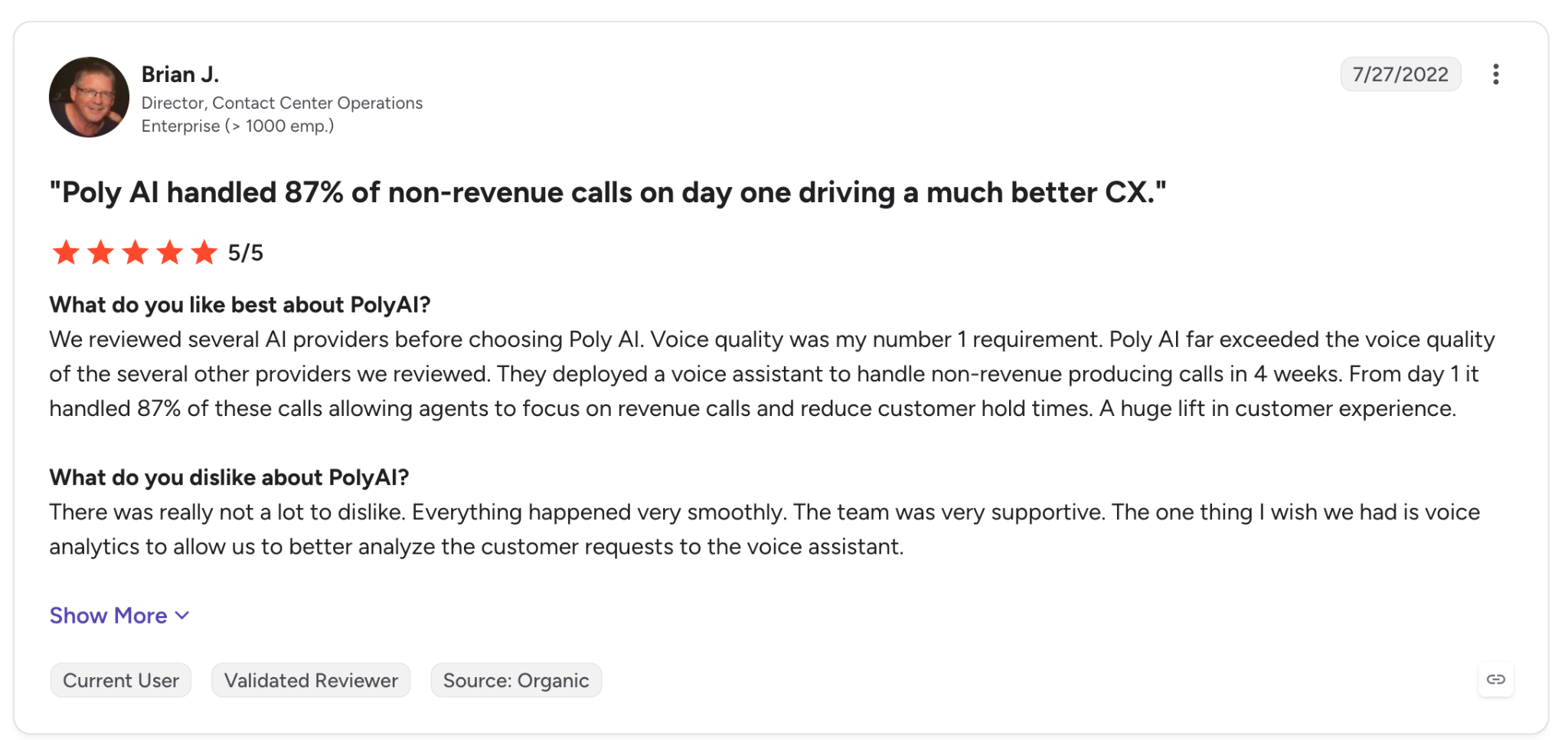
"Poly AI far exceeded the voice quality of the several other providers we reviewed." (Brian J., Director, Contact Center Operations, G2, July 2022)
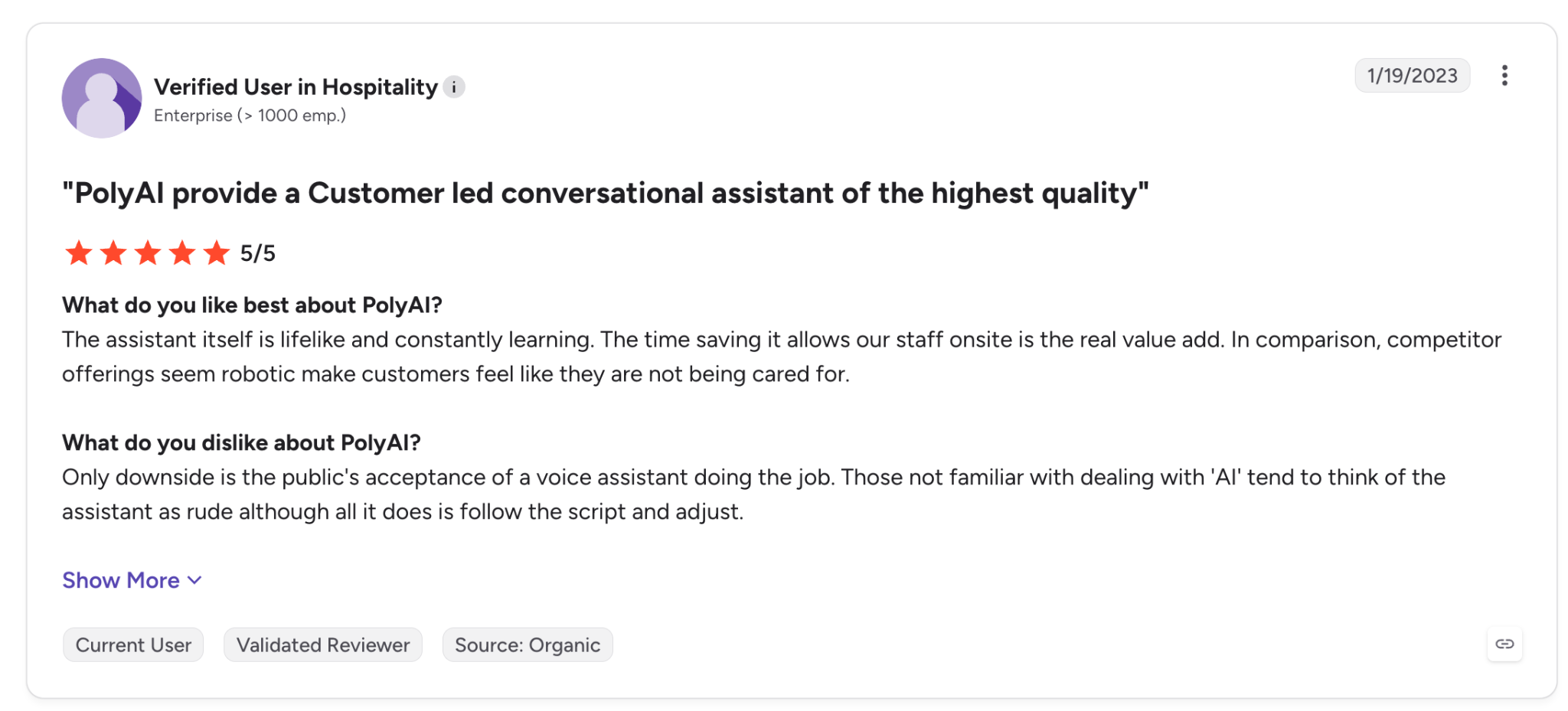
"Those not familiar with dealing with 'AI' tend to think of the assistant as rude…" (Verified User in Hospitality, G2, January 2023)
Best for
-
Enterprise inbound lines where resolution rate is the KPI.
-
Contact centers on Genesys, Five9, NICE CXone, or Amazon Connect.
-
Multi-region operations that need data kept inside one region.
Pricing
PolyAI quotes the voice agent per minute. The Dialog-RSN-1 API costs $0.02 per connected minute plus text tokens ($2.00 per million input and $5.00 per million output).
9. Replicant
Caption: Replicant handles tier-1 customer calls on an existing contact center stack.
Replicant takes tier-1 inbound calls off your contact center and works on the phone system you already have. The product splits into Conversation Automation, which handles the calls, and Conversation Intelligence, which reads every conversation for patterns.
Agents are edited with natural-language instructions. Its DoorDash case study cites six weeks from kickoff to launch, and the company passed 1 billion minutes handled by its AI agents in February 2026.
Key features
-
Contact center and telephony integrations: Genesys, Five9, Amazon Connect, Talkdesk, NICE inContact, UJET, 8x8, Avaya, and Cisco.
-
CRM and helpdesk connections: Salesforce, Zendesk, ServiceNow, Kustomer, and Gladly.
-
Uptime commitment: Replicant states 99.95%+ uptime for its platform.
-
ROI analysis up front: Replicant prepares an analysis of your projected annual savings.
Pros
✅ A dedicated Replicant team handles launch and ongoing tuning.
✅ Terms are month-to-month or multi-year.
✅ Contracts include an agreed business outcome to judge performance against.
Cons
❌ Replicant's G2 reviews date from April 2024, so the current product needs fresh off-script test calls.
❌ Rollouts run as managed programs, not self-serve builds.
❌ In the 2024 G2 reviews, the agent struggled with callers who went outside its set flows.
What users say
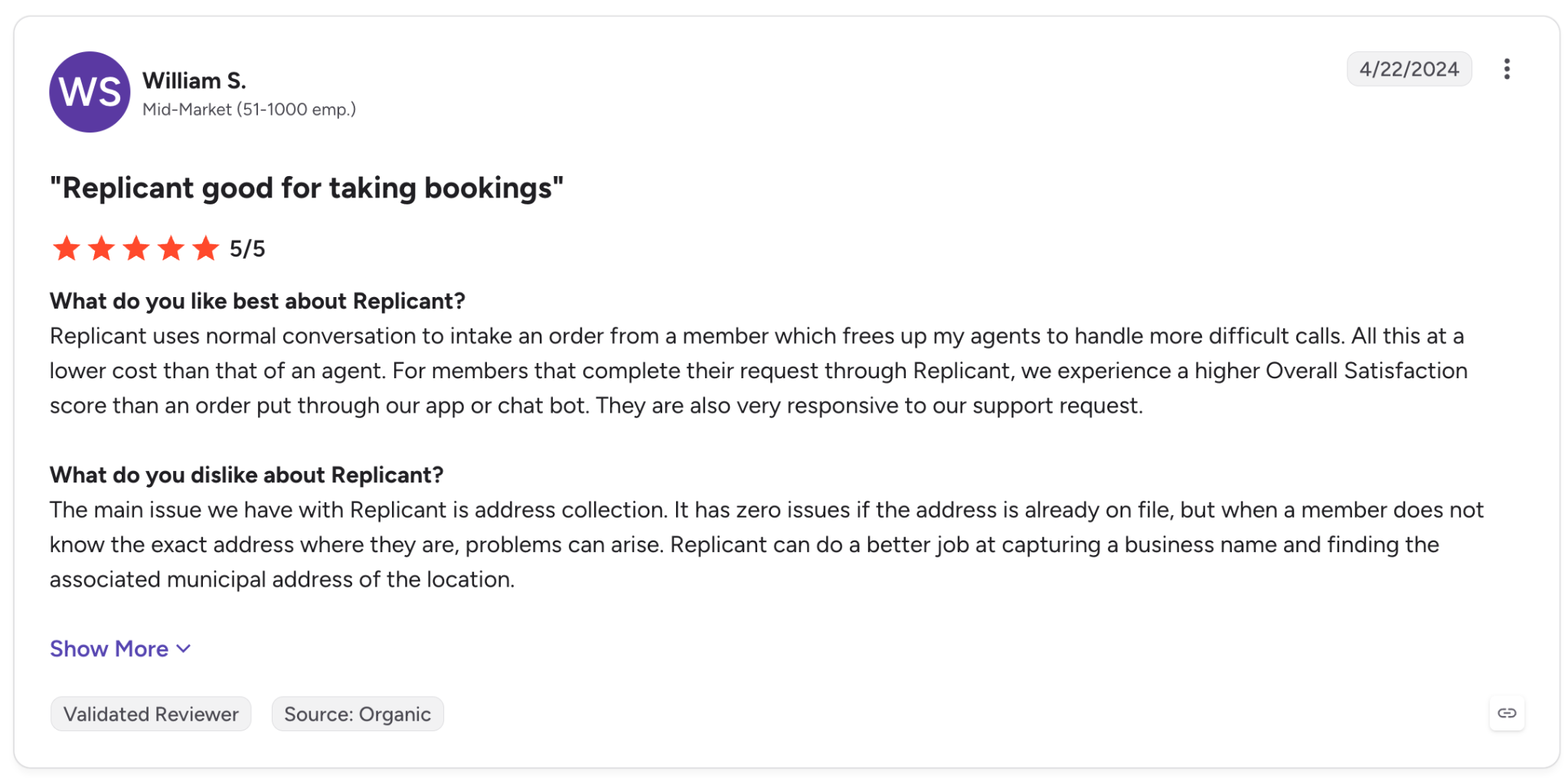
"For members that complete their request through Replicant, we experience a higher Overall Satisfaction score than an order put through our app or chat bot." (William S., Mid-Market, G2, April 2024)
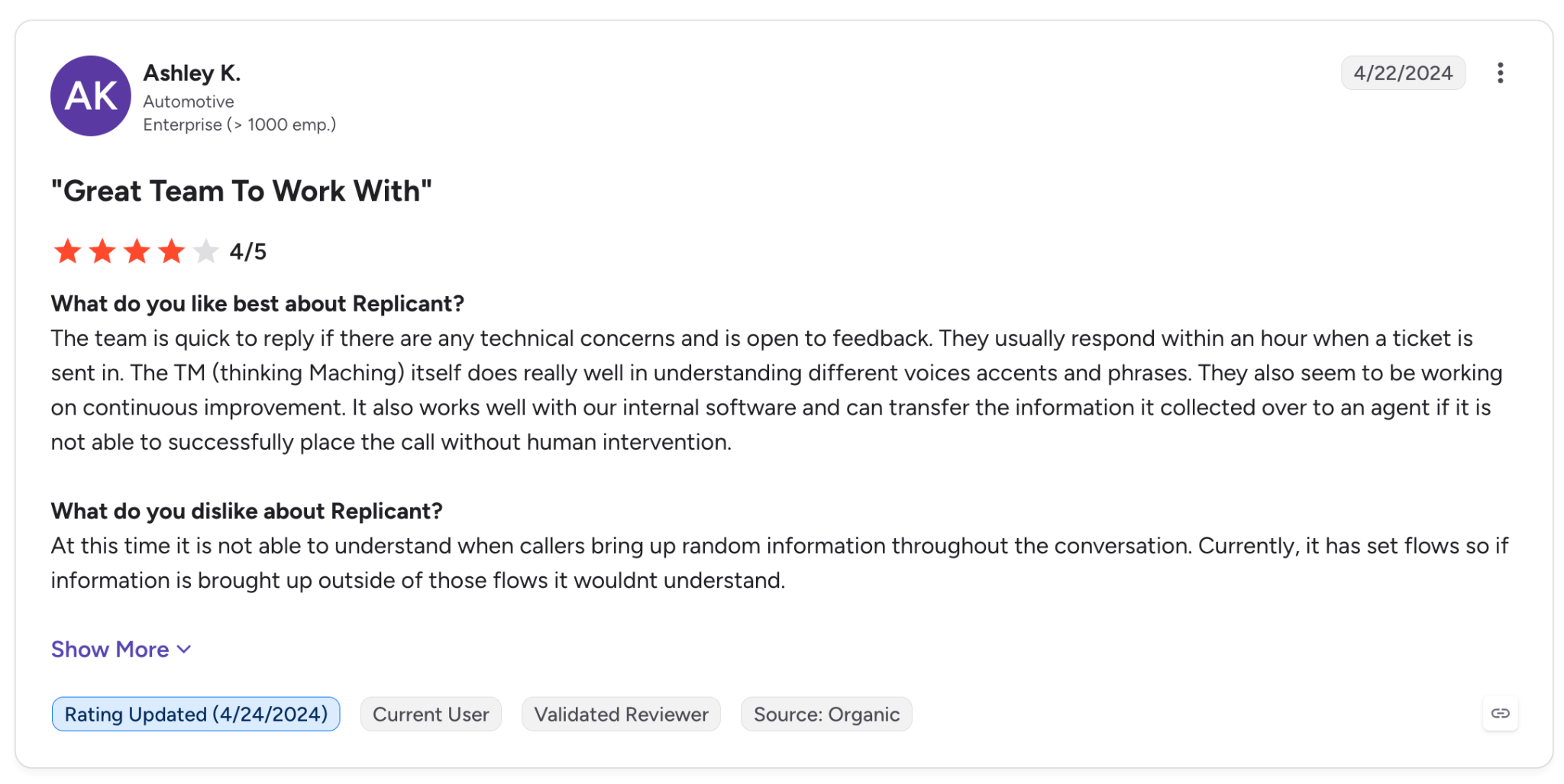
"Currently, it has set flows so if information is brought up outside of those flows it wouldn't understand." (Ashley K., Automotive, G2, April 2024)
Best for
-
Contact centers with heavy tier-1 payments volume, the call type Replicant’s homepage highlights.
-
Contact centers on Genesys, Five9, Talkdesk, or Avaya that plan to keep their phone system.
Pricing
Replicant describes pay-as-you-go pricing without listing a rate.
10. Fin Voice
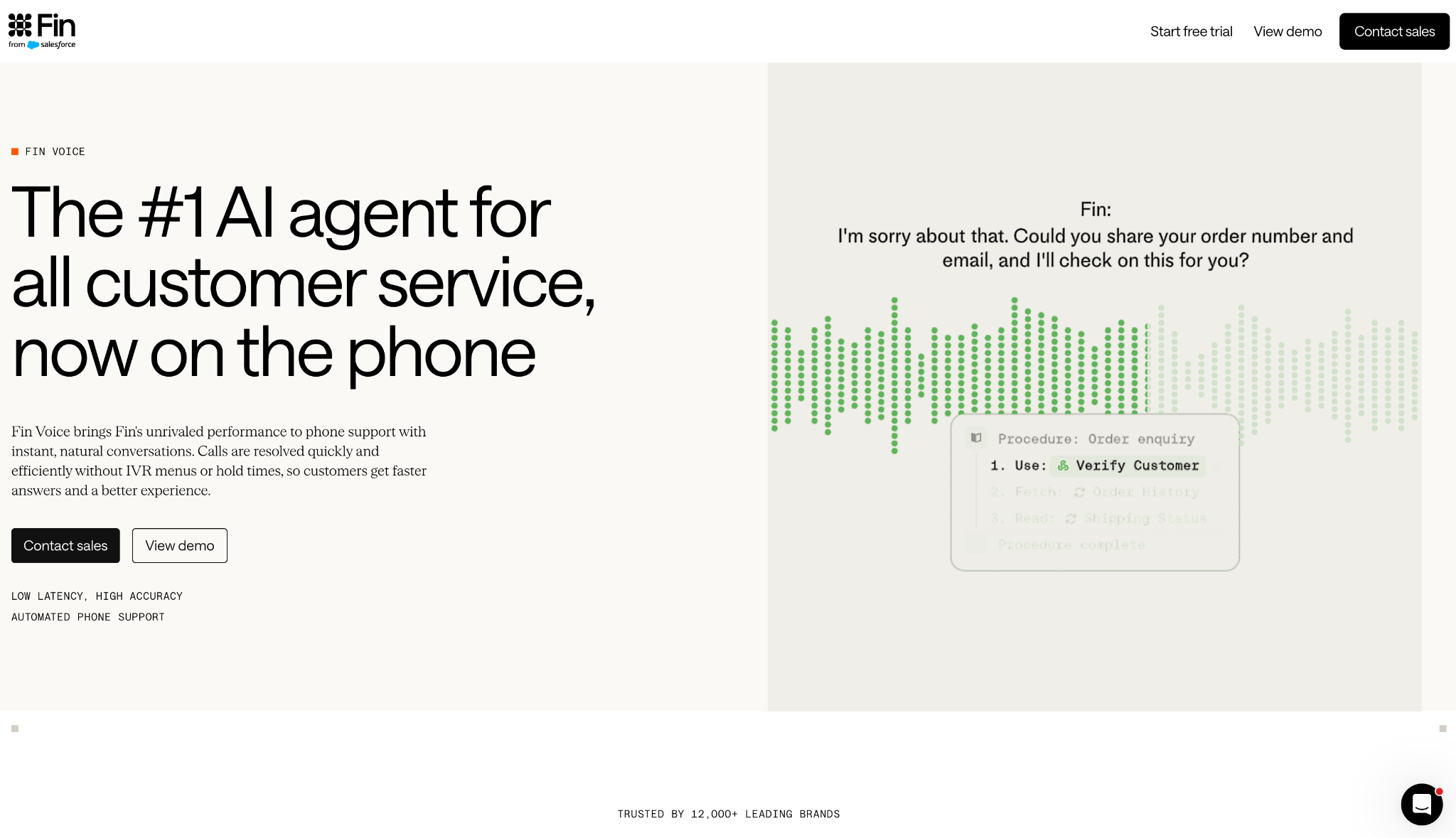
Caption: Fin Voice puts Intercom's Fin agent on the phone.
Intercom's Fin agent answers the phone through Fin Voice, so chat and voice work from one setup. Fin Voice 2 arrived in June 2026 with agent-initiated outbound calls and follow-up SMS, and Fin 4 moved voice to the Apex Flash 2.0 model in October 2026.
Intercom reports a 24.5% higher resolution rate for Fin Voice 2 and replies 0.43 seconds faster than before (vendor-reported).
Pricing is set in your Order Form. Unless Fin already handles your chat, I wouldn't start a sales process just for voice.
Key features
-
Monitors: Review Fin Voice calls next to Intercom Phone calls in one place, on the Pro add-on. Calls on Genesys, Amazon Connect, or Aircall aren’t included.
-
Fin Voice 2 additions: Agent-initiated outbound calls and follow-up SMS.
-
29 languages: Fin Voice speaks 29 languages, and Apex Flash 2.0 covers seven of them on US- and EU-hosted workspaces.
Pros
✅ Teams can keep their phone provider, whether that's RingCentral, Aircall, Genesys, or Five9.
✅ On helpdesks other than Intercom, Fin runs with no seat cost.
✅ Fin Voice 2 added agent-initiated outbound calls and follow-up SMS.
Cons
❌ Fin Voice is limited to select customers working with Intercom’s sales team, on workspaces hosted in the US, EU, or Australia.
❌ Calls end, or hand off to a teammate, at 29.5 minutes.
❌ Multilingual lines need a separate branch for each language.
What users say
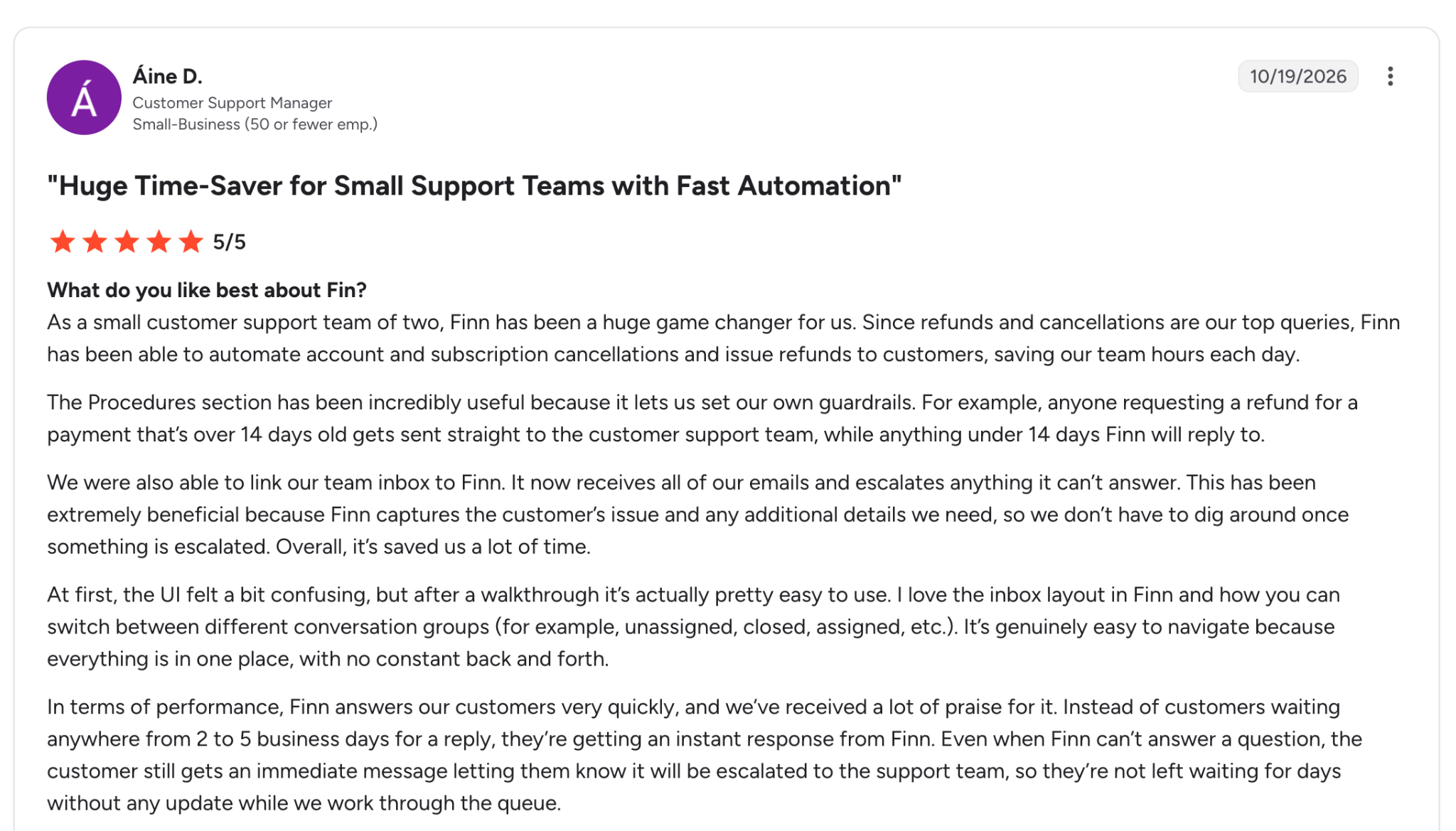
"Since refunds and cancellations are our top queries, Finn has been able to … issue refunds to customers, saving our team hours each day." (Áine D., Customer Support Manager, G2, October 2026)
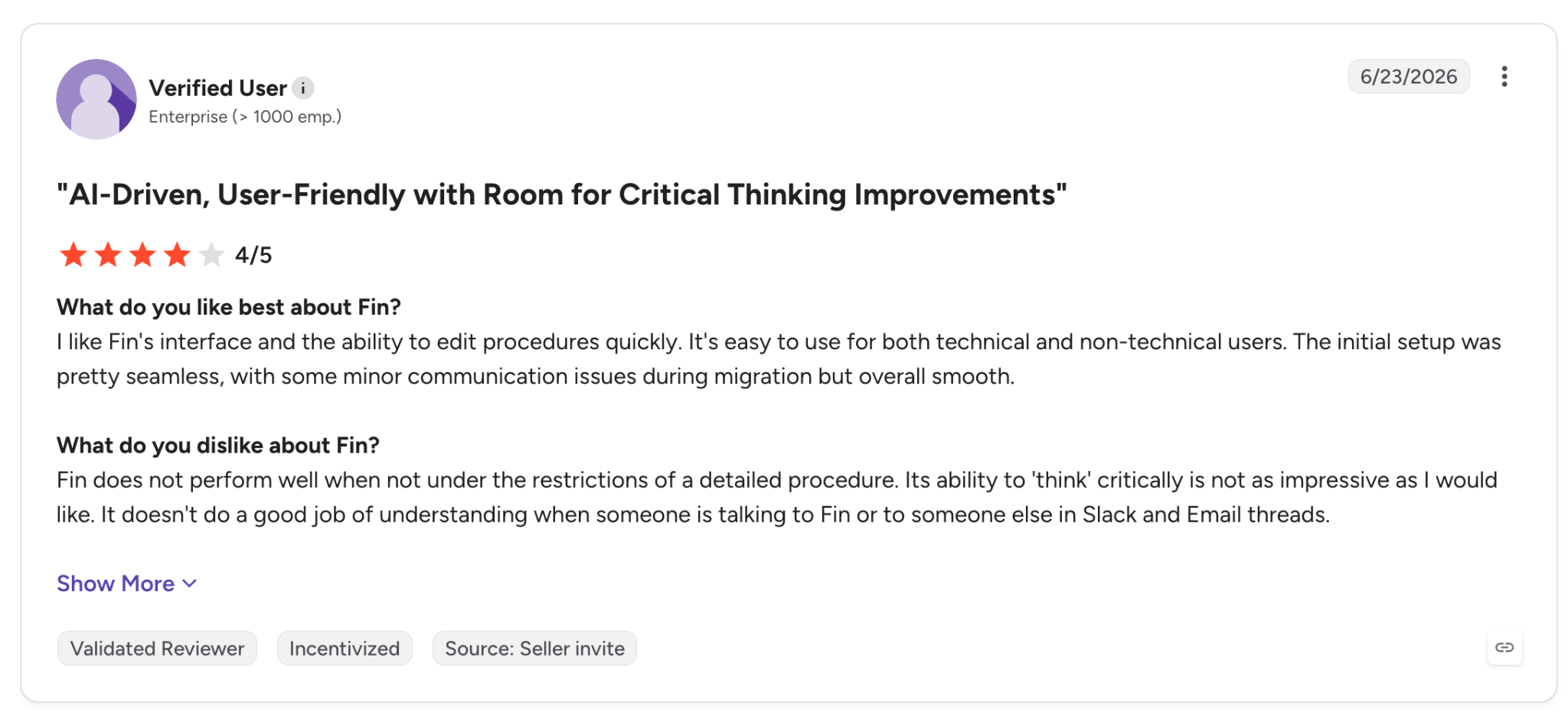
"Fin does not perform well when not under the restrictions of a detailed procedure." (Verified User, Enterprise, G2, June 2026)
Both reviews discuss Fin in general. I couldn’t find any G2 or Trustpilot reviews about Fin Voice specifically.
Best for
-
Support teams already resolving chat with Fin.
-
Companies on Genesys or Five9 adding a voice channel to Fin, who can review calls in their own phone system.
-
Enterprises with procurement already set up for a negotiated contract.
Pricing
Fin Voice is offered on a custom pricing plan. For comparison, Fin's published rate for other channels is $0.99 per standard outcome and $9.99 per qualification, with a 50-outcome monthly minimum on other helpdesks.
Intercom Phone bills telephony separately, per minute (US local inbound at $0.012).
Test your shortlist on your own Synthflow calls
The choice between these Synthflow alternatives turns on what a minute costs all-in, which tier holds the BAA, and who edits the agent after launch.
Those three questions narrow the list, and your call recordings settle it. They capture callers who interrupt, read account numbers unclearly, or ask for a person partway through a task, and they show how a new agent handles those moments.
Cekura handles the testing side of a platform switch. It sends the same scenarios to your Synthflow agent and your finalists, natively or over phone and SIP, then keeps scoring once the new agent is live. Voice testing bills $0.25 a minute with 300 free credits and no card required.
Cekura's coverage, grouped by where it acts:
-
Pre-production: Scenario simulations generated from your agent config, multi-turn red teaming, accent and multilingual runs, and GitHub Actions checks on every pull request or merge.
-
Infrastructure: Load testing at production concurrency, interruption and background-noise conditions, latency measurement, and DTMF keypad navigation for IVR paths.
-
Observability: Live call scoring on custom metrics, configurable PII redaction on transcripts and recordings, and production calls turned into regression cases.
Native integrations work out of the box for Synthflow, Retell, Vapi, ElevenLabs, LiveKit, Pipecat, Bland, and more.
Cekura supports SOC 2, HIPAA, and GDPR compliance, covering transcript redaction. A signed BAA and DPA start on the $500-a-month Startup plan, and role-based access and audit logs come with Enterprise.
Book a demo and bring a Synthflow call that a new agent has to get right. In the demo, Cekura shows how that call becomes a test scenario you can run against your current agent and your shortlist.
Frequently asked questions
What is the best Synthflow alternative in 2026?
The best Synthflow alternative depends on who builds and edits the agent. Retell AI suits engineering teams that want per-minute billing, and it includes simulation testing with QA as a metered add-on.
For enterprise inbound lines, PolyAI posted the highest task completion (98.8%) and Retell the highest pass^3 (90.2%) in Cekura’s ten-platform workflow benchmark. At the small-business end, Goodcall and Smith.ai suit owners who want a receptionist without a developer.
How much does Synthflow cost?
Synthflow doesn't publish a price. As of October 29, 2026, its pricing page describes an annual enterprise agreement scoped to your call volume and setup, with no free plan or trial and no per-minute rate.
Retell's October 2026 comparison page puts Synthflow contracts from $30,000 a year.
How do pricing models differ among Synthflow alternatives?
Synthflow alternatives use four pricing models. Retell, Vapi, and Bland bill per minute, and ElevenLabs sells monthly plans with included minutes. Goodcall bills per unique caller and Smith.ai per call, while Voiceflow and the three enterprise platforms quote through sales.
Which integrations should you check first when switching from Synthflow?
Telephony comes first when switching from Synthflow, then calendar and CRM, because they carry your numbers and bookings. Check whether the new platform accepts your SIP trunk or Twilio numbers and connects natively to your calendar and CRM.
Transfers are the last check. Confirm that live transfers reach your helpdesk or contact center.
Is a no-code or developer platform better than Synthflow?
A no-code platform is better if operations staff will edit the agent, and a developer platform is better if engineers will. Voiceflow and Goodcall keep editing in plain language or on a canvas, while Vapi and Retell's SDKs give engineers version control and provider choice.
What should you prepare before replacing Synthflow?
Before replacing Synthflow, export your prompts, flows, recordings, and transcripts, and list every integration and transfer number, plus the consent message callers hear.
With that inventory in hand, turn your known failed calls into scenarios and try them on your current agent and your finalists. Keep the Synthflow line live as a fallback until the new agent matches it.