
AI voice agent testing tools exist because voice agents sound fine in demos. They break fast once live callers bring accents, interruptions, and noisy audio into the conversation. This voice agent testing comparison covers seven tools I'd hand to a voice engineering team.
7 Best AI Voice Agent Testing Tools: Quick Comparison
I ran each platform through the same scenarios: mid-conversation interruptions, noisy audio conditions, and prompt changes that broke previously passing tests. Scoring the results is its own buying decision, and we rated the best AI evaluation tools for production on five criteria, from live scoring to voice coverage.
| 💻 Tool | ⚡ Strengths | 🎯 Best For | 💰 Starting Price |
|---|---|---|---|
| Hamming AI | Regression testing, load testing, production QA | CI/CD voice testing | Custom pricing |
| Cyara | IVR testing, CX assurance, enterprise workflows | Enterprise contact center teams | Custom pricing |
| Maxim AI | End-to-end eval, voice agent simulation, observability | Teams running LLM and voice evals in one system | $29/seat/month |
| Cekura | Workflow testing, infrastructure checks, production monitoring, red teaming | Full-stack voice agent QA | $30/month |
| Braintrust | LLM eval, observability, prompt experimentation, dataset management | Teams building eval pipelines for LLM-powered voice agents | $249/month |
| Roark | Call replay, post-call analysis, production monitoring | Teams optimizing live calls | Custom pricing |
| LangWatch | Open-source eval, headless voice CI, self-hosting | Engineering teams wanting open-source control with voice in CI | €29/core-seat/month |
TL;DR: Best AI Voice Agent Testing Tools in 2026
- Hamming AI: Best for CI/CD voice regression. Provider-aware integrations (Vapi, Retell, LiveKit, Pipecat) plus full audio simulation (accent, noise, barge-in timing). Custom pricing.
- Cyara: Best for enterprise IVR and AI agent assurance in one toolchain. 145+ country dialing, named at AT&T and Microsoft. Custom pricing, demo required.
- Braintrust: Best for teams extending existing LLM eval infra to voice. One-click production traces to test cases, but no built-in audio engine. From $249/month (free Starter tier).
- Cekura: Best for full-lifecycle voice QA in one place. Gibberish detection, interruption/latency tracking, red teaming. $30/month, 7-day trial.
- Roark: Best for teams learning from production failures. Clones real caller voices to rerun failed interactions; weak for pre-launch teams with no traffic. Usage-based pricing.
- Maxim AI: Best for teams already running evals across voice, text, and multimodal. Strongest compliance posture (SOC 2, ISO 27001, HIPAA, GDPR). Free 3-seat Developer plan.
- LangWatch: Best for open-source, code-first eval control. Headless voice-to-voice CI testing via Scenario, self-hostable. From €29/seat/month.
How I Researched and Tested These AI Voice Testing Platforms
Where free trials or sandboxes were available, I tested directly. For platforms without self-serve access, I worked from official documentation, published benchmarks, and developer-facing blog posts to verify what each tool measures versus what it markets.
I also paid close attention to five things:
- Simulation depth: Whether the platform tests full end-to-end call flows or just transcript evaluation after the fact, and how it handles non-deterministic LLM outputs. Our voice AI evaluation metrics guide covers which signals matter at each stage.
- Regression coverage: How each tool responds when a prompt or model change ships, and whether it blocks bad deploys or just flags them retroactively.
- Latency visibility: Whether you get a component-level breakdown across the pipeline or just total response time, which tells you nothing about where to fix.
- Compliance posture: What certifications are available, which plans they're locked to, and whether you need a sales call to access them.
- Integration depth: How each platform connects to the voice stacks teams are building on in 2026, including VAPI, Retell, LiveKit, and Pipecat.
Integration depth matters most. A lot of platforms call themselves voice testing tools. Several are LLM eval platforms with a voice tab bolted on.
1. Hamming AI: Best for CI/CD Voice Regression
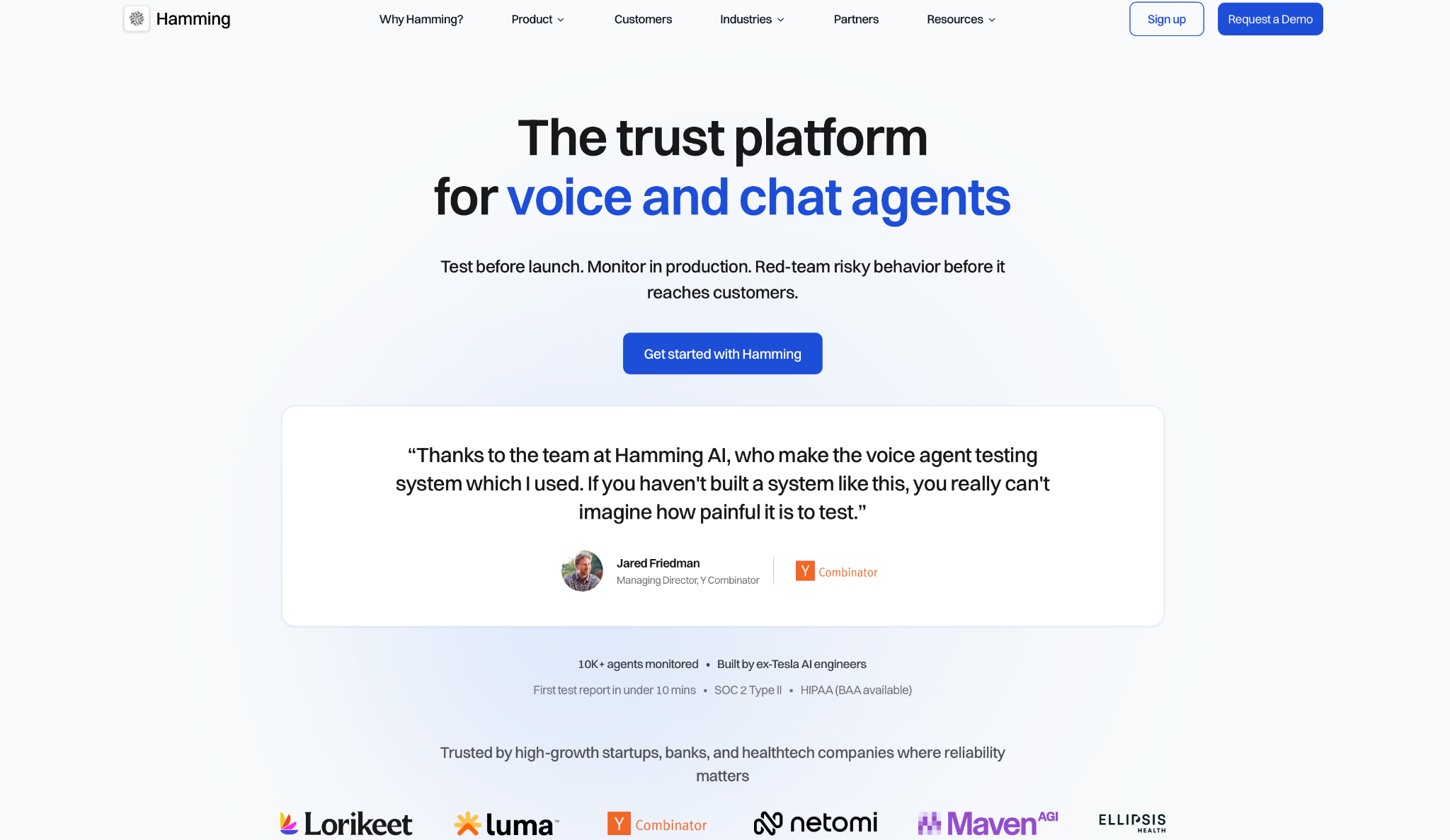
What it does: Hamming runs automated voice agent testing and call monitoring across simulation, regression, and production QA.
Best for: Engineering teams that need voice testing tied directly into their release workflow, with CI/CD coverage instead of manual call checks.
I connected Hamming to a Retell agent via webhook and had my first test report in under 10 minutes, with no configuration beyond pasting the endpoint. I fed the agent prompt directly into Hamming's scenario generator and got a set of test cases with assertions built in, covering edge cases I hadn't thought to write manually.
What I didn't expect was how far the audio simulation went. Hamming ran the same scenario with background noise, a heavy accent, and a mid-sentence barge-in. The agent passed the transcript eval on all three but failed the barge-in timing check, something that would have been invisible in a text-only eval pipeline.
Key Features
- Prompt-based scenario generation: Feed the agent prompt in, get test cases and assertions back.
- Provider-aware integrations: Vapi, Retell, LiveKit, Pipecat, OpenAI, and Fluents. No custom connectors needed.
- Voice Characters evaluation: Full audio simulation across accent, background noise, barge-in timing, and speech clarity metrics.
- Production replay: Full run summaries with transcripts, recordings, and tool-call data.
Pros and Cons
Pros:
✅ Strong fit for release-based QA, with scenario generation, monitoring, and CI-friendly workflows.
✅ Better voice coverage than generic LLM eval tools for audio conditions like noise, latency, and turn-taking.
✅ Broad integration coverage with no need to rewire the stack.
Cons:
❌ More technical than lightweight playground tools. Smaller teams need setup discipline.
❌ Optimized for ongoing QA workflows, not one-off prototype check.
What Users Say
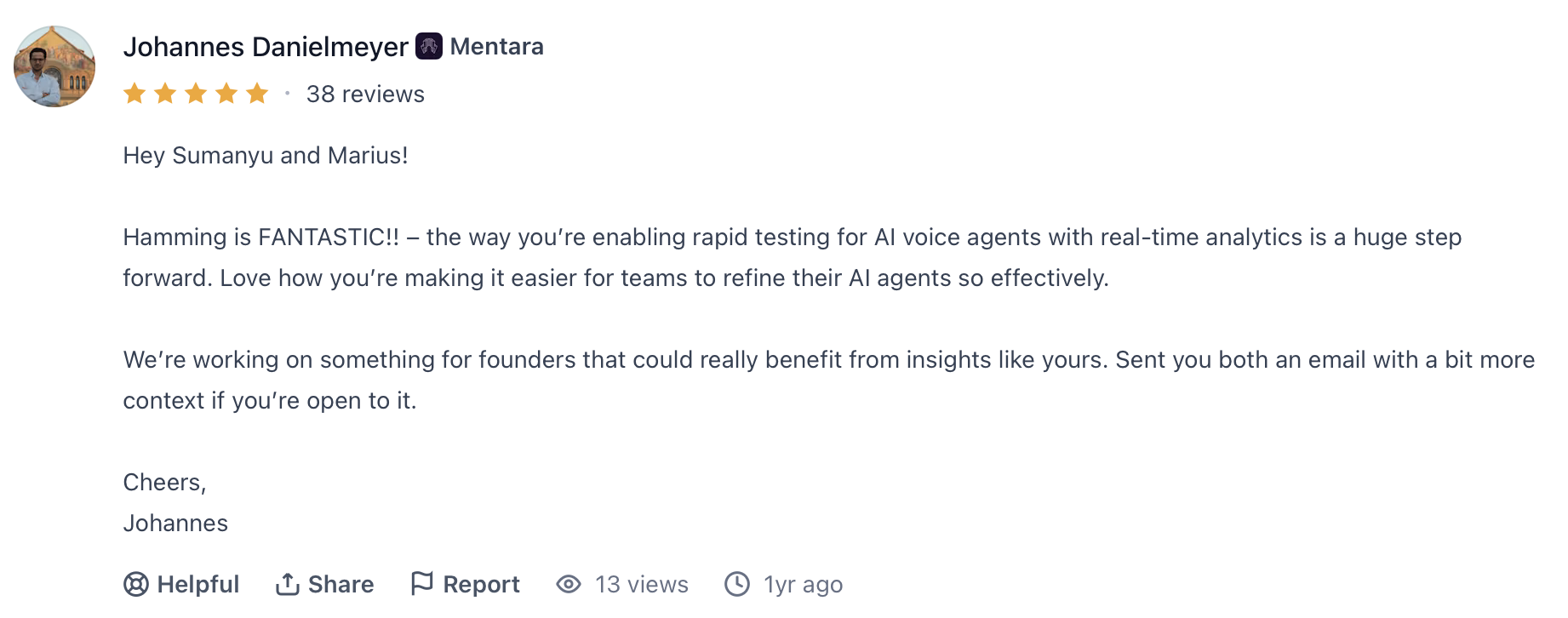
"Hamming is FANTASTIC! The way you're enabling rapid testing for AI voice agents with real-time analytics is a huge step forward. Love how you're making it easier for teams to refine their AI agents so effectively." (Johannes Danielmeyer, Product Hunt)
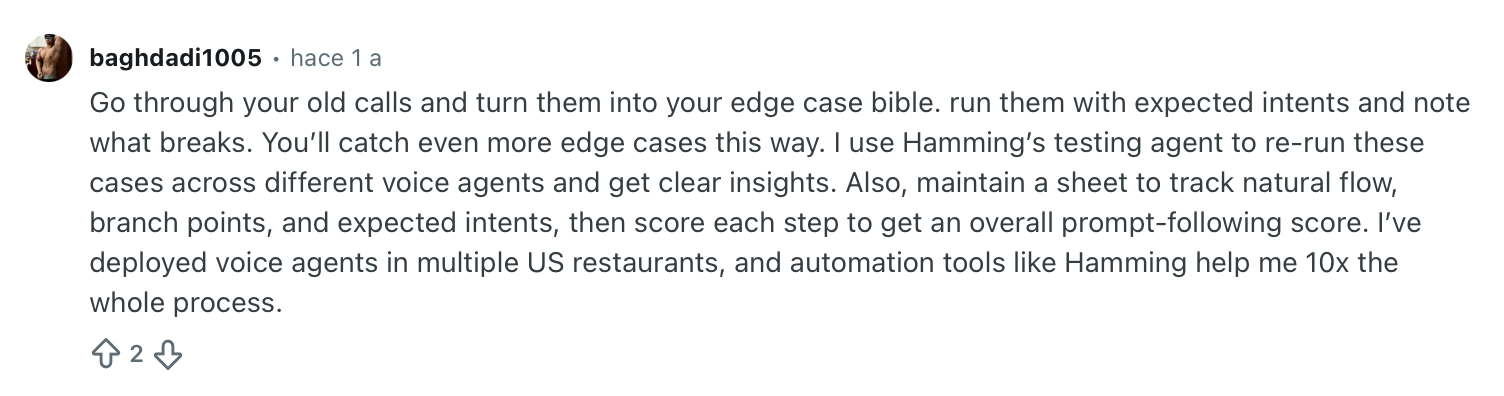
"I've deployed voice agents in multiple US restaurants, and automation tools like Hamming help me 10x the whole process." (Verified User, Reddit)
Pricing
Agency, Startup, and Enterprise plans available. All tiers require contacting the team directly. Contact sales.
Bottom Line
Teams running voice QA like a release process, with pre-deploy test cycles baked in, will get the most out of Hamming.
2. Cyara: Best for Enterprise IVR and AI Agent Assurance
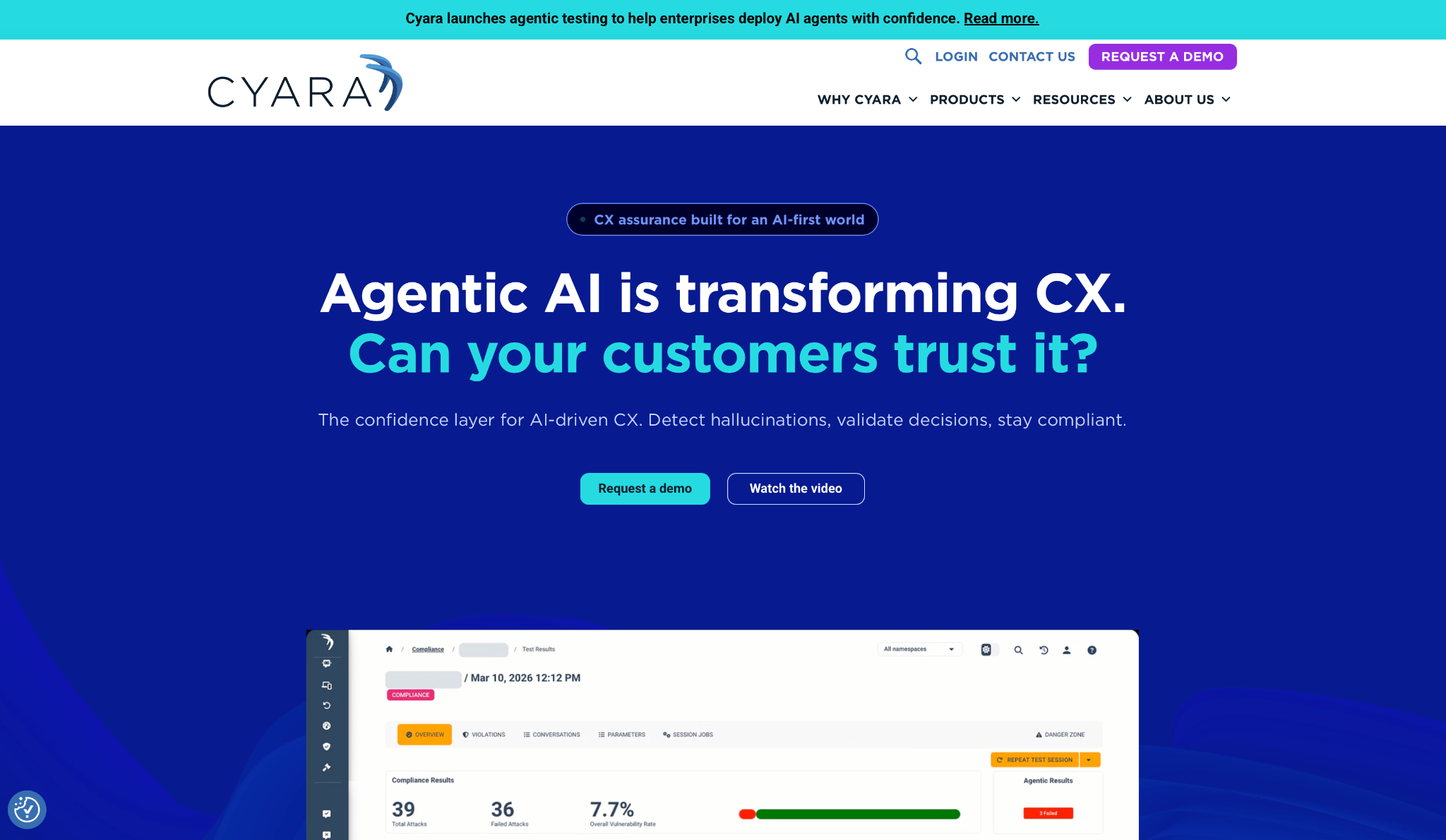
What it does: Cyara is one platform for IVR testing, conversational AI assurance, and agentic workflow validation. It handles organizations running legacy and AI systems in parallel.
Best for: Enterprise contact center teams maintaining legacy IVR while validating new AI agent deployments from the same QA toolchain.
Cyara doesn't have a self-serve sandbox, so access starts with a demo. I worked through the platform via their documentation and the AT&T case study, which made the core premise clear fast: this is built for teams running contact center infrastructure at scale, not for a two-person voice AI startup.
What makes it the right call for those teams is the IVR-plus-AI coverage. Most platforms handle conversational AI agents or legacy IVR, not both. Cyara's Botium module handles conversational AI while Velocity handles IVR, both feeding into the same dashboards.
For a team maintaining broad country coverage on legacy infrastructure while piloting new AI agents, that unified view matters.
Key Features
- Goal-based AI agent testing: Validates intent handling, multi-turn flows, and edge case behavior including hallucination detection.
- Generative AI assurance: Dedicated module for testing AI behavior across safety, compliance, and bias dimensions.
- IVR and voice testing across 145+ countries: True in-country dialing, 420+ carriers, 90% productivity increase in IVR development and testing per Forrester TEI.
- Production monitoring and CX observability: Unified dashboards for agent health and compliance.
- No-code test automation: QA teams create and run campaigns without engineering support.
Pros and Cons
Pros:
✅ Only platform on this list covering both legacy IVR and modern AI agent assurance in one toolchain.
✅ Named deployments at AT&T, Microsoft, Canada Life, and Dexcom
Cons:
❌ No-code automation covers campaign-level workflows only. Custom scripting requires engineering involvement beyond standard flows.
❌ Dashboard data is not easily exportable to external BI tools without additional configuration.
❌ Oversized for standalone LLM voice agent deployments without legacy infrastructure.
What Users Say
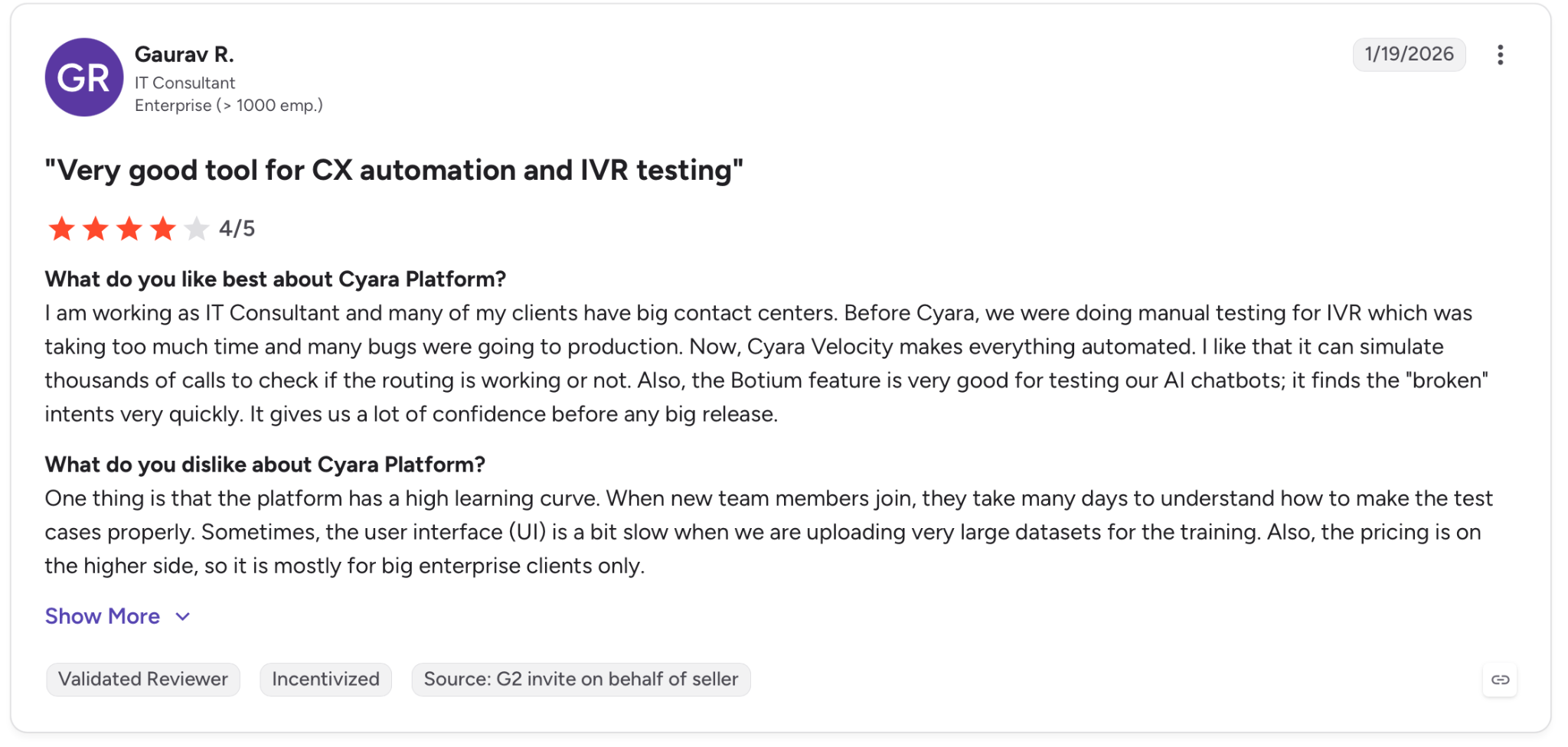
"Now, Cyara Velocity makes everything automated. I like that it can simulate thousands of calls to check if the routing is working or not." (Gaurav R., G2)
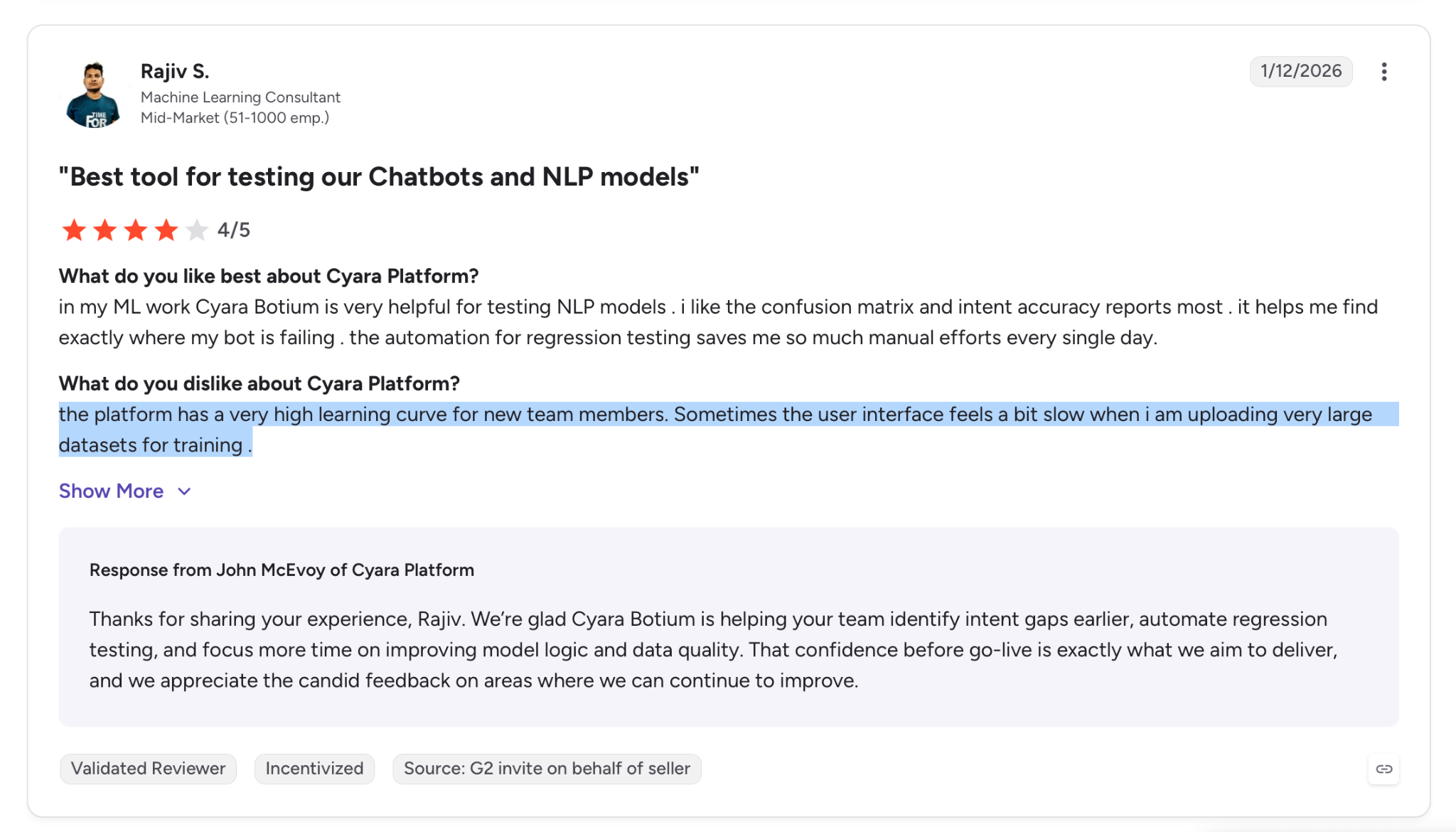
"The platform has a very high learning curve for new team members. Sometimes the user interface feels a bit slow when I am uploading very large datasets for training." (Rajiv S., G2)
Pricing
Custom pricing across all plans. Demo required to access the platform. Request a demo.
Bottom Line
Enterprise teams running IVR and AI agents in parallel will get solid value from Cyara. Teams deploying standalone LLM voice agents without legacy infrastructure will find it oversized.
3. Braintrust: Best for Teams That Want Evaluation Wired Into Their Development Workflow
What it does: Braintrust is an eval and observability platform for teams building on language models. Ties together production traces, dataset versioning, scoring, and CI/CD quality gates in one place.
Best for: Engineering teams already running evals on text and LLM outputs who want to extend that infrastructure to cover voice agents without switching tools.
I started on the free Starter plan and had production traces converting into test cases with one click. I ran two prompt variants through the Playground against the same dataset of voice scenarios, with Loop generating custom scorers from plain English descriptions. Setup took under 30 minutes and surfaced a regression on Spanish-accented inputs I had missed in manual testing.
The ceiling shows up in the audio layer. There is no built-in audio engine, so accent simulation, barge-in handling, and telephony scenarios need a partner integration to run, which means an extra onboarding step and a split toolchain for teams where voice failures are the main thing to catch.
Key Features
- Production traces to test cases in one click: Failed production calls convert directly into regression tests with no manual tagging.
- Audio attachments for debugging: Attach raw audio files to traces and replay what the agent heard during a failure.
- Loop: AI-generated scorers from natural language: Write scoring logic in plain English and Loop builds the eval criteria.
- Native GitHub Actions CI/CD integration: Runs evals on every pull request and posts pass/fail results before merging.
- 1 GB processed data and unlimited users on the free tier: More entry-level volume than most comparable free tiers.
Pros and Cons
Pros:
✅ Notion, Stripe, Vercel, Ramp, and Coursera run production eval workflows through Braintrust.
✅ AI Proxy routes LLM calls through Braintrust to capture logs, enable caching, and add fallbacks across OpenAI, Anthropic, and other providers.
✅ Playground lets PMs and engineers iterate on prompts against real datasets without an engineering handoff.
Cons:
❌ No built-in audio engine. Multi-accent simulation, interruption handling, and telephony path testing need a second platform.
❌ Free tier caps data retention at 14 days, which matters for teams comparing experiments across sprints.
❌ Human review is limited to one scorer configuration per project on the Starter tier.
What Users Say
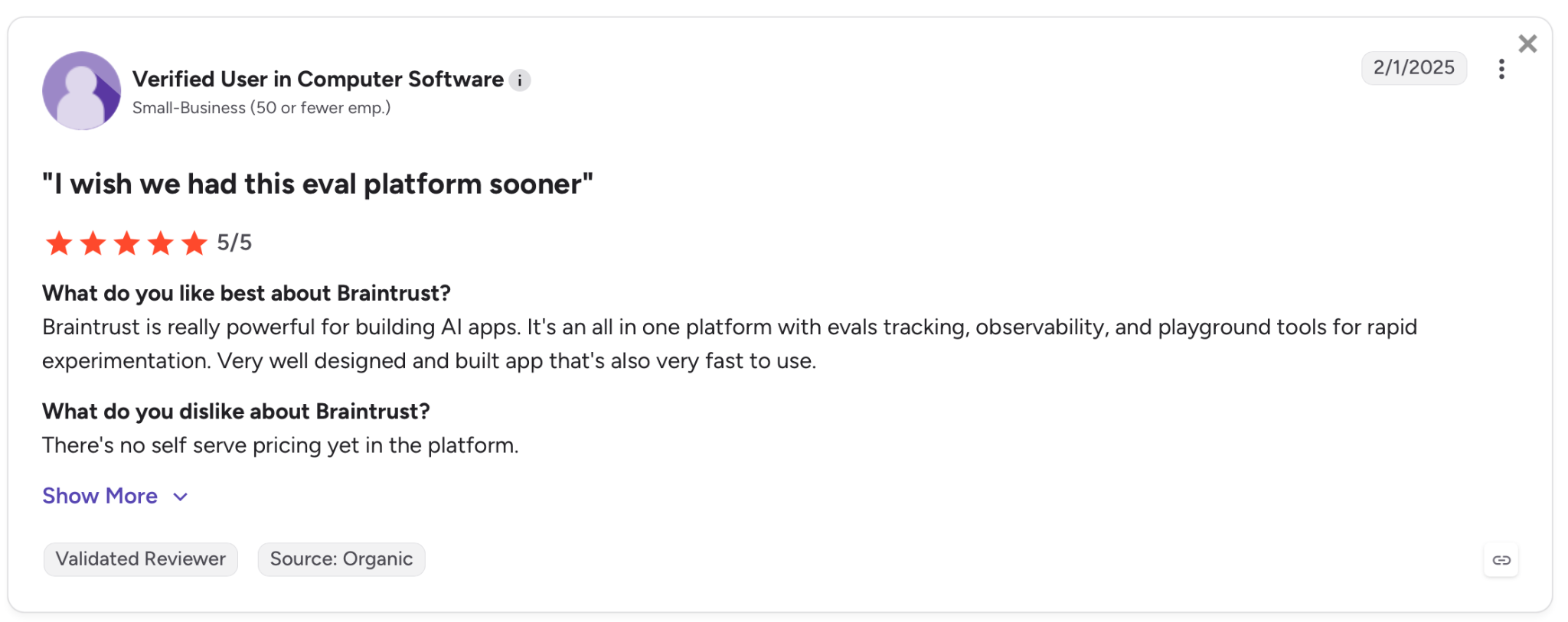
"Braintrust is really powerful for building AI apps. It's an all-in-one platform with evals tracking, observability, and playground tools for rapid experimentation." (Verified User in Computer Software, G2)
Pricing
Starter plan free for everyone. Pro price from $249/month covers 50k scores, dataset management, and full voice observability. Enterprise custom with SSO, role-based access, and dedicated support.
Bottom Line
Braintrust fits teams already running LLM evals who want voice in the same system. If audio simulation and telephony testing are your primary concern, Hamming or Cekura go deeper.
4. Cekura: Best for Teams That Need Full-Lifecycle Voice QA in One Place
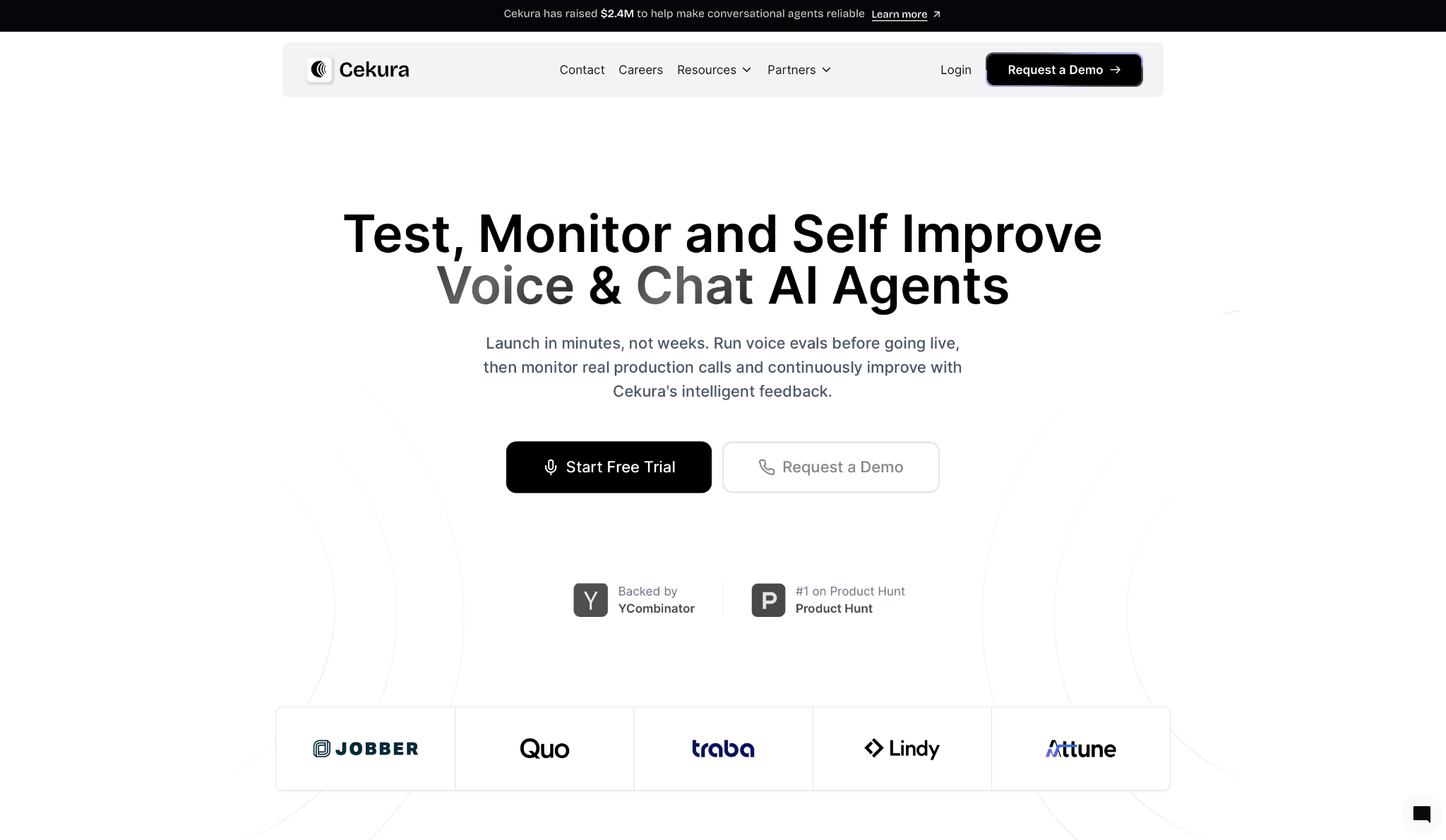
What it does: Cekura covers the full QA cycle for voice and chat agents, from pre-production simulation through live monitoring, with failed calls feeding back into future test runs automatically.
Best for: Conversational AI teams running simulation, eval, production monitoring, and CI/CD from a single platform.
I signed up for the $30/month Developer plan and connected it to a VAPI agent. The integration took about five minutes, with VAPI's webhook going into Cekura's agent settings, and from there every call gets scored automatically on latency, interruptions, instruction-following, and talk ratio.
The signal that surprised me was gibberish detection.
Cekura flagged three calls where the agent's TTS had produced garbled output under a network degradation scenario I'd set up, something none of the other platforms caught because they evaluate transcripts rather than audio. That alone made the platform worth the setup time.
The red teaming suite turned up something separate, a prompt injection path I hadn't covered, surfaced through one of its pre-built adversarial scenarios. If security is a gap in your own suite, our guide to penetration testing voice AI agents walks through the full process.
Key Features
- Testing at scale: Thousands of simulated calls before go-live.
- Interruption detection: Flags timing issues in how the agent cuts off or yields to callers.
- Latency tracking: Identifies where slowdowns originate in the pipeline.
- CI/CD integration: Runs full test suite before every prompt, TTS, or voice provider change.
- Conversation replay: Replay exact exchanges against updated configurations.
- A/B testing: Compare multiple agent versions against the same call scenarios.
- Custom evaluation: Score on accuracy, missed intents, and incorrect responses with full compliance controls including transcript redaction and role-based access.
Pros and Cons
Pros:
✅ Native integrations work out of the box for Retell, VAPI, ElevenLabs, LiveKit, Pipecat, Bland, and more. You add a testing and monitoring layer on top of what you already have.
✅ Voice-specific signals like gibberish detection, pitch analysis, and interruption tracking beyond what LLM eval platforms measure.
✅ YC F24-backed, used by 70+ conversational AI companies including Twin Health and Lindy. SOC 2 Type II, HIPAA, and GDPR compliant.
Cons:
❌ 6 Product Hunt reviews at 4.7 stars, thin third-party social proof compared to more established platforms.
❌ Early-stage teams will likely find the self-improvement loop more than they need on day one.
What Users Say

"I've been tracking it since the Vocera days, it's evolved impressively and keeps getting better." (Rohan Chaubey, Product Hunt)
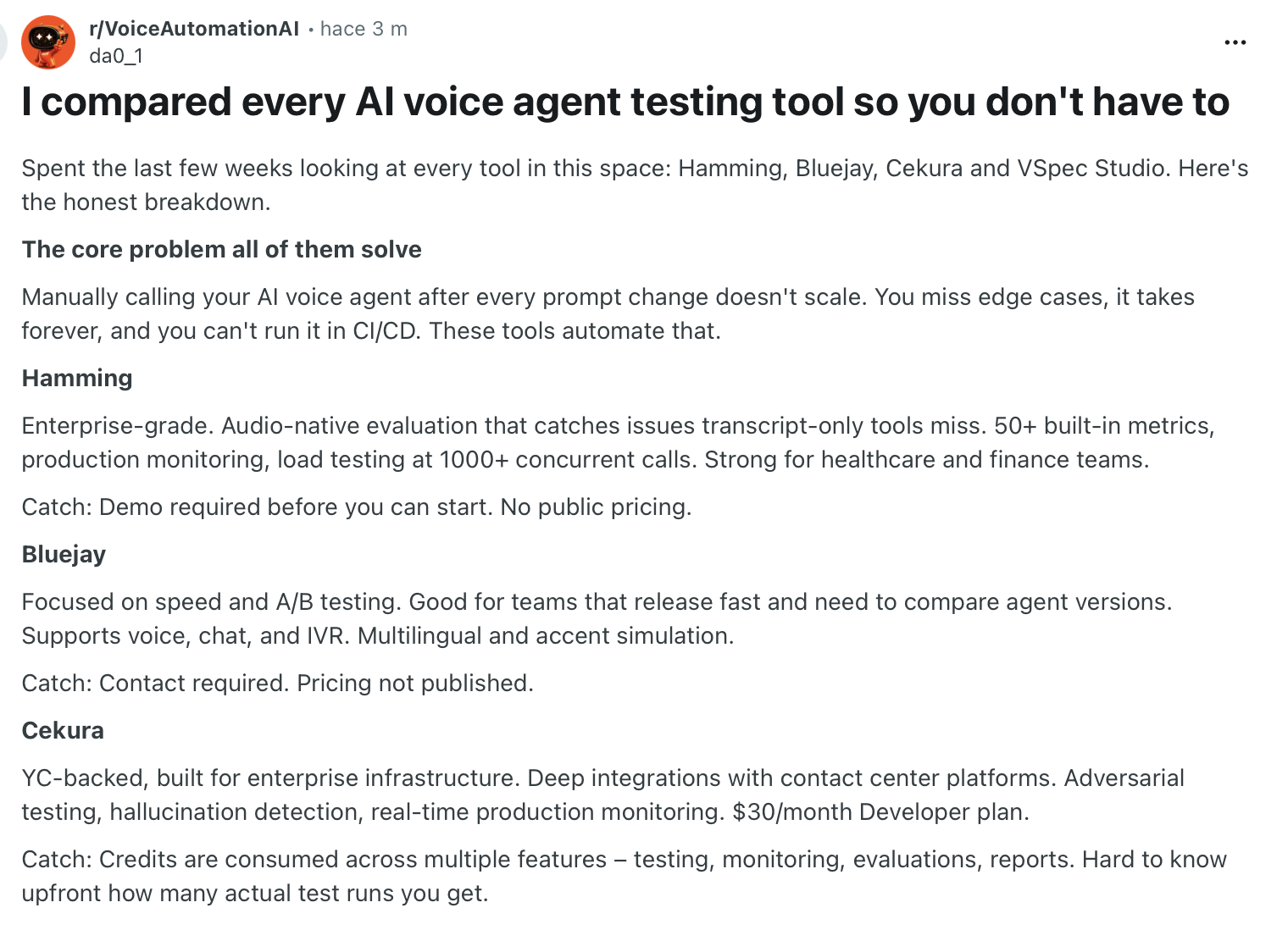
"Credits are consumed across multiple features. Testing, monitoring, evaluations, reports. Hard to know upfront how many actual test runs you get." (Verified User, Reddit)
Pricing
Developer plan at $30/month with a 7-day free trial, covering simulation, production monitoring, and CICD integration. Enterprise custom with dedicated support and expanded compliance coverage.
Bottom Line
Cekura is where to start if you want voice-specific signals like gibberish detection, pitch, and interruptions without a procurement cycle. The Developer plan includes a 7-day trial, and the platform is live with real call data in under ten minutes.
5. Roark: Best for Teams That Learn More From Production Failures
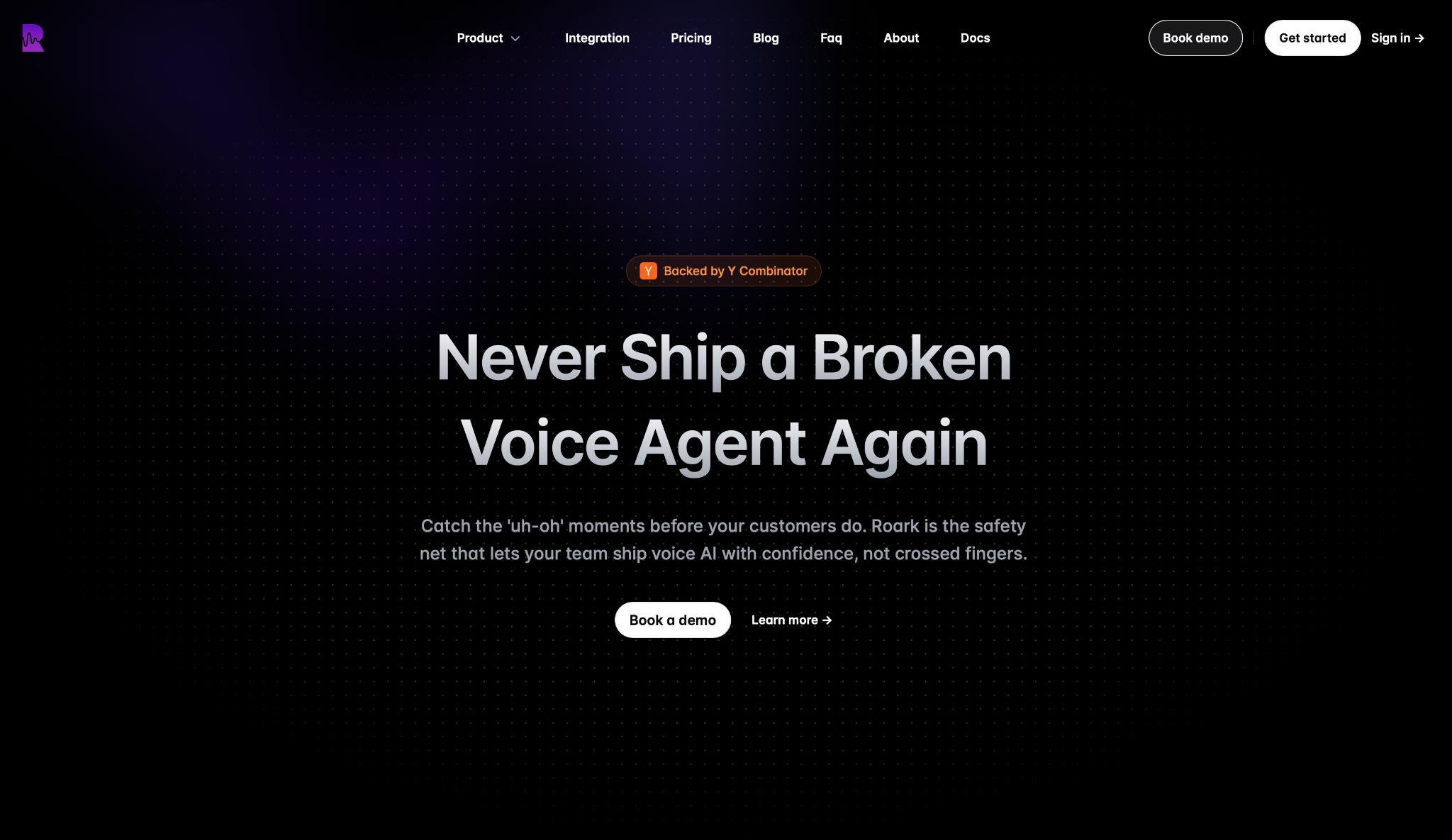
What it does: Production QA layer that monitors live calls, clones failure scenarios into regression tests, and stress-tests your agent with synthetic callers before you push an update.
Best for: Voice AI teams already in production who want their test suite grounded in what paying callers do, not in scripted assumptions.
I connected Roark to a VAPI agent in under 60 seconds, with the integration running on a single webhook and call data flowing immediately, with 40 metrics auto-populated and no configuration on my end.
Once it was running, I deliberately triggered a tool-call failure where the agent told a caller their appointment was booked when it hadn't been. Roark flagged it, cloned the caller's voice via Roark Prism, and reran the interaction against the fixed prompt. The second run passed.
The limitation showed up clearly when I looked for pre-launch coverage. With no existing traffic, there's almost nothing to work from and the regression suite starts empty.
For a team that hasn't shipped yet, Roark is the wrong starting point. For a team with millions of minutes of production calls, it's a different conversation.
Key Features
- Production call replay: Clones original caller's voice and reruns against updated logic.
- 40+ native call metrics: Covers latency, instruction-following, repetition patterns, and sentiment out of the box.
- Auto-generated test cases: Failed calls become regression tests automatically.
- Speaker-diarized transcripts: Per-participant breakdown of talk time, sentiment, and emotional cues, with tool call annotations and timestamps.
- One-click integrations: VAPI, Retell, LiveKit, Pipecat.
Pros and Cons
Pros:
✅ Production replay loop is the clearest differentiator on this list, covering caller voices, live failures, and production regression from real traffic rather than scripted scenarios.
✅ Integrates with Hume for emotional signal detection, adding sentiment depth few platforms cover natively.
✅ YC W25-backed, 10M+ minutes processed, named enterprise customers at production scale.
Cons:
❌ Pre-launch teams with no traffic yet will find limited ways to generate test cases from scratch.
❌ Blog and public documentation are thinner than established platforms, which makes it harder to know what you're getting before you sign up.
What Users Say
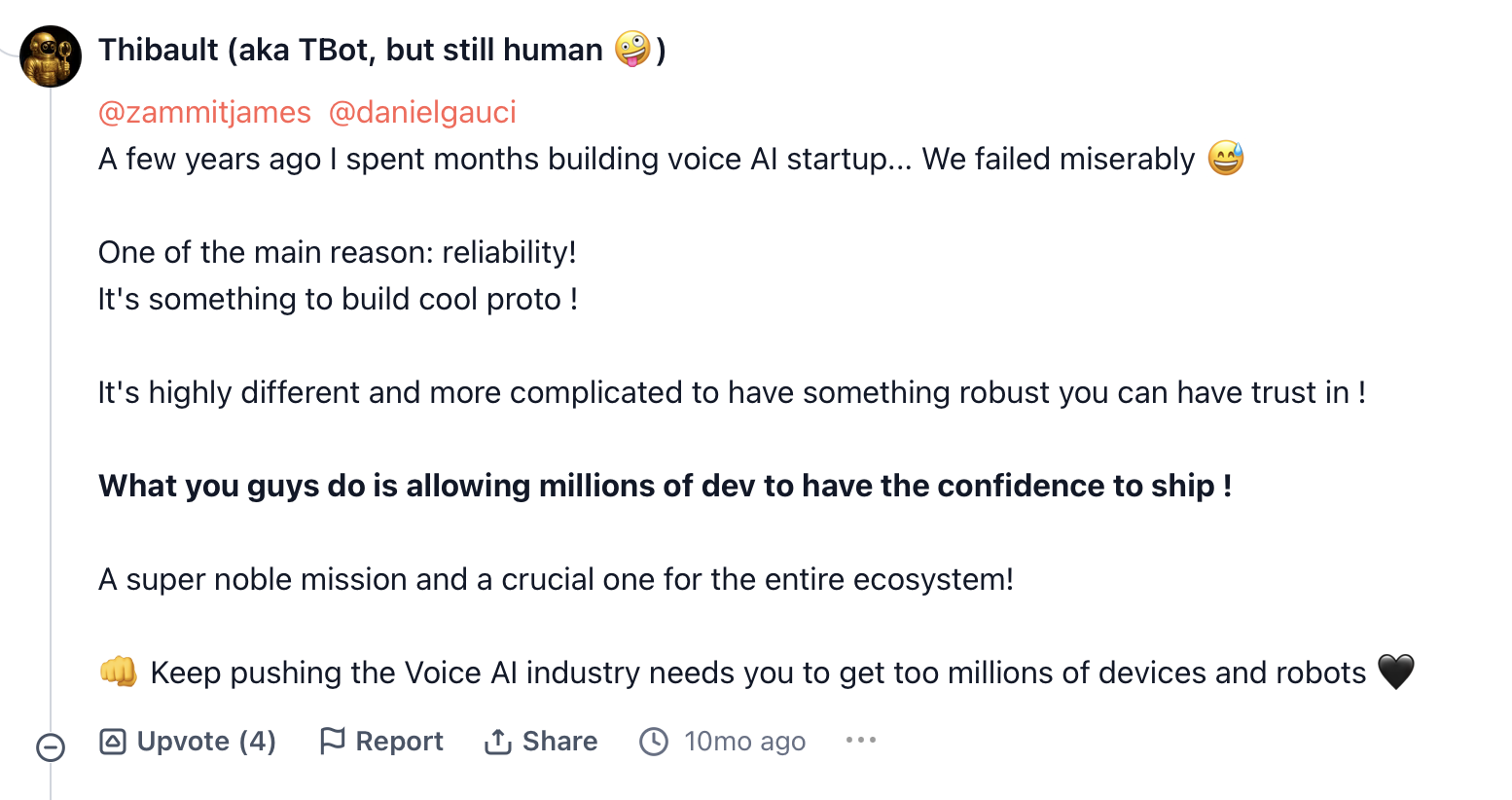
"What you guys do is allowing millions of dev to have the confidence to ship!" (Thibault, Product Hunt)
Pricing
Roark uses usage-based pricing. SOC 2 and HIPAA compliance are available on all plans. No long-term contracts required. Contact the team for current rates.
Bottom Line
Roark earns its keep once you're live and taking calls. Teams without traffic yet should start with Hamming or Cekura and come back to Roark once calls are flowing.
6. Maxim AI: Best for Teams That Already Run Evals
What it does: Maxim is an evaluation and observability platform for covering voice, text, and multimodal agents from one system, with prompt experimentation, regression testing, and production monitoring all built in.
Best for: Engineering and product teams already running evals on text or multimodal agents who'd rather add voice to the same system than spin up a separate platform.
I used the Developer plan, free with three seats, and started in the Prompt IDE, running two prompt variants against the same dataset of 40 voice scenarios.
The side-by-side comparison took about 20 minutes to set up and surfaced that one variant was failing on Spanish-accented inputs at twice the rate of the other, something I hadn't caught in manual testing.
Where Maxim showed its limit was on the telephony side. Voice simulation runs through VAPI or Twilio and covers latency and interruption patterns, but there's no way to test what happens at the carrier layer, covering packet loss, codec failures, and silent audio. That gap matters depending on what you're testing for.
Maxim is the right call for teams already running LLM evals who want voice in the same system, but not for teams whose primary concern is whether audio physically reaches the caller.
Key Features
- Voice agent simulation via personas: Live calls through VAPI or Twilio, evaluating latency, interruptions, and emotional tone.
- Evaluator Store: Pre-built evaluators for accuracy, hallucination, and safety checks, plus support for custom metrics.
- CI/CD integration with GitHub Actions: Automated evaluation pipelines that flag regressions before deploys go out.
- Human-in-the-loop pipelines: Domain expert annotation to build golden datasets.
- Multi-language SDKs: Available in Python, TypeScript, and Go, with Java support also included.
Pros and Cons
Pros:
✅ Voice, text, and multimodal agents in one platform, with no second tool needed for teams testing across modalities.
✅ SOC 2 Type II, ISO 27001, HIPAA, and GDPR compliant with In-VPC deployment on Enterprise, the strongest compliance posture on this list.
✅ Named enterprise customers with published testimonials at scale, including EY
✅ Developer plan with 3 seats at no cost, no credit card required.
Cons:
❌ Voice simulation is thinner than voice-native platforms. No production replay, telephony testing, or carrier-grade audio diagnostics.
❌ Documentation assumes engineering context. Non-technical teams will need support during initial setup.
What Users Say
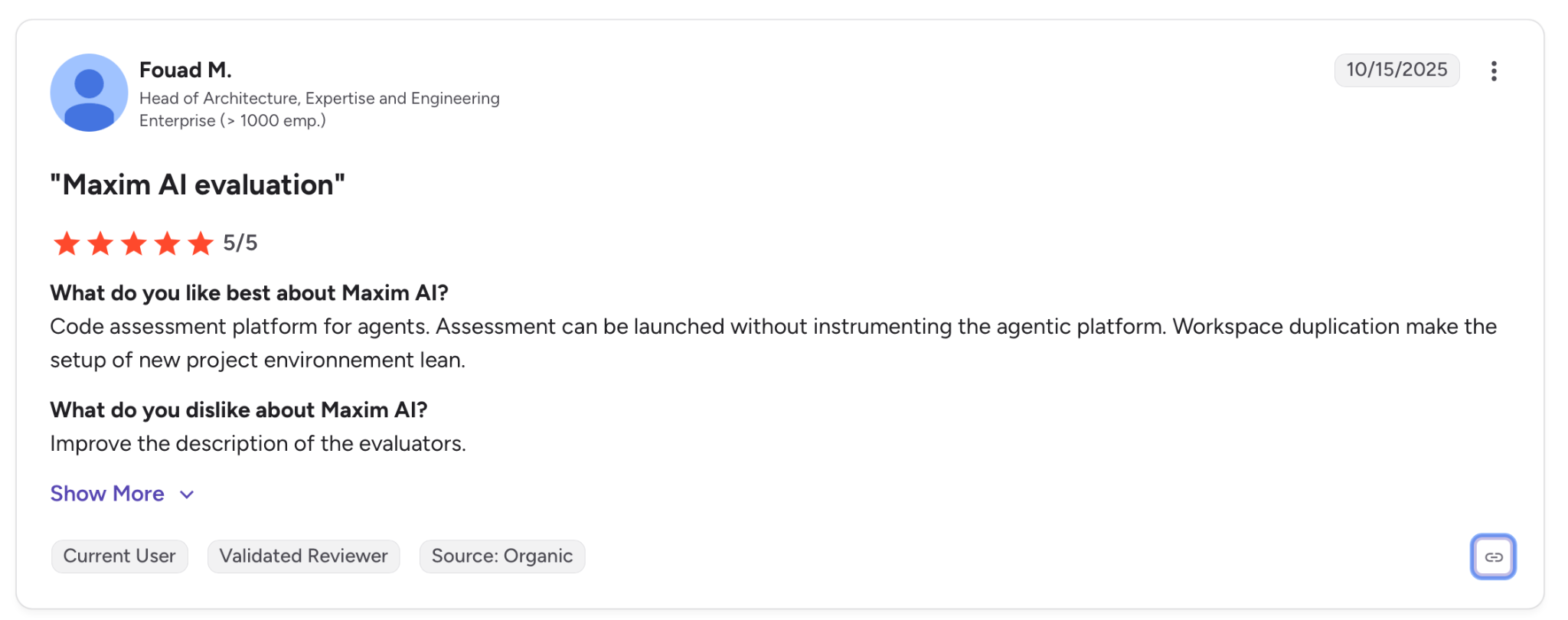
"Code assessment platform for agents. Assessment can be launched without instrumenting the agentic platform. Workspace duplication makes the setup of a new project environment lean." (Fouad M., G2)
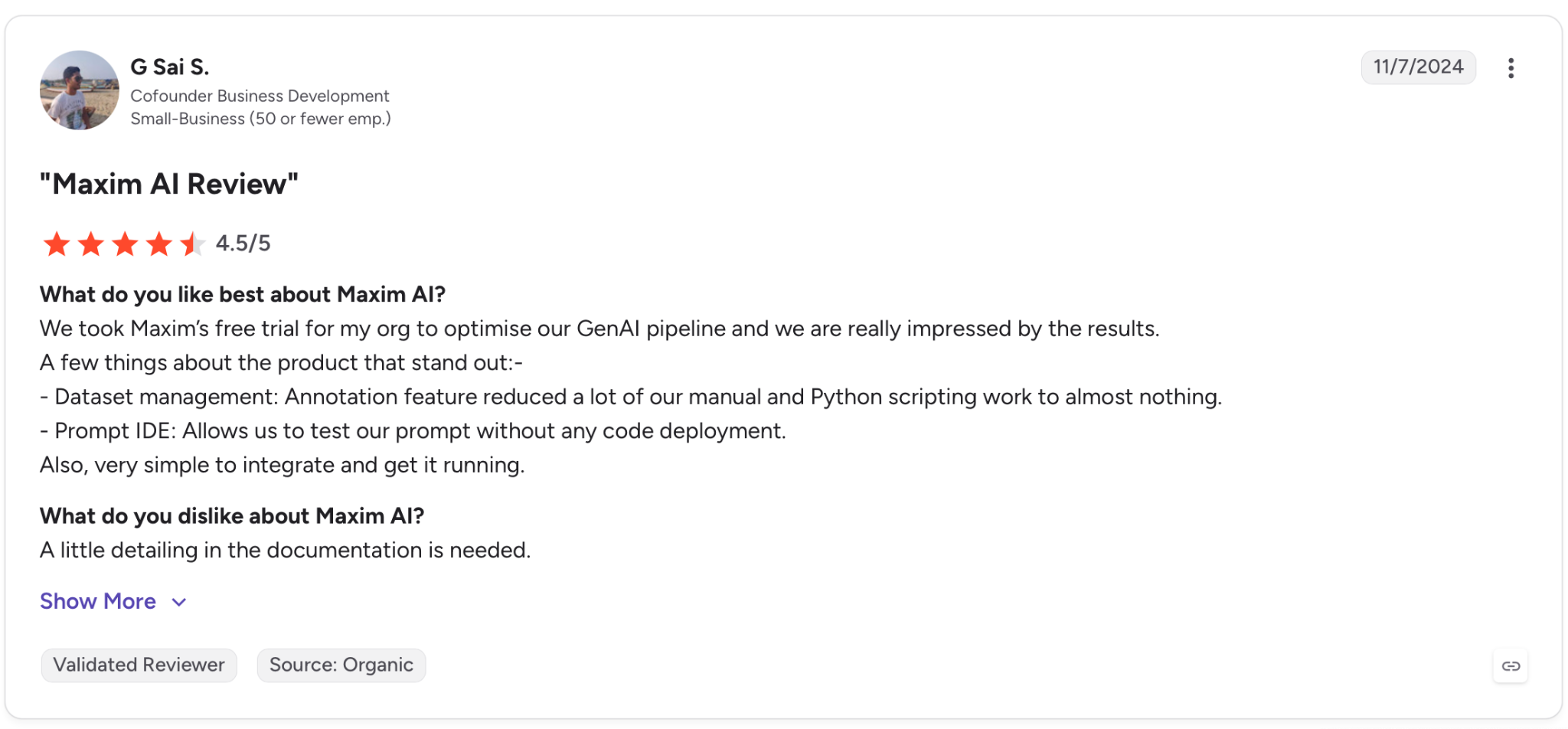
"A little detailing in the documentation is needed." (G Sai S., G2)
Pricing
Developer plan at no cost (3 seats). Professional at $29/seat/month, Business at $49/seat/month, both with a 14-day trial. Enterprise custom.
Bottom Line
Maxim makes sense when you're already running LLM or multimodal evals and want voice folded into the same system. If voice is your primary QA focus, Hamming or Cekura will go deeper.
7. LangWatch: Best for Teams That Want Open-Source Eval
What it does: Open-source AI agent testing and evaluation platform covering simulation, regression testing, observability, and voice evaluation, with self-hosted and cloud options.
Best for: Teams that want full control over their eval infrastructure and need voice testing that runs in CI without manual calls or a separate platform.
I had headless voice-to-voice tests running in CI in under 30 minutes using LangWatch Scenario, without a microphone, without manual calls, without any test infrastructure beyond the agent's endpoint. Scenario drove a simulated caller with a custom persona against the agent over a live VAPI connection, scored every call in plain English criteria, and posted pass/fail results before the pull request merged.
The architecture is worth understanding before you commit. LangWatch handles dataset management, regression tracking, scoring, and the platform UI, while Scenario handles the simulation calls through tests you write in pytest or vitest alongside your code.
That code-first approach is the right call for engineering teams, but teams used to no-code platforms will feel the friction during setup.
Key Features
- LangWatch Scenario, headless voice-to-voice CI: Drives callers with real ElevenLabs voices, custom personas, and audio effects like cafe noise or phone codec degradation.
- Visual diffing for behavioral regressions: Catches behavioral changes between versions that manual review can miss.
- DSPy-based prompt optimization: Tunes prompts based on evaluation feedback, drawing on Stanford's DSPy framework.
- OpenTelemetry-native tracing: Framework-agnostic observability that works across most LLM stacks without proprietary instrumentation.
- On-premise, VPC, and air-gapped deployment: Self-hosting support for teams with strict data residency requirements.
Pros and Cons
Pros:
✅ Open source on GitHub with an active repo. Teams can audit, extend, and self-host the platform.
✅ Claim to be GDPR and ISO 27001 certified, covering the compliance baseline for European enterprise deployments.
✅ MCP server lets teams build evals directly from Claude, Cursor, or Copilot without leaving the coding environment.
Cons:
❌ Voice testing requires writing tests in pytest or vitest, which is less accessible for non-engineering QA teams compared to no-code platforms.
❌ No named enterprise customers in official documentation, which makes it harder to assess production scale before committing.
What Users Say
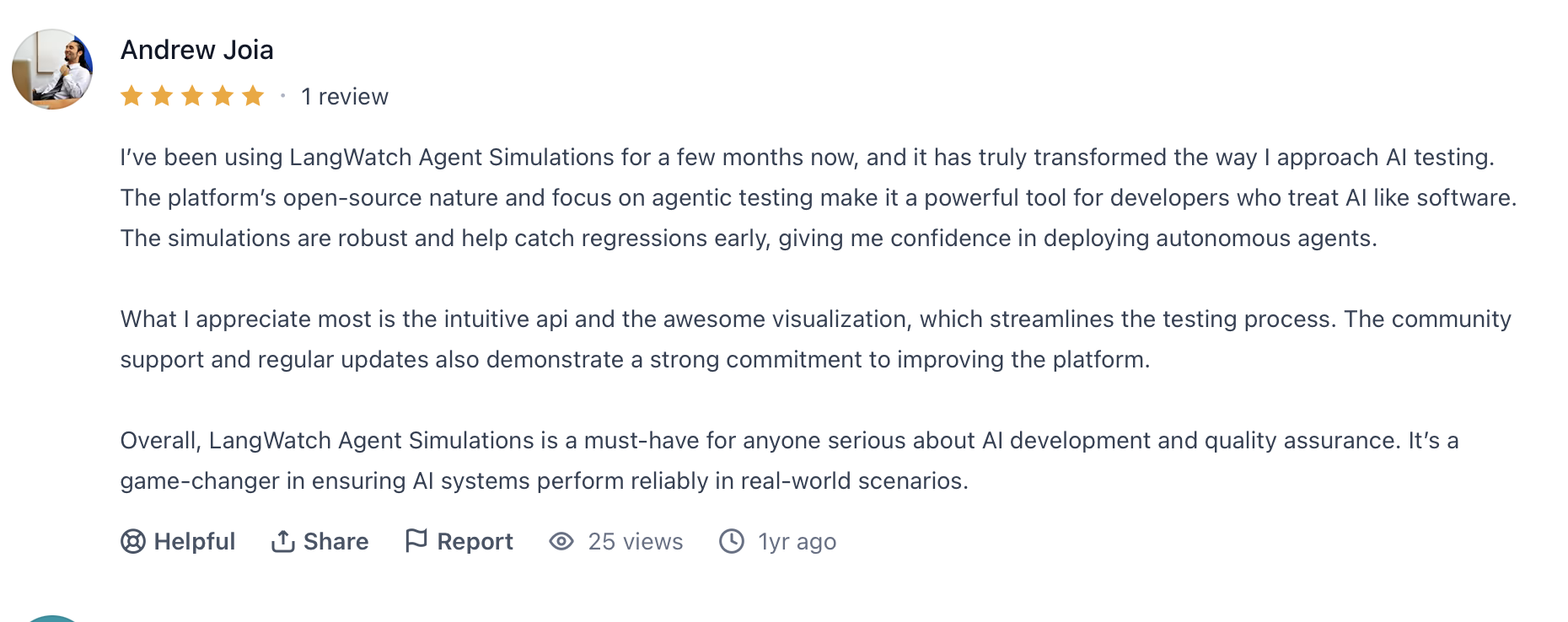
"I've been using LangWatch Agent Simulations for a few months now, and it has truly transformed the way I approach AI testing." — Andrew Joia, Product Hunt
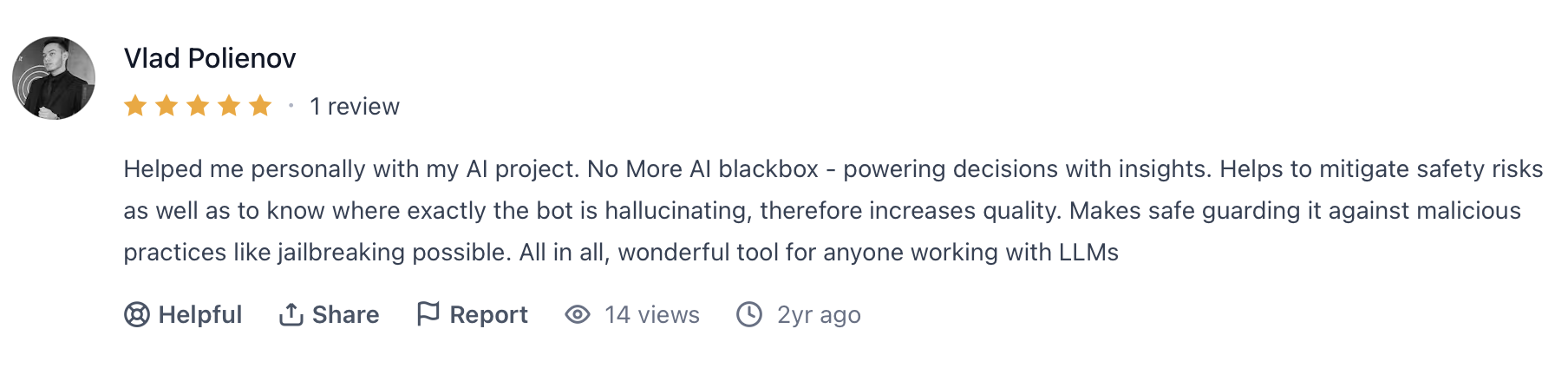
"Helped me personally with my AI project. No more AI blackbox, powering decisions with insights." (Vlad Polienov, Product Hunt)
Pricing
Growth plan at $34/seat/month with 200k events and full eval features. Self-hosted version free with no event costs. Enterprise custom with dedicated support and SLA.
Bottom Line
LangWatch belongs on the shortlist for engineering teams that want open-source control over their eval stack with voice testing included in CI from day one. Teams that need a no-code QA workflow or named enterprise references will find Hamming or Cekura a closer fit.
Which AI Voice Testing Platform Should You Choose?
For CI/CD voice-agent testing, start with a versioned regression set and a clear release gate. Include at least one bilingual conversation, an interruption, and a failed tool call. Compare how each tool stores the transcript and audio, reports the failed assertion, and lets the team reproduce the run. Those checks make the comparison concrete without treating every evaluation platform as interchangeable.
The right platform depends on three things: where your agent is in its lifecycle, how layered your telephony stack is, and what failure you can least afford.
Choose Hamming AI if you:
- Treat voice QA like a release process and want scenario generation, CI regression, and production monitoring in the same workflow.
- Need provider-aware integrations that sync directly with Vapi, Retell, LiveKit, Pipecat, or OpenAI Realtime without rebuilding your stack.
Choose Cyara if you:
- Run a contact center that still has IVR alongside new agentic AI and needs one platform to cover both in the same QA toolchain.
- Operate in a regulated enterprise environment where 450+ customers worldwide and a 334% ROI per Forrester TEI (composite organization, 2023) matter as much as the testing itself.
Choose Braintrust if you:
- Already run LLM evals on text agents and want to extend that same pipeline to voice without adopting a new platform.
- Need structured prompt experimentation with side-by-side dataset comparisons built into the workflow.
Choose Cekura if you:
- Need full-lifecycle QA (simulation, CI/CD regression, production monitoring, and A/B testing) from a single platform with a self-serve entry point at $30/month.
- Are deploying in regulated environments (healthcare, fintech) and need SOC 2 Type II, HIPAA, and GDPR compliance on a self-serve plan.
Choose Roark if you:
- Are already live in production and want your failed calls to become regression tests automatically, without building that pipeline yourself.
- Need to understand what callers do when they go off-script, using live production traffic as the source.
Choose Maxim AI if you:
- Already run evals on text or multimodal agents and want voice testing wired into the same workflow, using one platform for all modalities.
- Need the strongest compliance posture on this list, SOC 2 Type II, ISO 27001, HIPAA, and GDPR, with In-VPC deployment on Enterprise.
Choose LangWatch if you:
- Want open-source control over your eval stack with the option to self-host, audit, and extend the platform without vendor lock-in.
- Need headless voice-to-voice testing running in CI before pull requests merge, without a microphone or manual call workflow.
Skip this category entirely if:
- Your agent is still in the early prototype stage and you haven't defined your core call flows yet. Test those manually first, then bring in a platform once the flows stabilize.
- Your only voice channel is a single-language, low-stakes use case where a basic transcript review after the fact is sufficient.
Final Verdict
Cekura comes closest to a true full-lifecycle voice QA platform, covering simulation, regression, production monitoring, and A/B testing from one self-serve entry point.
For enterprise contact centers running IVR alongside new AI agents, Cyara is the only platform here that covers both without separate toolchains.
Teams already running LLM evals have two natural paths: Maxim AI folds voice into an existing workflow with no new platform to learn, while Braintrust is the stronger pick for building structured eval infrastructure from scratch.
If you're live in production, Roark turns failed calls into regression tests automatically. For engineering teams that want open-source control with headless voice testing in CI, LangWatch is the clearest fit. Hamming serves teams treating voice QA as a release discipline.
Several of these tools offer free tiers or trials, so take a couple for a spin before committing. If your team runs voice or chat AI agents in production, book a demo with Cekura and see how automated simulation testing fits into your stack.
Frequently Asked Questions
What is an AI voice testing platform?
An AI voice testing platform simulates phone conversations against your voice agent and flags failures before callers encounter them. It covers pre-deployment simulation, regression testing, and production monitoring across latency, interruptions, and instruction compliance.
How is voice AI testing different from chatbot testing?
The main difference between voice AI testing and chatbot testing is the layer being evaluated. Chatbot testing checks text input and output. Voice AI testing covers the full audio pipeline (transcription accuracy, latency, barge-in handling, and telephony delivery) which requires an entirely different toolchain.
What should I look for in an AI voice testing platform?
Look for pre-deployment simulation, CI/CD regression testing, and native integrations with your existing voice stack. Compliance documentation (SOC 2, HIPAA, GDPR) matters if you're deploying in healthcare or financial services.
Does Cekura integrate with VAPI and Retell?
Yes, Cekura integrates natively with both VAPI and Retell, along with ElevenLabs, LiveKit, Pipecat, and Bland. All connections include automatic prompt syncing, outbound calling, and production monitoring out of the box.