
Sierra AI vs Decagon comes down to who controls the agent after launch. Sierra AI routes every change through its Agent SDK, Agent Studio, and Workspaces review. Decagon lets CX staff rewrite logic in plain-English Agent Operating Procedures. In Sierra vs Decagon, Decagon wins iteration speed, Sierra AI wins governance, and neither verifies its own work.
Decagon wins on iteration speed, Sierra AI wins on governance, and neither verifies its own work. I built that verdict on published benchmarks, verified reviews, and Cekura simulation data from comparable deployments.
Sierra AI vs Decagon vs Cekura: TL;DR
- Choose Sierra AI if: you run a large consumer brand, you want vendor-led implementation, and agent changes should move through version control and release pipelines rather than ad hoc edits.
- Choose Decagon if: your CX org needs to rewrite agent logic in plain English every week without filing an engineering ticket, and you want a per-conversation billing option you can forecast.
- Choose Cekura if: you already picked one of the two and need independent proof the agent holds up across repeated runs, noisy audio, adversarial callers, and every prompt change after launch.
How I Reached This Verdict
I scored each platform on the four axes that decide real deployments. Change control, cost forecasting, repeat-run reliability, and voice infrastructure.
For evidence, I used three source types:
- Published benchmarks, including Sierra's own τ-bench and Cekura's Voice Orchestration Benchmarks.
- Verified reviews on G2, Product Hunt, and Reddit.
- Simulation data from comparable production deployments, including the Nurix load test covered below.
Where a vendor publishes no numbers, I say so. Neither Sierra AI nor Decagon publishes rates, so this comparison quotes no dollar figures for either vendor or a verified reviewer.
Meet the Contenders
Sierra AI: The Governed Agent OS
Sierra AI builds enterprise AI agents for customer experience on a platform it calls Agent OS. Bret Taylor, the former Salesforce co-CEO and current OpenAI board chair, founded the company in 2023 with former Google executive Clay Bavor.
In May 2026, Sierra announced a $950 million round, led by Tiger Global and GV, pushing its post-money valuation above $15 billion and leaving it more than $1 billion in capital to deploy.
The platform pairs a code-first Agent SDK for engineers with a no-code Agent Studio for CX staff.
Agent OS 2.0, announced November 5, 2025, added Workspaces, which Sierra describes as GitHub-style collaboration across CX, ops, and engineering, plus an Agent Data Platform that gives agents memory across interactions.
Sierra's research arm also published the benchmark that exposed how inconsistent customer service agents are, a finding this comparison returns to.
Decagon: The Configurable AI Concierge
Decagon builds conversational AI agents for concierge customer experiences across chat, voice, email, and SMS. Jesse Zhang and Ashwin Sreenivas founded the company in August 2023. On January 28, 2026, Decagon announced a $250 million Series D led by Coatue Management and Index Ventures.
The round tripled its valuation to $4.5 billion in under six months, after a 2025 in which it signed more than 100 new enterprise customers.
The core mechanism is the Agent Operating Procedure, or AOP. You write what the agent should do in natural language, and the platform pairs those instructions with code-level guardrails and integrations.
Decagon's published deflection benchmarks put mature e-commerce deployments at 55% to 75%, with rollouts starting at 30% to 40% and climbing toward 60% to 75% over three to six months. Its voice channel runs on ElevenLabs through a partnership launched in February 2025.
Cekura: The Verification Layer Above Both
Cekura is an automated QA and observability platform for voice and chat AI agents. It simulates thousands of conversations against an agent before launch, monitors production calls after, and runs red teaming in between.
The company is backed by Y Combinator, raised $2.4 million, serves 70+ conversational AI companies.
It builds no CX agents of its own, sitting one layer above platforms like Sierra AI and Decagon to answer a different question. . Does the agent you built actually work on every call, including the ones the vendor dashboard never flags?
Sierra AI vs Decagon vs Cekura: At a Glance
Here's how the three stack up before we get into the details.
| ⚙️ Tool | 🎯 Best For | 💰 Starting Price | 🚀 Key Strength |
|---|---|---|---|
| Sierra AI | Large consumer brands wanting managed, governed deployment | Custom outcome-based contracts, no published rates | Version-controlled Agent OS with vendor-led builds |
| Decagon | CX orgs that change agent logic weekly | Custom, with per-conversation or per-resolution billing | Natural-language AOPs owned by the CX team |
| Cekura | Any org shipping either platform to production | Usage-based credits, published | Independent simulation, red teaming, and production call QA |
Here's how they compare on the four axes this review scores, plus channel coverage.
| 📊 Criteria | Sierra AI | Decagon | Cekura |
|---|---|---|---|
| Change control | Version-controlled releases through Agent SDK, Agent Studio, and Workspaces review | CX staff edit natural-language AOPs, live same day | Versions your test suite and replays it against every change |
| Pricing model | Custom outcome-based contracts, no published rates | Per-conversation or per-resolution billing, custom quotes | Usage-based credits with published mechanics |
| Repeat-run consistency | Supervision built around τ-bench findings, self-reported | Deflection benchmarks are single-run numbers | Reports pass^1 vs pass^3 consistency across repeated runs |
| Voice infrastructure | Native voice inside Agent OS, outcome-level monitoring | Voice runs on ElevenLabs partnership | Tests latency, VAD, and interruptions under load |
| Channels | Chat, voice, email, SMS, ChatGPT | Chat, voice, email, SMS | Tests voice and chat agents on any platform |
Neither Sierra AI nor Decagon publishes a pricing page. Every figure you see quoted for them online is a third-party estimate or a contract anecdote. I'd treat both as sales conversations, and budget for implementation on top.
Sierra AI vs Decagon vs Cekura: Feature Breakdown
Five areas decide this comparison. I weighed who controls agent changes, what triggers a bill, whether the agent behaves the same way twice, what happens to voice under real conditions, and how long each takes to deploy.
Agent Configuration and Change Control
Sierra AI: The SDK-plus-Studio split is genuinely well designed. Engineers compose skills like triage, respond, and confirm into workflows and connect the agent to internal and external systems, while CX staff tune tone and escalation paths without touching the code, and Workspaces push every change through review before it ships.
The tradeoff is dependency. Sierra owns implementation, and buyers consistently describe a long, vendor-led setup.
Decagon: AOPs are the fastest post-launch iteration loop in this comparison. A CX lead can rewrite refund logic in plain English on a Tuesday and have it live the same day, because the business logic layer belongs to them.
The tradeoff sits at setup. Engineering still wires the integrations and guardrails first, and one verified G2 reviewer notes the platform is "still learning with you as they go."
Cekura: It configures no CX agents, so it competes on a different verb. It versions your test suite instead, replaying the same scenario set against every AOP edit or Workspace release so a Tuesday logic change can't silently undo last month's fixes.
Winner: Sierra AI. Release pipelines, review gates, and versioned changes make it the strongest change-management story of the three. Decagon trades that rigor for speed.
Pricing Model and Cost Forecasting
Sierra AI: The outcome-based pitch aligns incentives. You pay when the agent resolves an interaction, so the vendor earns only what it solves.
However, what counts as "resolved" is determined by the contract, and the same review summary records users calling Sierra expensive with unclear pricing.
Decagon: Two published models, per-conversation and per-resolution. Per-conversation is the only option in this comparison a finance team can forecast from historical ticket volume alone.
Per-resolution carries the same definitional question Sierra's model does, since the platform reporting the resolution is the platform sending the invoice.
Cekura: Usage-based credits with published pricing mechanics. On this axis, its job is arithmetic. Production call QA scores every conversation against your own resolution criteria, an independent count to reconcile against an outcome-based invoice.
Winner: Decagon. Per-conversation billing is forecastable in a way outcome-based contracts are not yet, and offering the choice at all beats offering none.
Multi-Turn Reliability Across Repeated Runs
Sierra AI: Sierra published τ-bench, the 2024 benchmark that tests agents on realistic retail and airline customer service tasks with simulated users and policy rules.
The results were rough. GPT-4o, the top function-calling model tested, succeeded on roughly 61% of retail tasks and 35% of airline tasks on a single attempt. When they ran the same task eight times, the consistency rate fell to about 25% on retail.
Sierra built Agent OS supervision around exactly this problem, but the platform still grades its own homework.
Decagon: Decagon's published deflection range tops out at 75% for mature e-commerce deployments. Those are single-run numbers.
Deflection says nothing about whether the same customer with the same issue gets the same outcome on the next call, which is the pass^k question τ-bench was built to ask.
Cekura: It runs the same scenario across dozens of personas and repeated attempts, replays real production calls against every new prompt or model version, and reports consistency instead of best-case success.
It publishes this measurement openly. Its Voice Orchestration Benchmarks run one agent with a byte-identical system prompt across six voice platforms, three runs per scenario, and the pass^1 to pass^3 gap appears on every platform tested.
ElevenLabs, for example, resolves 88.1% of scenarios once but only 76.3% three times in a row. The limitation here is scope. Simulation measures an agent, but it cannot raise the underlying model's capability.
Winner: Cekura. A one-in-four chance of resolving eight identical cases is a benchmark finding, published by Sierra itself, that neither platform publishes a repeat-run consistency metric.
Voice Infrastructure and Production QA
Sierra AI: Voice runs natively inside Agent OS, and Sierra's enterprise deployments span phone-heavy consumer brands.
The platform's monitoring covers conversation outcomes. Sierra's public materials focus on those outcomes rather than infrastructure signals like turn-taking latency or voice activity detection thresholds.
Decagon: Voice arrived through the ElevenLabs partnership, which delivers strong speech quality. The same layering applies, where Decagon measures whether the conversation resolved, and the audio pipeline underneath belongs to a partner.
Cekura: Voice defects live below the conversation layer, and this is where independent infrastructure testing earns its keep.
The same Voice Orchestration Benchmarks quantify how much that layer varies. With the agent held constant wherever each platform allows it, median per-turn latency still ranges from 1.73 to 3.16 seconds across six platforms, driven by endpointing, VAD, buffering, and network path.
When Nurix, an enterprise voice AI company and a Cekura customer, load-tested a flagship voice agent with Cekura, timeouts took down 30% of calls at peak and average latency drifted to 2.65 seconds. Pre-launch fixes brought latency sub-second.
On the security side, its red-teaming data shows multi-turn attacks succeed 92.7% of the time against conversational agents, versus 19.5% for single-turn attempts.
Winner: Cekura. Latency drift, aggressive VAD thresholds, and adversarial callers are exactly the defects that pass a platform demo and surface on real calls.
Channels, Integrations, and Deployment Time
Sierra AI: The widest channel spread here. Agents deploy across chat, voice, email, SMS, and ChatGPT from a single configuration, a distribution channel Sierra added with the Agent OS 2.0 launch.
Integration work is vendor-led. Sierra owns implementation, and the Integration Library added in Agent OS 2.0 handles back-end connections. The tradeoff shows up in timelines, since G2 reviewers pair praise for the platform with notes on a complex setup process.
Decagon: Covers the four core channels: chat, voice, email, and SMS. Voice ships through the ElevenLabs partnership rather than an in-house stack.
Your engineering team wires the integrations and guardrails before CX takes over the AOPs. That split front-loads the technical work, and one verified reviewer noted setup and fine-tuning take time.
Cekura: Channel coverage means something different one layer up. It tests voice and chat agents on whichever platform you deploy, connecting natively to Retell, VAPI, ElevenLabs, LiveKit, Pipecat, and Bland, and reaching closed platforms like these two through webhooks and chat testing.
There is no build phase to schedule. Testing starts the same day the webhook connects.
Winner: Sierra AI on breadth, with a caveat. Five channels from one configuration is the strongest coverage story, and it costs you the longest vendor-led deployment of the three.
What Real Users Say
Sierra AI
Pro
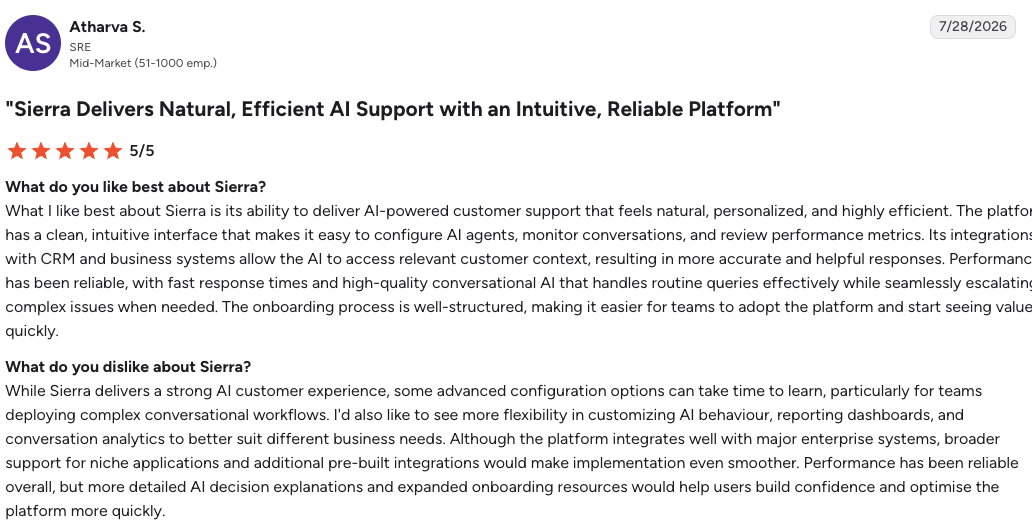
“What I like best about Sierra is its ability to deliver AI-powered customer support…” (Atharva S., G2)
Con

“What I dislike most is the lack of pricing transparency…” (Manohar D., G2)
Decagon
Pro
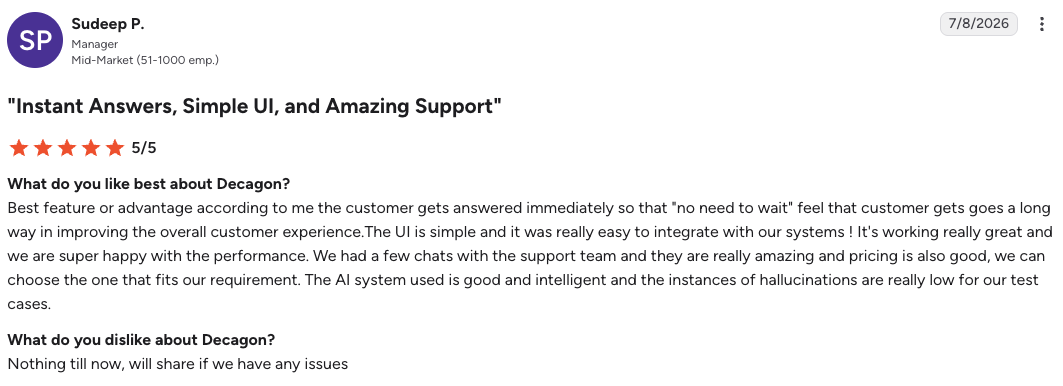
“The UI is simple, and it was really easy to integrate with our systems!” (Sudeep P., G2)
Con
“The main downside is that it takes some time to set up and fine-tune everything properly.” (Verified User in Logistics and Supply Chain, G2)
Cekura
Pro
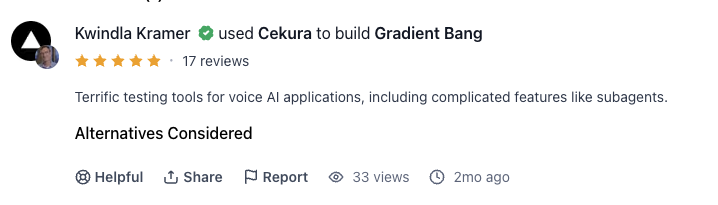
"Terrific testing tools for voice AI applications, including complicated features like subagents." (Kwindla Kramer, Product Hunt, builder of Gradient Bang)
Con

"Credits are consumed across multiple features – testing, monitoring, evaluations, reports. Hard to know upfront how many actual test runs you get." (Reviewer, Reddit)
Which Tool Should You Choose?
For me, the build decision comes down to team shape. An engineering org that gates every change picks differently from a CX org that owns support policy and iterates weekly. The verification decision applies to both.
Choose Sierra AI if you:
- Run a consumer enterprise where agent changes must clear review gates, version control, and brand-safety checks before touching a customer.
- Want the vendor to own implementation and are comfortable trading iteration speed for governance.
Choose Decagon if you:
- Have a CX org that owns support policy and needs to change agent behavior weekly without engineering in the loop.
- Want the option of per-conversation billing your finance team can model before signing.
Choose Cekura if you:
- Are deploying either platform and need pre-launch proof across repeated runs, accents, background noise, and adversarial callers.
- Bill on outcomes and want an independent, per-call resolution count instead of taking the invoice's word for it.
My Final Verdict
Cekura wins this comparison, on the narrow axis it competes on. Sierra AI and Decagon are both excellent at building CX agents, and picking between them is a team-shape decision I would not lose sleep over.
Verifying whichever one you pick is the decision that determines whether the project survives.
Gartner predicts more than 40% of agentic AI projects will be canceled by the end of 2027, with its analyst pointing to hype-driven pilots deployed without a clear strategy or the governance to handle failure. Model capability is absent from that diagnosis.
Strategy and governance are measurement problems, and measurement is precisely what buyers in the Sierra AI vs Decagon debate keep deferring until after the contract.
Pick the platform that fits your team, then instrument it before your customers do it for you.
Ready to Try Cekura?
Cekura wires into whichever platform wins your evaluation and starts testing the same day. The features that matter most for a Sierra AI or Decagon deployment bucket into three groups.
Pre-production:
- Scenario simulation that generates test cases from your agent's description and knowledge base, then runs them in parallel across 30+ languages and regional accents.
- Multi-turn red teaming that probes jailbreaks, prompt injection, and data extraction before an adversarial caller does.
Infrastructure:
- Latency, interruption, and VAD threshold testing under load, the layer where load-test timeouts and latency drift surface.
Observability:
- Production call QA that scores every conversation against your own resolution criteria, with drop-off and sentiment analysis.
- Regression replay that reruns real calls against every prompt or model change.
Native connections cover Retell, VAPI, ElevenLabs, LiveKit, Pipecat, Bland, and more. Platforms without a public testing API, including Sierra AI and Decagon, connect through webhook-based custom integration or chat testing, so a vendor-managed stack is testable too.
It also carries SOC 2, HIPAA, and GDPR compliance, backed by transcript redaction, role-based access, and audit trails.
Book a demo and run your first simulation against the platform you're evaluating this week.
Frequently Asked Questions
What is the Difference Between Sierra AI and Decagon?
The main difference between Sierra AI and Decagon is who controls the agent after launch.
Sierra AI routes changes through its Agent SDK, Agent Studio, and release pipelines, while Decagon lets CX staff rewrite agent logic in natural-language Agent Operating Procedures. Sierra fits governance, Decagon fits iteration speed.
Does Sierra AI or Decagon Cost More?
Sierra AI generally costs more than Decagon based on available reporting, though neither vendor publishes pricing.
Sierra sells custom outcome-based enterprise contracts, while Decagon offers per-conversation and per-resolution billing. Both require a sales process before you see a number.
Is Cekura a Competitor to Sierra AI and Decagon?
No, Cekura is a QA and observability layer that sits above Sierra AI and Decagon.
Sierra and Decagon build customer-facing AI agents, and Cekura independently tests and monitors those agents through simulation, red teaming, and production call analysis. You run Cekura on top of either platform.
How Reliable are AI Customer Service Agents?
AI customer service agents remain inconsistent across repeated attempts, according to Sierra Research's own τ-bench results.
GPT-4o resolved about 61% of retail tasks on a first attempt, but its chance of resolving the same task eight times in a row dropped to roughly 25%. That gap is why regression testing matters.
Can You Test Sierra AI or Decagon Agents Before Launch?
Yes, you can test Sierra AI or Decagon agents before launch using an independent QA platform.
Cekura connects to closed platforms through webhook integration and chat simulation, then runs scenario suites, red teaming, and load tests against the live agent. You get consistency data the vendor dashboard does not report.