
LiveKit vs Vapi comes down to three things. LiveKit wins on infrastructure control and compliance economics, Vapi wins on speed to a live phone call, and neither one confirms your agent survives contact with real callers.
I ran LiveKit vs Vapi head-to-head across booking flows, interruption handling, and peak-load bursts, then priced both from their own published calculators.
Here is where each platform earns its keep, and where a dedicated QA layer belongs.
LiveKit vs Vapi: TL;DR
- Choose LiveKit if: You want the media layer under your own control, self-hosting is on the table, and SOC 2 Type II bundled into a $500/month plan beats paying for compliance as an add-on.
- Choose Vapi if: You need a live phone agent this week, you want zero monthly floor, and swapping STT, LLM, or TTS providers without touching transport code matters more than owning the pipe.
Meet the Platforms
Both platforms ran the same three scenarios with identical speech-to-text, model, and voice providers behind them. That leaves the platform layer as the only variable.
Cost figures come from each vendor's published pricing page and calculator, checked in August 2026. Feature claims trace to platform documentation, and the user quotes further down come from G2 and Product Hunt.
LiveKit: The Media Layer You Can Own
LiveKit is an open-source WebRTC stack with an agent framework layered on top. The server is Apache 2.0, so you can self-host the whole thing or run it on LiveKit Cloud across four tiers, from a free Build plan to custom Enterprise contracts.
It powers real-time audio transport, agent hosting, telephony, and an inference gateway that brokers STT, LLM, and TTS models behind one API key.
Vapi: Managed Orchestration With Swappable Providers
Vapi runs the full voice pipeline as a managed service. You configure an assistant, pick your STT, LLM, and TTS providers, and Vapi handles the low-latency loop between them for a $0.05 per minute hosting fee.
Fresh off a $50M Series B, the platform now counts Amazon Ring, Kavak, and Instawork among its enterprise logos.
Cekura: The QA and Observability Layer Above Both
Cekura tests and monitors conversational AI agents on whatever platform runs them. Backed by Y Combinator with $2.4M raised, it simulates thousands of calls against your agent before launch and scores live conversations after it.
It plugs into LiveKit, VAPI, and the rest of the voice stack as an added layer.
LiveKit vs Vapi vs Cekura: At a Glance
| 💻 Tool | 🎯 Best For | 💰 Starting Price | ⚡ Key Strength |
|---|---|---|---|
| LiveKit | Engineering orgs that want infrastructure-level control and a self-hosting option | $0/month Build tier (1,000 agent minutes included) | Cold start prevention is unavailable on Build and Ship, arriving only at the Scale tier, so agents below Scale can lag on the first call after idle |
| Vapi | Developers who want a managed pipeline with provider swap at every layer | $0.05/min hosting fee (model costs pass through) | Fastest path from config to a live phone call, no monthly floor |
| Cekura | Engineers testing and monitoring voice or chat agents on any platform | Free to start (300 credits, ~60 min); $0.25/testing min · $30/month per extra seat | Pre-production simulation plus production call scoring in one loop |
LiveKit vs Vapi vs Cekura: Feature Comparison, Category by Category
Marketing pages for both platforms promise low latency and scale. The differences that matter live in deployment control, per-minute math, concurrency ceilings, compliance invoices, and test coverage. That is where I focused.
Infrastructure Ownership and Deployment Control
LiveKit: You get the source code. The media server is open source, and agents written with the LiveKit Agents framework run on your own metal, in a private VPC, or on LiveKit Cloud without a rewrite.
The tradeoff is operational weight. Cold start prevention is a paid feature that starts on the Ship tier, so free-tier agents can lag on the first call after idle.
Vapi: You get an API. Vapi hosts the pipeline, and you never touch a media server, a TURN configuration, or a WebRTC edge. The tradeoff is a ceiling on control. There is no self-hosting path, and your uptime rides on Vapi plus whichever telephony carrier you attach.
Cekura: Deployment sits outside its scope by design. It connects to agents wherever they run, including on-premise setups for its observability suite when data cannot leave your infrastructure.
Better fit: LiveKit. An Apache 2.0 escape hatch is worth real money the day procurement, data residency, or a pricing change forces your hand.
What a Minute of Conversation Actually Costs
LiveKit: A phone-based agent on the Ship plan runs roughly $0.22 per minute on LiveKit's published component rates with GPT-4o, Deepgram Nova-2, and ElevenLabs Multilingual v2. TTS alone accounts for $0.18 of that.
The agent session bills $0.01 a minute, so a ten-minute call costs ten cents on that line alone.
Swap the voice to Cartesia Sonic at $0.03 per minute, and the same agent drops to about $0.075 per minute. Your voice choice moves the bill more than the platform does.
Vapi: The $0.05 per minute covers hosting only. STT, LLM, TTS, and telephony pass through at provider cost, and drop to $0 on Vapi's side if you bring your own API keys.
There is no monthly floor, which makes Vapi cheaper at low volume. Past roughly 1,000 monthly minutes, LiveKit's $0.01 agent fee on a $50 Ship base undercuts Vapi's nickel per minute on the platform line.
Vapi's all-in cost lands near $0.30 to $0.33 per minute once third-party speech, model, and telephony charges are added, which is the figure to compare against LiveKit's $0.225.
Cekura: QA spend is a separate meter entirely. The pay-as-you-go plan bills $0.25 per voice testing minute and $0.05 per monitored call, with the first seat free and $30 a month for each one after.
Volume testing moves to the $500 Startup plan, which bundles roughly 2,000 testing minutes and 50 concurrent calls. A full pricing anatomy for both platforms lives in the LiveKit pricing guide and the Vapi pricing guide.
Better fit: Vapi below about 1,000 minutes a month, LiveKit above it. Model your own traffic before trusting either headline rate.
Concurrency Under Peak Load
LiveKit: Concurrent agent sessions scale by tier, from 5 on Build to 20 on Ship and up to 600 on Scale. Capacity is priced into the plan itself. An agent that outgrows 20 simultaneous sessions forces the $500 Scale conversation.
Vapi: Every account includes 10 concurrent lines, then $10 per line per month. Linear and predictable, and expensive at call-center volume. A 100-line outbound campaign adds $900 a month before a single minute is billed.
Cekura: Load is where it earns its slot in the stack. Simulated concurrency surfaces the timeouts and latency drift that show up only at peak, before real traffic does, and neither platform's dashboard would catch that ahead of launch.
Per Cekura's benchmarks, one byte-identical agent scored across six voice orchestration platforms produced a 33.3-point spread in workflow complexity and recovery, with each scenario run three times.
Better fit: LiveKit for raw ceiling. Run a load test before you find your true limit the hard way.
Compliance Pricing and Data Retention
LiveKit: SOC 2 Type II reports and a network pentest come bundled with the Scale tier at $500 per month, with region pinning available. HIPAA and role-based access sit on the Enterprise tier at custom pricing, so a regulated workload starts a sales conversation rather than paying a list price.
Vapi: HIPAA is a $2,000 per month add-on on either plan, and Zero Data Retention is another $1,000. SOC 2, SSO, and RBAC are on the annual-contract Scale plan only.
One more line worth reading twice on the self-serve plan is retention. Call history holds for 14 days, which is a short window if a customer disputes a call from three weeks ago.
Cekura: Cekura supports SOC 2, HIPAA, and GDPR compliance for transcript redaction, role-based access, and audit trails. Test recordings and production call data carry the same protections as the agents under test, which matters when half your callers are patients.
Better fit: LiveKit on price. Vapi publishes HIPAA at $2,000 per month. LiveKit places it on a custom-priced Enterprise contract, so the comparison is a known number against a quote rather than $500 against $2,000.
Pre-Production Testing and Live Call Observability
LiveKit: The Agents framework ships testing helpers that plug into pytest and Vitest, with LLM-based judging of message intent. The helpers work with text input and output only, and test runs never open a room connection.
Audio, interruptions, background noise, and telephony stay untested, and the same documentation points to third-party services, Cekura among them, for end-to-end audio coverage.
Vapi: Native Evals, Simulations, and Monitoring shipped between late 2025 and early 2026, and the older Test Suites feature is being deprecated in favor of Simulations. There's decent tooling, scoped to agents deployed on Vapi. If you move a workflow to another platform, the test suite stays behind.
Cekura: Simulation runs across 50+ personas, including interrupters, non-native accents, and adversarial callers, before an agent takes a real call. On LiveKit, the tracing SDK captures full session data for production monitoring, and automated room creation drives test calls over WebRTC.
On Vapi, WebRTC simulations run against a public key with no phone number and no telephony cost, which suits CI. Failed production calls convert into regression tests, closing the loop between monitoring and testing.
Better fit: Cekura. Platform-native tools test the transcript or test their own platform. End-to-end audio simulation across both stacks is a different job.
Per Cekura's benchmarks, one byte-identical agent scored across six voice orchestration platforms produced a 33.3-point spread in workflow complexity and recovery, with each scenario run three times.
What Real Users Say
LiveKit
Pro:
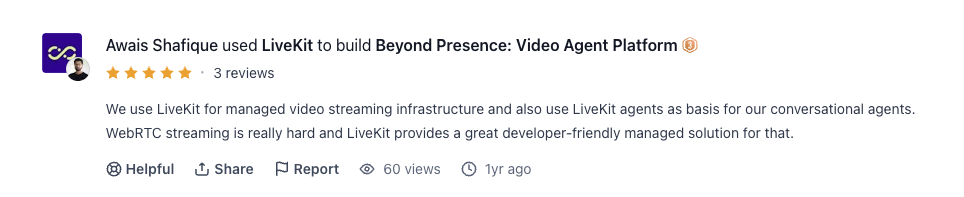
"WebRTC streaming is really hard and LiveKit provides a great developer-friendly managed solution for that."
— Awais Shafique, Product Hunt, builder of Beyond Presence
Con:
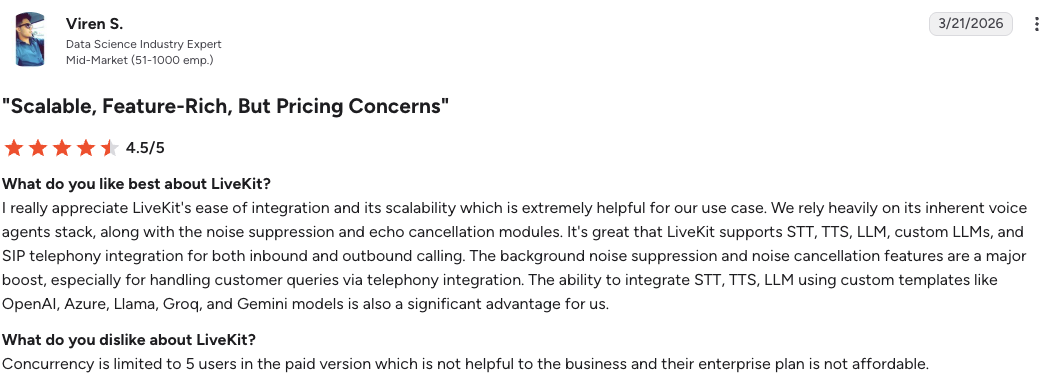
"Concurrency is limited to 5 users in the paid version which is not helpful to the business and their enterprise plan is not affordable."
— Viren S., G2, 21 March 2026
Note: Five concurrent agent sessions is the free Build limit. Paid Ship raises it to 20 sessions. Past that the only step up is the $500 Scale tier, so their complaint holds one tier higher than they place it.
Vapi
Pro:
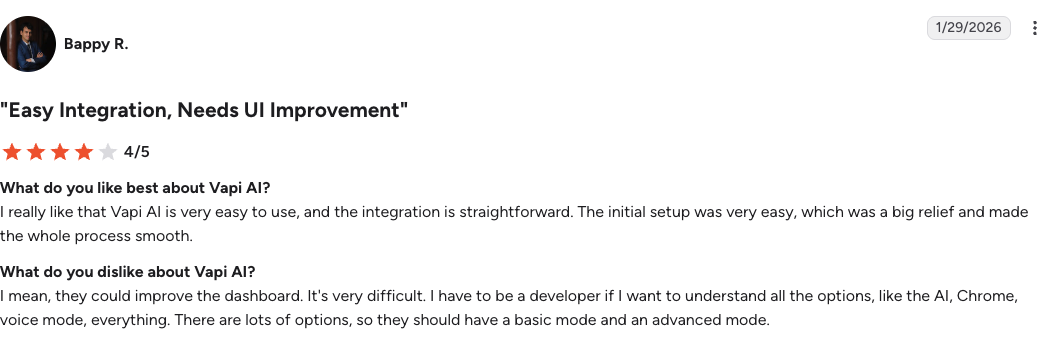
"The initial setup was very easy, which was a big relief and made the whole process smooth."
— Bappy R., G2
Con:
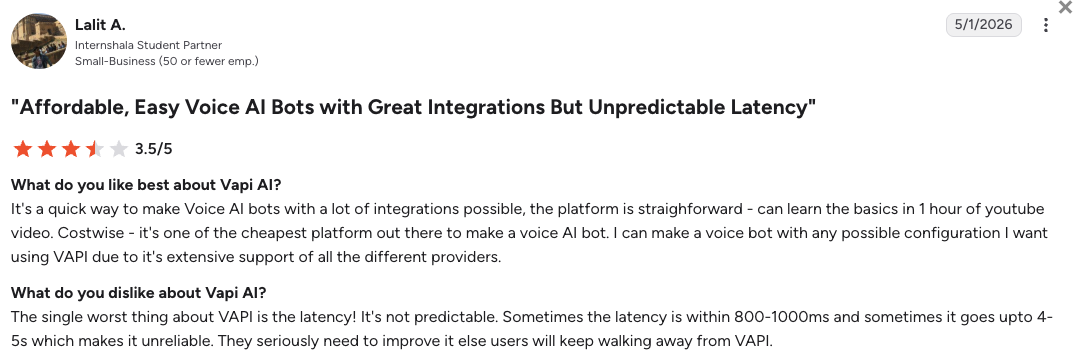
"The single worst thing about VAPI is the latency! It's not predictable. Sometimes the latency is within 800-1000ms and sometimes it goes upto 4-5s."
— Lalit A., G2
Cekura
Pro:
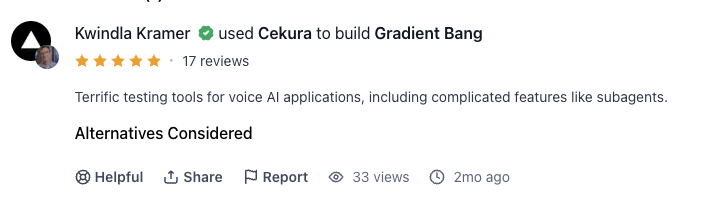
"Terrific testing tools for voice AI applications, including complicated features like subagents."
— Kwindla Kramer, Product Hunt, builder of Gradient Bang
Con:

"Credits are consumed across multiple features – testing, monitoring, evaluations, reports. Hard to know upfront how many actual test runs you get."
— Reviewer, Reddit
Which Tool Should You Choose for Your Stack?
After running all three, the platform question and the quality question turned out to be separate decisions. LiveKit and Vapi compete for the first, and Cekura handles the second on top of either:
- LiveKit: engineers who can operate real-time infrastructure, want a self-host option, and need concurrency headroom or bundled SOC 2.
- Vapi: teams that want a phone agent in days on a zero-floor bill, with provider swaps at every layer.
- Cekura: anyone shipping on either platform who needs pre-launch simulation and live-call scoring, with failed calls turned into regression tests.
My Final Verdict
LiveKit is my pick between the two platforms for anything past a prototype. The open-source escape hatch, the concurrency headroom, and the $500 SOC 2 tier beat Vapi's economics once volume and regulation enter the picture.
Vapi remains the faster on-ramp, and for a lean build with modest traffic, its zero-floor billing is genuinely hard to argue with. The LiveKit alternatives roundup covers the wider field if neither fits.
The sharper takeaway from testing is that neither platform verifies its own output end to end. LiveKit's evals never touch audio, and Vapi's simulations stop at Vapi's border.
LiveKit vs Vapi decides which platform carries your calls. Put a testing and monitoring layer above the winner before real callers become your QA process. That layer is what Cekura does.
Ready to Try Cekura?
Cekura covers the LiveKit vs Vapi decision from the side both platforms leave open, which is quality across the whole lifecycle.
Pre-production:
- AI-generated scenarios and metrics built from your agent config, with mock tools for predictable responses
- Simulation across 50+ personas covering interruptions, accents, background noise, and one-word repliers
- Multi-turn red teaming that establishes rapport before it probes, covering jailbreaks, prompt injection, and data extraction across 6 attack categories
Infrastructure:
- Load testing that surfaces timeout and latency drift before peak traffic does
- CI/CD gates through GitHub Actions that stop regressions at the pull request
Observability:
- Turn-level scoring of live calls for latency, interruptions, sentiment, and instruction-following
- One-step conversion of failed production calls into reusable regression tests
Native integrations cover Retell, VAPI, ElevenLabs, LiveKit, Pipecat, Bland, and more. Connect your keys, and testing starts against the agents you already deployed.
Request a demo to see simulated calls run against your LiveKit or Vapi agent.
Frequently Asked Questions
What is the main difference between LiveKit and Vapi?
The main difference between LiveKit and Vapi is ownership of the media layer. LiveKit gives you an open-source WebRTC stack you can self-host or run on LiveKit Cloud, while Vapi runs the entire pipeline as a managed service for a $0.05 per minute hosting fee.
Can I use Cekura with both LiveKit and Vapi?
Yes, Cekura works with both LiveKit and Vapi through native integrations. It runs simulated test calls and monitors production traffic on LiveKit via automated room creation or a tracing SDK, and on VAPI via direct WebRTC connections that need no phone number.
Which is cheaper, LiveKit or Vapi?
Vapi is cheaper at low volume because it has no monthly floor, while LiveKit wins past roughly 1,000 monthly minutes, where its $0.01 per minute agent fee after a $50 base undercuts Vapi's $0.05 platform rate. Model costs dominate both bills either way.
Does LiveKit include voice agent testing?
LiveKit includes a testing framework, but it covers text only. Its testing helpers run behavioral tests through pytest or Vitest without opening a room connection, so audio, interruptions, and telephony need a third-party tool such as Cekura.
Which platform is better for healthcare voice AI?
LiveKit is the stronger platform choice for healthcare on published pricing, because SOC 2 Type II comes bundled at the $500 per month Scale tier.
HIPAA sits on Enterprise at custom pricing on LiveKit and costs $2,000 per month on Vapi, so price the tier you actually need before deciding.
Do I need both a voice platform and a QA layer?
Yes, production deployments need both, because LiveKit and Vapi run calls while a QA layer verifies them. Platform-native testing covers text transcripts or platform-hosted agents only, so end-to-end audio simulation and live call scoring require a dedicated tool.