
Hamming's pricing page lists three tiers and no prices. If you are shopping for a Hamming alternative because you wanted a rate card before a sales call, Cekura, Coval, and Roark all publish theirs.
I checked every price below against the vendor's own pricing page on 1 September 2026. One of the seven publishes nothing at all, and I have said so plainly.
Pricing transparency separates the top of this list. Audio-native scoring separates the bottom. One class of problem survives every platform on it, and that belongs in your evaluation before you sign anything.
7 best Hamming alternatives: TL;DR
- Cekura: for pre-production simulation and production monitoring on one published per-minute meter
- Roark: for scoring live production calls on audio, with $50 of credit and no card
- Bluejay: for one QA layer spanning voice, chat, and legacy IVR
- Cyara: for enterprise contact centers already running CX assurance at scale
- Coval: for the closest like-for-like swap with a published rate card, from $100 per month
- LangWatch Scenario: for engineers who want the test harness living in their own repo
- Vapi, Retell, and LiveKit native testing: for confirming you need to buy anything at all
None of these is a contact center suite; our best NICE CXone alternatives & competitors list compares nine of those on cost and contract terms.
Why look for Hamming alternatives?
Hamming has been in voice QA since the Y Combinator S24 batch. It scores the call audio itself, integrates with LiveKit, Pipecat, ElevenLabs, Retell, and Vapi, and runs load tests at 50K concurrent calls.
Plenty of voice teams use it happily and have no reason to move. None of the friction below is about product quality. It is about what the buying process costs you, and where the compliance line sits.
Every price sits behind a sales call
Hamming lists three tiers on its pricing page. Agency, Startup, and Enterprise. All three read "Contact us," and every call-to-action routes to the same Book call with CEO button.
Sales-led pricing works for some buyers, and Hamming's enterprise base is evidence of that. It also means you cannot model a testing budget, compare cost per simulated minute, or get procurement a number without entering a sales cycle first.
Compare that to Cekura, Coval, Roark, and Bluejay, all of which publish per-minute or per-month rates you can put in a spreadsheet this afternoon.
Enterprise controls are gated to the top tier
Hamming's Enterprise tier is where SOC 2 and HIPAA coverage live, alongside support SLAs and a dedicated support engineer. The Startup and Agency tiers list automated testing, call analytics, and trust and safety reports without those controls.
For a healthcare or fintech buyer, compliance posture is a gating requirement. Roark and Coval both ship SOC 2 Type II and a HIPAA BAA on their entry tiers, and Cekura lists HIPAA and GDPR coverage on its entry plan. That changes the shape of the procurement conversation.
Vendor evaluation figures are self-reported
Hamming's site claims 95% to 96% agreement with human evaluators and a 90% win rate in head-to-head bake-offs. Both are vendor-measured on vendor-selected data, and neither carries a published methodology you can inspect.
That is standard practice across this category. A judge-agreement number describes the vendor's test set, and says nothing about how the same judge scores your call traffic.
Category listings send you to the wrong products
Search Hamming on the major review aggregators, and the alternatives you get back are contact center phone systems. Nextiva, Talkdesk, JustCall, CallRail, and Aircall all appear as substitutes because Hamming is filed under AI Voice Assistants.
None of those products test a voice agent. The category label is wrong, and the resulting shortlist is worse than useless if you are trying to replace a QA platform.
Which Hamming alternative should you choose?
Choose Coval if you want the closest like-for-like swap with a published rate card, and you are comfortable that simulation minutes are metered separately from monitored calls. Its Starter tier caps you at 5 concurrent simulations, which is thin for a large regression suite.
Choose Roark if your agent is already live and your priority is scoring real calls on the audio itself. It is a weaker starting point for a pre-launch agent with no production traffic to learn from.
Choose Bluejay if you are testing across voice, chat, and legacy IVR from one place. It publishes four tiers from $0 to $1,000 per month, so the coverage and the budget question both answer without a call.
Choose LangWatch Scenario if you want the harness version-controlled alongside your agent code. You are then responsible for running telephony, personas, and audio conditions yourself.
Stick with Hamming if you need 50K concurrent test calls, DTMF and IVR emulation, and single-tenant deployment in one product, and your procurement process can absorb a sales cycle. That combination is genuinely hard to assemble elsewhere.
7 best Hamming alternatives: at a glance
| 🏆 Platform | 🎯 Best for | 💰 Starting price | 🔒 Compliance on entry tier |
|---|---|---|---|
| Cekura | Full-lifecycle testing in one product | $0.25/min, 300 free credits | HIPAA, GDPR (BAA from $500 Startup) |
| Coval | Published pricing, simulation depth | $100/mo | SOC 2 Type II, HIPAA, GDPR |
| Roark | Audio-native production scoring | $0, $50 free credit | SOC 2 Type II, HIPAA BAA |
| Bluejay | Voice, chat, and IVR in one layer | $0/mo + usage, $1,000/mo Scale | SOC 2 Type II |
| Cyara | Enterprise CX assurance at scale | Not published | Enterprise agreements |
| LangWatch Scenario | Harness inside your own repo | Free, Apache-2.0 | Self-hosted, your controls |
| Vapi/Retell/LiveKit native | Confirming what you already have | Included in platform usage | Inherited from platform |
Every figure above links to the vendor page stating it, checked 1 September 2026. Hamming's own pricing page lists no figure on any tier. Confirm rates with the vendor before you commit.
The 7 best Hamming alternatives
1. Cekura
Cekura tests voice and chat agents before launch and scores them once they are live, with per-minute rates on a public page and 300 free credits to start. It is a Y Combinator Fall 2024 company based in San Francisco, California.
Testing spans four areas. Workflow simulation, infrastructure conditions, production call QA, and security red teaming. Healthcare teams run it under HIPAA, where a missed branch in a booking flow means a patient misses an appointment.
Key features
- Four-layer test coverage: workflow simulation, infrastructure conditions such as interruptions and background noise, production call scoring, and adversarial red teaming, all from one suite.
- Automated test case generation: the platform writes test cases from your agent context, description, and knowledge base, with six to seven assertions per test.
- Production call replay: rerun a new agent version against real recorded conversations to confirm a prompt change holds on traffic you already know.
- CI-native developer surface: REST API, MCP server, and Claude Skills, so a regression suite triggers from a pipeline.
- Independent orchestration benchmark: Cekura publishes pass^3 reliability, latency, and interruption scores for seven voice platform configurations at benchmarks.cekura.ai, with every run report public.
Pros
✅ Per-minute rates published, at $0.25 per voice testing minute and $0.05 per monitored call
✅ 300 free credits with no card and no expiry
✅ 10+ standard metrics and unlimited Python metrics included at no extra charge
Cons
❌ Usage meters in credits, so you convert 5 credits per minute to reach the $0.25 voice rate
❌ Seats bill at $30 per month past the first, where Coval and Bluejay include unlimited seats on every plan
❌ 300 free credits cover roughly 60 minutes of voice testing, which one wide regression run consumes
❌ Conditional Actions, the deterministic testing path, is still in beta
Best for
- Voice teams wanting pre-production simulation and production monitoring under one meter
- Regulated deployments needing HIPAA and GDPR coverage from the free tier, with a signed BAA on the $500 Startup plan
- Engineering groups gating merges on a voice regression suite from CI
Pricing
Usage bills at $0.25 per voice testing minute, $0.05 per monitored call, and $0.025 per chat reply, drawn from a credit balance. Voice testing consumes 5 credits per minute, chat 0.5 credits per message, and monitoring 0.2 credits per metric run. The first seat is free and each additional seat costs $30 per month. Rates are on Cekura's pricing page.
2. Coval

Coval is the closest structural match to Hamming with a rate card you can read without booking a call. The platform applies autonomous-vehicle simulation methodology to conversational agents.
The company announced a $28 million Series A on 29 June 2026.
Key features
- Simulation minutes metered separately from monitoring: you buy test volume and production observation as distinct meters, so a heavy pre-launch push does not consume your monitoring budget.
- Persona library scaling by tier: 10 personas on Starter and 50 on Growth, applied across generated scenarios.
- Human review queues: route disputed or high-stakes calls to a person and feed the verdict back into scoring.
- Agent-native developer surface: REST API, CLI, MCP server, and a skills framework on every tier, including the $100 entry plan.
- Published overage rates: $0.40 per simulation minute on Starter and $0.25 on Growth, so a volume spike stays arithmetic you can do in advance.
Pros
✅ SOC 2 Type II, HIPAA, and GDPR coverage starts on the $100 tier
✅ Unlimited seats on every plan, so QA reviewers cost nothing to add
✅ Rate limits published per tier at 60 and 300 requests per minute
✅ Annual billing carries a stated 20% discount
Cons
❌ Starter allows only 5 concurrent simulations, which throttles a wide regression suite
❌ SAML SSO, SCIM, audit logs, and data residency are Enterprise-only
❌ Enterprise starts at $4,500 per month, a steep step up from $500 Growth
❌ Credit card required even for the 7-day trial
Best for
- Engineering orgs that need a defensible number for procurement before a demo
- Regulated teams that want a signed compliance posture without an enterprise contract
- Organizations running vendor bake-offs across several agent platforms
Pricing
Starter is $100 per month for 100 simulation minutes and 1,000 monitored calls. Growth is $500 per month for 1,000 simulation minutes and 10,000 monitored calls. Enterprise starts at $4,500 per month.
3. Roark
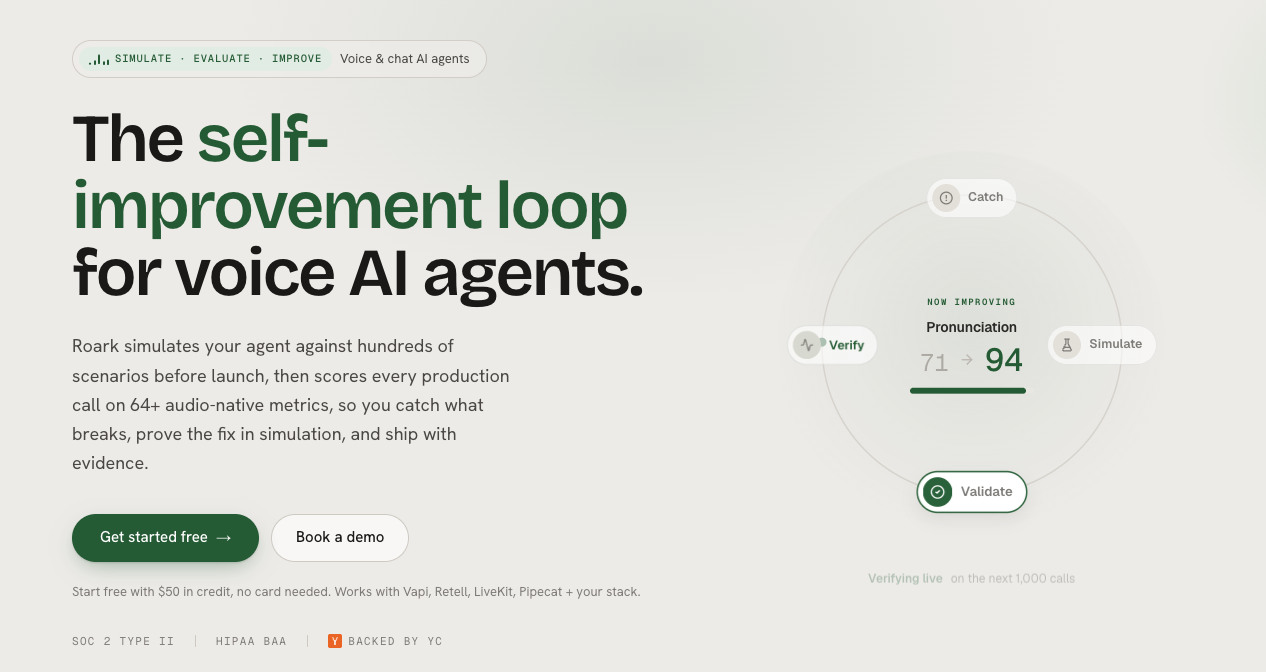
Roark scores every production call on audio-native metrics and turns the ones that go wrong into replayable tests. The platform now ships simulation templates alongside self-serve usage pricing.
Per Roark, simulation runs across 45 languages, with OTEL spans exposed per conversational turn.
Key features
- 64+ built-in metrics plus unlimited custom ones: pronunciation, empathy, resolution, and compliance scoring on live calls with no per-metric license.
- Production call replay: convert a live conversation into a regression test that preserves the original audio and caller timing.
- Human review and ground truth labeling: set the correct answer on real calls, then measure how closely each automated metric agrees.
- Issue tracker with clustering: failures are filed and grouped across deploys, so repeat offenders surface as one thread.
- Transparent provider pass-through: telephony and speech costs on Roark-placed calls bill at cost with no markup.
Pros
✅ SOC 2 Type II and a HIPAA BAA are available on every plan, including pay-as-you-go
✅ $50 of free credit with no card and no minimum
✅ No per-seat or per-metric licensing on any tier
✅ Live production calls bill as metric evaluation only, with no simulation fee attached
Cons
❌ Weaker fit pre-launch, since the replay loop needs real call traffic to be worth much
❌ Provider costs sit on top of the simulation rate, so the headline per-minute figure understates the all-in cost
❌ Concurrency beyond the included lines costs $100 per 10 lines per month
❌ SSO, RBAC, IP whitelisting, and a signed DPA require the $4,000 Enterprise commitment
Best for
- Voice teams with live traffic who want every call scored, down from the usual 1% sample
- Healthcare and finance deployments needing a BAA without an enterprise contract
- Engineers who want to test a platform properly before any spend commitment
Pricing
Pay-as-you-go starts at $0 with $50 free credit, billing $0.15 per simulation minute plus provider costs and $0.04 per metric per minute.
Team is $500 per month spent as usage at $0.10 per simulation minute. Enterprise starts at $4,000 per month committed.
4. Bluejay
Bluejay covers voice, chat, and IVR from a single QA layer, which matters when your agent estate spans all three. It generates scenarios automatically from agent and customer data, so nobody scripts conversation branches by hand.
Per Bluejay's own resource pages, the platform processes roughly 24 million voice and chat conversations a year across healthcare, financial services, food delivery, and enterprise technology customers.
Key features
- 500+ simulation variables: voices, accents, languages, environments, and behaviors combined automatically across generated scenarios.
- A/B testing and red teaming in one workflow: compare two agent versions and probe for adversarial handling from the same suite.
- Load testing up to 200 concurrent simulations: per Bluejay's pricing page, concurrency runs to 200 on the Scale plan, with higher limits quoted on Enterprise.
- CI/CD regression gates: run evaluations on every commit and hold the build when scores drop.
- Slack and PagerDuty alerting: route a regression to the engineer who pushed the change.
Pros
✅ Genuine multi-channel coverage across voice, chat, and legacy IVR
✅ Zero-setup scenario generation, with no manual branch scripting
✅ Load testing bundled into the platform, with no separate product to license
✅ Free entry point available without a sales conversation
Cons
❌ Simulation minutes are capped per tier at 1,500 on Growth and 4,000 on Scale, so a wide regression suite hits the ceiling before the concurrency limit does
❌ The volume claims are vendor-measured with no published methodology
❌ Multi-channel span means less depth on any single channel than a voice-only specialist
Best for
- Organizations running voice agents alongside chat and an existing IVR estate
- QA groups that want coverage fast without writing test scripts
- Multilingual or multi-market deployments needing accent and language spread
Pricing
Bluejay publishes four tiers. Pay-as-you-go is $0 per month plus usage with up to 25 concurrent simulations.
Growth is $500 per month with up to 100 concurrent simulations and up to 1,500 simulation minutes. Scale is $1,000 per month with up to 200 concurrent simulations and up to 4,000 simulation minutes.
5. Cyara
Cyara is the enterprise CX assurance incumbent, and it now tests agentic AI alongside the IVR estate it was built for. The platform states it covers more than 350 million customer journeys a year for its enterprise base, per its About page.
Its product line splits into separately licensed components. Botium handles conversational AI and NLP validation, Velocity covers journey and regression testing, Cruncher handles load, and Pulse 360 handles production monitoring.
Key features
- Voice Assure call path testing: originates real calls from servers in more than 80 countries to verify carrier-level routing and audio quality.
- Botium agentic testing: validates goal-driven AI behavior alongside deterministic call flows, with no scripting required.
- AI Trust module: probes for prompt injection, hallucination, and off-brand behavior as a named testing type.
- Cruncher load testing: simulates thousands of concurrent interactions across voice, chat, IVR, email, SMS, and web.
Pros
✅ Single toolchain covering legacy IVR and modern agentic AI
✅ Carrier-level call path verification that software-only platforms cannot replicate
✅ Established enterprise procurement track record and support model
✅ Components purchasable separately or bundled
Cons
❌ No published pricing, no self-serve trial, and no sandbox
❌ Every quote lands on a multi-year contract with professional services attached
❌ The evaluation model was designed around scripted expected outputs, which suits probabilistic agents less well
❌ Multiple separate products create licensing complexity a single-product vendor avoids
Best for
- Enterprise contact centers maintaining IVR while deploying agentic AI
- Regulated organizations with existing QA operations and procurement budgets
- Global deployments needing in-country call origination
Pricing
Cyara publishes no rates. Every plan is custom-quoted through sales, on a multi-year contract with professional services attached. A fuller breakdown of what Cyara actually charges for sits in our Cyara pricing teardown.
6. LangWatch Scenario
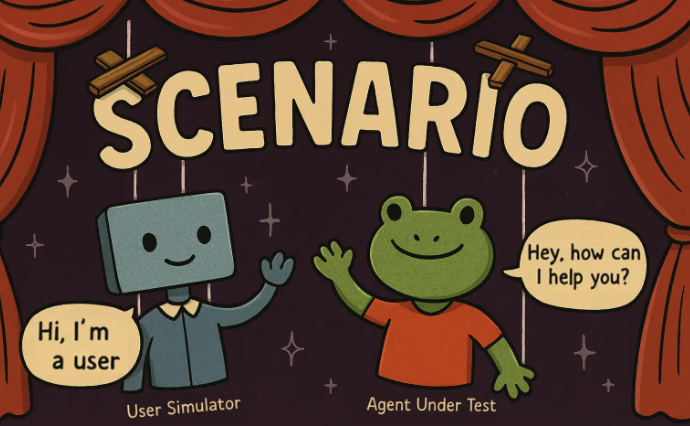
Scenario is an open-source agent testing framework that lives in your repository. It runs simulated conversations against your agent and scores them with LLM judges, all defined in code you own.
The repository carries an Apache-2.0 license and sits at 950+ stars with more than 75 forks, with commits landing as recently as 21 August 2026.
Key features
- Tests as code: scenarios live in Python alongside your agent, versioned and reviewed like any other test.
- Agentic simulation: a simulated user drives multi-turn conversations, so each run takes its own path.
- LLM judges with custom criteria: define pass conditions in natural language and score each run against them.
- Framework-agnostic: works against any agent you can call from code, with no provider lock-in.
- Self-hosted by default: no conversation data leaves your infrastructure unless you send it.
Pros
✅ No licensing cost and no per-minute metering
✅ Complete control over where transcripts and audio are stored
✅ Actively maintained, with commits landing the week of publication
✅ Test definitions review through your existing pull request process
Cons
❌ Telephony is limited to Twilio Media Streams, so there's no direct PSTN test call origination and DTMF coverage remains minimal
❌ You supply and pay for the model calls behind every simulation and judge
❌ Voice adapters ship for ElevenLabs, OpenAI Realtime, Pipecat, Gemini Live, and Twilio. Audio, interruption, and background-noise helpers exist, but the accent-and-persona simulation catalog is narrower than dedicated voice-only platforms.
❌ At fewer than 1,000 stars, the community is small, so expect fewer answers when you get stuck
Best for
- Engineering groups that want the test harness under version control
- Organizations with data residency constraints that rule out a hosted vendor
- Chat-first agents where audio realism matters less
Pricing
Free and open source under Apache-2.0. Your only cost is the model inference behind simulations and judging.
7. Vapi, Retell, and LiveKit native testing
Before you buy a QA platform, check what your voice stack already ships, because Vapi, Retell, and LiveKit may already cover your current stage. Vapi, Retell, and LiveKit all include some form of native testing at no additional platform cost.
Vapi's Test Suites carries a deprecation notice and will be replaced by Simulations, with a migration guide promised once the replacement lands.
Key features
- Vapi Test Suites: up to 50 test cases per suite with 1 to 5 attempts each, scored by an LLM against a rubric you write.
- Chat and voice test modes: chat runs faster and is text-only, while voice connects two agents on a real phone call.
- Vapi Simulations and Evals: the newer observability layer, with scenario-level mock tool responses and lifecycle hooks.
- Zero integration work: no webhook, no new vendor, no security review.
Pros
✅ No additional platform fee beyond the calling minutes you already pay for
✅ Nothing to integrate, so first test runs in minutes
✅ Rubric-based LLM scoring, which survives conversations that take a new path
✅ Enough coverage to validate happy paths during development
Cons
❌ Vapi Test Suites is deprecated, so building a suite on it now means migrating later
❌ Test calls cost the same as production calls, which gets expensive across a wide suite
❌ Scripted paths under-sample interruptions, noise, and off-script callers
❌ Locked to one platform, so a stack change means starting your test coverage again
Best for
- Pre-launch agents where scripted happy-path validation is genuinely enough
- Single-platform deployments with no plans to move
- Confirming a dedicated QA platform is worth the spend before you commit
Pricing
Included in platform usage, though test calls bill at standard call rates. Mechanics and the deprecation notice sit on Vapi's Test Suites documentation.
How to evaluate Hamming alternatives
Almost every platform here advertises simulation, monitoring, and red teaming, which is why a feature checklist ranks them badly. Five questions separate them in practice.
Can you price it without talking to sales?
A published rate card lets you model cost per regression run before committing engineering time to an integration. One of the seven platforms here publishes nothing, which pushes your evaluation into a sales cycle before you know whether the product suits you.
Ask for the per-simulation-minute rate, the overage multiplier, and whether monitoring meters separately from testing. A short heavy load test is exactly when included volume runs out.
Does it score audio or only transcripts?
A transcript hides pronunciation errors, endpointing mistakes, awkward pauses, and talk-over. An agent can pass every transcript assertion while sounding wrong to the caller.
Cekura, Roark, Coval, and Hamming all evaluate audio directly. Scenario works from text, a real constraint if voice quality drives your outcomes.
Does compliance come standard or cost an upgrade?
For a healthcare or finance deployment, a signed BAA is a gate. Roark and Coval both put SOC 2 Type II and a signed BAA on their entry tiers. Cekura lists HIPAA and GDPR from the free tier with a signed BAA from the $500 Startup plan. Hamming and Cyara place compliance at the enterprise level.
Ask which SOC 2 type a vendor holds. Type II covers an extended audit period, and a badge alone tells you nothing about which.
Does it run in CI, or only in a dashboard?
Voice regression testing earns its keep when it gates a merge automatically. That needs a real API, webhooks, and a documented CI path you can trigger from a pipeline.
Check for a CLI, an MCP server for coding agents, and a worked GitHub Actions example. Cekura documents an infrastructure test suite covering latency, stability, and failure handling that runs identically from a pipeline.
What does no testing platform fix?
Some problems live in the model layer, where no QA vendor patches them. Every pass rate a vendor shows you sits on top of the numbers below.
IHBench, a June 2026 benchmark covering 27 audio-language model configurations across 10 enterprise domains, measured what happens after a caller interrupts.
Every evaluated GPT-family audio model correctly resumed its utterance after a backchannel between 7% and 31% of the time. The Gemini 2.5 family reached 62% to 68%.
Self-correction runs worse still. In Full-Duplex-Bench v3, even GPT-Realtime handled fewer than 59% of self-correction scenarios successfully.
Your orchestration layer matters here too. Cekura's public voice orchestration benchmark runs the same 82 caller scenarios and evaluator suite across seven platform configurations, three times each. Six were submitted by the platforms themselves, and Cekura tested OpenAI's gpt-realtime directly.
Task completion lands at 97.56% for Vapi across 205 scored calls, against 95.12% for LiveKit across 246. Retell scores 5.00 out of 5 on interruption handling, where Vapi reaches 4.73.
A QA platform measures these differences, but closing them is a model and orchestration decision, which is why your choice of QA vendor matters less than whether you test at all.
Stop paying for QA you cannot price
The right Hamming alternative depends on which constraint is actually binding. Coval and Roark win on transparency, publishing rates you can budget against with compliance from the first tier.
Bluejay and Cyara win on span, covering channel estates that voice-only platforms leave uncovered. Scenario wins when code ownership outweighs audio realism.
None of these choices touches the underlying problem. A prompt edit can alter behavior across hundreds of call paths, and reviewing 1% of production calls will never surface it.
Cekura runs that layer across the full lifecycle. Pre-production simulation covers workflow, multilingual, accent, DTMF, and tool-call testing.
Infrastructure testing exercises latency, interruptions, background noise, and voice activity detection. Production monitoring scores live calls on custom metrics and feeds regressions back into the next test run.
Setup runs on Retell, VAPI, ElevenLabs, LiveKit, Pipecat, Bland, and more without rebuilding your stack, alongside a CLI, MCP server, and documented GitHub Actions path.
Cekura supports SOC 2, HIPAA, and GDPR compliance, covering transcript redaction, role-based access, and audit trails, with the current posture published at the trust center.
Pricing starts at $0.25 per voice testing minute with 300 free credits and no card. You can see a full breakdown on the pricing page.
Ready to see it against your own agent? Book a demo and watch a live simulation run interruptions, accents, and tool-call checks on your production configuration.
Frequently asked questions
What is the best Hamming alternative?
The best Hamming alternative is Cekura for teams wanting pre-production simulation and production monitoring on one published meter, starting at $0.25 per voice testing minute with HIPAA and GDPR coverage on the entry plan.
Roark is the stronger pick if your agent already handles live traffic and you want every production call scored on audio, down from the usual 1% sample.
Does Hamming publish its pricing?
No, Hamming does not publish pricing. All three tiers on its pricing page are listed as "Contact us," and every call-to-action routes to a scheduled sales call. Cekura, Coval, Roark, and Bluejay all publish per-tier rates you can review without contacting anyone.
What is the difference between Hamming and Coval?
The main difference between Hamming and Coval is pricing transparency. Coval publishes tier rates from $100 per month with SOC 2 Type II, HIPAA, and GDPR on the entry tier. Hamming quotes every tier through sales and places compliance at the Enterprise level.
Can I test voice agents without buying a QA platform?
Yes, you can test voice agents using native tooling from Vapi, Retell, and LiveKit at no additional platform cost. Those tools validate scripted happy paths well. They under-sample interruptions, background noise, and off-script callers, which is where production problems concentrate.
Is there an open-source Hamming alternative?
Yes, LangWatch Scenario is an open-source agent testing framework under Apache-2.0 that runs simulated conversations and scores them with LLM judges. It has no telephony layer, so PSTN behavior, DTMF, and audio conditions need separate coverage.
How much does voice agent testing cost?
Voice agent testing costs between $0 and $4,500 per month at the entry point, depending on vendor and volume. Per-minute simulation rates run from $0.10 to $0.40 across platforms that publish them, with monitoring typically metered separately from testing.