
Genesys Cloud CX, Five9, and Talkdesk are the strongest full-platform swaps for NICE CXone in 2026, while Verint and Calabrio cover the workforce and quality layer some organizations run alongside a lighter CCaaS platform instead of replacing CXone outright.
We built this comparison from vendor pricing pages, G2 and TrustRadius reviews, and the platforms that recur across Gartner Peer Insights and independent alternatives roundups, cross-checking every price and feature claim against a primary source rather than a single vendor's marketing page.
By the end, you'll know which NICE CXone alternative fits your situation, what each one actually costs today, and what to test on your new platform before real callers find the gaps.
9 Best NICE CXone Alternatives: TL;DR
- Genesys Cloud CX: Best for large enterprises that need deep journey orchestration and are willing to pay for it.
- Five9: Best for high-volume outbound and predictive dialing at enterprise scale.
- Talkdesk: Best for regulated industries that need compliance-ready, vertical-specific workflows.
- Amazon Connect: Best for AWS-native engineering organizations that want usage-based pricing over per-seat licenses.
- Dialpad Support: Best for mid-market organizations that want AI features included rather than sold as add-ons.
- RingCentral RingCX: Best for organizations that want CCaaS and UCaaS bundled under one provider.
- CloudTalk: Best for sales-driven voice organizations that don't need a full omnichannel suite.
- Verint: Best for enterprises that want workforce engagement management as a standalone layer, not a full CCaaS swap.
- Nextiva: Best for consumer-facing organizations that answer social messages and public reviews in the same queue as calls.
Why Look for NICE CXone Alternatives?
NICE CXone deserves its market position. It covers more than 30 digital channels, ships AI tools like virtual assistants and interaction summaries, and gives administrators deep control over routing, scripting, and reporting.
For large, complex contact centers, that depth is a real asset, not just a marketing claim.
- Pricing climbs fast once you need more than basic routing: CXone's published tiers run from $110 per agent per month for the Omnichannel Suite to $249 for the Ultimate Suite. The Ultimate tier also charges $0.25 per session on top of the seat price.
- Native unified communications isn't included: CXone is built as a CCaaS platform first. Organizations that also want video meetings and internal team messaging typically need NICE's 1CX add-on or a separate UCaaS vendor.
Regional pricing comes up in reviews too. On G2, a mid-market healthcare reviewer gave CXone 1 out of 5 in September 2024 and cited a "costing structure not conducive for Asian countries”.
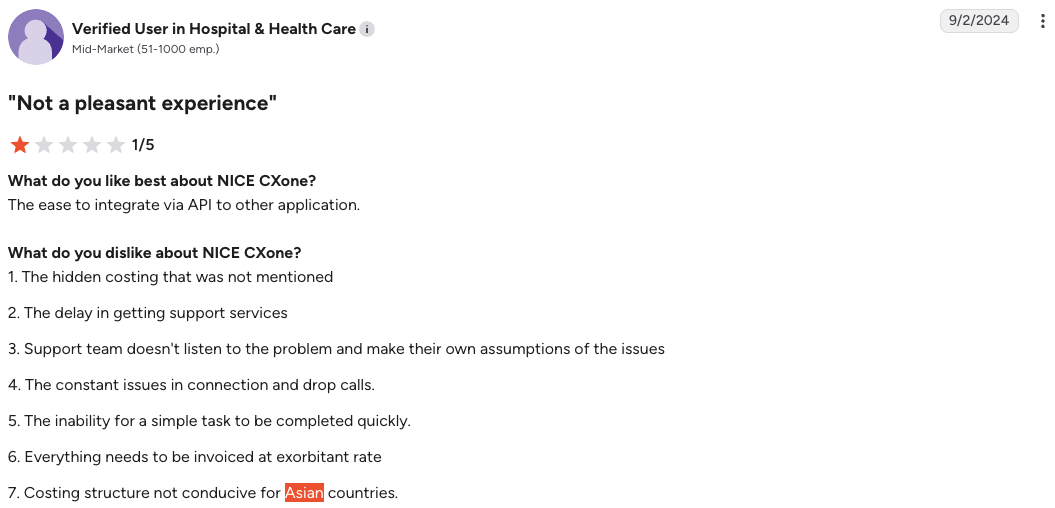
If you serve callers in more than one country, ask NICE in writing how licensing, number provisioning, and calling rates apply in each region before you sign.
Which NICE CXone Alternative Should You Choose?
Choose Genesys Cloud CX if you're a large enterprise running multi-channel customer journeys and have the engineering capacity to configure it. It's not the fastest to implement, so smaller organizations often find it overbuilt.
Choose Five9 if outbound volume and predictive dialing drive your contact center. It requires a 50-seat minimum on published pricing, so it isn't built for small operations.
Choose Talkdesk if you operate in healthcare, banking, insurance, or another regulated industry. Its Autopilot and Copilot AI features aren't included in any published plan and are priced through sales, so factor that into your total cost.
Choose Amazon Connect if your organization already runs on AWS and has engineering resources to build rather than configure. Usage-based billing means predicting monthly spend takes real volume forecasting.
Choose Dialpad Support if you want AI transcription, sentiment analysis, and coaching included natively rather than priced as separate modules. It's lighter on deep omnichannel orchestration than the enterprise platforms above it.
Choose RingCentral RingCX if you want contact center and unified communications from the same vendor. RingCX requires a RingEX subscription, which adds a layer to the pricing you'll need to confirm with sales.
Choose CloudTalk if you run a sales-driven voice operation and don't need 30 digital channels or workforce engagement management. It's a tighter, less expensive product than a full CCaaS suite.
Choose Verint if you need enterprise-grade workforce engagement management and plan to run it alongside a separate CCaaS platform rather than replacing your contact center outright.
Choose Nextiva if your agents answer Facebook messages, WhatsApp threads, and Google reviews alongside phone calls. Those channels sit in the Premium tier, so the published $75 entry price covers voice and web chat only.
Stick with NICE CXone if you've already built deep customizations and integrations, your team is fully trained on the platform, and migration costs would outweigh what you'd save switching. CXone's omnichannel range and AI feature set are genuinely still competitive at the enterprise tier.
9 Best NICE CXone Alternatives: At a Glance
Here’s how the nine alternatives compare at a glance:
| 🏆 Platform | 🎯 Best For | 💰 Starting Price |
|---|---|---|
| Genesys Cloud CX | Enterprise journey orchestration | $75/user/mo |
| Five9 | High-volume outbound and predictive dialing | $119/user/mo |
| Talkdesk | Regulated industries | $85/user/mo |
| Amazon Connect | AWS-native, usage-based pricing | $0.038/voice min |
| Dialpad Support | AI features included, no add-ons | $80/user/mo |
| RingCentral RingCX | Combined CCaaS + UCaaS | $65/user/mo* |
| CloudTalk | Sales-driven voice organizations | $25/user/mo |
| Verint | Standalone workforce engagement | Custom |
| Nextiva | Social and review channels in the agent queue | $75/agent/mo |
*RingCX Standard requires an active RingEX subscription. Pricing verified against vendor and third-party pricing pages as of September 2026. Verify current rates directly with each vendor before you commit.
The 9 Best NICE CXone Alternatives
1. Genesys Cloud CX
Genesys Cloud CX replaces CXone's omnichannel routing and analytics with what's arguably the most mature journey-orchestration engine in enterprise CCaaS.
It routes voice, email, chat, SMS, and social into a single agent workspace, with predictive engagement that acts on customer behavior on your website before an agent gets involved.
Key features:
- Predictive engagement that triggers chat or assistance based on visitor behavior
- Real-time supervisor dashboards with deep interaction analytics
- AI-powered speech and text analytics, agent assist, and predictive routing
Pros
✅ Among the most mature customer journey orchestration tools on the market
✅ Deep AI and sentiment analysis across voice and digital channels
✅ Highly configurable for large, complex operations
Cons
❌ Pricing rises steeply once you add workforce engagement and AI tiers
❌ Implementation is rarely fast at this scale
❌ Overbuilt for smaller organizations without dedicated CX engineering capacity
Best for: Large enterprises with complex, global customer service operations that need sophisticated journey mapping and have the resources to configure it.
Pricing: Genesys Cloud CX runs four tiers billed annually: CX 1 at $75/user/month (voice only), CX 2 at $115/user/month (adds digital channels, QA, and compliance), CX 3 at $155/user/month (adds workforce engagement), and CX 4 at $240/user/month (adds bonus AI tokens and journey management).
2. Five9
Five9 goes head-to-head with NICE CXone at the enterprise tier, but it leans harder into outbound.
Its machine-learning predictive dialer and sentiment analysis are built for high-volume sales and collections operations where connect rate is the metric that matters most.
Key features:
- AI-powered IVR and natural language processing for self-service
- Machine-learning predictive dialer optimized for agent connect rates
- Interaction analytics and sentiment analysis across voice and digital channels
Pros
✅ Few competitors match its predictive dialer maturity at scale
✅ Deep AI and analytics for large operations
✅ Workforce engagement tools built specifically for enterprise contact centers
Cons
❌ Long implementation cycles and a steep learning curve
❌ 50-seat minimum on published pricing
❌ Overkill for most small and mid-market support organizations
Best for: Large enterprises and high-volume contact centers that need advanced automation and predictive dialing, with the technical resources to run it.
Pricing: Digital-only starts at $119/seat/month; Core with essential AI is $159/seat/month; Plus, Pro, and Enterprise tiers require a custom quote. Published pricing assumes concurrent users with a 50-seat minimum, and usage-based charges may apply.
3. Talkdesk
Talkdesk replaces CXone's compliance and vertical-workflow depth with dedicated Industry Experience Clouds for financial services, insurance, healthcare, retail, travel and hospitality, and government.
Instead of a generic CCaaS build, you get pre-configured compliance settings and integrations shaped for how regulated organizations actually operate.
Key features:
- CXA platform with Autopilot (autonomous AI agent) and Copilot (real-time agent assist)
- AppConnect marketplace with 80+ third-party apps, integrations, services, and devices
- 30+ security certifications, including SOC 2, ISO 27001, HIPAA, and PCI DSS Level 1
Pros
✅ Vertical-specific compliance and workflow templates built for regulated industries
✅ Cleaner, more modern interface than most enterprise CCaaS platforms
✅ Strong AI capabilities once configured with the necessary add-ons
Cons
❌ Autopilot and Copilot aren't included in any published plan
❌ Talkdesk Phone is listed as an add-on on the plan comparison page
Best for: Mid-market and enterprise organizations in regulated industries that need compliance-ready workflows out of the box.
Pricing: Digital Essentials starts at $85/user/month, Voice Essentials at $105/user/month, Elite at $165/user/month, and Industry Experience Clouds at $225/user/month for financial services, insurance, healthcare, retail, travel and hospitality, and government
4. Amazon Connect
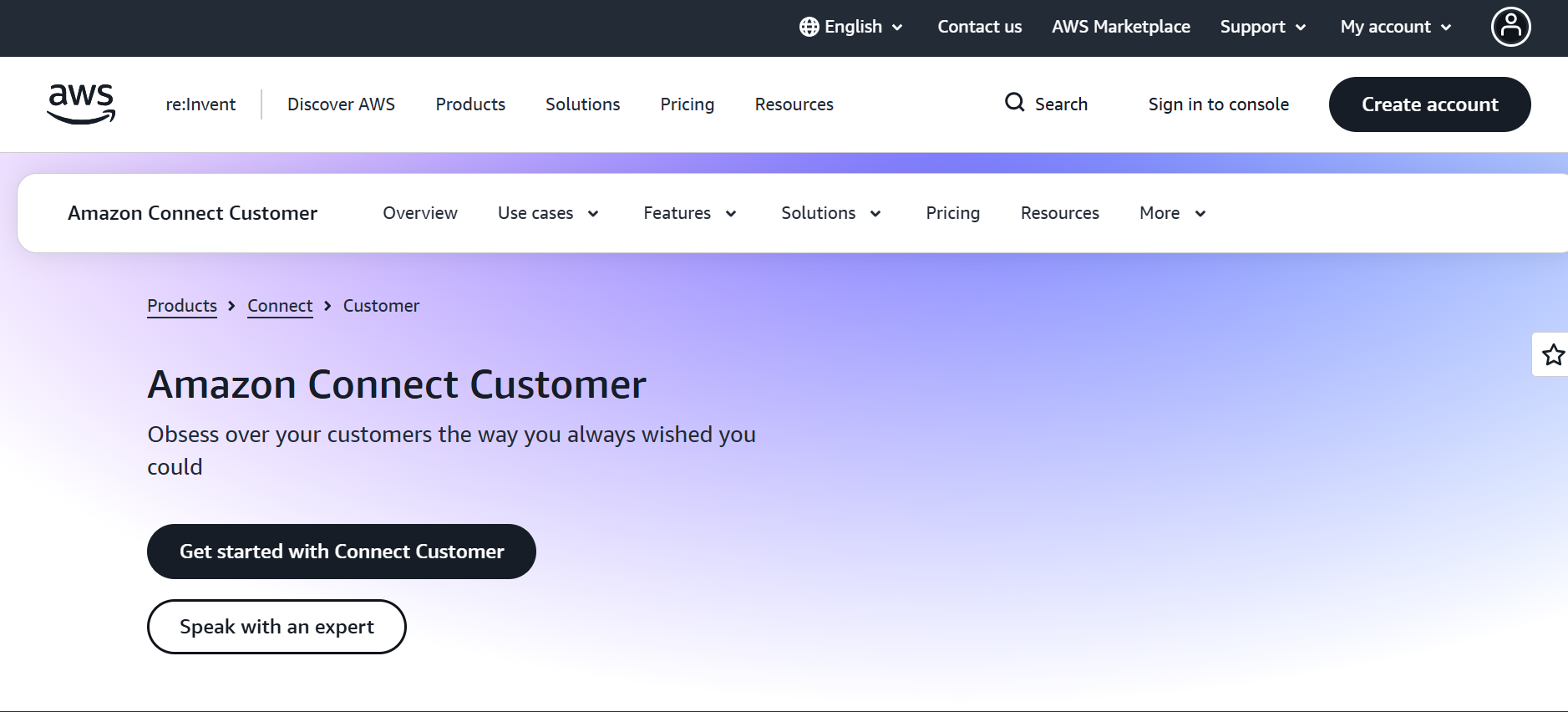
Amazon Connect replaces CXone's per-seat licensing model entirely. It's a usage-based contact center built and run by AWS, billed per minute of voice, per chat message, per email, and per task, with no seat licenses or long-term contracts required.
Key features:
- Pay-as-you-go billing with no seat licenses or minimum contracts
- Agent assist, agentic self-service, and post-contact summaries included in the per-channel usage rates
- Native integration with Lambda, Lex, S3, and Bedrock for custom AI workflows
Pros
✅ No seat licenses or long contracts, which suits variable or seasonal volume
✅ Strong fit for engineering-led organizations already invested in AWS
✅ AI capabilities included in the per-channel usage rates rather than sold separately
Cons
❌ Predicting monthly spend requires accurate volume forecasts across several billing categories
❌ Steeper learning curve for organizations without AWS familiarity
❌ Telephony, phone numbers, and outbound campaigns are billed separately
Best for: AWS-native organizations with engineering capacity that want a builder-led contact center and usage-based pricing over per-seat licenses.
Pricing: Voice runs $0.038/minute, chat $0.010/message, email $0.080/email, and SMS $0.014/message, plus applicable telephony charges. Customers not ready for AI can use the legacy Customer Basic pricing, which has lower base channel rates with features priced separately.
5. Dialpad Support
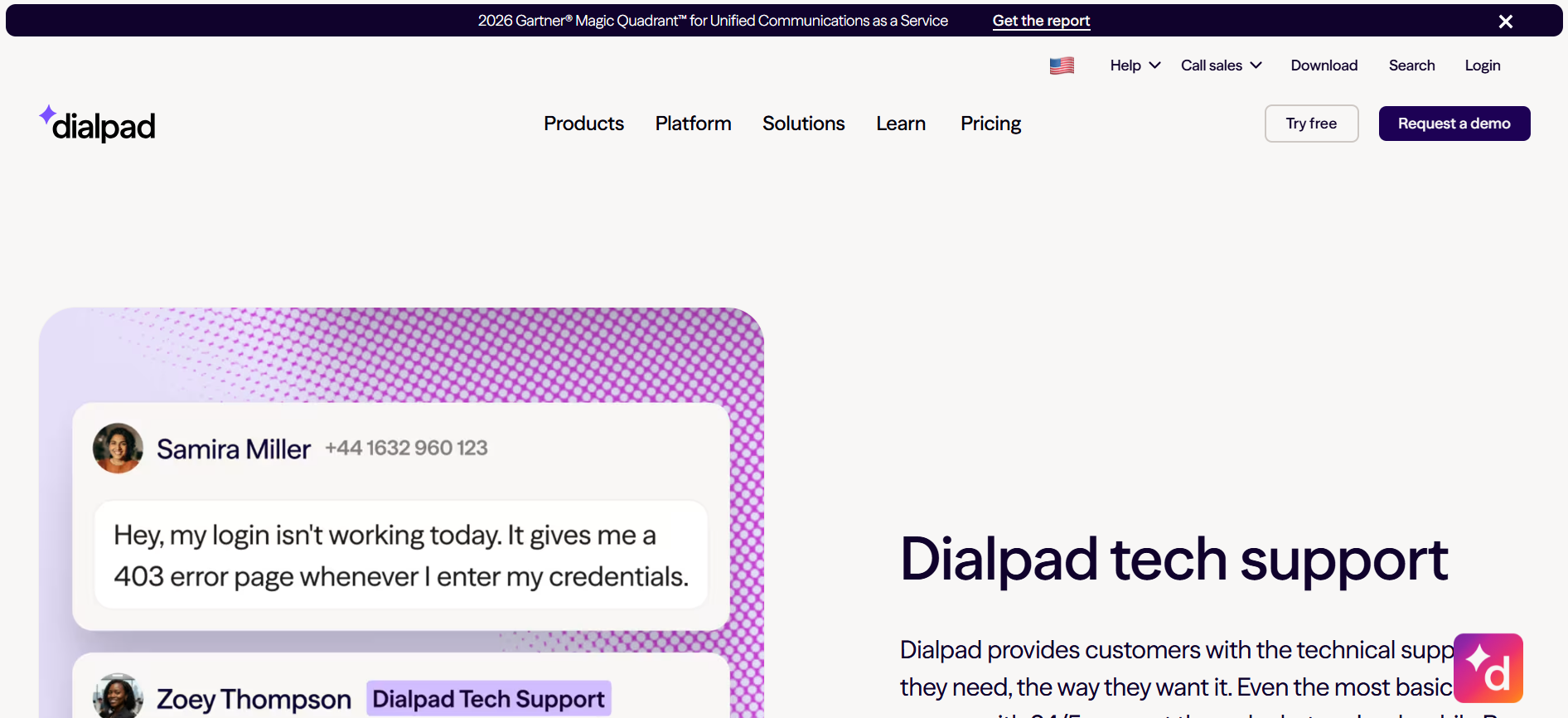
Dialpad Support replaces CXone's AI add-on model with AI built into every plan by default. Call transcription ships on every plan, and a digital virtual agent is included from the Advanced plan, which changes the total cost math for mid-market buyers.
Key features:
- AI call transcription on every plan
- Automatic call distribution and interactive voice response
- A digital channel and a digital virtual agent included from the Advanced plan, with the virtual agent an optional add-on on Essentials
Pros
✅ AI features are included rather than priced as separate add-ons
✅ Simpler tier structure than most enterprise CCaaS platforms
✅ Fast to deploy for mid-market support organizations
Cons
❌ Less omnichannel depth than Genesys or NICE CXone
❌ Workforce engagement management is thinner than dedicated WFM platforms
❌ Advanced digital channel features are gated to the higher tier
Best for: Mid-market support organizations that want AI capabilities included in the base price rather than layered on as upsells.
Pricing: Essentials starts at $80/user/month, Advanced at $115/user/month, and Premium at $150/user/month, all per user per month billed annually.
6. RingCentral RingCX
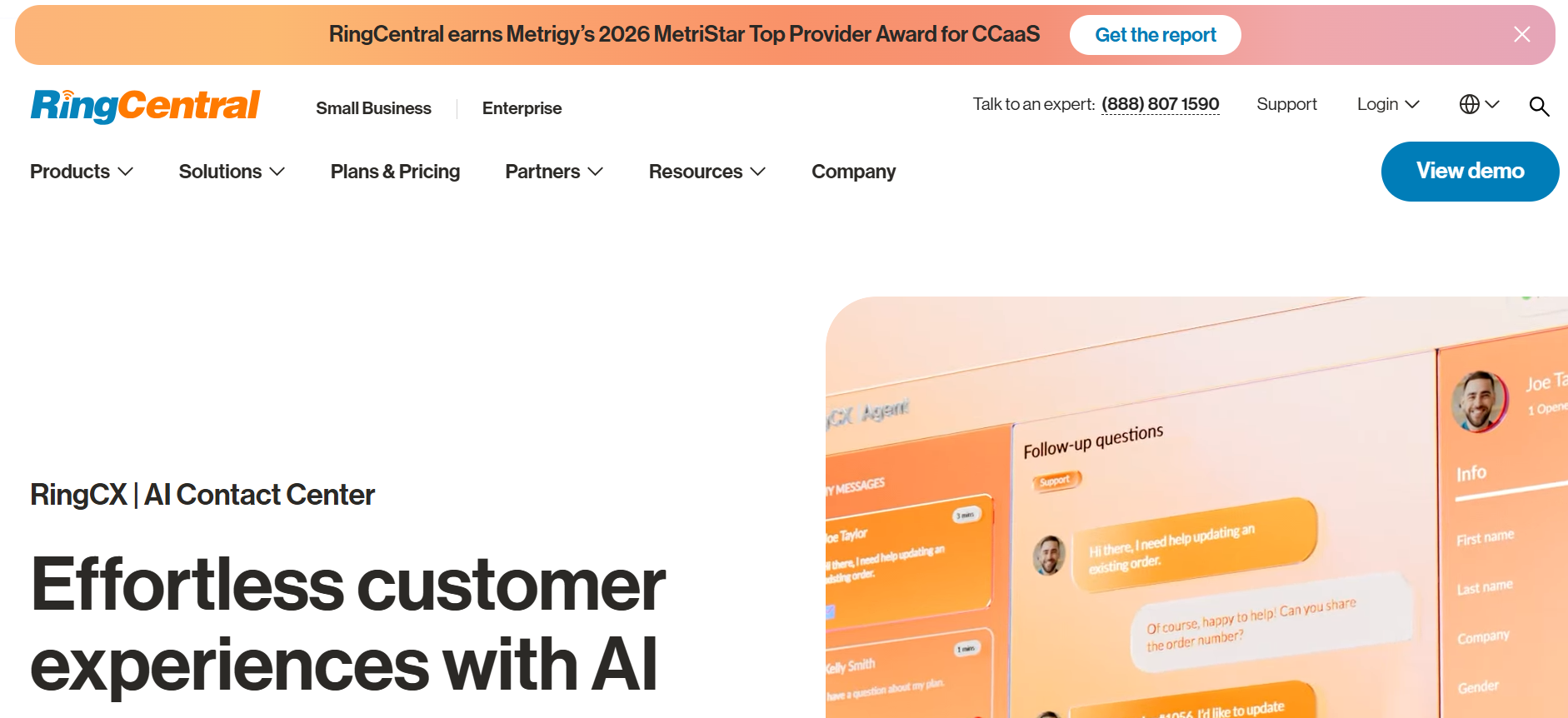
RingCentral replaces CXone's CCaaS-only scope with contact center and unified communications from a single provider.
RingCX handles voice and more than 20 digital channels, while a connected RingEX subscription adds business calling, video meetings, and team messaging.
Key features:
- Omnichannel routing across voice and 20+ digital channels in a shared workspace
- AI Interaction Analytics on the Elite plan or as a $25/user add-on
- Predictive, progressive, and preview dialing modes for outbound campaigns
Pros
✅ Combines CCaaS and UCaaS under one provider and one administration layer
✅ AI-assisted features can save time for your teams
✅ Established communications infrastructure for multi-location organizations
Cons
❌ RingCX requires an active RingEX subscription, which adds to the total cost
❌ Confirm with RingCentral whether every agent needs a separate RingEX license
❌ Less omnichannel channel depth than Genesys or NICE CXone at the entry tier
Best for: Mid-sized and enterprise organizations that want unified communications and contact center capabilities from a connected product environment.
Pricing: RingCX Standard starts at $65/user/month when billed annually and requires a RingEX subscription; Professional runs $95/user/month; Elite runs $145/user/month; Enterprise Contact Center requires a custom quote.
7. CloudTalk
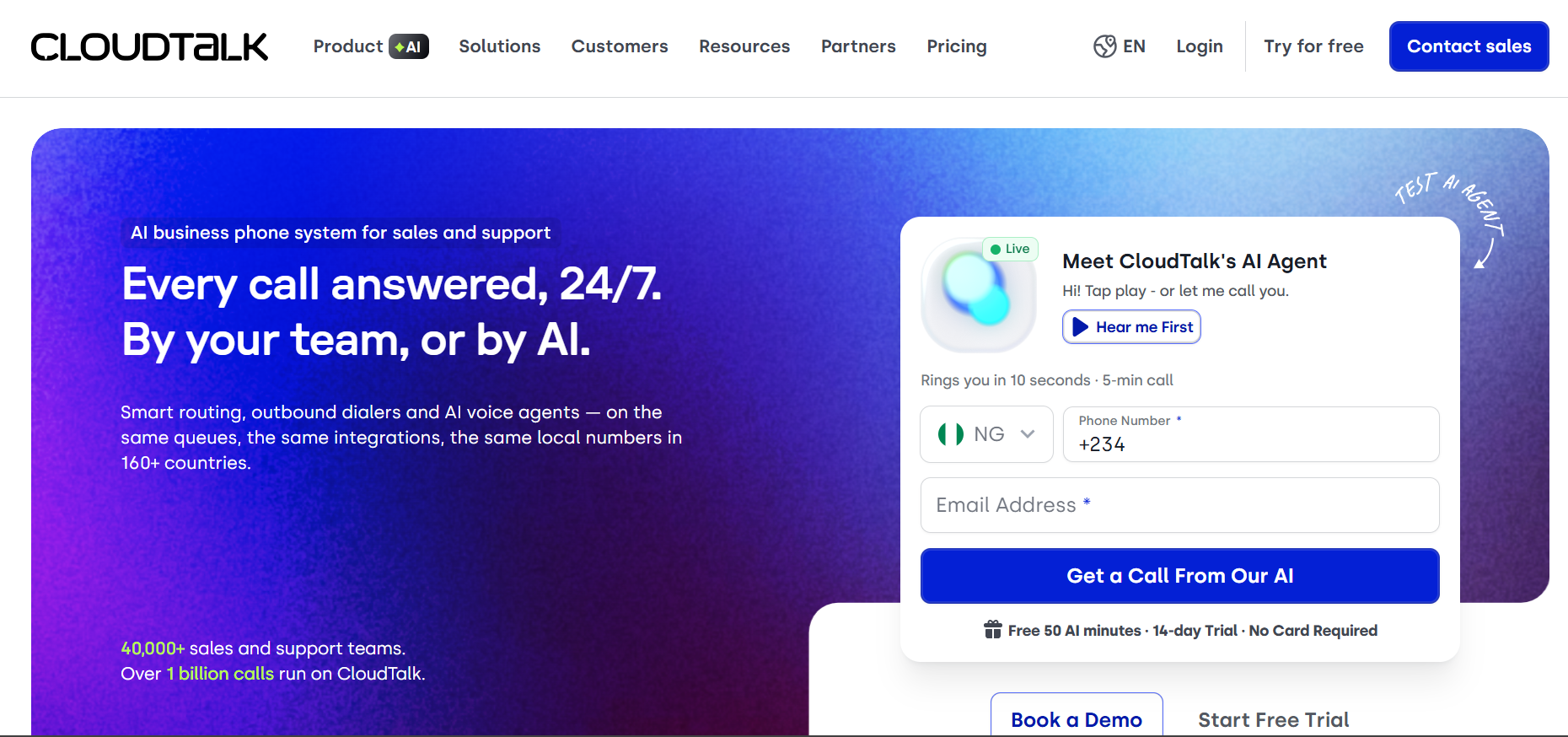
CloudTalk replaces CXone's omnichannel range with a tighter, voice-first product built for sales and support organizations that don't need 30 digital channels.
It focuses on outbound dialing, customizable routing, and international number coverage across 160+ countries.
Key features:
- Smart dialer and power dialer for outbound call throughput
- CRM integrations with Pipedrive, Zendesk, and HubSpot from the Essential plan, with Salesforce on Expert
- Live call monitoring and supervisor coaching tools
Pros
✅ Clean interface and faster setup than enterprise CCaaS platforms
✅ Strong CRM integration depth for sales workflows
✅ One of the broader international number footprints at this price point
Cons
❌ Doesn't compete on conversational AI depth or workforce engagement management
❌ Live phone support is gated behind higher tiers
❌ Not built for organizations with regulated, complex compliance needs
Best for: Sales-driven and customer support organizations that prioritize voice quality and outbound efficiency over deep omnichannel or AI capabilities.
Pricing: Starter runs $25/user/month, Essential $29/user/month, and Expert $49/user/month, all billed annually.
8. Verint
Verint replaces one specific slice of CXone rather than the whole platform: workforce engagement management.
Verint now includes Calabrio. Thoma Bravo completed its acquisition of Verint in November 2025 and combined it with Calabrio, so Calabrio ONE is sold as part of the Verint CX Automation Platform.
It's built for organizations that want enterprise-grade forecasting, scheduling, and adherence tracking as a standalone layer they can run on top of whatever CCaaS platform they choose.
Key features:
- AI-powered forecasting for complex, omnichannel staffing needs
- Flexible, self-serve scheduling that lets employees manage their own changes
- Real-time intraday data insights for workload balancing
Pros
✅ Deep, enterprise-grade forecasting and scheduling built specifically for workforce management
✅ Scales from SMB to global enterprise deployments
✅ Deployable on-premises, single- or multi-tenant cloud, or hybrid
Cons
❌ Pricing isn't published; it requires a direct sales conversation
❌ It's a workforce engagement layer, not a full contact center replacement
❌ Organizations still need a separate CCaaS platform underneath it
Best for: Enterprises that want workforce engagement management as a dedicated, standalone layer rather than a bundled CCaaS feature.
Pricing: Verint uses custom, quote-based pricing. See Verint's Workforce Engagement page to request a quote.
9. Nextiva
Nextiva runs public channels through the same agent queue as phone calls. Its Premium tier handles Facebook, Instagram, X, and WhatsApp messages alongside Google, Yelp, and TripAdvisor reviews, a capability that traces back to Nextiva's 2023 Simplify360 acquisition.
The contact center engine came from Thrio, which Nextiva acquired in 2024. That lineage shows up in the outbound tooling, where progressive, predictive, and Quarterback dialing modes start at the Professional tier.
Video meetings and team messaging live in Nextiva's business phone plans, so a contact center seat covers voice and digital channels only.
Key features:
- Progressive, predictive, and Quarterback dialing modes from the Professional tier
- Social and review management across Facebook, Instagram, X, WhatsApp, Google, Yelp, and TripAdvisor at Premium
- Workforce management with AI forecasting, shift swapping, and synchronized voice and screen recording
Pros
✅ Voice calling is included in all three contact center tiers
✅ Social messages and public reviews route into the same queue as calls
✅ SOC 2 attestation, ISO/IEC 27001, PCI-DSS, and HIPAA plans with signed BAAs
Cons
❌ Only the Essential tier carries a public price, so Professional and Premium need a sales conversation
❌ AI transcription and summarization is metered as usage at every tier
❌ Essential covers voice and web chat, caps smart call routing at five agents, and leaves out full API access
Best for: Consumer-facing organizations that answer social messages and public reviews in the same queue as phone calls.
Pricing: Contact Center Essential starts at $75/agent/month, and Professional and Premium are quote-based. Workforce management is an add-on at Professional and included at Premium. XBert AI, Nextiva's agentic AI product, runs $99/month for 100 interactions, then $0.99 per interaction.
How to Evaluate NICE CXone Alternatives
Knowing what to check before you sign saves more time than reading another feature list. These are the questions that actually separate a good fit from a costly mistake.
How predictable is the pricing at your actual volume? Per-seat, usage-based, and custom-quote models produce very different cost curves. Model your total cost at 12 and 24 months, including telephony, AI usage, and support-tier fees.
Are you replacing the whole platform or one layer of it? Full CCaaS platforms like Genesys and Five9 replace CXone outright. Verint and Calabrio, meanwhile, replace only the workforce and quality layer, which is the right call if your core routing and omnichannel setup already works.
How deep are the compliance requirements? If you operate in healthcare, finance, or another regulated industry, confirm HIPAA, PCI-DSS, SOC 2, or GDPR alignment in writing before signing anything.
Does the platform have native UCaaS, or will you need a second vendor? CXone lists UCaaS as a paid add-on, NICE 1CX, so confirm whether your next platform bundles it or whether you're fine managing two systems.
What happens to the voice and IVR flows you rebuild during migration? Whichever platform you land on, you'll likely rebuild IVR trees, routing logic, and any AI voice agents layered on top.
Are You Migrating a Voice or Chat Flow Off NICE CXone?
Four of the nine ship a way to test a flow, and so does CXone. CXone Studio and NICE CXone alternatives like Genesys Architect each dial a real number you answer yourself, one call at a time.
Amazon Connect goes furthest. Its Connect Customer Testing and Simulation runs assertion-based test cases, five at a time, feeding utterances in as text and DTMF as tones.
Talkdesk's Automation Designer Simulator works over web chat, and its newer AI Agent Platform Simulator adds a voice mode. Dialpad documents Proving Ground as a pre-production environment for AI agents.
None of them claims to simulate background noise, interruptions, accents, or adversarial callers.
That matters most right when you switch, because a newly configured flow is exactly where interruptions, mumbled inputs, and edge-case callers surface problems nobody caught in a demo.
The stakes are higher with multi-turn conversations than most organizations assume.
In the τ-Voice benchmark from March 2026, voice agents completed 31% to 51% of 278 grounded customer-service tasks in clean audio. With realistic noise and diverse accents, that fell to 26% to 38%.
A text reasoning model scored 85% on the same tasks. Your tests need to mirror real, messy calls, with interruptions, corrections, and callers who wander off script.
Cekura Bench ran eight voice agent configurations, including Retell, LiveKit, ElevenLabs, and Vapi, through the same 82 caller scenarios three times each. That's 1,968 retained calls, with dropped connections kept in the results.
Providers chose their own models, speech components, and settings. Task completion, scored on calls with outcome evidence, ranged from 87.80% to 97.56%. Repeatable reliability ran much lower.
The top-ranked configuration passed all three runs on 62 of 82 scenarios (75.61%), and the lowest passed on 30.49%.
Some errors only surface in the tool layer. In one benchmark call, the transcript captured the caller's phone number correctly, but the agent sent a different number to the tool. A manual test call that sounds fine would pass that flow.
This is where Cekura fits. Cekura tests any of these platforms over the phone by calling the number that routes to your flow, so the same scenarios can run on your old and new platform.
Cekura is an automated QA platform for voice and chat AI agents, built to catch the failures a manual test call or a quick demo won't surface.
Here's what to test at each stage of a migration.
- Pre-production: Cekura runs scenario simulations across your core workflows (appointment booking, refunds, order status), plus IVR-specific testing including DTMF input handling, before any of it reaches a real caller.
- Infrastructure: Cekura simulates callers who interrupt or call from noisy rooms, and scores latency and interruptions on every call, since these are exactly the conditions that expose gaps in a freshly migrated voice flow.
- Observability: Monitor production calls for drop-off points and negative sentiment, and run regression tests after every prompt or routing change so a fix on one flow doesn't silently damage another.
Cekura integrates natively with Genesys Cloud, pulling the Genesys transcript, wrap-up codes, and summary into each test result, and with voice AI stacks including Retell, Vapi, ElevenLabs, LiveKit, and Pipecat.
Cekura adds a testing and monitoring layer on top of the stack you already have, so there’s no rebuild required.
Cekura is also SOC 2-, HIPAA-, and GDPR-compliant for transcript redaction, role-based access, and audit trails.
Compare a broader set of conversational analytics platforms if analytics drives your CCaaS decision. For the cutover itself, our guide to contact center cloud migration covers cutover patterns, number porting rules, and go/no-go criteria.
The testing question doesn't change, and whatever you build or migrate to still needs validation before real callers find the issues first.
Most issues only show up when real people are on the line. Book a demo to see how you can catch them before your users do.
Frequently Asked Questions
How much does NICE CXone cost?
NICE CXone costs between $110 and $249 per agent per month across five core suites, from the Omnichannel Suite at $110 to the Ultimate Suite at $249, which also charges $0.25 per session.
What are the top contact center solutions?
The top contact center solutions in 2026 include NICE CXone, Genesys Cloud CX, Five9, Talkdesk, Amazon Connect, and RingCentral RingCX, each covering the same core omnichannel and AI capabilities with different trade-offs on pricing, implementation complexity, and vertical fit.
Which companies use NICE CXone?
Named customers include Tripadvisor, Carnival UK, Fulton Bank, Vera Bradley, PayPal, and Dutch Railways, spanning travel and hospitality, banking, retail, fintech, and public transport.
Is CXone part of NICE?
Yes, CXone is NICE Ltd.'s cloud contact center platform. NICE acquired inContact for $940 million in 2016, launched CXone with it in 2017, and renamed it NICE CXone in 2021. It later expanded into the CXone Mpower product line with agentic AI built in.