
For this ElevenLabs vs Cartesia test, we ran both vendors' models on the same 104 phone-agent sentences. The fastest on streamed text was ElevenLabs v4 Turbo at 69 ms, against 270 ms for Cartesia Sonic 3.6.
Cartesia’s case rests on on-prem deployment for Sonic 3.6 and lower cost at high volume, with per-character rates within $3 per 1M characters of v4 Turbo. Every measured figure here comes from Cekura's TTS benchmark, and every price from the vendors' own pages.
Below are the latency, reading-accuracy, deployment, and cost results, and which vendor fits a cloud agent versus a self-hosted one.
ElevenLabs vs Cartesia: What's the Difference?
ElevenLabs is a voice AI company whose API sells several TTS models, including the expressive Eleven v4 and the low-latency v4 Turbo and Flash v2.5. v4 and v4 Turbo cover 90+ languages.
Cartesia is a voice AI company centered on one TTS line, Sonic, whose current release (Sonic 3.6) covers 44 languages and can run inside your own data center.
Choose ElevenLabs if: your agent runs in the cloud and you want the faster start on streamed text, plus 90+ languages and one account for narration and dubbing.
Choose Cartesia if: compliance or data residency puts TTS inside your own data center or VPC, or you want a model version frozen for regression tests.
Meet ElevenLabs: Features and Highlights
ElevenLabs sells TTS, speech-to-text (Scribe), dubbing, music, and an agents platform from one account. This comparison sticks to the TTS lineup, and four models are current (the benchmark lists the first 2 as ElevenLabs v4 and v4 Turbo):
-
Eleven v4: The flagship, with 90+ languages and up to 10,000 characters per request, aimed at character voiceovers, audiobooks, and emotional dialogue.
-
Eleven v4 Turbo: v4's low-latency counterpart, with a median latency ElevenLabs quotes at about 100 ms, excluding application and network time.
-
Flash v2.5: The low-latency model for long requests, with 32 languages and 40,000 characters per request. It costs the same per character as v4 Turbo.
-
Eleven v3 Conversational: The previous-generation model, tuned for live conversation, in 70+ languages. ElevenLabs' model docs quote about 165 ms, while its pricing page says about 280 ms, and neither page explains the difference.
v3 Conversational isn't in Cekura's benchmark, but the benchmark comparison covers the other 3.
Flash v2.5 ships with text normalization off by default, and ElevenLabs' own docs warn it can misread numbers, dates, and currencies. The apply_text_normalization switch for v2.5 is Enterprise-only, and the accuracy results below show what that costs.
ElevenLabs' agents platform runs on these same TTS models. On the agent-performance run of Cekura's voice platforms benchmark, it recorded the fastest reply (1.27 s) and the top voice tone and clarity score (4.47 out of 5) among the platforms tested.
Meet Cartesia: Features and Highlights
Cartesia builds streaming speech models for voice agents. Sonic handles TTS, Ink handles speech-to-text, and Managed Agents is an end-to-end agent platform with telephony. Sonic 3.6 is the current generally available model, with Odia and Urdu new in this release.
The following details affect a production rollout of Sonic 3.6:
-
Dated snapshots: sonic-3.6 tracks the latest build, while sonic-3.6-2026-08-27 stays frozen, per Cartesia's docs. Cartesia recommends the dated ID when you need consistent behavior in production or for internal evals.
-
Context-aware delivery: Pacing and intonation follow the emotional context of the text with no SSML tags, and fillers like "uhm" written into the transcript come out at a natural thinking pace.
-
Self-hosting: Sonic 3.6 deploys inside your own data center (air-gapped too) or in your VPC on AWS, GCP, or Azure, per Cartesia.
Cartesia's own speed claim is "first audio in under 90ms," a figure taken at the model. From one US East cloud region, Sonic 3.6 clocked 270 ms on streamed text, about 3x that figure, and the benchmark counts its 142 ms of opening silence in the total.
At a Glance
Vendor claims and benchmark results are in separate rows, and the widest split is Cartesia’s latency, quoted under 90 ms and measured at 270 ms.
| Feature | ElevenLabs | Cartesia |
|---|---|---|
| Best for | Low-latency multilingual agents, plus expressive content and dubbing | Self-hosted TTS, pinned model versions, high-volume character billing |
| Low-latency models | Eleven v4 Turbo, Flash v2.5 | Sonic 3.6 |
| Expressive model | Eleven v4 | Sonic 3.6 (one model for both) |
| Vendor latency claim | ~100 ms median (v4 Turbo, Flash v2.5), excluding app and network | Under 90 ms model latency (Sonic 3.6) |
| Measured streaming latency | 69 ms (v4 Turbo), 177 ms (Flash v2.5), 561 ms (v4) | 270 ms (Sonic 3.6), 244 ms (Sonic 3.5) |
| Reading accuracy (estimate) | 80.4% (v4), 79.9% (v4 Turbo), 64.4% (Flash v2.5) | 74.9% (Sonic 3.6) |
| Naturalness (UTMOS estimate) | 4.42 (v4, v4 Turbo) | 4.41 (Sonic 3.6) |
| Languages | 90+ (v4, v4 Turbo), 32 (Flash v2.5) | 44 |
| Voice library | 19 default voices plus 10,000+ community voices (not via API on Free) | 1,000+ stock voices |
| Voice cloning | Short-sample from Starter, Professional from Creator | Short-sample from Pro, Professional from Startup (2 slots) |
| Pricing model | USD per 1K characters, by model | Credits, 1 per character, shared with Ink STT |
| Starting paid price | Pay as you go ($0.04 per 1K characters on v4 Turbo); plans from $6/month | $5/month (Pro, billed monthly) |
| Free tier | 10K credits/month | 20K credits/month |
| Deployment | Cloud API; private deployments on AWS and GCP | Cloud API; on-prem (air-gapped included) and VPC via sales |
| Ideal team | 3 seats on Scale, 10 on Business | Organizations from Startup |
| Main weakness | Flash v2.5 misreads hard text (64.4%); v4 is 8x slower than v4 Turbo on streamed text | 764 ms of audio keeps playing after a stop; 58% on context-dependent reads |
Pricing verified against vendor pages on November 2, 2026. Verify with the vendor before you commit. Measured figures come from benchmarks.cekura.ai/text-to-speech, last updated October 28, 2026.
ElevenLabs vs Cartesia Benchmark: What We Measured
The benchmark ran 28 TTS models through 104 sentences a phone agent says, from greetings to 500-character replies, three times each.
In total, it logged 32,792 requests from one US East region, each model on its own streaming protocol and one stock voice. Of those 28 models, 19 take streamed text, and only those get a streaming rank.
Streaming latency is timed from the last word sent to the first audible sound. The clock skips connection time and counts any silence at the start.
One disclosure belongs before the numbers. Cekura runs the benchmark and sells into the same market, and the same test setup and settings are applied to every model on the board.
| Model | Streaming | Full sentence | Plays after stop | Reading accuracy | Naturalness | List $/1M chars | Streaming rank (of 19) |
|---|---|---|---|---|---|---|---|
| ElevenLabs v4 Turbo | 69 ms | 176 ms | n/a | 79.9% | 4.42 | $40.00 | 3 |
| ElevenLabs Flash v2.5 | 177 ms | 182 ms | n/a | 64.4% | 4.33 | $40.00 | 9 |
| Cartesia Sonic 3.5 | 244 ms | 261 ms | 809 ms | 73.1% | 4.41 | $39.20 | 11 |
| Cartesia Sonic 3.6 | 270 ms | 286 ms | 764 ms | 74.9% | 4.41 | $39.20 | 13 |
| ElevenLabs v4 | 561 ms | 678 ms | n/a | 80.4% | 4.42 | $80.00 | 18 |
v4 Turbo started 201 ms ahead of Sonic 3.6 on streamed text. The benchmark notes that v4 Turbo starts sooner on word-by-word text, which matches how an LLM sends text to TTS on a live call.
That lead has limits. v4 Turbo ranks 3rd of 19 on streamed text, behind Gradium TTS and Inworld TTS-2 Flash, and with full sentences its margin over Sonic 3.6 shrinks to 110 ms (176 vs 286).
Cartesia's newer model is the slower one here. Sonic 3.6 started 26 ms behind Sonic 3.5 on streamed text, while reading hard text slightly better (74.9% vs 73.1%).
The two vendors stop differently. Sonic keeps sending 764 ms of audio after a stop message, while the ElevenLabs models read whatever text arrived before the stop and leave your agent to drop that audio.
v4 Turbo also stalls on some sentences. Its audio fell behind playback on 5% of sentences, and v4's on 7%.
Two columns are estimates, and the page says so. Reading accuracy comes from Deepgram Nova-3 and OpenAI Whisper transcribers, which differed by 10 points on one model.
Naturalness comes from UTMOS, an open model that predicts a listening-test score. Use both columns to build a shortlist.
Feature-by-Feature Comparison
Latency and Time to First Audio
On a phone agent, TTS time to first audio is one slice of the pause a caller hears after they stop talking, and on this pair the benchmark order runs opposite to the vendor quotes.
ElevenLabs' model docs quote about 100 ms for both v4 Turbo and Flash v2.5, as a median that excludes application and network latency. Its pricing page lists Flash at about 75 ms.
Over the network, v4 Turbo came in at 69 ms. The two numbers use different methods: the benchmark streams text word by word and starts the clock at the last word sent, so 69 ms can beat the vendor’s own quote. The benchmark ties part of it to word-by-word text, which starts v4 Turbo sooner.
Flash v2.5 came in above its quote. Quoted at about 75 to 100 ms, it recorded 177 ms.
Cartesia quotes under 90 ms for Sonic 3.6. Its 270 ms on streamed text ranks 13th of 19 (286 ms on full sentences). Cekura's TTS roundup for voice agents traces misses like this to vendor numbers taken at inference, before the network adds its share.
For latency, pick v4 Turbo. At 561 ms, v4 is the slowest of the 3 ElevenLabs models here, so leave it off live calls.
Voice Quality and Naturalness
On the UTMOS estimate, the two vendors sit a hundredth apart, with 4.42 for v4 and v4 Turbo and 4.41 for Sonic 3.6. Flash v2.5 trails at 4.33.
UTMOS predicts a listening-test score, so a hundredth of a point is too small to separate them. They differ on delivery style.
ElevenLabs aims v4 at emotional dialogue and character work. Cartesia, for its part, says Sonic 3.6 matches pacing and intonation to the emotional context of the text, no SSML needed.
For long-form expressive work, ElevenLabs gives us more to evaluate, since v4 takes 10,000-character requests and targets narration directly.
ElevenLabs ships 19 default voices and a Voice Library of over 10,000 community-shared voices, though Free accounts can't call them through the API, and its default voices expire on December 31, 2026. Cartesia lists 1,000+ stock voices across its 44 languages.
Pronunciation and Reading Accuracy
On a phone line, poor accuracy sounds like a misread confirmation code or a dollar amount spoken wrong. The benchmark splits hard parts into 4 categories:
| Model | Numbers & shorthand | Codes & addresses | Read from context | Medical terms |
|---|---|---|---|---|
| ElevenLabs v4 Turbo | 71% | 82% | 88% | 100% |
| ElevenLabs Flash v2.5 | 55% | 55% | 75% | 100% |
| Cartesia Sonic 3.6 | 71% | 75% | 58% | 100% |
v4 Turbo and Sonic 3.6 tie on numbers and on medical terms. The 30-point difference on words that need context (88% vs 58%) is the widest between them, followed by 7 points on codes and addresses.
Flash v2.5 scored 64.4% overall, the lowest of the 19 ranked models, and its 55% on numbers matches ElevenLabs' default of leaving normalization off.
v4 Turbo reads hard text best of the three. Use Flash v2.5 only if your LLM normalizes digits and dates before they reach TTS.
Languages and Accents
ElevenLabs v4 and v4 Turbo cover 90+ languages. Flash v2.5 handles 32 at v4 Turbo's $0.04 per 1K characters. On breadth alone, v4 Turbo gets you nearly 3x the languages at that rate.
Sonic 3.6 covers 44 languages, including Hindi, Tamil, Telugu, Bengali, Marathi, Gujarati, Kannada, Malayalam, Punjabi, Odia, and Urdu.
Cartesia says 3.6 handles Hinglish better and pronounces Indian names and places more accurately, which is worth knowing if your callers mix scripts mid-sentence.
ElevenLabs offers the longer language list. For Indian-language deployments, include Cartesia in your trial.
Voice Cloning
ElevenLabs puts short-sample cloning on Starter and professional cloning on Creator. Scale includes 3 professional voice clones, and Business includes 10.
Cartesia puts short-sample cloning on Pro. Its homepage says 10 seconds of audio is enough, though its FAQ asks for under a minute of clean audio.
Professional cloning starts on Startup with 2 slots (4 on Scale) and needs at least 30 minutes of reference audio, per Cartesia's cloning docs. For both clone types, Cartesia requires verified speaker consent.
Cloning splits by clone type. Cartesia's short-sample cloning starts $1 lower ($5 vs $6), but ElevenLabs reaches professional cloning on a $22 plan where Cartesia charges $49.
Deployment, Compliance, and Model Pinning
Deployment is Cartesia's strongest category. Sonic 3.6 can sit in your own data center, air-gapped setups included, or in a VPC on any of the 3 major clouds, arranged through sales.
Cartesia's compliance list supports that. It covers SOC 2 Type II, HIPAA eligibility, GDPR, and PCI, and its Enterprise plan adds BAAs and SSO, plus zero data retention.
ElevenLabs offers private deployments on AWS and GCP, through Amazon SageMaker or Vertex AI. Its docs say an Azure version is planned for later in H2 2026.
The supported model list limits that option. ElevenLabs' private deployment docs cover the v2 and v2.5 TTS models and Scribe v2, so a self-hosted ElevenLabs setup is limited to models like Flash v2.5, which scored 64.4% on hard text.
Full docs for that setup require an NDA. On the compliance side, Enterprise adds HIPAA BAAs and SSO, with custom contract terms.
Pinning differs too. Cartesia says each dated snapshot stays frozen once released, while ElevenLabs versions by model ID and deprecates old ones, as it has with eleven_turbo_v2_5, and now points users to Flash instead.
ElevenLabs vs Cartesia Pricing: Plans and Cost at Volume
Billing is monthly by default on each side, in different units. ElevenLabs charges USD per 1K characters by model, $0.04 for v4 Turbo and Flash and $0.08 for v4.
Each ElevenLabs plan's fee converts to usage at that rate. Cartesia sells credits instead, at 1 per character, shared between Sonic TTS and Ink STT.
ElevenLabs API plans (billed monthly):
| Plan | Price | Included TTS (v4 rate) |
|---|---|---|
| Free | $0 | 10,000 characters |
| Starter | $6/month | 75,000 characters |
| Creator | $22/month | 275,000 characters |
| Pro | $99/month | 1,238,000 characters |
| Scale | $299/month | 3,738,000 characters |
| Business | $990/month | 12,375,000 characters |
| Enterprise | Custom | Custom |
At the $0.04 rate for v4 Turbo and Flash, each plan covers twice the characters shown. When we checked, Starter's first month was $1, and Creator's was $11, and ElevenLabs shows a yearly billing toggle on the same page.
Cartesia plans (billed monthly):
| Plan | Price | Credits/month | TTS concurrency | Overage per 1M credits |
|---|---|---|---|---|
| Free | $0 | 20,000 | 2 | Not available |
| Pro | $5/month | 100,000 | 3 | $65 |
| Startup | $49/month | 1,250,000 | 5 | $45 |
| Scale | $299/month | 8,000,000 | 15 | $38 |
| Enterprise | Custom | Custom | Custom | Custom |
Cartesia's public page lists monthly pricing only, and overage applies only if you turn it on. With it off, Cartesia blocks new requests once credits run out.
Check the concurrency column too. Startup allows 5 simultaneous TTS streams, so a line with more than 5 calls at once needs a bigger plan, whatever your credit balance.
Each vendor’s bill at 4 monthly volumes. ElevenLabs is priced at its pay-as-you-go rate, since its plans add no volume discount. Cartesia uses the smallest plan that covers the load, plus overage where that’s cheaper than the next tier.
| Characters/month | ElevenLabs v4 Turbo or Flash | ElevenLabs v4 | Cartesia Sonic 3.6 |
|---|---|---|---|
| 100,000 | $4 (pay-as-you-go) | $8 (pay-as-you-go) | $5 (Pro) |
| 1,000,000 | $40 (pay-as-you-go) | $80 (pay-as-you-go) | $49 (Startup) |
| 5,000,000 | $200 (pay-as-you-go) | $400 (pay-as-you-go) | $217.75 (Startup + 3.75M overage) |
| 20,000,000 | $800 (pay-as-you-go) | $1,600 (pay-as-you-go) | $755 (Scale + 12M overage) |
At raw rates, the low-latency tiers are close together, with $40 per 1M characters for v4 Turbo against $37.38 to $39.20 effective on Cartesia's Scale and Startup plans.
ElevenLabs plans add no volume discount. Every tier, pay-as-you-go included, charges the same $0.04 per 1K characters for v4 Turbo, so a plan only prepays usage.
On a subscription, 1M characters means the $99 Pro plan on ElevenLabs against $49 Startup on Cartesia. Pay-as-you-go, or a smaller plan with usage-based billing, brings ElevenLabs v4 Turbo down to $40.
Converting characters to minutes depends on each vendor's own math. Cartesia counts 750 to 800 credits per minute of audio, while ElevenLabs maps 75,000 characters to about 75 minutes.
For full agent stacks, ElevenLabs lists $0.08 per extra agent minute. Cartesia's Managed Agents cost $0.03 per minute plus $0.014 for a Cartesia number.
For tier-by-tier detail, see our breakdowns of ElevenLabs pricing and Cartesia pricing.
What Users Are Saying
These come from G2 reviews with a visible date, all marked as incentivized by G2 and rated 4 or 4.5 out of 5. That's a small sample of 4 reviews, so read them next to the benchmark.
ElevenLabs
-
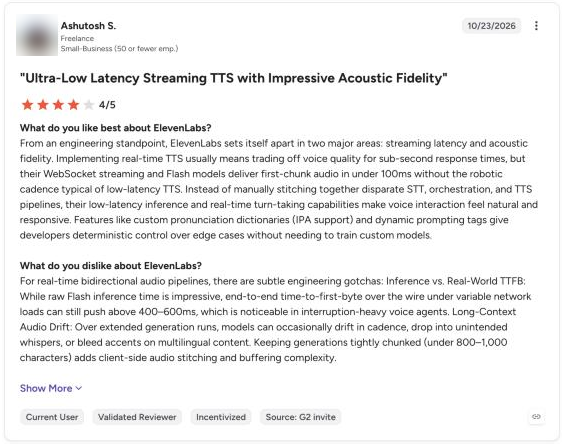
Pros: "…their WebSocket streaming and Flash models deliver first-chunk audio in under 100ms…" (Ashutosh S., G2, October 2026)
-
Cons: "On the lower-tier plans, I hit the character limits pretty quickly when I'm generating daily reports." (Subrata D., Stock Analyst, G2, October 2026)
Cartesia
-
Pros: "The speech generation feels responsive enough for conversational applications…" (Muhammed A., G2, August 2026)
-
Cons: "Indian English and Hinglish pronunciation can sometimes be inconsistent, especially with names and local terminology…" (Yogita B., Analyst, G2, September 2026)
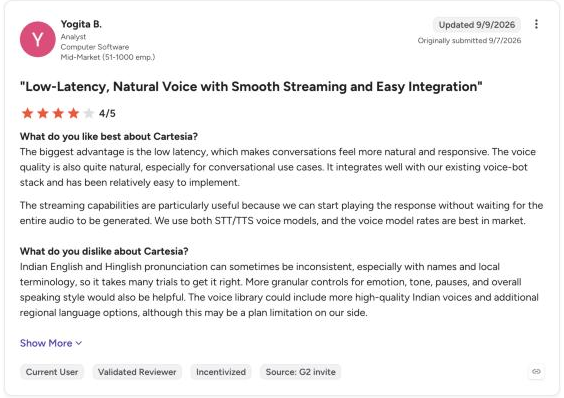
Yogita's review was posted after Sonic 3.6, the release where Cartesia says it improved Hinglish. Test Indian names on the current snapshot before you trust that fix.
Ashutosh's sub-100 ms figure reflects his own setup. From US East, the benchmark clocked Flash v2.5 at 177 ms.
How to Make Your Choice
Across the comparison, ElevenLabs led on latency, accuracy, and language breadth, while Cartesia led on deployment control, and on cost only at high volume.
Choose ElevenLabs If:
-
You run live phone agents and want the faster start on streamed text.
-
Your scripts include many context-dependent words, codes, and addresses (v4 Turbo scored 88% and 82% on those).
-
You need more than 44 languages from one model.
-
You also produce narration or dubbing and want it on the same ElevenLabs account as your agents.
Choose Cartesia If:
-
Security or data residency rules put TTS inside your own data center or VPC.
-
You want a dated model snapshot that stays fixed between regression runs.
-
You already use Ink for speech-to-text and want one credit pool.
-
You run more than about 7.5M characters a month, where Cartesia’s Scale plan undercuts ElevenLabs’ $0.04 rate ($755 vs about $800 at 20M).
Our Verdict
On this data, where the model has to run decides ElevenLabs vs Cartesia. For a cloud-hosted phone agent, we'd test ElevenLabs v4 Turbo first.
It started faster than Sonic 3.6 on streamed text. By the benchmark's estimates, it also read hard text more accurately and matched Sonic 3.6 on naturalness.
If compliance requires self-hosting, go with Cartesia. Your compliance team gets an air-gapped Sonic 3.6 and a snapshot frozen on August 27, 2026, and the rest of the compliance work still belongs with your team.
Cost depends on volume. Below about 7.5M characters a month, v4 Turbo on pay-as-you-go costs less than Sonic 3.6. Above that, Cartesia’s Scale plan pulls ahead.
How to Test ElevenLabs and Cartesia on Your Own Script
Run both vendors on your own agent lines before you sign, since your scripts carry the exact names, codes, and addresses your callers will hear:
-
Pull 50 to 100 agent lines from your own transcripts, weighted toward the hard parts, like confirmation codes, street addresses, dollar amounts, and drug names.
-
Pin every version. Use sonic-3.6-2026-08-27 on Cartesia and eleven_v4_turbo or eleven_flash_v2_5 on ElevenLabs, with one voice per run.
-
Stream text the way your LLM does, word by word, and time from the last word to the first audible sample, counting leading silence.
-
Interrupt mid-sentence and measure how much audio still plays after the stop.
-
Score readings with 2 transcribers, then have a person check a sample, since transcribers disagree.
-
Price your actual character volume against both plan tables above, concurrency included.
Repeating that by hand after every voice swap or model update turns into recurring manual work, and that's the part Cekura handles.
Before launch, Cekura sends batches of synthetic calls to each TTS setup, with interruptions, background noise, accents, and callers who go off-script. Swap a voice or model, and it repeats the same scenario suite, so you can compare results side by side.
On live traffic, it tracks turn latency across your LLM and telephony stack and flags when the agent talks over a caller. It also rates how the agent reads names and numbers in full conversations.
Its call QA also scores each call for accuracy and instruction-following.
Cekura has a native ElevenLabs integration, and native integrations also cover Retell, Vapi, LiveKit, and Pipecat.
It's SOC 2, HIPAA, and GDPR-compliant for transcript redaction, role-based access, and audit trails.
Book a demo to run ElevenLabs vs Cartesia through your own scenarios, then keep scoring the voice you pick on live calls.
Frequently Asked Questions
Is ElevenLabs better than Cartesia?
ElevenLabs came out ahead for cloud-hosted phone agents in Cekura's benchmark. v4 Turbo was faster (69 ms vs 270 ms) and more accurate by the transcriber estimate (79.9% vs 74.9%) than Sonic 3.6.
Cartesia is better when you need on-prem deployment or the cheaper plan step at your volume.
Which is faster, ElevenLabs or Cartesia?
ElevenLabs v4 Turbo is faster, at 69 ms median on streamed text versus 270 ms for Cartesia Sonic 3.6 on the benchmark's 104 sentences. Cartesia's "under 90ms" claim is model latency, taken without network time.
On the full board, Gradium TTS and Inworld TTS-2 Flash both started faster than v4 Turbo.
Is Cartesia cheaper than ElevenLabs?
Cartesia is cheaper than ElevenLabs only at high volume. Below about 7.5M characters a month, ElevenLabs v4 Turbo on pay-as-you-go is cheaper (about $40 vs $49 for 1M). Above that, Cartesia’s Scale plan is cheaper ($755 vs about $800 for 20M).
Cartesia's entry plan is $5/month against ElevenLabs' $6/month, and 1M characters costs $49 on Cartesia's Startup plan compared with $99 on ElevenLabs Pro, or $40 on ElevenLabs pay-as-you-go. Per character, v4 Turbo ($40 per 1M) and Sonic 3.6 ($37.38 to $39.20) are close.
Can ElevenLabs run on-prem like Cartesia?
Partly. ElevenLabs offers private deployments on AWS and GCP for its v2 and v2.5 TTS models and Scribe v2, which excludes v4 Turbo, with full docs under NDA.
Cartesia says its current model, Sonic 3.6, deploys in your own data center, air-gapped setups included, or in a VPC on AWS, GCP, or Azure.
Cartesia vs ElevenLabs: Which is better for voice agents?
The main difference between Cartesia and ElevenLabs for voice agents is deployment control versus benchmarked speed. ElevenLabs v4 Turbo started faster and read hard text more accurately in Cekura's benchmark, while Cartesia offers self-hosting and dated snapshots.