
Choosing among OpenAI Whisper alternatives for speech-to-text comes down to where you want the model to run. ElevenLabs Scribe or AssemblyAI for a managed API, faster-whisper if the weights stay on your own GPU, and NVIDIA Parakeet if you're ready to leave the Whisper architecture.
OpenAI's deprecations page puts a date on this decision. It lists whisper-1 for removal from the API on February 26, 2027, together with gpt-4o-transcribe and gpt-4o-mini-transcribe.
To make that call before February, I compared ten Whisper alternatives on each vendor’s pricing page and docs as they stood on November 11, 2026, and pulled accuracy and latency from our own speech-to-text benchmark, which runs every model on one shared set of audio.
Five of the ten have measured numbers. The other five are marked untested, and their accuracy figures are labeled as the vendor's own.
10 best Whisper alternatives: TL;DR
Managed APIs
-
ElevenLabs Scribe: Best for the lowest measured word error rate, with 1.89% overall WER on the combined benchmark.
-
AssemblyAI: Best for the fastest first words of a live turn, at a 485 ms median.
-
Google Cloud Chirp 3: Best for batch transcription inside a Google Cloud account that already exists.
-
Speechmatics: Best for running Speechmatics models on-prem or on-device under an Enterprise contract.
-
Deepgram: Best for voice agents that want end-of-turn detection inside the transcription model.
-
Gladia: Best for async transcription with diarization in the base rate, priced in euros.
Self-hosted open source
-
faster-whisper: Best for keeping Whisper's weights and cutting GPU time on the same hardware.
-
whisper.cpp: Best for running Whisper on a laptop, a phone, or a Raspberry Pi with no Python.
-
NVIDIA Parakeet and Canary: Best for high-throughput batch transcription in English and European languages.
-
Mistral Voxtral: Best for open weights that transcribe audio and answer questions about it in one model.
How I compared these Whisper alternatives
Accuracy and latency both come from Cekura's STT benchmark, last updated September 16, 2026. It plays every model one set of 1,000 short public clips from Pipecat's dataset and 300 turns from four recorded phone conversations licensed from Ocular.
On both sets, word error rate (WER) is scored against a reference transcript. Speed is timed on the streamed turns, and 206 of the 300 phone-call turns carry timing data.
The numbers come from one fixed test setup, so use them to build a shortlist, then run your final two on your own audio before you sign.
The leaderboard also covers models outside this list, such as Reson8 and Fish Audio. Each ranking quoted here says whether it refers to the whole board or to these ten.
Prices are taken from each company's pricing page, read on November 11, 2026 (Mistral's on November 12). Feature claims come from product docs, GitHub READMEs, and Hugging Face model cards, with no aggregators or comparison blogs. Where two pages from the same vendor disagree, the entry says so.
I didn't run the self-hosted models. faster-whisper, whisper.cpp, Parakeet, Canary, and Voxtral aren't in the benchmark, and neither is Gladia.
So apart from one Cekura figure for a related NVIDIA model, any accuracy or speed number in those entries is the publisher's own, run by the publisher on its chosen datasets and hardware.
Cekura partners with ElevenLabs and Speechmatics, which I'm disclosing up front. Their entries follow the same format as the rest, and Cekura isn't on the list because it tests voice agents and doesn't sell transcription.
Why look for Whisper alternatives?
Teams look past Whisper when they need live transcription, speaker labels, or a hosted API that keeps running after February 26, 2027. Whisper is still the model every other one gets measured against.
The weights are MIT-licensed, OpenAI's docs put coverage at 98 languages, and the turbo model runs at roughly eight times the speed of large in about 6 GB of VRAM, per the repo's own table (measured on an A100).
Offline batch jobs on your own hardware suit it well. Live calls, multi-speaker audio, and workloads on the hosted API run into the limits below.
The hosted Whisper API has an end date
OpenAI has notified developers that whisper-1 will be removed from the API on February 26, 2027. The deprecations page names gpt-transcribe or gpt-live-transcribe as the replacement.
You'll be rewriting those API calls before February anyway, so test a second vendor in the same sprint. Our Whisper API pricing breakdown lists what you pay OpenAI today, for comparison.
Whisper doesn't stream
OpenAI's speech-to-text guide says the gpt-4o transcription models support file streaming and that whisper-1 doesn't. The open-source model card states it more directly, saying Whisper models "cannot be used for real-time transcription out of the box."
A voice agent needs partial text while the caller is still talking. With Whisper, getting partial text means a chunking and buffering service you write and keep running yourself.
The model card warns about invented text
The Whisper model card states that predictions "may include texts that are not actually spoken in the audio input (i.e. hallucination)," and that the architecture is "prone to generating repetitive texts." A clean-looking transcript with invented words can pass review unnoticed.
Accents add a second risk. The card also says the models "perform unevenly across languages" and show disparate performance across accents and dialects, so accuracy on one caller doesn't predict accuracy on the next.
Speaker labels are missing
The open weights return text and timestamps. The model card lists speaker diarization among tasks the models might handle after fine-tuning but "have not been robustly evaluated" on.
Without a second model, call-center and meeting audio has no record of who spoke. On the hosted side, speaker labels come from gpt-4o-transcribe-diarize, which shares the February 26 shutdown date.
Self-hosting moves the bill to GPUs
The repo lists large at about 10 GB of VRAM. From there, you own batching, autoscaling, and failover, and those costs land on your infrastructure bill.
Which Whisper alternative should you choose?
Choose ElevenLabs Scribe if phone-audio accuracy is your main requirement. It posted the lowest overall WER in the benchmark and the lowest on the phone-call set. Data residency sits on its Enterprise plan, and HIPAA agreements go through sales.
Choose AssemblyAI if your agent needs the first words quickly and you'd like 185 free hours of files to prototype on. Its phone-call WER was the weakest of the five tested picks.
Choose Google Cloud Chirp 3 if you transcribe recordings in bulk and already bill through Google Cloud. Its streaming mode took 4.48 seconds to show first text in the benchmark, more than three times the 1.38 s of GPT Realtime Whisper.
Choose Speechmatics if a regulator or a customer requires transcription inside your own network. On-prem requires an Enterprise contract and runs Speechmatics’ Batch and Realtime models, including multilingual Melia 1. Linden, the model benchmarked here, stays SaaS-only.
Choose Deepgram if turn-taking is your agent's weak point and you'd rather have the transcriber signal end of turn. Its overall WER trails the other tested APIs, though Flux beats AssemblyAI and Chirp 3 on phone calls.
Choose Gladia if your audio is recorded, multilingual, and you need diarization included in the base rate. Cekura hasn't benchmarked it.
Choose faster-whisper if Whisper's output is good enough and your complaint is GPU time or the API shutdown.
Choose whisper.cpp if the transcript has to be produced on the device, with no server and no network.
Choose NVIDIA Parakeet or Canary if your audio is English or another European language and you care more about batch throughput than language breadth.
Choose Mistral Voxtral if you prefer Apache 2.0 weights and plan to summarize or query the audio after transcribing it.
Stick with Whisper if you self-host the open weights for offline batch jobs across many languages. The API shutdown doesn't touch the MIT-licensed model. Among the free options here, Parakeet covers 25 languages and Voxtral Realtime 13, compared with Whisper's 98.
10 best Whisper alternatives: at a glance
These are starting prices only. Per-tier rates and add-ons are in each entry further down.
| Platform | Best for | Starting price |
|---|---|---|
| ElevenLabs Scribe | Lowest measured WER | $0.20/hour batch, $0.22/hour real-time |
| AssemblyAI | Fast first words | Free tier, then $0.15/hour |
| Google Cloud Chirp 3 | Batch on Google Cloud | $0.96/hour ($0.016/minute) |
| Speechmatics | On-prem and on-device | $100 credit, then from $0.12/hour |
| Deepgram | In-model turn detection | $200 credit, then from $0.29/hour ($0.0048/minute, promotional) |
| Gladia | Async with diarization included | €50 credit, then €0.16/hour |
| faster-whisper | Faster Whisper on your GPU | Free (MIT), you pay for compute |
| whisper.cpp | On-device Whisper | Free (MIT), you pay for compute |
| NVIDIA Parakeet and Canary | High-throughput batch | Free weights (CC-BY-4.0) |
| Mistral Voxtral | Transcription plus audio Q&A | Free weights (Apache 2.0), API from $0.21/hour ($0.0035/minute) |
Pricing verified against vendor pages on November 11, 2026. Verify with the vendor before you commit.
How to evaluate Whisper alternatives
Vendor benchmark pages, Gladia's among them, run on datasets the vendor picked. These five questions help you read past those claims.
1. Ask who measured the WER, and on what audio
A vendor's WER figure was measured on that vendor's chosen audio. The table below uses one test setup for every model in it and leaves the rest blank.
| Model | Overall WER | Phone-call WER | First text (P50) | Final text (P50) |
|---|---|---|---|---|
| ElevenLabs Scribe v3 Live | 1.89% | 2.05% | 685 ms | 57 ms |
| GPT Realtime Whisper (OpenAI) | 2.63% | 3.53% | 1.38 s | 543 ms |
| AssemblyAI Universal 3.6 Pro | 2.71% | 4.50% | 485 ms | 91 ms |
| Google Chirp 3 | 2.76% | 4.19% | 4.48 s | 475 ms* |
| Speechmatics Linden | 2.97% | 3.93% | 1.19 s | 147 ms |
| Deepgram Nova-3 | 3.78% | 4.39% | 1.06 s | 103 ms |
| Deepgram Flux English | 4.00% | 4.18% | 791 ms | 108 ms |
| Gladia, faster-whisper, whisper.cpp, Parakeet, Canary, Voxtral | Untested | Untested | Untested | Untested |
Source: Cekura STT benchmark, last updated September 16, 2026. Provider defaults, one fixed test setup. *Measured after stream close.
The benchmark doesn't include whisper-1 or large-v3. The closest OpenAI entry is GPT Realtime Whisper, and among the measured APIs on this list, only Scribe v3 Live beats it on overall WER.
Five models outside this list, including NVIDIA’s Nemotron 3.5 Transcribe, also post a lower overall WER on the full leaderboard, and the side-by-side comparisons show any two models head-to-head.
2. Ask which latency number you're being quoted
ElevenLabs, AssemblyAI, Speechmatics, and Deepgram beat GPT Realtime Whisper on speed, and our voice AI latency guide defines where each timing starts and stops.
Time to first text and time to final text measure different moments, and a pricing page usually quotes one of them without saying which. Chirp 3 shows why that matters, with 475 ms to final text, measured after the stream closes, and 4.48 seconds to first text.
3. Ask what the bill looks like with add-ons
Diarization costs $0.12 an hour extra on AssemblyAI streaming and $0.0020 a minute on Deepgram, and it's included in Gladia's async rate. Add the cost of every add-on you plan to use before you compare rates.
4. Ask whether you need text while the speaker is talking
Chirp 3's speaker labels, Gladia's Solaria-3, Parakeet, Canary, and the two Whisper ports are designed for recorded files.
5. Ask where the audio is allowed to go
A managed API means your recordings leave your network. If that fails security review, you're down to self-hosted weights or a vendor's self-hosted option, which ElevenLabs, AssemblyAI, Deepgram, Speechmatics, and Google all sell.
The 10 best Whisper alternatives
Managed APIs come first, ordered by overall WER in the benchmark, with Gladia last because it has no benchmark result.
Self-hosted models follow, starting with the two that keep Whisper's weights.
Managed APIs. These six run on each vendor's infrastructure and bill per minute or per hour of audio. All six stream, which whisper-1 never did.
On the standard plans, your audio leaves your network. Check which plan holds the compliance terms you need before you compare rates.
1. ElevenLabs Scribe
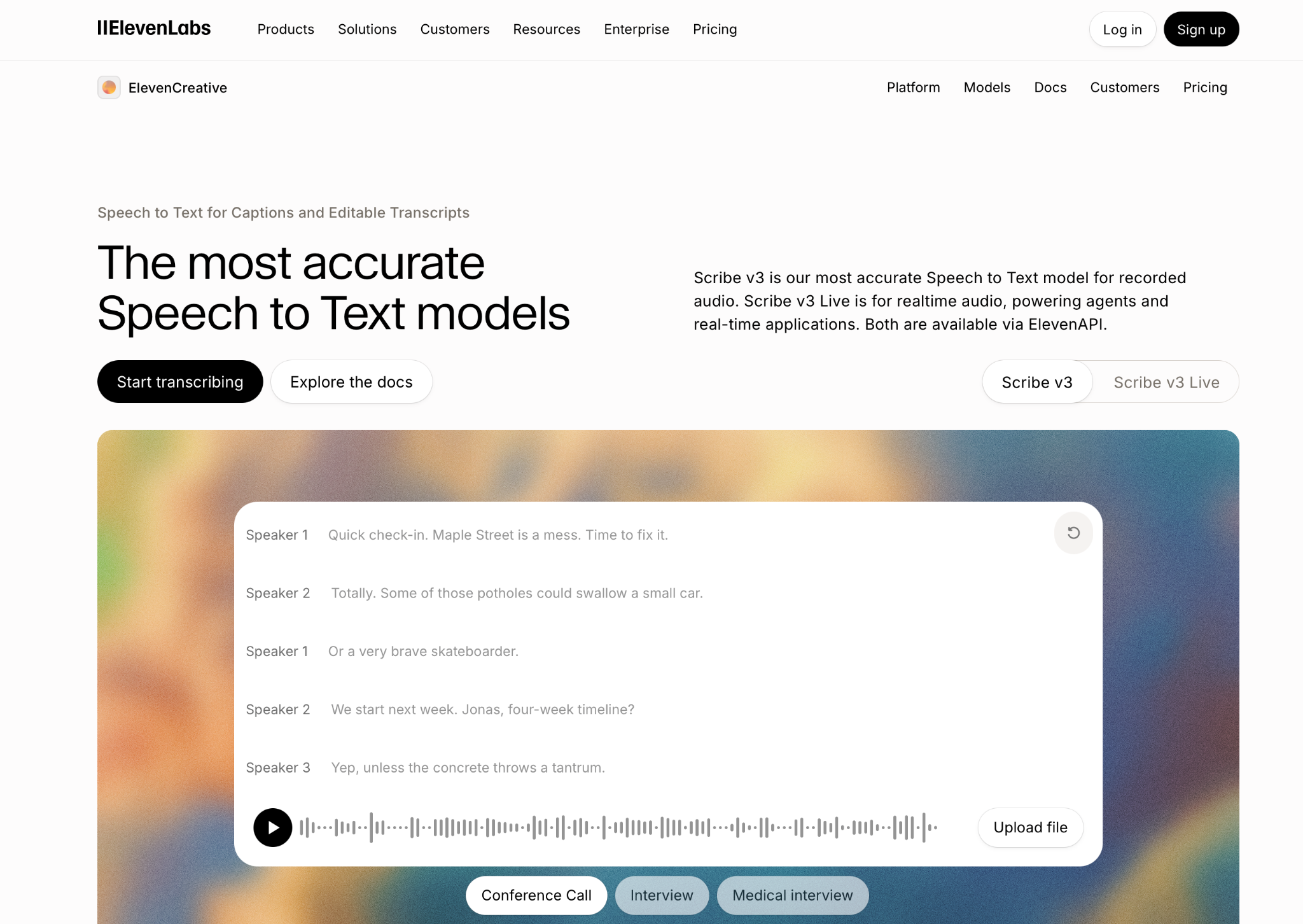
Scribe v3 Live had the lowest word error rate of any model in Cekura's benchmark, at 1.89% overall and 2.05% on the phone-call set. Once the caller stopped, the finished transcript arrived in 57 ms at the median.
On the phone-call set, Scribe’s 95% range runs from 1.57% to 2.52%, and five other models have ranges that overlap it. Read 2.05% as the top measured score, with the order behind it still open.
The benchmark tested the streaming model. ElevenLabs sells two current lines, Scribe v3 for recorded files and Scribe v3 Live for streams. Both cover 90+ languages, according to ElevenLabs’ docs and product page.
Key features
-
Speaker diarization for up to 32 speakers: Scribe v3 labels who spoke in recorded audio. Whisper's open weights need a second model for that.
-
Word-level timestamps and audio event tagging: Each word carries a start and end time, and non-speech sounds are tagged in the transcript.
-
Keyterm prompting: Up to 1,000 terms on batch requests and 50 on live streams. Load it with the product and drug names the model would otherwise misspell.
-
Large files: Files up to 5 GB and 15 hours per request. Whisper's API stops at 25 MB.
Pros
✅ Lowest WER in the benchmark, overall and on the phone-call set.
✅ Batch and live transcription are priced two cents apart per hour.
✅ ElevenLabs Private Deployment runs on Amazon SageMaker and Vertex AI.
Cons
❌ EU data residency is Enterprise-only, and a HIPAA BAA requires a sales conversation.
❌ The private deployment docs name Scribe v2 as the transcription model, and prospective customers sign an NDA to see the full documentation.
❌ Silence counts toward billed duration, per the docs, so long holds and pauses are paid minutes.
Best for
-
Phone-based agents where a misheard name or number leads to the wrong action.
-
Long recordings that would need chunking on Whisper's API.
-
Products already using ElevenLabs for voice output that want one vendor for both directions.
Pricing
Scribe v3 and Scribe v2 bill $0.20 per hour for batch. Scribe v3 Live and Scribe v2 Realtime bill $0.22 per hour. Keyterm prompting adds $0.05 an hour on batch and $0.08 on real-time. Pay-as-you-go carries no commitment, and Enterprise pricing is quoted by sales.
2. AssemblyAI
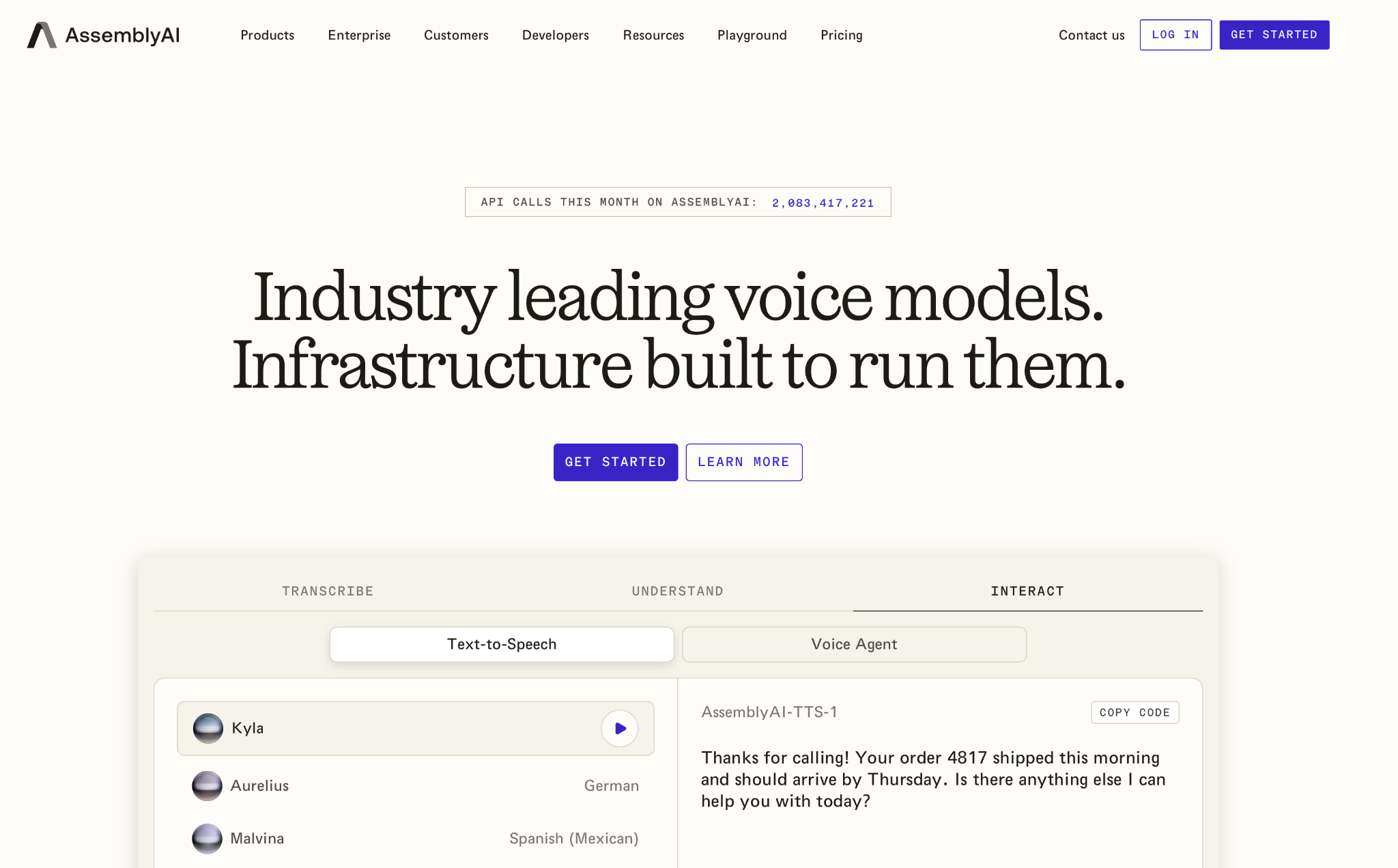
AssemblyAI returned the first text of a turn faster than anything else on the board, at a 485 ms median, one millisecond ahead of the runner-up. Universal-3.6 Pro's 2.71% overall WER sits close to GPT Realtime Whisper's 2.63%.
The 485 ms came from Universal-3.6 Pro Realtime, one of AssemblyAI’s speech-to-text models split by job. AssemblyAI-STT-3.7 transcribes files, and Universal-2 Pro Realtime, STT-3.7-Realtime, and STT-3.7-Realtime-Agent handle live audio.
Key features
-
Free tier sized for a full pilot: Up to 185 hours of pre-recorded and 333 hours of streaming transcription before you enter payment details.
-
Speech Understanding on the same request: Summarization, Sentiment Analysis, and Entity Detection are priced Speech Understanding add-ons, and PII Redaction for audio and text is a priced Guardrails add-on, so there’s no second pipeline.
-
Keyterms prompting: Included at no extra charge on Universal-3.6 Pro Realtime.
-
Self-hosted option: Available for the Realtime and Sync Speech-to-Text APIs through sales, at the same usage-based pricing as the cloud.
Pros
✅ 1.77% WER on the short public clips, the lowest of the tested APIs here and third on the full board.
✅ Final text at a 91 ms median, behind only Scribe among the tested APIs here.
✅ AssemblyAI's security page describes a SOC 2 Type II report covering security, availability, and confidentiality.
Cons
❌ WER rose to 4.50% on the phone-call set, the highest of the tested APIs here.
❌ Pre-recorded transcription has no zero-retention mode. The shortest time-to-live is one hour.
Best for
-
Voice agents on clean audio where time to first words matters more than phone-call WER.
-
Buyers who'd rather get summaries and redaction from the transcription vendor.
-
Pilots that need hundreds of free hours before a purchase approval.
Pricing
AssemblyAI-STT-3.7 is $0.21/hr and Universal-2 is $0.15/hr for files, STT-3.7-Realtime is $0.30/hr, and STT-3.7-Realtime-Agent is $0.45/hr for live audio.
Speaker diarization adds $0.02 an hour on files and $0.12 on streams.
3. Google Cloud Chirp 3
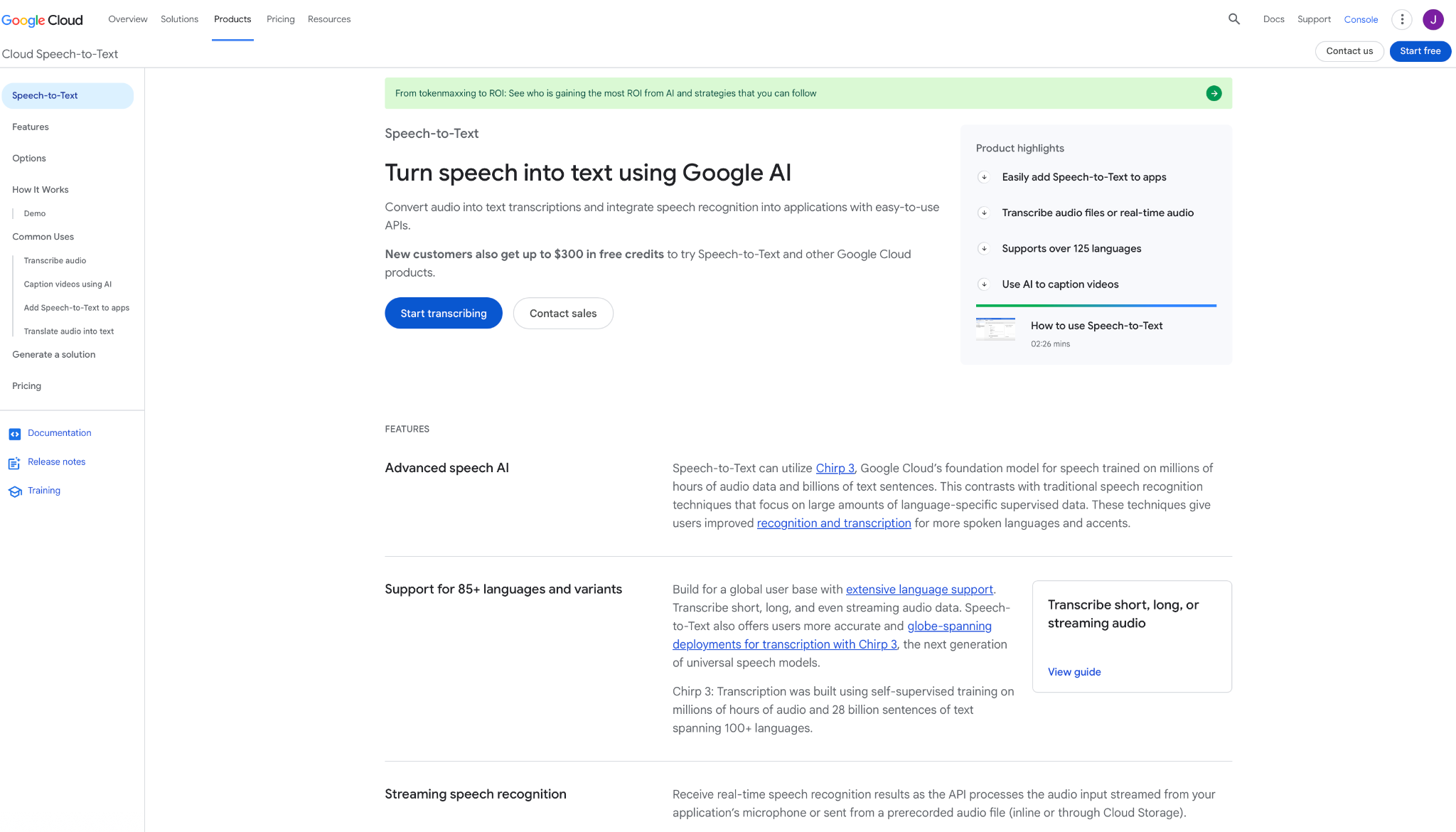
Chirp 3 matched AssemblyAI and Speechmatics on accuracy, at 2.76% overall WER and 4.19% on phone calls, and trailed both on timing. First text took a 4.48-second median, roughly nine times the fastest model's figure.
A delay that long, even with streaming recognition switched on, makes it a weak choice for a latency-sensitive voice agent.
Key features
-
Dynamic batch pricing: Non-urgent jobs cost $0.003 a minute at list price, a fraction of the standard rate. It suits backlogs and archives.
-
Language-agnostic transcription: Passing
autoas the language code lets the model identify the dominant language. Mixed-language queues don't need a routing step. -
Volume tiers on the public page: The per-minute rate falls from $0.016 to $0.004 past two million minutes a month, and every tier is on the public page.
-
Regional availability: Chirp 3 is generally available in the US and EU multi-regions, with data residency under the V2 API.
Pros
✅ Accuracy within a tenth of a point of AssemblyAI on the combined benchmark score.
✅ 85+ languages and variants on the Chirp 3 section of the product page, which elsewhere claims 125+.
✅ New Google Cloud customers get up to $300 in credits that apply to Speech-to-Text.
Cons
❌ Slowest time to first text on this list, 3.3 seconds behind Speechmatics, the next slowest at 1.19 s.
❌ The Chirp 3 feature table lists speaker diarization as available only in batch recognition, though another section of the same docs adds synchronous Recognize.
❌ The standard rate works out to $0.96 an hour, the highest list price among the APIs in the table.
Best for
-
Call recording archives transcribed overnight on dynamic batch.
-
Organizations with prepaid Google Cloud commitments to spend.
-
Multilingual queues where the language is unknown before the file arrives.
Pricing
The Speech-to-Text V2 standard recognition rate is $0.016 per minute up to 500,000 minutes a month, then $0.01, $0.008, and $0.004 at higher tiers. Dynamic batch costs $0.003 a minute. Speech-to-Text On-Prem is available through sales.
4. Speechmatics
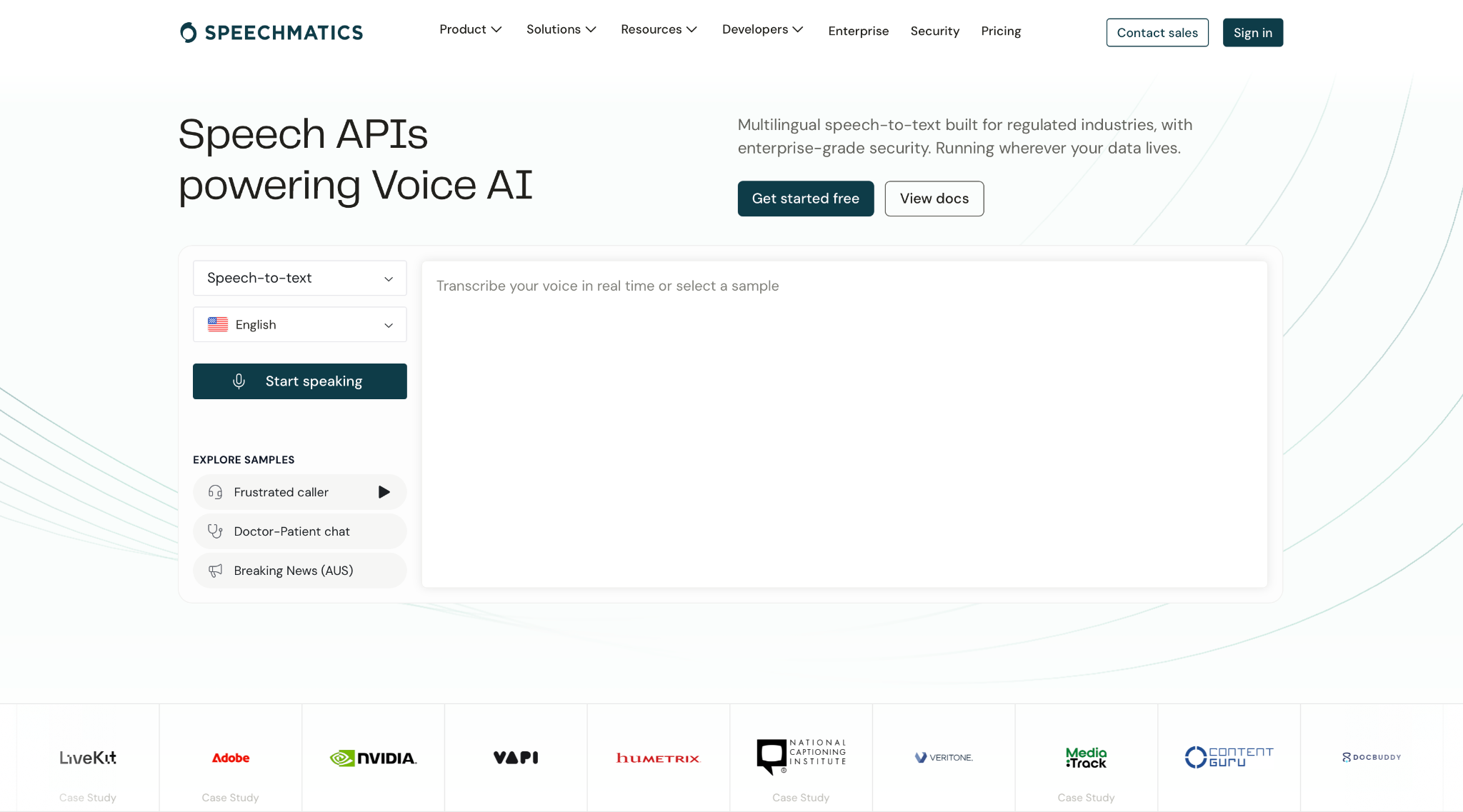
Speechmatics fits a bank or hospital that can’t send audio to a third-party cloud. Containers, virtual appliances, and on-device builds are listed on its pricing page, and all sit on the Enterprise plan.
Its voice-agent model, Linden, came in at 2.97% overall WER, with final text at a 147 ms median. On phone calls, it reached 3.93%, ahead of Chirp 3, both Deepgram models, and AssemblyAI.
Linden itself is SaaS-only, per the docs, so an on-prem deployment runs one of Speechmatics' other models instead of the one benchmarked here.
Key features
-
Models split by workload: Linden 1 for voice agents, Melia 1 for 55+ languages with mid-sentence language switching, Oak 1 for healthcare audio, and Enhanced for the highest accuracy in a chosen language.
-
Speaker diarization on streams: No speaker limit by default, with an optional max_speakers cap you can set.
-
Agent STT turn signals: Linden emits voice activity and turn events driven by silence detection, covering start and end of speech and start and end of turn.
-
Short retention by default: Unless you opt in to model training, streamed audio is never stored and pre-recorded data is deleted within seven days.
Pros
✅ Second-best phone-call WER among the five tested picks, after Scribe.
✅ SOC 2 Type II, ISO/IEC 27001:2022, GDPR, and HIPAA are all listed on the pricing page.
✅ The Pro plan allows 50 concurrent live streams on self-serve billing.
Cons
❌ On-prem, hybrid, and on-device deployment require an Enterprise contract.
❌ Server-side semantic turn detection is still listed as coming soon.
❌ Linden's price reads two ways: $0.15 an hour on the pricing page, and from $0.30 on the voice agents page, where it's sold as the Agent STT package.
Best for
-
Regulated deployments where audio can't leave a private data center.
-
Conversations that switch language mid-sentence.
-
Contact centers that need live speaker labels on multi-party calls.
Pricing
On the pricing page's pre-recorded tab, Melia 1 costs $0.12 an hour and Enhanced $0.38. Linden 1, which is real-time only, shows $0.15 an hour.
The voice agents page prices Agent STT, the package that runs on Linden with turn and speaker signals included, from $0.30 an hour with volume discounts down to $0.15.
Opting in to model training takes 33% off. Enterprise is quoted by sales. The Free plan starts with a $100 credit and no card.
5. Deepgram
Deepgram's Flux puts end-of-turn detection inside the transcription model. The stream that returns words also tells the agent when the caller has finished.
Nova-3 measured 3.78% overall WER and Flux English 4.00%, trailing every other tested API here and OpenAI's GPT Realtime Whisper.
Key features
-
Turn events from the model: Flux signals
StartOfTurnandEndOfTurn, and addsEagerEndOfTurnandTurnResumedonce you seteager_eot_threshold. -
Whisper Cloud: Deepgram's hosted Whisper, sizes tiny through large, for anyone who wants that output with no GPUs of their own. It handles pre-recorded audio only and isn't available on the EU endpoint.
-
High self-serve concurrency: 150 concurrent streaming connections on Pay As You Go and 225 on Growth.
-
EU endpoint: A dedicated
api.eu.deepgram.comhost for GDPR-scoped processing.
Pros
✅ Nova-3 closed a turn in 103 ms at the median, and Flux English in 108 ms.
✅ A $200 credit that doesn't expire, with sign-up open before any billing setup.
✅ Self-hosted containers run in your VPC or on-prem, with FIPS 140-3 images available.
Cons
❌ Highest overall WER of the five tested picks.
❌ Flux covers English plus a ten-language multilingual model, compared with Whisper's 98.
❌ A HIPAA BAA is limited to Enterprise customers, and so are self-hosted Docker and Kubernetes deployments. SageMaker is the exception.
Best for
-
Voice agents that interrupt callers or wait too long after they stop.
-
Anyone who needs hosted Whisper now and a streaming model later.
-
High-concurrency live transcription on a self-serve plan.
Pricing
Pay-as-you-go bills $0.0077 per minute for Nova-3 monolingual and Flux English streaming, and $0.0092 for Nova-3 multilingual. Growth starts at $4,000 a year (prepaid credits, redeemed against usage) and lowers those to $0.0065 and $0.0078.
Promotional prices apply until February 13, 2027, at $0.0048/min for Nova-3 Monolingual, $0.0065 for Flux English, and $0.0058 for Nova-3 Multilingual on pay-as-you-go, and $0.0042, $0.0057, and $0.0050 on Growth.
Speaker diarization and redaction each add $0.0020 a minute. Whisper Cloud (Whisper Large, pre-recorded) is listed at $0.0048 a minute on both Pay As You Go and Growth.
6. Gladia
Gladia includes speaker diarization and custom vocabulary in its async base rate. On AssemblyAI and Deepgram, diarization is a paid add-on.
Cekura hasn't tested Gladia. Its published accuracy figures come from Gladia's own benchmark run, mostly on public datasets plus one internal set, so weigh them as Gladia's claim.
Key features
-
Two models: Solaria-1 covers 100+ languages with code-switching between turns, and Solaria-3 is a pre-recorded model for five European languages that Gladia positions on accuracy, at a lower rate than Solaria-1.
-
Published volume discounts: The Solaria-3 rate drops in tiers from €0.16 an hour to €0.12 once monthly volume passes 10,000 hours.
-
Stated concurrency: 25 concurrent pre-recorded jobs and 30 live sessions on self-serve.
Pros
✅ €50 in free credits valid for a year, which Gladia equates to roughly 312 hours on Solaria-3.
✅ GDPR, HIPAA, and SOC 2 Type II are listed in the plan comparison.
✅ Translation, named entity recognition, and PII redaction each carry a published per-hour rate.
Cons
❌ Accuracy rests on Gladia's own published figures.
❌ Self-serve accounts are opted in to model training by default, with a free opt-out.
❌ Zero data retention and custom hosting are Enterprise-only.
Best for
-
Recorded multi-speaker audio in European languages.
-
Buyers who invoice and budget in euros.
-
Async workloads where diarization is switched on for every file.
Pricing
Self-serve async costs €0.16 per hour on Solaria-3 and €0.27 on Solaria-1. Real-time is a single rate of €0.68 an hour. Add-ons run from €0.02 an hour for sentiment to €0.07 for named entity recognition. Enterprise is custom.
None of them is in the benchmark, so the accuracy and speed figures below are the publisher's, apart from the one Nemotron result in the Parakeet entry. The GPUs, the scaling, and the upgrades are yours to manage.
7. faster-whisper
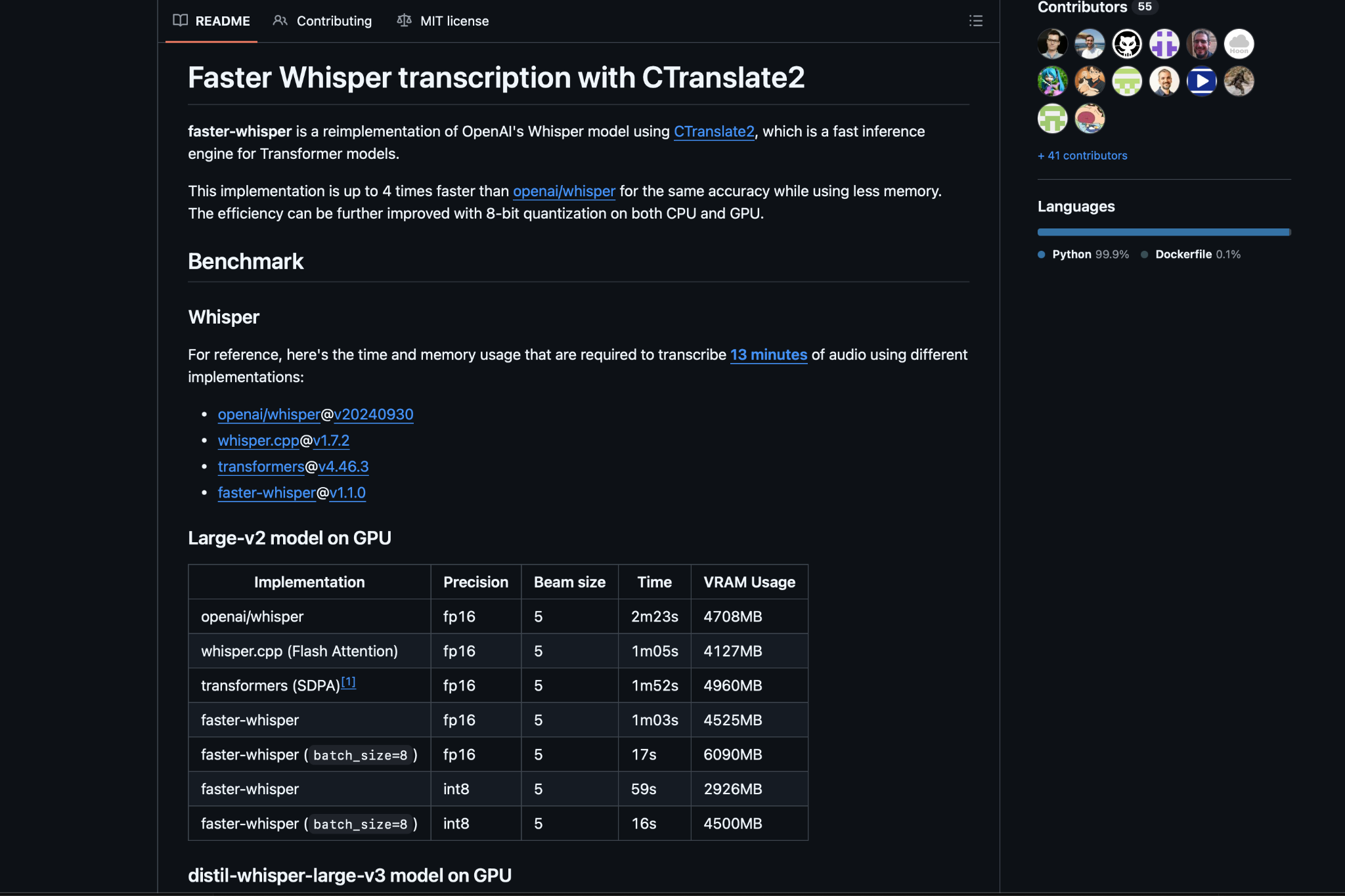
faster-whisper is Whisper's own weights on the CTranslate2 inference engine. The README calls it "up to 4 times faster than openai/whisper for the same accuracy while using less memory."
The README measured that on an RTX 3070 Ti with 13 minutes of audio. On that run, large-v2 took 2m23s on the reference implementation and 1m03s on faster-whisper at the same precision.
Key features
-
int8quantization: On the 8 GB RTX 3070 Ti test card, theint8run finished in 59 seconds using 2,926 MB of VRAM, against 4,708 MB for the original at fp16. -
Batched inference:
BatchedInferencePipelineis a drop-in replacement for the standard transcribe call. With a batch size of 8, the same file took 17 seconds. -
Silero VAD filter:
vad_filter=Truestrips silence longer than two seconds before decoding. -
Word-level timestamps: Returned per segment with one flag.
Pros
✅ MIT license, with no per-minute fee and no API shutdown date.
✅ No FFmpeg dependency, since audio is decoded through PyAV.
✅ Supports distil-large-v3 and
turbo, two lighter Whisper variants.
Cons
❌ It's still Whisper, so the model card's warnings about invented and repeated text apply unchanged.
❌ Streaming and diarization aren't native. Community projects listed in the README, WhisperLive and WhisperX, add them.
❌ GPU runs need CUDA 12 and cuDNN 9. Older CUDA setups have to pin an earlier ctranslate2 version, per the README.
Best for
-
whisper-1users who'd like to stay on the same model family after February. -
Batch pipelines where GPU hours are the main cost.
-
Smaller GPUs that can't hold
largeat full precision.
Pricing
Free under the MIT license. You pay for the GPU or CPU it runs on.
8. whisper.cpp
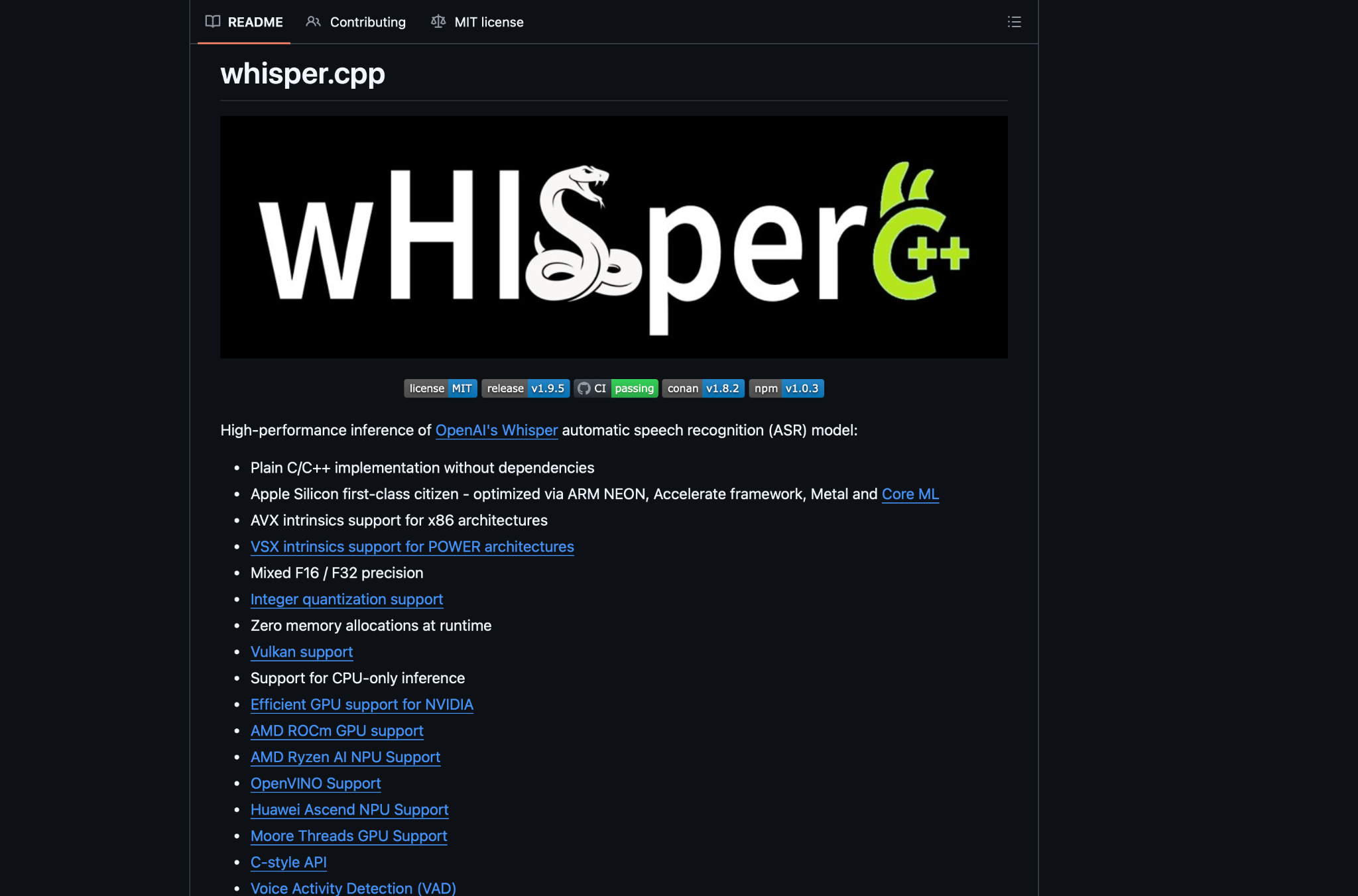
The whisper.cpp repository on GitHub.
If the transcript has to be produced on a phone or a laptop with no network, whisper.cpp is the Whisper build to start with. Its README describes it as a "plain C/C++ implementation without dependencies," which is why it runs in a browser and on a Raspberry Pi.
The supported list covers macOS, iOS, Android, Linux, Windows, WebAssembly, Raspberry Pi, and Docker. The tiny model takes 75 MiB on disk and about 273 MB of memory.
Key features
-
Apple Silicon support: ARM NEON, the Accelerate framework, Metal, and Core ML are all supported. A MacBook runs it on the M-series chip with no external GPU.
-
Wide backend support: Vulkan, NVIDIA GPUs, and OpenVINO, plus CPU-only inference.
-
Voice activity detection: The
--vadflag runs a Silero VAD model first. Silent stretches get dropped before decoding. -
Integer quantization: Shrinks the model files further for phones and embedded boards.
Pros
✅ Audio never leaves the device, which removes the main question in a privacy review.
✅ On the faster-whisper README's CPU benchmark, whisper.cpp ran the
smallmodel in 2m05s against 6m58s for the reference implementation.
✅ About 55k GitHub stars, roughly twice faster-whisper’s count.
Cons
❌ These are Whisper's weights, so the hallucination and accent caveats carry over.
❌ Speaker labels rely on tinydiarize, which the README marks as experimental.
❌ The
streamtool is a demo, andwhisper-clireads only 16-bit WAV files, so live audio and other formats need your own preprocessing.
Best for
-
Dictation and note-taking apps that must work offline.
-
Mobile and embedded products with tight memory budgets.
-
Mac-based teams prototyping before they rent a GPU server.
Pricing
Free under the MIT license, with no server cost when it runs on the user's device.
9. NVIDIA Parakeet and Canary
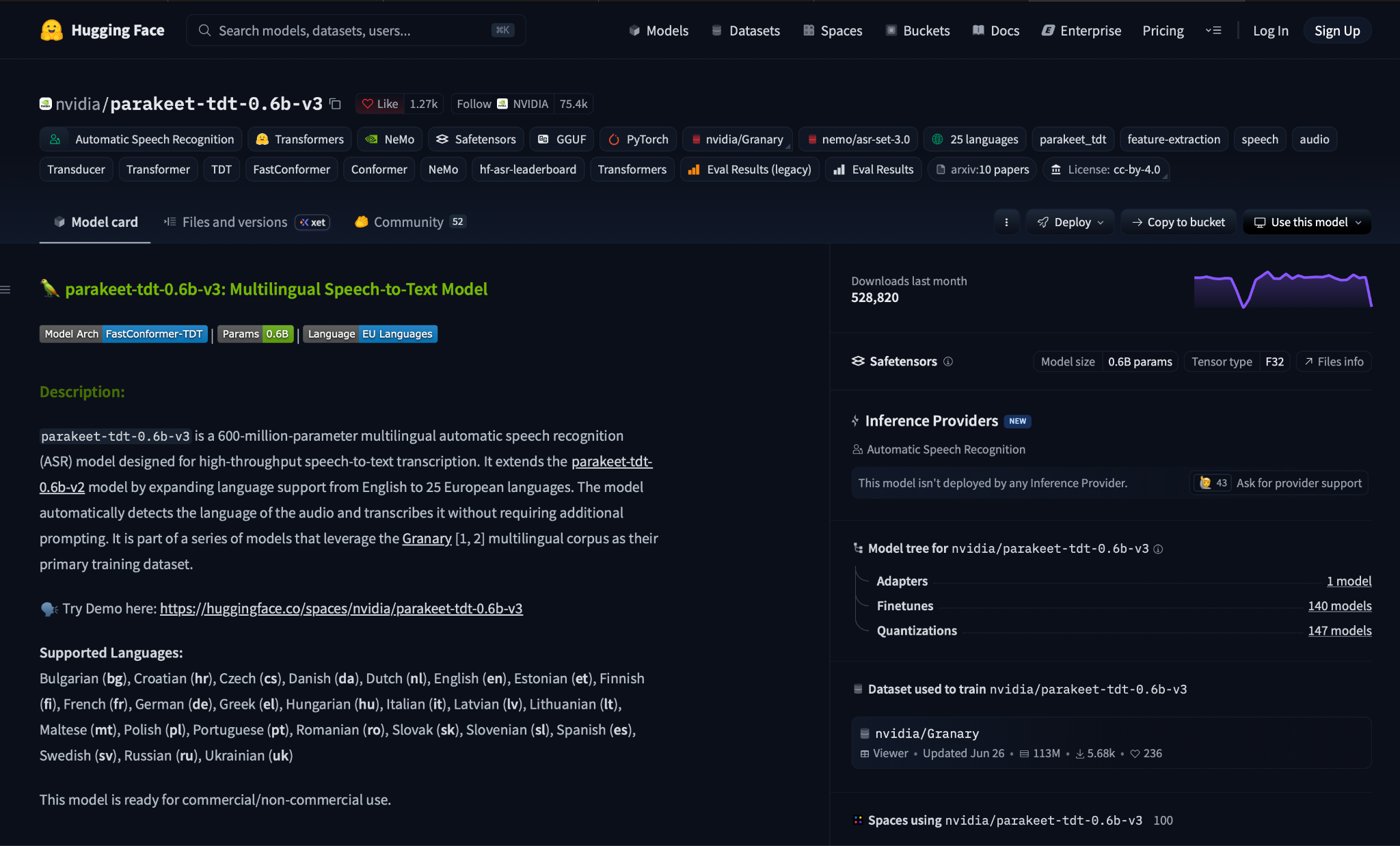
The Parakeet TDT 0.6B v3 model card on Hugging Face.
Parakeet and Canary are the open-source speech-to-text models to look at when you want to leave Whisper's architecture altogether. Both ship under CC-BY-4.0 and run on NVIDIA's NeMo framework.
Cekura hasn't tested Parakeet or Canary. It has tested Nemotron 3.5 Transcribe, a newer NVIDIA open-weights model, at 2.28% overall WER, which gives a rough sense of where NVIDIA's current open models land. The figures below come from NVIDIA's model cards.
Key features
-
Parakeet TDT 0.6B v3: A 600-million-parameter model for 25 European languages that detects the language on its own. NVIDIA reports a 6.34% average WER on the English Open ASR Leaderboard datasets.
-
Long files in one pass: Up to 24 minutes with full attention on an A100 80GB, or up to three hours with local attention.
-
Canary 1B v2: Transcribes the same 25 languages and translates to and from English. NVIDIA lists a 7.15% mean WER on the English Open ASR sets.
-
Canary Qwen 2.5B: English only, at 5.63% mean WER on the same sets, with an LLM mode that summarizes or answers questions about the transcript.
Pros
✅ The earlier English-only Parakeet v2 card reports an RTFx of 3,380 at batch size 128, meaning 3,380 seconds of audio per second of compute.
✅ Parakeet loads in as little as 2 GB of RAM.
✅ Word-level and segment-level timestamps with punctuation and capitalization.
Cons
❌ 25 European languages, compared with Whisper's 98.
❌ The cards list Linux as the supported operating system, and Canary's timestamps need NeMo's main branch.
❌ Streaming on Parakeet v3 runs through a chunked NeMo script (the model card’s example uses 2-second chunks), and Canary has no documented streaming mode. Canary Qwen was trained on audio of 40 seconds or less.
Best for
-
Large English or European-language archives processed in bulk.
-
Organizations already running NVIDIA GPUs and NeMo.
-
Pipelines that want transcription and translation from one checkpoint.
Pricing
The weights are free under CC-BY-4.0, which requires attribution. Compute is yours.
10. Mistral Voxtral
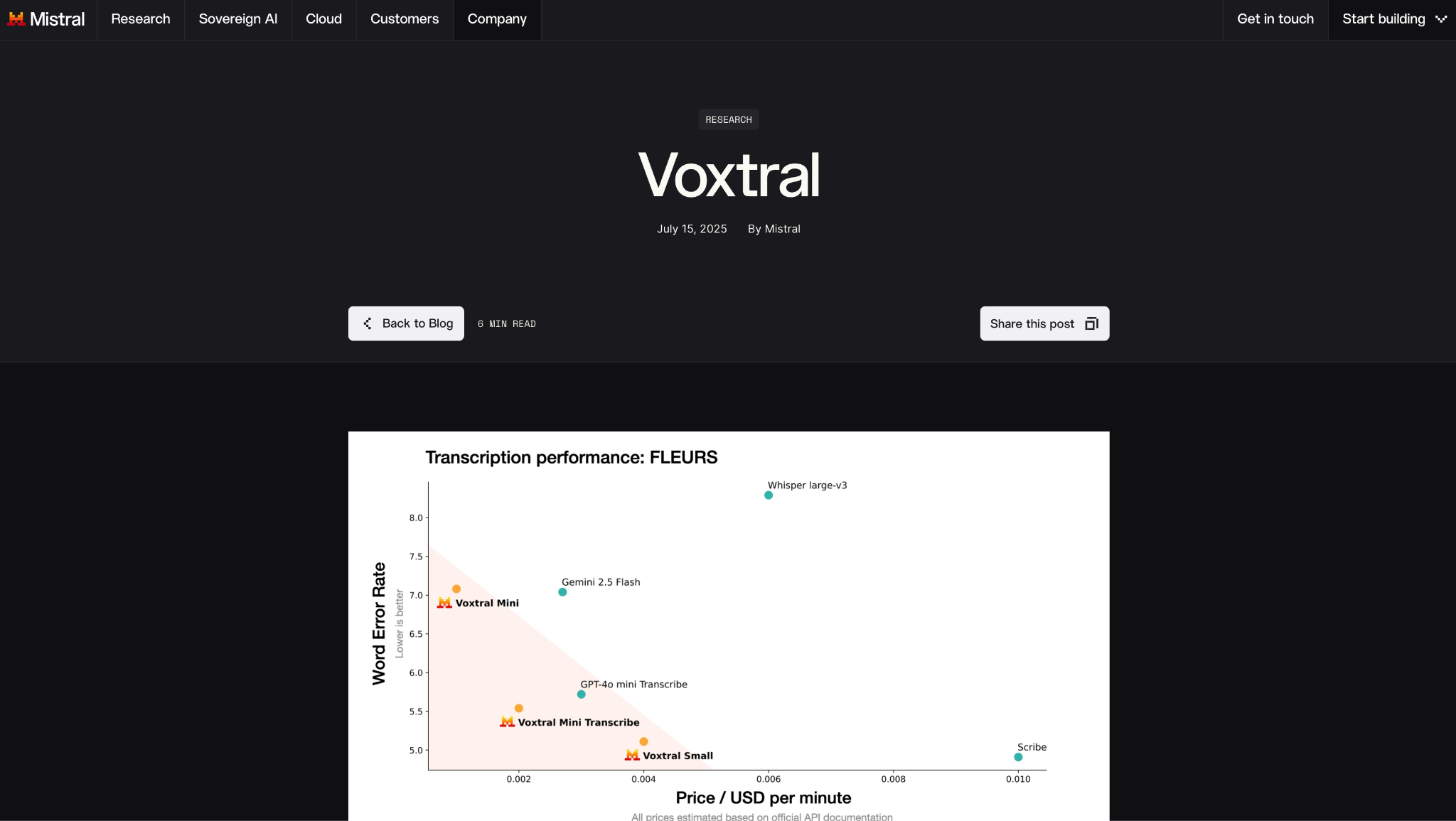
Voxtral now comes in two forms: open weights you can host and a newer family, Voxtral 3, that Mistral sells through its API and for self-deployment.
The Apache 2.0 weights come from two releases. The July 2025 release has a 3B and a 24B model that also answer questions, summarize, and call functions. Voxtral Realtime followed in February 2026.
Voxtral 3, which Mistral's docs list on October 20, 2026, runs on Mistral's API or as a self-deployment on your own infrastructure. The announcement doesn't mention open weights, and no Voxtral 3 checkpoint appears in Mistral's Hugging Face collection.
Mistral's Voxtral 3 announcement says Voxtral Small Transcribe 3 outperforms Whisper. That's Mistral's claim on its own evaluation, and Cekura hasn't tested any Voxtral model.
Key features
-
Voxtral Realtime, open weights: An Apache 2.0 streaming model for 13 languages, with a transcription delay you configure up to 2.4 seconds. The model card recommends 480 ms.
-
Speech understanding in the same model: Voxtral Mini 3B (July 2025) handles up to 30 minutes of audio for transcription or 40 minutes for questions, in a 32k-token context.
-
Voxtral 3 for files, over the API: Voxtral Mini Transcribe 3 and Voxtral Small Transcribe 3 cover 50 languages, with speaker diarization and context biasing.
-
Voxtral 3 for live audio: Voxtral Mini Transcribe Realtime 3 streams in over 35 languages, per Mistral's announcement, and adds turn detection.
Pros
✅ Apache 2.0 on the 2025 weights and on Voxtral Realtime.
✅ Open weights that stream, which Whisper's don't.
✅ Mistral's card puts the original Mini model at about 9.5 GB of GPU RAM.
Cons
❌ The open weights cover 13 languages on Voxtral Realtime, compared with more than 35 on Realtime 3, which ships through the API or self-deployment without public weights.
❌ Voxtral 3 models are labeled Public Preview in Mistral's docs.
❌ Mistral's card for the open Realtime model reports an 8.72% average FLEURS WER at the 480 ms delay, compared with 5.90% for its batch model, Voxtral Mini Transcribe 2.0, and the model needs a single GPU with at least 16 GB of memory.
Best for
-
Products that summarize or query calls right after transcribing them.
-
An Apache-licensed streaming model on your own GPUs.
-
Low-cost API transcription across the 50 languages Voxtral 3's file models cover.
Pricing
Open weights are free. Mistral’s Voxtral 3 announcement lists Voxtral Mini Transcribe 3 at $0.0035 per minute, Voxtral Small Transcribe 3 at $0.004, and Voxtral Mini Transcribe Realtime 3 at $0.008.
The February 2026 announcement listed Voxtral Mini Transcribe V2 at $0.003 per minute and Voxtral Realtime at $0.006.
Test your Whisper alternatives on your own calls
Use the leaderboard to narrow ten options to two, then run both on your own calls to see how each handles your callers' accents and your product names.
Scores move a lot between audio types. AssemblyAI went from 1.77% WER on short public clips to 4.50% on the phone-call set, and GPT-4o Transcribe from 3.90% to 12.45%.
Transcription is one stage of a voice agent. A wrong word costs you when it changes what the agent does next, like an appointment booked on the wrong day or a refund sent to the wrong order.
Cekura tests what happens after the transcript by running simulated callers against your agent end-to-end and scoring each call against the outcome you expected.
Cekura works at three stages:
-
Pre-production: Testing across 30+ languages and accents, plus A/B Testing that runs two versions of your agent, such as one per speech-to-text provider, through the same scenarios.
-
Infrastructure: Test calls can carry background noise, and Cekura scores interruptions and silences while logging latency on every agent turn.
-
Observability: Production calls are scored with pre-defined and custom metrics, and smart alerting flags anomalies. A failed call can be replayed in simulation to reproduce the problem.
Cekura plugs into Retell, Vapi, ElevenLabs, LiveKit, Pipecat, and more.
Cekura supports SOC 2, HIPAA, and GDPR compliance, covering transcript redaction, role-based access, and audit trails.
If you've narrowed this list to two models, book a demo, and we'll run the same simulated calls through both, so you can compare how often each one reaches the expected outcome before whisper-1 leaves the API on February 26.
Frequently asked questions
Is there anything better than Whisper?
Yes, compared with GPT Realtime Whisper, the closest OpenAI entry in Cekura’s benchmark. In Cekura's STT benchmark, ElevenLabs Scribe v3 Live posted 1.89% overall WER, ahead of 2.63% for GPT Realtime Whisper.
ElevenLabs, AssemblyAI, Speechmatics, and Deepgram returned final text 3.7 to 9.5 times faster.
whisper-1 and the open large-v3 weights weren't in that test, so there's no direct accuracy comparison with them. Whisper's open weights still lead the free options on language coverage, at 98 languages per OpenAI's docs.
What to use instead of Whisper?
Use ElevenLabs Scribe or AssemblyAI for a managed API, faster-whisper to keep Whisper’s weights on your own GPU, or NVIDIA Parakeet to leave the Whisper architecture. If you’d rather stay with OpenAI, its deprecations page points to gpt-transcribe and gpt-live-transcribe.
If audio must stay in your environment, use self-hosted weights. faster-whisper and whisper.cpp keep Whisper's model, while NVIDIA Parakeet and Mistral Voxtral replace it.
Is OpenAI shutting down Whisper?
Partly. OpenAI is removing the hosted whisper-1 model from its API on February 26, 2027, according to its deprecations page.
The open-source Whisper code and weights stay MIT-licensed on GitHub and keep working on your own hardware after that date.
What is the best open-source Whisper alternative?
The best open-source Whisper alternative is faster-whisper, if you want to keep Whisper’s model. It uses the same weights and, by its own README, runs up to four times faster.
If you'd rather switch models, NVIDIA Parakeet TDT 0.6B v3 is a different architecture for 25 European languages, and Mistral's Voxtral Realtime is an Apache 2.0 model that streams. None of the three appears in Cekura's benchmark.
Does Whisper support real-time transcription?
No, not out of the box. OpenAI’s speech-to-text guide states that whisper-1 doesn’t support streaming, and the open-source model card says Whisper models "cannot be used for real-time transcription out of the box." For live use, you either build a chunking layer or switch to a streaming model.