
Insurance calls carry legal weight that a demo never shows. I compared seven Vocara AI alternative platforms on published pricing, AMS integration depth, consent controls, and reviewer feedback.
Three stood out. Thoughtly leads for agencies converting aggregator leads, Sonant AI for P&C intake wired into your AMS, and Retell AI for engineering groups that want the call logic in their own hands.
My comparison covered each vendor's live pricing pages, AMS and CRM connector lists, named G2 and Capterra reviews, and how each platform handles the federal consent rules that govern AI-generated calls.
Below you'll find what each platform does well, where the fit runs out, and who each one serves, plus the consent and liability questions that matter more in insurance than in any other vertical.
7 best Vocara alternatives: TL;DR
- Thoughtly: Best for agencies working EverQuote or QuoteWizard leads where speed-to-lead decides the bind.
- Sonant AI: Best for independent P&C agencies that want intake synced to EZLynx, Applied Epic, or HawkSoft.
- Dialora: Best for smaller agencies that want published flat pricing and a fast setup.
- Retell AI: Best for insurtech engineering groups building custom call logic through an API.
- Bland AI: Best for high-volume outbound programs that want a fully self-hosted model stack.
- PolyAI: Best for carriers routing heavy inbound service volume through an existing contact center.
- Regal: Best for B2C revenue operations pairing AI agents with human reps in one outbound system.
Why look for Vocara alternatives?
The platform converts inbound calls and data leads into quoted, ready-to-bind opportunities for agencies, carriers, and aggregators. Vocara states on its site that it has already solved TCPA compliance, number health, and E&O claim avoidance. The founders come out of MIT and focus on one funnel with real depth.
The search for a Vocara alternative usually starts with fit, and four fit questions come up repeatedly.
- Vendor stage: Vocara's own company page lists eight named team members, and the founders told Scout InsurTech they raised $6.6 million from Felicis Ventures after graduating from MIT in May 2025. Procurement review at a carrier moves slowly for a vendor that young, and reference calls are hard to schedule when the customer list is still forming.
- Scope stops at the sales funnel: Intake, cross-sell, and renewal outreach are covered. Claims calls, FNOL, and routine policy service sit outside the product, so agencies handling those flows need a second system.
- No self-serve path: Evaluation runs through a sales conversation, with no published pricing and no trial account. Agencies that want to hear an agent on a live line this week will move faster elsewhere.
- Insurance-only by design: The vertical focus is the pitch. It also means an agency running home services or healthcare lines alongside insurance cannot consolidate onto one platform.
Which Vocara alternative should you choose?
Choose Thoughtly if you buy aggregator leads and need every form fill called inside a minute. Engineering-heavy embedded use cases are a weaker fit, since the platform targets operators over developers.
Choose Sonant AI if you run an independent P&C agency and your AMS is the system of record. It answers and qualifies inbound; it will not run your outbound sales campaigns.
Choose Dialora if you want flat monthly pricing you can budget without a sales call. Deep enterprise governance requirements will outgrow it.
Choose Retell AI if you have engineers and want component-level control of voice, model, and telephony. Budget real build time, because the API is the product.
Choose Bland AI if you run outbound at serious volume and want one vendor owning the whole model stack. Costs need active monitoring, since usage billing stacks across calls, transfers, and SMS.
Choose PolyAI if you are a carrier automating inbound service at contact-center scale. Smaller agencies will find the managed enterprise motion heavier than they need.
Choose Regal if your revenue org blends AI agents with human reps on outbound campaigns. Pure inbound reception is outside its center of gravity.
Stick with Vocara if insurance sales is your entire book, you want conversion outcomes owned by the vendor, and working with an early-stage partner suits your risk appetite.
7 best Vocara alternatives: at a glance
| 🏆 Platform | 🎯 Best for | ⚖️ Consent controls | 🔌 AMS / CRM fit | 💰 Price |
|---|---|---|---|---|
| Thoughtly | Aggregator lead conversion | Platform-level call logic | Salesforce, HubSpot, 200+ tools | From $0.05/min |
| Sonant AI | P&C agency intake | Inbound-first posture | EZLynx, Applied Epic, AMS360, HawkSoft, Momentum, QQCatalyst | Custom |
| Dialora | Budget-fixed small agencies | SOC 2 Type II posture | Salesforce, HubSpot | From $49/mo |
| Retell AI | Developer-built agents | You build the consent layer | API + webhooks to any CRM | From $0.07/min |
| Bland AI | Self-hosted outbound at scale | Enterprise controls | API-driven | ~$0.11/min + plan fee |
| PolyAI | Carrier contact centers | Managed enterprise governance | CCaaS and CRM integrations | Custom |
| Regal | Outbound revenue operations | Consent tooling for B2C sales | CRM-driven journeys | Custom |
Pricing correct as of July 2026. Verify with each vendor.
How to evaluate Vocara alternatives
Six criteria decide this, and they reflect the questions insurance buyers actually face.
Where consent and disclosure logic lives
The FCC's February 2024 Declaratory Ruling confirmed that AI technologies generating human voices fall under the TCPA's artificial-voice restrictions, so AI calls require prior express consent. The full ruling text covers voice cloning and wholly simulated voices alike.
Ask each vendor one question. Are consent checks, calling windows, and DNC scrubbing enforced in the platform's call logic, or do they depend on prompt wording an engineer can edit on a Tuesday afternoon?
Cekura replays consent and disclosure scenarios against the live agent on whichever platform you pick, so the answer to that question gets tested rather than trusted.
Who carries the liability?
TCPA liability attaches to the calling business and the seller, never to the tooling vendor. Statutory damages under 47 U.S.C. § 227 run $500 per violation, with no aggregate cap. For willful or knowing conduct, a court may, in its discretion, increase the award up to three times that amount, or $1,500 per violation.
The consent landscape also shifted recently. The Eleventh Circuit vacated the FCC's one-to-one consent rule in Insurance Marketing Coalition v. FCC in January 2025, days before its effective date.
The FCC later deleted the vacated language, effective August 29, 2025. Bundled lead consent remains permissible federally, while individual states run stricter regimes.
TCPA liability under 47 U.S.C. § 227(b)(1) runs to whoever initiates the call. Who counts as the initiator is a fact question, and the statute writes in no exemption for tooling vendors.
AMS and CRM integration depth
An agent that cannot write to Applied Epic, AMS360, EZLynx, or HawkSoft creates re-keying work for the staff it was supposed to relieve. Confirm sync direction and speed, since one-way batch sync and real-time two-way write-back are different products wearing the same label.
Speed-to-lead measurement
Vendors quote response times; few let you audit them. Ask for call-initiation timestamps in the platform's own reporting, so you can verify the sub-60-second claim against your CRM's form-fill records.
Vendor maturity and reference availability
Headcount, funding stage, and named customers are procurement data, and they vary wildly across this list. A four-person startup and a carrier-grade enterprise vendor carry different SLA realities, whatever the demo looks like.
Post-deployment validation
Every platform on this list demos beautifully. Cekura's Voice Orchestration Benchmarks ran one byte-identical agent across six platforms and found a 33.3-point spread in Workflow Complexity and Recovery, from Retell at 95.2% to ElevenLabs at 61.9% pass^3. Platform choice moves multi-step recovery more than prompt wording does.
The 7 best Vocara alternatives
1. Thoughtly
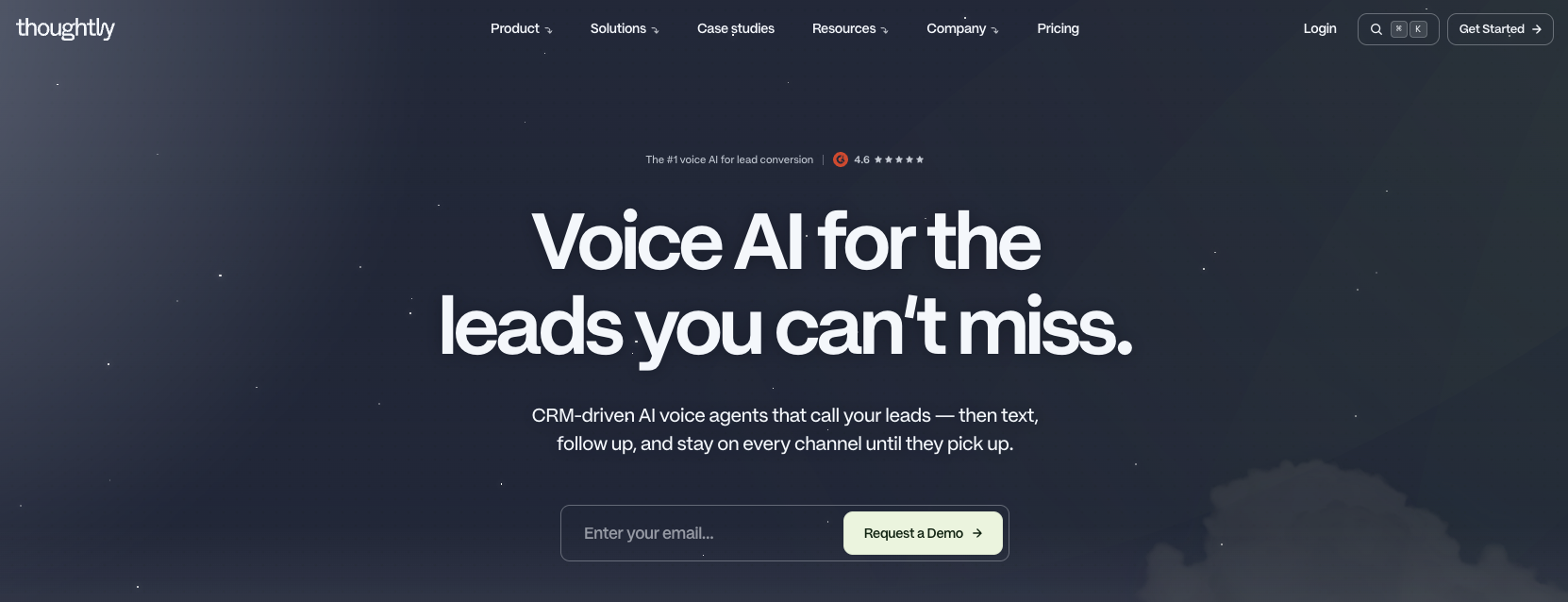
Thoughtly is the strongest pick for agencies whose economics live and die on speed-to-lead. The New York platform, which says it serves 1,000+ GTM teams, calls every new lead across voice, SMS, and email from one agent configuration and writes each outcome back to the CRM.
Key features
- Sub-60-second lead response: New form fills get called before a competing producer opens the queue, per Thoughtly's published workflow.
- Two-way CRM sync: Outcomes land in Salesforce or HubSpot the moment a call ends, tagged automatically.
- Multi-channel fallback: Unanswered calls trigger SMS and email follow-up from the same agent.
- Compliance in call logic: Time-of-day windows and DNC scrubbing run at the platform level, per its re-engagement documentation.
Pros
✅ Fastest documented speed-to-lead motion in this comparison.
✅ Voice, SMS, and email run from one configuration, so follow-up needs no second tool.
✅ Thoughtly displays a 4.6 rating in its own homepage hero.
Cons
❌ Initial configuration of triggers and in-call actions draws setup-time complaints from reviewers.
❌ Programmatic or embedded agent building sits outside its sweet spot, per Thoughtly's own FAQ.
Best for
- Agencies buying data leads from aggregators where response time decides the quote.
- Operations staff who need deployment without an engineering project.
Pricing
Per-minute pricing starts at $0.05, with custom quotes for volume. Model your expected minutes before signing, since monthly cost scales directly with call time.
2. Sonant AI
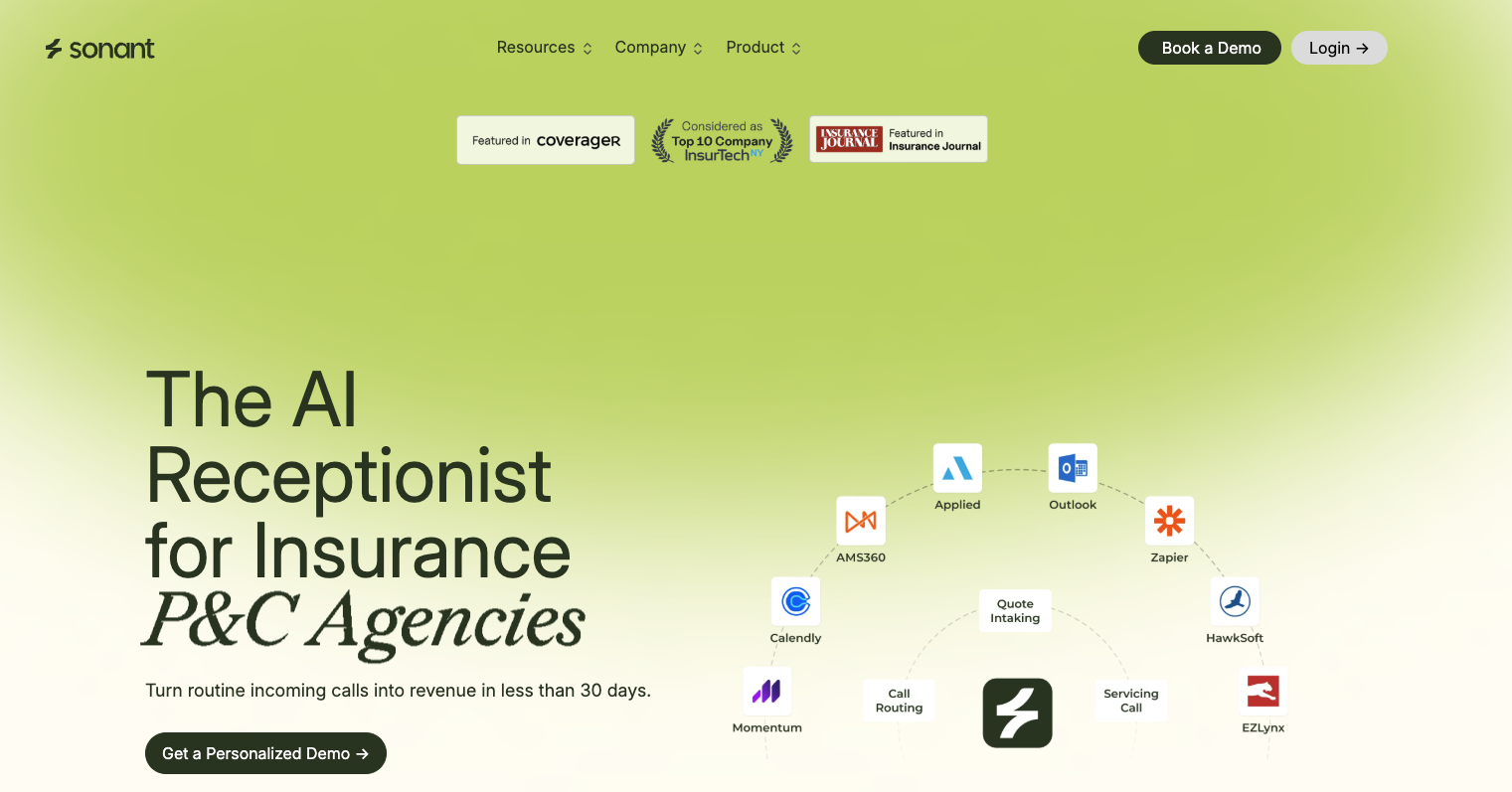
Sonant AI is the alternative built closest to how an independent P&C agency actually runs. It answers inbound calls around the clock, qualifies quote requests, schedules appointments, and writes summaries into the agency management system.
The AMS list is the differentiator. Sonant integrates with EZLynx, Applied Epic, AMS360, HawkSoft, Momentum, and QQCatalyst, and reports 100+ independent P&C agencies across the US and Canada on the platform.
Vendor-published results skew favorably by nature, so treat them as directional. Sonant reports one client, O'Connor Insurance, reaching 8X ROI with over 90% call handling accuracy in its first month.
Key features
- AMS write-back: Quote intake and caller data land in the agency record without manual entry.
- Insurance-trained conversation design: The agent handles policy-type vocabulary and servicing inquiries out of the gate, per Sonant's own product pages.
- Caller recognition: Returning policyholders get identified and routed with context.
- Multilingual answering: Coverage extends past English without a separate configuration.
Pros
✅ Deepest AMS coverage of any platform in this comparison.
✅ Purpose-built for P&C workflows, so setup skips generic prompt engineering.
✅ All-inclusive pricing covers setup, integrations, and support with no per-feature charges.
Cons
❌ Inbound-first design, so outbound lead activation campaigns need another tool.
❌ No published price card, which slows budget comparison against flat-rate rivals.
Best for
- Independent P&C agencies missing after-hours calls.
- Offices where the AMS is the single source of truth and re-keying data is the pain.
Pricing
Custom, based on agency size and call volume. Book a demo for a quote, and ask for the full cost including onboarding.
3. Dialora
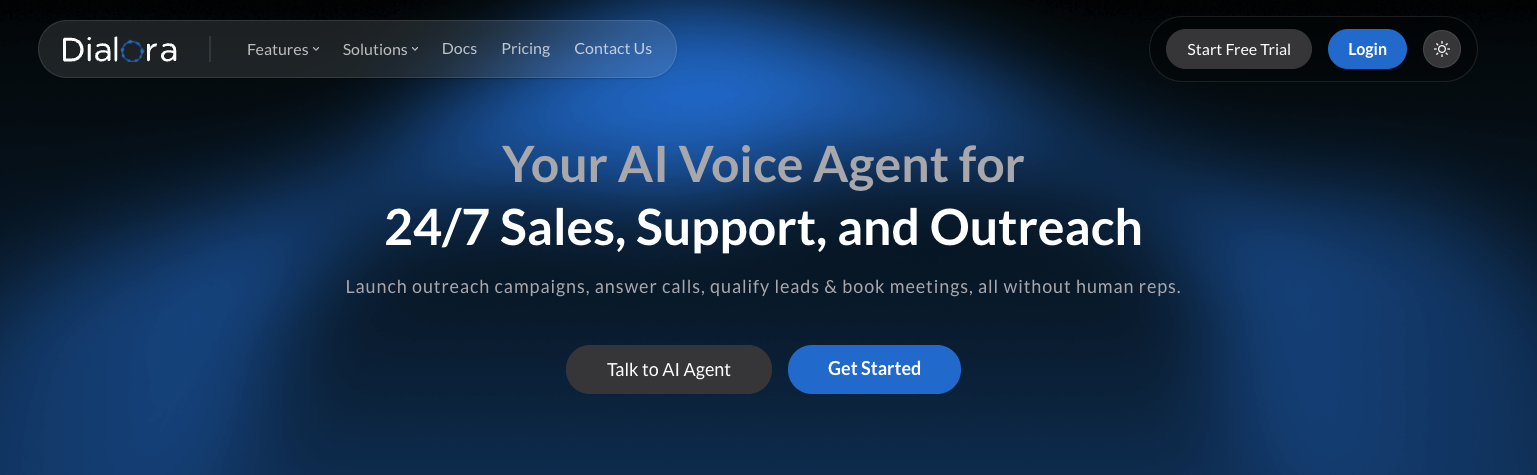
Dialora wins on price transparency in a category that hides its numbers. The platform publishes flat monthly tiers, ships an insurance-specific configuration, and gets a small agency live without an implementation project.
Plans run $49 per month for Starter, $97 for Pro, $149 for Business, and $297 for Agency, with a free trial on entry. Overage minutes range from $0.10 to $0.15 depending on tier.
Key features
- Flat monthly plans: Costs stay predictable at steady call volume, with overage rates published upfront.
- Inbound and outbound coverage: Appointment setting, lead qualification, reminders, and follow-ups run from one account.
- CRM connectors: Salesforce and HubSpot integrations move caller data into existing pipelines.
- Post-call analysis: Every call gets summarized and scored, on every plan tier.
Pros
✅ Cheapest verified entry price in this comparison at $49 per month.
✅ Free trial on every tier, with Starter capped at 200 monthly minutes.
✅ Vendor states SOC 2 Type II and PCI DSS coverage, a claim Dialora makes only in its own blog copy, with no trust page or certificate published.
Cons
❌ AMS connectivity trails Sonant, so Applied Epic or AMS360 sync may need middleware.
❌ Horizontal platform serving eleven industries, so insurance depth is a template, and templates have limits.
Best for
- Solo producers and small agencies budgeting under $100 per month to start.
- Offices that want to trial on live calls before any sales conversation.
Pricing
$49 to $297 per month across four tiers, plus custom enterprise.
4. Retell AI

Retell AI is the build-it-yourself option for insurtechs with engineers on staff. The platform exposes the full voice stack through an API, so your engineers own conversation logic, model choice, and telephony routing.
The pricing is honest and composite. Retell publishes $0.07 to $0.31 per minute for AI voice agents. The Retell voice infrastructure component runs $0.055 per minute. Retell's own estimator prices a default stack with Retell Twilio or Telnyx telephony at $0.130 per minute. New accounts get $10 in credits and 20 free concurrent calls.
HIPAA coverage is available on the standard pay-as-you-go plan, a rarity confirmed on Retell's own website.
Key features
- Component-level control: You pick the LLM, the voice, and the telephony route, and each carries a published rate.
- Programmable call flows: Consent scripts, state-specific disclosures, and transfer logic live in your code.
- Published telephony rates: US calls through the Twilio route run $0.015 per minute, with bring-your-own SIP supported.
- Enterprise tier: Managed setup and dedicated support for organizations without in-house builders.
Pros
✅ Full control over consent and disclosure logic, which matters when your lawyers write the script.
✅ Transparent per-component rates make cost modeling possible before launch.
✅ HIPAA availability without an enterprise contract.
Cons
❌ Consent enforcement is yours to build, and yours to defend.
❌ Add-ons meter separately, with extra concurrency at $8 per slot per month and US calls through Retell's Twilio or Telnyx routes at $0.015 per minute.
Best for
- Insurtech product groups embedding voice into their own software.
- Agencies with engineering support that outgrew no-code flow builders.
Pricing
Pay-as-you-go from $0.07 per minute for the voice layer; budget $0.13 to $0.31 all-in. The enterprise tier has custom pricing.
5. Bland AI
Bland AI takes the opposite bet from every other platform here: own the whole stack. Bland states every model is custom-made for phone calls and that your data never goes through third parties. Self-hosted and on-premises deployments are available for the most sensitive workloads.
For an insurance compliance office, that architecture answers a data-governance question before it gets asked. The tradeoff is model choice, since you cannot swap in your preferred LLM.
Cost needs watching. Rates run $0.14 per minute on the entry plan, dropping to $0.11 per minute on the Scale plan at $499 per month. Transfers, SMS, and add-ons each meter separately, so effective cost per completed conversation climbs with human escalation.
Key features
- Self-hosted model stack: Speech, reasoning, and voice run on Bland's own infrastructure, with roughly 400 ms vendor-reported latency.
- Programmatic pathways: Engineers script conversation trees with live tool actions like SMS sends and bookings.
- Tiered plans: Start, Build, Scale, and Enterprise map to concurrency and volume needs.
Pros
✅ Caller audio stays inside one vendor's infrastructure, with on-premises deployment available.
✅ Built for outbound volume that would swamp per-seat platforms.
✅ SOC 2 Type I and Type II, HIPAA, and PCI DSS certifications per Bland, with BAAs and DPAs in place.
Cons
❌ Usage billing across calls, transfers, and SMS makes monthly forecasting genuinely hard.
❌ No bring-your-own-model path if your ML preferences differ from Bland's.
Best for
- Carriers and aggregators running outbound at volumes where infrastructure control pays off.
- Compliance environments that require caller audio to stay inside one vendor.
Pricing
$0.14 per minute on Start with no platform fee, $0.12 on Build at $299 per month, and $0.11 on Scale at $499 per month; Enterprise is custom. Model transfer and SMS volume before comparing against flat-rate rivals.
6. PolyAI
PolyAI serves the carrier end of the market that most platforms on this list never touch. It deploys managed voice agents into enterprise contact centers, handling high-volume service calls with human handoff that preserves conversation context.
The buying motion matches the buyer. PolyAI does not publish pricing, scopes each contract through sales, and runs structured onboarding with ongoing optimization managed by its own staff.
Key features
- Managed deployment: PolyAI's people build and tune the agent, which cuts internal engineering load to near zero.
- Contact-center handoff: Escalations transfer with context to live agents through CCaaS integrations.
- Operational reporting: Containment rates and escalation trends surface in dashboards built for center leadership.
- Compliance by default: PolyAI states every agent ships governed with SOC 2, HIPAA, GDPR, and PCI DSS as standard.
Pros
✅ Proven at call volumes that would strain self-serve platforms.
✅ Minimal engineering dependency, since deployment is a managed service.
✅ Strong conversational accuracy across messy, multi-intent service calls.
Cons
❌ Enterprise pricing and onboarding cycles put it out of reach for independent agencies.
❌ Managed model reduces direct control over conversation logic between optimization cycles.
Best for
- Carriers automating policy service, billing inquiries, and claims status at scale.
- Contact-center leaders who want an accountable vendor over an internal build.
Pricing
Custom, sales-scoped contracts. Bring call-volume data to the first conversation to get a usable number.
7. Regal
Regal approaches insurance from the outbound sales side, where Vocara itself plays. The platform combines AI phone agents with human rep workflows in one system, built for B2C revenue operations running high-touch consumer sales.
That dialer heritage matters for consent posture. Regal publishes TCPA consent language on its own call-request form, and its product page lists SOC 2, HIPAA, GDPR, CCPA, and TCPA.
Key features
- Blended AI and human journeys: AI agents qualify and route; human producers close, inside one sequenced workflow.
- CRM-triggered outreach: Journeys fire off CRM events, so a quote request or renewal date starts the sequence automatically.
- Branded outreach: Caller identity tooling supports answer rates on outbound dials.
- Enterprise motion: No published pricing; contracts are scoped to volume and seat mix.
Pros
✅ Purpose-built for the AI-plus-human blend that most insurance sales floors actually run.
✅ Journey logic ties call timing to CRM state, which suits renewal and cross-sell campaigns.
✅ Solves outbound B2C sales deeply.
Cons
❌ Positioned around the whole contact center, so an agency wanting only outbound lead activation buys more platform than it needs.
❌ Sales-scoped pricing makes early-stage budget comparison slow.
Best for
- Revenue operations at carriers and large agencies blending AI qualification with human closing.
- Outbound programs where journey orchestration matters as much as the voice itself.
Pricing
Custom enterprise contracts. Ask how AI-agent minutes and human-seat licenses price separately.
The conversion rate is the easy part
Picking a Vocara alternative takes an afternoon of demos. Proving the agent still holds its consent script, still logs the disclosure, and still routes correctly six prompt revisions later takes months. The testing each platform ships grades its own homework, and the consent script you are accountable for needs a check from outside the stack that runs it
That verification layer is what Cekura adds on top of whichever platform you pick, backed by the same fixed-harness benchmarks that measured the platforms above.
Pre-production
- Scenario simulation: Thousands of simulated callers hit your agent with accents, interruptions, and off-script requests before a single real policyholder does.
- Red teaming: Adversarial runs probe whether the agent can be talked out of its consent script or into unauthorized disclosures.
Infrastructure
- Latency and interruption tracking: Voice quality testing pinpoints where response delays and talk-over failures originate in the stack.
Observability
- Production call QA: Voice observability flags compliance-step drift in live calls, so a skipped disclosure surfaces as an alert, never as a demand letter.
- Regression suites: Every prompt or model change triggers the full test suite before the change reaches a live caller.
Native integrations work out of the box for Retell, VAPI, ElevenLabs, LiveKit, Pipecat, Bland, and more. You don't rebuild anything. You add a testing and monitoring layer on top of what you already have. Retell, VAPI, LiveKit, and Pipecat are Cekura integration partners.
Cekura supports SOC 2, HIPAA, and GDPR compliance, covering transcript redaction, role-based access, and audit trails.
Running an insurance voice agent, or about to pick one? Schedule a demo to see what your agent does when a caller goes off script.
Frequently Asked Questions
What does Vocara do?
Vocara is an insurance-native voice AI platform that converts inbound calls and purchased leads into qualified, quote-ready sales opportunities for agencies, carriers, and aggregators. The company, founded in 2025 by MIT graduates, covers intake, cross-sell, and renewal outreach.
Are AI voice agents legal for insurance outbound calls?
Yes, AI voice agents are legal for insurance outbound calls when the called party has given prior express consent. The FCC's 2024 Declaratory Ruling placed AI-generated voices under the TCPA's artificial-voice rules, so consent, identification, and opt-out requirements all apply.
What is the main difference between vertical and horizontal voice AI platforms?
The main difference between vertical and horizontal voice AI platforms is scope. Vertical platforms like Vocara and Sonant ship pre-built workflows and integrations for one industry. Horizontal platforms like Retell and Bland offer raw infrastructure your engineers configure for any use case.
Which voice AI platforms integrate with Applied Epic and AMS360?
Sonant AI offers the deepest AMS coverage, with native connections to EZLynx, Applied Epic, AMS360, HawkSoft, Momentum, and QQCatalyst. Dialora and Thoughtly connect through CRM integrations, and API-first platforms like Retell reach any AMS through custom middleware.
How do you test an insurance voice agent before launch?
You test an insurance voice agent by running simulated calls across the scenarios real policyholders create: interruptions, accents, background noise, and adversarial callers. Cekura automates this with scenario simulation, red teaming, and regression suites that rerun on every prompt change.