
The best Twilio alternatives are Telnyx for an owned carrier network, Plivo for low-cost SIP trunking, and SignalWire if you want to move existing Twilio code with the fewest changes.
I read the live pricing and documentation pages for all 10 platforms on October 27, 2026, then set each rate against what Twilio charges today. I didn't place test calls through any of them, so the verdicts below are based on published rates and docs.
10 best Twilio alternatives: TL;DR
-
Telnyx: Best for voice AI teams that want the carrier and voice AI runtime on one invoice.
-
Plivo: Best for low-cost SIP trunking in the US and India.
-
Vonage: Best for teams that run video next to voice and SMS.
-
Bandwidth: Best for US-heavy voice with an emergency-calling API.
-
Sinch: Best for SIP trunking on a US network Sinch says it owns.
-
SignalWire: Best for moving existing Twilio code with minimal changes.
-
Infobip: Best for multichannel campaigns across WhatsApp, RCS, and Viber.
-
Bird: Best for sending email, SMS, and WhatsApp from one API.
-
LiveKit SIP: Best for connecting phone lines to LiveKit voice agents.
-
Daily: Best for phone-connected Pipecat agents on managed hosting.
How I compared these Twilio alternatives
Every rate here comes from the vendor's own pricing page, read on October 27, 2026.
I weighed the total monthly cost, approval wait, country coverage, uptime promise, and behavior under a voice agent. Entries flag any “from” or “as low as” rate.
This list covers developer APIs for voice and SMS. Use it to build a shortlist of two, then run your own traffic through both.
Why look for Twilio alternatives?
Teams look past Twilio for four reasons: carrier fees on top of the SMS rate, paid support tiers, slow approvals, and a tight free trial.
Carrier fees and extras add to the SMS rate
Twilio prices US SMS at $0.0083 per segment, then adds outbound long-code carrier fees of $0.0035 for AT&T, $0.0045 for T-Mobile, and $0.005 for Verizon, per its SMS pricing page. A message that ends in "Failed" status costs another $0.001, and a leased long-code number costs $1.15 a month.
Take 1,000 outbound segments to AT&T numbers. They cost $11.80 once the carrier fee is added, compared to $8.30 at the headline rate alone. The carrier fee adds about 42% to the cost.
Support is a paid tier
The free Developer plan gives an estimated 3 business days on every severity, with no guaranteed response time. Production support costs the greater of $250 or 4% of monthly spend, and Business costs the greater of $1,500 or 6%.
At an illustrative $10,000 of monthly usage, that's $400 for Production and $1,500 for Business. A one-hour response on a business-critical issue comes with the Business tier.
Approvals can stall a launch
Trustpilot reviewers describe a slow, unclear approval process. One wrote, "My submission sat in 'pending' status for three months" (Dmitry Grinberg, Trustpilot). Another called the approval process "confusing" (Mike Alkema, Trustpilot).
Two reviews are anecdotes, so ask any vendor on your shortlist for its current approval timeline.
The free trial limits what you can test
Trial accounts get 100 SMS, 100 WhatsApp messages, 3,000 emails, and 75 voice minutes for 30 days. Messages and calls go only to verified numbers, up to 5 per account, and you must use Twilio-provided templates.
Plivo gives $10 in free credit with no card required, and LiveKit's Build plan costs $0 a month.
Which Twilio alternative should you choose?
Your use case decides the choice, and the 4 groups below cover developer APIs, high-volume US voice, global omnichannel, and voice AI agents.
Developer APIs for voice and SMS
Go with Telnyx if you want carrier ownership and voice AI on one invoice and can wait through account verification. Its voice and messaging rates are "from" figures, so confirm the rate for your countries first.
Pick Plivo if voice cost per minute decides the budget. SMS requires its Enterprise plan, from $1,000 a month, so check that cost before you migrate messaging.
Take SignalWire if the priority is moving working Twilio code quickly. Its voice AI runtime at $0.16 a minute costs more than Telnyx or Plivo.
Vonage makes sense if video runs next to voice and SMS in your stack. Its US voice rates, from $0.00485 a minute inbound and $0.00849 outbound, come in under Twilio’s.
High-volume US voice
Choose Bandwidth if you run US-heavy inbound traffic and need an emergency-calling API. Anything beyond usage rates requires a quote.
Start with Sinch if you want elastic SIP trunking or bring-your-own-carrier on a US network Sinch says it owns. Voice API rates are in a downloadable price list, and the SIP trunking pages don’t publish rates.
Global reach and omnichannel
Shortlist Infobip if the campaign spans WhatsApp, Viber, RCS, and SMS. Rates are listed by country, and subscription pricing comes through sales.
Try Bird if email, SMS, and WhatsApp should come from one API with a CLI and MCP server. Voice rates need a separate lookup.
Voice AI agents
Use LiveKit SIP if your agents already run on LiveKit and you'll keep your current carrier. Its plans include a US local number for inbound calls, and LiveKit documents no SMS.
Daily works if you run Pipecat agents and want PSTN and SIP on the same hosting bill. Dial-out needs approval, and start requests are capped at 4 per rolling 5 seconds.
When to stay on Twilio
Stick with Twilio if you need a paid support tier with stated response times and a service credit for missed uptime, and you already know its approval path. Its API SLA promises 99.95% availability (99.99% on Enterprise Edition months).
10 best Twilio alternatives: at a glance
The table below puts all 10 side by side, with links to each tool and its pricing page.
| Tool | Best for | Starting Price |
|---|---|---|
| Telnyx | Owned carrier network | From $0.002/min voice API plus SIP trunking, $0.004/SMS |
| Plivo | Lowest outbound voice rate | From $0.0046/min outbound (US local SIP) |
| Vonage | Voice, SMS, and video | From $0.0086/SMS, $0.00485/min voice |
| Bandwidth | US voice and 911 | From $0.0055/min inbound, $0.004/SMS |
| Sinch | SIP trunking in the US | From $0.0078/SMS (10DLC) |
| SignalWire | Twilio code migration | From $0.0066/min inbound, $0.00415/SMS |
| Infobip | Multichannel campaigns | Per-country rates, pay as you go |
| Bird | Email, SMS, WhatsApp | From $0.0035/US SMS segment (example rate) plus carrier fees |
| LiveKit SIP | Phone lines for agents | $0/month Build, from $50/month Ship |
| Daily | Pipecat phone agents | From $0.018/min PSTN |
Pricing verified against each vendor's own page on October 27, 2026. Verify with the vendor before you commit.
US voice and SMS rates side by side
Twilio comes first as the reference point. Every figure is a published starting rate before taxes, and SMS rates exclude carrier fees unless noted.
| Platform | US voice, inbound | US voice, outbound | US SMS |
|---|---|---|---|
| Twilio (local numbers) | $0.0085/min | $0.0140/min | $0.0083/segment, plus carrier fees |
| Telnyx | About $0.0052/min ($0.002 API + $0.0032 SIP) | About $0.007/min ($0.002 API + $0.005 SIP) | From $0.004/message part |
| Plivo | $0.0055/min (Voice API), $0.0028 SIP | $0.0115/min (Voice API), $0.0046 SIP | From $0.0077 (Enterprise only) |
| Vonage | From $0.00485/min | From $0.00849/min | From $0.0086, plus carrier fees |
| Bandwidth | $0.0055/min | $0.0100/min | $0.004 (10DLC) |
| Sinch | Pricelist download | From $0.01/min (pricelist download) | $0.0078 (10DLC) |
| SignalWire | $0.0066/min | $0.0080/min | $0.00415 (10DLC), plus carrier passthrough |
| Infobip | Country average listed | Country average listed | $0.00818/message (country average) |
| Bird | Not published on main page | Not published on main page | $0.0035 example segment, plus carrier fees |
| LiveKit SIP | US local $0.01/min after included minutes | Bring your own carrier (third-party SIP $0.004/min on Ship) | Not offered |
| Daily | PSTN from $0.018/min | PSTN from $0.018/min | Not offered |
Twilio and Plivo show Voice API rates; Telnyx combines its API fee with SIP trunking; the other rows are each vendor’s own voice rate.
How to evaluate Twilio alternatives
Price your own traffic first, then read the fine print on each shortlist entry.
Total monthly cost: A rate per minute or per segment leaves out carrier fees, number rental, registration charges, and the support tier. Price one full month of your traffic on every shortlist entry and compare the totals.
Approval wait: Telnyx can put staff review on account verification, and Daily requires approval for dial-out. One Trustpilot reviewer reports a 3-month Twilio approval wait. A cheaper rate matters less if launch slips by weeks.
Coverage counts: Bandwidth cites voice in roughly 70 countries, with full PSTN replacement in 38+, and Vonage cites nearly 200 countries and 2,000+ networks.
Telnyx claims 230+ countries for SIP trunking, while Plivo’s pay-as-you-go plan covers the US and India, and its Enterprise plan lists 190+ countries (its Twilio page says 226 for SMS).
Uptime promise: Twilio commits to 99.95% monthly availability on its Services APIs, with a 10% service credit if it misses.
Bandwidth cites 99.999% network uptime, and Plivo advertises a 99.99% uptime SLA. A network uptime number and a service credit are separate promises, so read the credit terms behind each figure.
Behavior under a voice agent: Latency, SIP behavior, DTMF handling, and media streaming each affect what callers hear.
The voice AI section below walks through the same layers by carrier.
The 10 best Twilio alternatives
1. Telnyx
Telnyx puts an owned switch and its voice AI runtime under one vendor. Its SIP trunking page states "Telnyx owns the switch," and its Voice AI page claims a licensed carrier in 45+ countries.
"I love how easy Telnyx is as compared to Twilio, especially the number porting and 10DLC." (Azzaz, Trustpilot)
Key features
-
Voice API: $0.002 a minute for the API in both directions, plus SIP trunking from $0.0032 inbound and $0.005 outbound.
-
SIP trunking: Telnyx claims 230+ countries, plus A-level STIR/SHAKEN attestation on eligible US outbound calls.
-
Voice AI Agents: Speech models and orchestration at $0.05 a minute, with 80+ languages and dialects cited, though its FAQ lists about 30 languages.
-
Number inventory: Local and toll-free numbers from $1 a month.
-
Messaging: SMS from $0.004 per message part, and MMS from $0.015.
Pros
✅ With SIP trunking added, US calls start at about $0.0052 a minute inbound and $0.007 outbound, below Twilio’s $0.0085 and $0.0140.
✅ The compliance page lists SOC 2 Type II as active, and its help center covers GDPR.
✅ SMS at $0.004 per message part is under half of Twilio’s $0.0083 per segment, before carrier fees on both.
Cons
❌ Account verification can include a check by Telnyx staff, and international outbound calling stays locked until Level 2 verification clears.
❌ Voice and messaging rates are "from" prices, so per-country and per-number-type rates live in the portal.
❌ The 15% volume discount starts on the Growth plan at a $2,000 monthly minimum.
Best for
-
Voice AI stacks that put the carrier and speech models on one invoice.
-
SIP routing into LiveKit or Pipecat agents.
-
STIR/SHAKEN A-level attestation on US outbound traffic.
Pricing
Telnyx prices by usage: voice API from $0.002 per minute, SIP trunking from $0.0032, Voice AI Agents at $0.05, and numbers from $1 a month.
Growth is the entry commitment tier, at a $2,000 monthly minimum, that gives a 15% discount on voice, messaging, and numbers. Mobile voice for agents costs from $5 per SIM per month.
2. Plivo
Plivo’s SIP trunking starts at $0.0046 a minute outbound and $0.0028 inbound on US local numbers. Its Voice API runs $0.0115 outbound and $0.0055 inbound, against Twilio’s $0.0140 and $0.0085.
Check the plan table before you move messaging traffic, since SMS needs the Enterprise plan.
"What I like most about Plivo is the simplicity. You set it up quickly, it runs stably, and you don't have to constantly deal with it. That's exactly how I like it." (Majd K., G2)
Key features
-
Telephony: Pay-as-you-go spans SIP trunking, audio streaming, AI agents, and phone numbers in the US and India.
-
Voice AI Agents: $0.03 a minute, with telephony billed on top.
-
SMS and Verify API: Messages from $0.0077, available on Enterprise only.
-
10DLC migration: Plivo promises guided help from its compliance experts when you move campaigns over.
-
Number porting: US and Canada numbers port through self-service.
Pros
✅ Outbound SIP to US toll-free numbers starts at $0.0010 a minute.
✅ Sign-up comes with $10 in free credit and no card required.
✅ Enterprise adds BAA and HIPAA support alongside SSO and 190+ country coverage.
Cons
❌ SMS requires the Enterprise plan, which starts at $1,000 a month.
❌ Pay as you go caps at 2 requests per second and 50 concurrent calls, in the US and India only.
❌ Pay as you go stops at $2,500 of monthly usage, and the next step is Enterprise from $1,000 a month.
Best for
-
Cost-sensitive voice traffic in the US and India.
-
Voice agents that bring their own models and pay $0.03 a minute for the runtime.
-
10DLC campaign moves that need guided registration and can take the Enterprise plan.
Pricing
Pay as you go shows no monthly fee, with usage billed by the minute. Enterprise begins at $1,000 a month and adds SMS, WhatsApp, Verify, 190+ country coverage, BAA, HIPAA, and SSO.
3. Vonage
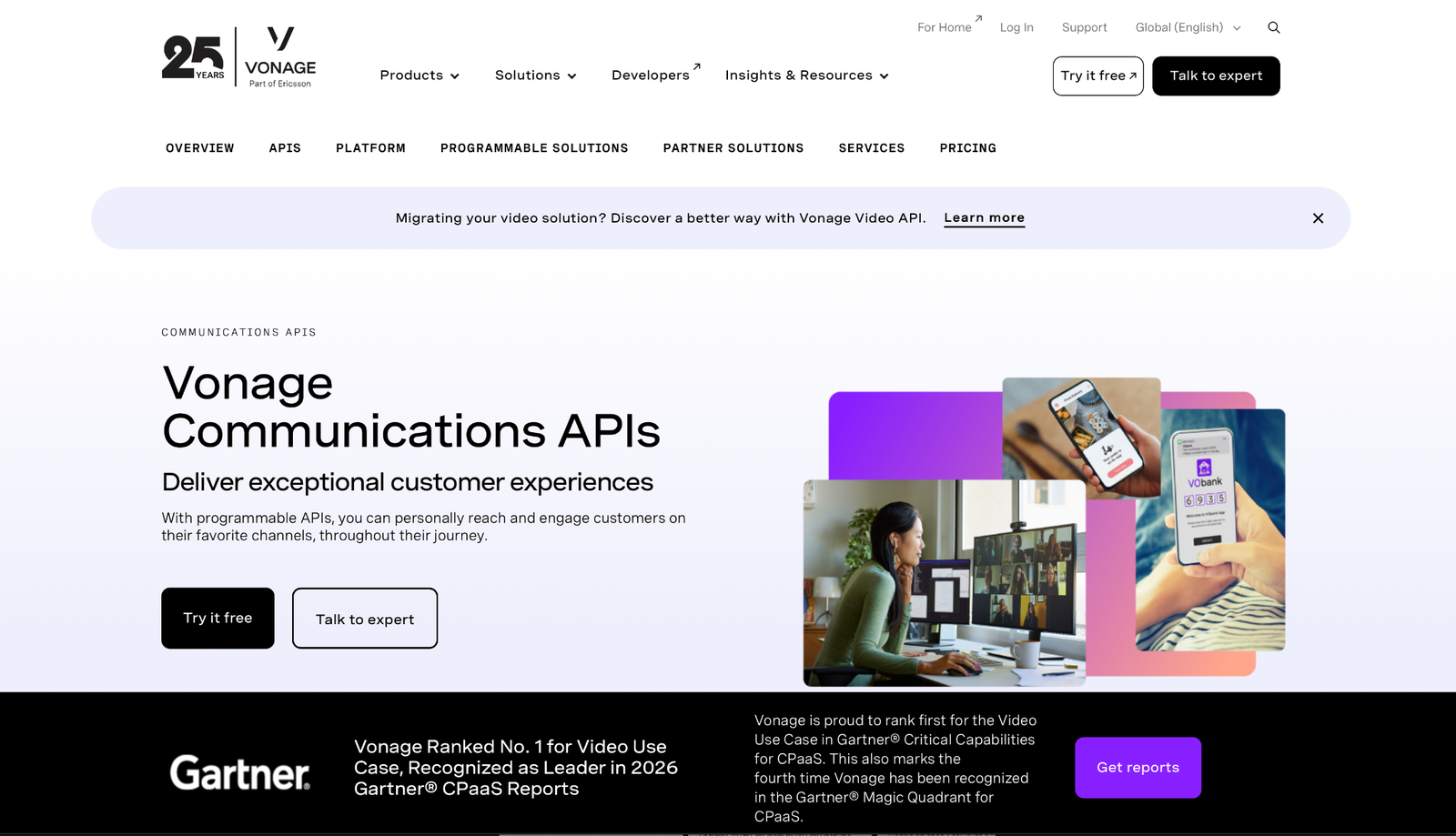
Vonage runs a Video API next to voice and SMS, so teams leaving Twilio Video have a path. The brand shows a migration banner for Twilio Video users and says it reaches nearly 200 countries and 2,000+ networks, per its Communications APIs page.
Voice, SMS, MMS, RCS, WhatsApp, and email run under one API family.
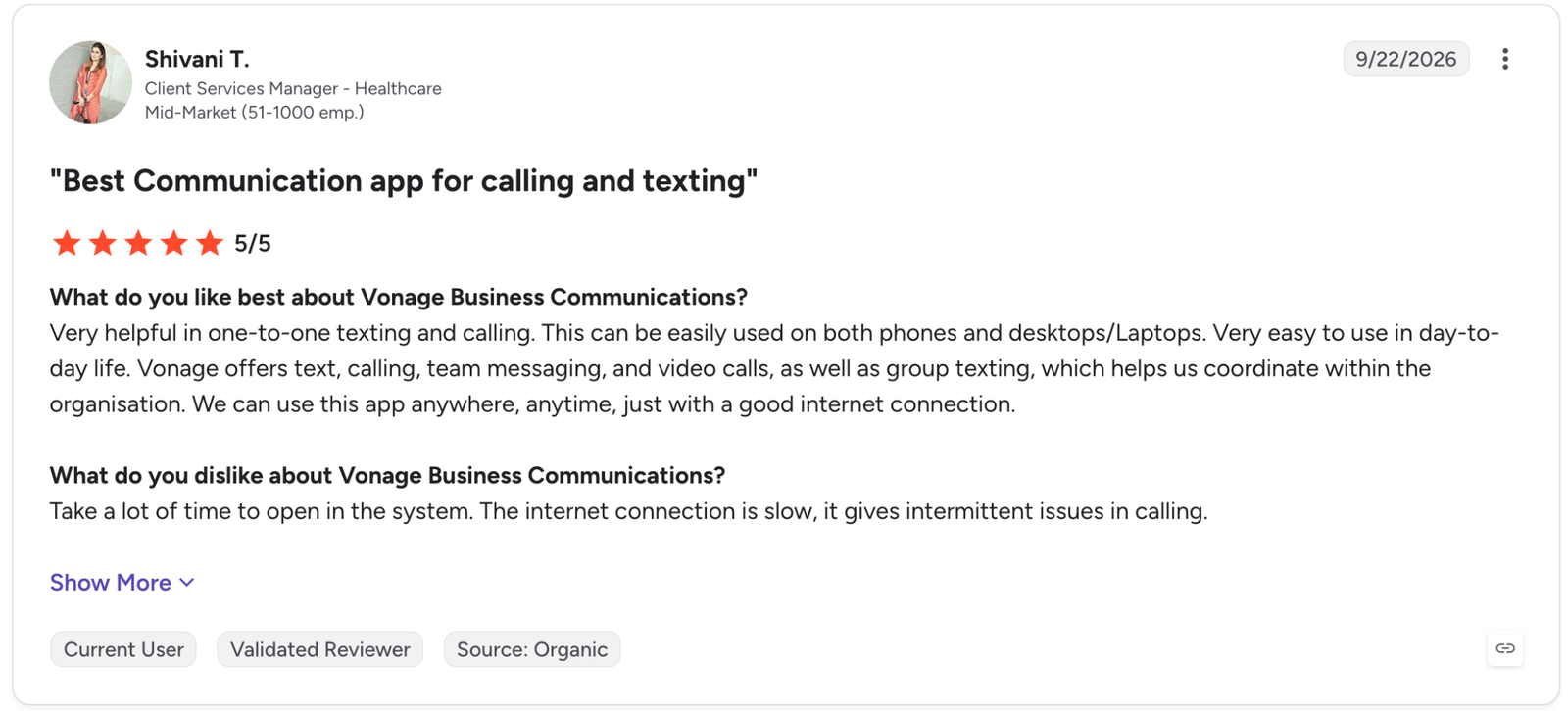
"Very helpful in one-to-one texting and calling. This can be easily used on both phones and desktops/Laptops" (Shivani T., G2)
Key features
-
Voice API: Programmable calls on what Vonage calls a carrier-grade network.
-
Messaging: SMS and MMS alongside RCS and WhatsApp, with email under the same API family.
-
Video API: Live video sessions, with migration guides for web and mobile teams leaving Twilio Video.
-
Global reach: Nearly 200 countries and 2,000+ networks, according to Vonage.
-
AI add-ons: Voice AI Engagement adds transcription, translation, sentiment analysis, and intent detection, with AI Connector SDKs for outside models.
Pros
✅ One vendor sells video, voice, and messaging on one platform.
✅ Vonage was recognized in the Gartner Magic Quadrant for CPaaS for the fourth time.
✅ Video starts from $0.0041 a minute, so a Twilio Video move doesn’t need a second vendor.
Cons
❌ Prices appear as "as low as" figures, with country-level rates on separate pages.
❌ US SMS carries carrier fees of $0.0025 to $0.005 a message on top of the $0.0086 rate.
❌ The test credit runs in demo mode. You can only send to numbers you’ve verified, voice calls reach only your registered number, and every SMS carries a demo notice.
Best for
-
Twilio Video migrations that also carry SMS and voice.
-
SMS, RCS, WhatsApp, and email behind one integration.
-
Reach in nearly 200 countries, per Vonage.
Pricing
Vonage shows SMS from $0.0086 per message (US long virtual number) and US voice from $0.00485 a minute inbound and $0.00849 outbound on its voice pricing page. It names no monthly plan fee.
4. Bandwidth
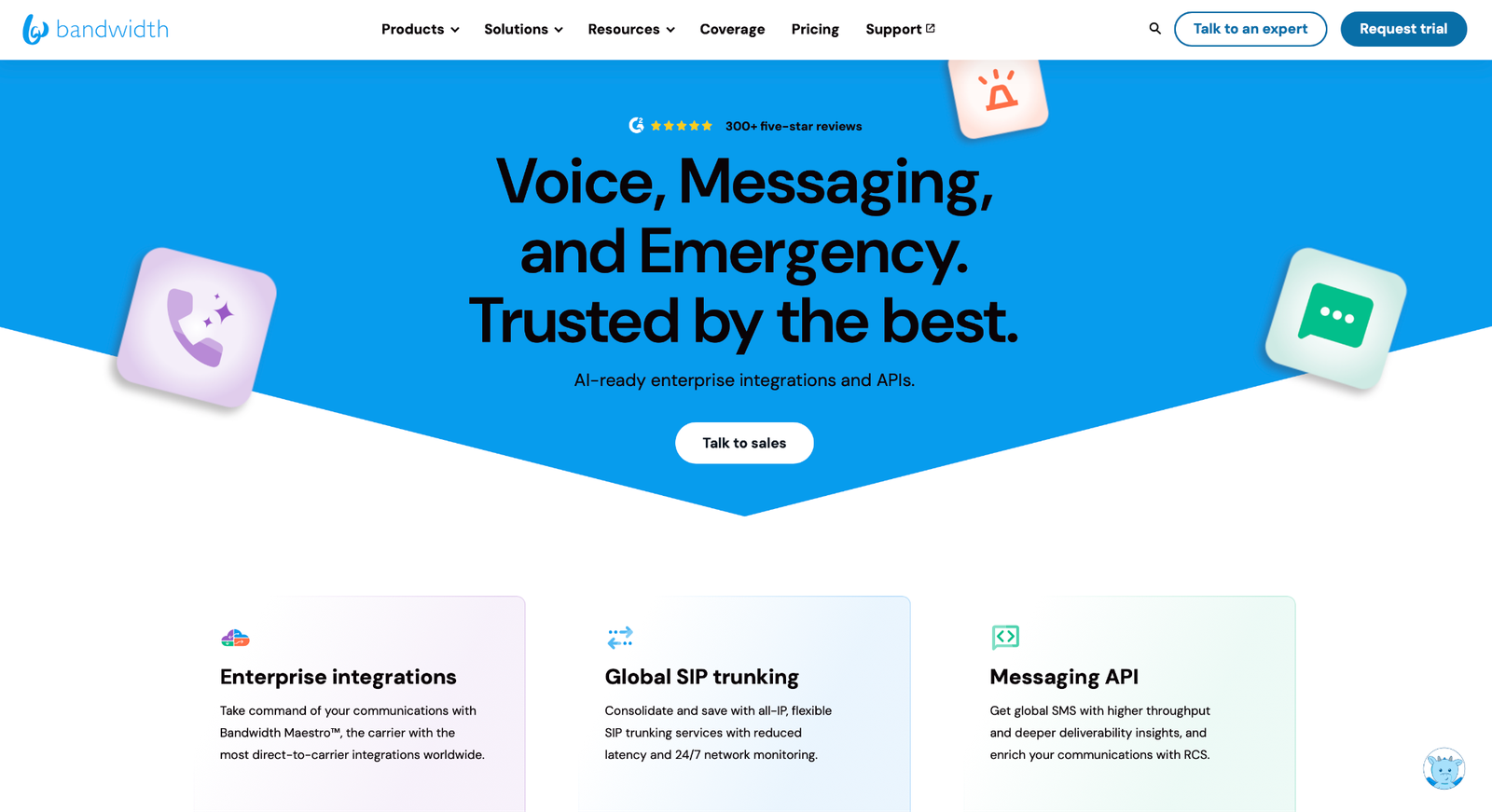
Bandwidth runs a global all-IP network that connects directly to the PSTN, per its voice page, with PSTN connections in roughly 70 countries and a 99.999% network uptime claim.
Its pricing page lists usage lines and 6-second billing.
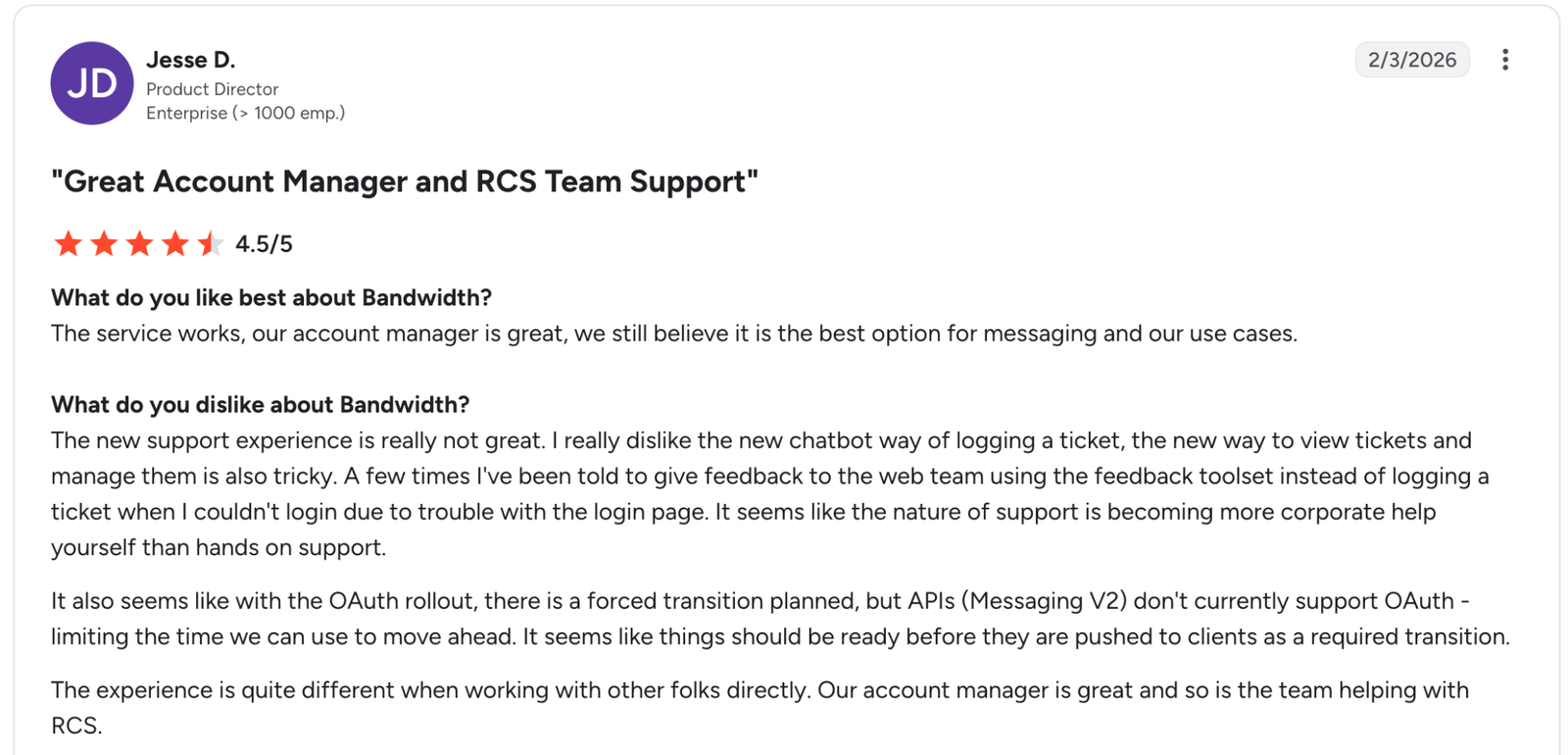
"The service works, our account manager is great, we still believe it is the best option for messaging and our use cases." (Jesse D., G2)
Key features
-
Voice API: US local inbound at $0.0055 a minute and outbound at $0.0100, billed in 6-second increments.
-
Messaging: US 10DLC SMS at $0.004, toll-free at $0.007, and short code at $0.008.
-
Media streaming: Unidirectional at $0.0035 a minute and bidirectional at $0.004, for voice agents that need raw audio.
-
Emergency calling: An Emergency Calling API and emergency services appear on the site.
-
Number management: API-driven porting and provisioning, plus toll-free from what Bandwidth calls the largest RespOrg in the US.
Pros
✅ Inbound voice at $0.0055 a minute is lower than Twilio's $0.0085.
✅ 6-second billing trims the cost of short calls.
✅ 10DLC SMS at $0.004 is under half of Twilio’s $0.0083, before carrier fees.
Cons
❌ Full pricing requires a quote request, and the page doesn't name plans or minimums.
❌ Outbound voice at $0.0100 a minute to US local numbers costs more than SignalWire’s $0.0080 and Plivo’s $0.0046 SIP rate.
❌ The pricing page lists local voice only, with no toll-free voice rate.
Best for
-
US-heavy inbound voice with emergency-calling requirements.
-
Phone service resellers like Aircall and Zoom Phone, which both appear on Bandwidth's voice page.
-
Raw audio streams at a stated per-minute rate.
Pricing
Bandwidth publishes usage rates and calls them volume-based. Voice costs $0.0055 a minute inbound and $0.0100 outbound, and 10DLC SMS is $0.004, with toll-free at $0.007 and short code at $0.008.
5. Sinch
Sinch claims the largest owned and operated facilities-based footprint in the US, which covers 94.5% of the country. Its voice page adds roughly 300 billion minutes of use a year and more than 140 million phone numbers.
Treat them as network-scale figures, and test call quality on your own traffic.
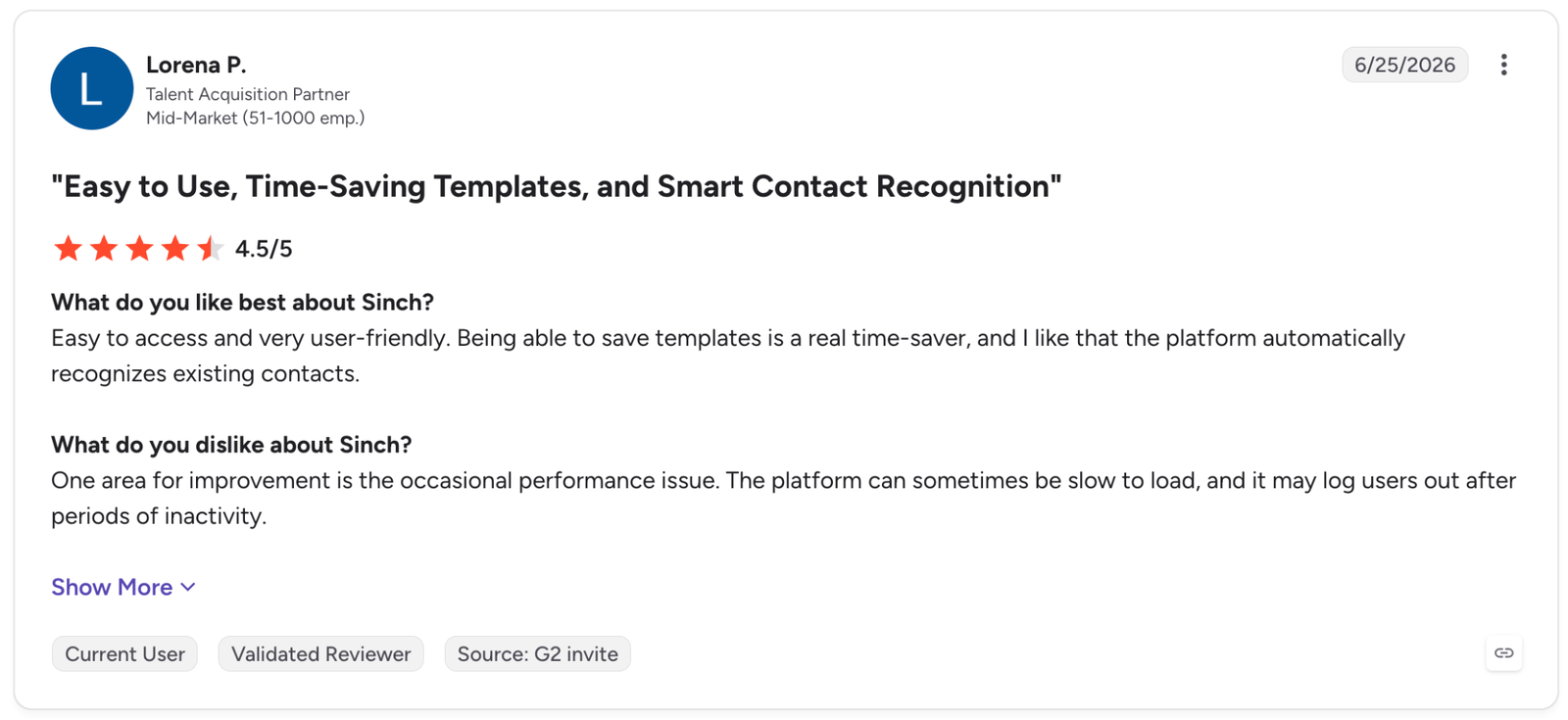
"Easy to access and very user-friendly. Being able to save templates is a real time-saver, and I like that the platform automatically recognizes existing contacts." (Lorena P., G2)
Key features
-
Elastic SIP Trunking: Capacity scales on demand with global connectivity.
-
Network SIP Trunking and BYOC: Run on Sinch's network or keep your own carrier.
-
Programmable Voice: IVR, text-to-speech, number masking, and call routing through REST APIs.
-
Compliance: E911, STIR/SHAKEN, and toll-free voice.
-
Integrations: 3CX, Genesys, LiveKit, Ribbon SBC, Cisco Webex, Microsoft Teams Operator Connect, and Zoom Phone Provider Exchange.
Pros
✅ 10DLC and toll-free SMS cost the same $0.0078 a message, so your sender type doesn’t change the rate.
✅ LiveKit appears among Sinch's integrations, so voice agent builds have a documented path.
✅ 92% of directly connected calls originate and terminate on its tier 1 network, per Sinch.
Cons
❌ The voice pricing page shows $0.00 in places, and per-destination rates sit in a downloadable price list.
❌ US 10DLC SMS at $0.0078 is $0.0038 above Telnyx and Bandwidth at $0.004.
❌ Voice Relay, Sinch’s AI agent voice layer, shows $0.00 a minute while it’s in public preview, so its real rate isn’t known yet.
Best for
-
Enterprises routing SIP into Teams or Zoom Phone.
-
Existing carriers kept in place through BYOC.
-
US voice traffic on a network Sinch says covers 94.5% of the country.
Pricing
Sinch publishes US SMS at $0.0078 per message for 10DLC and toll-free, with short code at $0.009 and 10DLC MMS at $0.02, plus carrier fees. Voice rates come from a downloadable price list, and the page names no subscription fee.
6. SignalWire
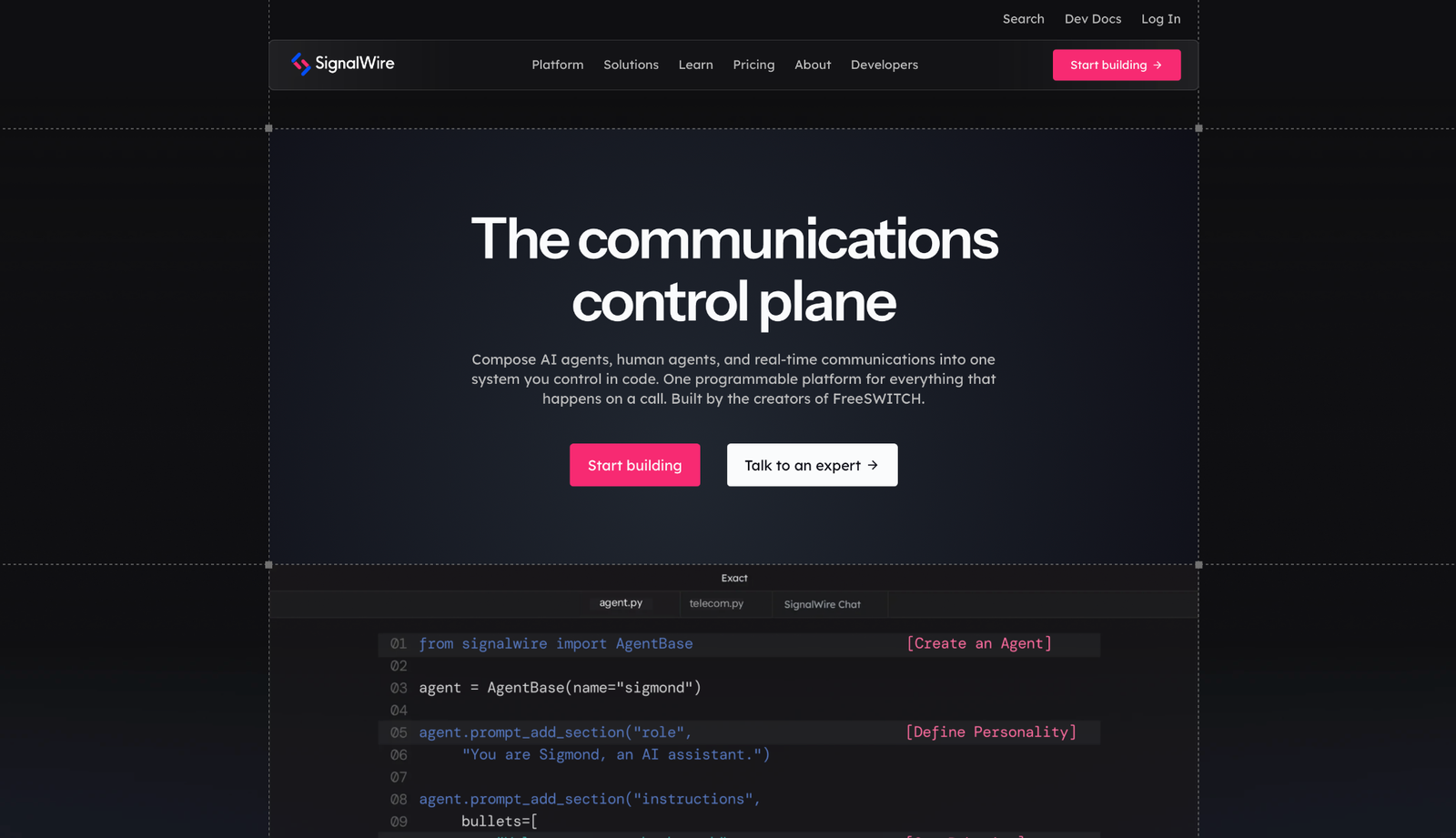
SignalWire markets compatible APIs and SDKs for teams leaving Twilio. Its docs say teams can migrate from Twilio “with minimal changes,” and they add SWML, a markup language that links LLMs and speech models with PSTN, SIP, and WebRTC.
Without a migration, I couldn't confirm the compatibility claim, which makes the "few lines" a vendor statement.
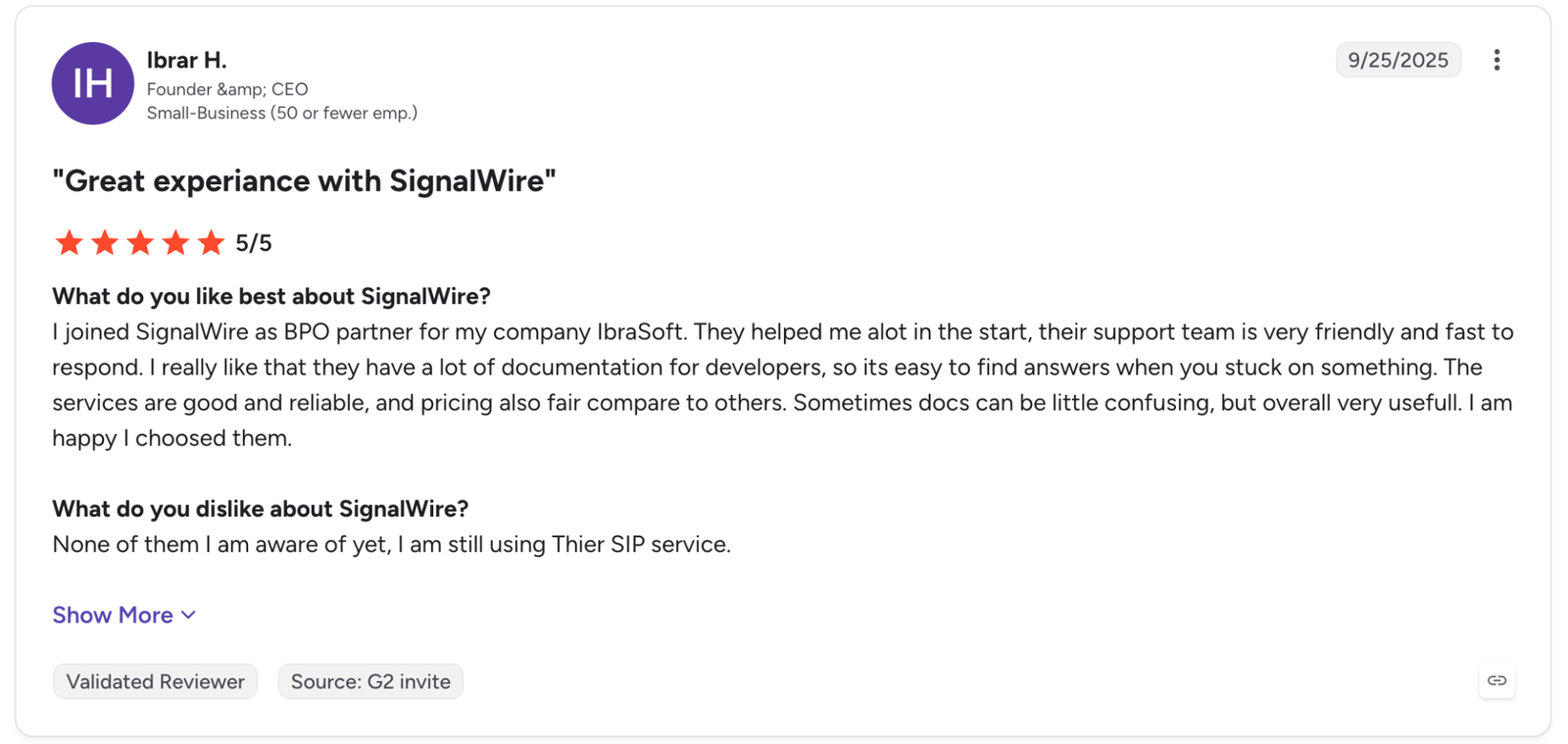
"I really like that they have a lot of documentation for developers, so it's easy to find answers when you stuck on something." (Ibrar H., G2)
Key features
-
Compatibility API: Targets existing Twilio calling and messaging code, next to separate SDKs for voice, video, messaging, and AI.
-
AI Agent Runtime: $0.16 a minute with standard text-to-speech included.
-
SWML: One markup language that ties LLMs and speech models to phone transport.
-
Call Flow Builder: A drag-and-drop tool for building calling applications.
-
SIP and WebRTC: $0.0030 a minute on both.
Pros
✅ US local voice costs $0.0066 a minute inbound and $0.0080 outbound, under Twilio's $0.0085 and $0.0140.
✅ The pricing page itemizes fees down to $0.75 a month for E911 and $0.008 per CNAM lookup.
✅ SMS at $0.00415 per segment is half of Twilio’s $0.0083, before carrier fees on both.
Cons
❌ The AI runtime at $0.16 a minute includes the LLM and standard text-to-speech, while Telnyx’s $0.05 and Plivo’s $0.03 leave parts of the stack billed on top, so compare totals for your model.
❌ Carrier passthrough fees apply to SMS, and short codes require a $500 minimum monthly spend plus $1,500 to $3,000 a quarter and a one-time $750 setup fee.
❌ The Compatibility API covers calling, messaging, and fax, so Twilio Video or AI code moves to SignalWire’s own SDKs.
Best for
-
Porting a Twilio codebase with minimal changes.
-
One markup language over telephony and models for voice AI builds.
-
Agents on SIP or WebRTC at $0.0030 a minute.
Pricing
SignalWire has no monthly plan, so spend follows usage. Local numbers run $0.0066 a minute inbound and $0.0080 outbound, SMS costs $0.00415 per segment, and each number is $0.50 a month. Standard 10DLC brand registration costs $4.50 once, with a $10 monthly campaign fee.
7. Infobip
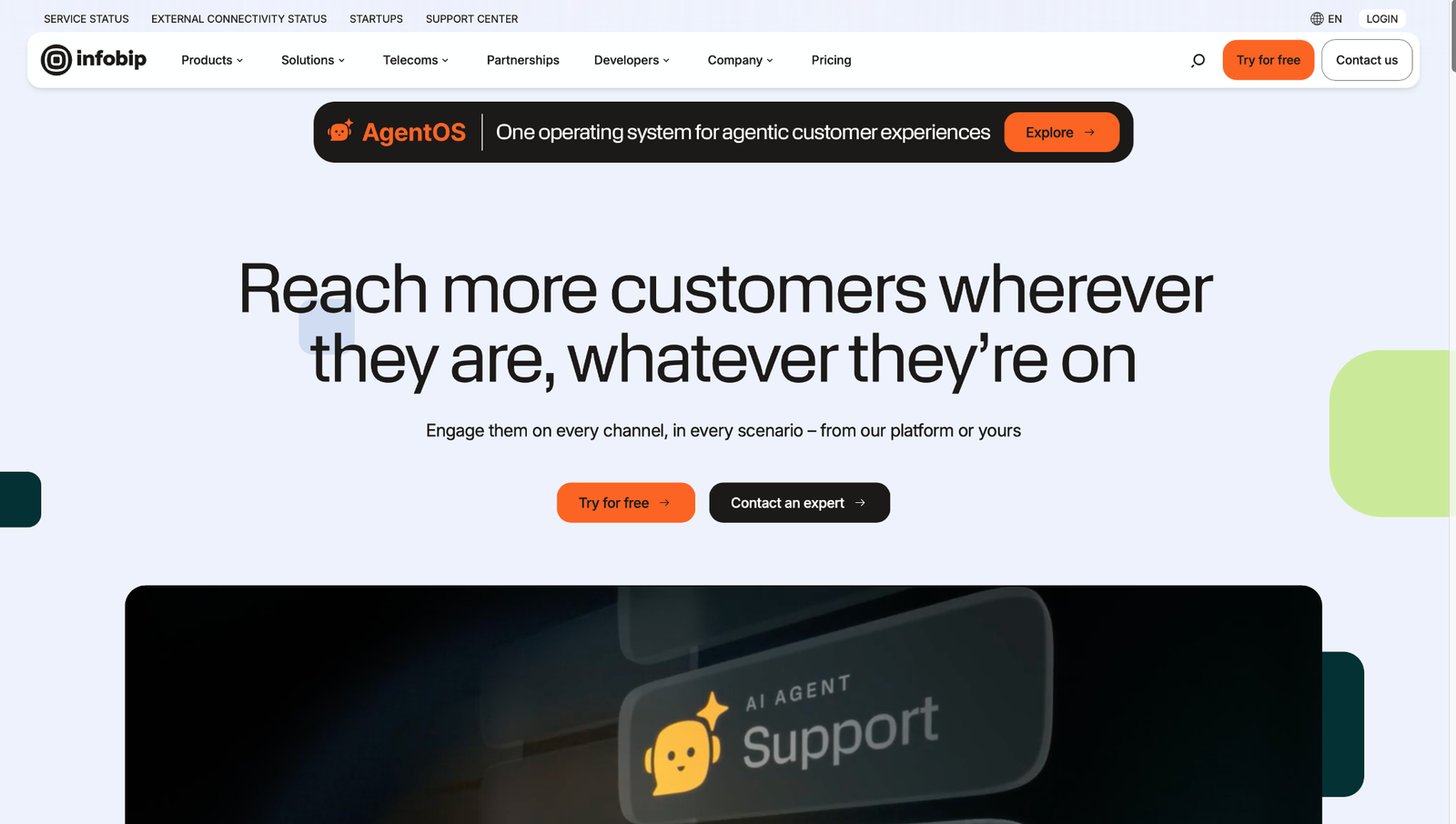
As channels, Infobip lists SMS, MMS, RCS, email, voice, live chat, video, WhatsApp, Viber, Messenger, Instagram, Telegram, Apple Messages, Kakao, LINE, and Zalo.
The company says it serves 10,000+ businesses.
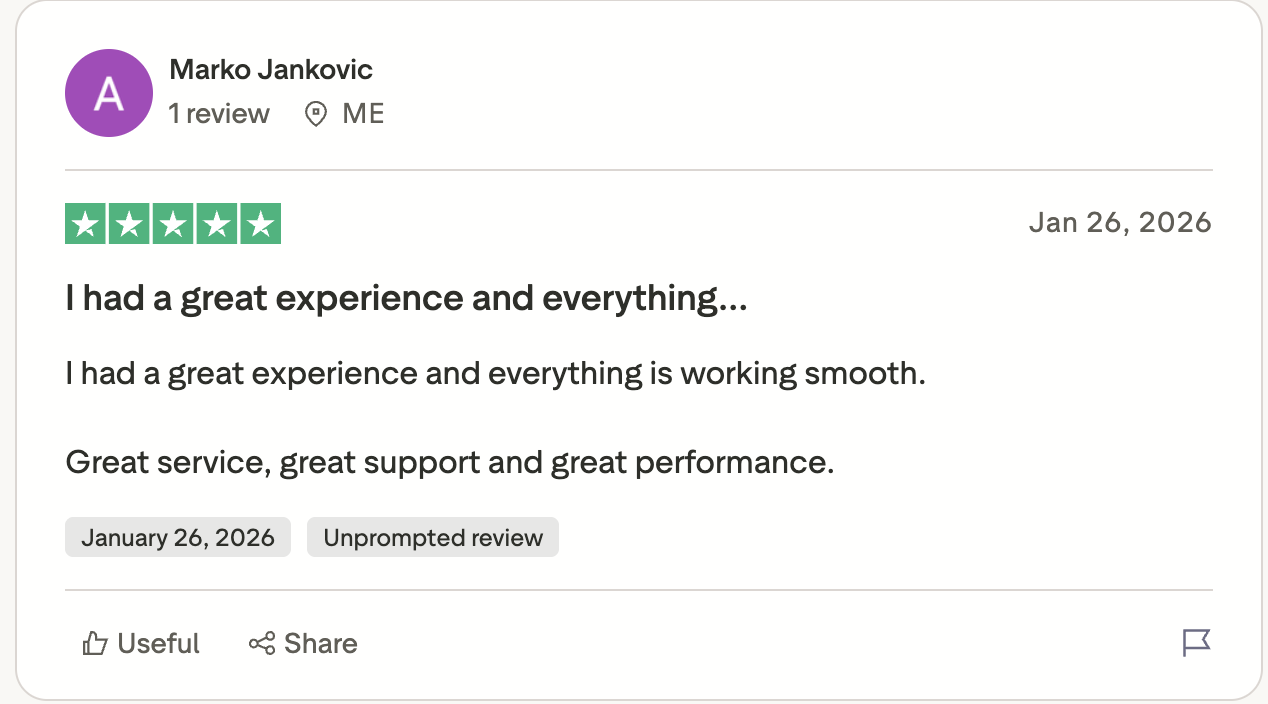
"I had a great experience and everything is working smooth." (Marko Jankovic, Trustpilot)
Key features
-
Channel breadth: One platform for chat apps, RCS, email, and voice.
-
Voice AI Agents: Shown alongside an AI chatbot builder and AgentOS, which carries a "NEW" label.
-
10DLC numbers: Campaign registration is handled inside the platform.
-
Authentication and number lookup: Authentication, mobile identity, and number lookup APIs appear as products.
-
Contact center: A cloud contact center and customer data platform are available.
Pros
✅ US SMS averages $0.00818 a message, just under Twilio’s $0.0083 per segment.
✅ You choose pay as you go or a monthly subscription.
✅ Infobip says it handled 12.2 billion interactions on its busiest days of 2025 "with 0 downtime."
Cons
❌ Published rates are country averages, and per-network pricing sits in the portal.
❌ The US voice rates on the pricing page read $0.0002 to $0.0007 a minute, which looks like a display error, so get a voice quote before you budget.
❌ AgentOS carries a "NEW" label, so ask for customer references before you build on it.
Best for
-
Campaigns that span WhatsApp, Viber, RCS, and SMS.
-
Chatbots and a contact center on the same platform.
-
Sales-led pricing, with rates quoted after a conversation.
Pricing
Infobip offers pay-as-you-go or a monthly subscription that adds features, with custom plans through sales. Per-country SMS and voice rates are on each channel’s pricing page, and the hub calculator estimates totals.
8. Bird
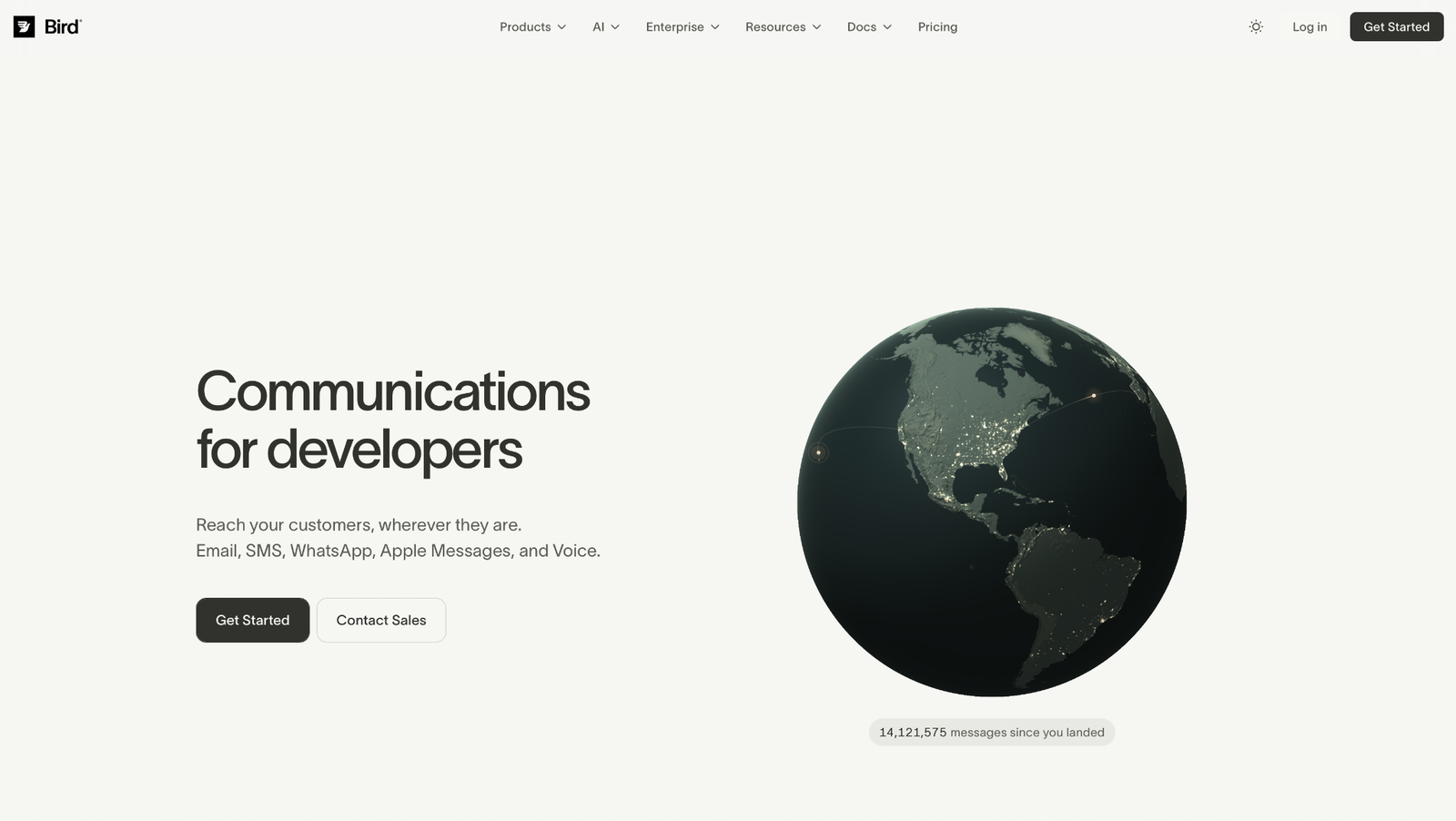
Bird sells email, SMS, WhatsApp, Apple Messages, and voice from one API. Its homepage also names Verify, Lookup, eSIM, and a managed WebSocket service called Realtime.
The developer pitch centers on tooling, with a REST API, SDKs for TypeScript, Python, Go, and PHP, a CLI, and an MCP server.
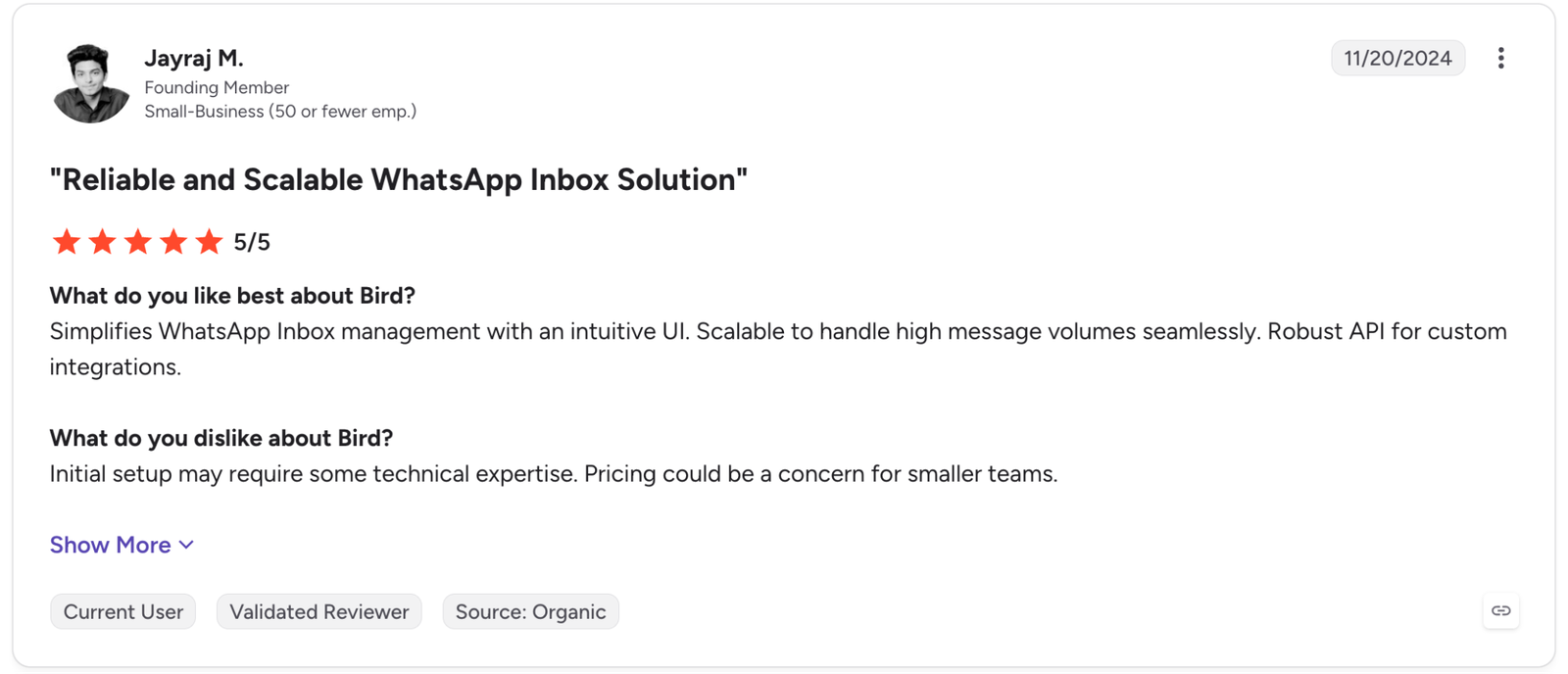
"Scalable to handle high message volumes seamlessly. Robust API for custom integrations." (Jayraj M., G2)
Key features
-
Messaging channels: Email, SMS, WhatsApp, and Apple Messages from one account.
-
Verify and Lookup: OTP delivery plus phone and email validation.
-
Developer tooling: REST API, SDKs, CLI, and MCP server, with integrations for Claude, Cursor, ChatGPT, and VS Code.
-
Mailbox API: Dedicated inboxes for agents that answer their own email.
-
Voice: Priced by destination and duration.
Pros
✅ The pricing page shows a $0.0035 US outbound long-code segment, below Twilio's $0.0083 (both before carrier fees).
✅ You can send without a monthly plan.
✅ A US local number costs $0.50 a month, under Twilio’s $1.15 for a leased long code.
Cons
❌ Voice rates aren't on the main pricing page.
❌ Every call carries a $0.0040 per-minute handling fee on top of the destination rate.
❌ The SMS rate appears as an example, so confirm the live rate for your destination.
Best for
-
Email, SMS, and WhatsApp from one vendor.
-
Messaging wired into AI tools through a CLI or MCP server.
-
Products that need OTP and number lookup next to messaging.
Pricing
Bird bills pay-as-you-go with optional plans, such as $15 a month for Email Startup and from $100 a month for Apple Messages, paid as balance funding. The example rate is $0.0035 per US outbound long-code segment plus carrier fees, and a US local number costs $0.50 a month.
9. LiveKit SIP
LiveKit SIP connects phone calls to AI agents and leaves the carrier role to your provider. Its SIP docs cover inbound and outbound trunks, and they name Twilio, Telnyx, Exotel, Plivo, Wavix, Sinch, didlogic, and DIDWW as tested providers.
Our LiveKit Agents guide covers the build.
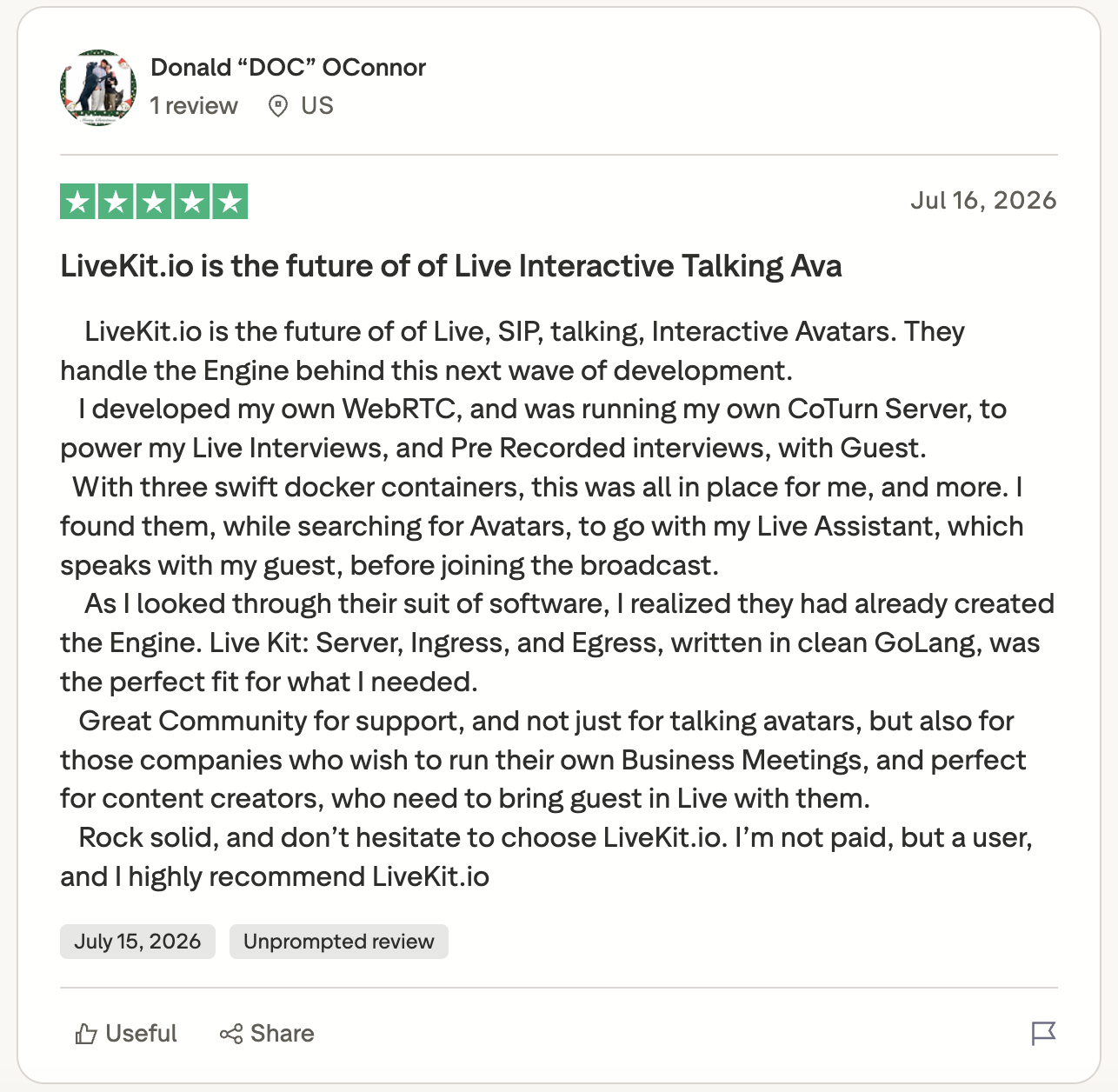
"LiveKit.io is the future of of [sic] Live, SIP, talking, Interactive Avatars." (Donald "DOC" OConnor, Trustpilot)
Key features
-
Inbound and outbound trunks: Inbound can be restricted by IP address or phone number, and outbound is created through the CreateSIPParticipant API.
-
DTMF: Supported through RFC 2833 and RFC 4733.
-
Transfers: Cold transfer by REFER and warm transfer are both supported.
-
Media security: SIP over UDP, TCP, and TLS, plus RTP and SRTP.
-
Hosting: SIP works on LiveKit Cloud with no extra configuration, and self-hosting needs the SIP service deployed separately.
Pros
✅ Tested providers include Twilio, Telnyx, Plivo, and Sinch, so the same agent can sit behind more than one carrier.
✅ Build costs $0 a month, with 1,000 agent session minutes and one free US local number.
✅ Third-party SIP minutes drop to $0.003 on Scale, from $500 a month, under Twilio’s $0.0040 SIP interface rate.
Cons
❌ LiveKit’s own numbers take inbound calls only, so you bring a carrier for outbound calls, and LiveKit documents no SMS.
❌ SIP REGISTER, SIPREC, and video over SIP are unsupported.
❌ Custom SIP domains for inbound endpoints aren’t available on Build, Ship, or Scale.
Best for
-
Builds already on LiveKit Agents that keep their current carrier.
-
Agents that take phone calls without a frontend.
-
Self-hosted deployments of the SIP service.
Pricing
Build costs $0 a month with 1,000 agent minutes and 5 concurrent sessions. Ship starts at $50 a month for 5,000 minutes and 20 sessions, and Scale starts at $500 a month for 50,000 minutes and up to 600 sessions.
Overage is $0.01 a minute. After included minutes, US local inbound is $0.01 a minute and third-party SIP is $0.004 (Ship) or $0.003 (Scale). Extra numbers cost $1.00 a month.
10. Daily
Daily sells the hosting and transport under Pipecat voice agents, with phone dial-in and dial-out on top. Its dial-in and dial-out docs connect PSTN and SIP callers to rooms, and Pipecat is the framework Daily manages.
Deepgram announced on October 29, 2026, that it is acquiring Daily, and says Pipecat stays open source.
Daily's pricing and docs both omit SMS, so it fits voice agents rather than messaging.
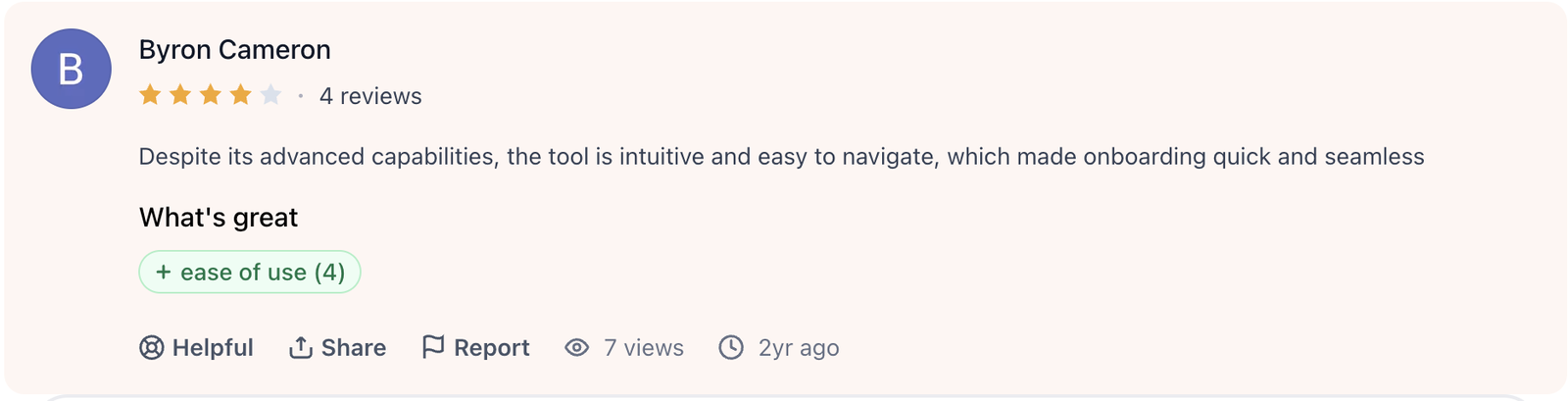
"Despite its advanced capabilities, the tool is intuitive and easy to navigate, which made onboarding quick and seamless." (Byron Cameron, ProductHunt)
Key features
-
Pipecat Cloud hosting: $0.01 to $0.03 per active minute, depending on the agent size.
-
PSTN dial-in and dial-out: $0.018 a minute, with SIP transport included.
-
DTMF: Out-of-band tones send and receive over RTP events or SIP INFO.
-
Call transfers: SIP REFER transfers the call, and Daily leaves it, for a one-time $0.20 fee.
-
Recording: Audio-only recording at $0.005 a minute.
Pros
✅ Pipecat Cloud concurrency is listed as unlimited, and support raises the 5-session room default on request.
✅ Daily names Twilio, Telnyx, and SignalWire among its tested SIP providers.
✅ Pipecat Cloud lists integrated WebRTC transport for voice agents next to PSTN.
Cons
❌ Dial-out needs a paid plan with a card on file and approval through a request form.
❌ Dial-in, dial-out, and live-streaming start requests share a cap of 4 per rolling 5 seconds per domain, and PSTN dial-out defaults to 1 call per second.
❌ Daily doesn’t apply echo cancellation or noise removal to received audio, so phone and SIP callers rely on their handset or carrier for it.
Best for
-
Pipecat builds that want managed hosting and phone access together.
-
Voice agents that need PSTN dial-in and dial-out at a flat per-minute rate.
-
Hosted agents that need many simultaneous calls, within Daily’s rate limits.
Pricing
Daily has no named plan tiers. Pipecat Cloud bills $0.01 to $0.03 per active minute by agent size. PSTN dial-in and dial-out cost $0.018 a minute with SIP transport included, and direct SIP dial-in and dial-out run $0.003 to $0.02 a minute.
The Video SDK starts with 10,000 free minutes a month. See also our LiveKit alternatives roundup, which prices Daily next to its rivals.
Twilio alternatives for voice AI agents
Latency, SIP behavior, DTMF handling, and media streaming matter more once an agent answers the call, and a carrier can add delay to each turn.
Twilio itself sells telephony plus Conversation Relay, and platforms such as Vapi orchestrate the pipeline on top (see our Twilio vs Vapi comparison and Vapi alternatives).
How much delay callers notice, and what vendors claim
Under ITU-T G.114, one-way delay below 150 ms feels essentially transparent for most applications, and 400 ms is the upper limit for network planning, per the ITU-T recommendation. That budget covers network and agent processing together.
Telnyx claims sub-200 ms agent latency, and Twilio shows a median under 0.5 seconds for Conversation Relay. The two figures measure different things, so neither tells you what your callers hear.
SIP trunk prices and which carriers each framework has tested
Telnyx prices SIP trunking from $0.0032 a minute inbound and $0.005 outbound. Plivo includes it in pay-as-you-go, and Sinch sells elastic and network trunks.
LiveKit names Twilio, Telnyx, Plivo, and Sinch among its tested providers, and Daily names Twilio, Telnyx, and SignalWire, so check your carrier is on the list for your framework.
Media streaming and agent pricing
Agent runtimes bundle different pieces, so compare what each rate includes.
| Platform | AI agent pricing | SIP or media pricing |
|---|---|---|
| Twilio | Conversation Relay $0.07/min, voice minutes billed separately | SIP interface $0.0040/min; local numbers $0.0085/min inbound, $0.0140/min outbound |
| Telnyx | $0.05/min for speech-to-text, text-to-speech, and orchestration | SIP trunking from $0.0032 inbound and $0.005 outbound |
| Plivo | $0.03/min, telephony billed separately | SIP outbound from $0.0046/min, inbound from $0.0028/min (US local) |
| SignalWire | $0.16/min runtime, standard text-to-speech included | SIP and WebRTC $0.0030/min |
| Bandwidth | No AI runtime priced; Maestro bring-your-own-AI orchestration, pricing not published | Media streaming $0.0035/min (one-way), $0.004/min (two-way) |
| LiveKit SIP | $0.01/min overage per agent session | Third-party SIP $0.004/min (Ship), $0.003/min (Scale) |
| Daily | Pipecat Cloud $0.01 to $0.03/min | PSTN $0.018/min, SIP $0.003 to $0.02/min |
DTMF
LiveKit SIP supports DTMF through RFC 2833 and RFC 4733, and Daily sends and receives tones over RTP events or SIP INFO.
Testing the same agent across carriers
Cekura isn't ranked here because it tests the agent layer. The agent it tests runs on the carrier you pick.
Cekura's telephony testing accepts numbers from Twilio or Plivo for live call testing and can test SIP-based agents directly, so you can run one scenario suite before a carrier change and again after it.
Cekura’s voice platform benchmark ran the same agent through 82 scenarios on 10 platforms, with 246 calls each. Telnyx completed 97.6% of tasks with no connection issues on any call, at a mean response time of 1.82 seconds.
LiveKit completed 95.1% at 2.59 seconds, and Pipecat completed 94.2% at 1.97 seconds. Only 68.3% of Telnyx’s scenarios and 70.7% of LiveKit’s passed on all three runs, which is why a single test call tells you little.
Twilio alternatives come down to the fees outside the rate card
Carrier fees, approval waits, and what each rate card leaves out separate these 10 platforms.
Before you shortlist, work out your monthly SMS segments, your monthly voice minutes, the countries you call, and how long your launch can wait for account approval. Those answers can narrow 10 options to two. Among Twilio competitors, no single option leads on every one of them.
If you run voice agents, the agent's behavior matters as much as the carrier. Cekura tests the agent on top of it, with Retell, Vapi, ElevenLabs, LiveKit, Pipecat, and Bland all connecting natively. Voice testing starts at $0.25 a minute with 300 free credits and no card required.
Cekura covers the agent at each stage:
-
Pre-production: Scenario simulations for your agent’s workflows, multi-turn red teaming, and A/B runs that compare prompt, model, or configuration changes.
-
Infrastructure: Load testing at production concurrency, interruption conditions, latency measurement, and DTMF keypad navigation for IVR paths.
-
Observability: Live call scoring against custom and predefined metrics, plus alerting on quality drops and regression cases built from production calls.
Cekura supports SOC 2, HIPAA, and GDPR compliance, covering transcript redaction, role-based access, and audit trails.
Before you move carriers, run a baseline test. Book a demo to set up a before-and-after test suite.
Frequently asked questions
How reliable is Twilio?
Twilio commits to 99.95% monthly availability on its Services APIs, and 99.99% in months when you hold Enterprise Edition, per its service level agreement updated April 9, 2026. A miss gets you a 10% credit on that month's fees, and you must file a claim within 30 days of the end of that month.
Support response times are a separate matter, since the free Developer plan only estimates 3 business days.
Is Twilio free?
No, Twilio is a paid service with a 30-day trial. Trial accounts get 100 SMS, 100 WhatsApp messages, 3,000 emails, and 75 voice minutes, limited to up to 5 verified numbers and Twilio-provided templates. You then upgrade and load a balance to continue.
Is Plivo better than Twilio?
Yes on voice cost, no on SMS access.
On the Voice API, US outbound starts at $0.0115 a minute against Twilio’s $0.0140, and inbound at $0.0055 against $0.0085.
On SMS, Plivo's API requires its Enterprise plan from $1,000 a month, while Twilio sells SMS at $0.0083 per segment plus carrier fees with no plan floor.
What is the cheapest Twilio alternative?
Plivo has the lowest published US local outbound carrier rate here, with SIP trunking from $0.0046 a minute. Telnyx comes to about $0.007 once its $0.002 API fee and $0.005 trunk rate are added.
For SMS, Bird shows a $0.0035 US outbound long-code segment, and Telnyx and Bandwidth publish $0.004. All are starting rates before carrier fees, so price your own traffic.
Who are Twilio's main competitors?
Twilio’s main competitors for voice and SMS APIs are Telnyx, Plivo, Vonage, Bandwidth, Sinch, SignalWire, Infobip, and Bird. For voice agents, LiveKit SIP and Daily round out the 10 by bridging phone lines into your agents.