
For voice agents, Telnyx vs Twilio splits on cost and support. Telnyx charges about half of Twilio's US outbound rate and runs its own network between its points of presence.
Twilio, in turn, offers guaranteed support at a lower spend and sells PCI payments through Pay Connectors at a published rate. Telnyx’s Voice Payments API is still in beta.
I read both vendors' pricing pages on November 2, 2026, and priced the same 50,000-minute month on each. Then I checked how Vapi, Retell, and LiveKit connect to either carrier.
I didn't place test calls, so the latency section sticks to what each vendor publishes and what Cekura's benchmark measured.
The pricing shows how little the carrier weighs in some setups. With your own SIP trunk on an orchestration platform, it’s under 10% of the phone and platform bill in the example below. When you stream audio through the carrier’s API, its share grows much bigger.
Telnyx vs Twilio: What's the Difference?
Telnyx is a licensed carrier that sells voice, SIP trunking, messaging, and its from $0.05-per-minute Voice AI Agents product over a network it says it owns.
Twilio is a cloud communications platform (CPaaS) that routes calls over third-party Tier 1 carriers and sells voice, messaging, and AI products.
Choose Telnyx if: per-minute cost sets your margin, and you can work without a published support response-time guarantee.
Choose Twilio if: you want guaranteed support response times from $250 a month, or your Vapi agent takes international calls through Vapi’s native number import, where the Telnyx import has a documented codec mismatch (more below).
Meet Telnyx: What It Sells
Telnyx sells telephony and the AI layer on one invoice. Its pricing page lists a Voice API at $0.002 per minute and Voice AI Agents from $0.05 per minute, and its SIP trunking pricing starts at $0.005 per minute outbound in the US.
Telnyx leads its marketing with network ownership. Its network page says it runs privately owned fiber between its points of presence and holds carrier licenses in 30+ countries.
That license count changes from page to page. The Voice AI page says 45+, so Telnyx gives 2 different figures. Outside its licensed countries, Telnyx still relies on partners, and one G2 thread below shows what happens when a partner leg fails.
For voice agents, the relevant products are media streaming over WebSockets at $0.0035 per minute, standard noise suppression at $0.002 per leg per minute, and deepfake detection at $0.01 per invocation.
Telnyx also hosts LLM inference on its own GPUs, which its network page says are colocated with the telephony PoPs that carry the call.
Meet Twilio: What It Sells
 Twilio's US pricing starts with Programmable Voice, which costs $0.0140 per minute to make a local call and $0.0085 per minute to receive one, and a local number costs $1.15 a month. Its pricing page lists numbers in over 100 locales and a free trial with $15 toward a number.
Twilio routes calls over carriers it partners with. Its Super Network page describes a "provider-agnostic approach" to routing across Tier 1 carriers that it continually tests and evaluates, and its docs name 8 public edge locations plus a "roaming" edge that picks the lowest-latency data center.
Twilio's voice AI product is Conversation Relay, which handles speech-to-text and text-to-speech while you bring the LLM over a WebSocket. It costs $0.07 per minute on top of voice minutes.
If you're weighing that build path against an orchestration platform, our Twilio vs Vapi breakdown shows what each layer handles.
Around the call itself, Twilio meters a long list of extras, including Branded Calling at $0.12 per call, Answering Machine Detection at $0.0075 per call, Media Streams at $0.0044 per minute, and transcription through Conversation Intelligence.
Twilio vs Telnyx: At a Glance
Every Telnyx and Twilio figure in this table comes from the vendor's page.
| Feature | Telnyx | Twilio |
|---|---|---|
| Best for | Cost-sensitive voice agents at volume | Support SLAs at low monthly spend |
| US voice pricing | $0.007/min outbound, $0.0052/min inbound local (Voice API + SIP, pay as you go, $0/month minimum) | $0.0140/min outbound, $0.0085/min inbound local (pay as you go, no commitments) |
| Local number | $1.00 per number per month | $1.15 per number per month |
| Network | Owned private fiber between PoPs, carrier licenses in 30+ countries | Routes across third-party Tier 1 carriers, 8 public edge locations |
| Voice AI | Voice AI Agents from $0.05/min (STT, TTS, orchestration) | Conversation Relay at $0.07/min plus voice minutes |
| Messaging (US SMS) | $0.004 per message part plus carrier fee | $0.0083 per segment plus $0.0035 to $0.005 carrier fee |
| Support | 24/7 support for all customers with no minimum spend and no published response-time guarantee | Free Developer plan (no guaranteed response); Production from the greater of $250/month or 4% of spend |
| G2 rating | 4.7/5 (500+ reviews) | 4.1/5 (500+ reviews) |
| Main weakness | G2 reviewers report account verification delays | Higher per-minute rates on every published US voice line |
Pricing verified against vendor pages on November 2, 2026. Verify with the vendor before you commit. G2 figures come from G2's Telnyx vs Twilio comparison page on the same date.
Telnyx vs Twilio: Feature-by-Feature Comparison
1. US Per-Minute Voice Pricing
When you control calls through its Voice API, Telnyx bills a $0.002 platform fee on top of the SIP trunking rate. Its Voice API pricing page states it as "$0.002 per minute + the SIP Trunking fee."
That detail is easy to miss. When you count both lines, Telnyx's outbound rate comes to $0.007 a minute against Twilio's $0.0140, about half the price.
| US rate (pay as you go) | Telnyx | Twilio |
|---|---|---|
| Outbound local call | $0.002 + from $0.005 = $0.007/min | $0.0140/min |
| Inbound local call | $0.002 + from $0.0032 = $0.0052/min | $0.0085/min |
| Inbound toll-free call | $0.002 + from $0.015 = $0.017/min | $0.0220/min |
| SIP trunk outbound (no API) | From $0.005/min | $0.0100/min (lower 48 states) |
| SIP trunk inbound local (no API) | From $0.0032/min | $0.0034/min |
| Media streaming to your agent | $0.0035/min | $0.0044/min |
| Call recording | $0.002/min, $0 storage | $0.0025/min + $0.0005/min per month storage |
| Answering machine detection | $0.002 per call (standard) | $0.0075 per call |
Telnyx's SIP rates are "starting at" figures, and its pages note that carrier passthrough and taxes vary by destination. Twilio's SIP trunking page dates its rates to August 2026.
The inbound difference is smaller than the outbound one. Telnyx is about 1.6 times cheaper on local inbound and about 1.3 times cheaper on toll-free inbound, and that makes a difference for an inbound-heavy agent like the 40,000-inbound-minute month in the next section.
For inbound-heavy lines, Telnyx also offers channel billing, which swaps per-minute inbound charges for a flat fee per concurrent call, from $12 per channel per month for the first 10.
Its support docs say a number on channel billing gets unlimited inbound minutes, capped at one live call per channel, and only numbers in countries covered by Telnyx's Channel Zones qualify.
Our full Telnyx pricing breakdown explains every Telnyx line item, including 800 toll-free number fees and short-call rules.
Winner: Telnyx, on every published US voice rate in the table.
2. One Month, Same Volume: A Worked Cost Example
Take an illustrative month for a US voice agent with 40,000 inbound minutes, 10,000 outbound minutes, and 10 local numbers. I priced it 2 ways, because the way you connect the agent changes how much the carrier matters.
Path A is a bring-your-own SIP trunk into an orchestration platform like Vapi or Retell, or a framework like LiveKit. Path B is a custom stack where the carrier's API streams audio to your own agent server.
| Line item | Telnyx | Twilio |
|---|---|---|
| Path A: SIP trunk only | ||
| 40,000 inbound min | $128.00 ($0.0032) | $136.00 ($0.0034) |
| 10,000 outbound min | $50.00 ($0.005) | $100.00 ($0.0100) |
| 10 local numbers | $10.00 | $11.50 |
| Path A total | $188.00 | $247.50 |
| Path B: Voice API + media streaming | ||
| 40,000 inbound min | $348.00 ($0.0052 + $0.0035) | $516.00 ($0.0085 + $0.0044) |
| 10,000 outbound min | $105.00 ($0.007 + $0.0035) | $184.00 ($0.0140 + $0.0044) |
| 10 local numbers | $10.00 | $11.50 |
| Path B total | $463.00 | $711.50 |
Illustrative scenario at published list rates. Excludes taxes, carrier passthrough fees, emergency calling, and volume discounts.
On Path A, Telnyx saves $59.50 a month, or about 24% of the carrier line. Add Vapi's $0.05 per minute platform fee, and those 50,000 minutes cost $2,500 before model costs. The carrier choice then moves the total by about 2%.
On Path B, Telnyx saves $248.50 a month, about 35%, because the carrier also bills the media stream. That's the setup for frameworks like Pipecat, which read audio from the carrier's WebSocket media stream.
The table leaves out emergency calling, and Twilio is cheaper there, at $0.75 per number per month against $1.50 on Telnyx, so a 10-number account pays $7.50 more for 911 coverage on Telnyx.
Winner: Telnyx, by about 35% on Path B, and by about 2% of the total on Path A once platform fees are added.
3. Network Ownership and Latency
Telnyx runs its own fiber between PoPs while Twilio routes over partner carriers, and the latency figures each vendor publishes come from its own measurements. No independent test I found compares the two carriers alone on the same route.
ITU-T G.114 notes that one-way delays under 150 ms don’t significantly affect most voice applications. That budget covers the network alone, so a carrier hop that adds 100 ms uses two-thirds of it before speech-to-text, the LLM, and text-to-speech add their own time.
-
Telnyx network: Its network page says traffic stays on "Privately owned" fiber between PoPs and puts the PoP-to-PoP round trip under 200 ms. It also shows a sample trace with zero public internet transits.
-
Telnyx Voice AI: Its Voice AI page claims "Sub-200ms" response times from GPUs colocated with telephony PoPs, while the network page's sample trace puts audio back on the phone line at about 460 ms. Both figures are vendor-measured.
-
Twilio network: Twilio's roaming edge picks the lowest-latency data center, but its docs say roaming isn't available for Elastic SIP Trunking, so SIP trunk customers select a specific edge instead.
-
Twilio Conversation Relay: Its page cites a median of 491 ms and a P95 of 713 ms "per internal benchmarks," measured with different models.
For data from outside the vendors' pages, Cekura's voice agent benchmark ran 82 caller scenarios 3 times each across 10 platforms (2,460 scored calls), including Telnyx's agent stack, which Telnyx configured itself.
Telnyx posted a 1.82-second mean response time (third fastest of 10), 100% infrastructure-clean calls, and 97.6% task completion. The benchmark times the full agent turn, with Telnyx's carrier, models, and settings together, so it can't separate the carrier's share.
That run also showed where Telnyx struggled. Telnyx scored 4.63 out of 5 on interruption handling, the lowest of the 10 platforms, and 68.3% on pass³ (all 3 runs passing).
Twilio isn't in the benchmark, so there's no Twilio result to compare it with. Treat the scores as relative and confirm them on your own traffic.
Cekura publishes the benchmark, Cekura’s testing runs inside Telnyx’s AI Assistants, and Vapi, Retell, LiveKit, and Pipecat are also Cekura integration partners, so read the results with those relationships in mind.
Winner: Telnyx on architecture, though every latency figure in its favor comes from Telnyx's pages or from a Cekura run where Telnyx picked the stack.
4. Bring-Your-Own-Carrier Support in Vapi, Retell, and LiveKit
All 3 platforms accept either carrier. Setup steps differ, and Vapi's Telnyx import has a codec issue outside North America.
-
Vapi: It has a dashboard import for both carriers. Twilio asks for the number, Account SID, and Auth Token. Telnyx asks for the number and an API key, then needs an Outbound Voice Profile in the Telnyx portal before outbound calls work.
-
Retell: Its custom telephony docs recommend elastic SIP trunking and link guides for Twilio, Telnyx, and Vonage. The fallback, dialing a Retell SIP URI, removes Retell’s built-in transfer call feature.
-
LiveKit: The SIP trunk setup page has quickstarts for Telnyx, Twilio, Plivo, and Wavix. You also need an inbound trunk and at least one dispatch rule before a call reaches a room.
The codec issue is highlighted in Vapi's Telnyx import guide. It warns that on some calls outside North America, the native integration can receive distorted audio because those legs use G.711 A-law while the integration expects µ-law.
Vapi’s suggested fixes include a US Telnyx number or a SIP trunk, and a Twilio or Vonage number also works, so international traffic has a way around the issue without leaving Vapi.
Smaller platforms price bring-your-own telephony too. In our Vapi alternatives roundup, Synthflow lists BYO Twilio at $0.00 per minute for telephony, and Bland doesn’t charge transfer fees to customers who bring their own telephony.
Winner: Tie for US traffic. For international callers on Vapi, a Twilio number avoids the codec issue on Vapi's native Telnyx import.
5. Voice AI Features and Messaging Extras
Each vendor also sells its own voice AI product, which puts it in the same layer as Vapi and Retell, the platforms that run on top of these carriers.
Telnyx's Voice AI Agents start at $0.05 per minute. Telnyx's pricing and product pages both describe that rate as speech-to-text, text-to-speech, and orchestration. The LLM is in the stack but outside that rate.
Twilio's Conversation Relay costs $0.07 per minute plus voice minutes and leaves the LLM to you. Twilio also bills Dialogflow CX virtual agents at $0.095 per second, which works out to $5.70 a minute, far above either vendor's AI rate.
Telnyx is also cheaper on messaging. US SMS on Telnyx costs $0.004 per message part plus carrier fees. Twilio charges $0.0083 per segment plus $0.0035 to $0.005 depending on the carrier, so a Verizon-bound text costs $0.0133.
The two catalogs overlap on the extras around the call. Telnyx's product menu lists Branded Calling, Verify, WhatsApp, RCS, an Email API, and deepfake detection, and its Voice API rate card adds Krisp noise suppression at $0.005 per leg per minute.
Twilio's voice rate card adds PCI payments through Pay Connectors (from $0.150 per transaction) and Conversation Intelligence operators. Payments are where the catalogs split. Telnyx’s Voice Payments API is in beta, open only to existing customers, with no published price.
Winner: Telnyx, unless your agent takes card payments mid-call, which Twilio covers with Pay Connectors at a published rate, while Telnyx’s payments product is still in beta.
6. Coverage, Routing, and Support
Twilio sells guaranteed response times from $250 a month, while Telnyx offers 24/7 support to every account but publishes no response-time guarantee.
Twilio's free Developer plan gives an estimated 3-business-day response time with no guarantee.
Production costs the greater of $250 or 4% of monthly spend and guarantees 3 business hours on business-critical issues. A 24/7 1-hour response starts on the Business plan, at the greater of $1,500 or 6%.
Telnyx's Voice API pricing page puts "Support 24/7 via chat or call" on the Growth card, which needs $2,000 a month in spend and takes 15% off voice, messaging, and numbers. Enterprise starts at $5,000 a month, and Telnyx’s main pricing page promises “dedicated support at volume”.
Telnyx’s support page says its team is available 24/7 to all customers, with “no minimum spend requirements or premium support plans.” Its pricing pages aren’t consistent, as the Growth card lists “Support 24/7 via chat or call,” and the Voice AI pay-as-you-go card lists Community support.
G2 users rate Telnyx higher on support and setup. On G2's comparison page, Telnyx scores 9.2 for quality of support against Twilio's 7.8, and 9.0 for ease of setup against 7.6.
Telnyx sells local numbers in 130+ countries, and its SIP trunking page claims coverage in 230+. Twilio offers numbers in over 100 locales and spreads traffic across multiple Tier 1 carriers, with 8 public edge locations.
Telnyx counts countries, and Twilio counts locales, so treat the 2 coverage figures as a rough match.
Winner: Twilio if you need a guaranteed response time on business-critical tickets, which starts at $250 a month. Telnyx gives every account 24/7 support but no published guarantee.
What G2 Reviewers Say
These quotes come from G2 reviews I checked word for word on November 2, 2026, with 2 pros and 2 cons per vendor.
Telnyx
Pros:
-
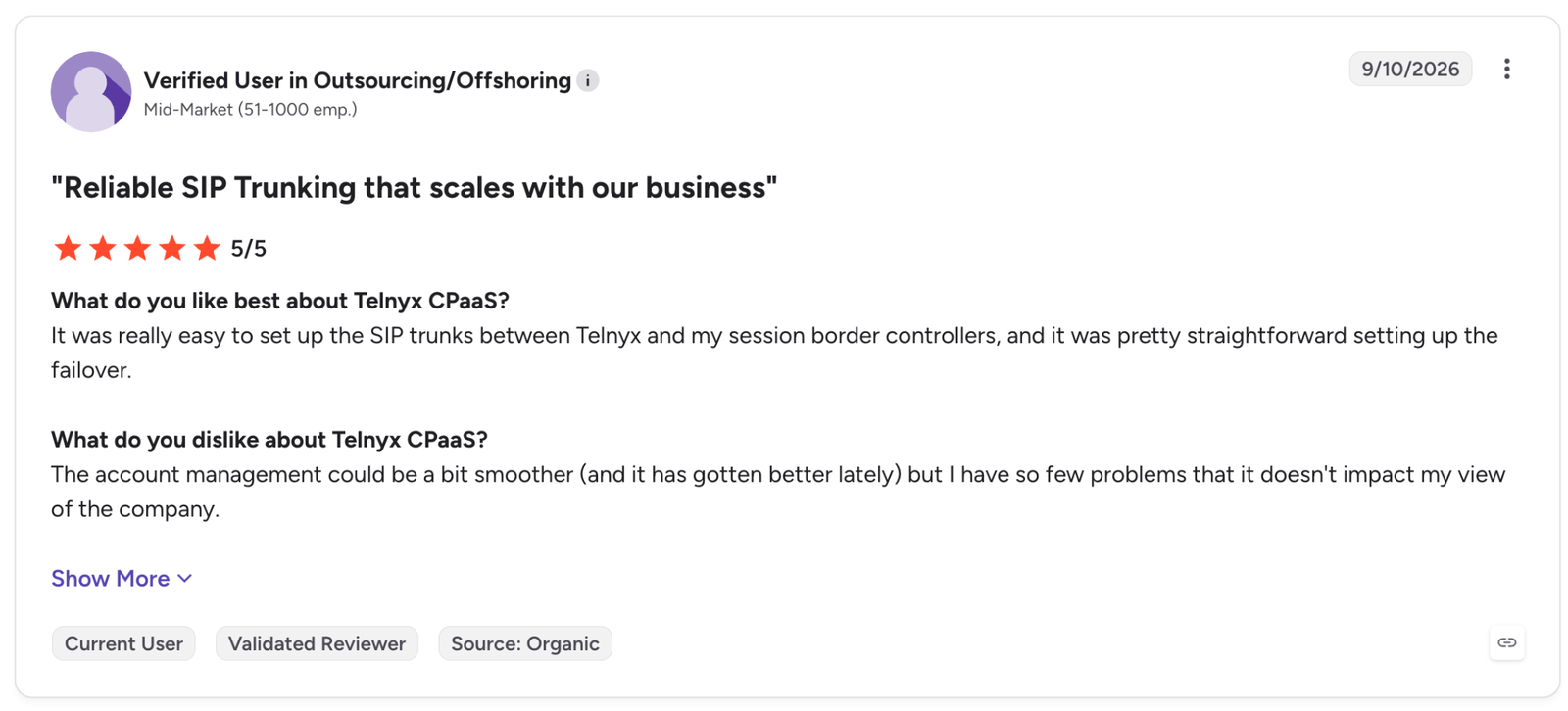
SIP setup: A verified reviewer in outsourcing said, "It was really easy to set up the SIP trunks between Telnyx and my session border controllers."
-
Support speed: Srdjan L., CEO, wrote, "The support team is outstanding, they always respond quickly, provide clear and helpful answers."
Cons:
-
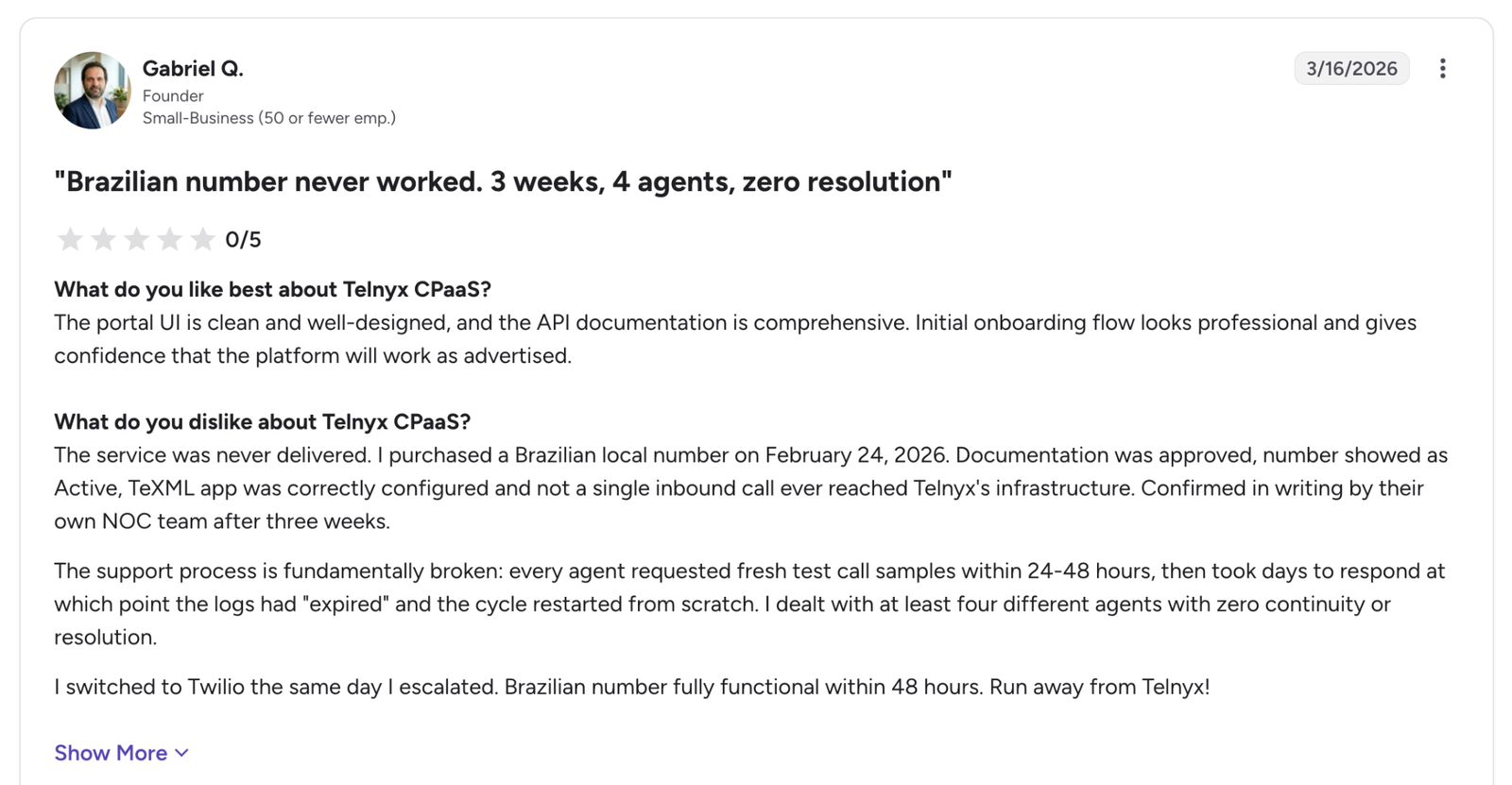
Number routing: Gabriel Q., Founder, said a Brazilian number never worked and "not a single inbound call ever reached Telnyx's infrastructure." Telnyx’s reply traces the fault to its Brazilian carrier partner, takes ownership, and says it’s processing a refund.
-
Verification: Dan B., IT Administrator, reported, "My account was denied L2 verification, which is required to use the SMS API." Telnyx says the account was later verified.
Twilio
Pros:
-
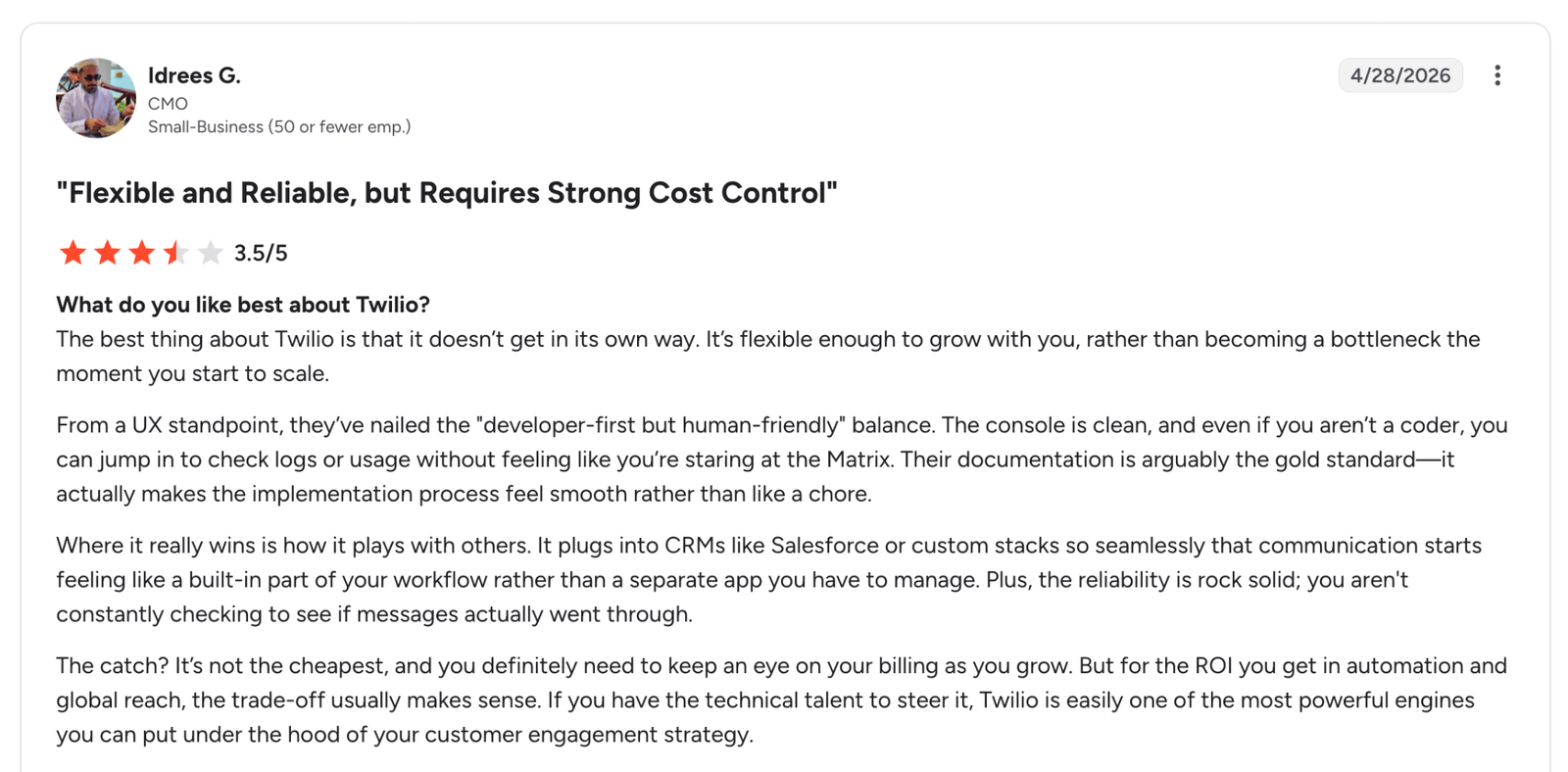
Documentation: Idrees G., CMO, called Twilio's docs "arguably the gold standard."
-
Call quality: Haritha P., QA Engineer, wrote that "call quality is stable which is critical for hotels."
Cons:
-
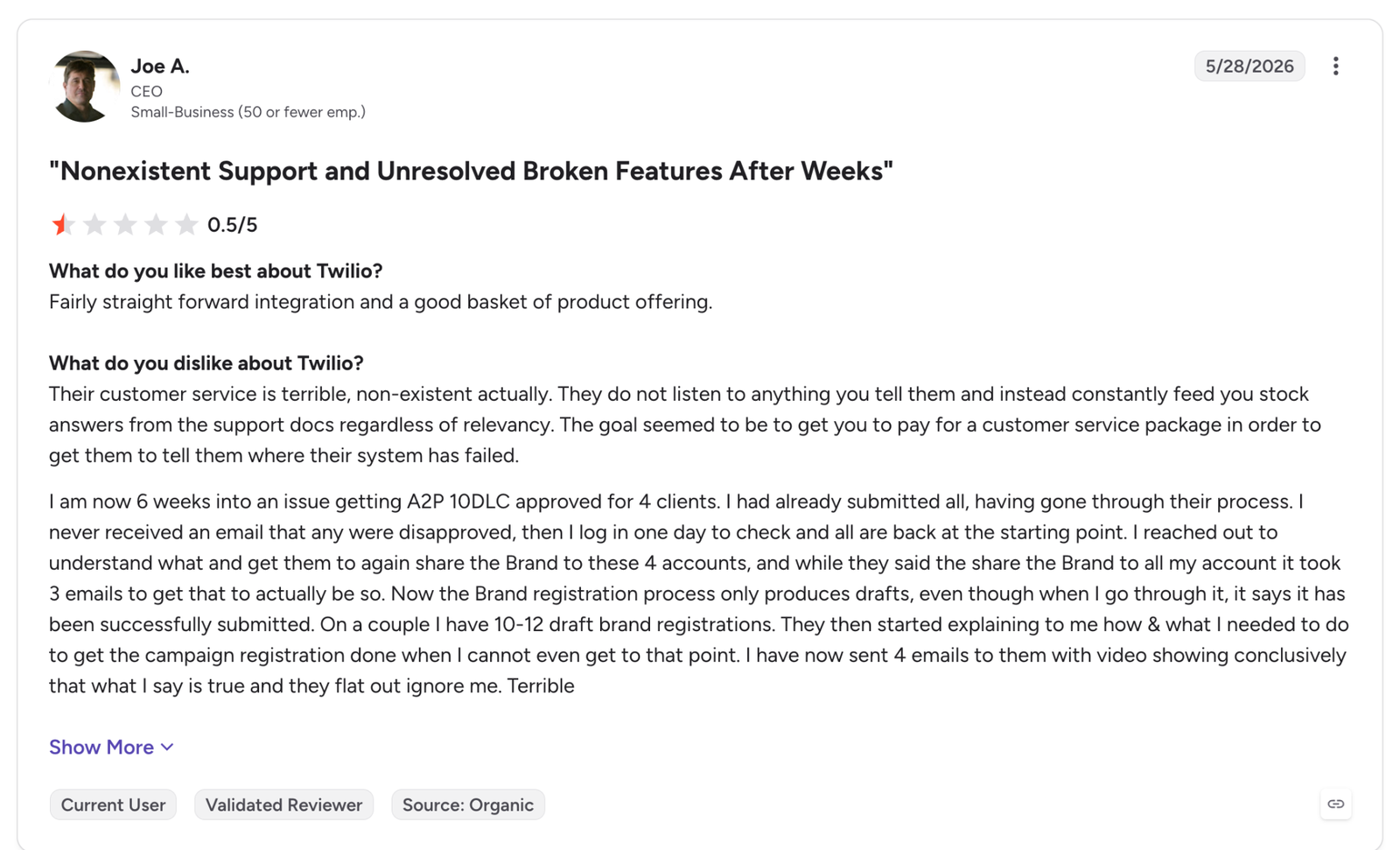
Support: Joe A., CEO, 6 weeks into a stuck A2P 10DLC approval, wrote, "Their customer service is terrible, non-existent actually."
-
Cost creep: Raul G., Director, said, "I find it expensive in terms of use, as they keep charging you even if you don't use it."
Support shows up on both sides. A Telnyx CEO praises how fast its team responds, while a Twilio CEO calls Twilio's support non-existent. Beyond that, Telnyx's complaints center on onboarding and number routing, and Twilio's on cost, from a small sample of 4 reviews per vendor.
How to Make Your Choice
For a voice agent where per-minute cost sets the margin, Telnyx is the cheaper carrier on published US voice rates and runs more of its own network. Twilio makes more sense if you need a support SLA below $2,000 a month in spend, or if your agent has to take a card number mid-call.
Telnyx Is Better For
-
Custom agent stacks that stream audio through the carrier, saving about 35% of the phone bill
-
Inbound lines with steady concurrent call volume, where channel billing turns per-minute charges into a flat fee per channel
-
One vendor and one invoice for telephony and model inference
Twilio Is Better For
-
Teams that need a guaranteed response time on business-critical tickets
-
Vapi agents with international callers on Vapi’s native number import (see the codec note in section 4)
-
Products that collect PCI-compliant payments over the phone
My Verdict
On Telnyx vs Twilio, I’d pick Telnyx for a new US voice agent and plan around 3 weak points.
Budget time for account verification, test interruption handling closely if you use Telnyx Voice AI Agents, and place international test calls of your own before you rely on Vapi's native Telnyx import.
If you already run on Twilio through an orchestration platform, there's less reason to move. At $0.05 a minute in platform fees, changing carriers saves about 2% of the total, so only switch if Twilio support or routing has caused problems for you.
Test Calls on Both Carriers Before You Move Traffic
A carrier swap changes the audio path under an agent that already works. One low-risk way to migrate is to run test calls on both carriers while production traffic stays put. Once those pass, route a small share of production calls to the new carrier, compare, then move the rest over in steps.
That comparison needs the same scenarios on both numbers. Cekura places test calls from your own Twilio or Plivo numbers, or sends them straight to the agent's SIP endpoint, so one test suite covers both the Twilio number and the Telnyx number.
Pre-production:
- Scenario replay on each carrier: One suite of booking and transfer flows, plus off-script calls, runs against both numbers, with DTMF input for keypad flows. Our telephony testing guide lists which carrier failures to test first.
Infrastructure:
-
Latency and audio checks: 18+ infrastructure scenarios cover latency, packet loss, interruptions, and hold, so a slower route or a codec problem appears as a score per carrier.
-
Load testing: Concurrent calls check whether the new trunk holds turn latency at your busiest hour.
Observability:
- Live call scoring: Every production call is scored on latency, interruptions, and task completion, with alerts when a metric drops after you move traffic.
Cekura works with both Telnyx and Twilio on the telephony side, with native integrations for Retell, Vapi, ElevenLabs, LiveKit, Pipecat, and more, so testing and monitoring sit on top of the stack you already run.
It’s SOC 2-, HIPAA-, and GDPR-compliant for transcript redaction, role-based access, and audit trails.
Use the rate card to shortlist a carrier, then use test calls on your own agent to decide. Book a demo to see how Cekura tests your agent on both carriers before the switch reaches your callers.
Frequently Asked Questions
What is the main difference between Telnyx and Twilio?
The main difference between Telnyx and Twilio is network ownership, and it shows up as cost. Telnyx holds carrier licenses in 30+ countries (Telnyx’s pages vary), runs its own fiber between its points of presence, and charges about half of Twilio's US outbound rate.
Twilio, by contrast, routes calls over third-party carriers and sells guaranteed response times from $250 a month. Telnyx offers 24/7 support to every account but publishes no response-time guarantee.
Is Telnyx any good?
Yes, Telnyx is a strong option for voice agents on cost and user ratings, with a 4.7/5 G2 score from over 500 reviews on November 2, 2026. Its weak points are account verification delays and, in Cekura's benchmark, the lowest interruption-handling score of 10 voice AI platforms.
Is Telnyx cheaper than Twilio?
Yes, Telnyx is cheaper than Twilio on published US voice rates. Outbound local calls cost $0.007 per minute on Telnyx (Voice API plus SIP) versus $0.0140 on Twilio, and inbound local calls cost $0.0052 versus $0.0085.
Does the carrier affect voice AI latency?
Yes, the carrier adds network delay to every turn, and ITU-T G.114 notes that one-way delays under 150 ms don’t significantly affect most voice applications. I found no independent test that compares the two carriers' latency on the same route, so measure turn latency on your own calls first.
Who are Twilio's main competitors?
Common Twilio alternatives for voice include Telnyx, Plivo, Vonage, Bandwidth, Sinch, and SignalWire.