
Rasa, Retell AI, and Decagon lead the Sierra AI alternatives in 2026. Rasa wins on self-hosted ownership, Retell AI on production-grade voice, and Decagon on managed enterprise CX at scale.
My comparison covered each vendor's live pricing pages, deployment models, security documentation, and named G2 reviews, set against Sierra's outcome-based pricing and agent platform.
Below you'll find what each Sierra AI alternative does well, where the fit runs out, and who each one is built for.
9 Best Sierra AI Alternatives: TL;DR
Here's the ranked shortlist. Each line is one platform and the job it's best at.
- Rasa: Best for technical enterprise teams that need self-hosted or air-gapped deployment.
- Decagon: Best for managed CX agents with a strong build-test-observe loop.
- Retell AI: Best for low-latency production voice on real phone lines, and the top reliability score (96.6% pass^3) on Cekura's voice orchestration benchmarks.
- Kore.ai: Best for broad omnichannel workflow automation across many business functions.
- Salesforce Agentforce: Best for teams already standardized on Salesforce.
- Ada: Best for no-code automated resolution across chat and messaging.
- PolyAI: Best for natural-sounding voice quality in service-heavy industries.
- Parloa: Best for European enterprises that need strong German-language voice.
- Synthflow: Synthflow: Best for no-code voice workflows, at enterprise contract sizes.
Why Look for Sierra AI Alternatives?
Founded in 2023 by Bret Taylor and Clay Bavor and out of stealth in February 2024, Sierra built Agent OS for brand-aligned agents that take real actions across chat, voice, email, and messaging.
It crossed $150M in ARR and counts a big share of the Fortune 50 as customers. For a company that wants a vendor to run its customer experience agents, Sierra earns the look.
But once you move past early pilots and into production, a few structural trade-offs show up. None are deal-breakers on their own, but together they explain why buyers start comparing Sierra AI competitors and building a shortlist.
- Outcome-based pricing is hard to forecast: Sierra charges when an agent resolves a case. Finance teams say modeled resolution rates are harder to baseline than a per-seat or per-minute line item.
- Voice arrived after chat: Sierra launched voice in October 2024, roughly eight months after the company came out of stealth, and later acquired Receptive AI to strengthen it. Telephony, barge-ins, accents, and jitter are newer investments than its chat stack.
- Platform lock-in: Because Sierra positions an end-to-end Agent OS, core workflows get rebuilt inside its platform. That centralization raises switching costs later, so data and export rights are worth negotiating up front.
- No public pricing and a sales-led motion: Every engagement runs through sales with custom outcome definitions. Procurement and finance modeling take time before you can even start.
- You give up code-level ownership: Changing workflows often means working inside Sierra's operating model rather than your own engineering, release, and security process.
9 Best Sierra AI Alternatives: At a Glance
Here's how the shortlist stacks up before the detail.
| 🏆 Platform | 🎯 Best for | 💰 Starting price |
|---|---|---|
| Rasa | Self-hosted enterprise ownership | Free; Enterprise custom |
| Decagon | Managed CX agent lifecycle | Custom |
| Retell AI | Production voice calls | ~$0.07/min |
| Kore.ai | Omnichannel automation | Custom |
| Salesforce Agentforce | CRM-native contact centers | $500 per 100K Flex Credits |
| Ada | No-code resolution | Custom |
| PolyAI | Natural voice quality | Custom |
| Parloa | DACH-market voice | Custom |
| Synthflow | No-code voice workflows | From $30,000/year |
Pricing verified against vendor pages on 11 August 2026. Verify with the vendor before you commit.
The 9 Best Sierra AI Alternatives for 2026
1. Rasa
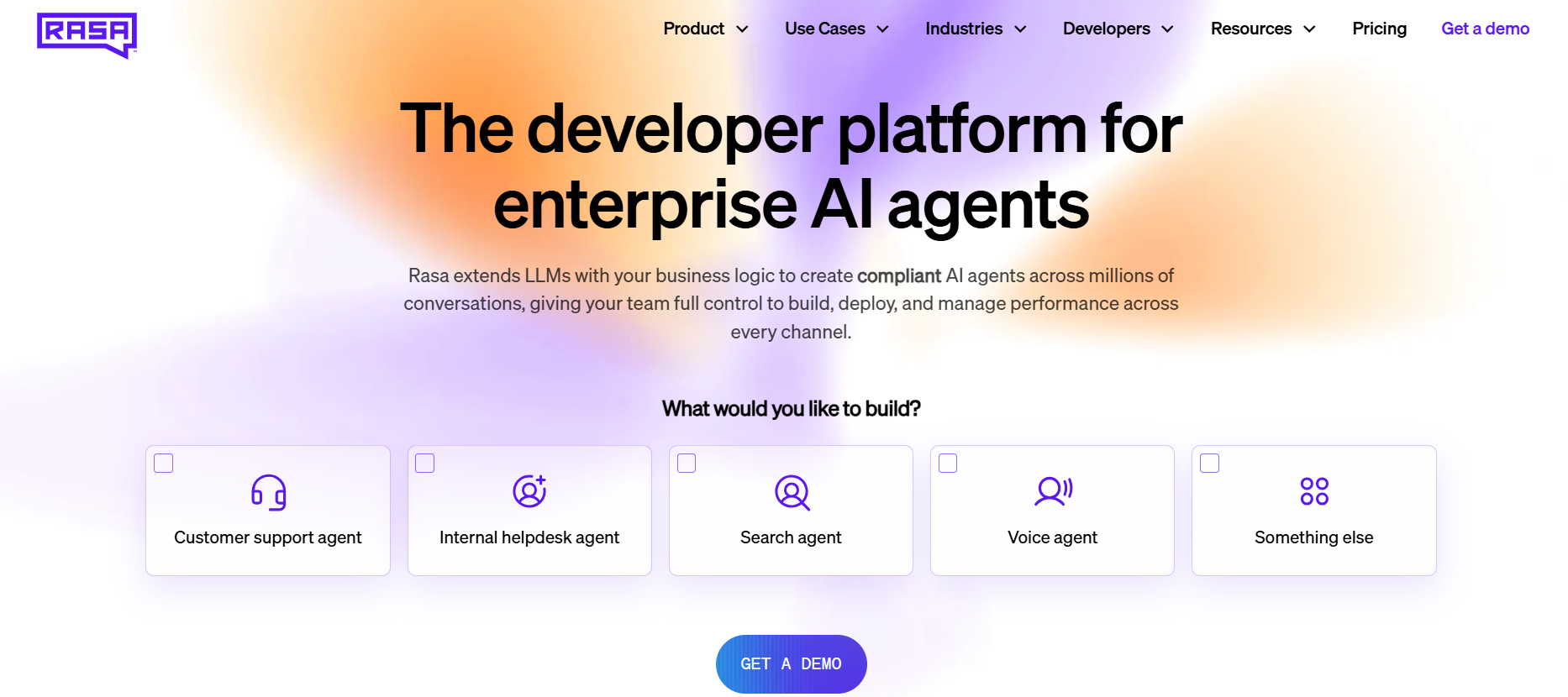
Rasa is for technical enterprise teams that want to own the whole agent stack.
Where Sierra runs a managed operating model, Rasa is built to fit your architecture, deployment, engineering workflow, and release process. It brings together a Framework, Orchestrator, and Studio so teams build, run, and improve agents across voice and digital channels.
That ownership matters most in regulated environments. Rasa supports self-hosted, private-cloud, and air-gapped deployment, so customer data and agent operations stay inside your walls.
Key Features
- Patented Orchestrator manages conversation state, skills, memory, tools, and channel behavior in one place.
- Code-level ownership gives engineering teams control over integrations, tests, versioning, and controlled releases.
- Flexible-plus-strict control lets you allow natural conversation where it helps, then add approvals, policy checks, and required steps where the use case demands.
- Model and provider choice works across LLM and speech providers instead of locking you to one.
Pros
✅ Customer-controlled deployment covers self-hosted, private-cloud, and air-gapped options.
✅ Voice and digital channels run inside one operating model.
✅ The event-based tracker keeps agent behavior observable and auditable.
Cons
❌ It requires engineering resources or an implementation partner to run well.
❌ It's less turnkey than a managed CX vendor.
❌ It's the wrong fit if you want a vendor to fully operate the agent for you.
Best For
- Regulated industries needing self-hosted or air-gapped deployment.
- Teams that want code, CI/CD, and release control over their agent.
- Enterprises running voice and digital in one governed stack.
Pricing
The Developer Edition is free for local or production use, with one bot per company and up to 1,000 external conversations per month. Enterprise is custom.
2. Decagon
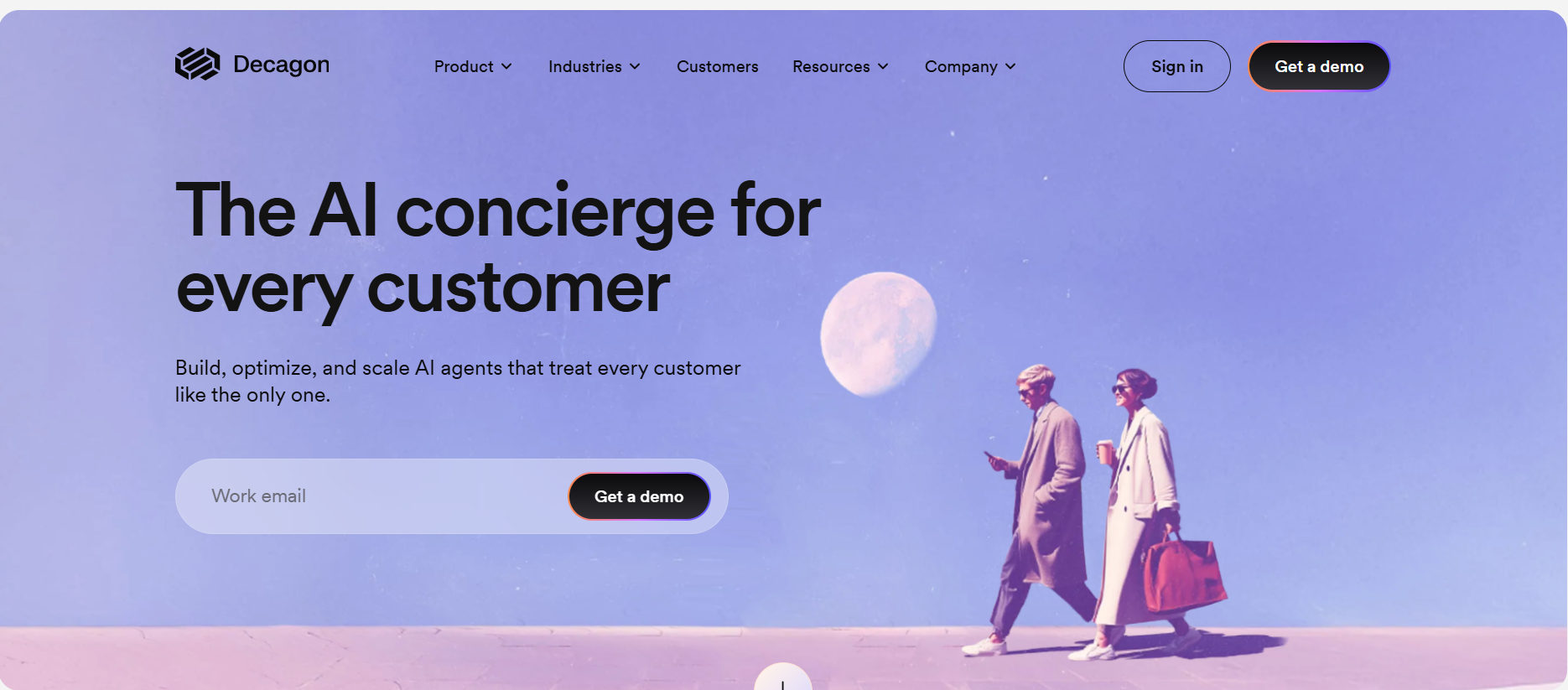
Decagon is a managed CX platform for teams that want a strong improvement loop around their agents.
Its core idea is Agent Operating Procedures: natural-language instructions that compile into validated logic. That lets support teams iterate on agent behavior without pushing every change through engineering.
Decagon covers chat, email, and voice, and pairs that with tooling for debugging, QA, and continuous improvement after launch.
Key Features
- Agent Operating Procedures turn plain-language instructions into working agent logic.
- Trace View gives turn-by-turn visibility into agent decisions and tool use.
- Watchtower runs always-on QA across live conversations.
- Built-in testing and simulations validate behavior before a release ships.
Pros
✅ It covers the full managed lifecycle: build, test, observe, and improve.
✅ Trace View makes agent logic debuggable instead of a black box.
✅ Integrations reach helpdesks, CRMs, knowledge bases, and APIs.
Cons
❌ It's a managed SaaS model, so there's no customer self-hosting.
❌ Its best fit is CX automation, not broad enterprise agent ownership.
❌ Pricing is custom and sales-led.
Best For
- CX teams that want a vendor-run improvement loop.
- Support orgs iterating on agent behavior without heavy engineering.
- Teams that value built-in QA and tracing over deployment control.
Pricing
Decagon uses custom pricing with two models: a per-conversation rate for every incoming conversation, or a higher per-resolution rate charged only when the AI fully resolves an issue. Decagon says most customers pick per-conversation. No dollar figures are published, so contact Decagon for a quote.
3. Retell AI
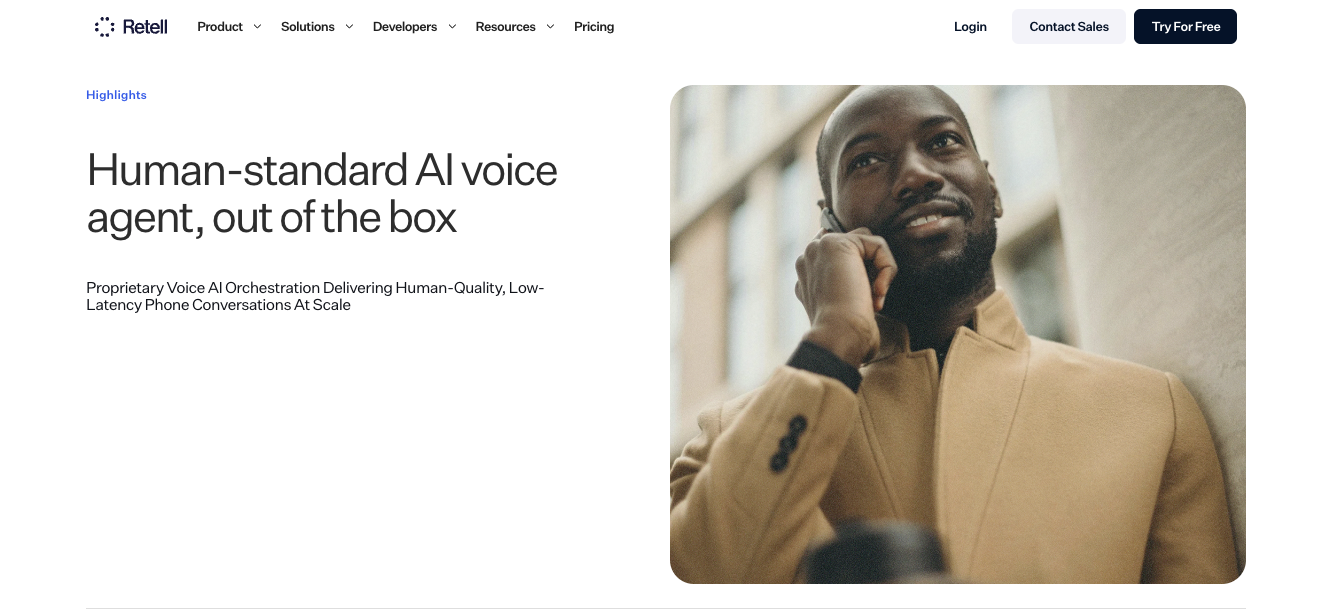
Retell AI is a voice-first platform built for real-time phone calls.
Unlike platforms that started with chat and bolted voice on later, Retell was designed for low-latency telephony from the start. That makes it reliable for AI receptionists, inbound routing, and outbound campaigns.
It plugs directly into PBX, VoIP, and SIP systems, so you can layer voice agents onto existing phone infrastructure with little friction.
Key Features
- Sub-second response times keep calls sounding natural through pauses and interruptions.
- Native telephony integrations connect to Twilio, Vonage, and SIP providers directly.
- Batch calling and warm transfers support high-volume outbound and inbound operations.
- Post-call analysis transcribes and scores every call for intent and accuracy.
Pros
✅ It's purpose-built for voice, so telephony-heavy workflows stay stable.
✅ The no-code builder lets teams launch and update flows fast.
✅ Usage-based pricing is transparent and published.
Cons
❌ It's primarily voice-focused, so digital orchestration is lighter.
❌ Complex backend workflows still need integration work.
❌ Costs scale with call volume, which matters at high concurrency.
Best For
- Healthcare, finance, and logistics teams that live on the phone.
- Inbound routing and outbound campaign use cases.
- Teams that want predictable per-minute pricing.
Pricing
Retell uses transparent usage-based pricing at $0.055 per minute for the base voice infrastructure, with an all-in range of $0.07 to $0.31 per minute once you add LLM inference, TTS voices, and telephony.
4. Kore.ai
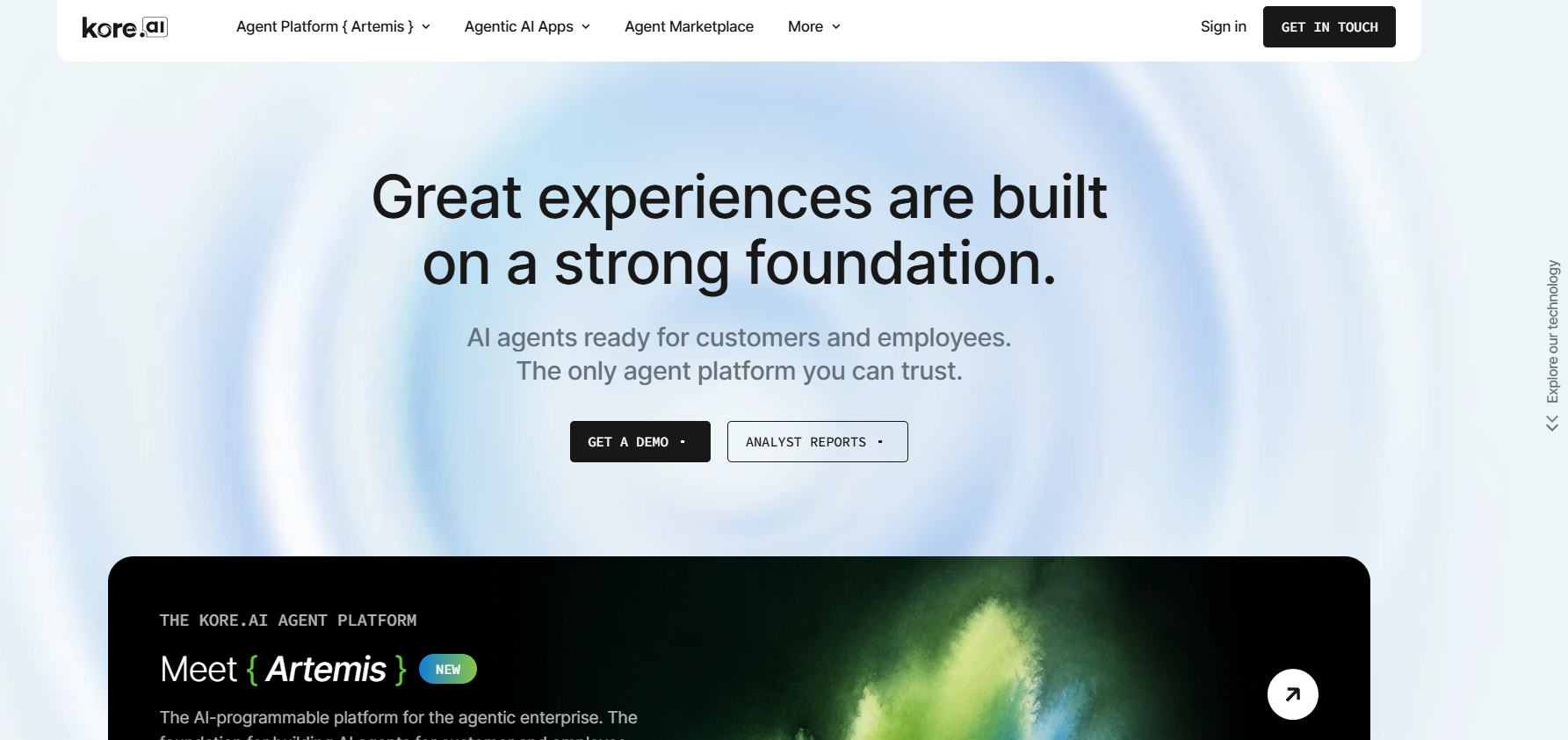
Kore.ai is a broad enterprise platform for automation across many business functions.
It handles customer service, employee support, HR, IT, and process automation in one place, with pre-built agents, enterprise integrations, and multi-agent orchestration.
For large organizations that want one vendor across customer-facing and internal use cases, Kore.ai covers a lot of ground.
Key Features
- Omnichannel coverage spans voice, chat, email, and social with context carried across them.
- Multi-engine NLP improves intent detection and sentiment analysis.
- Pre-built agents speed up common customer and employee use cases.
- Enterprise integrations connect to CRMs, ERPs, and backend APIs.
Pros
✅ It covers customer-facing and employee-facing use cases in one platform.
✅ Governance, analytics, and observability are strong.
✅ Pre-built agents and marketplace assets shorten common builds.
Cons
❌ Integration configuration can get messy in practice.
❌ Enterprise pricing is opaque.
❌ Advanced features carry a real learning curve.
Best For
- Large enterprises wanting one platform across many functions.
- Organizations needing pre-built industry agents.
- Teams that value omnichannel breadth over deployment control.
Pricing
Kore.ai offers tiered plans where only the top tier is fully custom, plus model-compute credits for infrastructure usage. Large voice and agentic deployments are quoted case by case. Contact Kore.ai for details.
5. Salesforce Agentforce
Salesforce Agentforce is the strongest fit for teams already standardized on Salesforce.
It brings AI agents, CRM context, voice, and digital channels together inside the Salesforce platform, with routing, workflows, and human handoff built in.
If your service operation already runs on Salesforce, Agentforce gives your agents the deepest CRM context of any option here.
Key Features
- Deep CRM context pulls directly from Salesforce data during every interaction.
- Service Cloud Voice supports native telephony through partner providers or Amazon Connect.
- Hyperforce data residency handles regional compliance requirements.
- Native workflows route and escalate inside the Salesforce ecosystem.
Pros
✅ It has the deepest CRM context of any platform on this list.
✅ Telephony is native through Service Cloud Voice.
✅ Data residency is handled through Hyperforce.
Cons
❌ The best fit requires deep Salesforce commitment.
❌ Licensing spans several products and usage models.
❌ Total cost is hard to model across conversations, seats, voice, and data.
Best For
- Enterprises already running Salesforce Service Cloud.
- Teams that want AI agents inside their existing CRM.
- Contact centers needing native CRM context and voice.
Pricing
Agentforce is free to get started for customer-facing agents, or $500 per 100,000 Flex Credits under its per-action model, where a standard action costs $0.10. Employee-facing add-ons start at $125 per user per month.
6. Ada
Ada is a no-code platform for automated resolution across chat, messaging, and voice.
It's built for CX teams that want to deploy and coach agents without deep engineering support, with knowledge-based answers and multi-step Playbooks.
Ada leans into fast setup and broad channel coverage inside a managed model.
Key Features
- No-code coaching lets CX teams tune agent behavior without engineers.
- Playbooks support multi-step processes across channels.
- 50+ language translation extends coverage globally.
- Pre-built integrations connect to Salesforce, Zendesk, Twilio, and more.
Pros
✅ No-code coaching puts CX teams in control of the agent.
✅ It supports messaging, email, voice, and social channels.
✅ Pre-built integrations connect to major business systems.
Cons
❌ It's cloud-only, with no self-hosted option.
❌ It's less suited to teams wanting code-level ownership.
❌ Pricing is custom and not transparent.
Best For
- CX teams wanting no-code automation at scale.
- E-commerce, fintech, and telecom brands prioritizing fast setup.
- Multilingual support operations.
Pricing
Ada uses performance-based custom pricing tied to successful resolutions and interaction volume. Contact Ada for a quote.
7. PolyAI
PolyAI is built for natural-sounding voice in high-volume customer interactions.
Its focus is speech quality, multi-accent support, and conversational resilience, which makes it popular where phone experience defines the brand.
For service-heavy industries, PolyAI's voice realism is its main draw.
Key Features
- Highly realistic voice handles turn-taking, interruptions, and tone shifts smoothly.
- Vertical templates ship pre-built industry flows for faster launch.
- Agent Studio tunes voice persona and behavior without deep scripting.
- Guardrails reduce off-script generative behavior.
Pros
✅ Voice quality is engineered for human-like calls from day one.
✅ Industry templates speed up deployment in banking, travel, and retail.
✅ Conversational control lowers hallucination risk on live calls.
Cons
❌ Custom pricing can be costly for smaller teams or pilots.
❌ It's less flexible for highly custom business logic.
❌ Integration work may need dedicated technical resources.
Best For
- Hospitality, travel, retail, and banking phone lines.
- Teams where customer trust depends on natural voice.
- High-volume inbound voice operations.
Pricing
PolyAI uses custom, usage-based pricing billed per minute.
8. Parloa

Parloa is a voice-first platform for European enterprises, especially the DACH region.
It's designed for contact centers that need native German and European language support, with LLM integration for natural conversations.
For European buyers, Parloa's regional voice focus is its clearest advantage.
Key Features
- Voice-first architecture built for contact center automation.
- Contact center integrations connect to existing telephony stacks.
- LLM integration powers natural, multi-turn conversations.
Pros
✅ Parloa connects over SIP and owns the audio pipeline, so calls stay low-latency on your existing phone system.
✅ One agent serves German and other European markets, which cuts the cost of building per-language versions.
✅ Prebuilt connections to Genesys, Avaya, Five9, and Salesforce mean your current CCaaS and CRM stack stays in place.
Cons
❌ It's less suited to teams wanting a code-first developer platform.
❌ Market presence outside DACH is limited.
❌ Its ecosystem is smaller than Rasa or Kore.ai.
Best For
- European enterprises, particularly in the DACH region.
- Contact centers needing native German voice.
- Voice-first customer service in regulated European markets.
Pricing
Parloa uses custom enterprise pricing tuned to deployment scale and channel usage. Contact Parloa for a quote.
9. Synthflow
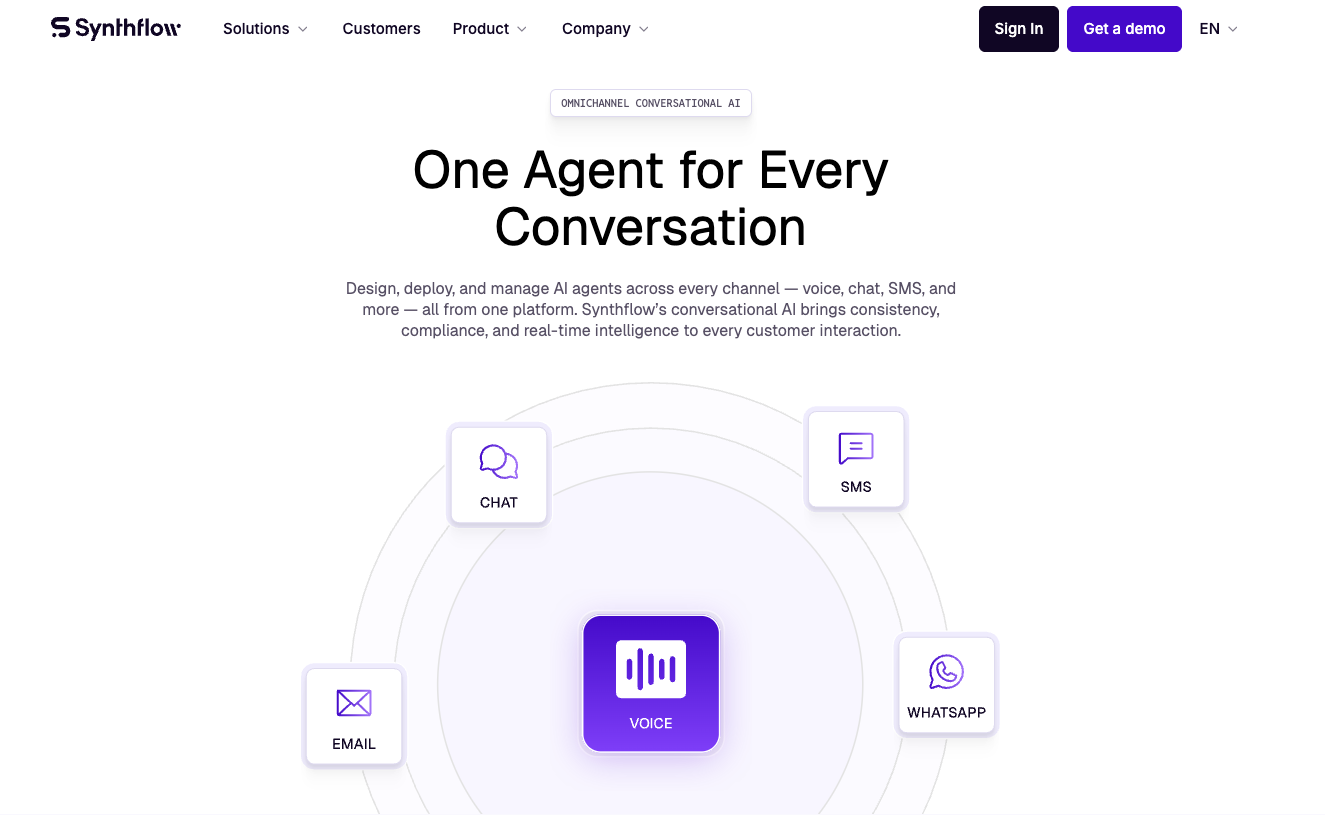
Synthflow is a no-code voice AI platform with a visual workflow builder.
It's aimed at teams and agencies that want to build production-grade voice agents without heavy engineering, with real-time personalization and CRM integrations.
Its drag-and-drop builder and multi-tenant management make it a fit for agencies running many client agents.
Key Features
- No-code visual builder lets non-technical users design voice agents.
- 300+ AI voices with multilingual voice cloning.
- SIP trunking works with any telephony provider for flexible routing.
- Built-in post-call analysis captures performance metrics automatically.
Pros
✅ The no-code builder removes most engineering effort.
✅ Telephony setup is flexible with SIP and multilingual voices.
✅ Call analytics and logging come built in.
Cons
❌ Pricing rises with call volume at high scale.
❌ It's focused on voice, not deep omnichannel orchestration.
❌ Advanced logic still needs careful manual configuration.
Best For
- Marketing teams and agencies managing multiple client agents.
- No-code teams building inbound voice automation.
- Compliance-sensitive voice workflows needing quick setup.
Pricing
Synthflow moved to enterprise-only pricing. Contracts start at $30,000 annually, scoped around call volume, concurrency, telephony setup, integrations, and launch support. There's no self-serve monthly tier.
10. Cognigy
Cognigy is an enterprise platform for voice and chat AI agents built around contact center operations.
It now operates as NiCE Cognigy after NiCE closed its $955 million acquisition in September 2025. The platform pairs a low-code builder with orchestration across AI agents and human agents.
Deployment flexibility is its clearest draw for regulated buyers. Cognigy runs as SaaS or as a dedicated deployment, with components like its Voice Gateway able to run inside your own data center.
Key Features
- Voice Gateway connects agents to contact center stacks including Amazon Connect, Genesys, Avaya, and Five9.
- Low-code flow builder combines scripted workflows with LLM-driven conversation handling.
- 100+ language support with real-time translation covers multilingual operations in one deployment.
- SaaS and dedicated deployment options keep voice traffic inside your infrastructure where required.
Pros
✅ Voice and chat run inside one platform designed for contact center operations.
✅ Dedicated and on-premises deployment keeps conversation data in your environment.
✅ NiCE ownership ties it into an established contact center ecosystem.
Cons
❌ Pricing is custom and sales-led, with no published tiers.
❌ The NiCE acquisition ties its roadmap to the CXone ecosystem, which matters for buyers on other CCaaS stacks.
❌ On-premises deployment demands a capable DevOps team to run.
Best For
- Enterprise contact centers running voice and chat on one platform.
- Regulated organizations that need dedicated or on-premises deployment.
- Companies already standardizing on the NiCE CXone ecosystem.
Pricing
Cognigy uses custom enterprise pricing shaped by interaction volume, voice capacity, and deployment model. There are no published tiers. Contact Cognigy for a quote.
How to Evaluate Sierra AI Alternatives
Knowing which questions to ask before you commit saves more time than any feature list. Here's where to start.
- How do you want to operate the agent? Some platforms are managed CX systems that run the lifecycle for you. Others are built to become part of your own software operation. Start with the operating model, not the feature grid.
- Where does your data need to live? For regulated teams, deployment is often the first filter. If conversation data, voice data, and backend actions must stay in your environment, prioritize self-hosted, private-cloud, or VPC options.
- How mature is the voice layer? Voice added late tends to lag on telephony, barge-ins, jitter, and accents. If phone is a primary channel, weigh how long the vendor has invested in it, and validate with your own tests.
- How does pricing scale at your volume? Outcome-based, per-conversation, per-minute, and per-seat models produce very different cost curves. Model the full cost at 12 and 24 months, including LLM, speech, telephony, and implementation.
- How deep are the integrations? Enterprise agents need to retrieve data, trigger workflows, and hand off with context. Compare how each platform connects to your CRMs, ERPs, ticketing, and internal APIs.
- What happens when a release regresses? Some platforms surface a problem after users hit it. Others let you catch it before launch. That gap matters when you ship several times a week.
Are You Building a Voice or Conversational AI Agent?
The ten Sierra AI alternatives above build and run your agent, but none of them test how it holds up when real people push it off-script across thousands of conversations. That's the gap Cekura fills, and it runs on top of whichever platform you choose.
Cekura's published benchmarks measure this directly. Across 59 evaluators and three runs per scenario, Retell scored 96.6% on pass^3 with a P50 latency of 1.96s, while Synthflow scored 81.4% with a P50 of 3.16s. The full methodology and per-platform results are public.
This matters directly for the Sierra trade-offs. A newer voice layer and a lock-in-heavy build are exactly the conditions where hidden failures show up after launch. Pre-launch simulation and production monitoring are how you catch them first.
The data backs this up. Per the X-Teaming paper (COLM 2025), attack success rate climbs from 19.5% at two turns to 92.7% at eight, then falls back to 87.8% at ten. Multi-turn red teaming has to mirror real, messy conversations because that's where agents give ground.
Here's what to test before you commit, grouped by stage.
- Pre-production: Run scenario simulations across booking, refunds, and FAQ flows, plus multi-turn red teaming against adversarial callers, before any of it reaches a customer.
- Infrastructure: Test interruptions, latency, background noise, and endpointing, since these voice-layer failures hit newer voice stacks and voice-first platforms alike.
- Observability: Monitor production calls for drop-off and sentiment, and run regression tests after every prompt or model change.
Native integrations work out of the box for Retell, VAPI, ElevenLabs, LiveKit, Pipecat, and Bland. You don't rebuild anything. You add a testing and monitoring layer on top of what you already have.
Cekura is SOC 2-, HIPAA-, and GDPR-compliant for transcript redaction, role-based access, and audit trails.
Most issues only show up when real people are on the line. Book a demo to see how you can catch them before your users do.
Frequently Asked Questions
What are the best Sierra AI alternatives?
The best Sierra AI alternatives are Rasa for self-hosted enterprise ownership, Decagon for managed CX agents, and Retell AI for production voice. The right pick depends on whether you want a vendor-managed platform or code-level control over deployment and releases.
What are Sierra AI's limitations?
Sierra AI's main limitations are outcome-based pricing that's hard to forecast, a voice layer added nine months after launch, and platform lock-in from rebuilding workflows inside Agent OS. Its sales-led motion also means no public pricing and longer procurement.
Does Sierra AI support voice and chat?
Yes, Sierra AI supports voice, chat, email, and messaging through Agent OS. Its voice capability launched in October 2024, later than its chat stack, and was strengthened through the acquisition of Receptive AI.
How is Sierra AI priced?
Sierra AI uses outcome-based pricing, charging when an agent resolves a case rather than per seat or per minute. Do you still need to test a Sierra alternative before launch?
Yes, you still need to test any Sierra alternative before launch because no agent-building platform tests itself. Running simulations, red teaming, and infrastructure tests before go-live catches the interruptions, accents, and adversarial inputs that only surface with real callers.