
Grok Voice 3.0 is xAI's newest speech-to-speech model, one API that hears a caller, reasons, calls tools, and talks back.
To test those claims, we checked its 8 key features and pricing against xAI's docs and ran it through 246 simulated calls on the Cekura speech-to-speech benchmark. Its median reply was the second-fastest of 14 models, level with Rime Prism at 1.34s, and lost fields on long Medicare calls.
What Is Grok Voice 3.0?
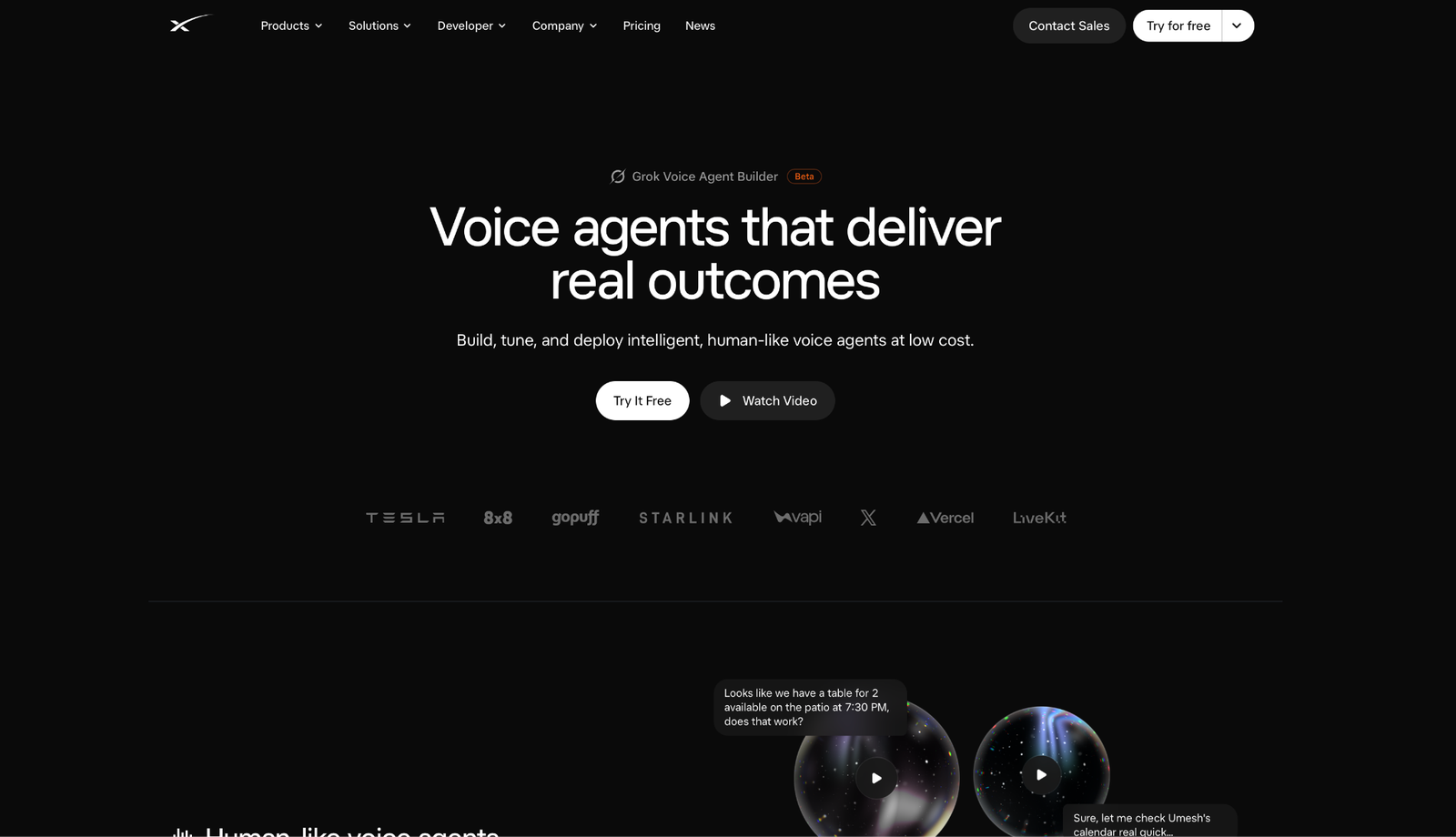
Grok Voice 3.0 is a native speech-to-speech model for voice agents, and it's available in the API as grok-voice-3.0.
The company now publishes its site and docs under the SpaceXSI name, so you'll see both brands on the source pages. You'll also see the model called Grok Voice 3, and xAI's docs use the full version number.
On the developer side, you open one WebSocket, stream audio in, and get audio, transcripts, and tool calls back. A cascaded stack splits that work across 3 vendors (speech-to-text, an LLM, and text-to-speech), so one socket and one bill is the main draw.
The table below sums up the launch facts, each checked against xAI's launch post and docs on November 2, 2026.
| What | Grok Voice 3.0 |
|---|---|
| Announced | October 14, 2026 |
| API model ID | grok-voice-3.0 (the grok-voice-latest alias now points here) |
| Endpoint | wss://api.x.ai/v1/realtime (WebSocket) |
| Price | $0.08 per minute of audio ($4.80 per hour), plus $0.004 per billable text message |
| Latency claim | "Under one second"; 0.81s average time to first audio, per Artificial Analysis |
| Languages | 20+ claimed; the docs list 20 entries covering 16 base languages, with auto-detection |
| Voices | 28 stock voices and custom voice cloning |
| Telephony | SIP (Twilio, Telnyx, Plivo, Bandwidth, or your own trunk), LiveKit, G.711 μ-law and A-law |
xAI uses the model in its own products. It says Grok Voice 3.0 handles millions of conversations a day in Tesla vehicles and powers Grok Bot's voice mode.
Customer support is the closest match to a contact-center build. Starlink's call centers use Grok Voice for 20,000 calls a day, and about 70% end without a human in the loop. Those operating numbers come from xAI alone.
Grok Voice 3.0 vs. Grok Voice 2.0
Grok Voice 3.0 swaps the model and leaves the API alone. xAI's docs say 3.0 uses the same endpoint, session parameters, and events as 2.0, at the same price.
Grok Voice 2.0 is now deprecated. If you pinned grok-voice-2.0 in production, the docs tell you to set model to grok-voice-3.0. If you used the alias, you're already on 3.0.
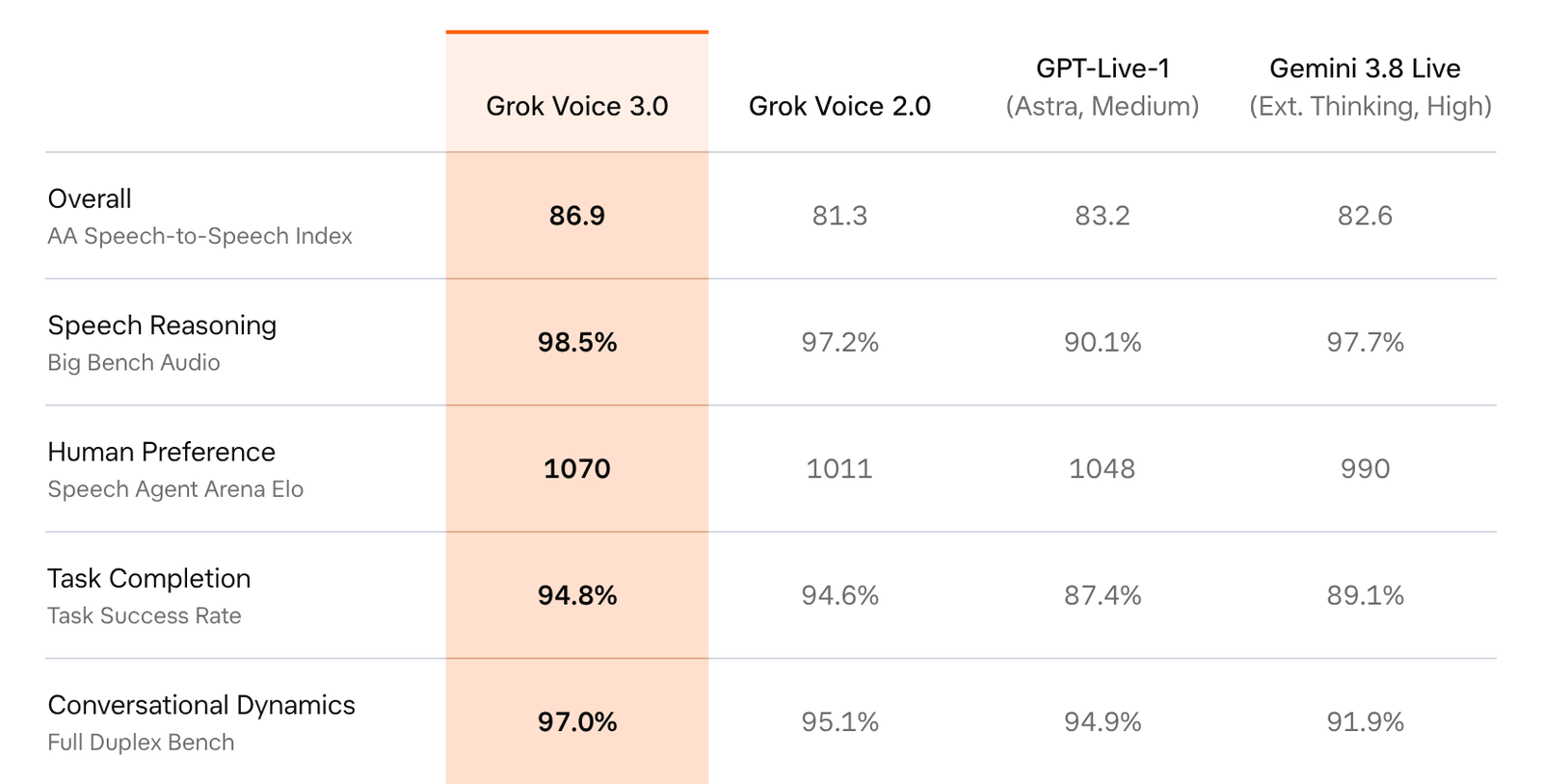
The model swap shows up in xAI's published gains, all from Artificial Analysis as of October 13, 2026:
| Benchmark | Grok Voice 2.0 | Grok Voice 3.0 |
|---|---|---|
| AA Speech-to-Speech Index | 81.3 | 86.9 |
| τ-Voice | 56.5% | 71.6% |
| Speech Agent Arena Elo | 1011 | 1070 |
| Full Duplex Bench | 95.1% | 97.0% |
| Big Bench Audio | 97.2% | 98.5% |
AA's live leaderboard has since moved the Elo scores to 1059 (3.0) and 991 (2.0).
If you compare launch posts, watch the index name. The Grok Voice Think Fast 2.0 launch in July listed 82.9% on Artificial Analysis's older "Speech-to-Speech Quality Index."
The 81.3 in the table above is 2.0's score on the newer index. They're different index versions, so compare 2.0 and 3.0 on the newer index only.
Time to first audio is the one metric where 2.0 still wins. On Artificial Analysis's leaderboard, Grok Voice 3.0 averages 0.81 seconds to first audio and Grok Voice 2.0 averages 0.70 seconds, so 3.0 starts speaking about 0.11 seconds later on that test.
Our own benchmark, which uses a different clock, found 3.0 quicker than 2.0. Its median reply came 0.28 seconds sooner. On identical calls, 3.0 also passed 81.7% of scenarios on all 3 runs, against 67.1% for Cekura’s Grok Voice 2.0 row (listed as Grok Voice Think Fast 2.0).
8 Key Grok Voice 3.0 Features
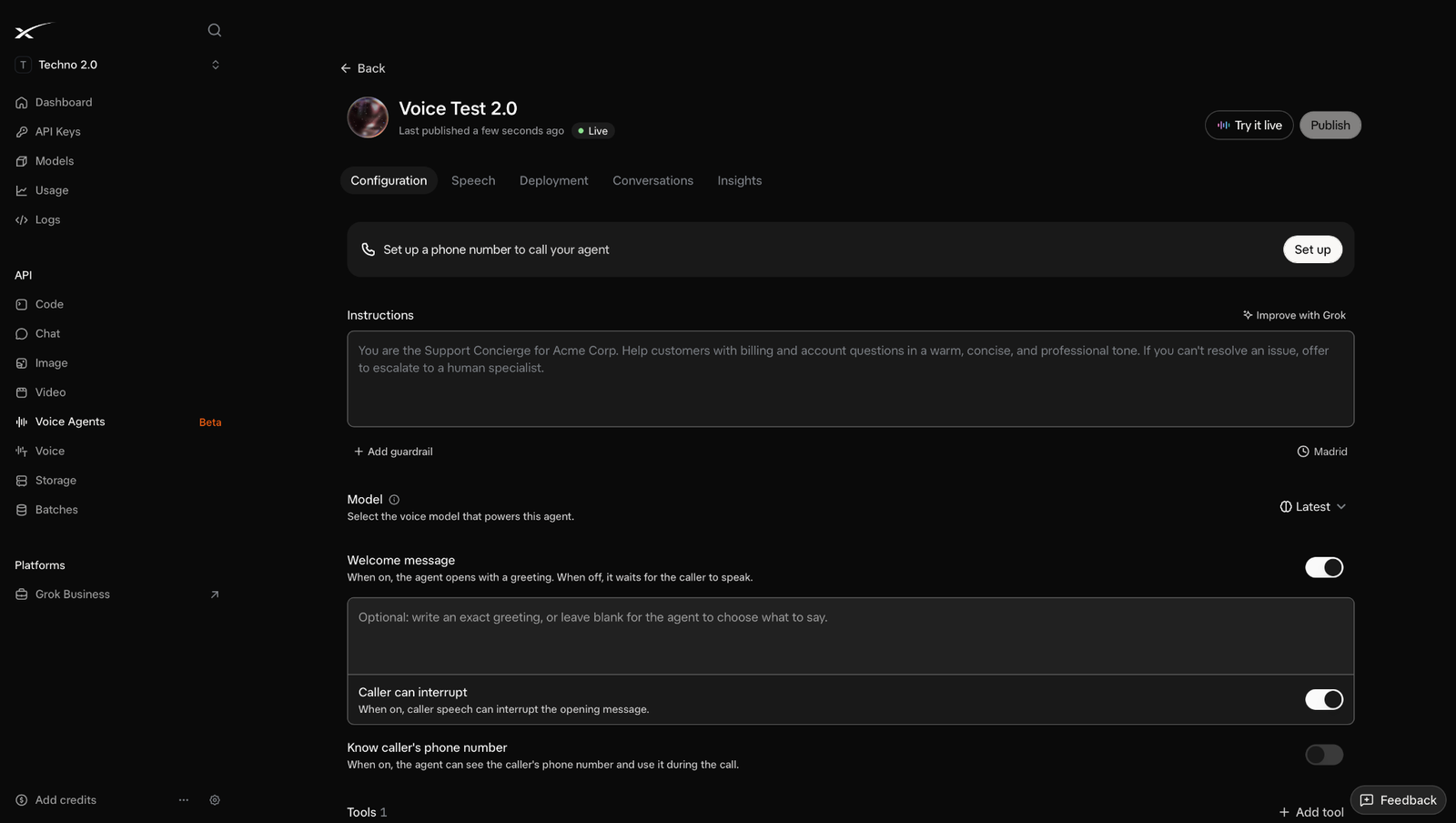
Each feature below comes from xAI's Speech to Speech docs, with what to watch for when you build on it.
1. Reasoning While It Speaks
In the 3.0 docs, reasoning.effort defaults to "high", so the model reasons through a request while it talks. You can set it to "none" to switch reasoning off.
When xAI launched Grok Voice Think Fast 2.0, it said reasoning runs in parallel with speech, so tool calls usually execute before the agent finishes its first sentence. Our benchmark points the same way.
With reasoning on high, 3.0 posted the second-fastest median reply of the 14 models tested, level with Rime Prism at 1.34s.
Because 3.0 is more capable, xAI's migration guide says it needs a much shorter system prompt and that instructions written to patch GPT-model bugs can go. You should treat that rewrite as a regression risk, since a new prompt changes behavior across your call flows at once.
2. Tool Calling and MCP
Mid-conversation, the model can call five tool types:
-
Custom functions: You write your own JSON-schema tools for booking, CRM lookups, refunds, or transfers.
-
Collections search (file_search): The model retrieves from document collections you upload.
-
Web search: xAI handles web lookups on its servers.
-
X search: xAI searches posts on X on its servers.
-
Remote MCP tools: You can connect any MCP server, or several at once.
The API also supports parallel tool calling. When the model needs 2 lookups, it emits both function calls before speaking. Your client sends both results back before the next response.create.
The docs warn about one failure tied to tool calls. If your client sends the tool result and response.create right away, the next reply can start while the last one is still playing, and the caller hears two answers at once.
The solution is to wait until playback finishes before you send response.create. That way, each reply starts only after the caller has heard the last one.
3. SIP Phone Calls, Transfers, and DTMF
Phone calls reach Grok Voice over SIP. You register a number you already own, point your carrier at sip.voice.x.ai, and join each call over your existing WebSocket connection with a call_id.
Setup guides cover Twilio Elastic SIP Trunking, Telnyx, Plivo, and Bandwidth, and any PBX or contact center that can route a SIP trunk.
Call control comes with the API. A refer request transfers the caller and blocks until the transfer resolves, so a 200 means the destination answered.
When a transfer fails, the API returns a 502 with the carrier's SIP code in the body when one is available. The caller stays on the session, so the agent can keep talking.
DTMF goes in both directions. Keypresses get buffered and handed to the model as text, and the agent can press keys itself to navigate another company's phone menu.
4. Telephony-Ready Audio
Native G.711 μ-law and A-law at 8 kHz means phone audio needs no transcoding. For wideband sources, PCM goes up to 48 kHz and Opus runs at 24 kHz.
An 8 kHz PSTN leg passes only 300 to 3,400 Hz of audio, so telephony testing on a live carrier can catch codec errors that browser demos miss.
You can send audio as base64 JSON or as raw binary WebSocket frames. Binary frames skip base64 encoding, which otherwise adds about a third to each packet's size.
5. 20+ Languages With Auto-Detection
The docs list 20 language entries covering 16 base languages. Arabic has 3 regional variants, Spanish and Portuguese have 2 each, and Hindi, Bengali, Japanese, and Korean are on the list too. The model detects the caller's language and answers in it, and it can switch languages mid-call.
To improve transcription, a language_hint biases recognition toward one BCP-47 code, and keyterms takes up to 100 product names or proper nouns.
Spanish and Portuguese need extra care, because the hint only accepts regional codes like es-MX or pt-BR.
Languages outside the list work "with varying degrees of accuracy," per xAI. Our benchmark's 82 scenarios use English-speaking callers, so test each additional language with calls before launch.
6. 28 Voices and Custom Voice Cloning
xAI's voice table lists 28 stock voices, with eve as the default, and every voice speaks every supported language. Speech to Speech and Text to Speech share one voice roster.
Custom voices clone a speaker from a clip up to 120 seconds long. You can create up to 30 for free in the console, and the cloned voice_id works in a session like any stock voice.
Region and plan limit who can use it. The feature only works in the United States, excluding Illinois, and creating custom voices through the API is Enterprise-only.
7. Scripted Lines and Pronunciation Fixes
Some lines must be spoken exactly as written. The force_message item makes the agent speak a fixed sentence through TTS, word for word, with no model call. Use it for recording disclosures and IVR-style prompts.
Keep portability in mind before your call flows depend on it. force_message is an xAI extension outside the OpenAI Realtime spec, so it won't carry over if you later move the agent to another voice API.
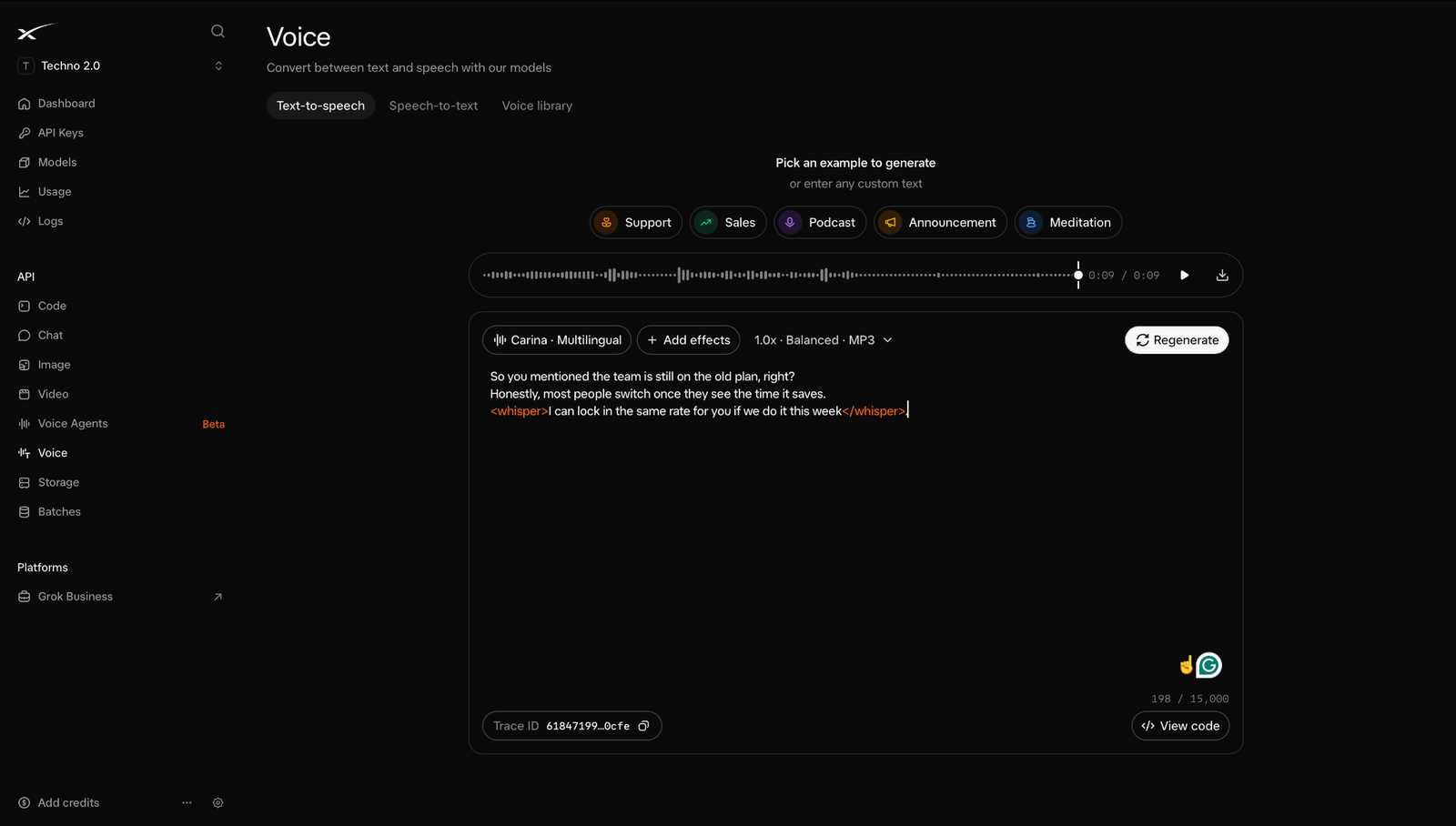
The replace setting fixes pronunciation without touching the transcript. Map "Acme Mobile" to "Acme Mobull," and callers hear the correct pronunciation while your logs keep the brand spelling.
8. Session Resumption and OpenAI Realtime Compatibility
resumption.enabled keeps a conversation alive through a dropped connection. The server caches each turn by conversation_id and replays it when you reconnect, and xAI’s Speech to Speech docs say that history expires after 30 minutes of inactivity.
The Grok Voice API also follows OpenAI's Realtime schema. xAI's docs say an OpenAI Realtime client connects once you swap the base URL to wss://api.x.ai/v1/realtime. So a comparison test against OpenAI's Realtime API pricing and models takes one configuration change.
The docs list a few exceptions. Unsupported events include conversation.item.done and rate_limits.updated, and some audio-buffer events only exist on WebRTC or SIP. Test your event handlers on the new endpoint before you switch production traffic.
Grok Voice 3.0 Pricing
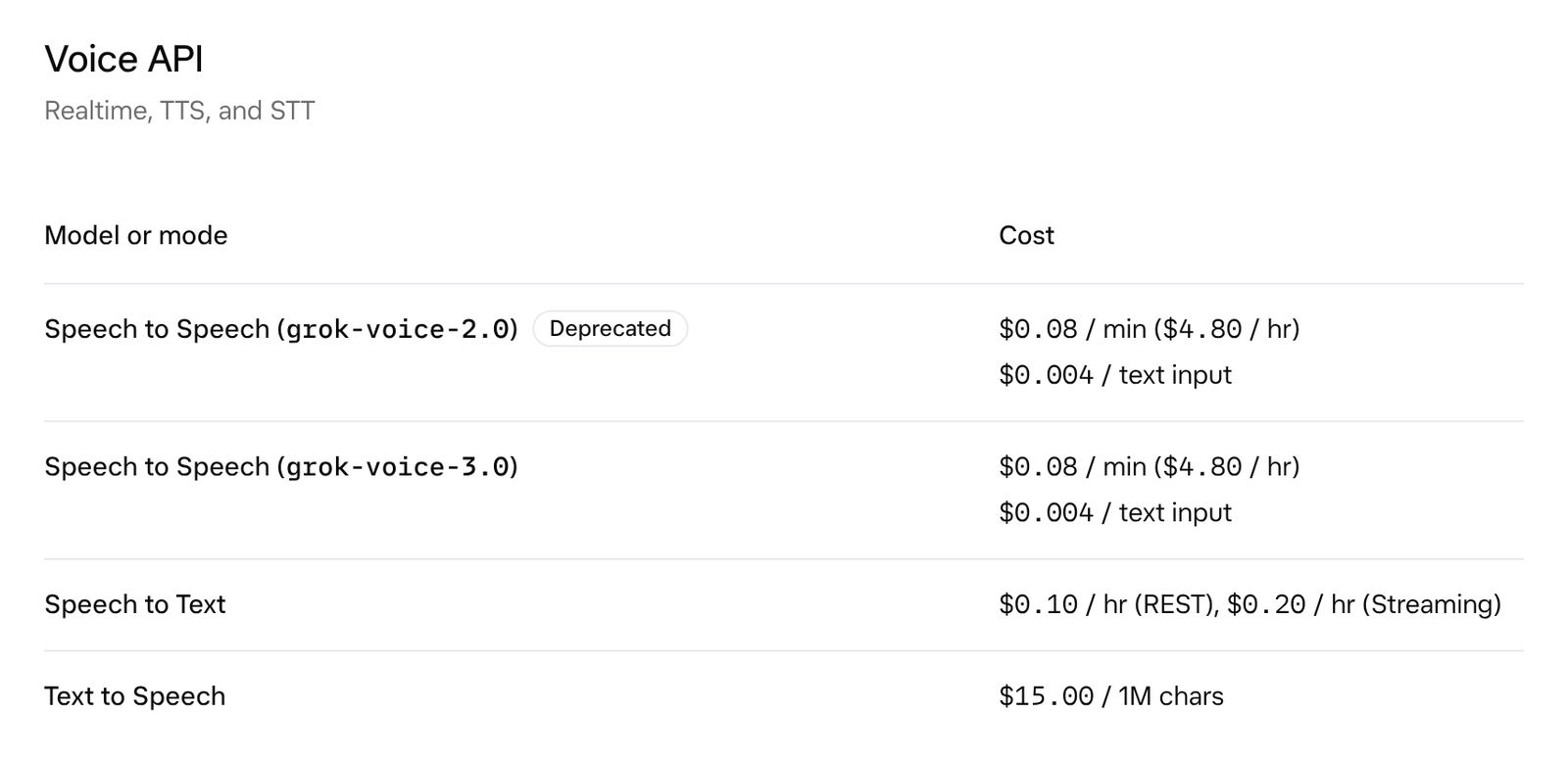
Grok Voice 3.0 bills by usage, with a per-minute audio rate and a flat fee per text message. The headline price is $0.08 a minute, or $4.80 an hour.
| API product | Price (per xAI's docs) |
|---|---|
| Speech to Speech, grok-voice-3.0 | $0.08/min ($4.80/hr), plus $0.004 per billable text message |
| Speech to Speech, grok-voice-2.0 (deprecated) | $0.08/min ($4.80/hr), plus $0.004 per billable text message |
| Speech to Text | $0.10/hr REST, $0.20/hr streaming |
| Text to Speech | $15.00 per 1M characters |
| Custom voices (console) | Up to 30 free |
Pricing verified against xAI's pricing page on November 2, 2026. Verify with the vendor before you commit.
Per-minute billing keeps cost estimates simple. A 5-minute support call costs $0.40 in audio fees, and 10,000 minutes a month costs $800. Billable text messages and carrier charges from Twilio, Telnyx, or whoever routes your SIP trunk come on a separate line.
The text-message fee needs a closer look. xAI's Speech to Speech model page defines the $0.004 charge as one fee per conversation.item.create event your client sends.
In practice, tool results (function_call_output) and audio items aren't billed as text, so the fee applies to injected context, scripted lines, and text turns.
Silence is billed as well. Sessions on the default server_vad turn detection are billed for session duration, so hold time and silence on an open session count as minutes. Push-to-talk sessions bill only for audio sent and received.
Cekura's benchmark lists $0.080 per minute because it counts the audio rate alone, without text-message fees.
For contrast, token-billed models such as Gemini Live charge by audio tokens, so cost per minute varies with call length. Our Gemini Live API pricing breakdown works through the numbers.
Can You Talk to Grok? Grok Voice in the App
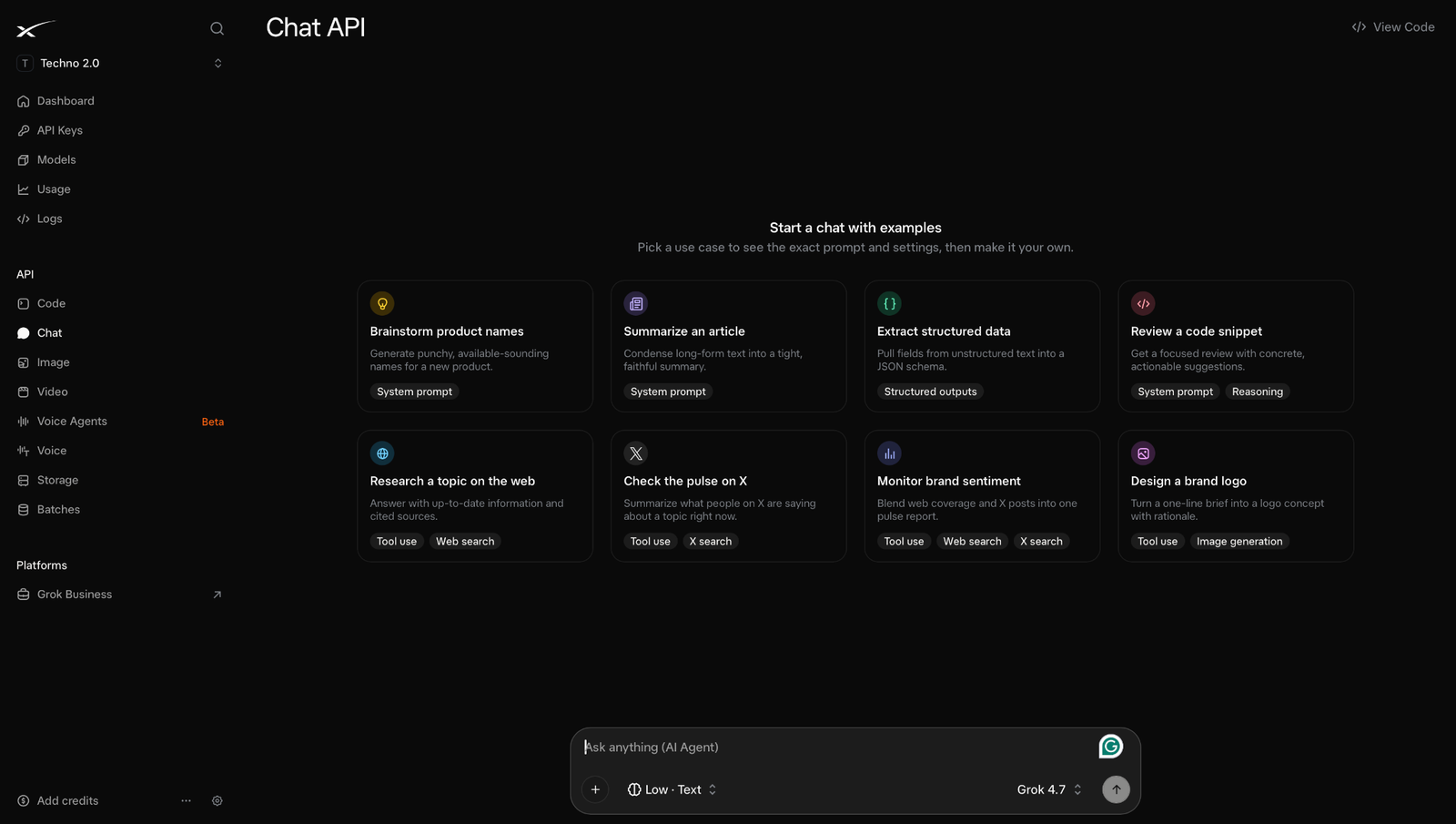
Yes, you can talk to Grok out loud. xAI's help docs list hands-free voice as a core feature of Grok on grok.com and the iOS and Android apps.
Voice is part of the free tier, too. xAI's FAQ lists it among the free-tier limits, which reset on their own schedule, separate from the weekly usage pool that paid plans share.
How to Turn On Grok Voice Mode
You can talk to Grok by voice on grok.com and in the iOS and Android apps, including on the free tier.
xAI’s help docs list voice as a core feature but don’t publish step-by-step instructions for the main Grok app. The one voice flow xAI documents is for Grok Bot, a separate product on eligible paid plans.
On paid plans, voice draws from the same weekly usage pool as Chat, Imagine, and Build. The Usage tab in Settings shows Voice as its own percentage, so you can see how much of the pool your calls use.
The step-by-step voice flow xAI documents is for Grok Bot, which works in the desktop app and the phone app.
Grok Bot is a separate product that needs an eligible paid plan (Premium, Super, or Ultra on The X Subscription, or a linked SuperGrok or X Premium+ subscription). To start a voice chat in the Grok Bot mobile app:
-
Open a conversation with a Bot and leave the composer empty.
-
Tap Start voice chat to talk live.
-
On iPhone, open the Start Voice Chat shortcut from Siri, or map it to the Action Button.
-
Press the Action Button again to hang up.
On desktop, the same Start voice chat button sits in the composer, and you may need to allow microphone access the first time. Voice chat works with one Bot at a time, so open that Bot's own chat to call it.
xAI has confirmed that Grok Voice 3.0 powers Grok Bot's voice mode. Which Grok apps and plans use 3.0 is still unannounced, so the app may run a different model than the API. Test the API directly before you build on it.
How to Change Grok Bot's Voice
During a voice chat with your own Bot, choose Show settings to change the Voice, the Speed, and the Language. The Auto-detect option sets the language from what you say.
In the API, you set the voice per session from 28 stock voices, with eve as the default. A custom voice you clone in the console works the same way, as covered in the voices section above.
Grok Voice 3.0 Benchmark Scores
xAI picked which third-party scores to show in its launch post, from Artificial Analysis and ServiceNow.
| Benchmark | Grok Voice 3.0 | What it measures |
|---|---|---|
| AA Speech-to-Speech Index | 86.9 (xAI claimed #1 at launch; Phonic 1 now leads at 87.1) | Equal-weight blend of speech reasoning, τ-Voice, arena preference, and task success |
| τ-Voice | 71.6% (GPT-Live-1 Astra: 74.5%) | Customer-service tasks spoken by callers with a range of accents |
| EVA-Bench | 74% accuracy (xAI's figure) | ServiceNow's enterprise voice-agent test, scored on accuracy and caller experience across 200+ scenarios |
| Full Duplex Bench | 97.0% | Turn-taking and interruptions in two-way speech (now outside AA's index) |
| Big Bench Audio | 98.5% | 1,000 spoken reasoning questions, each asked on its own |
The launch post's "40% lower latency" claim compares how fast a reply starts (0.81s for Grok against about 1.34s for GPT-Live-1 Astra). That's a different measure from Cekura's 1.34s median below, and the matching number is a coincidence.
These scores help you shortlist. Full calls that use your prompt and tools, with a caller who changes their mind halfway through, tell you the rest.
Cekura Benchmark Results for Grok Voice 3.0 on Live Test Calls
Cekura's Grok Voice 3.0 benchmark used the model as the complete agent inside one open-source Pipecat pipeline shared by all 14 speech-to-speech models, each with an identical prompt and toolset.
The calls themselves were scripted. A simulated caller placed calls across 82 scenarios, 3 times each, over live WebRTC audio, and a call only passed if the agent said the right things and saved the right data.
That adds up to 246 test calls per model. They don't include PSTN carriers or live customers, so treat the results as a lab benchmark.
-
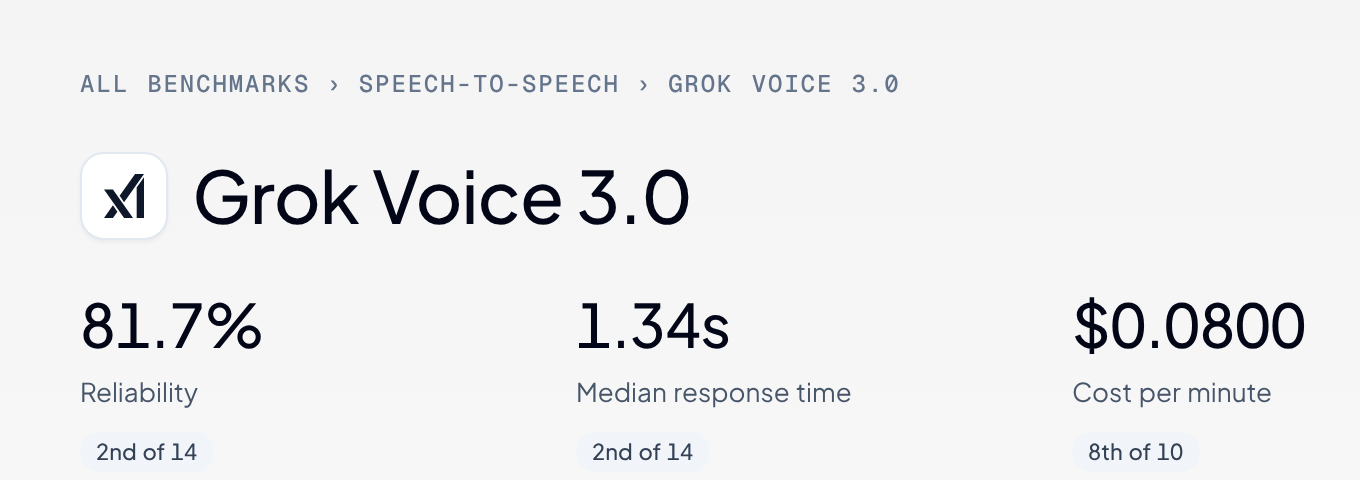
Pass³ (all 3 runs): 81.7%, 2nd of 14. Grok Voice 3.0 passed 67 of 82 scenarios on all 3 runs. Only Phonic 1 scored higher, at 90.2%. Per call, 86.6% of the 246 calls passed every check. Pass³ is the stricter measure.
-
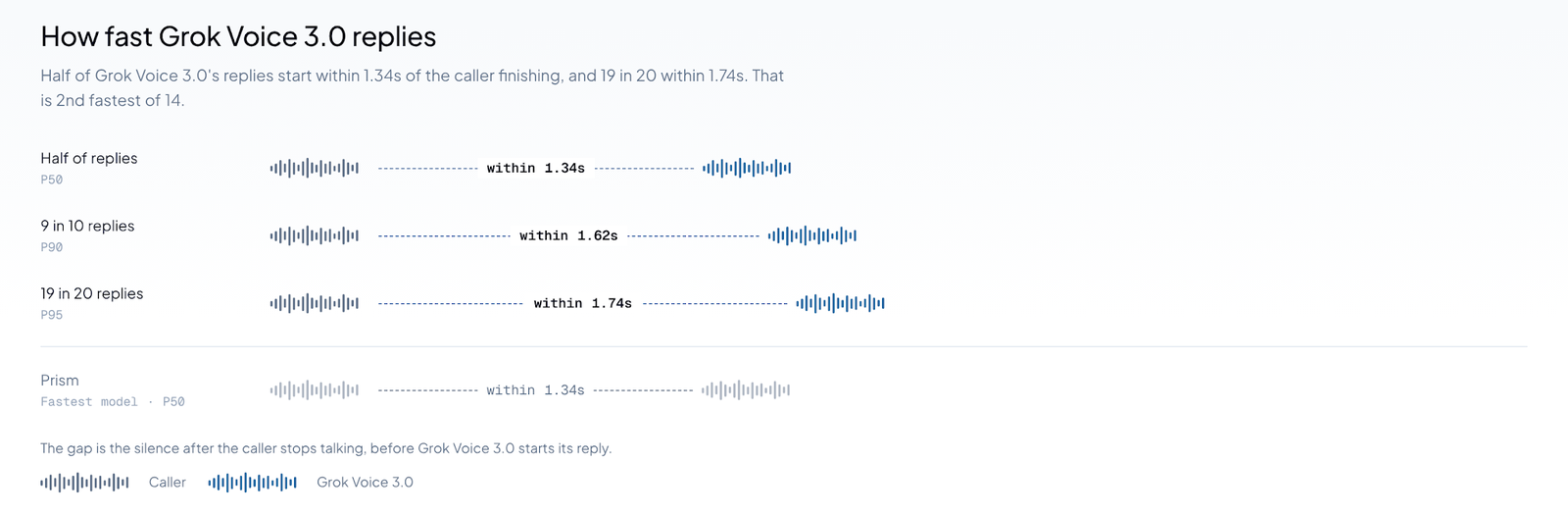
Median response time: 1.34 seconds, second-fastest of 14, level with Rime Prism. Half its replies started within 1.34s of the caller finishing, and 19 in 20 within 1.74s.
-
Interruption pass rate: 87%, level with the field median.
It passed every test call in the background-noise, silence, cough, packet-loss, accent, slow-speech, and failed-tool categories.
Long, detail-heavy calls produced its lowest scores. In Cekura's per-call results, Medicare compliance and routing calls passed 60% of the time, against 93% for plain booking and lookup calls. Of its data errors, 64% were omitted fields, usually a ZIP code or route ID.
Comparing the 0.81s and 1.34s Latency Figures
Artificial Analysis's 0.81-second average and Cekura's 1.34-second median come from different tests with different clock boundaries, so each one answers a different question.
Artificial Analysis defines time to first audio as the average seconds to the first audio token across its Big Bench Audio questions. Each is a single spoken question sent to the model outside a phone call.
Cekura measures from the moment the caller stops talking to the moment the agent begins its reply. That window includes the turn-detection wait, where the model decides the turn is over.
It also covers network time and the model's own processing. Because it bundles all of those pieces into one number, it's closer to the silence a caller sits through.
Grok Voice 3.0 posts fast numbers on both tests. It ranked second-fastest of 14 in Cekura’s benchmark, level with Rime Prism, and its 0.81s on Artificial Analysis's chart is about 40% quicker than GPT-Live-1 (Astra).
Your stack will add its own delays, so measure latency on it before you quote either figure. For where each clock starts and stops, see our voice AI latency guide, and publish the boundary with any latency number.
Benefits of Grok Voice 3.0 Features
Grok Voice 3.0's main benefits are reply speed, noise handling, phone-ready audio, and a flat audio rate.
In our benchmark, Grok Voice 3.0 posted a 1.34s median reply with reasoning on, where GPT Realtime 2.1 needed 1.94s. Across Grok's average of 6.8 replies per call, that's roughly 4 seconds less silence per call (an estimate from the two medians and the reply count).
It handled rough audio well, too. It scored 100% in the background-noise, cough, packet-loss, accented-English, and slow-speech categories across our 82 scripted scenarios.
Telephony is part of the API. G.711 audio, SIP trunking, transfers, and DTMF are all included, so you can point a Twilio or Telnyx trunk directly to sip.voice.x.ai without an intermediate media server.
Billing has one meter for audio and one for text messages. At $0.08 a minute, the audio bill grows one-to-one with session length, and billable text messages are the other model cost xAI lists.
And because the event schema follows OpenAI's, a head-to-head against OpenAI can start with a base-URL change.
Limitations of Grok Voice 3.0 Features
Those strengths come with limits to check during your pilot:
-
Detail loss on long calls: Medicare compliance and routing calls passed 60% of the time, and omitted fields made up 64% of its data errors. Flows that collect several fields, such as ZIP codes and route IDs, need field-level checks.
-
Interruptions are only average: Barge-in calls passed 87% of the time, level with the field median. Test how your agent recovers when callers interrupt.
-
An alias that can change: grok-voice-latest switched to 3.0 on launch day with no action from users. xAI's docs say to pin a version in production.
-
Custom voices are limited by region: They're available only in the US, excluding Illinois, and API creation requires an Enterprise plan.
-
Tight default limits: xAI's model page lists 10 concurrent sessions per team and a 120-minute cap per session. Any deployment that handles more than 10 simultaneous calls needs a rate-limit increase first.
-
Vendor-picked benchmarks: xAI chose which scores went into its launch post. Its τ-Voice result trails GPT-Live-1, and every number comes from benchmark test sets, so test the model on your traffic.
Testing Grok Voice Agents With Cekura
Cekura puts your Grok Voice agent through calls like the ones in our benchmark, then keeps scoring it on production traffic.
Pre-production
Cekura places synthetic calls at scale through your Grok agent with off-script callers and mid-call corrections. Each call is scored on what the agent said and what it saved. Before launch, red-team sessions try jailbreaks and prompt injection.
Infrastructure
Cekura tracks P50 and P95 response time on your production stack and scores barge-in handling on each of those calls. It also places inbound and outbound calls over a live carrier on 8 kHz audio, where SIP and codec problems surface.
Observability
Production call QA scores calls for drop-offs and missed fields. Regression gates rerun the test suite after each prompt change or model swap, including the next time an alias moves.
Native integrations work out of the box for Retell, Vapi, ElevenLabs, LiveKit, Pipecat, Bland, and more. You don't rebuild anything. Cekura is SOC 2-, HIPAA-, and GDPR-compliant, with transcript redaction, role-based access, and audit trails.
Grok Voice 3.0 delivers a 1.34s median reply at a flat per-minute rate. Keeping the ZIP code correct on call 10,000 takes testing.
Book a demo to put your Grok Voice agent through calls like these before launch.
Frequently Asked Questions
Can you talk to Grok?
Yes, you can talk to Grok by voice on grok.com and in the Grok iOS and Android apps, including on the free tier. Grok Bot, a separate product that needs an eligible paid plan, adds a Start voice chat button and a Siri shortcut on iPhone.
How much does Grok Voice cost?
The Grok Voice 3.0 API costs $0.08 per minute of audio, or $4.80 per hour, plus $0.004 per billable text message sent with conversation.item.create. Billing is pay-as-you-go.
Sessions on the default server_vad turn detection bill for the full session duration, including silence. Consumer voice in the Grok app works differently and falls under Grok's free tier and paid subscription limits.
What is the difference between Grok Voice 3.0 and Grok Voice 2.0?
The main difference between Grok Voice 3.0 and 2.0 is model quality. Grok Voice 3.0 scores 86.9 on the Artificial Analysis Speech-to-Speech Index against 81.3 for 2.0, with the same endpoint and price. Grok Voice 2.0 is deprecated, and grok-voice-latest now points to 3.0.
How fast is Grok Voice 3.0?
Grok Voice 3.0 averages 0.81 seconds to first audio on Artificial Analysis's leaderboard. On Cekura's live-audio benchmark, its median reply started 1.34 seconds after the caller finished speaking, second-fastest of 14 speech-to-speech models, level with Rime Prism.
What languages and voices does Grok Voice support?
Grok Voice supports 20+ languages and detects the caller's language on its own; the docs list 20 entries across 16 base languages, including Arabic, Hindi, Japanese, and regional Spanish and Portuguese. It has 28 stock voices, and any voice can speak any supported language.
What is the Grok Voice API endpoint?
The Grok Voice API endpoint is wss://api.x.ai/v1/realtime, a WebSocket that streams audio, text, and tool calls both ways. It follows the OpenAI Realtime event schema, with a few unsupported events listed in xAI's docs.