
ElevenLabs built its reputation on voice quality for content creation. But developers running voice agents in production hit different constraints, and these five ElevenLabs alternatives are built around them. If you're evaluating the wider field, our guide to the best TTS for AI voice agents ranks engines beyond these five.
5 Best ElevenLabs Alternatives: At a Glance
Here's how they compare on the criteria that actually matter in production.
| 🏆 Platform | 🎯 Best For | 💰 Price |
|---|---|---|
| Cartesia | Lowest verified latency | Free plan and paid plans starting at $4/month with Pro (billed annually) |
| Deepgram | STT + TTS on one stack | Pay-as-you-go tier with $200 in credits and custom Enterprise pricing |
| Smallest.ai | Full compliance stack | Pay-as-you-go and custom Enterprise tiers |
| Azure Speech | Microsoft infrastructure | Free, pay-as-you-go, and commitment tiers, with the Standard plan starting at $1,600 for 2,000 hours |
| Murf AI Falcon | Predictable per-character costs | Four pricing plans, starting with a free tier or the Creator plan, at $19/month or $228 annually |
*Pricing correct as of April 2026. Verify with each vendor.
Why Look for an ElevenLabs Alternative?
ElevenLabs gets you running fast. The API is clean, setup is straightforward, and a working prototype rarely takes more than a day.
Things change once real callers are involved:
- Latency numbers that don't reflect what you actually pay: The 75ms figure applies to Flash model inference only, not the network round-trip, authentication, or encoding overhead that production systems pay. Independent benchmarks show real figures running materially higher under load.
- Concurrency caps with no graceful path forward: Bursty traffic pushes you into overage charges before you catch quality issues. Raising the ceiling means an Enterprise negotiation, and retry behavior under pressure compounds the cost fast.
- ElevenLabs fixes language per API call: Agents serving multilingual workflows can't switch languages mid-conversation without extra engineering. Non-English text normalization for numbers, addresses, and IDs has to happen before the request reaches the API.
- Credit-based billing that's hard to model at scale: Test runs, edits, and retries consume credits the same way a real call does. Teams report consuming credits faster than projected, with model switching and conversational overhead driving consumption. See our ElevenLabs pricing breakdown for what those credits actually cost at production volume.
- No built-in observability once you go live: There's no native way to know if your agent is holding up across thousands of calls. The platform was built to help you launch, and keeping it running takes tools it doesn't ship.
Which ElevenLabs Alternative Should You Choose?
The right pick depends on where your stack breaks down today, whether that's latency, compliance, cost structure, or infrastructure lock-in.
Choose:
- Cartesia if latency is the primary bottleneck, and 42 languages cover your markets, though HIPAA and SSO both sit behind an Enterprise contract with no published price.
- Deepgram if you're running STT and TTS through separate vendors and want both in one API call, keeping in mind that Nova-3's keyword gap may still force a fallback model.
- Smallest.ai if every certification needs to be cleared before you go-live, and compliance bundled into one contract is the deciding factor.
- Azure Speech in Foundry Tools if your infrastructure already runs on Microsoft, or if FedRAMP and fully offline licenses are hard requirements that no other provider here covers.
- Murf AI Falcon if per-character billing is easier to forecast than subscription tiers, and you want geographic coverage across 11 regions out of the box.
Stick with ElevenLabs if your agent runs in controlled conditions, stays within your plan's concurrency limits, and speed to market matters more than the gaps above.
The 5 Best ElevenLabs Alternatives Worth Switching To
1. Cartesia
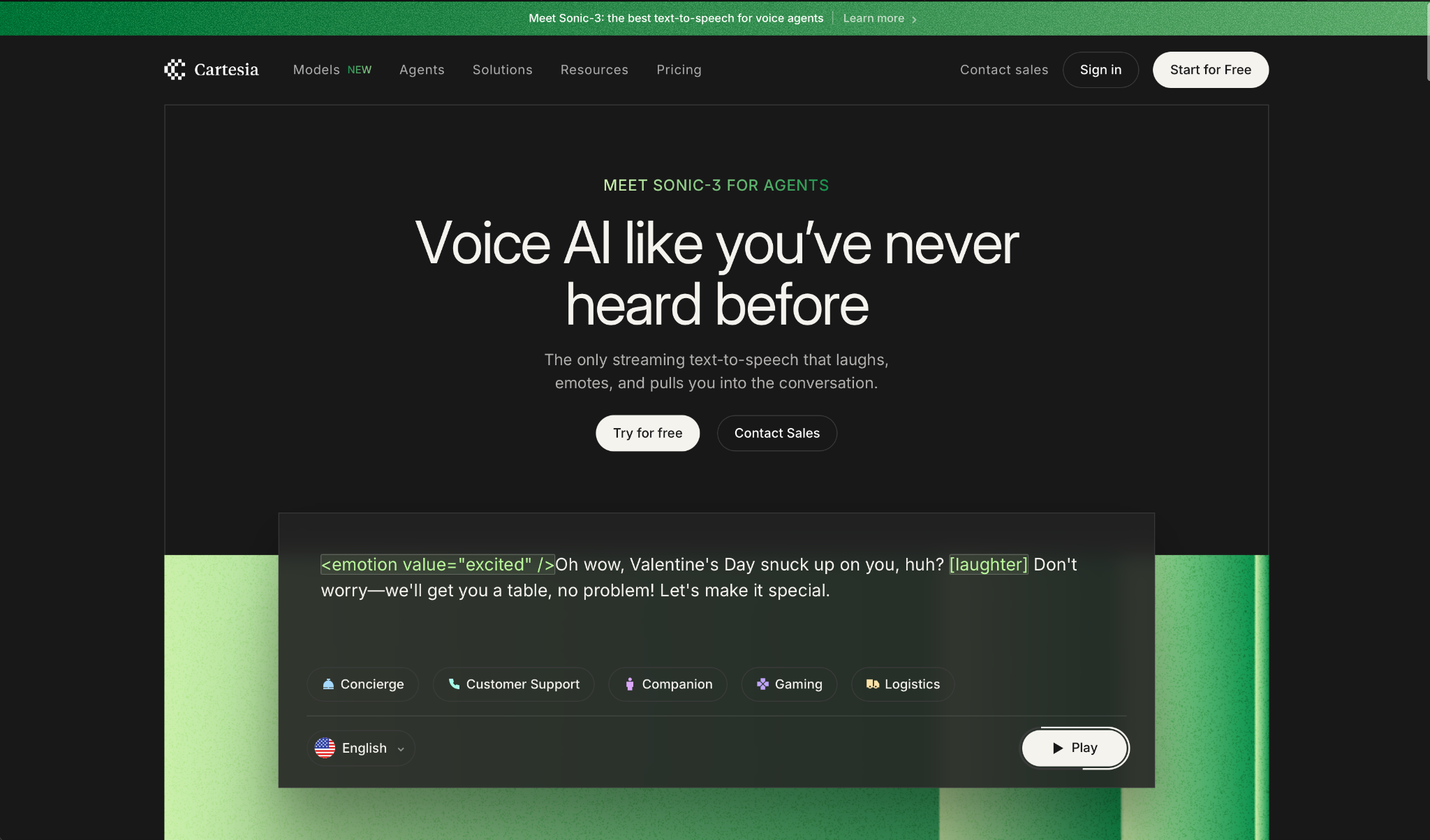
Cartesia built its stack to get your agent's response to the caller before the conversation dies.
Sonic-3 keeps deployment testing and call monitoring in one place, so you don't have to wire up a separate tool to watch what breaks in production.
"Easy to integrate and build on. I love how low the Latency is." — Harris Mohammed, Product Hunt
Key Features
- Sonic-Turbo at 40ms: Third-party verified under production load. Available on every plan, including free
- WebSocket streaming with interruption handling: Keeps the connection open through mid-sentence interruptions without dropping state
- Model version pinning: Lock to a specific Sonic version so a model update doesn't break a live deployment
- 42 languages with accent localization: Covers major global markets
- Line platform: Automated tests on every deploy with CLI tooling and call-level monitoring built in
Pros
✅ Every feature ships on every plan, including free
✅ Pro starts at $4/month billed yearly, the lowest entry point on this list
Cons
❌ The free LLM tier has no committed end date, so any pricing change hits every deployment built around it
❌ HIPAA, PCI, and SSO sit behind an Enterprise contract with no published price
❌ Language coverage stops at major markets, so less common languages need a second provider
Best For
- Engineering teams where response latency is the primary bottleneck
- Teams that want phone infrastructure and call monitoring without adding a separate vendor
- Deployments that need stable, predictable API behavior across model updates
Pricing
Cartesia offers a free plan and paid plans starting at $4/month with Pro (billed annually). Teams or businesses with large-scale use cases may prefer either the Startup plan at $39/month or Scale at $239/month. Contact their sales team for Enterprise pricing.
2. Deepgram
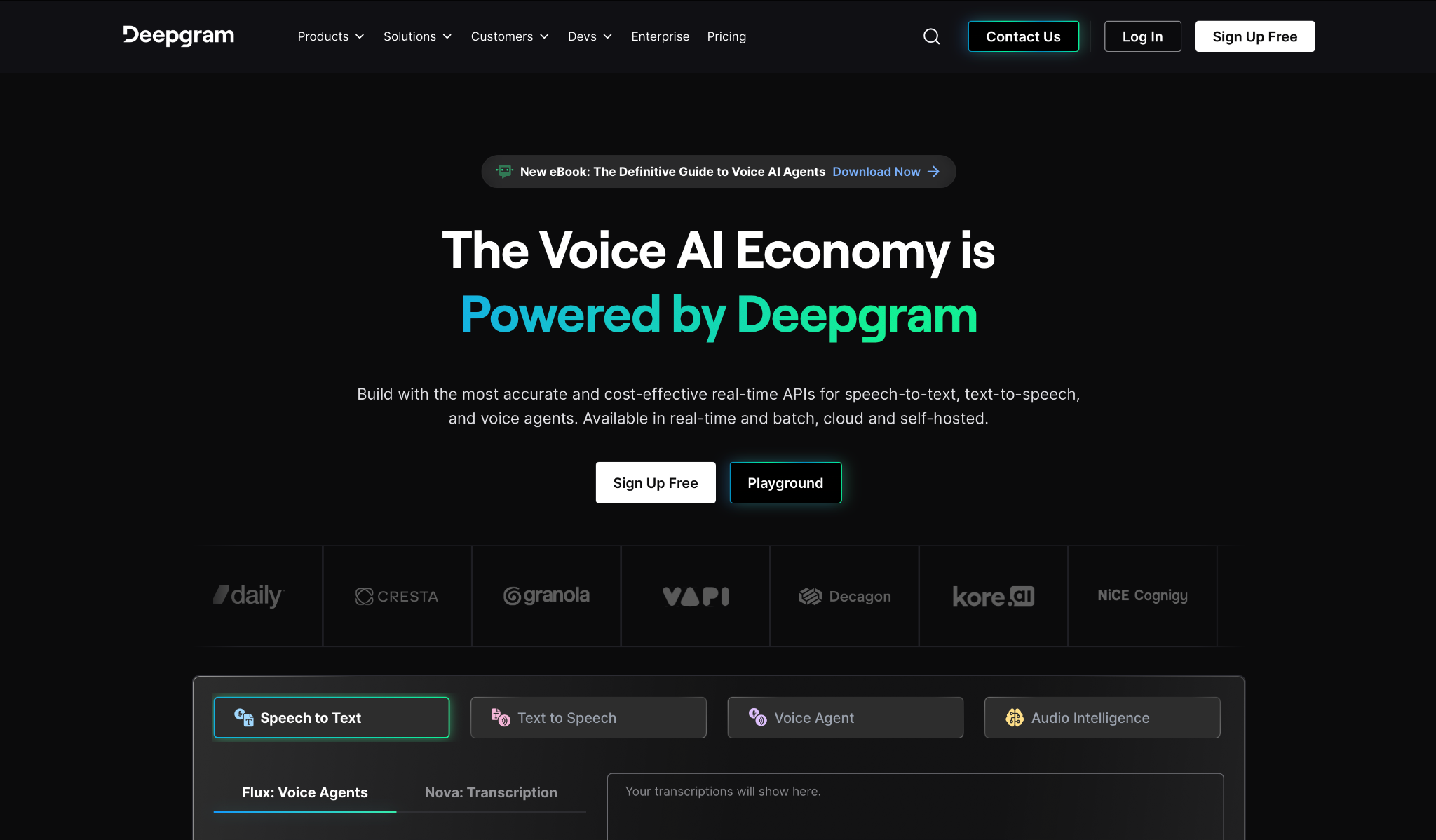
Deepgram runs STT, TTS, and LLM orchestration through a single API call, so your pipeline stops bleeding latency at every handoff.
Most voice agent stacks connect three separate vendors in sequence. Each connection adds delay and another thing that can break. Deepgram collapses that into one call, billed by the exact second with no rounding.
"The best part of Deepgram is its insane speed, which is the difference between a clunky tool and a natural conversation." — Jyotiraditya D., G2
Key Features
- Flux: STT built for real-time voice agents with turn detection and interruption handling native to the model, no extra configuration needed
- Nova-3: 45+ languages with speaker diarization and smart formatting included.
- Aura-2: TTS starts at $0.030/1k characters and is built for conversational agent output
- Voice Agent API with BYO support: Bring your own LLM or TTS at lower rate tiers. Billed per websocket connection time
- EU data residency: GDPR-compliant endpoint available on all plans, including pay-as-you-go
- Per-minute billing: Charged by the exact minute with no rounding up to the next interval
Pros
✅ STT, TTS, and agent orchestration in one API call, no separate vendors to wire together
✅ $200 in free credits, no credit card required to start
✅ EU data residency on all plans, not just Enterprise
Cons
❌ Nova-3 doesn't support keywords. Teams that need them have to run Nova-2 instead
❌ Speaker diarization and PII redaction each carry their own per-minute cost on top of the base rate
❌ HIPAA requires an Enterprise contract. There's no self-serve path to compliance
Best For
- Teams running STT and TTS through two different vendors who want to consolidate into one API call
- Pipelines where per-second billing matters, and paying for silence or rounded minutes is a real cost
- Teams that need EU data residency without an Enterprise contract
Pricing
Deepgram offers a pay-as-you-go tier with $200 in credits. Teams with higher volume can move to the Growth plan, which starts at $4,000/year and includes up to 20% off pay-as-you-go rates. For Enterprise pricing, contact their sales team.
3. Smallest.ai
Smallest.ai is built for teams that can't ship until compliance is signed off.
SOC 2, HIPAA, GDPR, and on-premise all come with the Enterprise plan. A separate negotiation isn't required for each. HIPAA on the pay-as-you-go plan costs an extra $1,000/month, so that plan isn't the right entry point if compliance is the reason you're here.
"I have an all-in-all AI platform that is easy to use and doesn't take too much time to set up." — Hermant S., G2
Key Features
- Lightning V3.1: TTS with 100ms TTFB. Works natively with phone systems across 15 languages
- Pulse STT: Streaming and batch support with interruption handling across 36+ languages
- Hydra (speech-to-speech): Full-duplex model where both sides can speak without waiting for the other to finish
- Electron SLM: In-house small language model with 53.25ms TTFT for conversational agent use cases. Available on Enterprise only
- On-premise deployment: TTS and STT models run on your own infrastructure. Available on Enterprise only
- Instant voice cloning: Available on all plans with no minimum audio requirement
Pros
✅ All four certifications ship with the Enterprise plan. There's no separate procurement process
✅ 99.99% uptime SLA on Enterprise
Cons
❌ Usage data updates once a day, so there's no need for real-time spend tracking
❌ Rate limits activate without warning when concurrency caps hit
❌ Language coverage stops at 30+, gaps for deployments that need more
Best For
- Regulated industries where every certification needs to be in place before you go live
- Teams that need to run models on their own infrastructure
- Builders who want to test before committing, the free tier covers that
Pricing
Smallest.ai's Model API is available as a pay-as-you-go tier that lets you launch instantly and scale when you're ready, or as custom Enterprise pricing for teams already running production workloads at scale.
4. Azure Speech in Foundry Tools
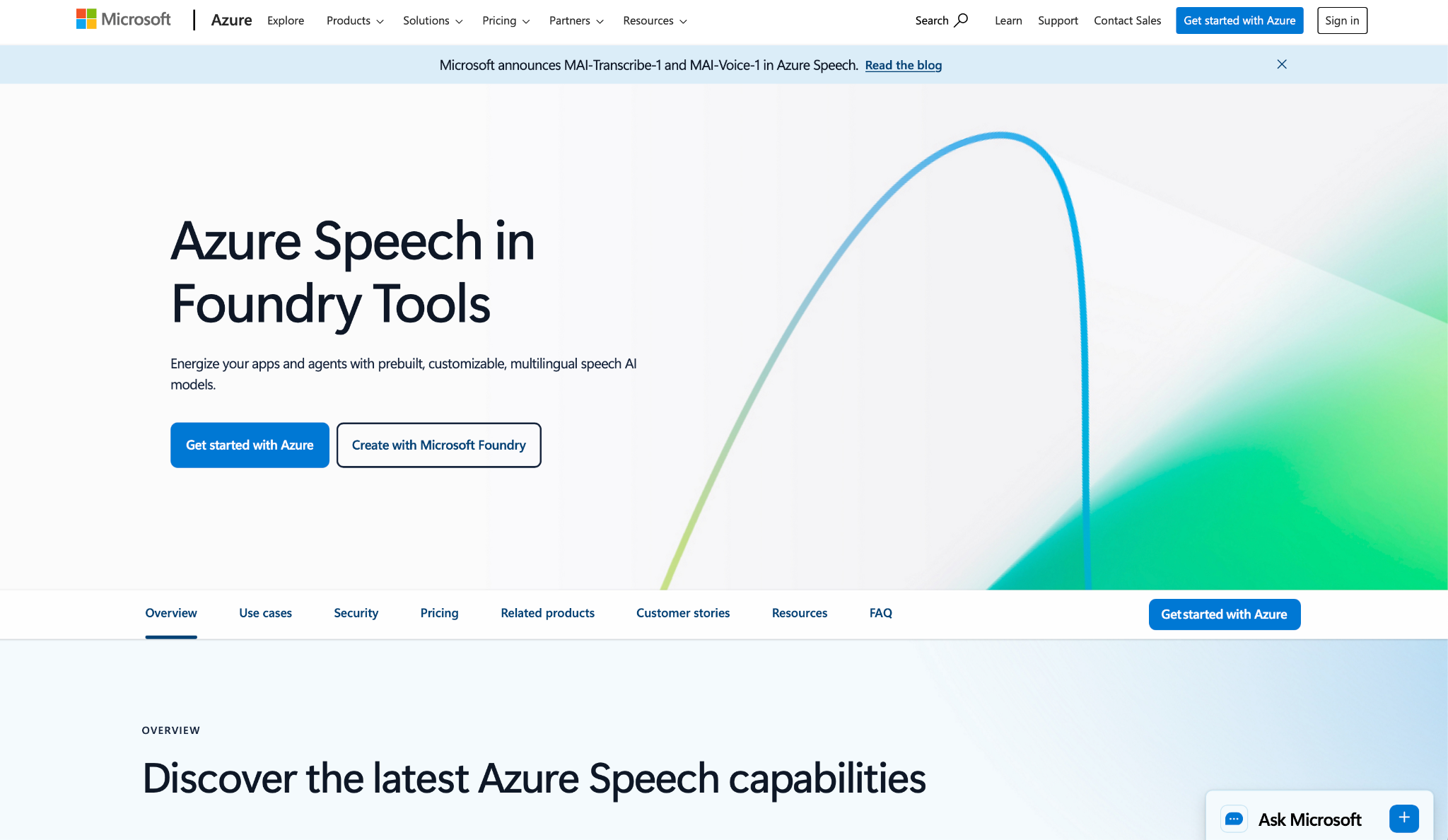
Azure Speech in Foundry Tools makes sense when your stack already runs on Microsoft infrastructure, and adding another vendor relationship isn't worth the overhead.
Voice Live API handles real-time agent conversations with GPT and Phi models built in. There's no external LLM to connect.
It's also the only provider on this list with FedRAMP certification and fully offline annual licenses for air-gapped environments.
"The SDKs and REST API are straightforward, like just grab your key, hit the endpoint, and you are talking in minutes." — Shubham U., G2
Key Features
- Voice Live API: Real-time two-way agent conversations with GPT or Phi built in and billed per token
- Four transcription modes: Real-time streaming, fast single requests, batch for large volumes, and custom domain models. All billed in one-second increments
- Three deployment modes: Cloud, connected containers on your own infrastructure, and fully offline disconnected containers for isolated environments
- 100+ compliance certifications: FedRAMP, HIPAA, ISO 27001, GDPR, and 50+ country-specific standards
- OpenAI Whisper in Azure: Microsoft-managed Whisper integration through the same API key, no self-hosting required
Pros
✅ FedRAMP and fully offline annual licenses. This is the only provider on this list that covers both
✅ STT billed in one-second increments, no rounding
✅ One API key covers STT, TTS, translation, and agent orchestration
Cons
❌ Budgeting for premium voices and the agent API requires a sales call before you see actual numbers
❌ Custom voice approval sits with Microsoft. The timeline to get started isn't published
❌ Switching from the free tier to the Standard plan can take several hours for quota changes to apply
Best For
- Teams already on Azure who don't want to bring in a new vendor
- Deployments that need FedRAMP or a fully offline license with no cloud dependency
- Regulated industries that need country-specific certifications beyond what other providers cover
Pricing
Azure Speech in Foundry Tools offers a free tier with 5 hours of STT and 0.5 million TTS characters per month. There are also pay-as-you-go and commitment tiers, with the Standard plan starting at $1,600 for 2,000 hours.
You can explore pricing scenarios to get a clearer idea of what your custom quote for the Voice Live API may include.
5. Murf AI Falcon
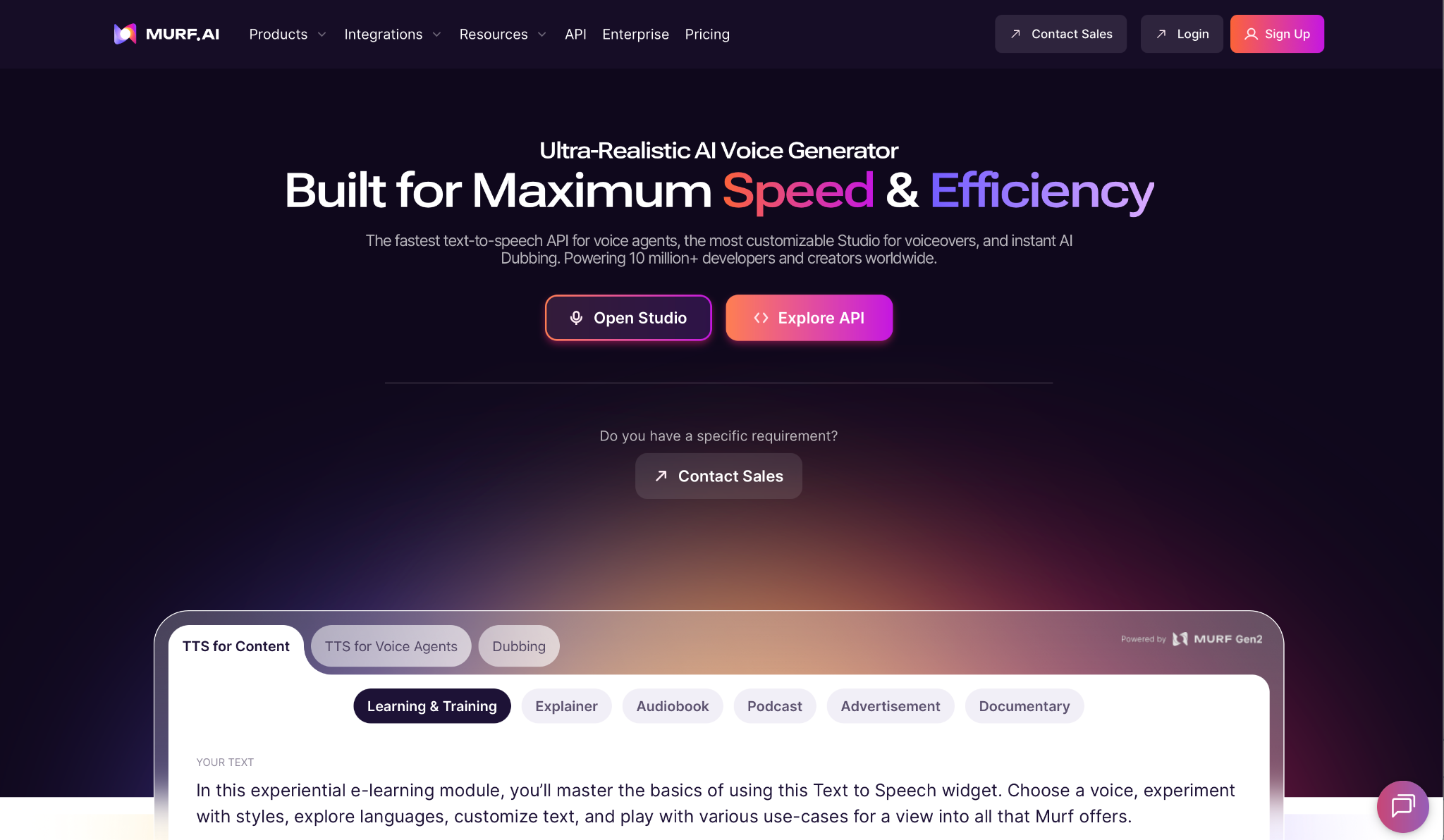
Murf AI Falcon is built for teams where the per-minute cost of TTS kills production scale.
At $0.01 per 1,000 characters with edge deployment across 11 major regions, Murf Falcon is the easiest TTS cost to forecast at scale. Paid plans cap at 15 concurrent requests before you hit a hard rate limit, so production volume beyond that needs an Enterprise contract.
"The output and degree of control are both much better than I expected." — Chi-Kai Chien, ProductHunt
Key Features
- Flat per-character rate: $0.01 per 1,000 characters across all 200+ voices and languages. There are no per-language surcharges
- Edge deployment across 11 regions: Data stays local by default. A separate configuration isn't needed
- Code-mixing across 35 languages: Agents switch languages mid-conversation without breaking audio flow
- Startup Incubator: 50 million free characters over 3 months for qualifying early-stage teams
- On-premise option: Available on Enterprise for teams that need full infrastructure control
Pros
✅ Free trial includes $10 in credits, with no credit card needed to start
✅ SOC 2, HIPAA, GDPR, and ISO 27001 all ship with the Enterprise plan
✅ Qualifying startups get 50 million characters free before any billing starts
Cons
❌ Latency figures are published by Murf without independent third-party verification
❌ Custom voice cloning is unavailable below the Enterprise tier
❌ Audio downloads locked on the free tier. Evaluation stays inside the platform
Best For
- Teams where per-minute billing makes more sense than per-character math at scale
- Workloads that need geographic coverage without adding a separate configuration layer
- Early-stage teams that need runway before committing to paid usage
Pricing
Murf Falcon offers four pricing plans:
- The free tier includes 10 projects and 10 minutes of voice generation.
- Creator is $19/month or $228 annually for 100 projects and 24 hours/year of voice generation.
- The Business plan comes with more features for high-usage businesses, starting at $66/month or $792/year.
- The Enterprise plan offers unlimited access and requires a quote from the sales team.
How to Evaluate ElevenLabs Alternatives
The demo is never the problem. These are the questions that matter once you're past it.
- Latency under load: A provider's published figure tells you how fast their model runs under ideal conditions. Ask whether it's third-party-verified and whether it includes network overhead or just inference time.
- What compliance actually costs: Most providers list certifications in marketing copy and lock them behind an Enterprise contract. Confirm which ones are included at each plan tier before you build anything.
- How billing behaves at scale: Per-character, per-minute, and credit-based pricing produce different cost curves depending on call volume and average turn length. Factor in retries and test runs, not just successful calls.
- Concurrency limits and what breaks when you hit them: Every provider caps concurrent requests by plan tier. Find out if the cap degrades gracefully or throws a hard error before you discover it in a live deployment.
- Integration depth with your existing stack: Check whether the API fits your current orchestration layer, whether you can bring your own LLM instead of using theirs, and how model version pinning works if stable behavior across updates is required.
- Deployment flexibility: Cloud-only providers introduce data residency constraints that become blockers in regulated industries. Confirm on-premise or disconnected container options exist before the architecture conversation gets too far.
How to Test Your ElevenLabs Alternative in Production
Picking a provider is the easy part. Knowing whether it holds up once real callers are on the line is a different problem, and most teams find out something is wrong after the fact. Cekura runs on top of whichever provider you choose and closes that gap.
- Testing at scale: Thousands of simulated calls run before go-live, catching the edge cases that only surface when real people push your agent off-script.
- Latency tracking: Cekura pinpoints where slowdowns originate in the pipeline so you know exactly what to fix after each provider swap or prompt update.
- CI/CD integration: Every time you update a prompt or swap a provider, Cekura runs your full test suite before anything goes live.
- A/B testing: Compare multiple versions of your agent against the same call scenarios and review results in one place.
- Conversation replay: When something breaks, replay that exact exchange against your updated configuration to confirm the fix held.
Native integrations work out of the box for Retell, VAPI, ElevenLabs, LiveKit, Pipecat, Bland, and more. You add a testing and monitoring layer on top of what you already have. Nothing needs to be rebuilt.
Cekura is also SOC 2-, HIPAA-, and GDPR-compliant. Transcript redaction, role-based access, and audit trails are included.
Switching TTS providers is easy. Knowing whether the new one holds up in production isn't. Schedule a demo to see how Cekura helps you test before you find out the hard way.
Frequently Asked Questions
What Is the Best ElevenLabs Alternative for Voice Agents?
The best ElevenLabs alternative for your voice agent depends on your needs.
Cartesia leads on latency at 40ms, making it the strongest pick when response speed is the constraint. Deepgram wins when you need STT and TTS in a single API call, rather than using two separate vendors. For regulated industries, Smallest.ai ships all four compliance standards under a single contract.
Is There a Cheaper Alternative to ElevenLabs for Production Use?
Yes, there are more cost-effective alternatives to ElevenLabs for production use.
Murf AI Falcon starts at $0.01 per 1,000 characters, Deepgram's Aura-2 runs at $0.030 per 1,000 characters, and Cartesia's Pro plan starts at $4 per month. All three cost less than ElevenLabs at comparable production volume.
Do Any ElevenLabs Alternatives Offer a Free Tier for Developers?
Yes, many of the alternative tools offer a free tier for developers.
Deepgram provides $200 in free credits with no credit card required. Cartesia offers a free plan with access to every feature. Murf's Startup Incubator gives qualifying teams 50 million free characters for three months.
What Is the Difference Between ElevenLabs and Deepgram?
The main difference between ElevenLabs and Deepgram is their core use case. ElevenLabs was built for content creation and studio production. Deepgram combines STT and TTS into a single API call, with per-minute billing designed for production agent pipelines. Our full ElevenLabs review goes deeper on where that focus helps and hurts voice agents.