
If you want a Cyara IVR alternative you can start using this week, Cekura leads the field for hybrid estates that mix DTMF menus with AI voice agents. Sipfront covers SIP-layer diagnostics with published pricing, and Hammer covers large legacy deployments.
I ran each tool through the same gauntlet. DTMF menu navigation, call flow regression, load behavior, and time from signup to first test call. The gaps between them turned out to be wider than any feature page admits.
This roundup covers what each one does well, where it comes up short, and who it's built for. Pricing comes from each vendor's own page, verified on 3 September 2026, so every number here is one you can check against the vendor before you commit.
Disclosure: Cekura publishes this article and includes itself in the list below, at number one. Cyara, Hammer, and Sipfront compete with Cekura in this category, and every figure below is sourced to the vendor's own page so you can check it yourself.
6 best Cyara IVR alternatives: TL;DR
- Cekura: hybrid estates running DTMF menus next to AI voice agents, with self-serve signup and a free first seat.
- Sipfront: SIP and RTP packet-level diagnostics with published pricing, built for engineers who want telephony evidence, and voicebot testing on the same engine.
- Hammer: legacy enterprise DTMF estates that want a services-led deployment and three decades of contact center testing history.
- Klearcom: global operations that need in-country IVR and toll-free number testing across 100+ countries.
- Nopaque TotalPath: small IVR estates that want a zero-cost pilot on a monthly free tier.
- SIPp: engineering orgs that want free, open-source SIP load generation and accept the build cost that comes with it.
Cyara itself earns strong marks, and our Cyara telecom CX testing reviews show G2 and Capterra users praising its carrier coverage while flagging port-based pricing.
Why look for Cyara alternatives?
Credit where it's due. Cyara runs the deepest product portfolio in CX assurance, monitors across 145+ countries and 420+ carriers, and validates more than 350 million customer journeys a year for hundreds of enterprise brands. The reasons to look elsewhere sit in how it's bought, priced, and scoped.
You can't see a price before a sales call. Cyara publishes no plan page and offers no self-serve trial, so every evaluation starts with a demo request and a procurement cycle. Our full Cyara pricing breakdown covers what that process looks like product by product.
The contract shape assumes an enterprise buyer. Cyara was founded in 2006 and took a $350 million growth investment from K1 in 2022; a Forrester Consulting study commissioned by Cyara projected it would reach $6.5 billion by 2024.
Companies at that scale sell multi-year contracts with professional services built in, and that's exactly what you'll be quoted.
You pay for platform scope when you need one job done. IVR testing is one slice of a four-product suite spanning journey testing, load, chatbot QA, and production monitoring. Buying the slice alone is rarely how the deal is structured.
The independent market keeps shrinking. Cyara acquired chatbot-testing vendor Botium in April 2022 and global call-testing firm Spearline in 2023, which brought testRTC along with it. Several tools that would have made this list three years ago now sit inside the platform you're trying to replace.
Search for replacements, and you'll mostly find phone systems. Most published lists of Cyara competitors name contact center platforms like Aircall or Genesys. Those route calls, but they can't test the system routing them, which is the job you're actually hiring for.
Which Cyara IVR alternative should you choose?
Choose Cekura if your IVR estate is becoming an AI voice agent estate and you want DTMF menus and non-deterministic conversations tested from one place. It skips SS7 trunk-side testing, so pure carrier-infrastructure work belongs elsewhere.
Choose Sipfront if you want packet-level SIP and RTP evidence behind every test, with pricing you can read before talking to anyone. It won't cover chat or digital channels.
Choose Hammer if you run a large, regulated DTMF estate and want a vendor whose test technology has been in contact centers since the Teradyne spin-out in 2000. Expect a services-led deployment and a slower start.
Choose Klearcom if your callers dial in from dozens of countries and reachability across local carriers is the risk that keeps you up. Conversational flow scoring is outside its center of gravity.
Choose TotalPath if you want to pilot automated IVR testing on a small estate without spending anything. It's a young, telephony-only product from a small vendor.
Choose SIPp if you have engineers to spare and want full control of a free load generator. You'll build the DTMF media, the assertions, and the reporting yourself.
Stick with Cyara if you run regulated, omnichannel journeys across voice, chat, and digital, already fund an enterprise QA operation, and need monitoring across 145+ countries from one contract. At that scope, the platform earns its procurement cycle.
6 best Cyara IVR alternatives: at a glance
| 🏆 Tool | 🎯 Best for | 💰 Starting price |
|---|---|---|
| Cekura | Hybrid DTMF and AI voice agent estates | Free first seat, $0.25/test minute |
| Sipfront | SIP-layer diagnostics plus voicebot testing | €89/month |
| Hammer | Legacy enterprise DTMF estates | Custom |
| Klearcom | In-country testing across 100+ countries | Custom |
| TotalPath | Zero-cost pilots on small estates | Free tier, then $49/month |
| SIPp | DIY open-source load generation | Free |
Pricing correct as of August 2026. Verify with each vendor.
The 6 best Cyara IVR alternatives
1. Cekura
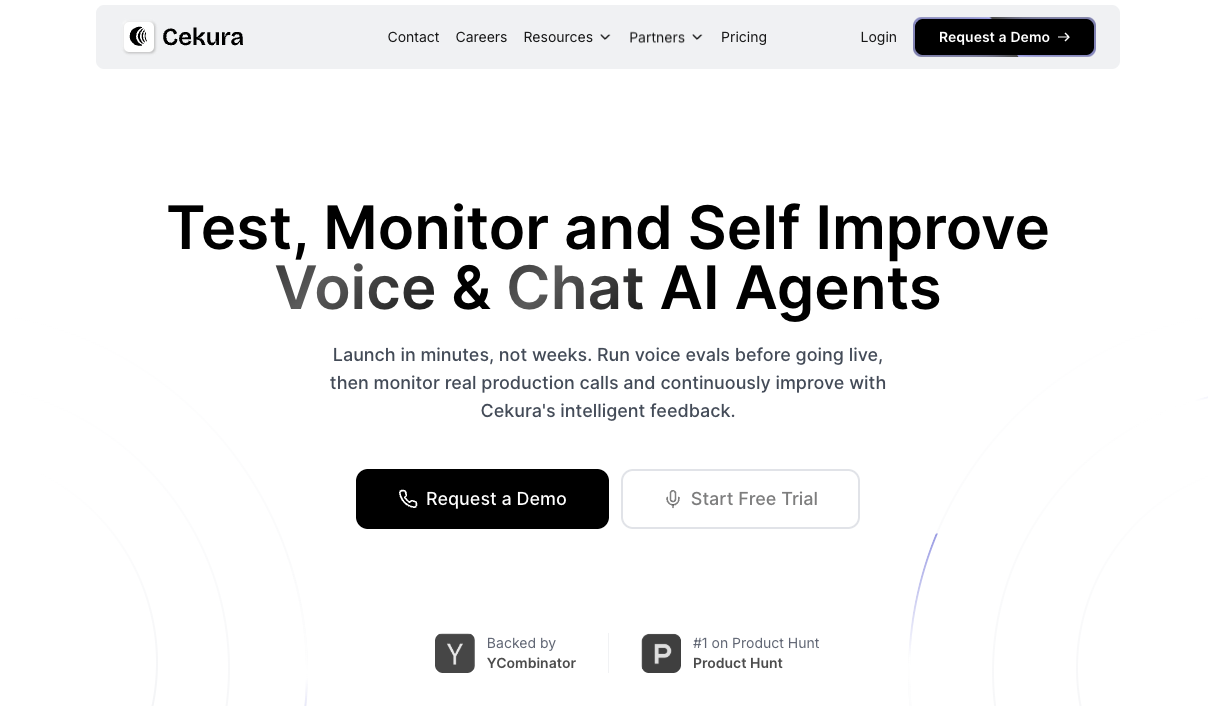
Cekura tests the IVR you have and the AI agent you're replacing it with, from one platform. Built by a Y Combinator-backed team in San Francisco that raised a $2.4 million seed round, it runs automated call simulations against DTMF menus, scripted flows, and fully non-deterministic voice agents.
The DTMF side is configurable down to the keypress. Test cases simulate entire IVR trees, send tones like "press 1" at each branch, and verify the call lands where the menu promised.
The same engine handles conversations no script could predict, scoring multi-turn behavior that single-exchange checks miss.
In the X-Teaming study, attack success climbs from 19.5% at two conversation turns to 92.7% at eight, so a check that ends after one exchange never reaches the range where failures concentrate. So testing one exchange at a time leaves most of the risk untouched.
Key features
- Pre-production: auto-generated test scenarios, DTMF and IVR tree simulation, regression suites in CI/CD, and adversarial red teaming across 30+ languages and accents.
- Infrastructure: load testing at concurrent volume, plus interruption, background noise, and latency scenarios that mimic hostile real-world calls.
- Observability: production call monitoring with custom metrics, drop-off analysis, and Slack alerts when quality dips.
- Conditional Actions: rule-based test steps that react to what the agent actually says, so one flaky LLM response doesn't poison a whole run.
- Ecosystem depth: a Cisco partnership extends testing and observability into enterprise deployments.
Pros
✅ Signup to first test call takes minutes, with a free first seat and no card.
✅ One platform covers DTMF menus, voice agents, and chat agents, so a hybrid estate needs one vendor.
✅ Published usage pricing makes cost per test call calculable before you commit.
Cons
❌ No SS7 or trunk-side carrier testing, so pure network-infrastructure work needs a different tool.
❌ Usage-based credits require estimating monthly call volume, which first-time buyers sometimes get wrong.
Best for
- Contact centers replacing touch-tone menus with conversational AI agents
- Healthcare and fintech orgs that need compliance coverage on call data
- Engineering orgs that want IVR regression running in CI/CD on every prompt change
Pricing
The pay-as-you-go plan includes a free first seat, $0.25 per voice testing minute, $0.05 per monitored call, and 300 starter credits worth roughly 60 minutes. The Startup plan runs $500 per month for about 2,000 testing minutes, 10,000 monitored calls, 50 concurrent calls, and a signed BAA.
2. Sipfront
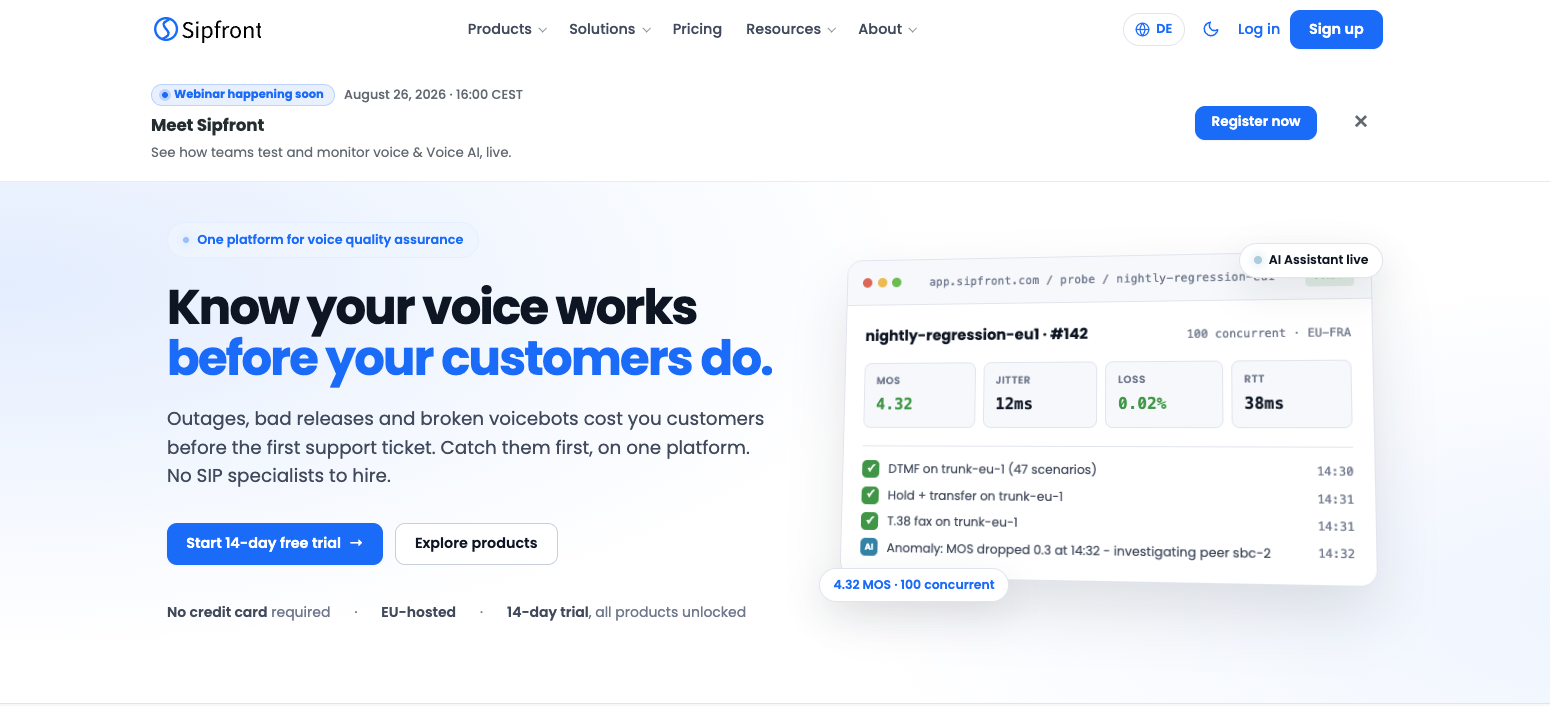
Sipfront is the alternative for engineers who want proof, down to the packet. The Vienna-based platform analyzes SIP signaling and RTP media on every test call, so a defect report shows you the network evidence instead of a red X.
The founders built rtpengine and worked deep in the Kamailio ecosystem, and it shows in the product's telephony depth. The platform has shipped 1.5 million+ AI test minutes for customers including CloudTalk and Parloa.
Key features
- Packet-level diagnostics: every test captures SIP and RTP data, so one-way audio, jitter, and codec faults get pinned to a specific network cause.
- Voicebot testing: LLM-driven test callers exercise your IVR or voice agent end to end, with time-to-first-answer measured against latency budgets.
- Load simulation: hundreds of simultaneous calls stress the stack before your busiest day does.
- Compliance evidence: test logs double as EU AI Act and GDPR audit material, hosted entirely in the EU.
Pros
✅ Published pricing and a 14-day trial across all four products, no card required.
✅ Deepest network-layer visibility of any tool on this list.
✅ Bot-to-bot adversarial testing covers prompt injection and jailbreak attempts on voicebots.
Cons
❌ Voice only. Chat and digital channel testing need a second tool.
❌ EU-centric hosting and compliance framing fit European buyers better than US-first orgs.
Best for
- Engineering orgs that treat telephony defects as network problems first
- European companies that need audit evidence from their test runs
- SIP-heavy stacks where call quality disputes with carriers are routine
Pricing
Plans start at €89 per month, and each tier adds products without stripping capability from lower ones. The company raised a €1.8 million seed round in January 2026 to push further into enterprise voice AI QA.
3. Hammer

Hammer is the veteran, and for legacy DTMF estates the pedigree is the point. The technology, spun out of Teradyne as Empirix in 2000, and joined Infovista in April 2021, where it now anchors the VistaCX portfolio.
Three decades of contact center work translate into deep coverage of the flows nobody else remembers how to test. Touch-tone menus, trunk-side behavior, and agent desktop connectivity all reside within a single toolchain.
Key features
- End-to-end IVR test campaigns: scripted calls validate prompts, routing, and database lookups across large menu trees.
- WebRTC and agent-side testing: validates the desktop leg of the call, which most IVR tools ignore.
- CCaaS migration validation: purpose-built assurance for moves to Amazon Connect and similar platforms.
Pros
✅ Unmatched depth on legacy protocols and complex regulated estates.
✅ Vendor-neutral testing runs against Amazon Connect, Genesys, NICE, Cisco, and Avaya estates alike.
✅ The VistaCX portfolio spans journey discovery, pre-launch QA, load, and production monitoring in one toolchain.
Cons
❌ Deployment assumes professional services, so first useful results take weeks.
❌ No published pricing. Every engagement starts with a sales conversation, the same friction that sent you looking past Cyara.
Best for
- Banks, insurers, and healthcare payers running large regulated DTMF estates
- Contact centers mid-migration to a CCaaS platform
- Orgs that prefer a services-led vendor relationship over self-serve tooling
Pricing
Custom pricing through sales. Budget for a statement of work alongside the license.
4. Klearcom
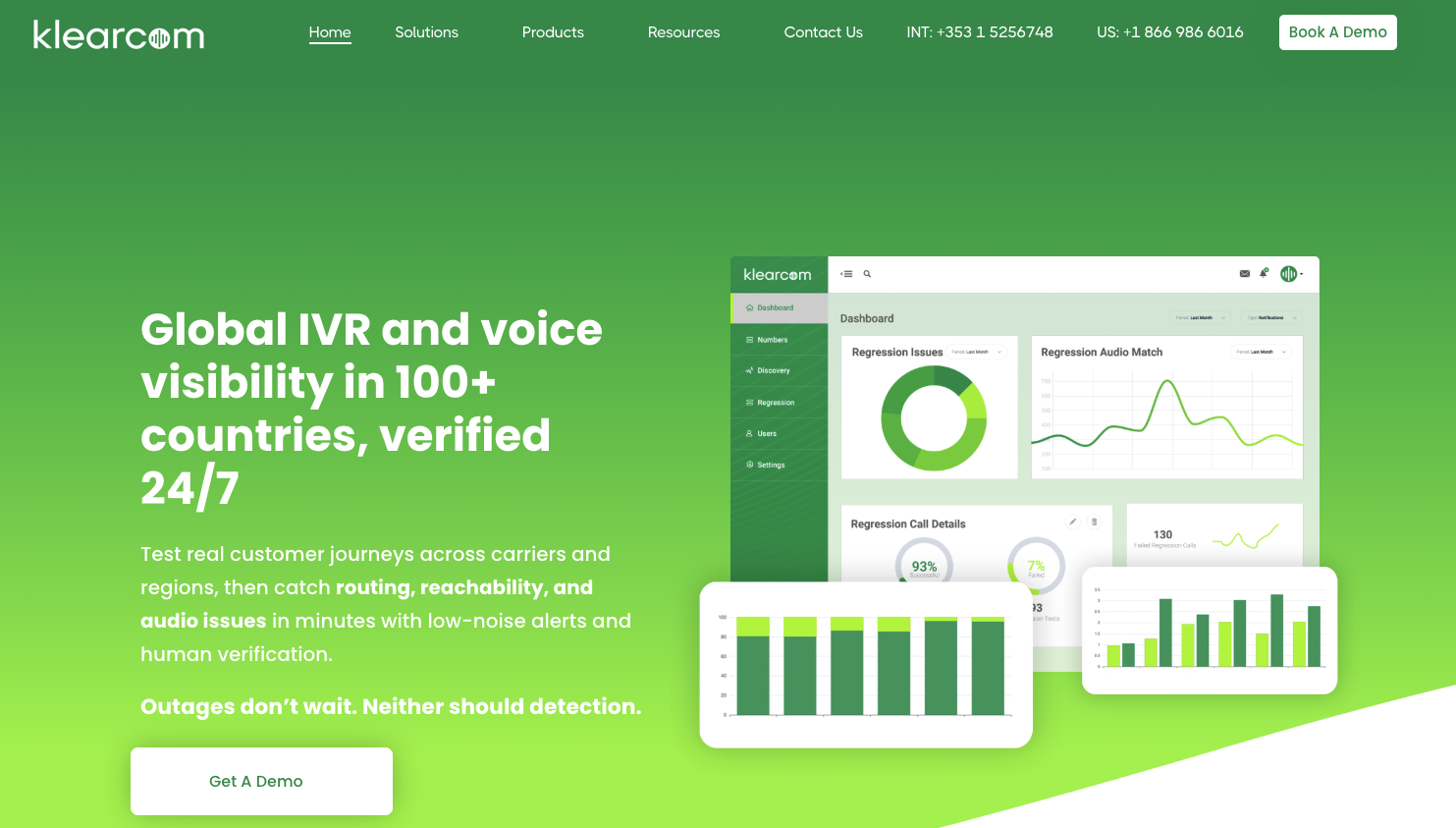
Klearcom answers one question better than anyone else. Can a customer in any given country actually reach your IVR? It was the first platform to run in-country number and IVR testing across more than 100 countries, and Klearcom publishes coverage of over 330 carriers for local testing.
Calls originate from real local fixed and mobile lines. A toll-free number that works from your office and dies on a mobile in São Paulo is precisely the defect this catches.
Key features
- In-country dialing: tests place real calls through local carriers in each market, replicating the actual customer path.
- IVR mapping and regression: every menu leg, DTMF or speech, gets mapped and monitored, with IVR messaging transcribed in 100+ languages and translated back to English.
- Audio quality scoring: MOS grades on each call flag degraded prompts before customers complain.
- Non-intrusive setup: nothing installs on your IVR, so procurement and security reviews move fast.
Pros
✅ Widest genuine in-country coverage on this list, used by Pfizer and HPE.
✅ 24/7 human triage verifies outages before your on-call engineer gets paged.
✅ Zero-integration model means testing can start without touching production systems.
Cons
❌ Reachability and menu health are the focus. Conversational scoring for AI agents sits outside its lane.
❌ No published pricing, so budgeting requires a sales conversation.
Best for
- Multinationals with toll-free numbers in dozens of markets
- Pharma, tech, and enterprise support orgs where a dead number is a compliance incident
- Operations groups that want outage alerts verified by humans
Pricing
Custom pricing, arranged through Klearcom directly.
5. Nopaque TotalPath
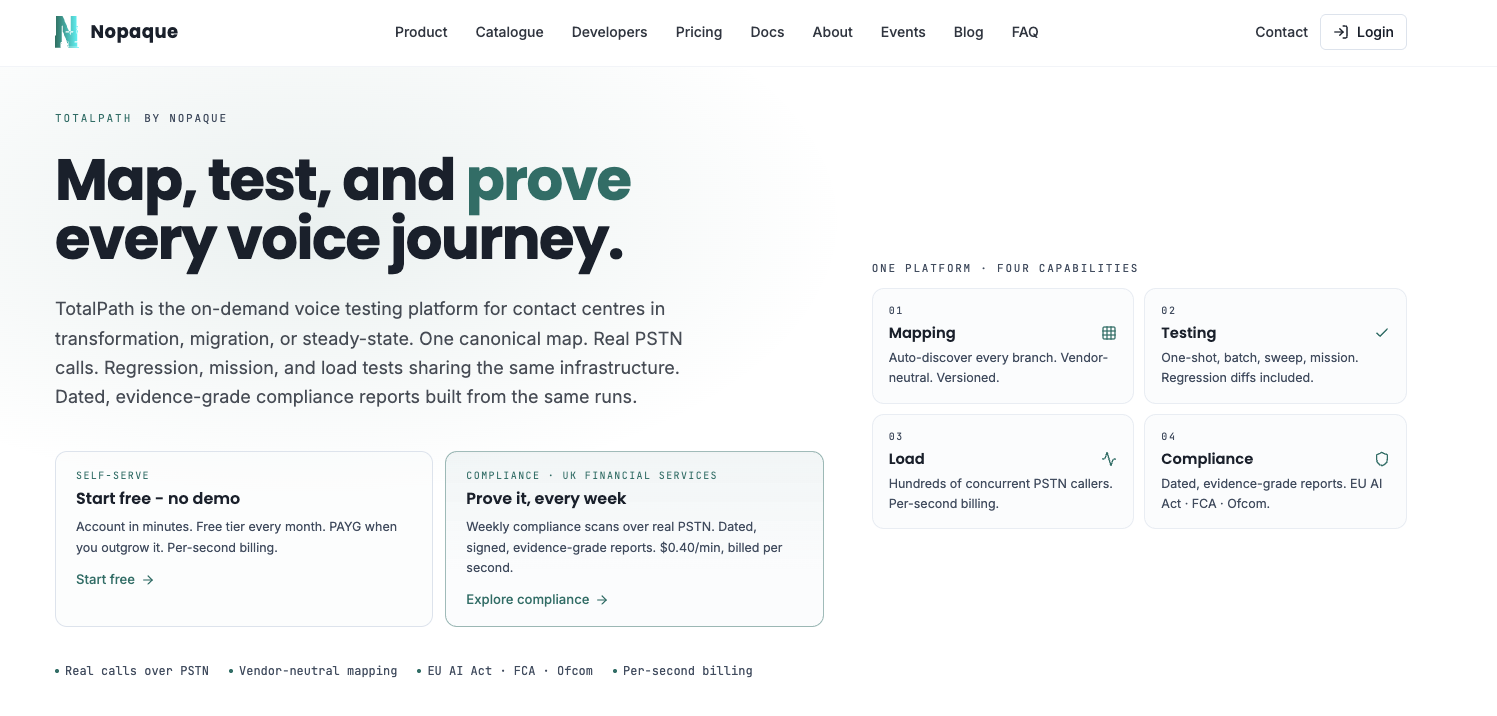
TotalPath is the cheapest way to find out whether automated IVR testing changes anything for you. The London-based product offers a free tier of 150 minutes a month with no card, and paid plans start at $49 per month with per-second billing.
Scope is deliberately narrow. Voice testing only, over the real PSTN, covering classic DTMF menus, hybrid flows, and agentic voice bots from one product.
Key features
- Self-serve onboarding: sign up for a first real test call in the same hour.
- Intent-based assertions: tests check outcomes and disclosures rather than exact strings, which suits LLM-driven flows.
- Vendor-neutral dialing: anything that terminates a phone number is testable, from Genesys to a Vapi agent.
- Elastic load testing: built into the base product as a first-class capability.
Pros
✅ Free tier makes a side-by-side pilot against your current tool essentially free.
✅ Per-second billing keeps small regression suites cheap.
✅ Covers both legacy DTMF and agentic flows despite the small footprint.
Cons
❌ Telephony only, with no chat, digital, or production monitoring layer.
❌ A young product from a small vendor carries continuity risk for multi-year enterprise bets.
Best for
- Small estates with a few dozen test cases
- Procurement-fatigued buyers who want to trial before any conversation
- UK and European mid-market contact centers
Pricing
Free for 150 minutes a month, then from $49 per month with per-second billing on top.
6. SIPp
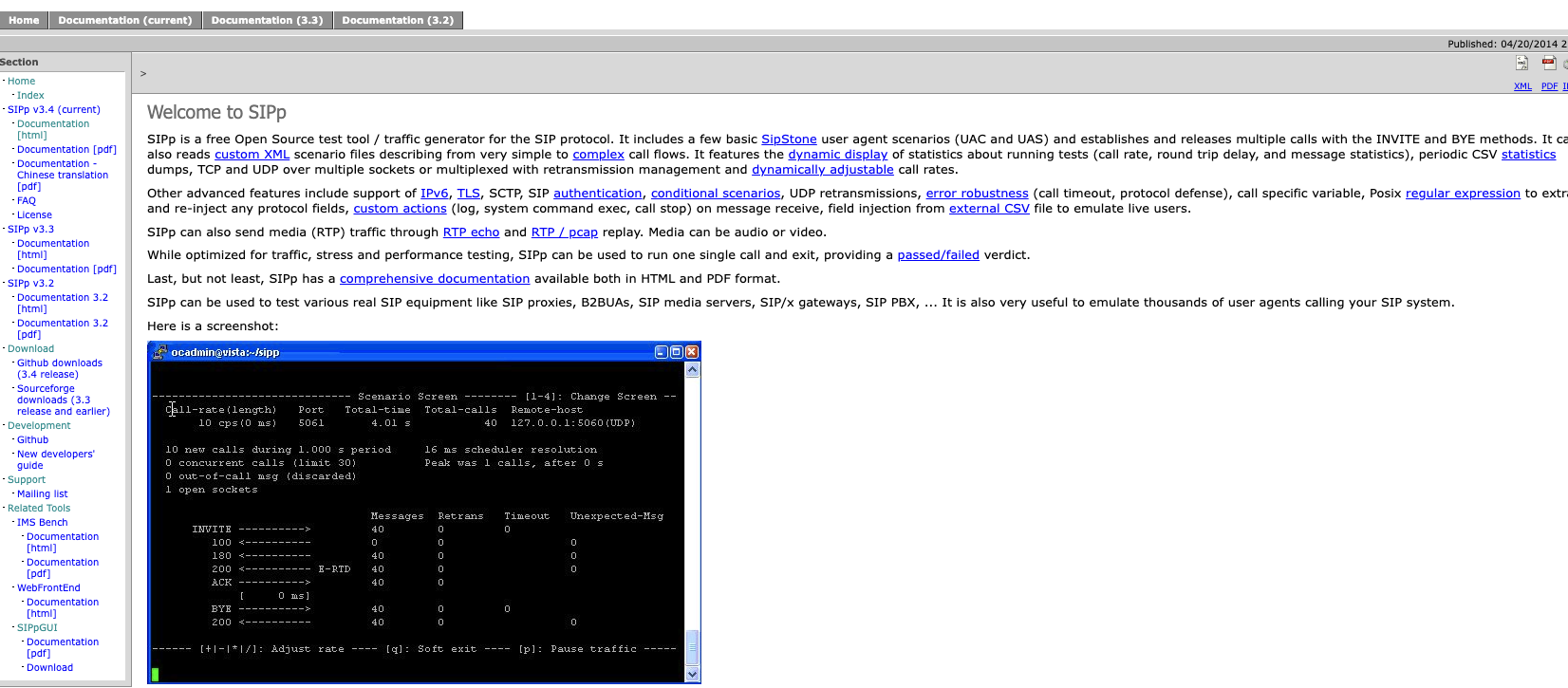
SIPp is what engineers reach for when the budget is zero and the SIP knowledge is deep. The open-source traffic generator has stress-tested SIP systems for two decades and can flood an IVR with thousands of simultaneous calls from a single Linux box.
The catch is everything around the calls. Scenarios live in verbose XML, and interacting with a menu means preparing PCAP media files containing correctly timed DTMF tones by hand. There's no evaluation layer, no transcript, and no report your VP can read.
Key features
- High-volume SIP load generation: efficient enough to saturate most estates from modest hardware.
- Custom signaling scenarios: full control over SIP messages, timing, and authentication.
- Statistics output: call rates, response distributions, and retransmissions logged for your own tooling.
- Zero licensing cost: free under an open-source license, forever.
Pros
✅ Free, battle-tested, and infinitely scriptable.
✅ No vendor, no procurement, no data leaving your network.
Cons
❌ DTMF interaction requires hand-built media files, which the community has spent years building wrappers to avoid.
❌ Everything downstream of the call, from assertions to reporting, is yours to build and keep running.
Best for
- Telecom engineering groups with existing SIP expertise
- One-off load tests before a launch or seasonal spike
- Orgs whose security posture rules out SaaS testing tools
Pricing
Free and open source via the SIPp project. The real cost is the engineering time spent on scenario upkeep.
How to evaluate Cyara IVR alternatives
DTMF and speech path coverage: Your estate almost certainly mixes touch-tone menus with speech recognition. A tool that tests only one path leaves the other unverified, so make sure keypress simulation and spoken-input handling both exist before anything else.
Our voice quality testing guide walks through what a complete menu test includes.
Support for non-deterministic flows: If an AI voice agent is anywhere on your roadmap, string-matching assertions will drown you in false alarms. Look for intent-based and outcome-based checks that tolerate an LLM phrasing the same answer three ways.
Our review of AI voice agent testing tools shows how big that difference gets on real calls.
Setup model: Self-serve tools produce results the same day and expose their weaknesses just as fast. Services-led tools take weeks to start and bundle expertise you may genuinely need. Decide which trade you're making before the demo, because the vendor already has.
Load behavior at realistic concurrency: An IVR that works for one caller and collapses at two hundred is a marketing site, and your busiest day is the only test that counts. Confirm the tool's concurrent call capacity exceeds your peak.
Production monitoring after go-live: Pre-launch testing catches what you predicted. Live calls surface what you didn't. Tools that carry the same test logic into production monitoring close that gap without a second vendor.
Pricing transparency: A published price is also a signal about the sales process behind it. Three tools on this list show you a number today, and three make you ask.
IVR testing is splitting into two jobs
The estate you're testing in 2026 is rarely the estate the incumbent tools were built for. One job is keeping deterministic menus honest, which Hammer and Klearcom have done for years.
The other is conversational AI testing, scoring exchanges that never follow a script. Any Cyara IVR alternative you pick should be judged on the job your roadmap is heading toward, and for most contact centers that job is the second one.
The platform underneath that second job changes the result. Cekura's voice agent benchmark ran 82 caller scenarios against seven complete configurations, three times each, counting a scenario as passed only when all three runs passed. Retell led on that measure at 75.61%, with ElevenLabs third at 69.51%.
Providers submitted their own models and speech components, so those figures compare configurations rather than platforms at default settings. Use them to build a shortlist, then validate against your own traffic.
Cekura was built for estates making that transition. Native integrations work out of the box for Retell, VAPI, ElevenLabs, LiveKit, Pipecat, Bland, and more. You add a testing and monitoring layer on top of what you already have, without rebuilding anything.
The platform supports SOC 2, HIPAA, and GDPR compliance, covering transcript redaction, role-based access, and audit trails.
Which half of the transition is riskier for you right now? Book a demo and watch Cekura run a DTMF tree test and a multi-turn agent simulation against your own stack in the same session.
Frequently Asked Questions
What is the best Cyara alternative for IVR testing?
The best Cyara alternative for IVR testing depends on your estate. Cekura fits hybrid estates mixing DTMF menus with AI voice agents, Sipfront fits SIP-heavy stacks that want packet-level evidence, and Hammer fits large legacy enterprise deployments.
Wider picks sit in our roundup of the best AI voice testing platforms, reviewed here with test results per tool.
Does Cekura support DTMF testing?
Yes, Cekura supports DTMF testing. Test cases can simulate full IVR trees, send tones like "press 1" at each branch, and verify that every menu path routes correctly before launch.
Is there a free Cyara alternative?
Yes, four options on this list cost nothing to start. Cekura's pay-as-you-go plan includes a free first seat with 300 starter credits, TotalPath offers 150 free minutes a month, Sipfront runs a 14-day trial across all four of its products with no card, and SIPp is fully open source.
What is the difference between IVR testing and voice AI agent testing?
The main difference between IVR testing and voice AI agent testing is determinism. IVR testing validates fixed menus where every input has one correct route, while voice AI agent testing scores open conversations where the agent may phrase a correct answer many different ways.
Can I run Cyara and an alternative side by side?
Yes, you can run Cyara alongside any alternative on this list, because none of them require changes to your IVR itself. A one-month parallel pilot against the same call flows is the fastest way to compare defect detection and cost per test.