
Silence and overtalk detection measures the two ways a conversation loses its rhythm: dead air where nobody is speaking, and moments where both parties speak at once. Both are computed from the audio rather than the transcript, and both mean something different when one of the speakers is a machine.
TL;DR
- Silence is the share of a call where neither party is speaking. Overtalk is the share where both are. They are measured from the audio channels, not from what was said, which is why a clean transcript can hide both.
- Human conversation is not silence-free. Measured on question-and-answer transitions across 10 languages, the mean response offset is 208 milliseconds and the most common offset is zero. The target is not eliminating silence, it is matching that rhythm.
- For a human agent these are coaching signals. For an AI agent they are symptoms of a broken turn-taking model, and coaching is not available as a fix.
- Overtalk from an AI agent has a specific cause worth separating out: the endpointing model deciding the caller has finished when they have not.
- Interruption is scoreable with a formula you can check, and across six voice platforms the published scores cluster in a narrow band, so a vendor who cannot produce the number at all is not measuring it.
What Is Silence and Overtalk Detection?
Silence and overtalk detection analyzes the audio of a conversation and reports two proportions: how much of the call had nobody speaking, and how much had more than one person speaking simultaneously.
Both come from the audio rather than the transcript, and that distinction is the whole reason the measurement exists. A transcript records what was said. It does not record the four seconds of nothing before it was said, or the fact that two people said it at once. Read a transcript of a badly paced call and it can look perfectly reasonable.
The measurement is easiest when the two speakers are on separate audio channels, which is normal for telephony. With a stereo recording, silence is the interval where neither channel carries speech, and overtalk is the interval where both do. Mixed to mono, both become much harder to compute reliably, which is worth checking before you buy anything that promises to measure them.
What Do Silence and Overtalk Actually Tell You?
They are different signals with different causes, and treating them as one number loses the diagnosis.
| Silence | Overtalk | |
|---|---|---|
| What it measures | Share of the call where neither party speaks | Share where both speak at once |
| How to report it | Split agent-side and caller-side, not one call-level share | Count discrete events alongside the share |
| What it usually means, human agent | Looking something up, or not knowing the answer | Impatience, or a script the agent is pushing through |
| What it usually means, AI agent | Latency in the pipeline, or endpointing waiting too long for silence | Endpointing firing early, deciding the caller has finished when they paused |
| Caller experience | Assumes the line dropped, and often repeats themselves or hangs up | Feels talked over, and stops volunteering information |
| Fix for a human | Coaching, better tooling, faster lookups | Coaching on listening |
| Fix for an AI agent | Reduce pipeline latency, or shorten the end-of-turn threshold | Lengthen the threshold, or use a semantic turn-detection model |
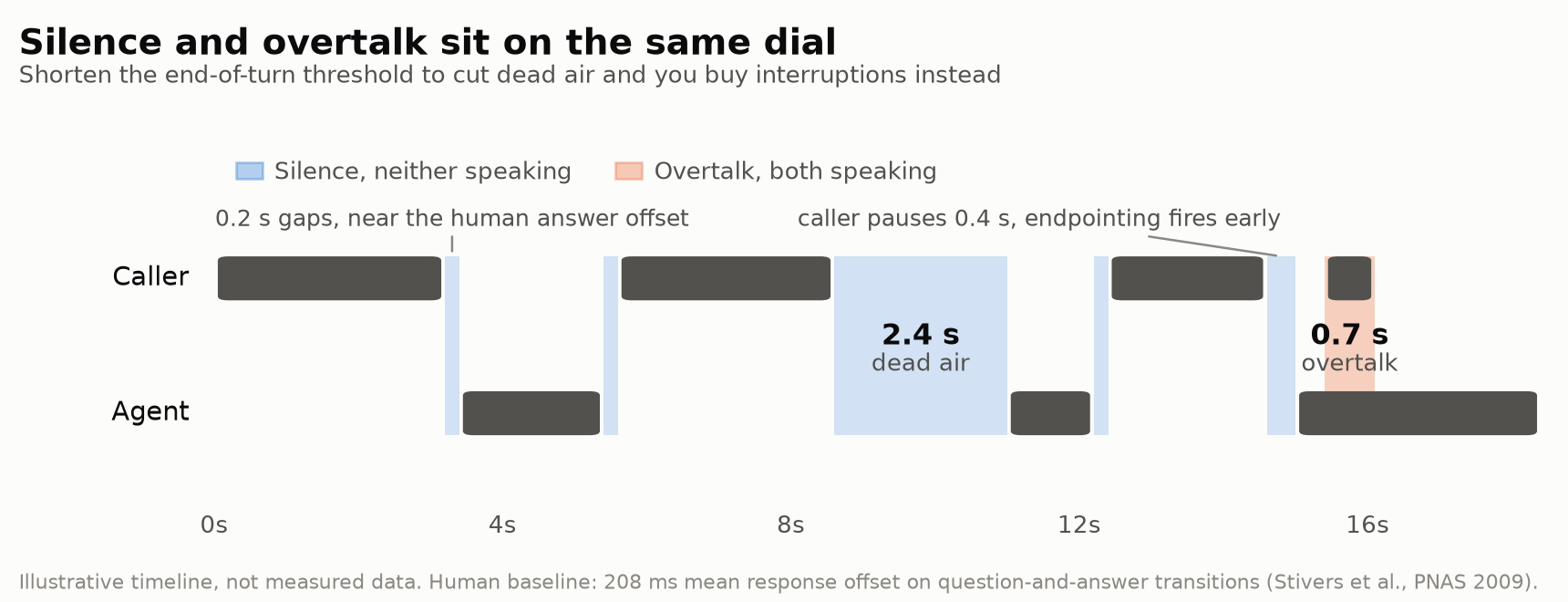
Notice the last two rows. For an AI agent the two fixes pull in opposite directions on the same dial. Shorten the endpointing threshold to cut dead air and you cause more interruptions. Lengthen it to stop interrupting and you add silence to every single turn. There is no setting that removes both, which is why the pair has to be measured together rather than optimized one at a time.
How Much Silence Is Normal?
More than most people assume, and the number comes from linguistics rather than from contact center practice.
A 2009 study in PNAS measured turn transitions across a worldwide sample of 10 languages, restricting the comparison to polar questions so the context was identical everywhere. The cross-language mean response offset was 208 milliseconds, and the single most common offset was zero. Language-specific means ranged from Japanese at +7 ms to Danish at +469 ms.
Two things follow. First, a gap of a fifth of a second is normal and invisible, so the goal is not silence elimination. Second, the tolerance around it is tight. Levinson and Torreira report that gaps longer than about 300 ms already reduce the likelihood a response is heard as an unqualified acceptance, and, citing Roberts and colleagues, that gaps of 600 ms or more start generating inferences the speaker did not intend. That is far narrower than latency budgets usually assume.
There is a second finding that matters more for AI agents than for human ones. Stephen C. Levinson, Director Emeritus of the Language and Cognition Department at the Max Planck Institute for Psycholinguistics, and Francisco Torreira, writing in Frontiers in Psychology in 2015, point out that the gaps between turns run around 200 ms while the latency of language production is "600-1500 ms or more" before articulation begins. Humans answer faster than they can possibly compose an answer.
They resolve it with prediction. Listeners begin planning a response as soon as they have the gist, well before the other person stops talking, so comprehension and production overlap. That is how a 200 ms gap is achievable at all.
A conventional voice pipeline does the opposite. It waits for end-of-turn detection to fire, then starts recognition finalization, then inference, then synthesis, in sequence. Nothing begins until the caller has finished. That is an architectural gap rather than a tuning problem, and it is why threshold tweaking has a floor it cannot go below.
Overtalk has no equivalent published target, and it is worth being honest that any threshold a vendor quotes is a convention rather than a measured constant. What the research does establish is a direction: the same PNAS study found that all 10 languages showed "a general avoidance of overlapping talk and a minimization of silence between conversational turns". Speakers work to avoid both, which is why either one rising is a signal that something has gone wrong.
Avoidance is not elimination. Some overlap is a feature of natural speech: backchannels like "mm-hm" and "right" land on top of the other speaker constantly and signal that the listener is engaged. A detector that counts those as overtalk will report a problem that is not there, which is the most common way these numbers mislead.
Silence also has a component that has nothing to do with the agent. Network transmission delay on the audio path is spent before any speech recognition, inference or synthesis happens, so part of the gap a caller hears was never the agent's to give back.
Responsiveness thresholds for interactive systems are long established. Dean and Barroso, citing Card and colleagues, note in The Tail at Scale (Communications of the ACM, 2013) that systems responding "within 100 milliseconds" feel "more fluid and natural to users than those that take longer". A voice agent starts behind that line, because the network has already spent part of the budget before the agent has heard a word.
Why an AI Agent Fails Differently
For a human agent, silence and overtalk are behavioral. Somebody was hunting through a knowledge base, or somebody was not listening. The fix is coaching, and it works because a person can hold the correction in mind on the next call.
For an AI agent, neither is behavioral. Both are outputs of the turn-taking machinery, and the machinery is the same on every call.
- Silence comes from the pipeline. Speech recognition finalizing the transcript, the end-of-turn model waiting out its silence threshold, model inference, then speech synthesis. Every stage adds to the gap before the agent speaks, and the caller experiences the total.
- Overtalk usually comes from endpointing firing early. The caller pauses mid-sentence to think, the model reads the pause as the end of the turn, and the agent starts talking into the middle of a sentence. An explainer on voice activity detection covers how that decision is made.
- Both change globally when you tune. A human agent coached on listening improves on their own calls. An endpointing threshold changed to fix one complaint changes every conversation the agent will ever have, including the ones that were working.
That last point is the reason these two metrics belong in a regression suite rather than a coaching report. The change that fixes overtalk on the complaint you just received is the same change that adds dead air to several thousand calls you have not looked at.
How Do You Score Overtalk on an AI Agent?
A definition you can check beats a number you cannot. Cekura scores interruption from the stereo recording, using voice activity detection to find every point where the agent starts speaking while the caller is still talking, then scoring 5 x (1 minus interruptions divided by turns), clamped to a 0 to 5 range.
That formula is worth reading closely, because it normalizes by turn count. A twenty-turn call with two interruptions and a four-turn call with two interruptions are not equally broken, and a raw count would score them the same.
Across six platforms running one byte-identical agent, Cekura's voice orchestration benchmarks put interruption scores between 4.63 and 4.90 out of 5, measured on the interruption scenarios specifically, those that inject barge-in, coughs or mid-turn silence, rather than the whole suite, and at each platform's default settings. Those two caveats matter: a whole-suite average would be diluted by calls with nothing to interrupt, and tuning moves the numbers.
Listed alphabetically, since the point is how tightly they cluster rather than who leads:
| Platform | Interruption score, out of 5 |
|---|---|
| ElevenLabs | 4.77 |
| LiveKit | 4.89 |
| Pipecat | 4.90 |
| Retell | 4.79 |
| Synthflow | 4.66 |
| Vapi | 4.63 |
The practical read is not that one platform is much better than another on this axis, it is that the metric is measurable and comparable at all, so a vendor who cannot produce a number for it is not measuring it.
Silence is best measured as a distribution rather than an average, because an average is dominated by the many ordinary turns and says nothing about the few bad ones. An agent averaging a comfortable gap can still leave a handful of callers waiting several seconds, and those are the calls that get abandoned.
How Do You Reduce Silence Without Causing Overtalk?
The endpointing threshold trades one against the other, so most of the real gains come from everywhere else. Each of these costs something.
Start synthesizing from the first tokens rather than waiting for the whole model response. This is the closest a pipeline gets to the predictive planning humans use.
Cost: the agent commits to a sentence before it has finished composing it, so mid-sentence correction becomes impossible.
Take tool calls off the critical path. Prefetch a likely lookup while the caller is still speaking.
Cost: work you often discard, and prefetching the wrong thing adds load without helping.
Use semantic turn detection rather than a fixed silence timer. A model that judges whether the sentence is complete handles the caller who pauses to think.
Cost: another model in the path, and it can be wrong in both directions.
Cap response length. Shorter answers finish sooner and leave more room for the caller.
Cost: some questions genuinely need a longer answer.
Fill deliberately, and sparingly. A short acknowledgement while a lookup runs is better than silence.
Cost: it sounds artificial fast if overused, and callers learn to ignore it.
Measure the pair together after every change. A change that improves one and quietly degrades the other is the normal outcome, not the exception, and only measuring both catches it.
What Else Belongs Alongside These Two?
Silence and overtalk describe the shape of a conversation but not its content. Two related measures fill in the rest of the pacing picture, and both have published figures.
Talk ratio is the share of speaking time taken by the agent. Cekura reports in its voice AI evaluation metrics guide that more than half of evaluated agents sit at or above a 0.80 talk ratio, meaning the agent is doing four fifths of the talking. An agent that dominates does not need to interrupt to feel domineering.
Speaking pace is the other half. The same guide reports more than half of evaluated agents pacing above 190 words per minute. Fast speech compresses the natural gaps a caller uses to interject, which produces the same felt experience as overtalk without registering as overlap at all.
Read together, the four describe pacing completely: silence for dead air, overtalk for collisions, talk ratio for balance, and pace for whether a caller can get a word in. For the production-reliability side of the same problem, Cekura's post on the silence between words covers the architectural causes.
Where Does Cekura Fit?
Cekura tests, monitors, and self-improves voice and chat AI agents, and scores interruption, talk ratio and speaking pace from the audio of simulated runs rather than offering them as an add-on.
Cekura runs scenario suites as simulated calls, deliberately including the cases that produce both failures: callers who pause mid-sentence, callers who interrupt, slow speakers, and calls with background noise. Cekura scores each run from the audio channels rather than the transcript, gates prompt and endpointing changes in CI against those scores, then keeps measuring once the agent is live.
If your floor is human agents, a speech analytics platform built for coaching is the right purchase and Cekura is not what you need. The measurements look similar and the thing you do with them is completely different.
FAQ
What is overtalk in a call, and is it always bad?
Overtalk is the portion of a conversation where more than one party is speaking at the same time, measured from the audio channels rather than the transcript. Not all of it is bad. Backchannels like "mm-hm" overlap constantly and signal engagement, so a detector that counts every overlap will overstate the problem. What matters is sustained overlap where one party is talking over the substance of what the other is saying, not a half-second "right" landing on top of a sentence.
What is a good silence percentage on a call?
There is no single published target, and the useful reference point is conversational rather than operational: on question-and-answer transitions humans leave a mean offset of about 208 milliseconds, with zero as the most common offset. Track the distribution of gaps rather than a call-level percentage, because an acceptable average can still hide multi-second pauses.
How is silence and overtalk detection measured?
From the audio, ideally with each speaker on a separate channel. Silence is the interval where neither channel carries speech and overtalk is the interval where both do. Recordings mixed to mono make both far harder to compute reliably, so check the recording format before buying a tool that promises these metrics.
Should silence and overtalk be reported per party?
Yes. Splitting silence into agent-side and caller-side separates an agent that is slow to respond from a caller who has gone quiet, and those need opposite fixes. For overtalk, count discrete events alongside the share of the call, because ten brief backchannels and one sustained talk-over produce a similar percentage and a completely different call.
Why does my AI voice agent keep interrupting callers?
Almost always the end-of-turn detection threshold firing early. The caller pauses mid-sentence to think, the model reads that pause as the end of their turn, and the agent starts speaking. Lengthening the threshold fixes it and adds dead air to every turn in exchange, which is why the two metrics have to be tuned together.
Can these metrics be measured from a transcript?
Not reliably. A transcript records what was said, not the gaps before it or the overlap during it. Timestamped word-level transcripts recover some of it, but the audio remains the source of truth, which is why a call can read perfectly on paper and sound broken.
Cekura scores interruption, talk ratio and pacing from the audio of simulated runs before your agent takes a real call. Book a demo to hear how yours sounds.