
I've watched teams pick the wrong AI voice agent platform and spend weeks rebuilding. After testing seven in call scenarios, here's what separates the ones worth deploying from the ones worth skipping.
Quick Comparison: Best AI Voice Agent Platforms
Not every AI voice agent platform competes in the same weight class. Knowing which category you belong to before you evaluate pricing or features will save you weeks of wrong-direction testing. Here's a quick overview:
| 🖥️ Platform | ⚡ Strengths | 🎯 Best For | 💰 Starting Price |
|---|---|---|---|
| Bland AI | Own LLM, STT, and TTS stack on dedicated infra with all-in-one pricing | Enterprise teams that run high-volume outbound campaigns | $0.14/min (LLM, STT, TTS, telephony included; transfers and SMS billed separately) |
| Decagon | Helpdesk-native ticket management, historical learning engine, Zendesk/Intercom integration | Support teams automating tier-1 resolution at scale | Contact sales (annual contract) |
| Retell AI | Post-call analytics, knowledge base integration, SIP trunking, and broad CRM integrations | If you fast deployment with full call lifecycle visibility | $0.07/min (pay as you go, billed per second) |
| Regal | Behavioral lead prioritization, multi-channel orchestration, and intent-based call timing | B2B outbound sales teams qualifying and nurturing leads | Contact sales (annual contract, volume-based) |
| Vapi | Model-agnostic (swap LLM/STT/TTS freely), real-time tool calling, automated testing | Developers building fully custom voice AI infrastructure | $0.05/min platform fee (pay as you go) |
| Synthflow | Visual no-code builder, GDPR/SOC2/HIPAA, voice cloning, post-call CRM sync | Non-technical teams that deploy voice agents without engineering | $0.09/min Voice Engine (pay as you go, no contract) |
| PolyAI | Own speech model trained on enterprise calls, 99.9% uptime SLA, accent/dialect handling | Large enterprise contact centers where conversation quality is non-negotiable | Contact sales (per-minute, custom contract) |
How I Researched and Tested These AI Voice Agent Platforms
I spent one full month running each platform through call scenarios across outbound sales, inbound support, and enterprise automation.
Every platform ran through the same three flows. A lead qualification call, an inbound support ticket, and an off-script interruption sequence designed to knock the agent off track.
-
Features: How well each platform handles the core tasks relevant to voice AI in production, including barge-in detection, multi-turn context retention, tool calling mid-conversation, and knowledge base accuracy.
-
Usability: Whether the setup from blank account to live agent felt fast and required no engineering background to get something working on your own.
-
Integrations: How smoothly each platform connects to telephony providers, CRMs like HubSpot and Salesforce, and external APIs without custom workarounds or undocumented configuration steps.
-
Pricing: What per-minute cost looks like once you factor in LLM, STT, and TTS providers on top of the platform fee, and whether the free tier gives enough runway to evaluate the tool fairly.
-
Use Cases: How each platform performs across outbound campaigns, inbound support flows, and no-code deployment scenarios, including where conversation quality breaks down under pressure.
The goal was to find which AI voice agent platforms hold up in production calls where callers go off script.
1. Bland AI: Best for High-Volume Enterprise Outbound at Scale
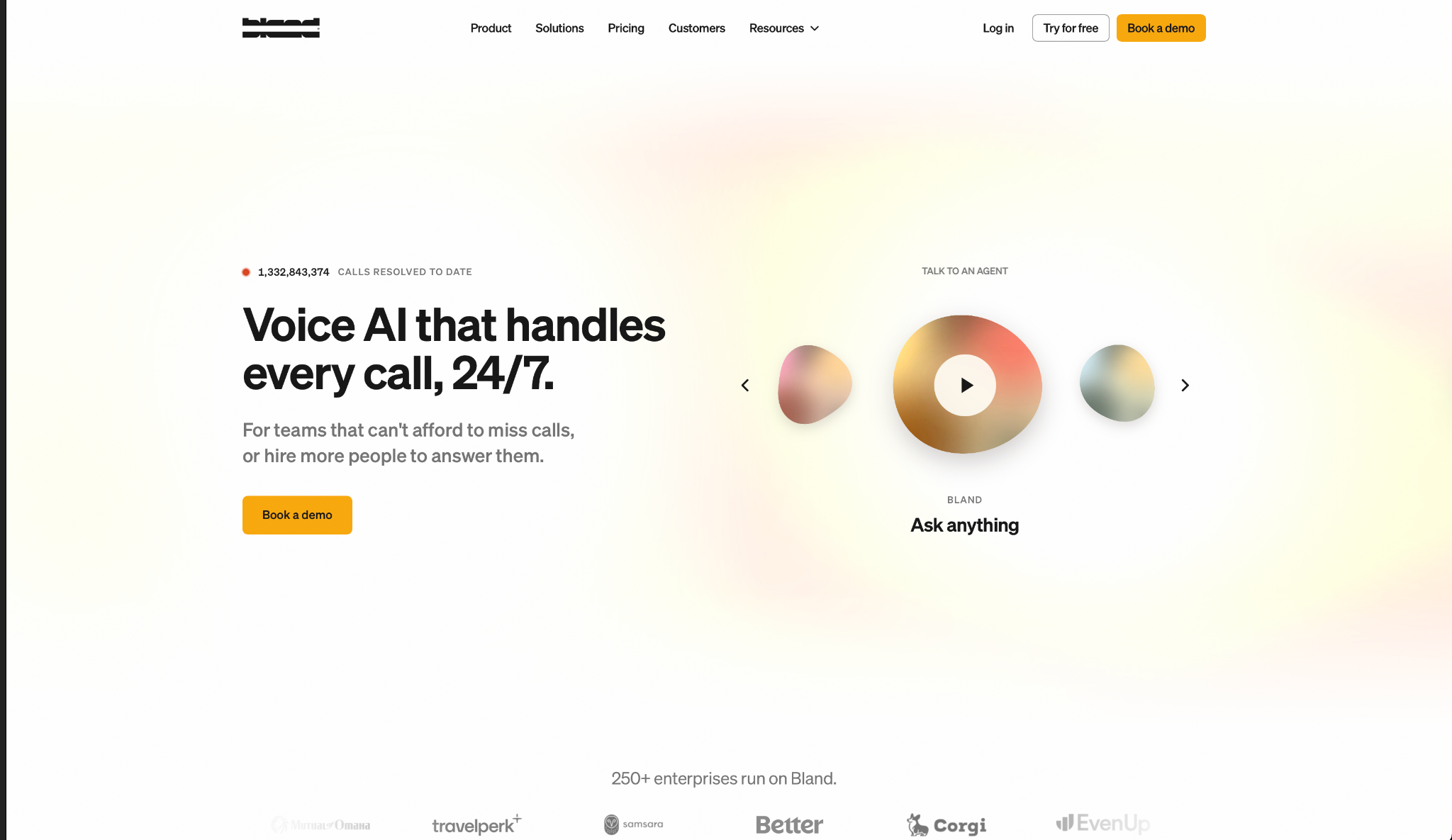
What it does: Bland AI is an enterprise voice AI platform that runs its own LLM, STT, and TTS models on dedicated infrastructure, handling inbound and outbound calls without routing data through third-party providers.
Best for: Enterprise engineering teams running high-volume outbound campaigns who need predictable all-in pricing, full data containment, and compliance coverage.
Bland's pricing structure sets it apart from every other tool on this list. One rate covers LLM, STT, TTS, and telephony with no provider pass-throughs and no per-token surcharges.
When I ran the outbound qualification flow, Bland held the script tighter than anything else I tested. The self-hosted infrastructure meant no latency spikes mid-call from third-party model routing.
That control extends to how you build flows. Conversational Pathways gives you fine-grained control over multi-turn call flows, though getting there on anything more than basic scripts takes configuration time.
Key Features
- Conversational Pathways: Multi-turn flows mixing scripted and generative responses, with variable extraction.
- Self-hosted infrastructure: Models on dedicated servers per account. No third-party data exposure.
- Batch calling: Thousands of outbound calls at once for reminders, follow-ups, and campaigns via a single API call.
- 40+ language support: 40+ languages natively, with live translation in 23 of them.
Pros and Cons
Pros:
✅ Self-hosted LLM, STT, and TTS means call data stays on Bland's infrastructure with no third-party routing
✅ SOC 2 Type I and II, HIPAA, PCI DSS, and GDPR certified, with BAA available on Enterprise
✅ Bland Evals lets you evaluate call quality at scale directly inside the platform
Cons:
❌ Conversational Pathways has a steep learning curve and requires setup time for flows beyond basic scripts
❌ No sandbox. Every test run uses live infrastructure, which slows iteration on multi-branch flows
What Users Say
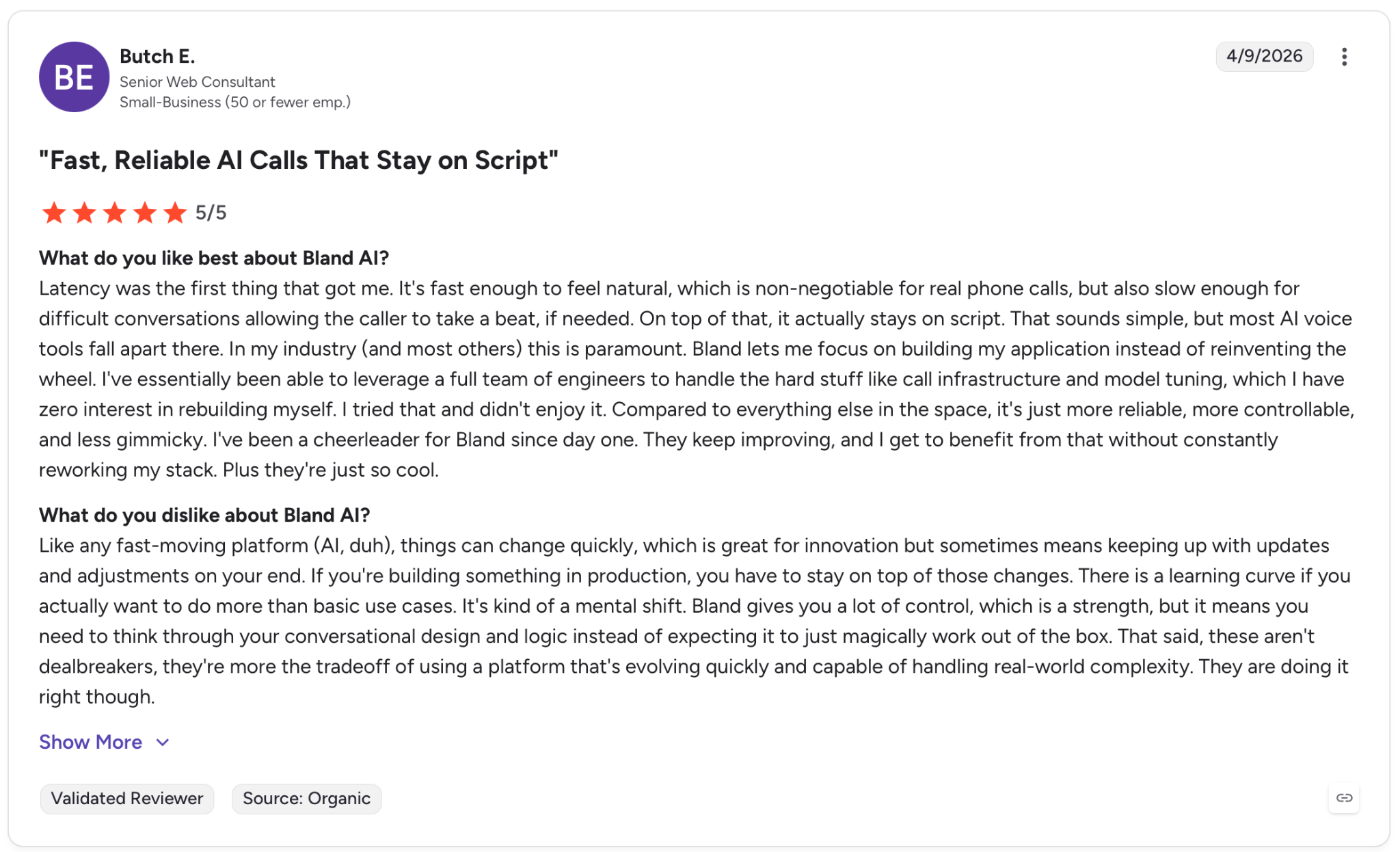
"It's fast enough to feel natural, which is non-negotiable for real phone calls, but also slow enough for difficult conversations allowing the caller to take a beat, if needed." — Butch E., G2
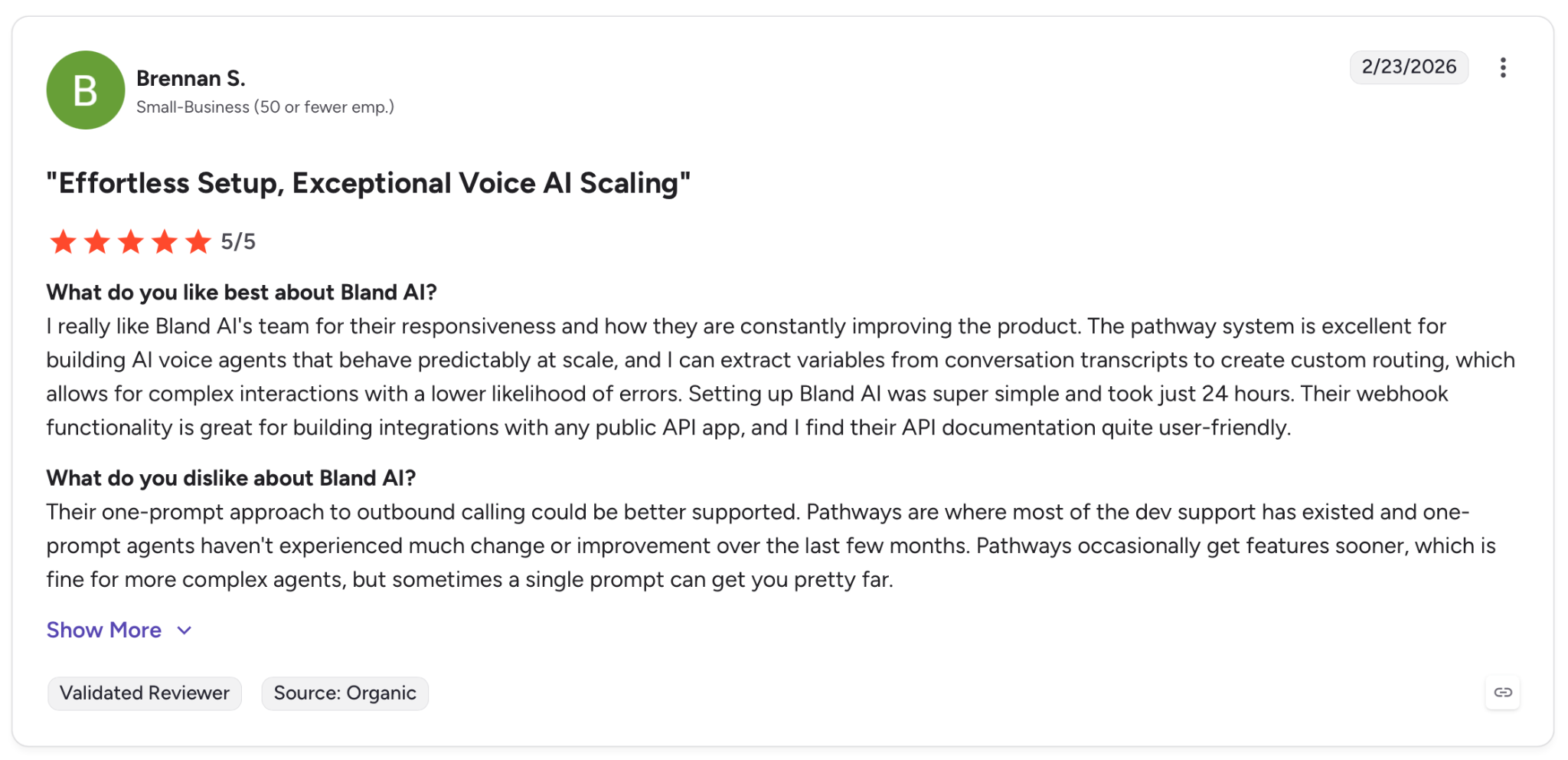
"Their one-prompt approach to outbound calling could be better supported." — Brennan S., G2
Pricing
Bland AI is free to start at $0.14/min with 100 calls/day and 10 concurrent calls. LLM, STT, TTS, and telephony are included. Transfers and SMS are billed separately.
Bottom Line
Bland AI is designed for enterprise teams running high-volume outbound with strict data governance requirements. If you need a voice agent live in a day or don't have a dev team on hand, the setup time won't pay off.
2. Decagon: Best for Enterprise Support Teams Resolving Tickets
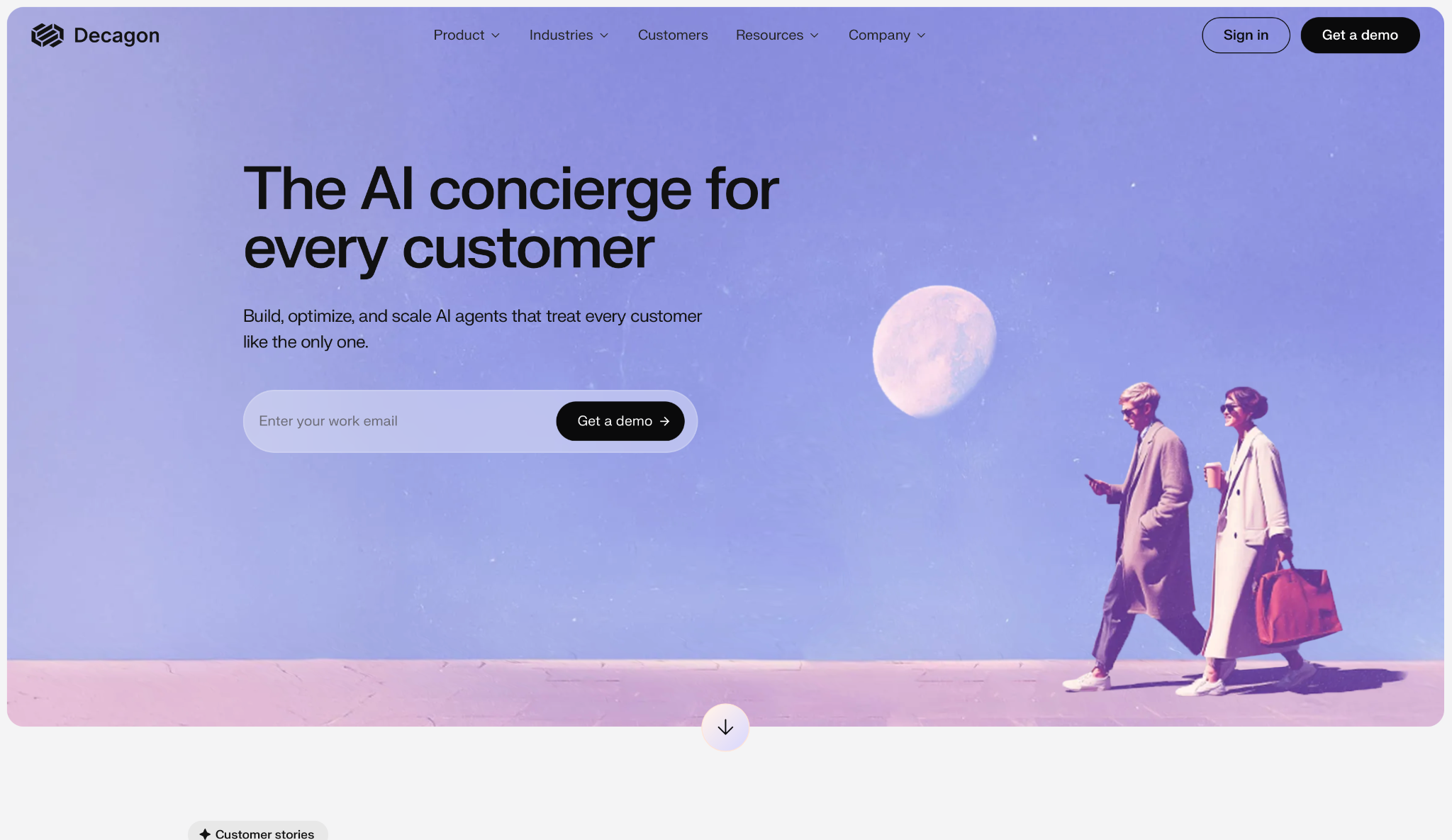
What it does: Decagon is a conversational AI platform that deploys voice, chat, email, and SMS agents from a single intelligence layer.
Best for: Enterprise CX teams handling high-volume inbound support who need high deflection rates without overhauling their existing helpdesk stack.
Decagon runs as an AI concierge. You define agent behavior once through AOPs, and it runs the same way across every channel without rebuilding it for each one. In testing, the AOP setup took longer than expected, but the agent held context across channels better than any other tool I ran.
The voice layer runs on ElevenLabs and shares the same agent brain as chat and email. Getting it live requires cross-functional coordination between your CX team and Decagon's. Plan for weeks rather than days.
Key Features
- Agent Operating Procedures (AOPs): Plain-language behavior definitions. CX teams iterate without engineering.
- Unified Intelligence: One agent across all channels with shared memory, with no repeat context on channel switches.
- Proactive Agents: Outbound calls for reminders and re-engagement on the same intelligence layer as inbound.
- OpenAI model layer: Runs on multiple models (GPT-4.1, GPT-5.2, Claude Sonnet, Claude Opus). Model selection is handled at the platform level.
Pros and Cons
Pros:
✅ AOPs let CX teams update agent behavior without engineering, which cuts iteration from days to hours
✅ Duolingo hit 80% chat deflection after deployment. ClassPass saw a 10x increase in resolution rate
Cons:
❌ No self-service access. You don't see the platform until the sales process closes
❌ Implementation needs committed resources from both sides. Go-live timelines run weeks instead of days
❌ Support use cases only. Outbound sales and revenue-generating flows fall outside its scope
What Users Say
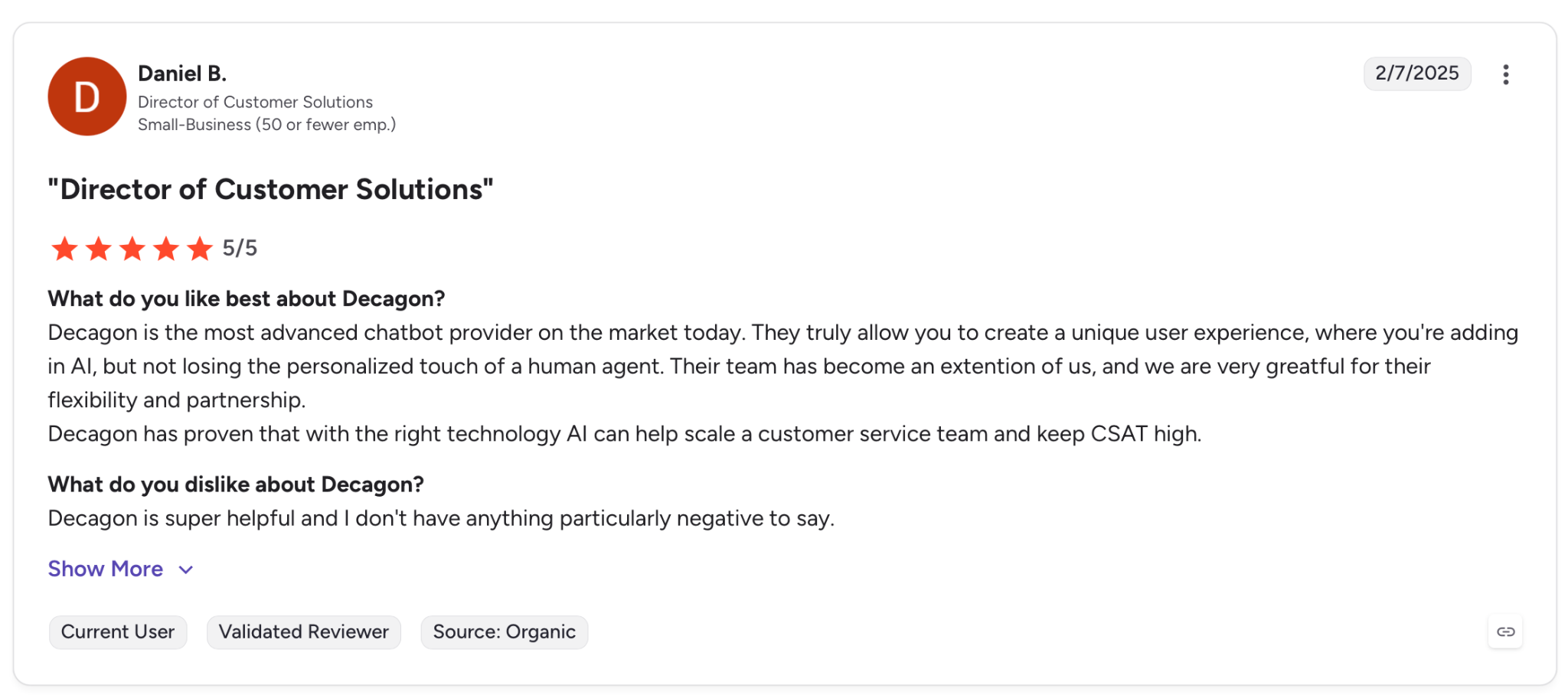
"They truly allow you to create a unique user experience, where you're adding in AI, but not losing the personalized touch of a human agent." — Daniel B., G2
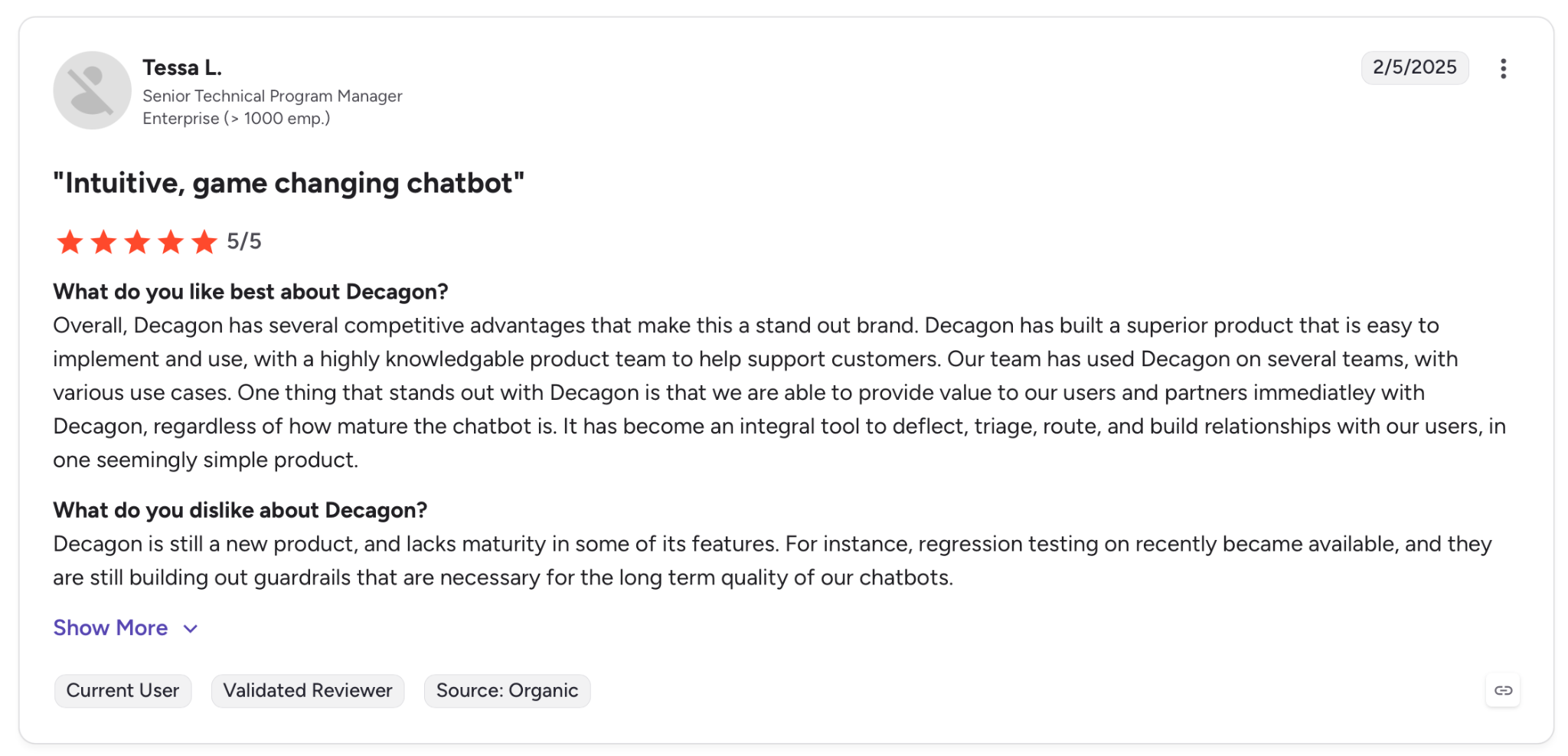
"Regression testing has recently become available, and they are still building out the guardrails necessary for the long-term quality of our chatbots." — Tessa L., G2
Pricing
Decagon contracts are scoped through their sales team based on call volume, channel coverage, and workflow demands. Annual contracts are standard.
Bottom Line
Decagon earns its spot for enterprise CX teams that need high deflection rates across voice, chat, and email without overhauling their helpdesk.
That said, if you want to know what you'll pay before starting an evaluation, or your use case is outbound sales rather than inbound support, look at Retell or Regal instead.
3. Retell AI: Best for Production-Ready Voice Agents with Built-In Testing
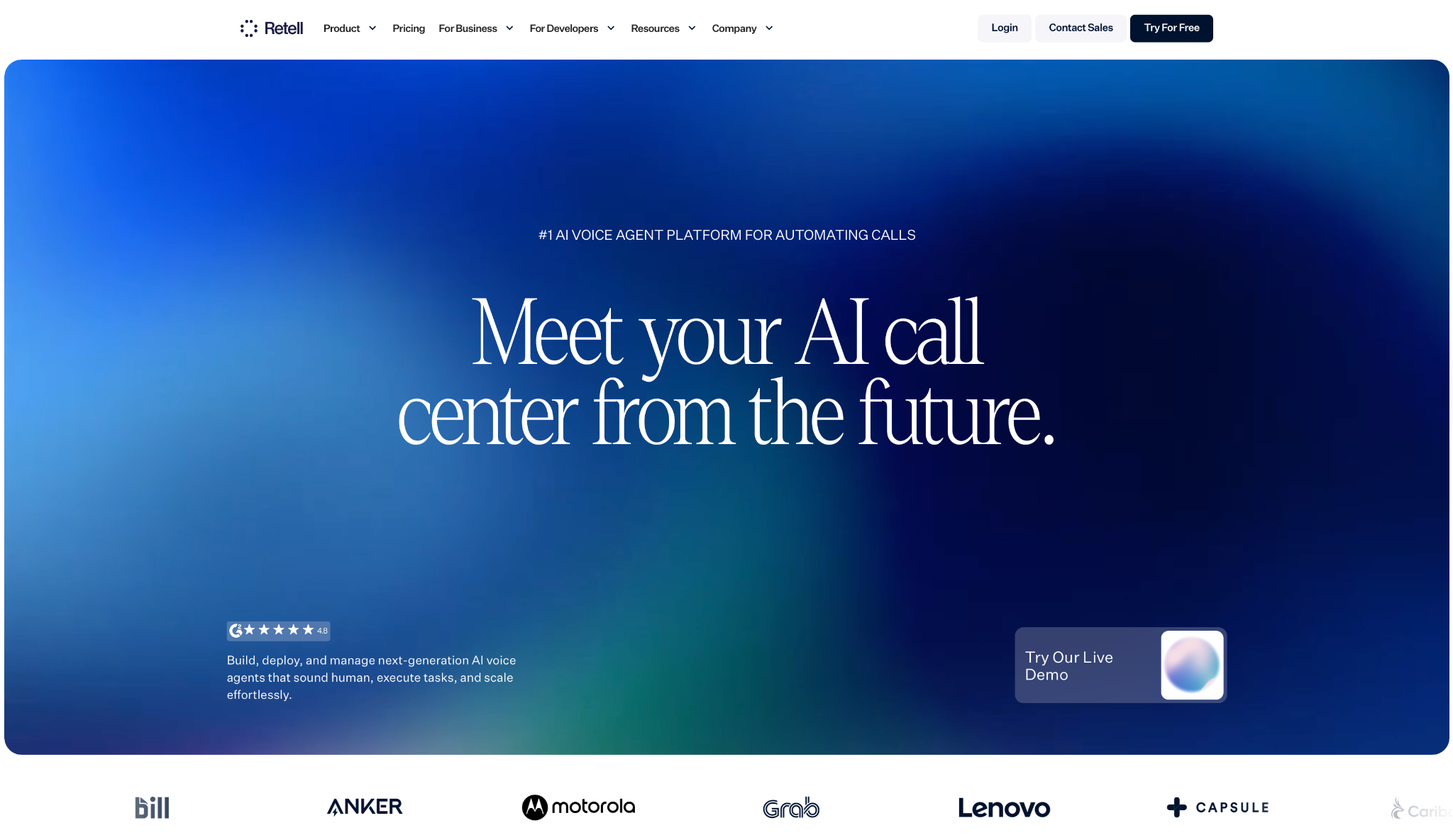
What it does: Retell AI lets teams build, deploy, and monitor inbound and outbound phone agents through a visual conversation flow builder.
Best for: Product and CX teams that need a production-ready AI voice agent platform up quickly, with full post-call visibility into call outcomes, sentiment, and resolution rates.
Retell was the fastest platform I reached a working agent on. Simulation testing caught two edge cases in my outbound qualification flow before I put it anywhere near a caller. That testing layer ships natively, so you don't need to wire anything extra to use it.
Watch the add-ons, though. Billing covers the full call duration. Silence and hold time count too, because the STT engine stays active the entire call, but costs compound fast at volume.
Key Features
- Conversation Flow: Multi-turn flows with guardrails, fallback handling, and live function calling.
- Simulation Testing: Automated test conversations before deployment to catch failures before callers do.
- Knowledge Base: Upload docs or sync web content. Answers retrieved on demand with auto-sync.
- SIP trunking and verified numbers: Any telephony provider at no extra charge. Verified numbers prevent spam flags.
Pros and Cons
Pros:
✅ The agent hands off with full conversation context. Human agents pick up mid-thread, no recap needed
✅ Unconnected and failed calls don't count against usage
✅ Barge-in handling lets callers interrupt mid-response without breaking the conversation flow
Cons:
❌ Silence and hold time run through the STT engine, so long pauses can skew transcription
❌ AI QA, Safety Guardrails, and extra concurrency are separate add-ons. A production setup requires several of them
❌ Pay-as-you-go support runs through community and email. Response times are slow when something breaks in a live flow
What Users Say
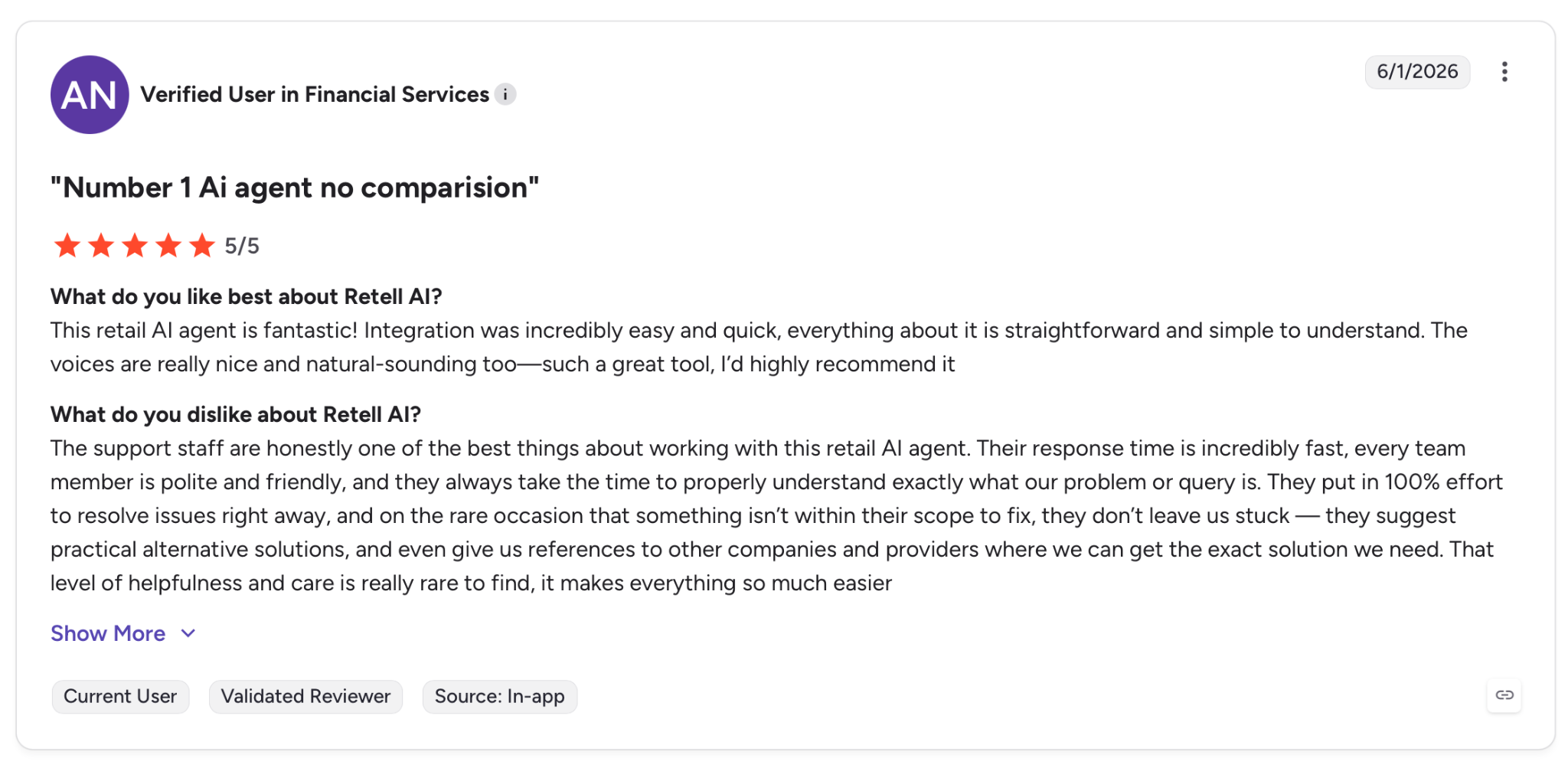
"This retail AI agent is fantastic! Integration was incredibly easy and quick, everything about it is straightforward and simple to understand." — Verified User, G2
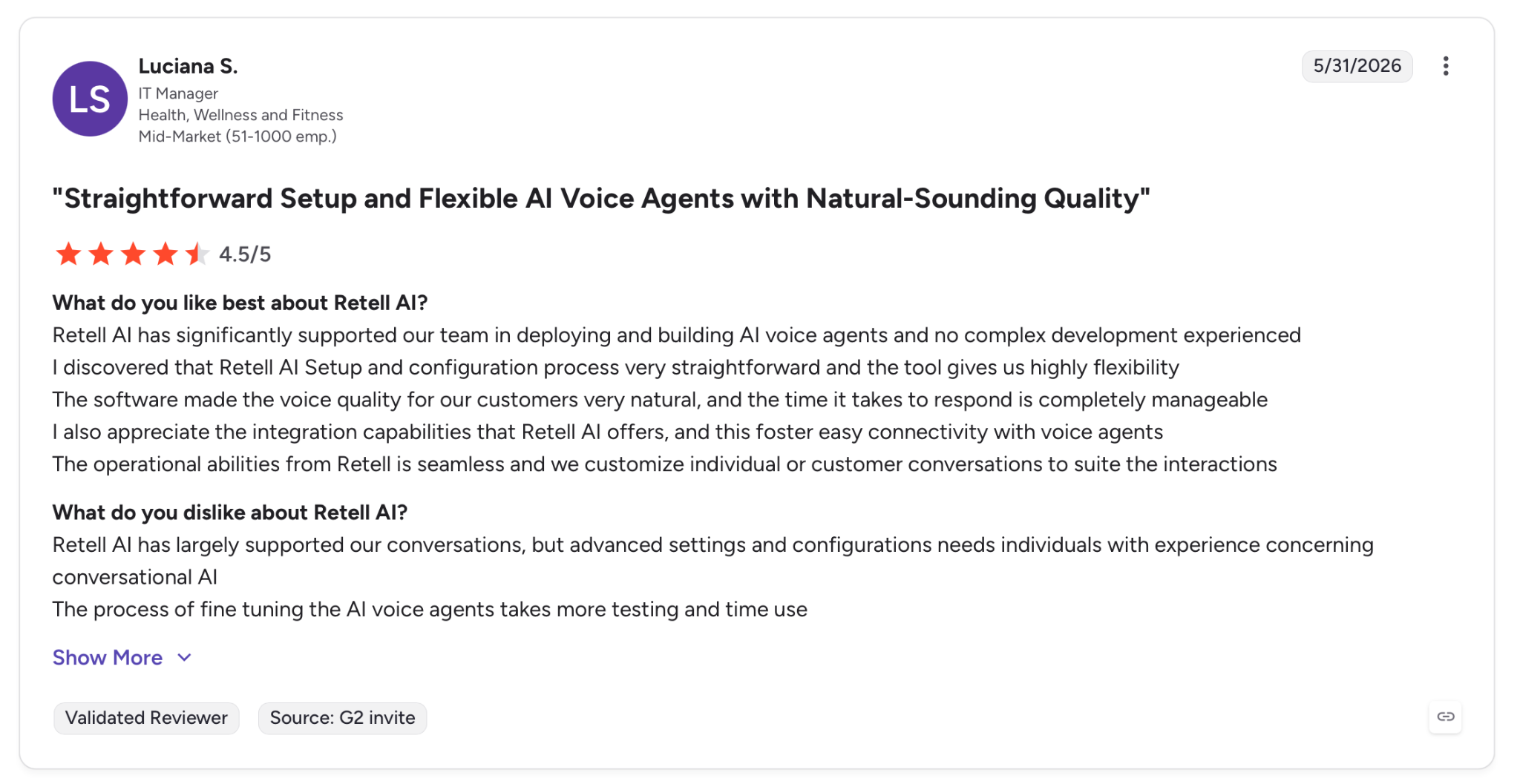
"Retell AI has largely supported our conversations, but advanced settings and configurations need individuals with experience concerning conversational AI." — Luciana S., G2
Pricing
Retell AI charges $0.07/min as a starting baseline (Voice Infra, standard TTS, and telephony), billed per second with no platform fee and $10 in free credits at signup. HIPAA/BAA is included on standard pay-as-you-go plans.
Bottom Line
Retell is the strongest starting point if you want a production-ready voice agent without assembling a stack from scratch. If you need enterprise SLAs and hands-on support out of the gate, start the Enterprise conversation early.
4. Regal: Best for B2C Contact Centers Running Outbound Sales, Scheduling, and Collections
What it does: Regal is a voice AI agent platform designed for B2C contact centers that need to handle inbound support, outbound lead qualification, scheduling, and collections across voice.
Best for: B2C sales and CX teams in healthcare, insurance, financial services, and education that need AI agents handling multi-step call flows with compliance guardrails and safety controls included.
When I tested Regal's off-script handling on the lead qualification flow, the Journey Builder's behavioral routing held up across every scenario I threw at it. Under the hood, it's a no-code orchestration layer that designs multi-touch AI agent workflows using customer data and behavioral signals, with native A/B tests to measure which approach converts.
Regal ships with a forward-deployed engineering team that manages implementation alongside yours, which cuts time-to-production.
Key Features
- Journey Builder: Triggers actions from Salesforce, your CRM, or any webhook. Native A/B testing included.
- Collections and revenue recovery: Collections and delinquency outreach via voice and SMS.
- Built-in safety layer: Privacy controls, compliance guardrails, and hallucination controls on every call flow.
- Language support: 30+ languages in hundreds of accents, with no extra configuration needed.
Pros and Cons
Pros:
✅ Forward Deployed Engineering team handles implementation alongside yours from day one
✅ 97% containment, 80% cost-to-serve reduction, 4x faster speed-to-lead
Cons:
❌ No self-service trial. You can't test the journey builder against your own flows before committing
❌ Built for outbound sales. Complex inbound support operations typically need additional tooling on top
What Users Say
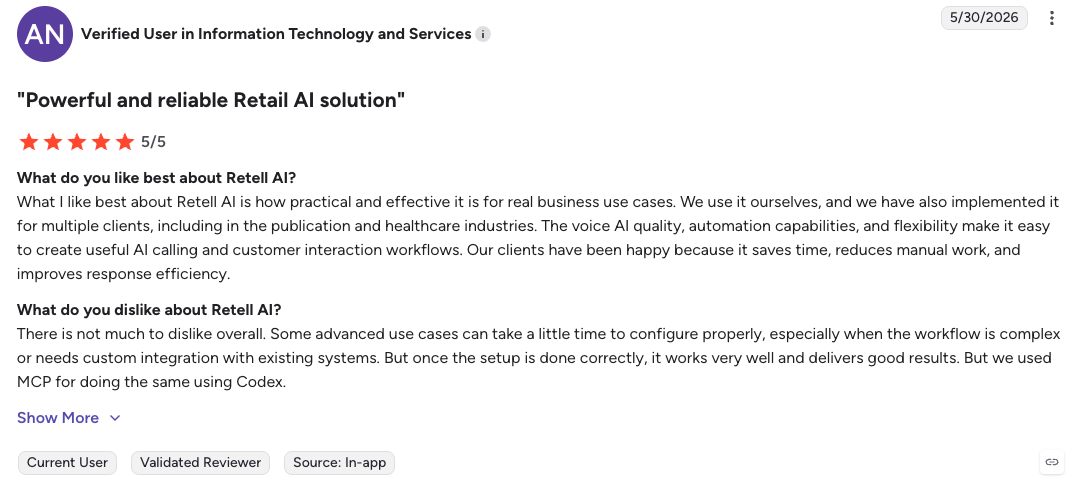
"What I like best about Retell AI is how practical and effective it is for real business use cases. We use it ourselves, and we have also implemented it for multiple clients, including in the publication and healthcare industries." — Verified User in Information Technology and Services, G2
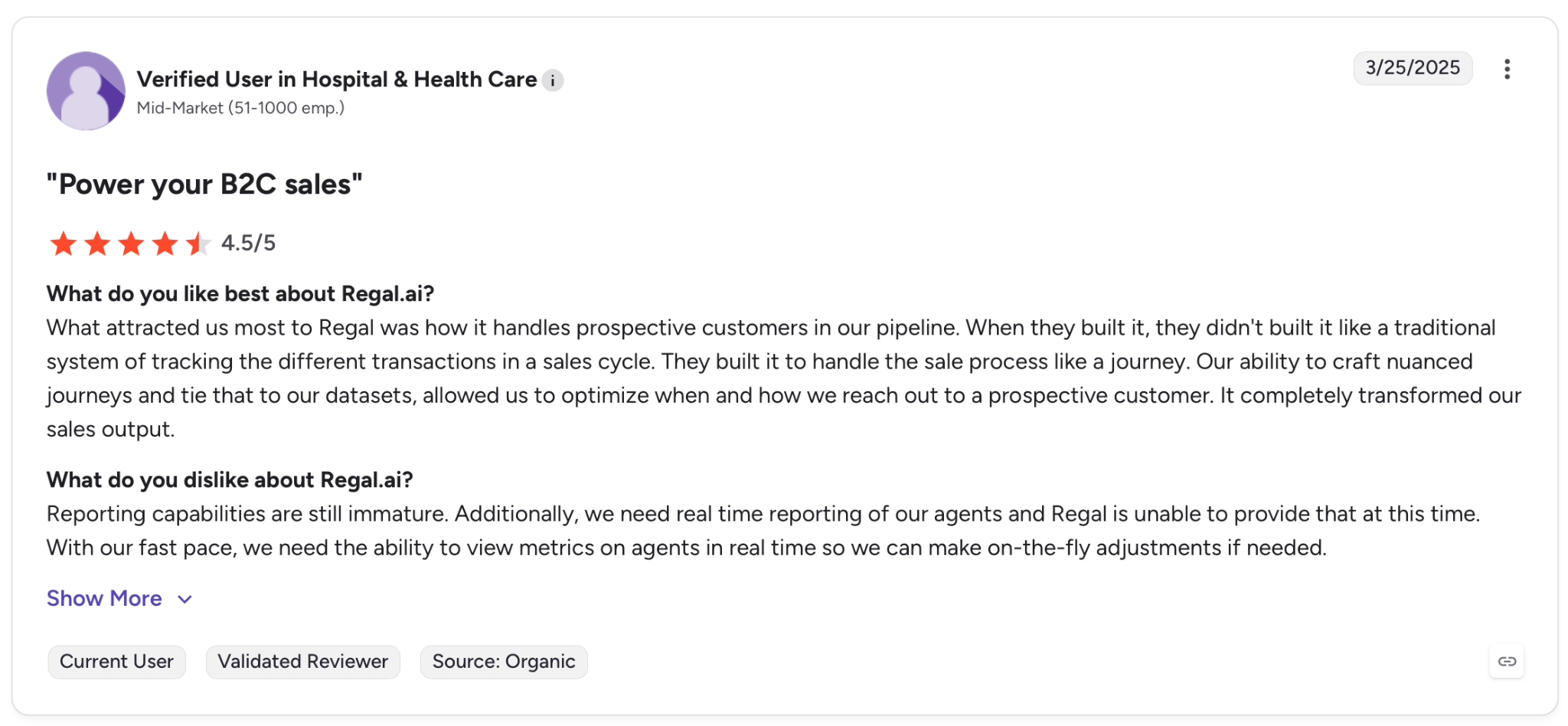
"Reporting capabilities are still immature. Additionally, we need real time reporting of our agents and Regal is unable to provide that at this time." — Verified User, G2
Pricing
Contracts are scoped by number of users, call volume, and length. Discounts apply at higher spend. Request a demo.
Bottom Line
Regal makes sense for B2C contact center teams in regulated industries that need AI agent workflows across sales, support, and collections.
If pricing transparency matters before you commit, or you're running straightforward inbound support without an implementation team on hand, Retell or Synthflow will serve you better.
5. Vapi: Best for Developers Building Custom Voice AI Infrastructure
What it does: Vapi is a developer-first voice AI platform that handles orchestration, telephony, and real-time call infrastructure. Engineering teams can build voice AI applications on top of it using their own choice of LLM, STT, and TTS providers.
Best for: Engineering teams building custom voice AI products who want full model flexibility and API-first infrastructure. Open to bringing their own provider keys to eliminate pass-through costs.
Vapi gave me the most control of any platform I tested and the least hand-holding. The $0.05/min covers only hosting. LLM, STT, and TTS pass through at provider cost, dropping to $0 with your own API keys.
Two teams running the same call volume can end up with very different monthly bills depending on their model stack. Ring routed 100% of their inbound calls through Vapi and saw improved CSAT scores after deployment.
Key Features
- Model-agnostic architecture: Swap LLM, STT, and TTS providers freely. Bring your own API keys with no Vapi markup.
- Real-time tool calling: Trigger external APIs and execute actions mid-conversation without breaking the flow.
- On-premise and enterprise deployment: SOC 2, HIPAA, PCI, GDPR certified. Enterprise includes an embedded engineer.
- White-label and multi-tenancy: Embed without Vapi branding. Stripe-style multi-tenancy for end-customer accounts.
Pros and Cons
Pros:
✅ Bring-your-own-key means you swap any LLM, STT, or TTS freely. Tested three combinations without rebuilding
✅ 750K+ developers, 1B+ calls, 2.5M+ agents launched
✅ 99.9% uptime for enterprise clients per Vapi.ai, with horizontal scaling to 1,000+ concurrent sessions
Cons:
❌ The full stack is yours to assemble and monitor. No warning when a provider combination degrades latency or accuracy
❌ Homepage claims sub-500ms latency; the FAQ puts round-trip at 800ms. The gap shows in fast outbound flows
What Users Say
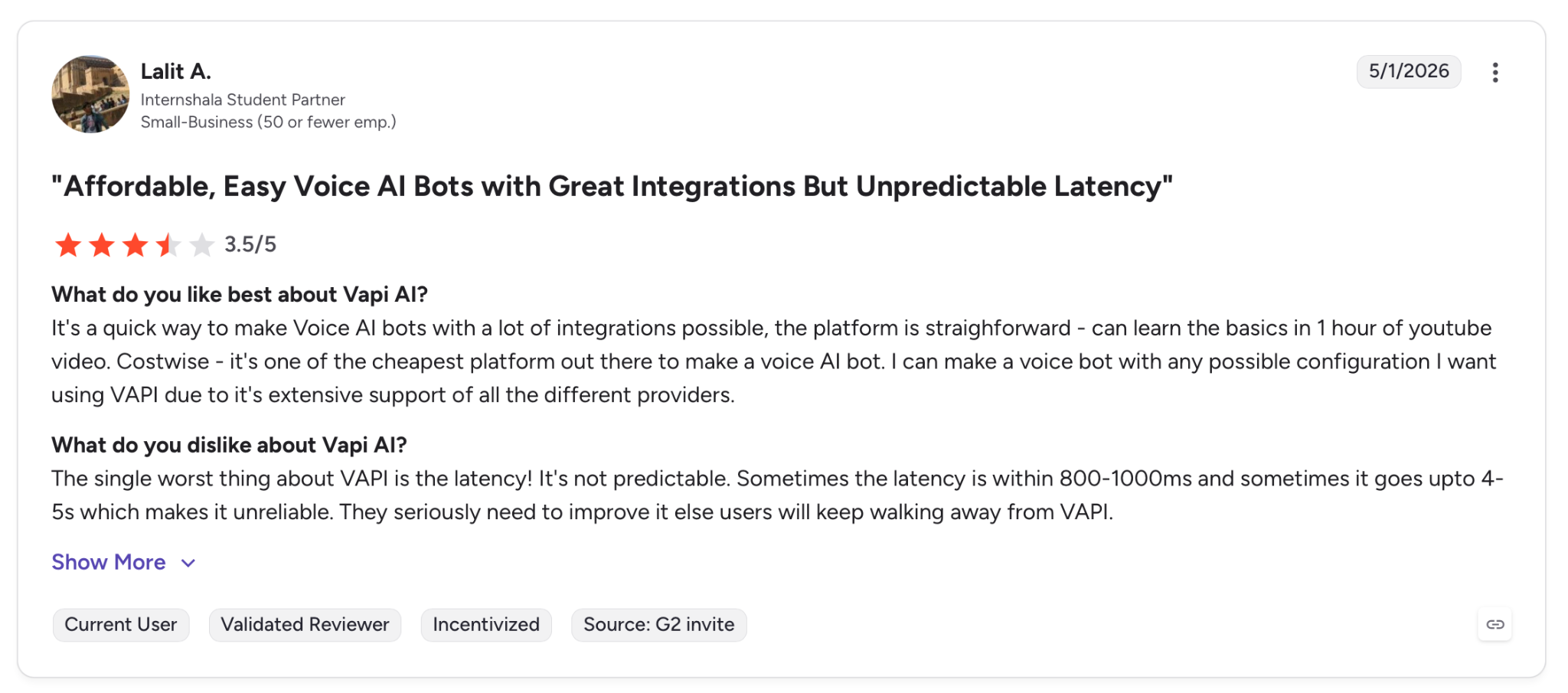
"It's a quick way to make Voice AI bots with a lot of integrations possible, the platform is straightforward." — Lalit A., G2
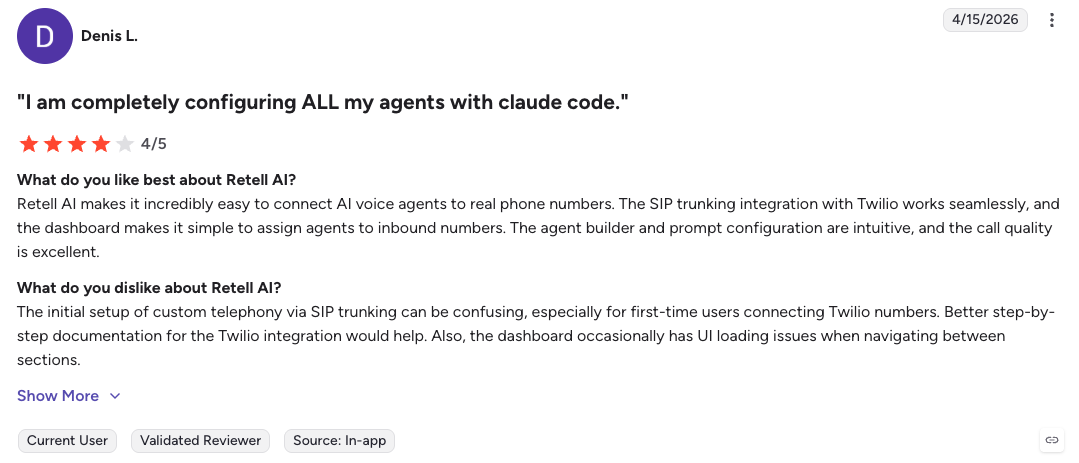
"The initial setup of custom telephony via SIP trunking can be confusing, especially for first-time users connecting Twilio numbers." — Dennis L., G2
Pricing
Vapi charges $0.05/min for platform hosting only. LLM, STT, and TTS are billed at provider cost on top, or $0 with your own API keys. Enterprise adds HIPAA, SOC 2, PCI, and SSO.
Bottom Line
Vapi suits developer teams that want full model control and are comfortable assembling their own stack. If your team needs a working voice agent without writing infrastructure from scratch, Retell or Synthflow will get you there faster.
6. Synthflow: Best for Non-Technical Teams Deploying Voice Agents
What it does: Synthflow is a voice AI platform with in-house telephony and the Flow Designer, a no-code visual builder. Its BELL deployment framework (Build, Evaluate, Launch, Learn) takes teams from pilot to production in weeks.
Best for: Non-technical CX and ops teams that need to deploy voice agents across inbound support, lead qualification, and appointment scheduling without relying on engineering resources.
Synthflow runs its own communications infrastructure instead of routing calls through Twilio or third-party carriers. Direct SIP trunking covers Cisco, Avaya, Genesys, and RingCentral. I had an agent live in under an hour without writing a line of code.
The main point of friction is pricing. HIPAA, white-label, and native telephony are all gated behind Enterprise, and the latency add-ons stack fast on top of the base rate.
Key Features
- Flow Designer: Build workflows, configure knowledge bases, and set fallback logic visually. No code needed.
- In-house native telephony: Own network with SIP trunking for Cisco, Avaya, Genesys, RingCentral. Enterprise only.
- BELL deployment framework: Build, Evaluate, Launch, Learn — a structured go-live process embedded in the platform.
- 200+ integrations: CRMs, CCaaS platforms, and calendars, with white-label and reseller options.
Pros and Cons
Pros:
✅ In-house telephony removes Twilio dependency. Teams control routing, quality, and compliance directly
✅ Smartcat cut booking costs 70%, and Medbelle hit 2.5x more qualified appointments and 30% fewer no-shows
Cons:
❌ HIPAA, white-label, and native telephony are Enterprise-only. Pay-as-you-go teams hit capability limits fast
❌ White-label requires Enterprise. Agencies can't test the full feature set on lower tiers
❌ Global Low Latency Edge is a separate add-on. Latency-sensitive workflows need it, but it's not in the base setup
What Users Say
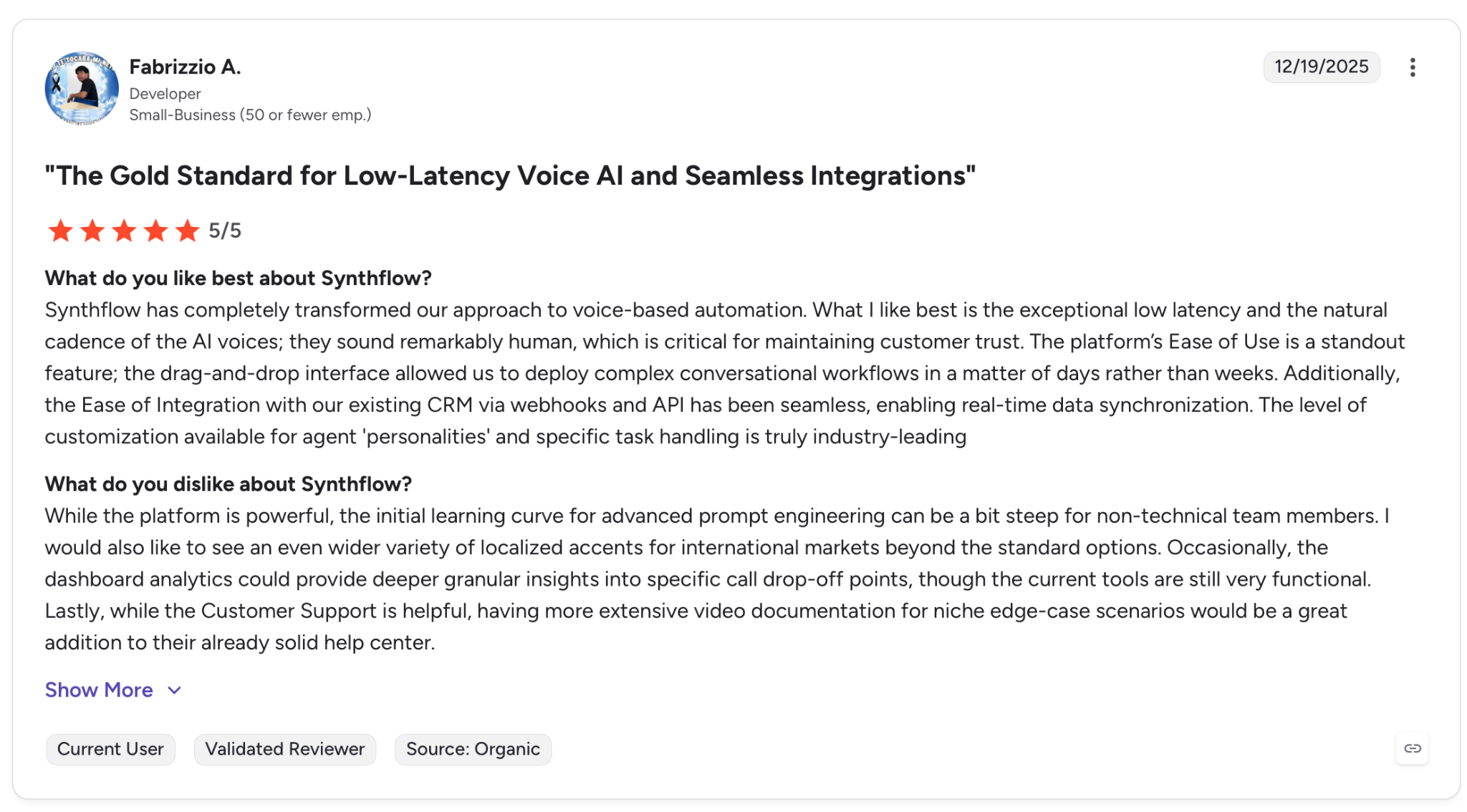
"Synthflow has completely transformed our approach to voice-based automation." — Fabrizzio A., G2
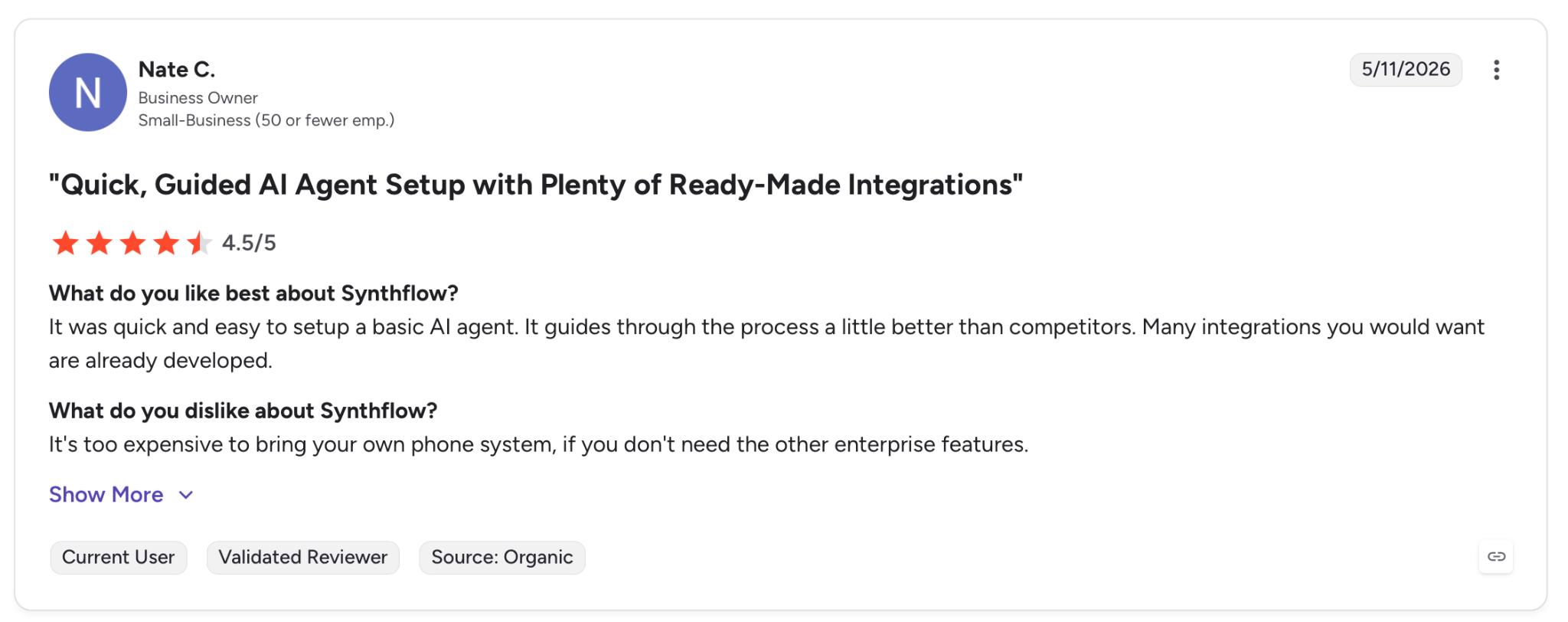
"It's too expensive to bring your own phone system if you don't need the other enterprise features." — Nate C., G2
Pricing
Synthflow charges $0.09/min for Voice Engine plus LLM costs on top ($0.02 to $0.05/min depending on model). Native telephony, HIPAA, and white-label are Enterprise-only.
Bottom Line
Synthflow gets non-technical teams to live faster than most options here. If your use case requires white-label or HIPAA compliance and you're below Enterprise volume, run the full cost model before you commit.
7. PolyAI: Best for Large Enterprises Handling High-Stakes
What it does: PolyAI is an enterprise dialog platform that builds, runs, and governs voice AI agents. It runs on Raven, a model trained specifically on enterprise voice interactions and multi-turn conversations across chat and digital channels.
Best for: Large enterprise contact centers in healthcare, financial services, hospitality, and retail that need voice agents handling fraud, outage, triage, and multilingual disputes.
PolyAI was the hardest platform to get into and the most impressive once I did. It's the only one on this list that ships its own purpose-built dialog model. Raven is trained on enterprise conversation data rather than general-purpose web text.
That distinction matters when the call itself is the hard part. Generic LLMs stumble on fraud detection, clinical triage, and multilingual disputes. Raven was trained on exactly those.
The tradeoff is a closed evaluation process. There's no public pricing, no self-service sign-up, and a sales conversation before you see anything.
Key Features
- Raven model: Trained on 1B+ enterprise voice interactions. Handles ambiguous and emotionally charged calls.
- Agent Studio: Two build paths on one runtime. Poly Agent Builder for non-technical teams, ADK for developers.
- Compliance by default: SOC 2 and HIPAA on every plan. 24/7/365 support, audits, and auto-upgrades included.
- Analyst Agents: Plain-language questions answered from live call data. No SQL, no BI export.
Pros and Cons
Pros:
✅ Raven is the only dialog model here trained specifically on enterprise voice
✅ SOC 2 and HIPAA on every plan at no extra cost, with 24/7/365 support and an uptime SLA
✅ PG&E saved 35,000 labor hours, Audibel cut abandonment by 44%, UniCredit up 14 NPS points
Cons:
❌ No public rate card. You enter a sales process before you have enough to know if the fit is right
❌ No sandbox or trial. Every evaluation starts with a demo request
What Users Say
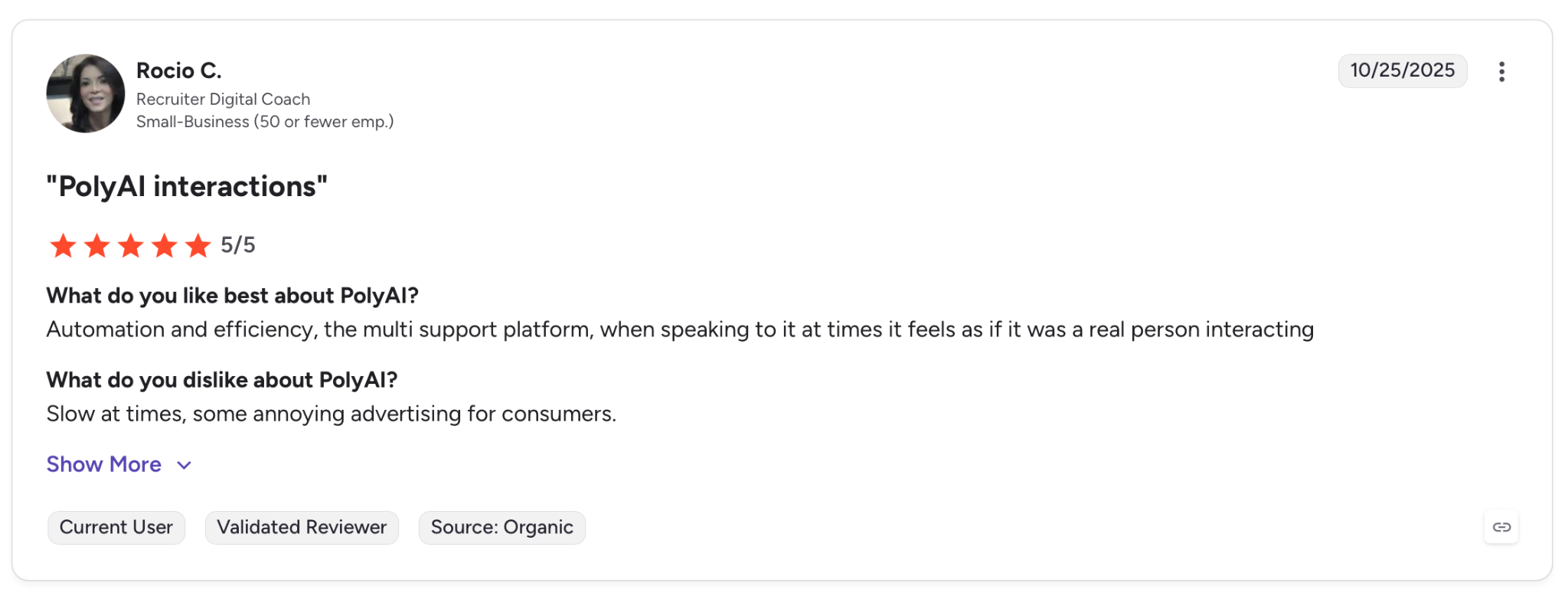
"Automation and efficiency, the multi support platform, when speaking to it at times it feels as if it were a real person interacting." — Rocio C., G2
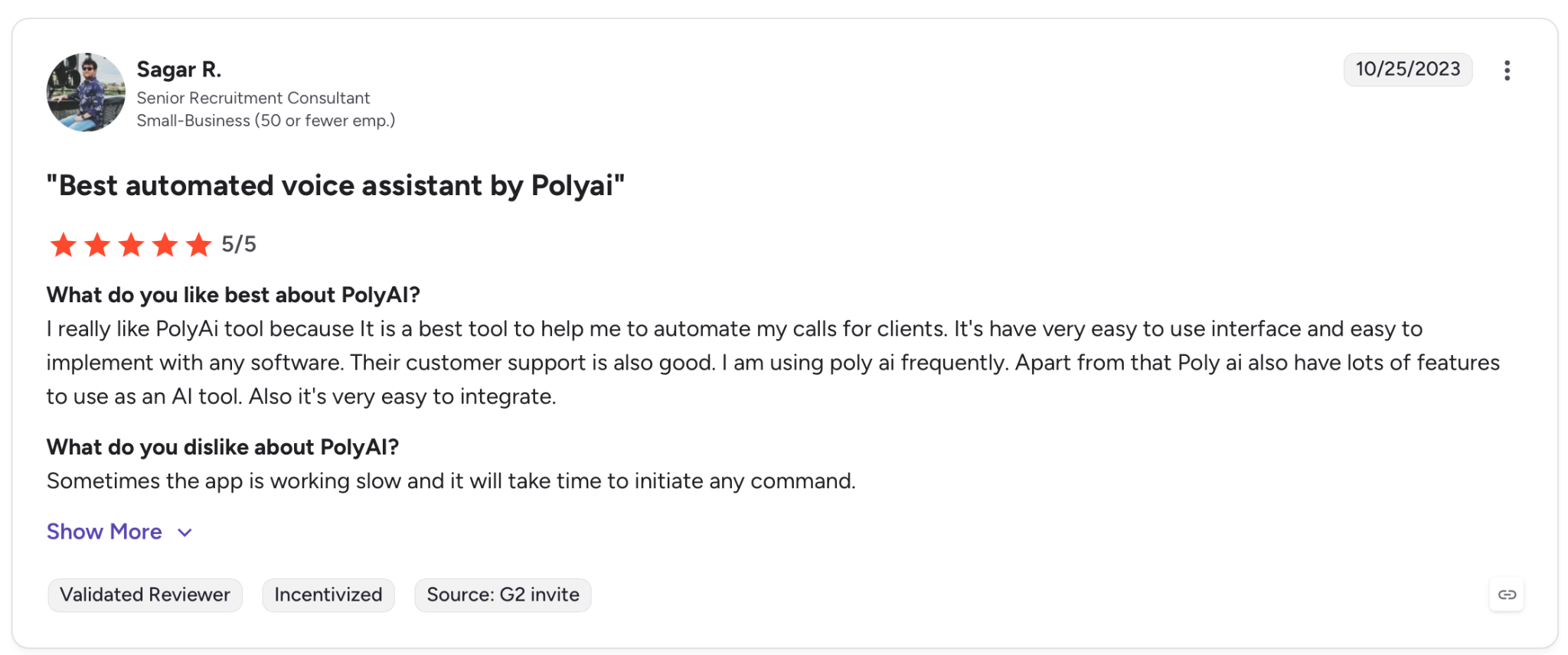
"Sometimes the app is working slowly, and it will take time to initiate any command." — Sagar R., G2
Pricing
PolyAI prices on a per-minute basis, with no public rates. Every plan includes 24/7/365 emergency support, SOC 2 and HIPAA compliance, and an uptime SLA.
Bottom Line
PolyAI is worth the effort for enterprises with compliance-heavy contact center operations and the budget for a full procurement process. If you need pricing clarity upfront or your use case is standard inbound support, every other platform reviewed here will get you live faster.
Which AI Voice Agent Platform Should You Choose?
Where you sit today matters more than any feature comparison. Think about your technical resources, call volume, use case, and how much configuration time you can spare before you need it live.
Choose Bland AI if you:
- Run high-volume outbound campaigns and need predictable all-in pricing with no provider pass-throughs
- Have strict data governance requirements and need call data to stay off third-party infrastructure
- Have engineering resources to configure Conversational Pathways for flows beyond basic scripts
Choose Decagon if you:
- Run enterprise inbound support across voice, chat, and email, and need high deflection rates without rebuilding your helpdesk
- Already use Zendesk, Intercom, or Freshdesk and want AI that operates natively inside your existing support stack
- Can commit to a multi-week implementation with dedicated resources from both sides
Choose Retell AI if you:
- Need a production-ready AI voice agent platform up quickly, with published, component-level pricing before you sign anything
- Want post-call analytics, sentiment scoring, and simulation testing without building your own observability layer
- Are running inbound support or outbound sales and want full call lifecycle visibility from day one
Choose Regal if you:
- Operate a B2C contact center in healthcare, insurance, financial services, or education with multi-step call flows
- Need outbound sales, scheduling, and collections running on a single orchestration layer with compliance guardrails included
- Have an in-house implementation team and can work through a sales-gated procurement process
Choose Vapi if you:
- Have a software engineering team that wants full control over every layer of the stack (LLM, STT, TTS, and telephony)
- Need to bring your own API keys to eliminate provider pass-through costs at scale
- Are building a custom voice AI product that no off-the-shelf platform can support out of the box
Choose Synthflow if you:
- Don't have engineering resources and need a voice agent deployed across inbound support, lead qualification, or scheduling without writing code
- Want a structured deployment process with Flow Designer, native telephony, and post-call CRM sync in one platform
- Can evaluate Enterprise pricing before committing, since HIPAA and white-label are locked behind it
Choose PolyAI if you:
- Run a large enterprise contact center handling fraud, multilingual disputes, clinical triage, or outage management at scale
- Need a purpose-built dialog model trained on enterprise conversations rather than a general-purpose LLM adapted for voice
- Have the procurement resources and timeline for a vendor assessment with no self-service option
Skip this category entirely if:
- Your call volume is under a few hundred calls per month, and a human answering service is cheaper than any platform on this list
- You're still validating whether voice AI solves your problem. Run a manual pilot first before committing to a platform
Are You Adding a QA Layer on Top of Any of These AI Voice Agent Platforms?
The seven platforms above cover building, deploying, and running voice agents in live environments. Production failures in conversational AI often don't look like crashes, though.
Confused users and missed intents surface gradually, buried in thousands of conversations you'll never manually review.
Retell ships simulation testing for basic flows. Adversarial scenarios, latency tracking across providers, and CI/CD integration go beyond what any of them include natively.
Cekura fills that gap, covering:
- Testing at scale: Thousands of simulated calls before go-live to surface edge cases that only users trigger.
- Red teaming and security testing: Adversarial inputs and bias scenarios run against your agent before go-live.
- Latency tracking: Pinpoints where slowdowns originate after each provider or prompt change.
- CI/CD integration: Test suites run automatically on every prompt or provider change.
- Custom evaluation: Scores every call on accuracy and missed intents against your own criteria.
Native integrations work out of the box for Retell, VAPI, ElevenLabs, LiveKit, Pipecat, Bland, and more.
You add a testing and monitoring layer on top of what you already have. Nothing gets rebuilt. Teams at companies like Twin Health and Lindy use Cekura to catch failures before they reach callers.
It's SOC 2-, HIPAA-, and GDPR-compliant for transcript redaction, role-based access, and audit trails.
Production failures show up when people use your agent. See how Cekura helps you catch them first.
The Bottom Line
Of the seven platforms I tested, Retell is the one I'd tell most teams to start with.. It's production-ready, pricing is published before you sign anything, and post-call analytics give you something to improve on from day one.
If you have an engineering team that wants full-stack control, Vapi gives you the infrastructure and expects you to wire the rest. For strictly outbound at enterprise volume, where data governance is non-negotiable, Bland is the only option.
Decagon and Regal each solve one problem well. Decagon owns support deflection, Regal owns B2C sales, and neither does much outside of it. Synthflow gets teams without technical resources to production faster than anything else here.
Remember that the answer is usually in the doing, not in the comparison chart. Take two or three of these for a spin. Whichever one you pick, Cekura is the QA layer that makes sure it works in production.
Frequently Asked Questions
What Is an AI Voice Agent Platform?
An AI voice agent platform combines speech-to-text, a large language model, and text-to-speech to handle live phone conversations automatically. Platforms range from no-code builders like Synthflow to API-first layers like Vapi, where engineering teams assemble their own stack.
What Is the Difference Between an AI Voice Agent and an IVR?
IVR routes callers through fixed menus using touch-tone input. An AI voice agent handles unscripted conversations, understands natural language, and adapts its response to what the caller says.
How Much Does an AI Voice Agent Platform Cost?
AI voice agent platform pricing typically starts between $0.07 and $0.14 per minute on pay-as-you-go plans. Enterprise platforms like Decagon, Regal, and PolyAI don't publish pricing and require a sales conversation to scope a contract.
What Should I Look for When Choosing an AI Voice Agent Platform?
The key factors when choosing an AI voice agent platform are your technical resources, call volume, and primary use case. Total cost matters too. Factor in LLM, STT, and TTS provider fees on top of the platform rate before comparing options.
Are AI Voice Agent Platforms HIPAA Compliant?
Several platforms offer HIPAA compliance. Retell includes it on standard pay-as-you-go plans. Bland, Synthflow, and PolyAI require an Enterprise plan and a signed BAA. Confirm directly with the vendor before deploying in healthcare.
What Is the Best AI Voice Agent Platform for Small Businesses?
Synthflow works best for small businesses without a technical team. It has a free tier and doesn't require engineering to deploy. Retell suits small dev teams that want transparent component pricing and post-call analytics.