
Voice AI sentiment analysis for upsell offers scores a caller's emotional state mid-call and uses that score to decide whether the agent presents an upgrade, add-on, or renewal.
The score becomes control flow, so an error reaches the customer immediately. Trigger design moves outcomes further than model selection does.
Most teams build it backward. The sentiment score gets wired to the offer trigger before anyone measures how often that score is correct. On a live call, you get one attempt.
TL;DR
- A widely cited 2021 wav2vec 2.0/HuBERT benchmark reached 73.01% weighted accuracy on speakers it had never heard, across four coarse emotion classes. Every caller who dials your agent is a speaker it has never heard.
- Callers give an AI agent about half the words they give a human, and the positive emotional window you want to sell into is far rarer in machine conversations than in human ones.
- Fix the trigger design first, then the model. A gate built on task completion and behavioral signals outperforms a gate built on a raw sentiment score.
What Voice AI Sentiment Analysis Actually Measures
Voice AI sentiment analysis for upsell offers scores a caller's emotional state mid-conversation and uses that score to decide whether the agent presents an upgrade, add-on, or renewal. The score becomes control flow. It changes what the agent says next.
A dashboard score can be wrong for a week and cost you nothing, but a trigger score that is wrong once costs you the call.
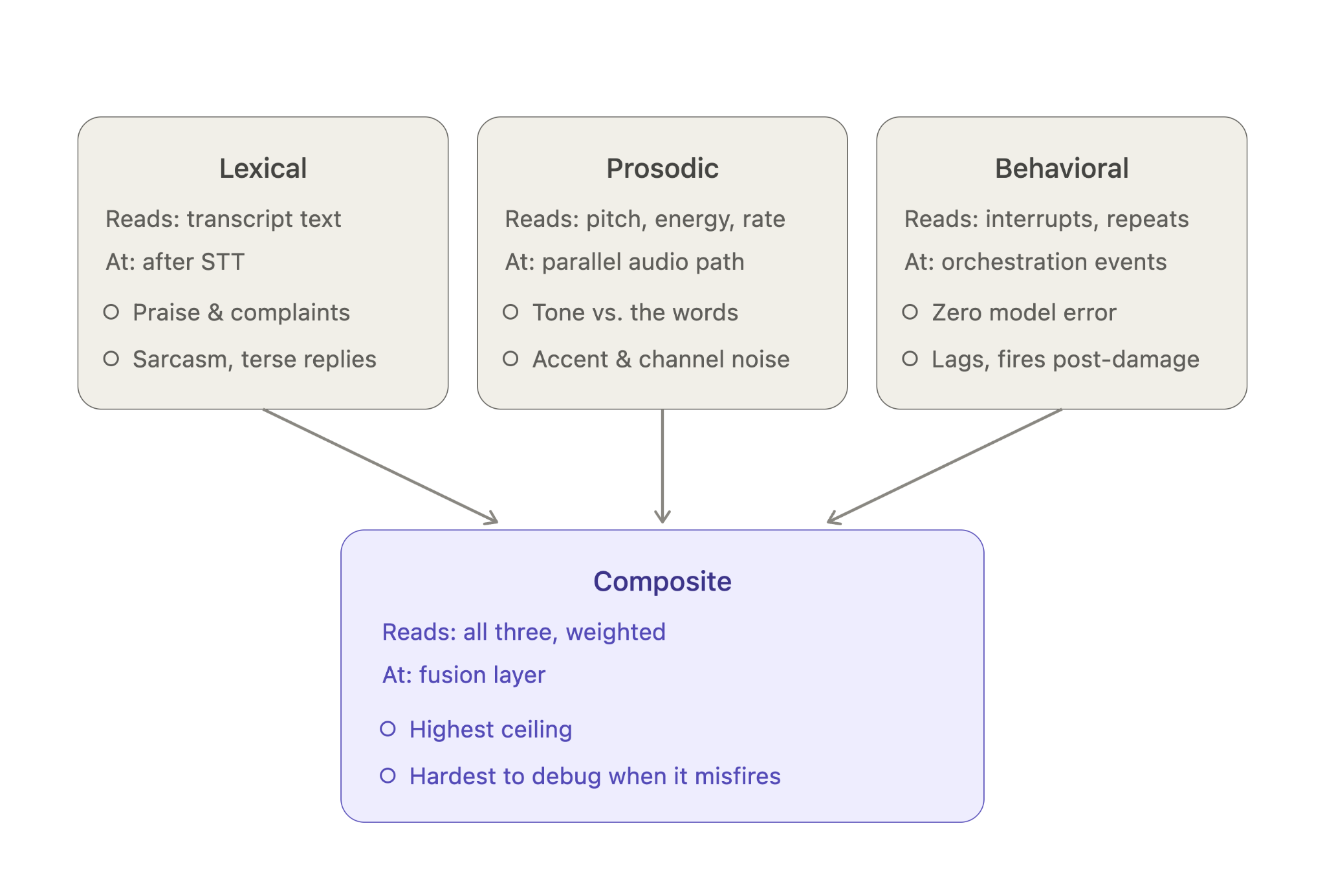
Three signal sources feed that decision.
Lexical signals: what the caller said
The transcript goes to a classifier or an LLM judge, which returns a polarity or an emotion label. It reads explicit language well. "This is great" and "I've called three times" land cleanly.
It reads implicit dissatisfaction badly, which matters because dissatisfaction is usually implicit.
Prosodic signals: how the caller said it
Pitch, energy, speaking rate, and pause structure carry emotional information the transcript discards. A flat "that's fine" and a warm "that's fine" produce identical text.
Prosodic models need the audio, so they sit outside the transcript pipeline and add their own inference step.
Behavioral signals: what the caller did
Interruption counts, repeated questions, requests to reach a human, and long silences require no emotion model at all. They are events your orchestration layer already emits.
They are also the only signals in this list with no classifier error attached to them. A caller either asked for a human or they didn't.
| Signal | 🎧 What it reads | ⚡ Where it sits | ✅ Strength | ❌ Weakness |
|---|---|---|---|---|
| Lexical | Transcript text | After STT | Explicit praise and complaints | Sarcasm, terse replies, implicit frustration |
| Prosodic | Pitch, energy, rate | Parallel audio path | Tone that contradicts the words | Accent and channel sensitivity, extra inference |
| Behavioral | Interruptions, repeats, escalation requests | Orchestration events | Zero model error | Lagging indicator, fires after damage |
| Composite | All three, weighted | Fusion layer | Highest ceiling | Hardest to debug when it misfires |
Why Is the Sentiment Score Wrong More Often Than Your Dashboard Suggests?
Vendor pages report accuracy, but they rarely report which accuracy.
What the 2021 IEMOCAP benchmark actually reported
Speech emotion recognition has a public benchmark, IEMOCAP, built from about 12 hours of dialogue across 10 speakers. The strongest fine-tuned result on that benchmark reaches 79.58% weighted accuracy when the model has heard the test speakers during training, and 73.01% when it has not.
That gap is the whole problem, since your production callers are all unheard speakers.
The 73.01% figure also covers four classes only, which are anger, happiness, sadness, and neutral. Frozen encoders without task-specific fine-tuning score 67.62% on the same split.
A four-way classifier that is right three times in four is a reasonable research result. It is a shaky foundation for a revenue decision made in the middle of a live turn.
Your ground truth disagrees with itself
Emotion labels come from human annotators, and human annotators do not converge. The EmoWOZ corpus covers more than 11,000 task-oriented dialogues with over 83,000 emotion annotations, with three annotators per utterance.
All three agreed on 72.1% of utterances. Two of three agreed on 26.4%. On 1.5%, all three chose differently.
Agreement measured as Fleiss' Kappa lands at 0.611 for human-to-human dialogue and 0.465 for human-to-machine dialogue. Callers express emotion less explicitly once they know a machine is listening, so the labels get harder to assign and the models get harder to train.
Callers give your agent half the words
In the EmoWOZ corpus, users averaged 11.6 tokens per turn when speaking to a human operator and 5.7 tokens per turn when speaking to a machine-generated policy.
Halve the input, and you halve the evidence available to a lexical classifier. This is why transcript-only sentiment degrades on voice agents even when it performed well on human contact center calls.
A model trained on human calls fails on agent calls
Cross-dataset results in EmoWOZ are stark. A context-aware BERT model trained on human-to-human dialogue and tested on human-to-machine dialogue scored 7.7 F1 on dissatisfaction, down from 75.7 when trained on matched machine-dialogue data.
Off-the-shelf sentiment APIs are largely trained on human-to-human and written text, so dropping one in front of your voice agent can drop dissatisfaction F1 from 75.7 to 7.7.
The Positive Window Is Rarer Than You Planned For
Here is the finding that should reshape your offer-rate forecast.
In EmoWOZ human-to-human task dialogue, 23.8% of user turns were labeled satisfied and 1.3% dissatisfied. In human-to-machine dialogue over the same domains, 3.9% were satisfied, and 34.8% were dissatisfied.
Callers reserve warmth for humans and direct frustration at machines. If your trigger requires a satisfied state, you are gating on roughly one turn in twenty-five. Loosen the gate to lift offer volume, and you start presenting upgrades into the 34.8%.
That means every upsell trigger is a choice about where to sit on that curve, and pretending the curve looks like a human contact center's will cost you.
Consent and Compliance for Emotion Data
Emotion inference is regulated data, and the rules tighten the moment a score drives an offer.
Under GDPR, an inferred emotional state is personal data, so you need a lawful basis, a clear purpose, and up-front transparency before you process it. Consent is the usual basis, and it has to be specific to emotion analysis.
The EU AI Act goes further and bans emotion inference outright in workplaces and schools, a sign of where customer-facing rules are heading.
CCPA treats emotion inference as an "inference" drawn to profile a caller's attitudes and predispositions, which makes it personal information a consumer can access or delete.
A voiceprint is different: it is biometric information under the CCPA, and once you use it to identify a caller, it becomes sensitive personal information they can tell you to limit.
Recorded calls carry a separate disclosure duty. All-party-consent states such as California require every caller to know the call is recorded, and emotion analysis is a distinct purpose you should name.
This is why regulated verticals in healthcare, lending, and insurance gate offers on task completion. Completion is a logged, deterministic event you can defend to a regulator. A probabilistic emotion score, acted on mid-call, is far harder to justify when a complaint lands.
Four Trigger Designs for Timing an Upsell Offer
Trigger architecture moves outcomes further than model selection does. Four designs cover nearly every production deployment, and each one makes a different bet about which signal to trust.
Terminal-state gate
What it is: The agent presents the offer only after the caller's original task completes successfully.
How it works: Your workflow already knows whether the appointment was booked, the payment posted, or the ticket resolved. That completion event opens the offer window. Sentiment is either ignored or used only to close the window, never to open it.
Real example: A dental scheduling agent confirms the appointment slot, receives the caller's verbal confirmation, and only then mentions a whitening add-on.
Where it fails: Calls that end in escalation or partial completion produce no offer at all, so revenue concentrates on your cleanest calls.
Trajectory gate
What it is: The trigger reads the change in sentiment across turns rather than the score at any single turn.
How it works: You store a rolling sentiment value and fire when the delta is positive across a defined window. A call that opens frustrated and recovers is a save, and a save is a strong moment. A call that opens neutral and drifts down is a call to leave alone.
Real example: A billing agent resolves a duplicate charge. Sentiment moves from negative to neutral to positive across four turns, and the trigger offers autopay enrollment on the fifth.
Where it fails: Trajectory needs turns. Short calls never accumulate enough signal, and short calls are common.
Behavioral-proxy gate
What it is: The trigger uses observable caller actions and runs no emotion model.
How it works: You count interruptions, repeated questions, agent-transfer requests, and dead air. Any threshold crossing suppresses the offer. Absence of all of them permits it.
Real example: An insurance agent suppresses a policy-upgrade mention on any call where the caller interrupted twice or asked the same question twice.
Where it fails: These are lagging signals. By the time a caller has interrupted twice, the moment for a graceful offer has already passed.
Two-key gate
What it is: The offer requires a positive signal present and a dissatisfaction signal absent, evaluated independently.
How it works: One evaluator asks whether the caller expressed satisfaction. A separate evaluator asks whether the caller expressed dissatisfaction anywhere in the call, and both must agree before the offer fires.
Independence matters, because a single classifier forced to choose between labels will hand you a confident wrong answer.
Real example: A subscription renewal agent requires task completion plus a positive closing signal plus zero dissatisfaction flags across the full transcript.
Where it fails: Offer volume drops sharply. This design trades revenue for safety, deliberately.
The Precision and Recall Tradeoff You Cannot Avoid
Every dissatisfaction detector forces one decision, and most deployments make it by accident.
Adding human-machine dialogue to a context-aware model's training set moved dissatisfaction recall on EmoWOZ's human-to-human split from 31.4 to 60.4 while precision fell from 43.7 to 20.9.
Those figures were measured on human-to-human dialogue, so treat them as the shape of the tradeoff rather than the rates your voice agent will see.
At 20.9% precision, four out of five suppressed offers were suppressed on a false alarm. At 31.4% recall, roughly two out of three unhappy callers received an offer anyway.
Neither setting is correct in isolation. The correct setting depends on the cost ratio between a missed offer and a bad offer.
High recall, low precision fits when: a bad offer damages a regulated relationship, generates a complaint, or triggers a compliance review. You accept the lost revenue.
High precision, low recall fits when: offers are cheap, low-friction, and easy to decline. A mistimed add-on suggestion in a food delivery call costs almost nothing.
Write the ratio down before you change what the detector learns from. Tuning without it is guessing with extra steps. The same asymmetry drives platform selection for outbound sales calls, where offer volume and offer quality pull against each other.
How to Test an Upsell Trigger Before a Caller Reaches It
A trigger is logic, and logic is testable. Sentiment work often skips this step because emotion feels subjective, which it is at the label level and is not at the behavior level.
Simulate the states you gate on
Generate calls that occupy each emotional state your trigger cares about.
Some examples could be a satisfied caller who completes the task, a caller who recovers from frustration, or a caller who stays polite while getting increasingly annoyed, which is the hardest case and the one that costs the most.
Cekura runs these as multi-turn simulations with configurable personas, including interrupters, pausers, and accented speakers, plus separate adversarial red-team scenarios, so the trigger meets every state before a customer does.
"The caller who stays polite while their patience drains is the one that breaks an upsell trigger. The words read positive, the state is negative, and a naive gate sells straight into it. Simulate that caller before production does."
— Tarush Agarwal, Co-founder and CEO, Cekura
Encode the gate as a pass/fail assertion
The question is binary. Did the agent present the offer, and should it have?
Cekura supports Boolean, rating, and enum custom metrics scoped at project or agent level, which lets you write the gate as an explicit assertion rather than a subjective score. Scope it to the node where the offer belongs.
Cekura scopes the metric to the node where the offer belongs because a full-call average dilutes a signal that lives at one turn. This is a pattern covered in depth in our guide to custom KPIs for voice agents.
Re-run after every prompt change
An upsell trigger is prompt-adjacent, so it regresses whenever the prompt moves. A wording change three nodes upstream can shift where the agent believes the task is completed.
Across Cekura customer agents, safety and compliance evaluators flag more than 20 percent of calls in regulated verticals, which is the base rate you are working against when you assume a prompt edit was harmless.
Red team the gate
Ask whether a frustrated caller can be pushed into an offer. Feed the agent sarcastic praise, polite complaints, and false agreement. Anything that produces a positive lexical signal on top of a negative underlying state belongs in this suite.
Per Cekura's benchmarks, safety, red team, and privacy behaviour is one of four scored categories across six voice platforms running a byte-identical agent, with each scenario run three times.
Metrics That Prove the Gate Is Working
Offer conversion rate alone hides the failure you care about, because a suppressed offer never appears in the numerator or the denominator.
Track five instead:
- Offer rate by sentiment bucket: Segment offers presented across positive, neutral, and negative states. Any meaningful volume in the negative bucket is a defect.
- Post-offer sentiment delta: Compare caller sentiment on the two turns before the offer against the two turns after. A consistently negative delta means your timing is wrong even when conversion looks fine.
- False-trigger rate: Sample calls where the offer fired, label them by hand, and count the ones that should have been suppressed. This is the only number that measures the gate directly.
- Decline-then-complete rate: Of callers who declined the offer, how many still finished their original task without escalating? A falling number means the offer is costing you the primary outcome.
- Offer-to-escalation rate: Transfers requested within two turns of an offer. This catches damage that conversion metrics never surface.
For the wider metric families that surround these, Cekura's breakdown of voice AI evaluation metrics covers accuracy, conversation quality, customer experience, and speech quality signals in detail.
Best Practices for Timing an Upsell Offer
- Gate on task completion before you gate on emotion. Completion is a deterministic event your workflow already knows. Emotion is a probabilistic guess. Put the reliable signal first in the chain.
- Validate the sentiment model on your own calls. Benchmark numbers come from acted or crowd-sourced dialogue. Label 200 of your production calls by hand and measure the model against them.
- Cap offers per call and per caller. One attempt per conversation. A cool-down window across conversations. This limits the blast radius of every false positive.
- Keep the negative detector separate from the positive detector. Two independent evaluators fail independently. One multi-class classifier fails in one direction, confidently.
- Log the trigger decision, the inputs, and the reason. When an offer fires wrongly, you need the sentiment value, the completion state, and the threshold that let it through. Reconstructing that from a transcript is guesswork.
- Convert every bad offer into a regression test. Cekura converts each failed production call into a permanent regression test, an approach detailed in our walkthrough of self-improving agents.
- Model the revenue before you build. At EmoWOZ's 3.9% satisfied-state rate, a strict gate may not clear its own engineering cost. Our AI voice agent ROI calculator guide covers how to build a case that survives finance review.
Cekura Makes Upsell Trigger Testing Easier
Cekura is an automated QA and observability platform for voice and chat AI agents, backed by Y Combinator and serving 70+ conversational AI companies from Sunnyvale, California. Upsell triggers sit exactly where its four testing pillars overlap.
Pre-production
- Multi-turn simulations across the emotional states your gate depends on, including polite frustration and false agreement.
- Boolean assertions that check whether the offer fired and whether it should have, scoped to the node where the offer belongs.
- Red teaming against sarcasm, adversarial phrasing, and jailbreak attempts aimed at the trigger logic.
Infrastructure
- Interruption, background noise, latency, and voice activity detection tests, since a trigger that reads turn boundaries wrongly reads sentiment wrongly.
- Benchmarking across model and prompt versions, so you can compare trigger behavior before a swap goes live.
Observability
- Production call QA that scores every conversation instead of the small sample a human could review.
- Drop-off and sentiment tracking on live calls, with threshold alerts routed to Slack, email, or a webhook.
- Failed production calls converted into regression tests, so each mistimed offer becomes a permanent check.
Kastle, running consumer lending voice agents on Cekura, reported 70 percent lower cost-per-call alongside 90 percent CSAT, which is the kind of outcome a monitoring layer exists to protect.
Your existing stack stays put. Cekura connects natively to Retell, VAPI, ElevenLabs, LiveKit, Pipecat, Bland, and others, so the QA layer wraps around what you have already shipped.
Cekura supports SOC 2, HIPAA, and GDPR compliance, covering transcript redaction, role-based access, and audit trails.
Book a demo and see how your upsell trigger behaves against a thousand callers before it meets the first real one.
This work rewards the people who treat the trigger as testable logic. Pick the gate that matches your cost ratio, measure the classifier on your own audio, and let regression testing hold the line every time the prompt moves.
Frequently Asked Questions
What is voice AI sentiment analysis for upsell offers?
It is the practice of scoring a caller's emotional state during a live conversation and using that score to decide whether an AI agent presents an upgrade or add-on.
It converts a monitoring signal into control flow, so the score changes what the agent says next rather than what a dashboard reports later.
How accurate is sentiment analysis on voice calls?
On the IEMOCAP benchmark, a 2021 wav2vec 2.0/HuBERT study reached 73.01% weighted accuracy on speakers they have not heard during training, measured across four emotion classes on the IEMOCAP benchmark.
In that same study, accuracy rose to 79.58% when the model had trained on the same speakers, a condition that never holds for production callers.
When should an AI voice agent make an upsell offer?
An AI voice agent should make an upsell offer after the caller's original task completes successfully and no dissatisfaction signal has appeared in the conversation.
Task completion is a deterministic event your workflow already emits, which makes it a more reliable trigger than any emotion score. In EmoWOZ's machine-directed dialogue, only 3.9% of caller turns register as satisfied, so an emotion-only gate fires rarely.
Can you run upsell timing without a sentiment model?
Yes, you can run upsell timing without a sentiment model by using behavioral signals your orchestration layer already produces. Interruption counts, repeated questions, escalation requests, and long silences carry no classifier error, though they lag the emotional moment they represent.
What is the difference between post-call sentiment scoring and real-time sentiment gating?
The main difference between post-call sentiment scoring and real-time sentiment gating is consequence.
Post-call scoring feeds dashboards and coaching, so an error costs you a slightly wrong report. Real-time gating decides what the agent says during the call, so an error reaches the customer immediately.